The document discusses Quality by Design (QBD) in pharmaceutical development, emphasizing that quality must be built into products from the onset, as outlined in the ICH Q8 guideline. It covers the systematic approaches in defining target product profiles, critical quality attributes, risk assessments, and control strategies to ensure product quality and regulatory compliance. Key tools and methodologies such as design of experiments and process analytical technology are highlighted to improve efficiency and adaptability in pharmaceutical manufacturing.
CONTENTS
Introduction
Definition
QbD for Drug products, Drug substances & Excipients
Analytical QbD
Quality by Design Tools
Conclusion
References
2
3.
Introduction
The conceptof QbD was mentioned in the ICH Q8
guideline, which states that “quality cannot be tested
into products, i.e., quality should be built in by
design”.
QbD encompasses designing and developing
formulations and manufacturing processes which
ensures predefined product specifications.
3
4.
Quality by Design
Thepharmaceutical Quality by Design (QbD) is
a systematic approach to development that
begins with predefined objectives and
emphasizes product and process understanding
and process control, based sound science and
quality risk management.
4
Why QbD?
Higherlevel of assurance of product quality.
Cost saving and efficiency for industry & regulators.
Enhance opportunities for first cycle approval.
Streamline post approval changes & regulatory
processes.
More focused inspections.
Opportunities for continual improvement.
6
Target Product Profile
Summary of the quality characteristics of a drug
product to ensure safety and efficacy.
Includes, but not limited to:
Dosage form
Route of administration
Pharmacokinetic characteristics
„e.g., dissolution, aerodynamic performance
Quality characteristics for intended use
e.g., sterility, purity
10
11.
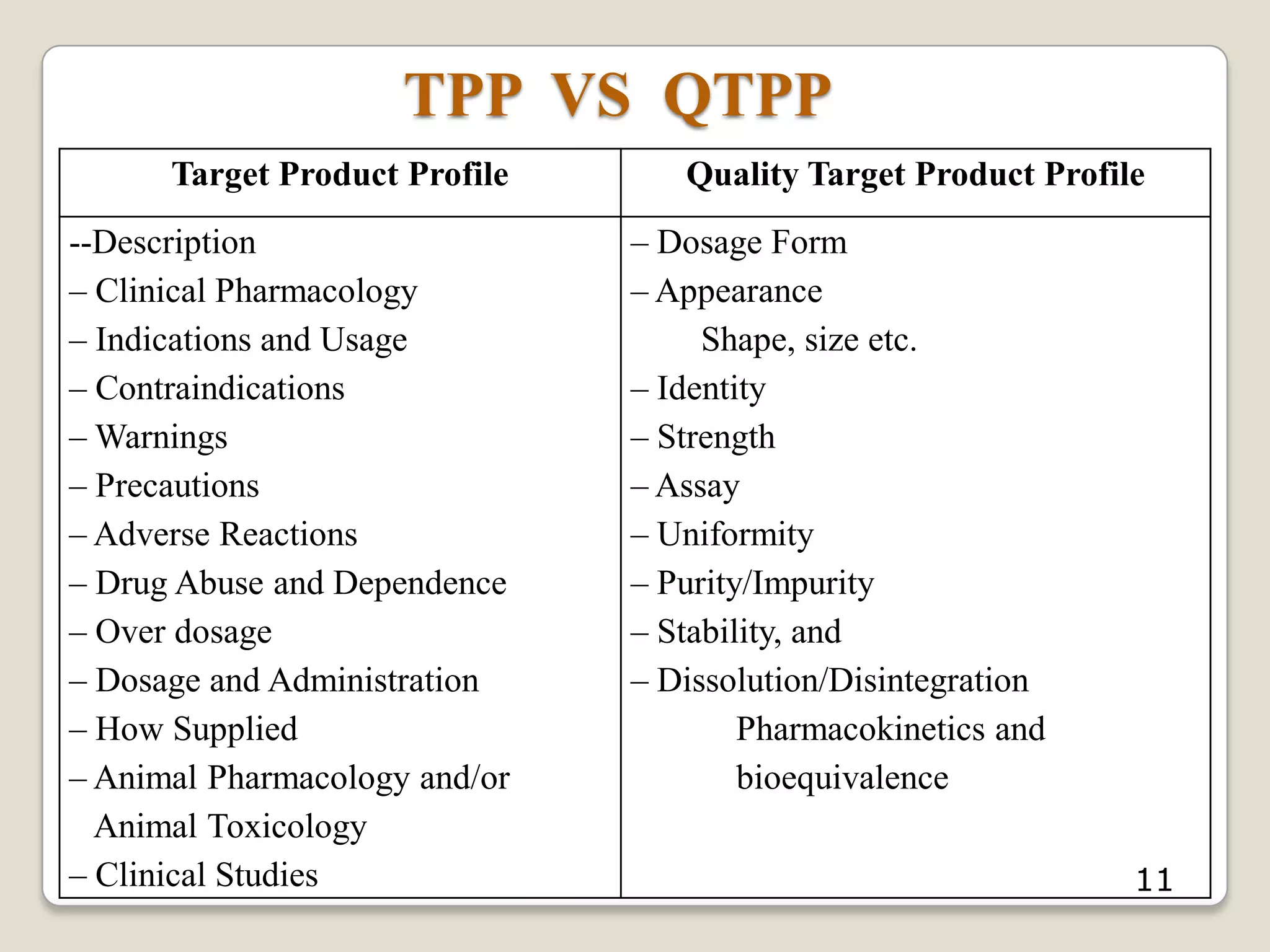
TPP VS QTPP
TargetProduct Profile Quality Target Product Profile
--Description
– Clinical Pharmacology
– Indications and Usage
– Contraindications
– Warnings
– Precautions
– Adverse Reactions
– Drug Abuse and Dependence
– Over dosage
– Dosage and Administration
– How Supplied
– Animal Pharmacology and/or
Animal Toxicology
– Clinical Studies
– Dosage Form
– Appearance
Shape, size etc.
– Identity
– Strength
– Assay
– Uniformity
– Purity/Impurity
– Stability, and
– Dissolution/Disintegration
Pharmacokinetics and
bioequivalence
11
12.
Critical Quality Attributes(CQAs)
Physical, chemical, biological or microbiological
property or characteristic.
„Drug product, drug substance, intermediates, and
excipients can possess CQAs.
o Directly affect product quality.
o Affect downstream processability.
Drug product CQAs affect product quality, safety,
and/or efficacy.
o Attributes describing product purity, potency, stability
and release.
o Additional product specific aspects (e.g., adhesive
force for transdermal patches).
12
13.
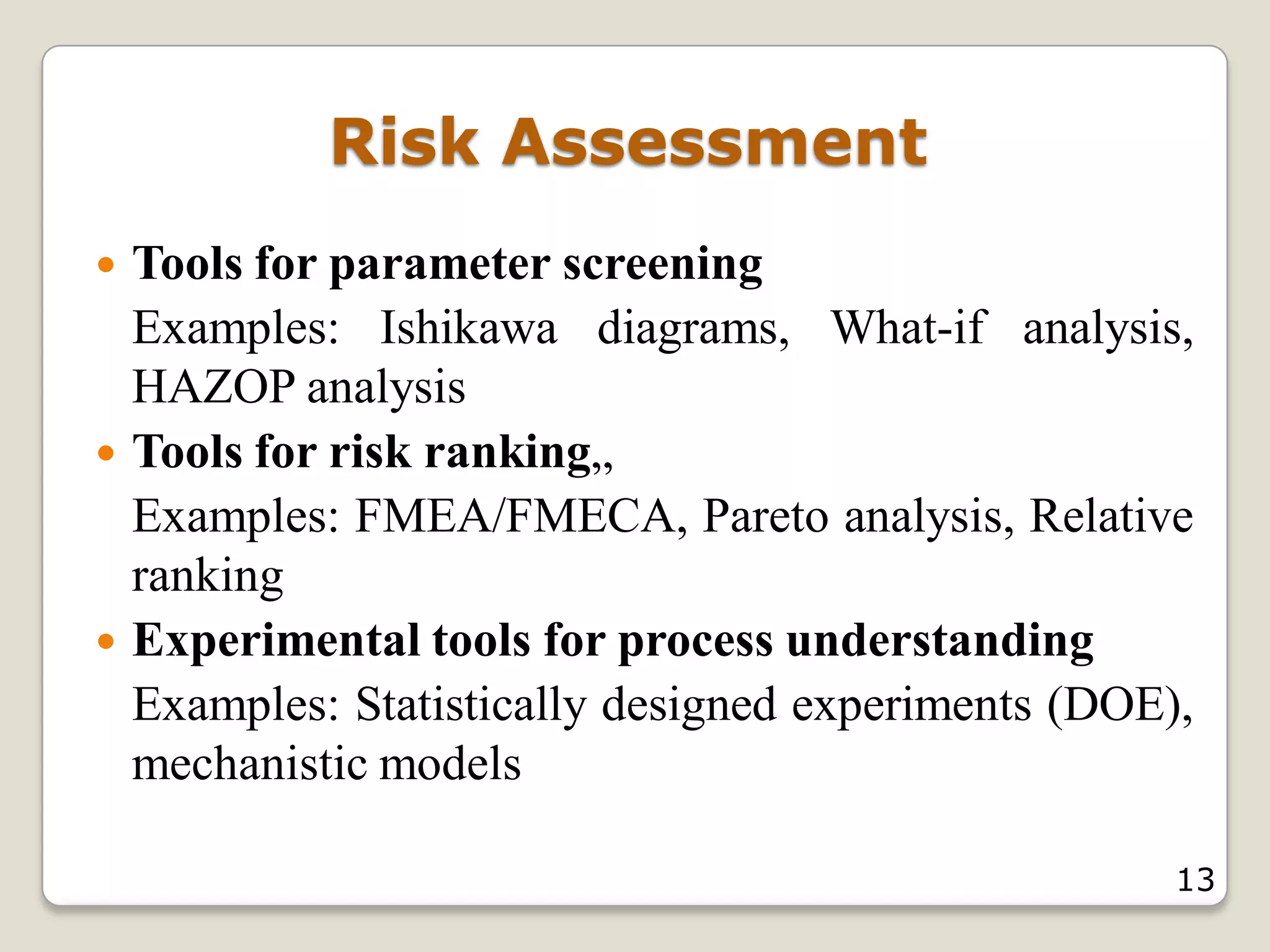
Risk Assessment
Toolsfor parameter screening
Examples: Ishikawa diagrams, What-if analysis,
HAZOP analysis
Tools for risk ranking„
Examples: FMEA/FMECA, Pareto analysis, Relative
ranking
Experimental tools for process understanding
Examples: Statistically designed experiments (DOE),
mechanistic models
13
14.
Design Space
Themultidimensional combination and interaction of
input variables (e.g., material attributes) and process
parameters that have been demonstrated to provide
assurance of quality.
A design space may be constructed for all unit
operations, or for the specific unit operations.
14
15.
Design Space Determination
First-principles approach
Non-mechanistic/empirical approach
Scale-up correlations
„Risk Analysis
„Any combination of the above
15
16.
Describing Design Spaces
Linear Ranges of Parameters
„Mathematical Relationships
Time-dependent functions
Combinations of variables
e.g., Principle components of multivariate
model
Scaling Factors
Single or multiple unit operations
16
17.
Control Strategy
Controlstrategy is defined as “a planned control
operations, derived from current product and process
understanding that assures process performance and
product quality”.
The control strategy can include the following
elements:
procedural controls process in process quality controls, lot
release testing, process monitoring, physical characterization,
comparability testing and ageing studies.
Input material controls, process parameters, process
operations and monitoring, design spaces around individual
or multiple unit operations, and or final product specifications
used to ensure consistent quality.
17
18.
Life Cycle Management
A monitoring program for verifying the validity of
process models should be established and be based on
a risk analysis of the model itself and includes
possible ways to verify the model by another means.
Continuous improvement is an essential element in a
modern quality system that aims at improving
efficiency by optimizing a process and eliminating
wasted efforts in production.
18
QbD Approach forAnalytical
methods
ICH Q8 doesn’t explicitly discuss analytical method
development.
However, concepts apply:
Application of science and Risk based methodology
Systematic approach that includes: Risk assessment,
defining a Design space, Control Strategy and
continual improvement to increases method
robustness and understanding.
20
Elements of analyticalQbD
Target Measurement
Select Technique
Risk assessment
Method Develop/ Validation
Control strategy
Continual Improvement
22
23.
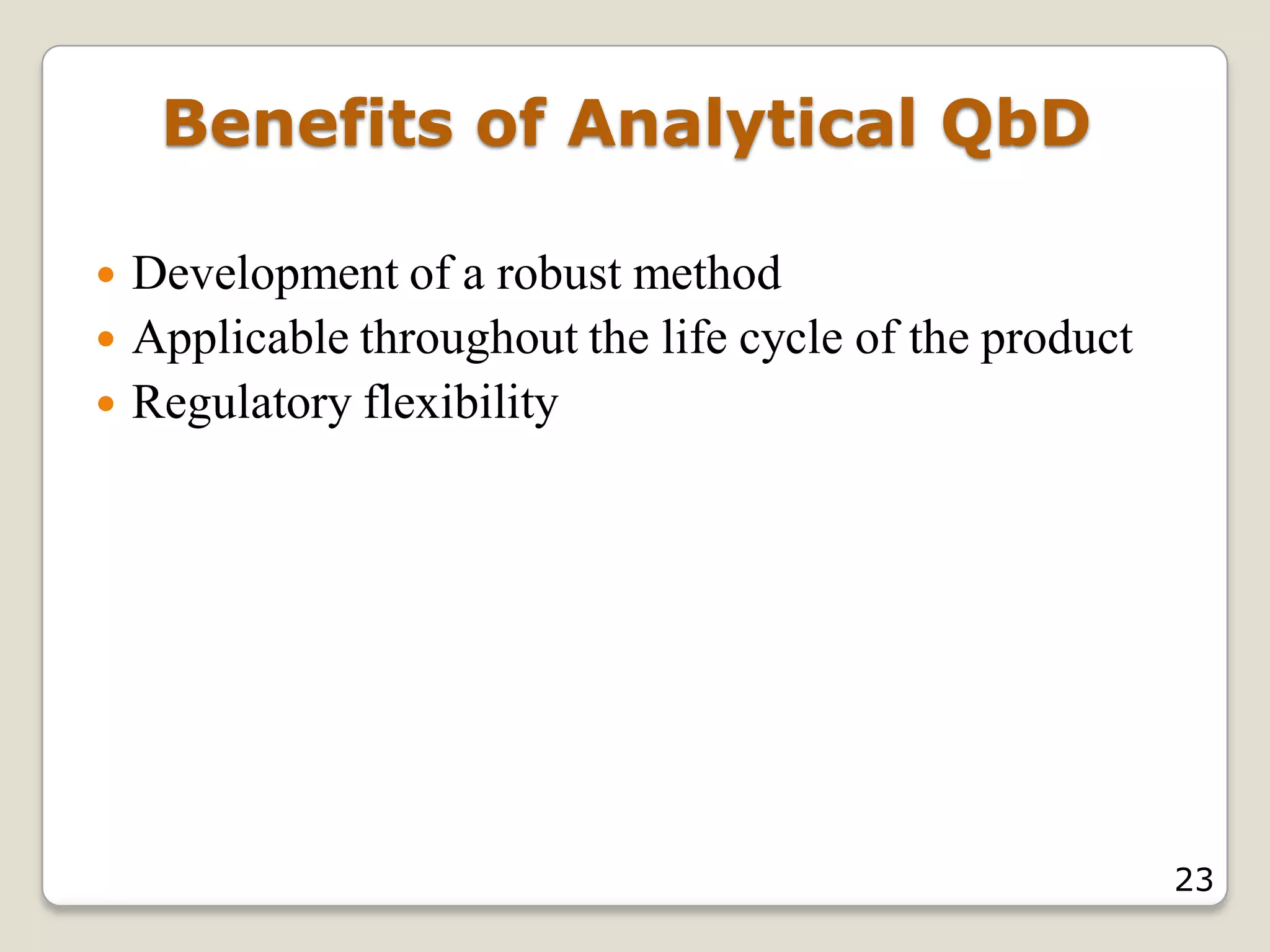
Benefits of AnalyticalQbD
Development of a robust method
Applicable throughout the life cycle of the product
Regulatory flexibility
23
24.
Quality by DesignTools
Design of experiments (DoE)
Risk assessment
Process analytical technology (PAT)
24
25.
Design of Experiment(DoE)
A systematic, planned approach to solving problems
by gaining information through carefully planned
experiments or studies.
These studies have adequate statistical properties to
be able to:
accurately measure the effects of formulation &
process factors on the key response variable(s) (i.e.,
dissolution, content uniformity, etc.)
tell if these factor effects are real (above the noise
level) and if so to accurately quantify these effects.
25
26.
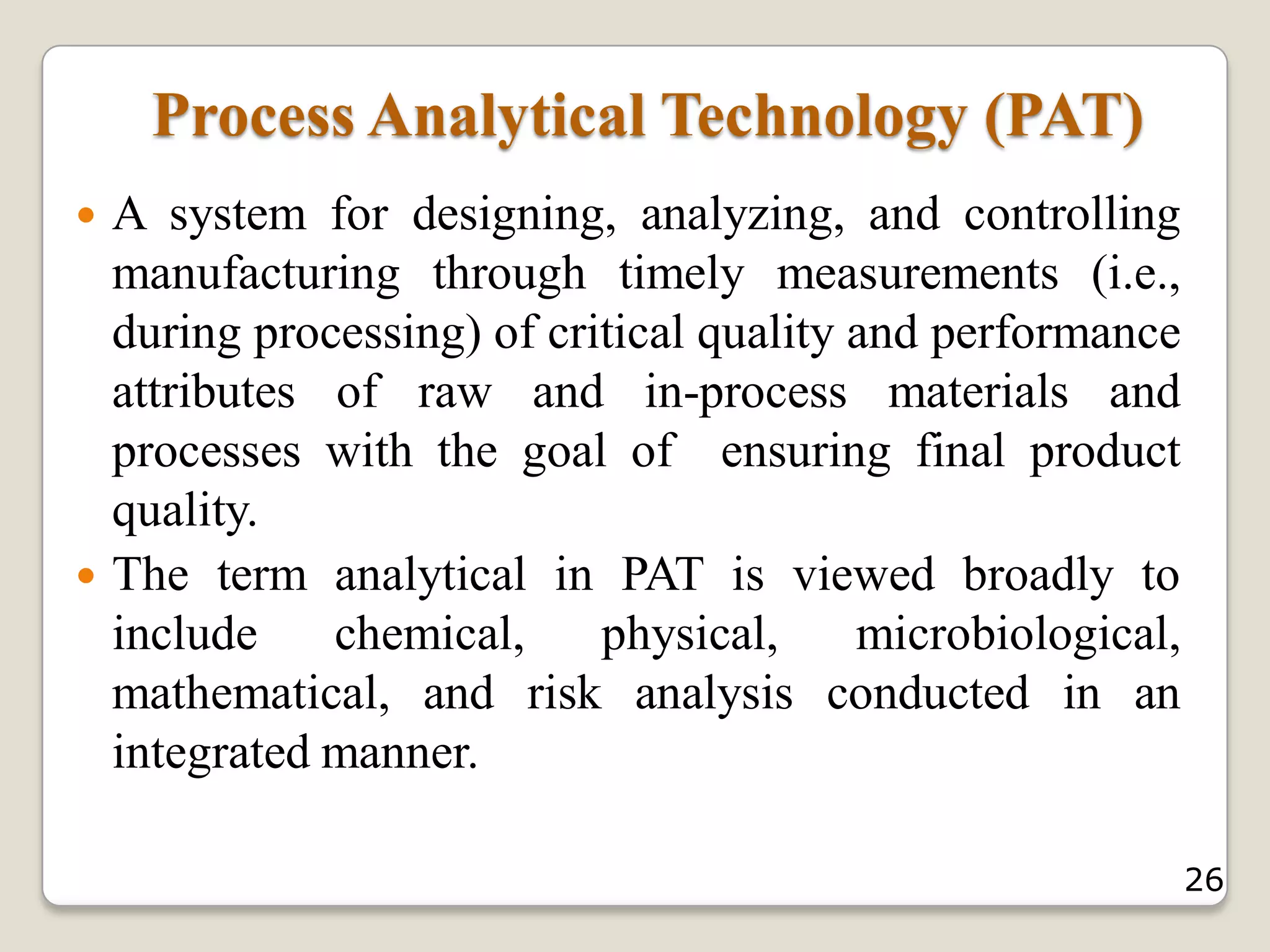
Process Analytical Technology(PAT)
A system for designing, analyzing, and controlling
manufacturing through timely measurements (i.e.,
during processing) of critical quality and performance
attributes of raw and in-process materials and
processes with the goal of ensuring final product
quality.
The term analytical in PAT is viewed broadly to
include chemical, physical, microbiological,
mathematical, and risk analysis conducted in an
integrated manner.
26
27.
Risk Assessment
A systematicprocess of organizing information to
support a risk decision to be made within a risk
management process. It consists of the identification
of hazards and the analysis and evaluation of risks
associated with exposure to those hazards.
27
28.
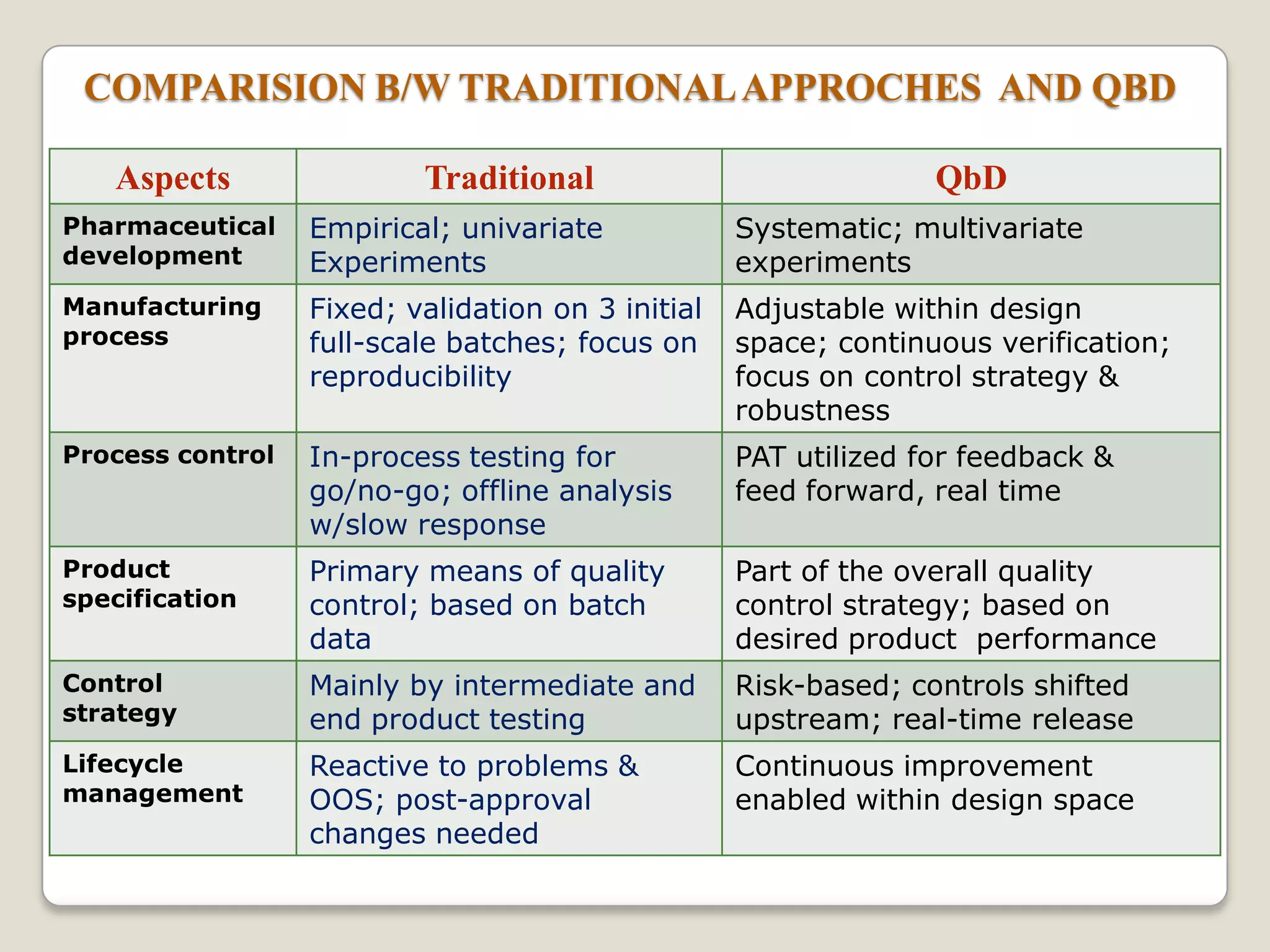
COMPARISION B/W TRADITIONALAPPROCHESAND QBD
Aspects Traditional QbD
Pharmaceutical
development
Empirical; univariate
Experiments
Systematic; multivariate
experiments
Manufacturing
process
Fixed; validation on 3 initial
full-scale batches; focus on
reproducibility
Adjustable within design
space; continuous verification;
focus on control strategy &
robustness
Process control In-process testing for
go/no-go; offline analysis
w/slow response
PAT utilized for feedback &
feed forward, real time
Product
specification
Primary means of quality
control; based on batch
data
Part of the overall quality
control strategy; based on
desired product performance
Control
strategy
Mainly by intermediate and
end product testing
Risk-based; controls shifted
upstream; real-time release
Lifecycle
management
Reactive to problems &
OOS; post-approval
changes needed
Continuous improvement
enabled within design space
29.
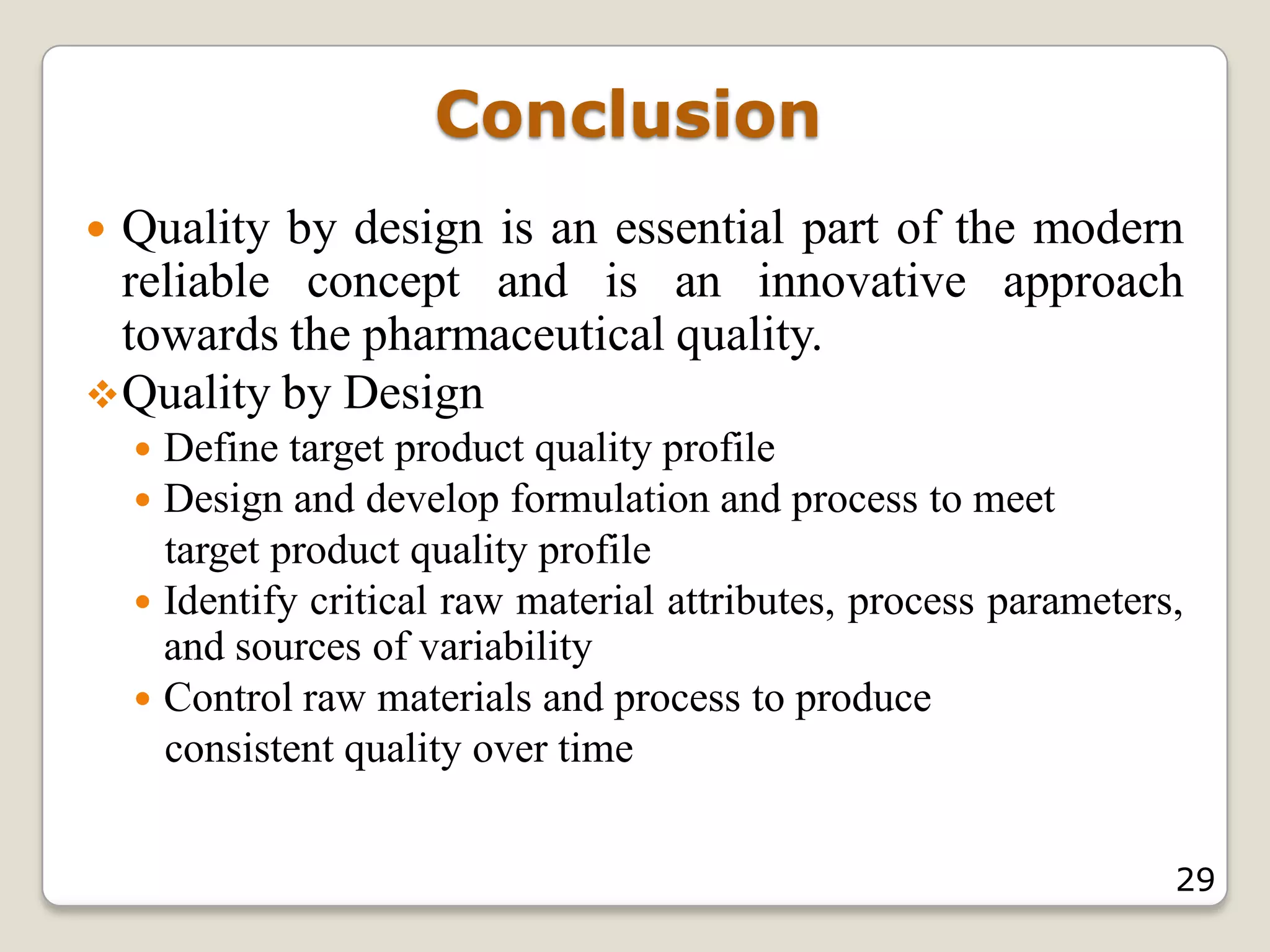
Conclusion
Quality bydesign is an essential part of the modern
reliable concept and is an innovative approach
towards the pharmaceutical quality.
Quality by Design
Define target product quality profile
Design and develop formulation and process to meet
target product quality profile
Identify critical raw material attributes, process parameters,
and sources of variability
Control raw materials and process to produce
consistent quality over time
29
30.
References
Khatri S,Saini S, gangawat K, Gurubalaji S. Pharmaceutical
QbD: Concepts for Drug Product Development. Int J Pharm
Sci. 2014;26(1):84-91.
S. Patil A, M. Pethe A. Quality by Design (QbD) : A new
concept for development of quality pharmaceuticals. IJPQA.
2013;4(2):14-9.
https://www.ich.org/fileadmin/Public_Web_Site/Training/G
CG_Endorsed_Training_Events/APEC_LSIF_JCCT_workshop
_Beijing__China_Dec_08/Day_1/Regulatory_perspective.pd
f (Accessed on 23 march 2019)
https://www.fda.gov/downloads/AboutFDA/CentersOffices/
OfficeofMedicalProductsandTobacco/CDER/UCM301056.pdf
(Accessed on 23 march 2019)
Joseph M Juran, Joseph A De Feo. Juran’s quality handbook.
6 th ed. Mcgraw Higher Ed. 2010:439-466.
30