MICROENCAPSULATION


                   shivakumar
                    B.pharmacy
         kottam institute of pharmacy, A.P
INTRODUCTION

 Microencapsulation is a process by which very tiny droplets or

particles of liquid or solid material are surrounded or coated with a continuous
film of
   polymeric material.


 The product obtained by this process is called as micro particles,
microcapsules.


 Particles having diameter between 3 - 800µm are known as micro particles or
   microcapsules or microspheres.
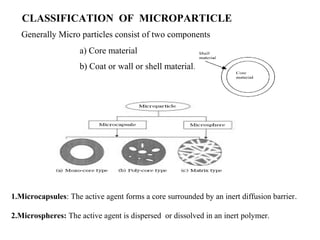
CLASSIFICATION OF MICROPARTICLE
   Generally Micro particles consist of two components
                     a) Core material
                     b) Coat or wall or shell material.


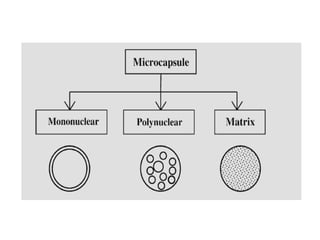
1.Microcapsules: The active agent forms a core surrounded by an inert diffusion barrier.

2.Microspheres: The active agent is dispersed or dissolved in an inert polymer.
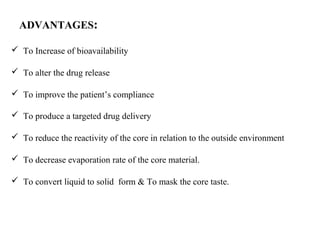
ADVANTAGES:

 To Increase of bioavailability

 To alter the drug release

 To improve the patient’s compliance

 To produce a targeted drug delivery

 To reduce the reactivity of the core in relation to the outside environment

 To decrease evaporation rate of the core material.

 To convert liquid to solid form & To mask the core taste.
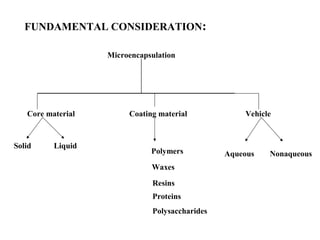
FUNDAMENTAL CONSIDERATION:

                   Microencapsulation


   Core material        Coating material            Vehicle


Solid     Liquid
                              Polymers          Aqueous   Nonaqueous
                              Waxes

                              Resins
                              Proteins
                              Polysaccharides
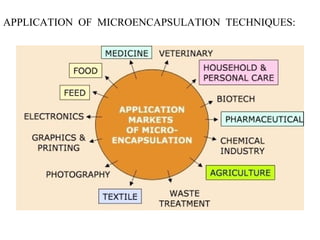
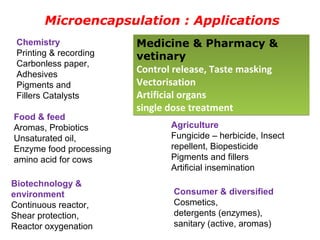
APPLICATION OF MICROENCAPSULATION TECHNIQUES:
Microencapsulation : Applications
 Chemistry               Medicine & Pharmacy &
 Printing & recording    vetinary
 Carbonless paper,
 Adhesives
                         Control release, Taste masking
 Pigments and            Vectorisation
 Fillers Catalysts       Artificial organs
                         single dose treatment
Food & feed
Aromas, Probiotics              Agriculture
Unsaturated oil,                Fungicide – herbicide, Insect
Enzyme food processing          repellent, Biopesticide
amino acid for cows             Pigments and fillers
                                Artificial insemination
Biotechnology &
environment                     Consumer & diversified
Continuous reactor,             Cosmetics,
Shear protection,               detergents (enzymes),
Reactor oxygenation             sanitary (active, aromas)
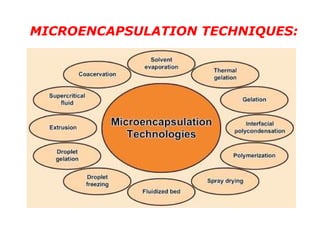
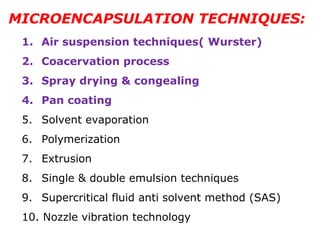
MICROENCAPSULATION TECHNIQUES:
 1. Air suspension techniques( Wurster)
 2. Coacervation process
 3. Spray drying & congealing
 4. Pan coating
 5. Solvent evaporation
 6. Polymerization
 7. Extrusion
 8. Single & double emulsion techniques
 9. Supercritical fluid anti solvent method (SAS)
 10. Nozzle vibration technology
Air Suspension Techniques( Wurster)

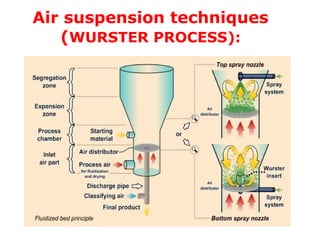
Microencapsulation by air suspension technique consist
of the dispersing of solid, particulate core materials in a
supporting air stream and the spray coating on the air
suspended particles. Within the coating chamber,
particles are suspended on an upward moving air stream.
The design of the chamber and its operating parameters
effect a recalculating flow of the particles through the
coating zone portion of the chamber, where a coating
material, usually a polymer solution, is spray applied to
the moving particles.
During each pass through the coating zone, the core
material receives an increment of coating material.
The cyclic process is repeated, perhaps several
hundred times during processing, depending on the
purpose of microencapsulation the coating
thickness desired or whether the core material
particles are thoroughly encapsulated. The
supporting air stream also serves to dry the product
while it is being encapsulated. Drying rates are
directly related to the volume temperature of the
supporting air stream.
Air suspension techniques
   (WURSTER PROCESS):
Coacervation process
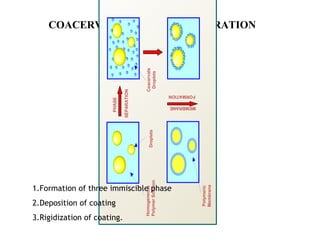
Formation of three immiscible phases; a liquid manufacturing
phase, a core material phase and a coating material phase.

 Deposition of the liquid polymer coating on the core material.
 Rigidizing the coating usually by thermal, cross linking or
desolvation techniques to form a microcapsule.

In step 2, the deposition of the liquid polymer around the interface
formed between the core material and the liquid vehicle phase. In
many cases physical or chemical changes in the coating polymer
solution can be induced so that phase separation of the polymer
will occur.
Droplets of concentrated polymer solution will form and coalesce to
yield a two phase liquid-liquid system. In cases in which the coating
material is an immiscible polymer of insoluble liquid polymer it may
be added directly. Also monomers can be dissolved in the liquid
vehicle phase and subsequently polymerized at interface.

Equipment required for microencapsulation this method is relatively
simple; it consists mainly of jacketed tank with variable speed
agitator.
COACERVATION / PHASE SEPARATION


                                            Coacervate
                                             Droplets
                              SEPARATION
                                                              FORMATION


                      PHASE
                                                              MEMBRANE


                                               Droplets
                                           Polymer Solution


1.Formation of three immiscible phase

                                                                          Membrane
                                                                          Polymeric
                                           Homogeneous


2.Deposition of coating
3.Rigidization of coating.
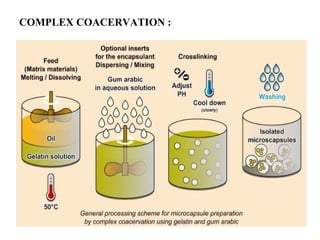
COMPLEX COACERVATION :
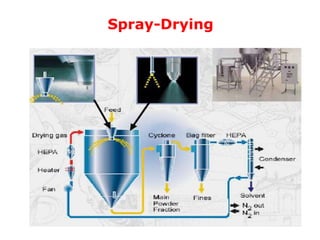
Spray-Drying & spray-congealing

Spray-Drying & spray-congealing :

- Microencapsulation by spray-drying is a low-cost commercial
process which is mostly used for the encapsulation of fragrances,
oils and flavors.

Steps:
1- Core particles are dispersed in a polymer solution and sprayed into
a hot chamber.

2- The shell material solidifies onto the core particles as the solvent
evaporates.
- The microcapsules obtained are of polynuclear or matrix type.
Spray-congealing

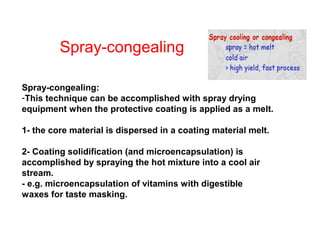
Spray-congealing:
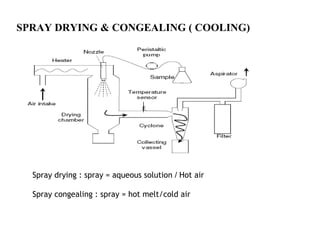
-This technique can be accomplished with spray drying
equipment when the protective coating is applied as a melt.

1- the core material is dispersed in a coating material melt.

2- Coating solidification (and microencapsulation) is
accomplished by spraying the hot mixture into a cool air
stream.
- e.g. microencapsulation of vitamins with digestible
waxes for taste masking.
Spray-Drying
SPRAY DRYING & CONGEALING ( COOLING)


  Spray drying : spray = aqueous solution / Hot air

  Spray congealing : spray = hot melt/cold air
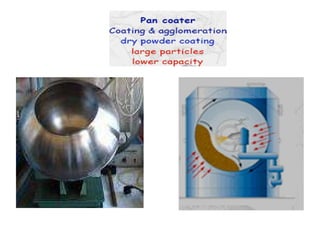
PAN COATING
1- Solid particles are mixed with a dry coating
material.

2- The temperature is raised so that the coating
material melts and encloses the core particles, and
then is solidified by cooling.

Or, the coating material can be gradually applied to
core particles tumbling in a vessel rather than being
wholly mixed with the core particles from the start of
encapsulation.
MULTIORIFIC-CENTRIFUGAL PROCESS
The Southwest Research Institute (SWRI)
has developed a mechanical process for
producing microcapsules that utilizes
centrifugal forces to hurl a core material
particle trough an enveloping
microencapsulation membrane thereby
effecting mechanical microencapsulation.
Processing variables include the rotational
speed of the cylinder, the flow rate of the
core and coating materials, the
concentration and viscosity and surface
tension of the core material. The
multiorifice-centrifugal process is capable
for microencapsulating liquids and solids
of varied size ranges, with diverse coating
materials. The encapsulated product can be
supplied as slurry in the hardening media
or s a dry powder. Production rates of 50
to 75 pounds per our have been achieved
with the process.
POLYMERIZATION
A relatively new microencapsulation
method utilizes polymerization techniques
to from protective microcapsule coatings
in situ. The methods involve the reaction
of monomeric units located at the interface
existing between a core material substance
and a continuous phase in which the core
material is dispersed. The continuous or
core material supporting phase is usually a
liquid or gas, and therefore the
polymerization reaction occurs at a liquidliquid,
liquid-gas, solid-liquid, or solid-gas
interface.
POLYMERIZATION:

   Drug
            Monomer(s) (e.g. acrylamide, methacrylic acid)           Monodisperse microgels in the micron or
             + Cross-linker (e.g. methylenebisacrylamide)
                                                                     submicron size range.

              Preparation of the
            Polymerization Mixture            Alcohol
                                                                     Precipitation polymerization starts from
                                Addition of the alcoholic solution
                                                                     a homogeneous monomer solution in
                                  of the initiator (e.g., AIBN)      which the synthesized polymer is
                                                                     insoluble.
                Initiation of
               Polymerization
                                                                     The particle size of the resulting
                         8 hrs Reaction time
                                                                     microspheres depends on the
                                                                     polymerization conditions, including the
             Monodisoerse Latex
            Formation by Polymer                                     monomer/co monomer composition, the
                Precipitation
                                                                     amount of initiator and the total
                             T (reaction) = 60 °C
                                                                     monomer concentration.
                            Nitrogen Atmosphere


          RECOVERY OF POLYMERIC
              MICROPARTICLES
EVALUATION OF MICROCAPSULES
Percentage Yield
The total amount of microcapsules obtained was weighed and
the percentage yield calculated taking into consideration the
weight of the drug and polymer [7].
Percentage yield = Amount of microcapsule obtained /
Theoretical Amount×100

Scanning electron microscopy
Scanning electron photomicrographs of drug loaded ethyl
cellulose microcapsules were taken. A small amount of
microcapsules was spread on gold stub and was placed in the
scanning electron microscopy (SEM) chamber.
The SEM photomicrographs was taken at the
acceleration voltage of 20 KV.
Particle size analysis
For size distribution analysis, different sizes in a
batch were separated by sieving by using a set of
standard sieves. The amounts retained on
different sieves were weighed [5].

Encapsulation efficiency [8]
Encapsulation efficiency was calculated using
the formula:
Encapsulation efficiency = Actual Drug Content /
Theoretical Drug Content ×100
Estimation of Drug Content

Cefotaxime sodium drug content in the microcapsules was
calculated by UV spectrophotometric (Elico SL159 Mumbai
India) method.
 The method was validated for linearity, accuracy and
precision. A sample of microcapsules equivalent to 100 mg
was dissolved in 25 ml ethanol and the volume was
adjusted upto 100 ml using phosphate buffer of pH 7.4. The
solution was filtered through Whatman filter paper. Then the
filtrate was assayed for drug content by measuring the
absorbance at 254 nm after suitable dilution [9].
Invitro Drug release Studies
Drug release was studied by using USP type II dissolution test apparatus
(Electrolab TDT 08L) in Phosphate buffer of pH 7.4 (900 ml). The paddle
speed at 100 rpm and bath temperature at 37 ± 0.5°c were maintained
through out the experiment.

A sample of microcapsules equivalent to 100 mg of cefotaxime sodium was
used in each test. Aliquot equal to 5ml of dissolution medium was
withdrawn at specific time interval and replaced with fresh medium to
maintain sink condition. Sample was filtered through Whatman No. 1 filter
paper and after suitable dilution with medium; the absorbance was
determined by UV spectrophotometer (Elico SL159) at 254 nm.

All studies were conducted in triplicate (n=3). The release of drug from
marketed sustained release tablet was also studied to compare with
release from microcapsules.
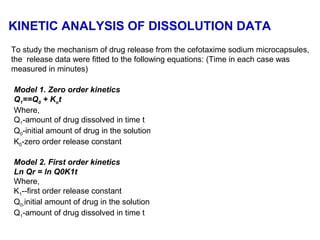
KINETIC ANALYSIS OF DISSOLUTION DATA
To study the mechanism of drug release from the cefotaxime sodium microcapsules,
the release data were fitted to the following equations: (Time in each case was
measured in minutes)

Model 1. Zero order kinetics
Q1==Q0 + Kot
Where,
Q1-amount of drug dissolved in time t
Q0-initial amount of drug in the solution
K0-zero order release constant

Model 2. First order kinetics
Ln Qr = ln Q0K1t
Where,
K1--first order release constant
Q0-initial amount of drug in the solution
Q1-amount of drug dissolved in time t
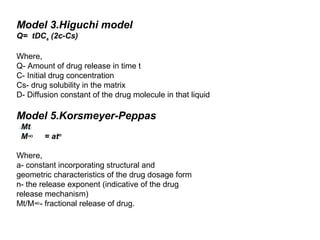
Model 3.Higuchi model
Q= tDCs (2c-Cs)

Where,
Q- Amount of drug release in time t
C- Initial drug concentration
Cs- drug solubility in the matrix
D- Diffusion constant of the drug molecule in that liquid

Model 5.Korsmeyer-Peppas
 Mt
 M∞     = atn

Where,
a- constant incorporating structural and
geometric characteristics of the drug dosage form
n- the release exponent (indicative of the drug
release mechanism)
Mt/M∞- fractional release of drug.
Microencapsulation (2)

Microencapsulation (2)

  • 1.
    MICROENCAPSULATION shivakumar B.pharmacy kottam institute of pharmacy, A.P
  • 2.
    INTRODUCTION  Microencapsulation isa process by which very tiny droplets or particles of liquid or solid material are surrounded or coated with a continuous film of polymeric material.  The product obtained by this process is called as micro particles, microcapsules.  Particles having diameter between 3 - 800µm are known as micro particles or microcapsules or microspheres.
  • 3.
    CLASSIFICATION OF MICROPARTICLE Generally Micro particles consist of two components a) Core material b) Coat or wall or shell material. 1.Microcapsules: The active agent forms a core surrounded by an inert diffusion barrier. 2.Microspheres: The active agent is dispersed or dissolved in an inert polymer.
  • 5.
    ADVANTAGES:  To Increaseof bioavailability  To alter the drug release  To improve the patient’s compliance  To produce a targeted drug delivery  To reduce the reactivity of the core in relation to the outside environment  To decrease evaporation rate of the core material.  To convert liquid to solid form & To mask the core taste.
  • 6.
    FUNDAMENTAL CONSIDERATION: Microencapsulation Core material Coating material Vehicle Solid Liquid Polymers Aqueous Nonaqueous Waxes Resins Proteins Polysaccharides
  • 7.
  • 8.
    Microencapsulation : Applications Chemistry Medicine & Pharmacy & Printing & recording vetinary Carbonless paper, Adhesives Control release, Taste masking Pigments and Vectorisation Fillers Catalysts Artificial organs single dose treatment Food & feed Aromas, Probiotics Agriculture Unsaturated oil, Fungicide – herbicide, Insect Enzyme food processing repellent, Biopesticide amino acid for cows Pigments and fillers Artificial insemination Biotechnology & environment Consumer & diversified Continuous reactor, Cosmetics, Shear protection, detergents (enzymes), Reactor oxygenation sanitary (active, aromas)
  • 9.
  • 10.
    MICROENCAPSULATION TECHNIQUES: 1.Air suspension techniques( Wurster) 2. Coacervation process 3. Spray drying & congealing 4. Pan coating 5. Solvent evaporation 6. Polymerization 7. Extrusion 8. Single & double emulsion techniques 9. Supercritical fluid anti solvent method (SAS) 10. Nozzle vibration technology
  • 11.
    Air Suspension Techniques(Wurster) Microencapsulation by air suspension technique consist of the dispersing of solid, particulate core materials in a supporting air stream and the spray coating on the air suspended particles. Within the coating chamber, particles are suspended on an upward moving air stream. The design of the chamber and its operating parameters effect a recalculating flow of the particles through the coating zone portion of the chamber, where a coating material, usually a polymer solution, is spray applied to the moving particles.
  • 12.
    During each passthrough the coating zone, the core material receives an increment of coating material. The cyclic process is repeated, perhaps several hundred times during processing, depending on the purpose of microencapsulation the coating thickness desired or whether the core material particles are thoroughly encapsulated. The supporting air stream also serves to dry the product while it is being encapsulated. Drying rates are directly related to the volume temperature of the supporting air stream.
  • 13.
    Air suspension techniques (WURSTER PROCESS):
  • 14.
    Coacervation process Formation ofthree immiscible phases; a liquid manufacturing phase, a core material phase and a coating material phase.  Deposition of the liquid polymer coating on the core material.  Rigidizing the coating usually by thermal, cross linking or desolvation techniques to form a microcapsule. In step 2, the deposition of the liquid polymer around the interface formed between the core material and the liquid vehicle phase. In many cases physical or chemical changes in the coating polymer solution can be induced so that phase separation of the polymer will occur.
  • 15.
    Droplets of concentratedpolymer solution will form and coalesce to yield a two phase liquid-liquid system. In cases in which the coating material is an immiscible polymer of insoluble liquid polymer it may be added directly. Also monomers can be dissolved in the liquid vehicle phase and subsequently polymerized at interface. Equipment required for microencapsulation this method is relatively simple; it consists mainly of jacketed tank with variable speed agitator.
  • 16.
    COACERVATION / PHASESEPARATION Coacervate Droplets SEPARATION FORMATION PHASE MEMBRANE Droplets Polymer Solution 1.Formation of three immiscible phase Membrane Polymeric Homogeneous 2.Deposition of coating 3.Rigidization of coating.
  • 17.
  • 18.
    Spray-Drying & spray-congealing Spray-Drying& spray-congealing : - Microencapsulation by spray-drying is a low-cost commercial process which is mostly used for the encapsulation of fragrances, oils and flavors. Steps: 1- Core particles are dispersed in a polymer solution and sprayed into a hot chamber. 2- The shell material solidifies onto the core particles as the solvent evaporates. - The microcapsules obtained are of polynuclear or matrix type.
  • 19.
    Spray-congealing Spray-congealing: -This technique canbe accomplished with spray drying equipment when the protective coating is applied as a melt. 1- the core material is dispersed in a coating material melt. 2- Coating solidification (and microencapsulation) is accomplished by spraying the hot mixture into a cool air stream. - e.g. microencapsulation of vitamins with digestible waxes for taste masking.
  • 20.
  • 21.
    SPRAY DRYING &CONGEALING ( COOLING) Spray drying : spray = aqueous solution / Hot air Spray congealing : spray = hot melt/cold air
  • 22.
    PAN COATING 1- Solidparticles are mixed with a dry coating material. 2- The temperature is raised so that the coating material melts and encloses the core particles, and then is solidified by cooling. Or, the coating material can be gradually applied to core particles tumbling in a vessel rather than being wholly mixed with the core particles from the start of encapsulation.
  • 24.
    MULTIORIFIC-CENTRIFUGAL PROCESS The SouthwestResearch Institute (SWRI) has developed a mechanical process for producing microcapsules that utilizes centrifugal forces to hurl a core material particle trough an enveloping microencapsulation membrane thereby effecting mechanical microencapsulation. Processing variables include the rotational speed of the cylinder, the flow rate of the core and coating materials, the concentration and viscosity and surface tension of the core material. The multiorifice-centrifugal process is capable for microencapsulating liquids and solids of varied size ranges, with diverse coating materials. The encapsulated product can be supplied as slurry in the hardening media or s a dry powder. Production rates of 50 to 75 pounds per our have been achieved with the process.
  • 25.
    POLYMERIZATION A relatively newmicroencapsulation method utilizes polymerization techniques to from protective microcapsule coatings in situ. The methods involve the reaction of monomeric units located at the interface existing between a core material substance and a continuous phase in which the core material is dispersed. The continuous or core material supporting phase is usually a liquid or gas, and therefore the polymerization reaction occurs at a liquidliquid, liquid-gas, solid-liquid, or solid-gas interface.
  • 26.
    POLYMERIZATION: Drug Monomer(s) (e.g. acrylamide, methacrylic acid) Monodisperse microgels in the micron or + Cross-linker (e.g. methylenebisacrylamide) submicron size range. Preparation of the Polymerization Mixture Alcohol Precipitation polymerization starts from Addition of the alcoholic solution a homogeneous monomer solution in of the initiator (e.g., AIBN) which the synthesized polymer is insoluble. Initiation of Polymerization The particle size of the resulting 8 hrs Reaction time microspheres depends on the polymerization conditions, including the Monodisoerse Latex Formation by Polymer monomer/co monomer composition, the Precipitation amount of initiator and the total T (reaction) = 60 °C monomer concentration. Nitrogen Atmosphere RECOVERY OF POLYMERIC MICROPARTICLES
  • 27.
    EVALUATION OF MICROCAPSULES PercentageYield The total amount of microcapsules obtained was weighed and the percentage yield calculated taking into consideration the weight of the drug and polymer [7]. Percentage yield = Amount of microcapsule obtained / Theoretical Amount×100 Scanning electron microscopy Scanning electron photomicrographs of drug loaded ethyl cellulose microcapsules were taken. A small amount of microcapsules was spread on gold stub and was placed in the scanning electron microscopy (SEM) chamber. The SEM photomicrographs was taken at the acceleration voltage of 20 KV.
  • 28.
    Particle size analysis Forsize distribution analysis, different sizes in a batch were separated by sieving by using a set of standard sieves. The amounts retained on different sieves were weighed [5]. Encapsulation efficiency [8] Encapsulation efficiency was calculated using the formula: Encapsulation efficiency = Actual Drug Content / Theoretical Drug Content ×100
  • 29.
    Estimation of DrugContent Cefotaxime sodium drug content in the microcapsules was calculated by UV spectrophotometric (Elico SL159 Mumbai India) method. The method was validated for linearity, accuracy and precision. A sample of microcapsules equivalent to 100 mg was dissolved in 25 ml ethanol and the volume was adjusted upto 100 ml using phosphate buffer of pH 7.4. The solution was filtered through Whatman filter paper. Then the filtrate was assayed for drug content by measuring the absorbance at 254 nm after suitable dilution [9].
  • 30.
    Invitro Drug releaseStudies Drug release was studied by using USP type II dissolution test apparatus (Electrolab TDT 08L) in Phosphate buffer of pH 7.4 (900 ml). The paddle speed at 100 rpm and bath temperature at 37 ± 0.5°c were maintained through out the experiment. A sample of microcapsules equivalent to 100 mg of cefotaxime sodium was used in each test. Aliquot equal to 5ml of dissolution medium was withdrawn at specific time interval and replaced with fresh medium to maintain sink condition. Sample was filtered through Whatman No. 1 filter paper and after suitable dilution with medium; the absorbance was determined by UV spectrophotometer (Elico SL159) at 254 nm. All studies were conducted in triplicate (n=3). The release of drug from marketed sustained release tablet was also studied to compare with release from microcapsules.
  • 31.
    KINETIC ANALYSIS OFDISSOLUTION DATA To study the mechanism of drug release from the cefotaxime sodium microcapsules, the release data were fitted to the following equations: (Time in each case was measured in minutes) Model 1. Zero order kinetics Q1==Q0 + Kot Where, Q1-amount of drug dissolved in time t Q0-initial amount of drug in the solution K0-zero order release constant Model 2. First order kinetics Ln Qr = ln Q0K1t Where, K1--first order release constant Q0-initial amount of drug in the solution Q1-amount of drug dissolved in time t
  • 32.
    Model 3.Higuchi model Q=tDCs (2c-Cs) Where, Q- Amount of drug release in time t C- Initial drug concentration Cs- drug solubility in the matrix D- Diffusion constant of the drug molecule in that liquid Model 5.Korsmeyer-Peppas Mt M∞ = atn Where, a- constant incorporating structural and geometric characteristics of the drug dosage form n- the release exponent (indicative of the drug release mechanism) Mt/M∞- fractional release of drug.