This document discusses capsules as a dosage form of medication. It provides an introduction to capsules, describing them as solid dosage forms that contain one or more ingredients enclosed in a gelatin shell. The document outlines the advantages of capsules, such as masking unpleasant tastes and being easy to swallow. Disadvantages include some drugs or solutions being unsuitable for capsules. The document also describes various quality control tests for capsules, such as appearance, size, disintegration testing, weight variation, and content uniformity testing. It provides details on procedures for several of these tests.
Introduction and types of capsules, including soft and hard types.
Advantages: masks taste, easy to swallow, economical. Disadvantages: hygroscopic issues and irritation potential.
Tests for capsule quality: appearance, size, disintegration time, moisture, bloom strength, and content uniformity. Each is crucial for quality assurance.
Citations of essential literature and resources related to capsule formulation and testing.
Prepared By: GuidedBy:
Rajpurohit Ganpatsingh Mrs.Avani Khristi
M.Pharm , 2st sem, (QA) Assistant prof,QA
PARUL INSTITUTE OF PHARMACY,LIMDA
9/15/2019 1RAJPUROHIT
2.
CONTAIN
INTRODUCTION TOCAPSULE
ADVANTAGES OF CAPSULES
DISADVANTAGES OF CAPSULE
IPQC TEST
REFERENCES
9/15/2019 2RAJPUROHIT
3.
INTRODUCTION
Capsule isthe most versatile of all dosage forms. Capsules are
solid dosage forms in which one or more medicinal and inert
ingredients are enclosed in small shell or container usually
made of gelatin.
Soft gelatin capsules are one piece, hermetically saled, soft
gelatin shells containing a liquid, a suspension, or a semisolid.
9/15/2019 3RAJPUROHIT
ADVANTAGES OF CAPSULES
Capsules mask the taste and odour of unpleasant drugs and can
be easily administered.
They are slippery when moist and hence easy to swallow with
a draught of water.
The shells are physiologically inert and easily and quickly
digested in the gastrointestinal tract.
They are economical.
They are easy to handle and carry.
The shells can be opacified (with titanium dioxide) or colored,
to give protection from light.
9/15/2019 5RAJPUROHIT
6.
DISADVANTAGES OF CAPSULES
The drugs which are hygroscopic absorb water from the
capsules shell making it brittle and hence are not suitable for
filling into capsules.
The concentrated solutions which require previous dilution
are unsuitable for capsules because if administered as such lead
to irritation of stomach.
9/15/2019 6RAJPUROHIT
7.
IPQC TEST FORCAPSULE :
1. Appearance
2. Size and Shape
3. Disintegration Test
4. Weight variation
5. Moisture permeation test
6. Bloom strength of gelatin
7. Content uniformity
9/15/2019 7RAJPUROHIT
8.
1. Appearance :
Capsulesproduced on a small or a large scale should be
uniform in appearance. Visual or electronic inspection should
be undertaken to detect any flaws in the integrity and
appearance of the capsule. Evidence of physical instability is
demonstrated by gross changes in appearance, including
hardening or softening, cracking, swelling, mottling, printing
mistake or discoloration of the shell. Defective capsules
should be rejected.
9/15/2019 8RAJPUROHIT
9.
2. Size andShape:
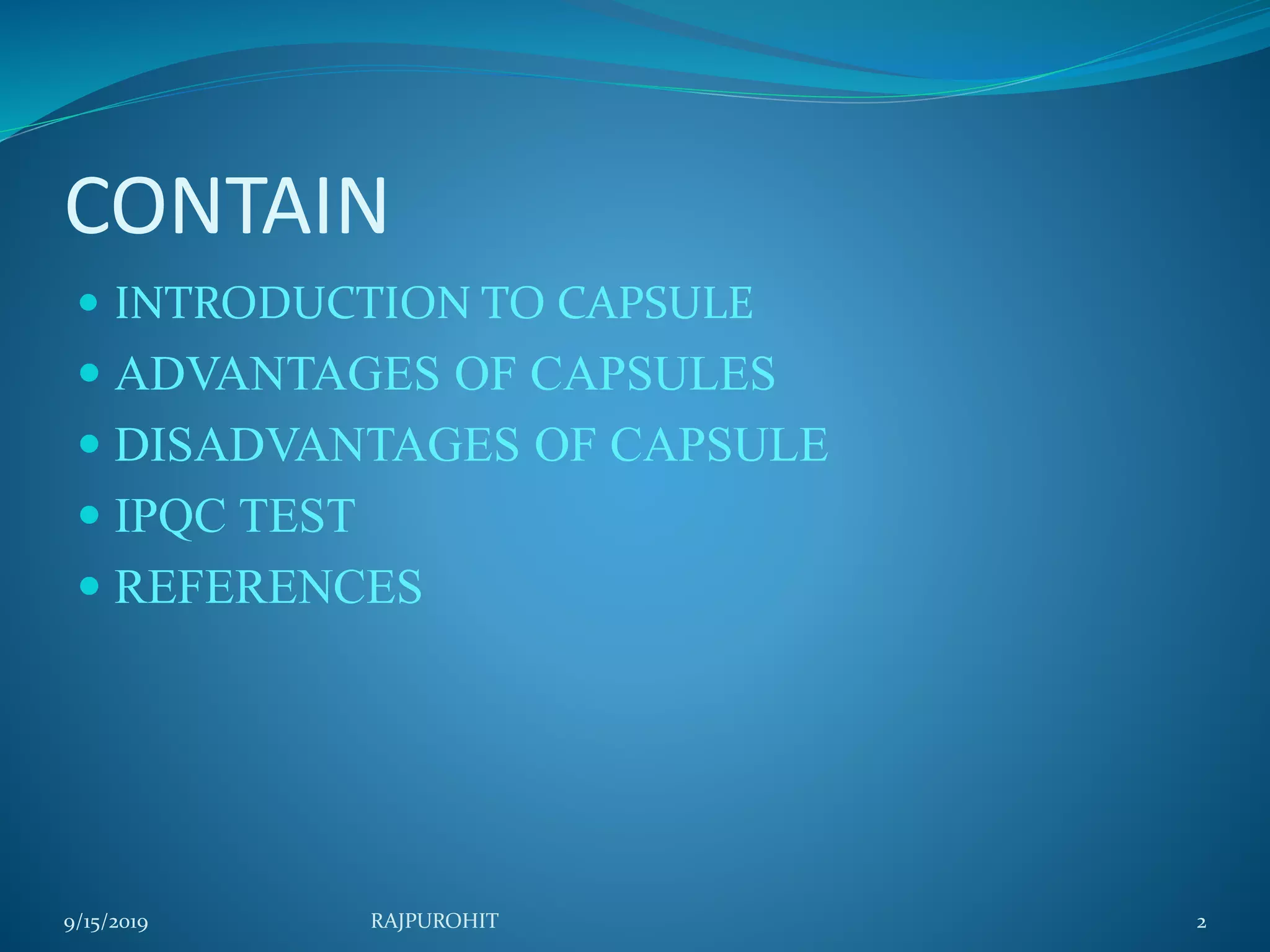
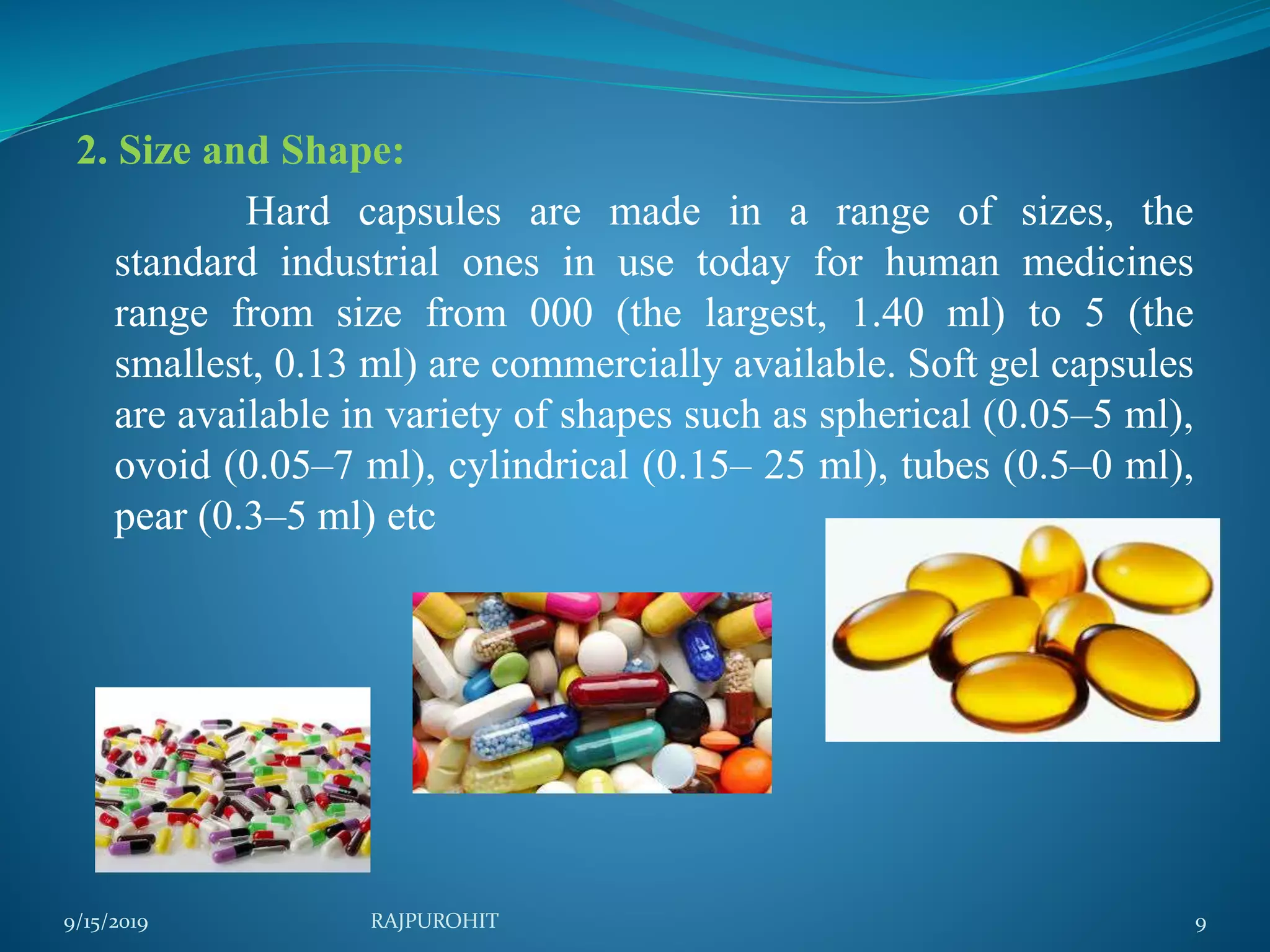
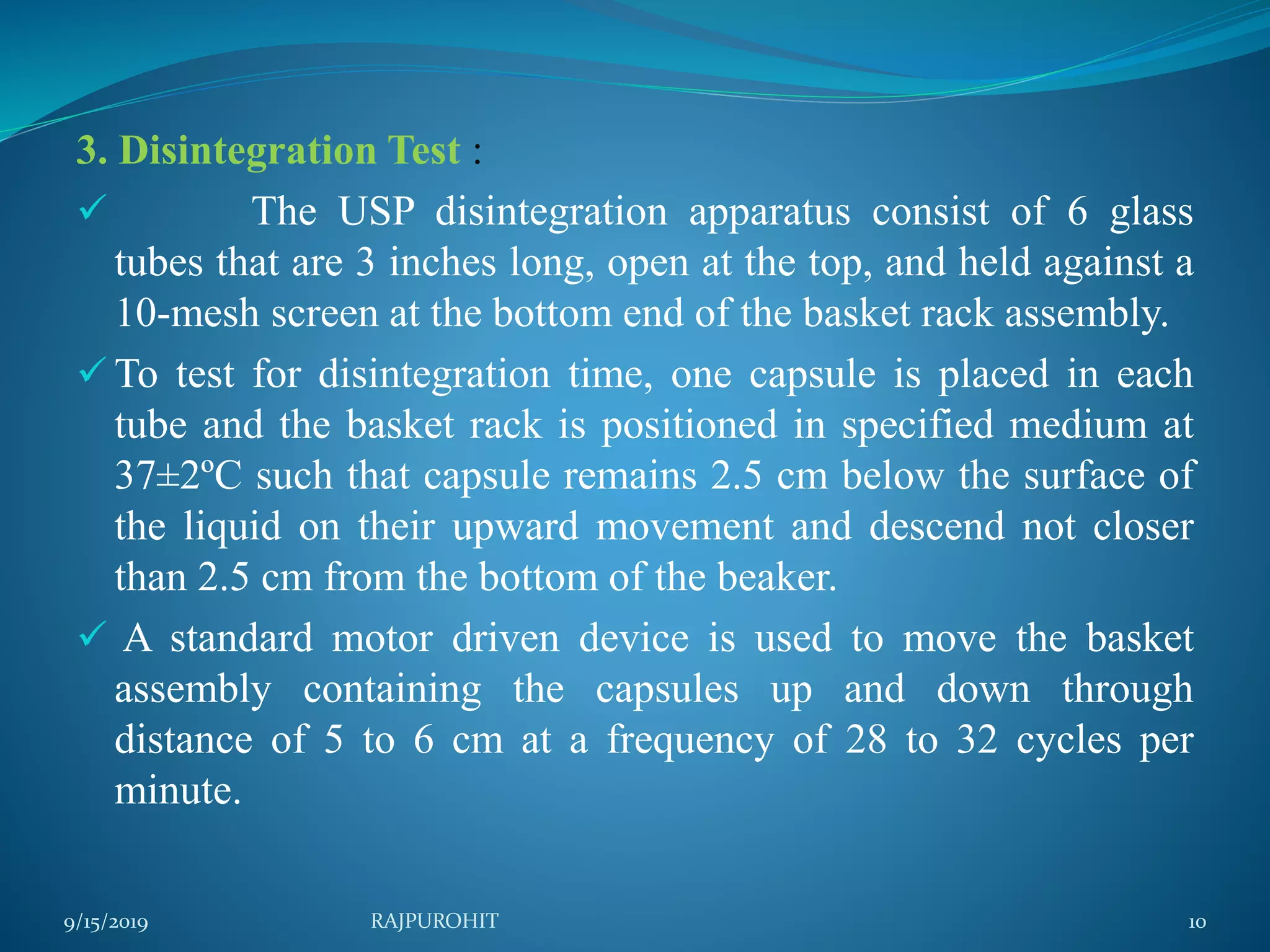
Hard capsules are made in a range of sizes, the
standard industrial ones in use today for human medicines
range from size from 000 (the largest, 1.40 ml) to 5 (the
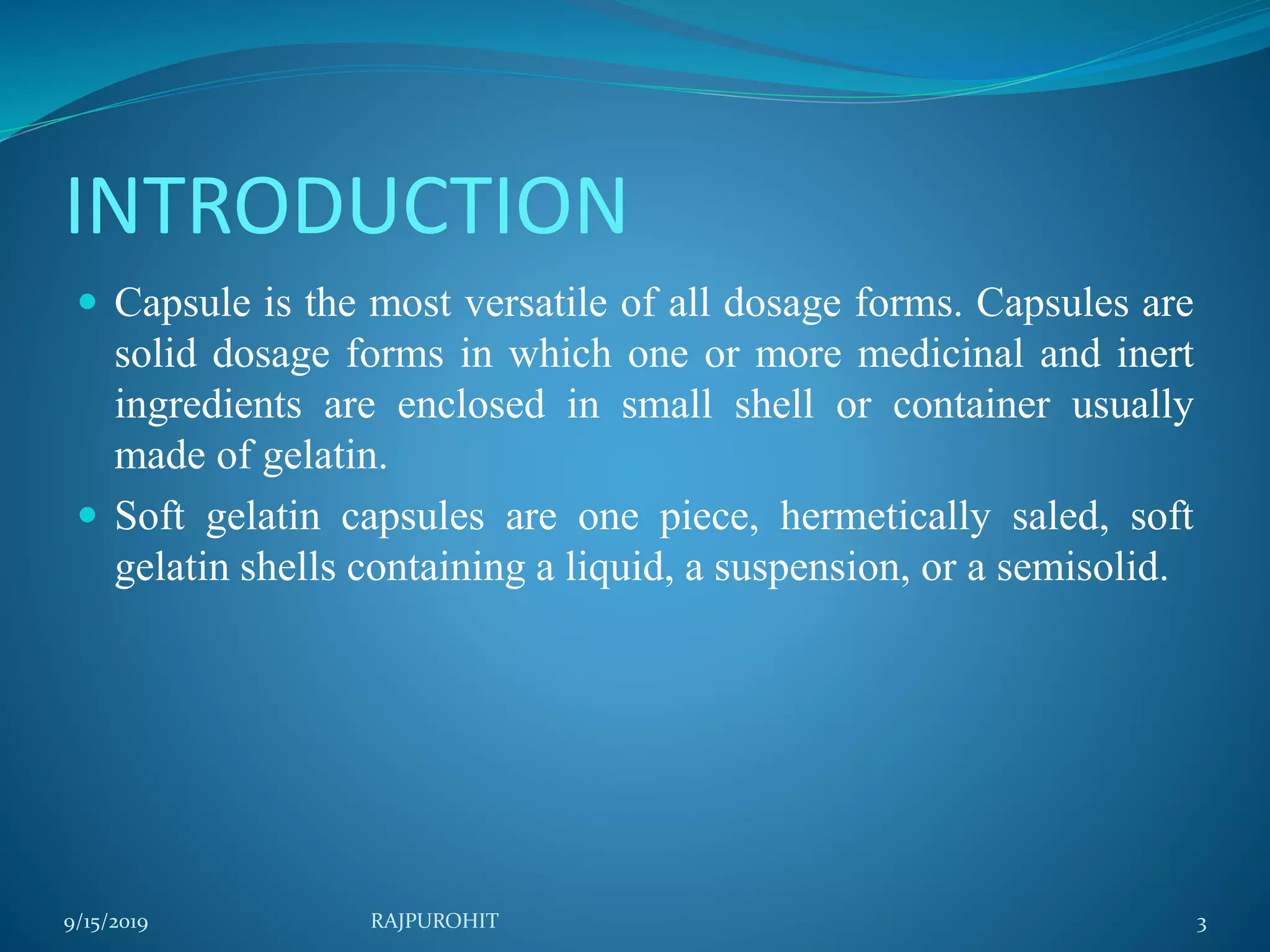
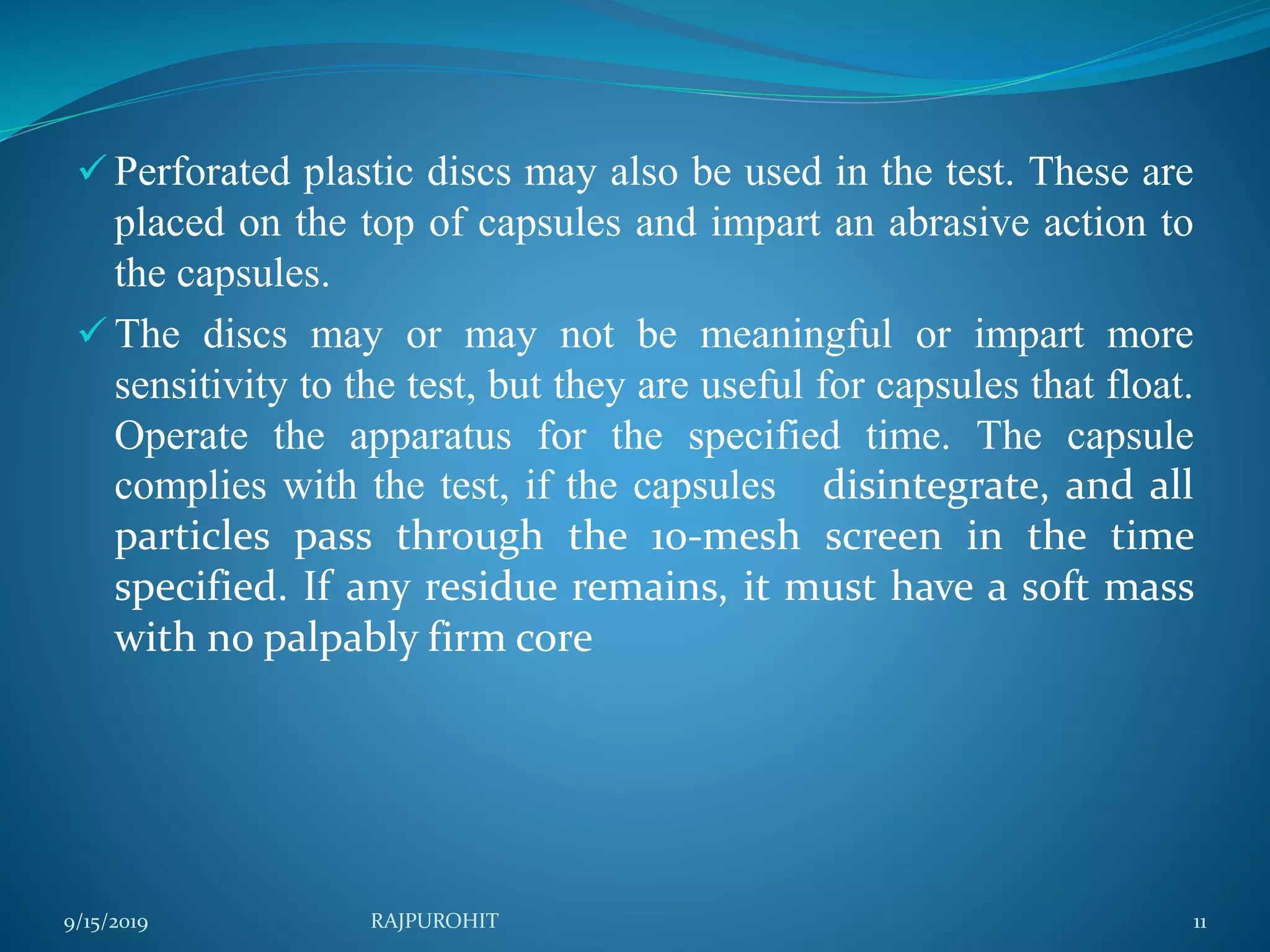
smallest, 0.13 ml) are commercially available. Soft gel capsules
are available in variety of shapes such as spherical (0.05–5 ml),
ovoid (0.05–7 ml), cylindrical (0.15– 25 ml), tubes (0.5–0 ml),
pear (0.3–5 ml) etc
9/15/2019 9RAJPUROHIT
10.
3. Disintegration Test:
The USP disintegration apparatus consist of 6 glass
tubes that are 3 inches long, open at the top, and held against a
10-mesh screen at the bottom end of the basket rack assembly.
To test for disintegration time, one capsule is placed in each
tube and the basket rack is positioned in specified medium at
37±2ºC such that capsule remains 2.5 cm below the surface of
the liquid on their upward movement and descend not closer
than 2.5 cm from the bottom of the beaker.
A standard motor driven device is used to move the basket
assembly containing the capsules up and down through
distance of 5 to 6 cm at a frequency of 28 to 32 cycles per
minute.
9/15/2019 10RAJPUROHIT
11.
Perforated plasticdiscs may also be used in the test. These are
placed on the top of capsules and impart an abrasive action to
the capsules.
The discs may or may not be meaningful or impart more
sensitivity to the test, but they are useful for capsules that float.
Operate the apparatus for the specified time. The capsule
complies with the test, if the capsules disintegrate, and all
particles pass through the 10-mesh screen in the time
specified. If any residue remains, it must have a soft mass
with no palpably firm core
9/15/2019 RAJPUROHIT 11
12.
The capsulecomplies with the test according to USP, if all of
the capsules have disintegrated completely. If 1 or 2 capsules
fail to disintegrate completely, repeat the test on 12 additional
capsules. The requirement is met if not less than 16 of the
total of 18 capsules tested are disintegrated . According to IP
and BP the disintegration time of various capsules is given in
Table .
9/15/2019 12RAJPUROHIT
13.
Capsule Disintegration time(min)
Hard capsule 30
Soft capsule 60
Enteric Capsules 60
Disintegration time of various capsules according to IP
9/15/2019 13RAJPUROHIT
14.
Disintegration timeof various capsules according to
BP
Capsule Disintegration time (min)
Hard capsule 30
Soft capsule 30
Gastro resistance capsule 60
Rectal capsules 30
According to IP the disintegration test is not applicable to modified-
release capsules. For those hard or soft capsules for which a
requirement for dissolution is included in the individual monograph,
the requirement for disintegration does not apply
9/15/2019 14RAJPUROHIT
15.
4. Uniformity ofMass :
For this test weigh an intact capsule. Open the capsule without
losing any part of the shell and remove the contents as
completely as possible. To remove the contents of a soft
capsule the shell may be washed with ether or other suitable
solvent and the shell allowed to stand until the odor of the
solvent is no longer perceptible. Weigh the shell. The weight of
the contents is the difference between the weighing. Repeat the
procedure with a further 19 capsules. Determine the average
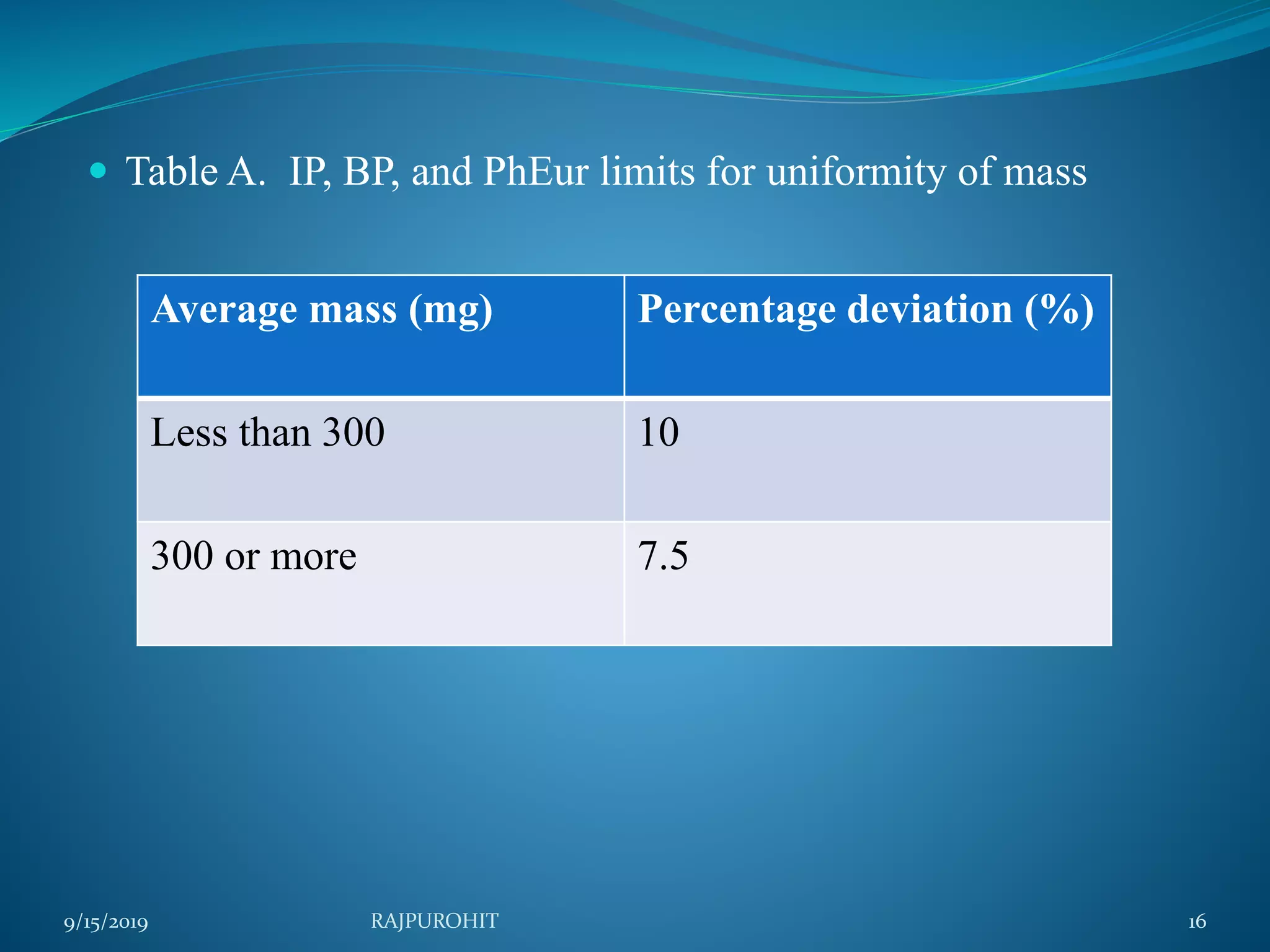
mass. According to IP, BP, PhEur a capsules not more than 2 of
the individual masses deviate from the average mass by more
than the percentage deviation shown in the Table “A’’
9/15/2019 15RAJPUROHIT
16.
Table A.IP, BP, and PhEur limits for uniformity of mass
Average mass (mg) Percentage deviation (%)
Less than 300 10
300 or more 7.5
9/15/2019 16RAJPUROHIT
17.
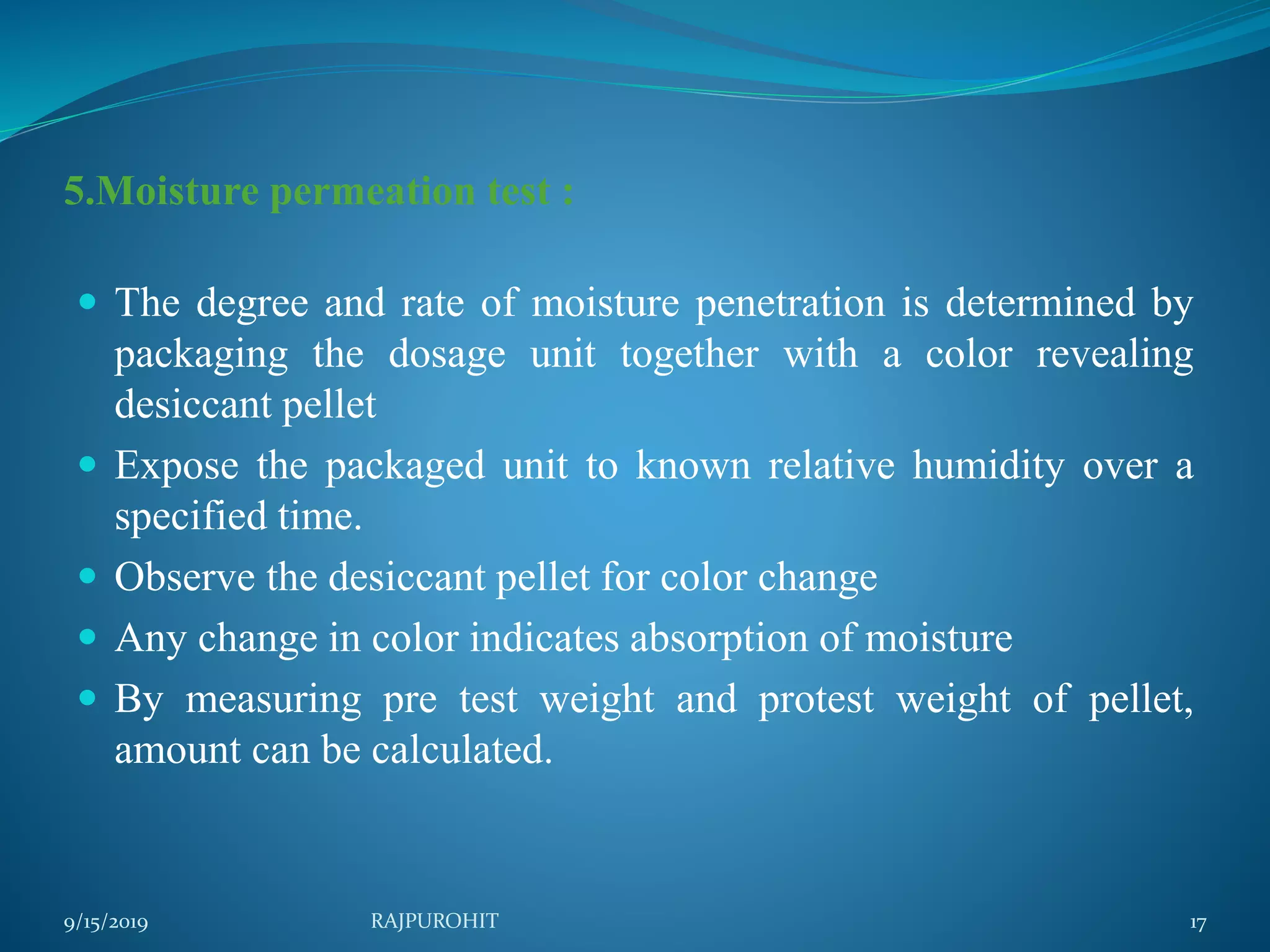
5.Moisture permeation test:
The degree and rate of moisture penetration is determined by
packaging the dosage unit together with a color revealing
desiccant pellet
Expose the packaged unit to known relative humidity over a
specified time.
Observe the desiccant pellet for color change
Any change in color indicates absorption of moisture
By measuring pre test weight and protest weight of pellet,
amount can be calculated.
9/15/2019 17RAJPUROHIT
18.
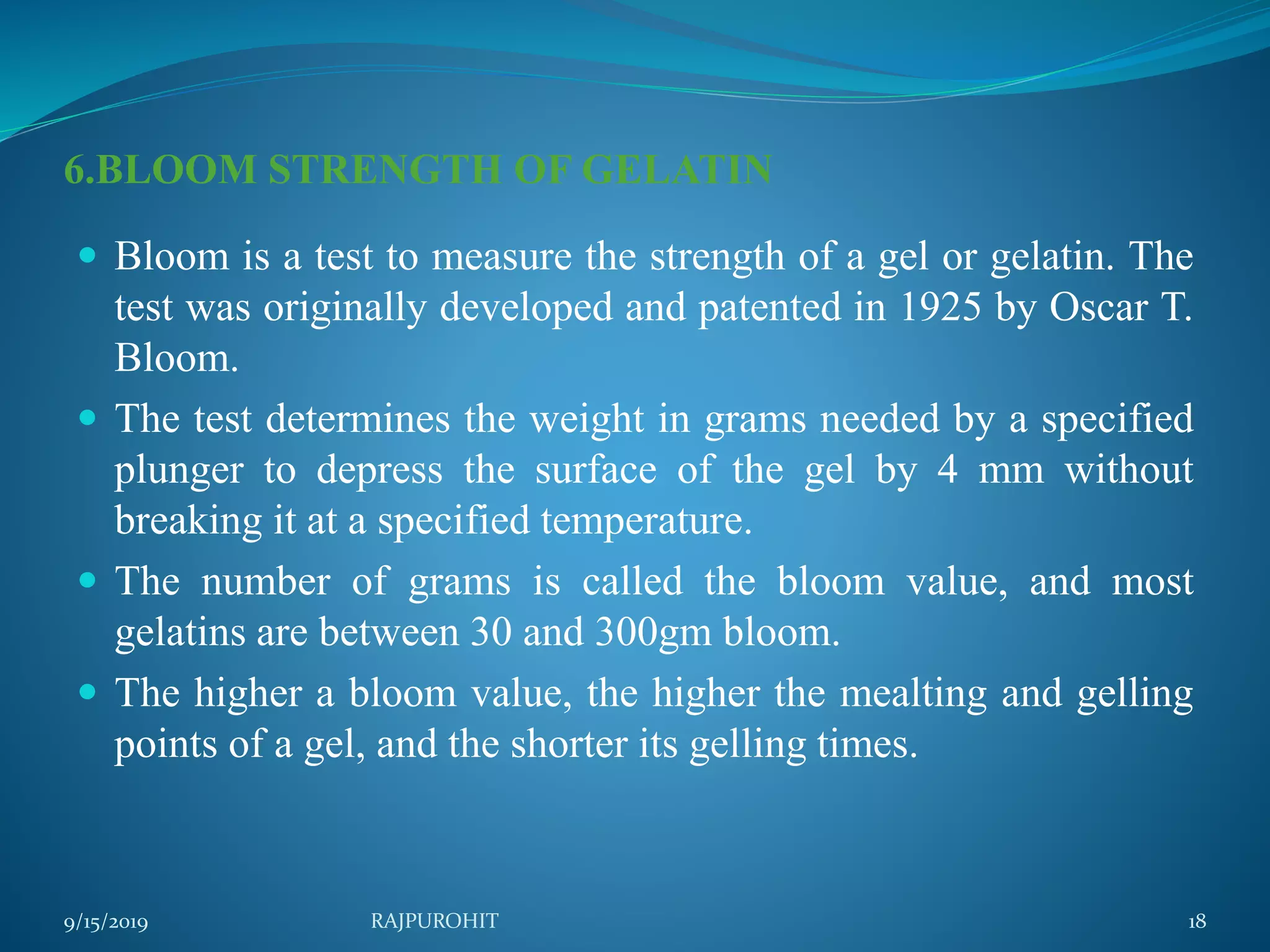
6.BLOOM STRENGTH OFGELATIN
Bloom is a test to measure the strength of a gel or gelatin. The
test was originally developed and patented in 1925 by Oscar T.
Bloom.
The test determines the weight in grams needed by a specified
plunger to depress the surface of the gel by 4 mm without
breaking it at a specified temperature.
The number of grams is called the bloom value, and most
gelatins are between 30 and 300gm bloom.
The higher a bloom value, the higher the mealting and gelling
points of a gel, and the shorter its gelling times.
9/15/2019 18RAJPUROHIT
7.Content uniformity
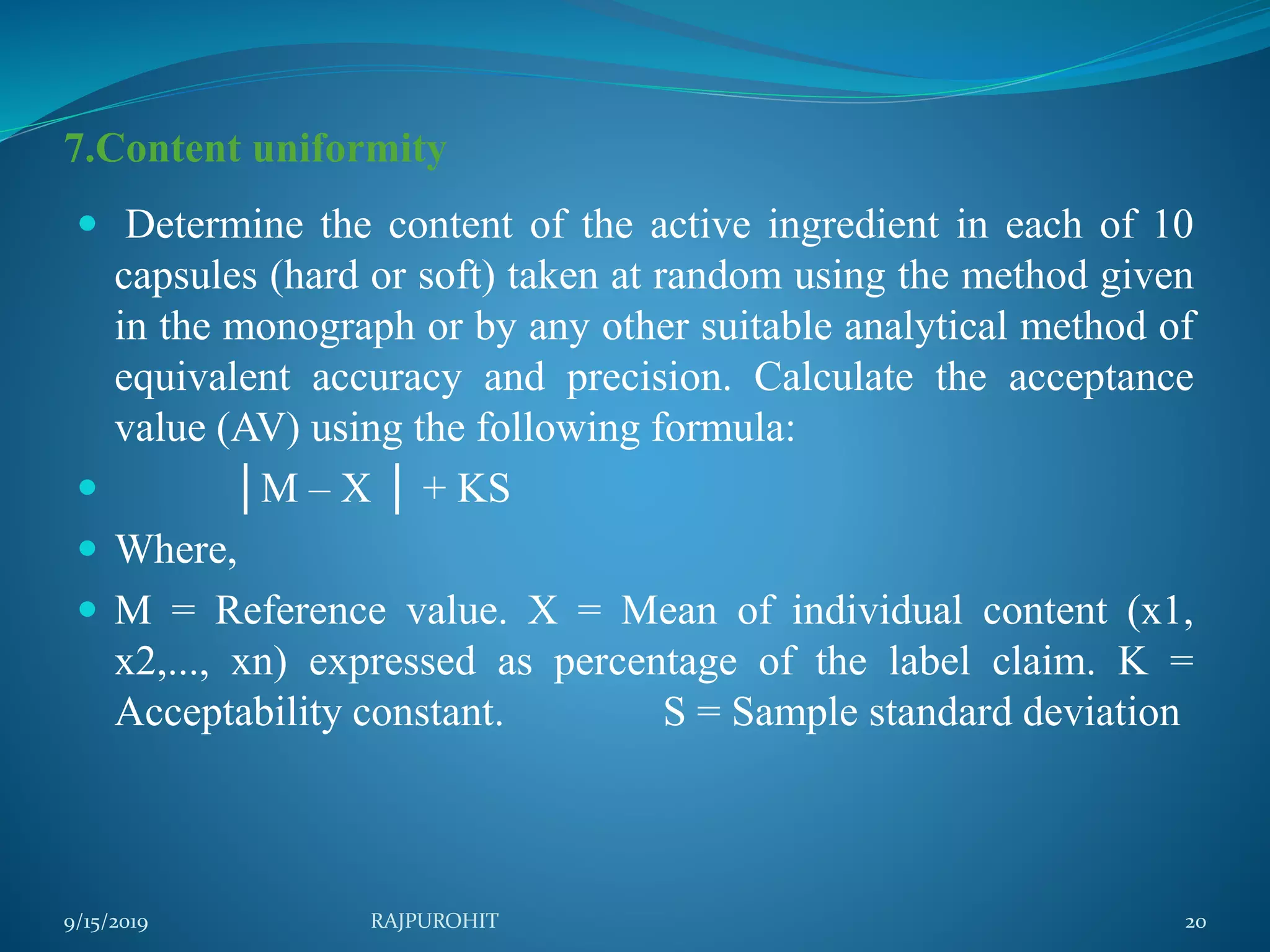
Determinethe content of the active ingredient in each of 10
capsules (hard or soft) taken at random using the method given
in the monograph or by any other suitable analytical method of
equivalent accuracy and precision. Calculate the acceptance
value (AV) using the following formula:
│M – X │ + KS
Where,
M = Reference value. X = Mean of individual content (x1,
x2,..., xn) expressed as percentage of the label claim. K =
Acceptability constant. S = Sample standard deviation
9/15/2019 20RAJPUROHIT
21.
As perBP capsules comply with the test if not more than one
of the individual values thus obtained is outside the limits 85 to
115 percent of the average value and none is outside the limits
75 to 125 percent.
The capsules fails to comply with the test if more than 3
individual contents are outside the limits of 85 percent to 115
percent of the average content or if one or more individual
contents are outside the limits of 75 percent to 125 per cent of
the average content.
If 2 or 3 individual values are outside the limits 85 to 115
percent of the average values, repeat the determination using
another 20 capsules.
9/15/2019 21RAJPUROHIT
22.
The capsulescomply with the test if in the total sample of 30
capsules not more than 3 individual values are outside the
limits 85 to 115 percent and none is outside the limits 75 to 125
percent of the average value .
9/15/2019 22RAJPUROHIT
23.
9/15/2019 RAJPUROHIT 23
REFERENCES:
1. L Lachman, HA Lieberman, JL Kanig. The Theory and
Practice of Industrial Pharmacy, 3rd Edition, Lea & Febiger,
Philadelphia, 1986, 374-398.
2. Haleem RM, Salem MY, Fatahallah FA, Abdelfattah LE.
Quality in the pharmaceutical industry - A literature review.
Available:http://www.sciencedirect.com/sci
ence/article/pii/S1319016413001114.
3. Indian Pharmacopoeia Commission. Indian Pharmacopoeia.
7th ed. Ghaziabad: Indian Pharmacopoeia Commission; 2014.
4. United States Pharmacopeial Convention. United States
Pharmacopoeia 33-National Formulary 28. USA: Stationery
Office; 2010.
5. British Journal of Pharmaceutical Research 9(2): 1-9, 2016,
Article no.BJPR.22044 ISSN: 2231-2919.









![In Process Quality Control Tests For Capsules [Autosaved].pptx](https://cdn.slidesharecdn.com/ss_thumbnails/07surendrainprocessqualitycontroltestsforcapsulesautosaved-230427052347-2c49b37e-thumbnail.jpg?width=640&height=640&fit=bounds)


