M. Pharm Sem-II Presentations
TITLE:TYPES OF CLOSURE AND CLOSURE LINERS
SUBMITTED TO
SAVITRIBAI PHULE, PUNE UNIVERSITY , PUNE
FOR
PARTIAL FULFILMENT OF REQUIREMENTS FOR THE AWARD OF
MASTER OF PHARMACY
IN THE SUBJECT
Pharmaceutical Manufacturing Technology
IN THE FACULTY OF SCIENCE AND TECHNOLOGY
Bhujbal Knowledge City,
MET’s Institute of Pharmacy,
Adgaon, Nashik, 422003.
Maharashtra, India
Academic Year-2021-2022
1
Presented By-shaikh Saniya
Zakir
Guided By-Dr. Sapana
Ahirrao
CLOSURES:
• Closures are devices and methods for closing or sealing containers such as bottles,
jugs, jars, tubes, cans, and so on.
• A cap, cover, lid, plug, or other type of closure can be used.
PURPOSE OF CLOSURE:
• To retain or contain the contents
• Assist in dispensing and use of product
• Keep the product secure from undesired premature opening
• Provide a barrier to dirt, oxygen, moisture
• restricting ingress (odours, taints, moisture, oxygen, carbon dioxide, mould, bacteria,
etc.) and egress (loss by evaporation, loss of moisture, perfume, flavourings, volatiles,
etc.).
2
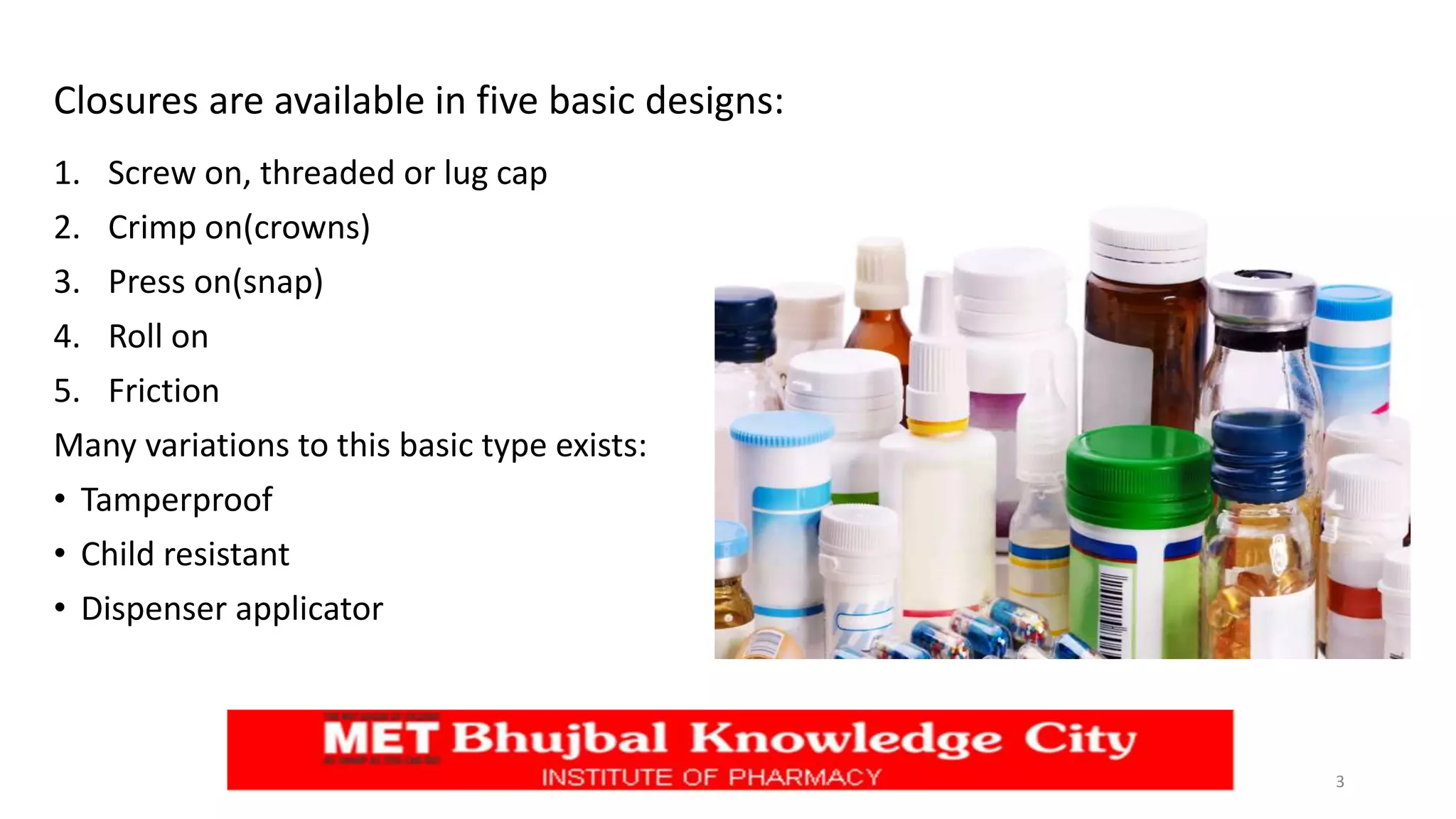
Closures are available in five basic designs:
1. Screw on, threaded or lug cap
2. Crimp on(crowns)
3. Press on(snap)
4. Roll on
5. Friction
Many variations to this basic type exists:
• Tamperproof
• Child resistant
• Dispenser applicator
3
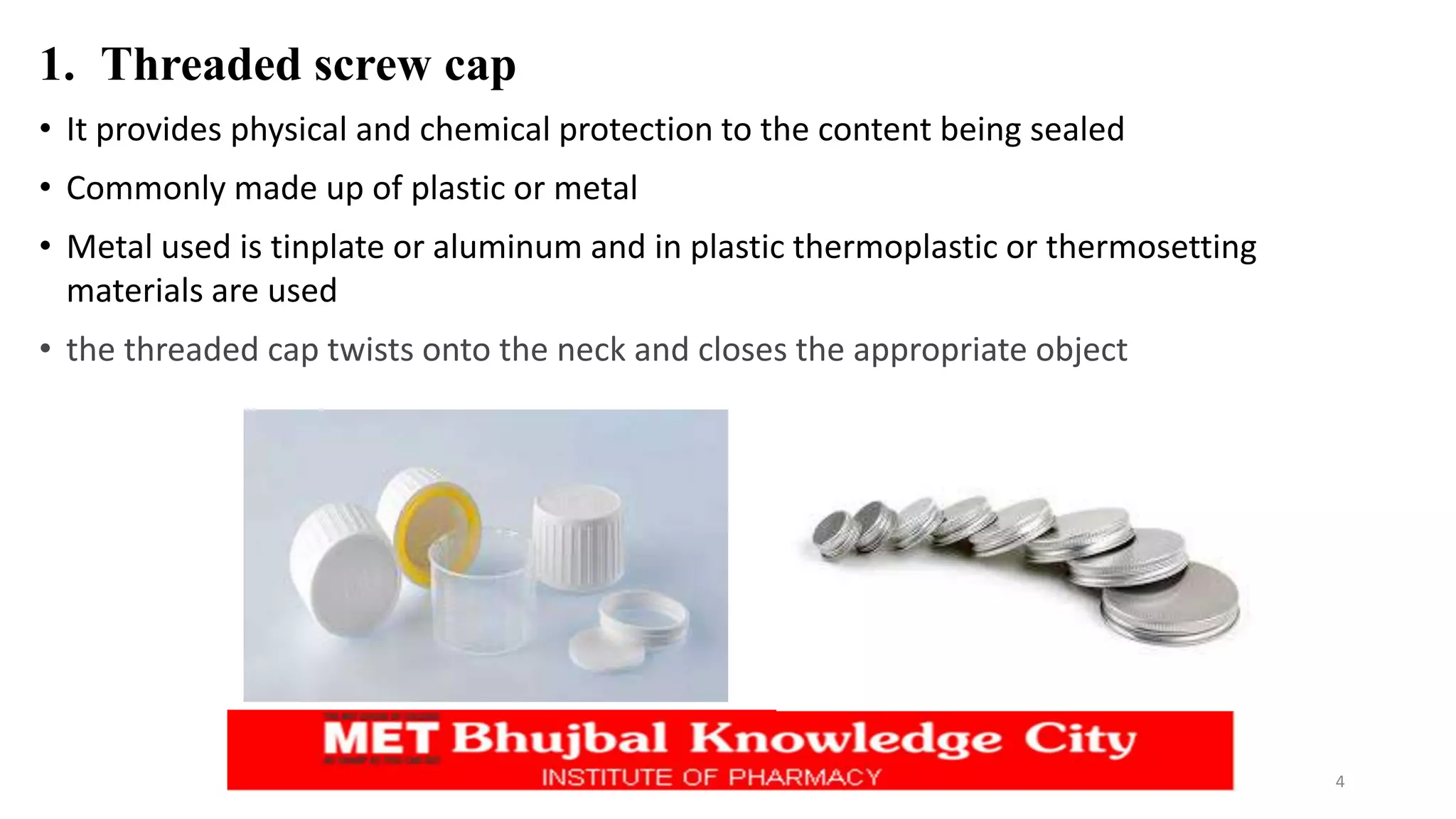
1. Threaded screw cap
• It provides physical and chemical protection to the content being sealed
• Commonly made up of plastic or metal
• Metal used is tinplate or aluminum and in plastic thermoplastic or thermosetting
materials are used
• the threaded cap twists onto the neck and closes the appropriate object
4
Lug cap
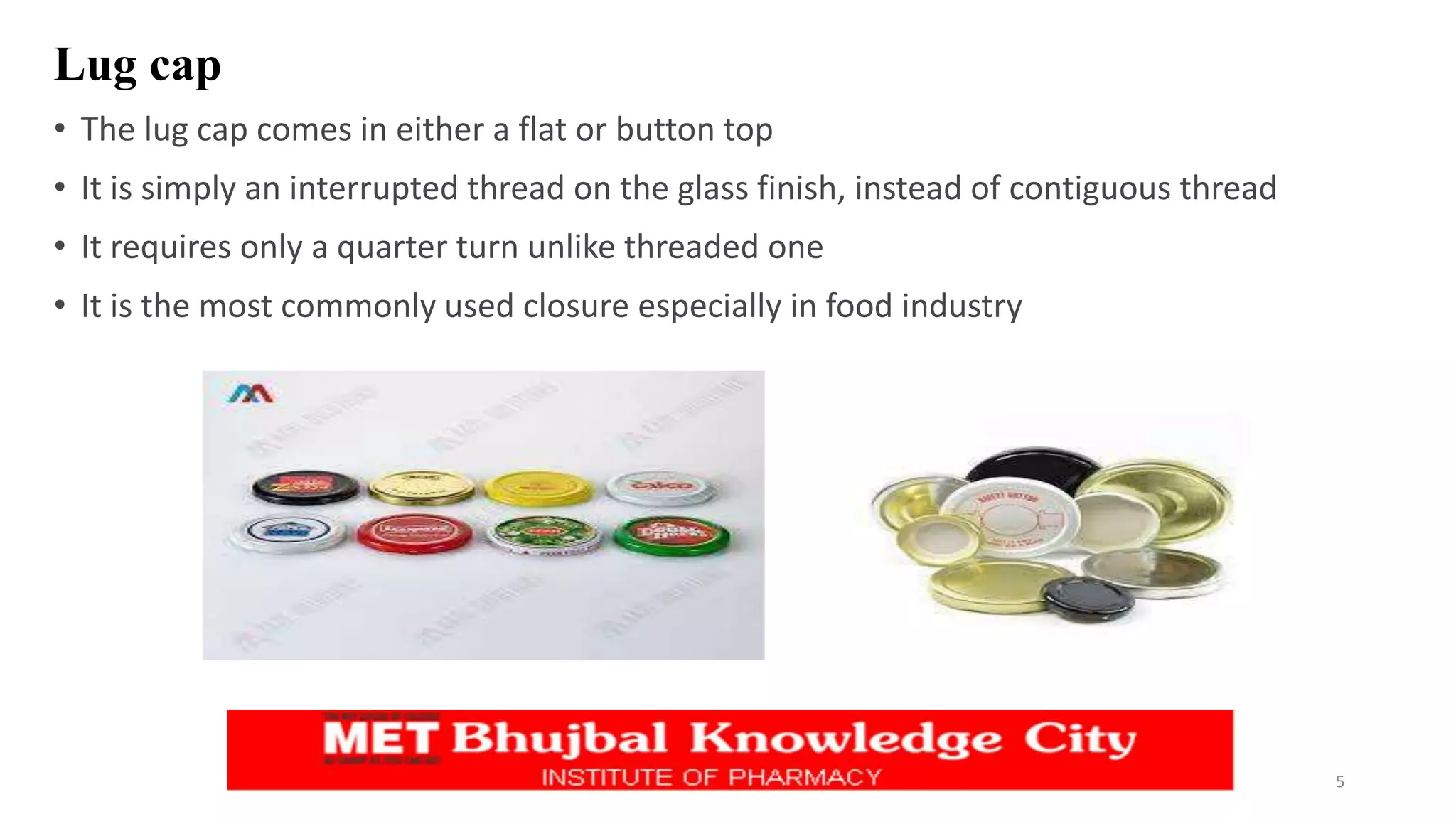
• The lug cap comes in either a flat or button top
• It is simply an interrupted thread on the glass finish, instead of contiguous thread
• It requires only a quarter turn unlike threaded one
• It is the most commonly used closure especially in food industry
5
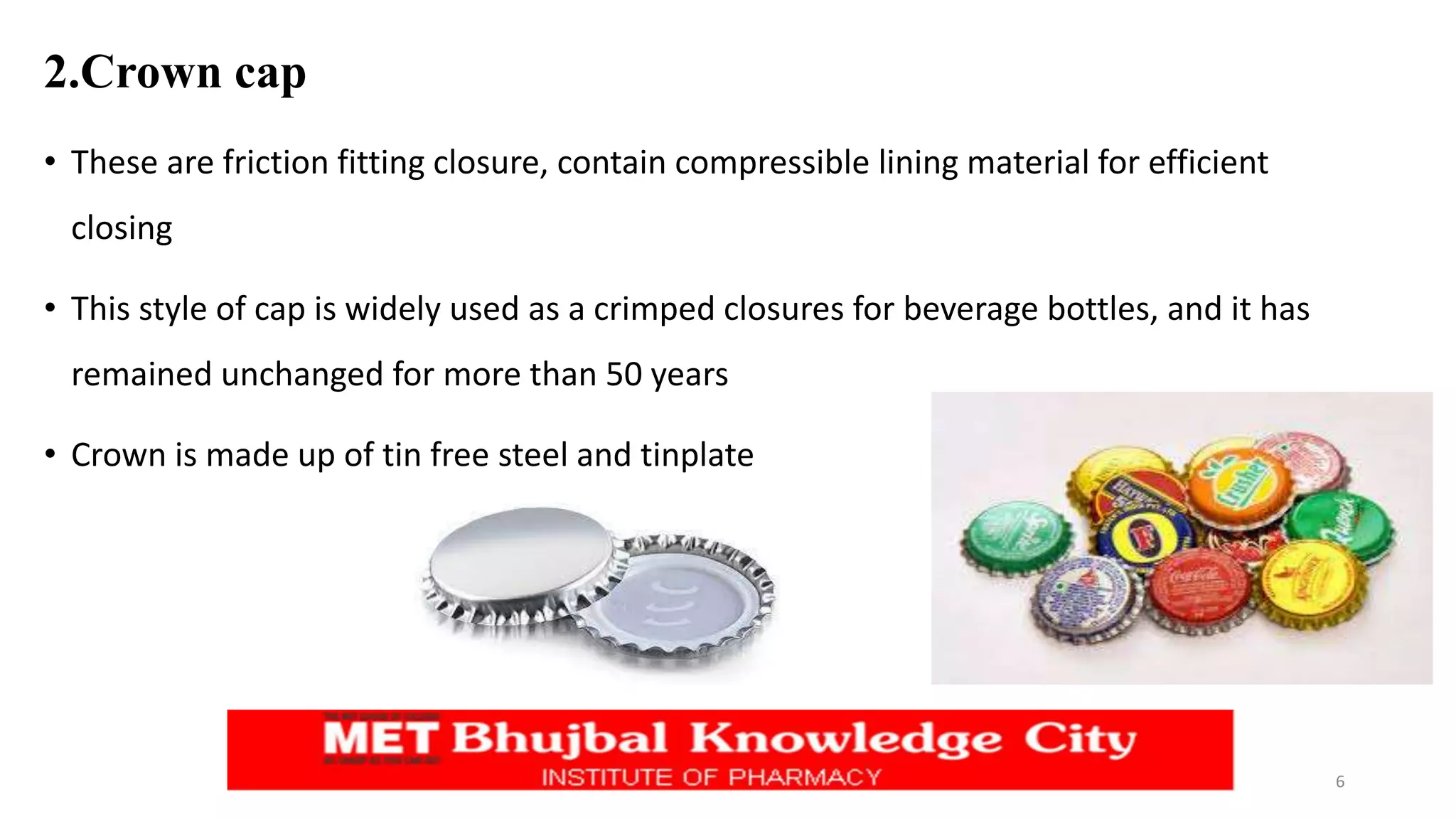
2.Crown cap
• These are friction fitting closure, contain compressible lining material for efficient
closing
• This style of cap is widely used as a crimped closures for beverage bottles, and it has
remained unchanged for more than 50 years
• Crown is made up of tin free steel and tinplate
6
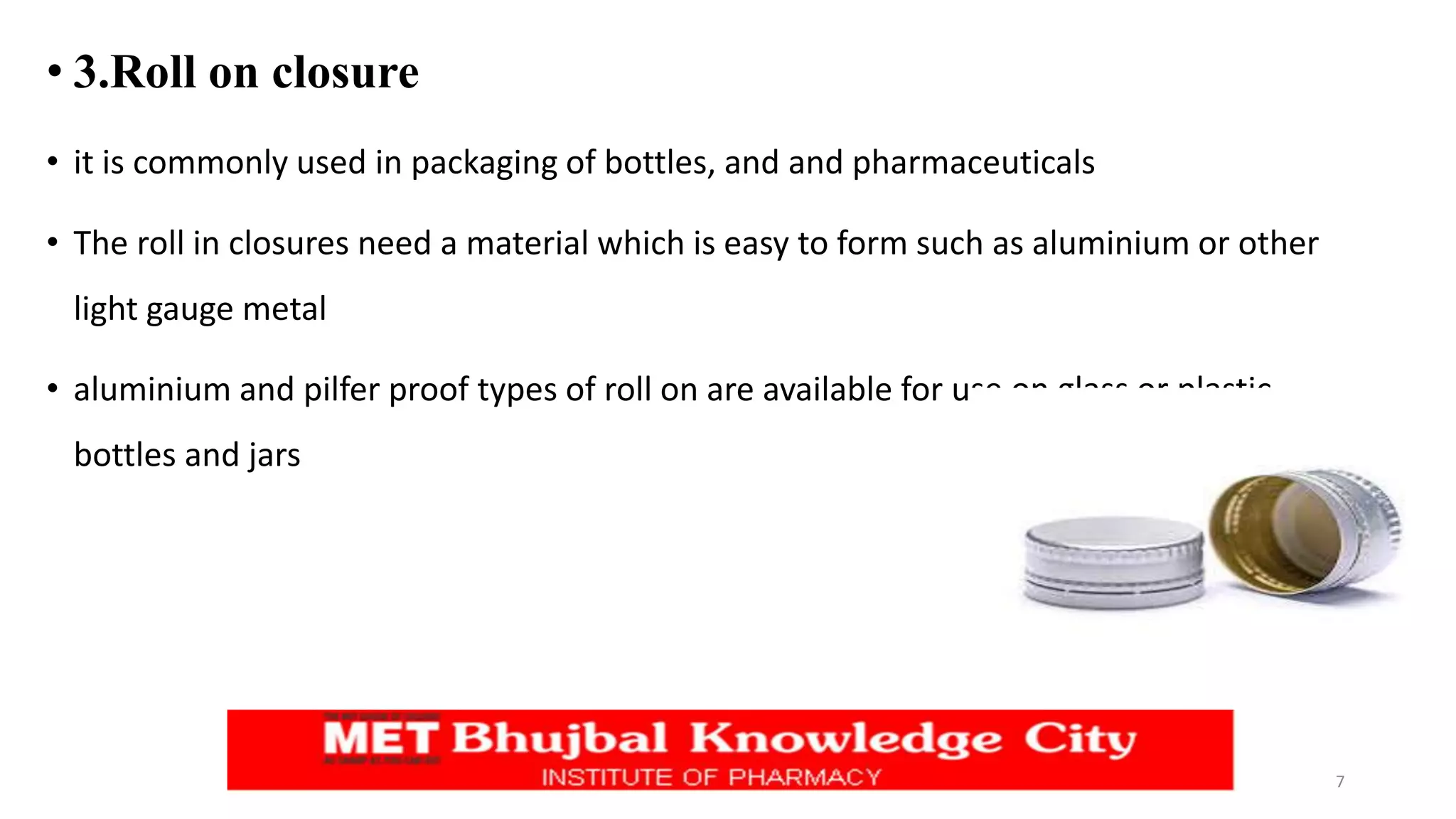
• 3.Roll on closure
• it is commonly used in packaging of bottles, and and pharmaceuticals
• The roll in closures need a material which is easy to form such as aluminium or other
light gauge metal
• aluminium and pilfer proof types of roll on are available for use on glass or plastic
bottles and jars
7
8
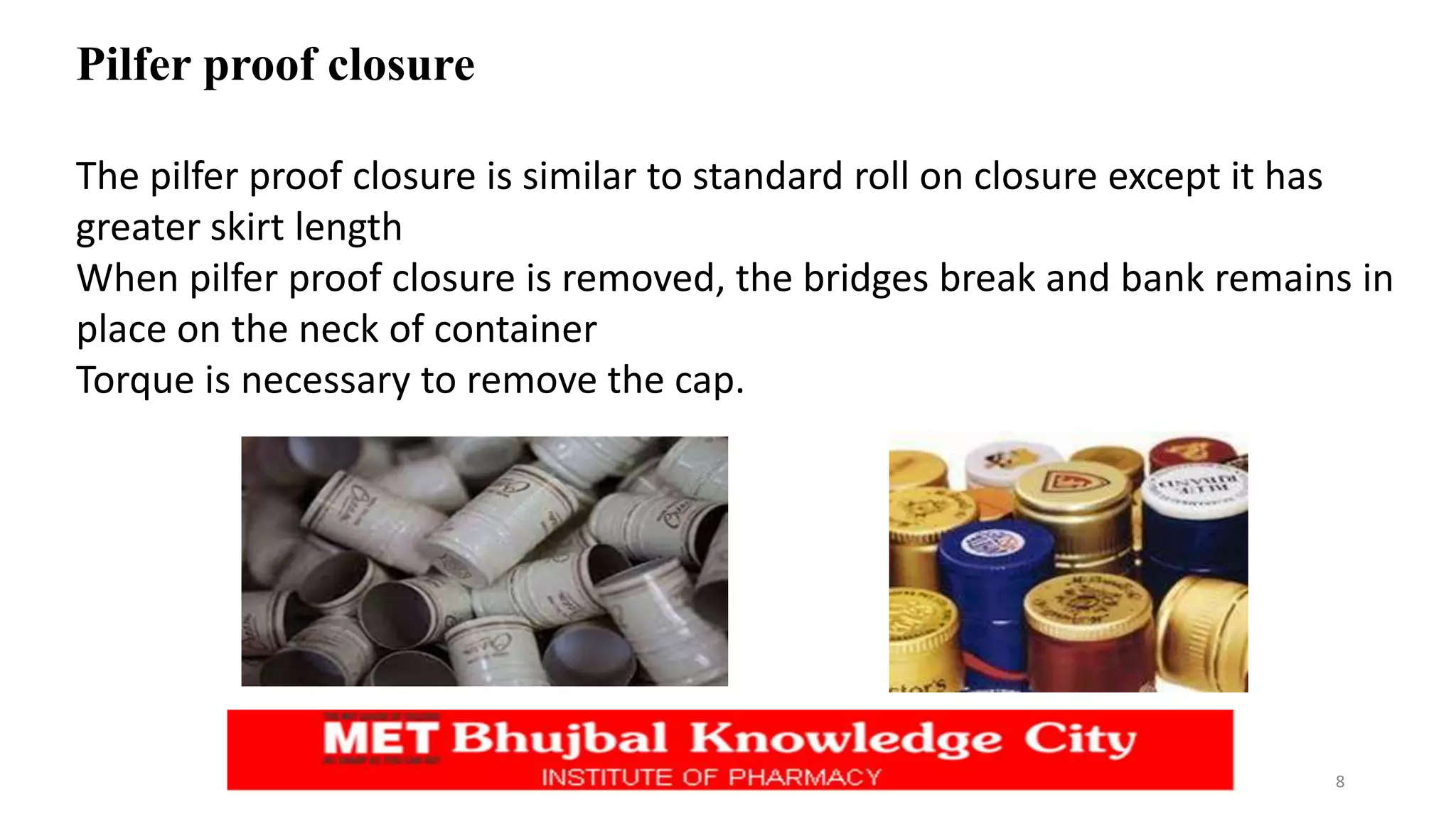
Pilfer proof closure
The pilfer proof closure is similar to standard roll on closure except it has
greater skirt length
When pilfer proof closure is removed, the bridges break and bank remains in
place on the neck of container
Torque is necessary to remove the cap.
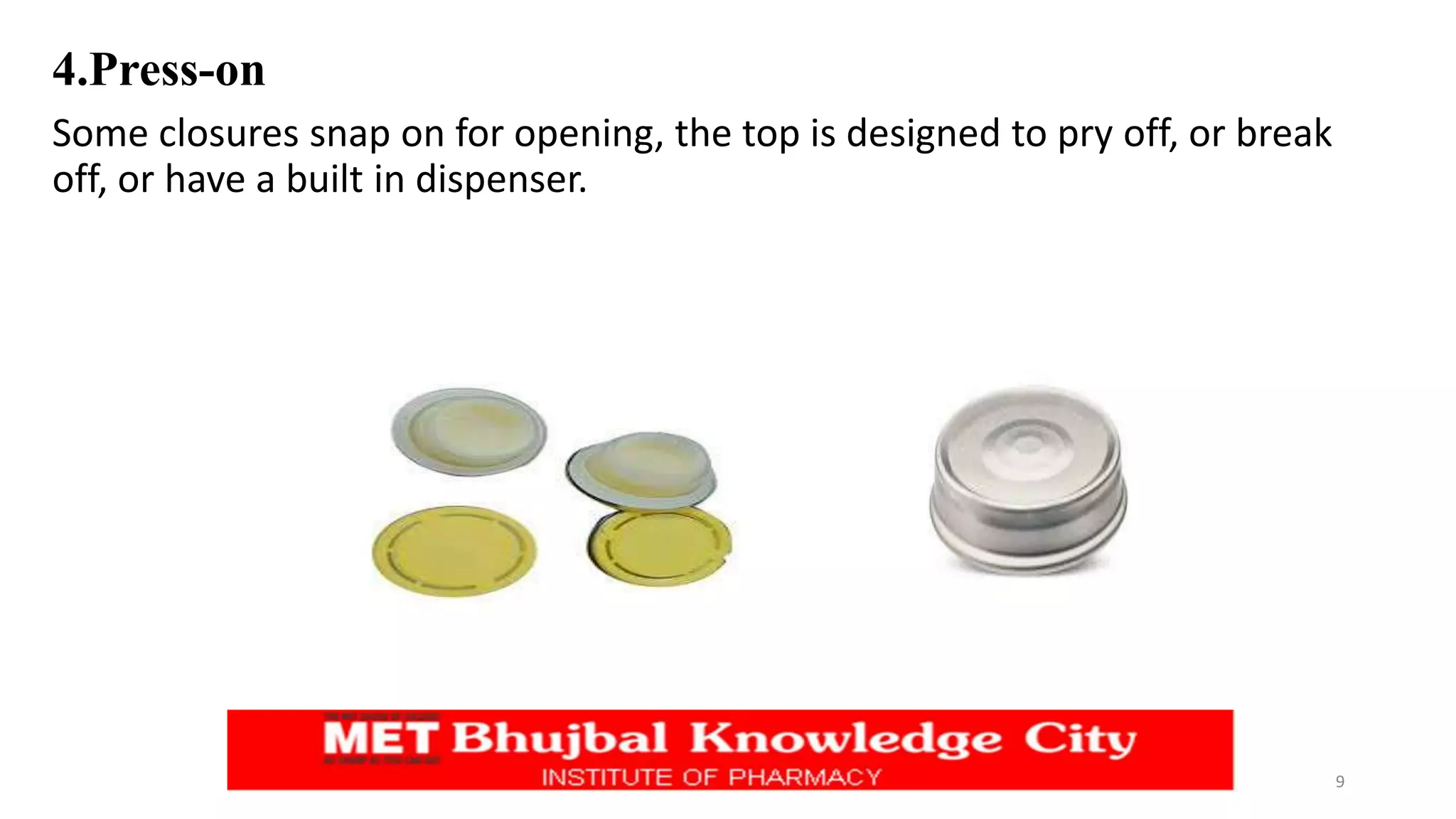
4.Press-on
Some closures snap on for opening, the top is designed to pry off, or break
off, or have a built in dispenser.
9
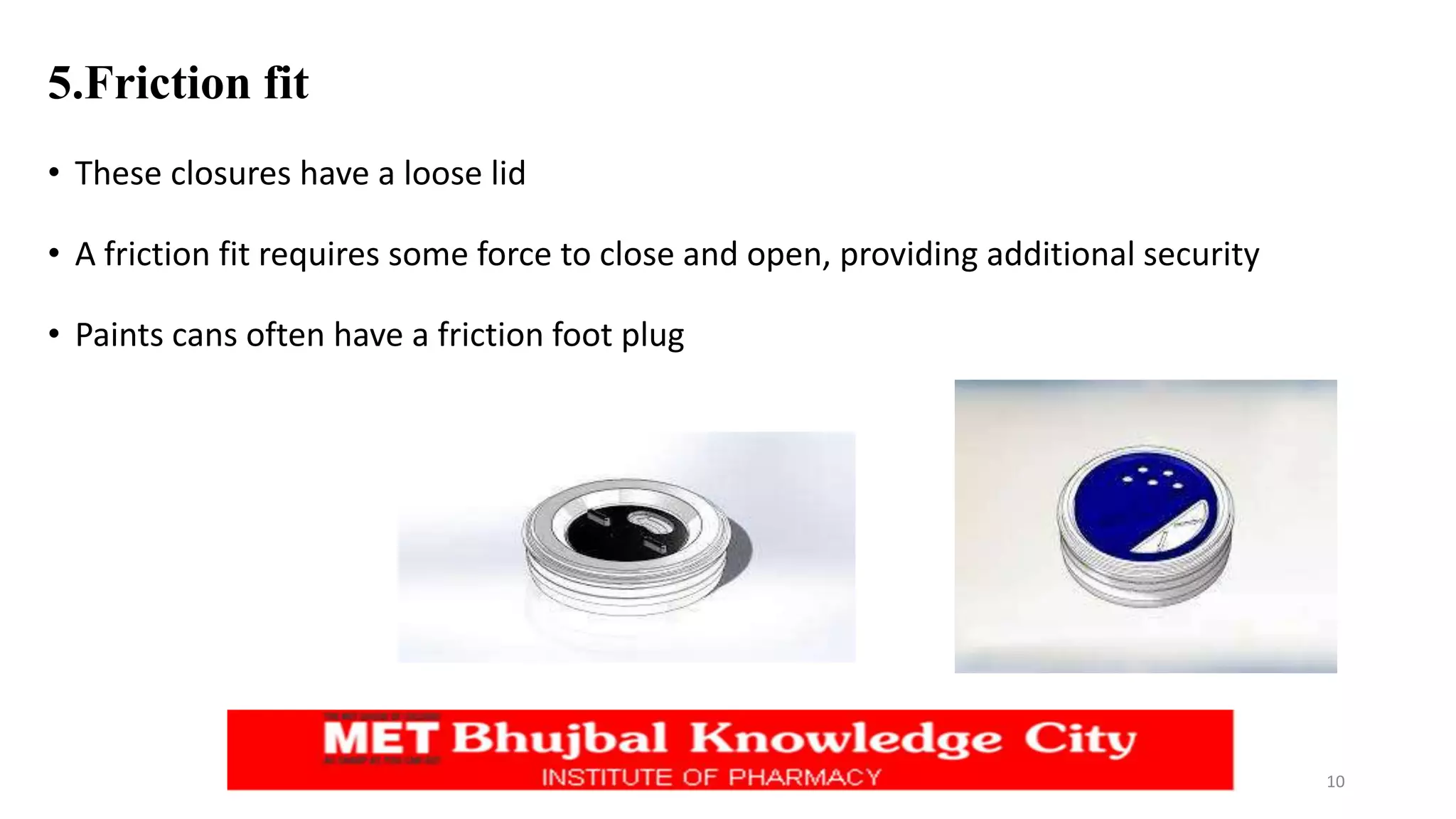
5.Friction fit
• These closures have a loose lid
• A friction fit requires some force to close and open, providing additional security
• Paints cans often have a friction foot plug
10
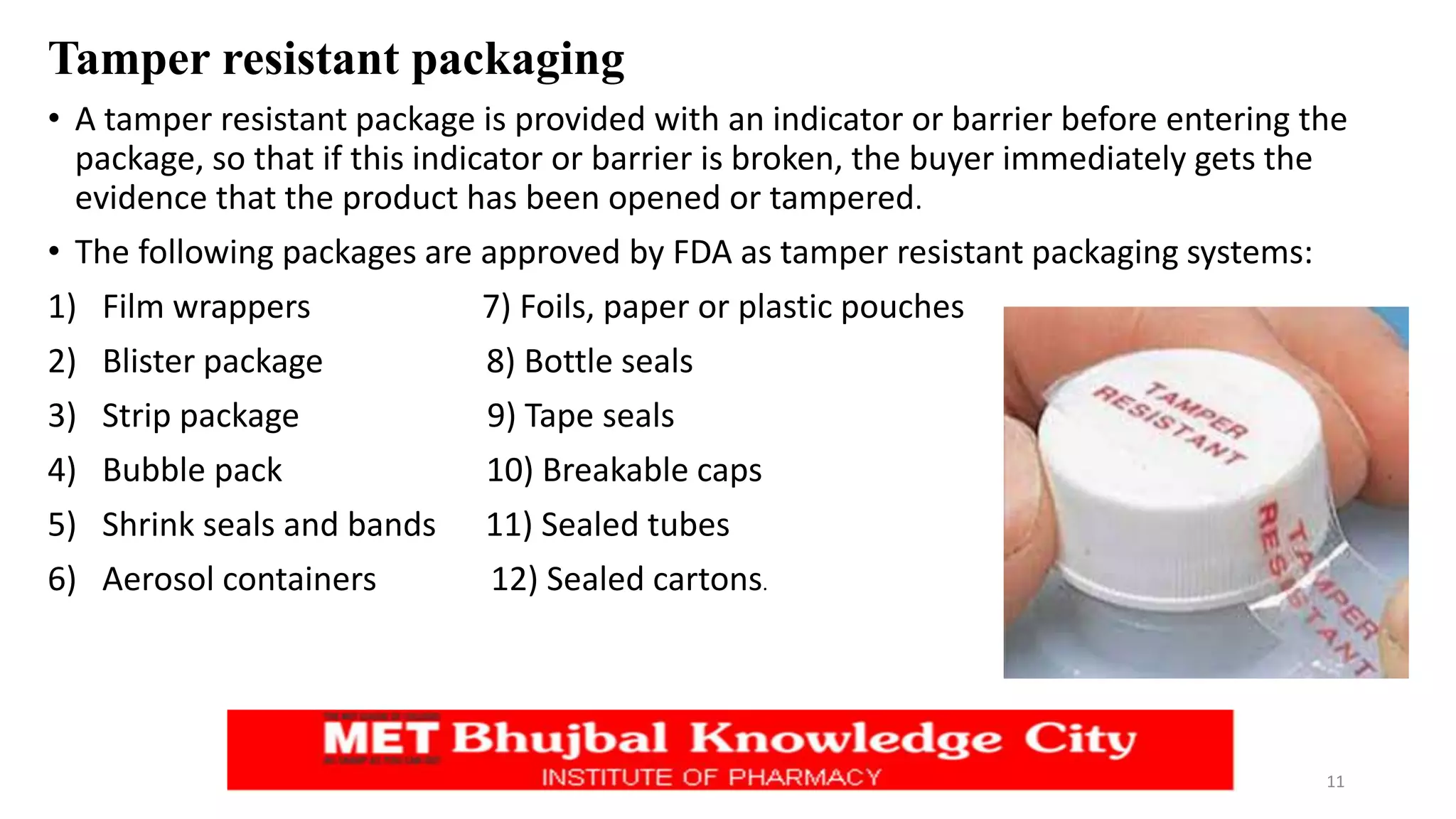
Tamper resistant packaging
• A tamper resistant package is provided with an indicator or barrier before entering the
package, so that if this indicator or barrier is broken, the buyer immediately gets the
evidence that the product has been opened or tampered.
• The following packages are approved by FDA as tamper resistant packaging systems:
1) Film wrappers 7) Foils, paper or plastic pouches
2) Blister package 8) Bottle seals
3) Strip package 9) Tape seals
4) Bubble pack 10) Breakable caps
5) Shrink seals and bands 11) Sealed tubes
6) Aerosol containers 12) Sealed cartons.
11
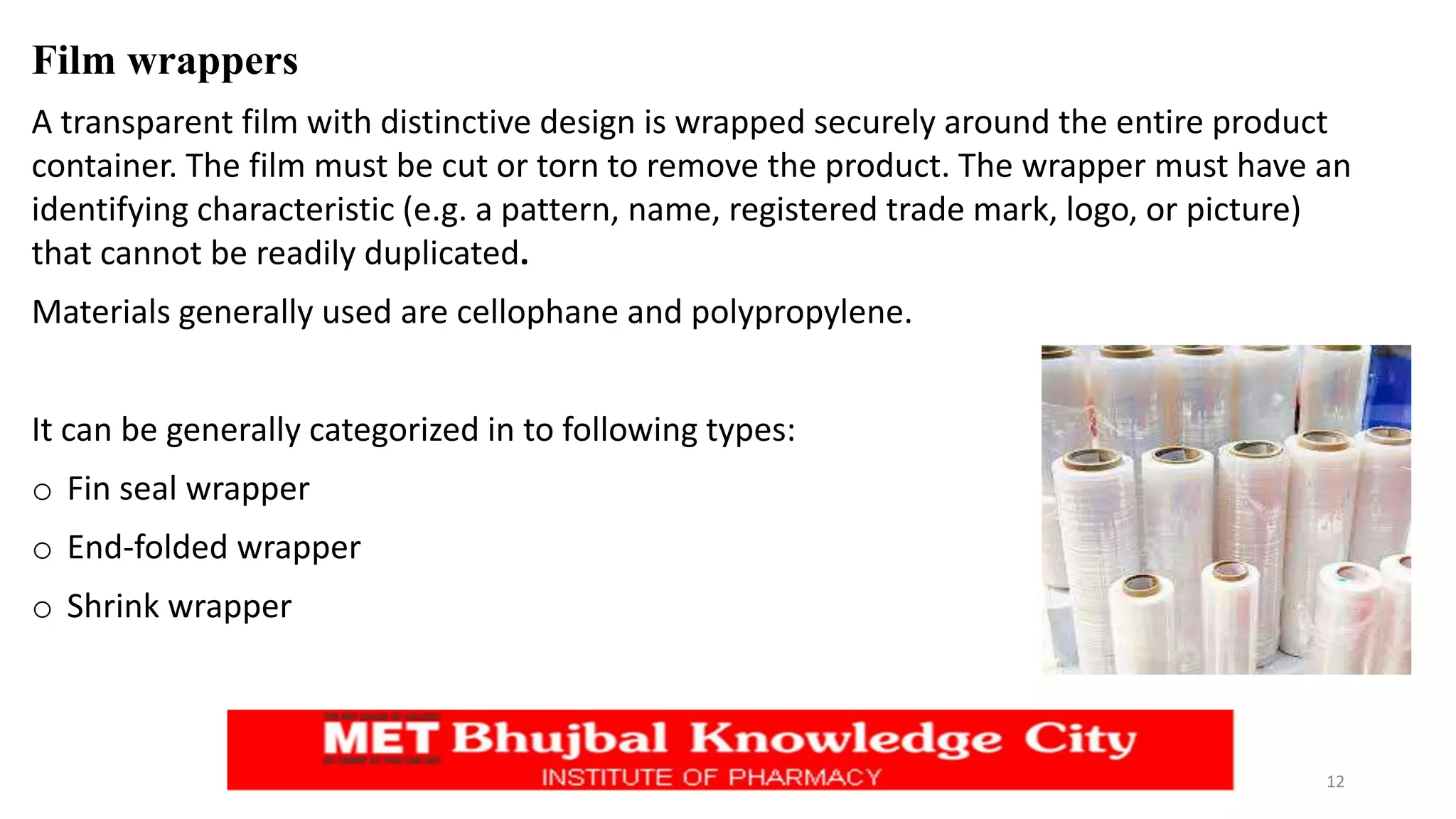
Film wrappers
A transparent film with distinctive design is wrapped securely around the entire product
container. The film must be cut or torn to remove the product. The wrapper must have an
identifying characteristic (e.g. a pattern, name, registered trade mark, logo, or picture)
that cannot be readily duplicated.
Materials generally used are cellophane and polypropylene.
It can be generally categorized in to following types:
o Fin seal wrapper
o End-folded wrapper
o Shrink wrapper
12
13
Blister package
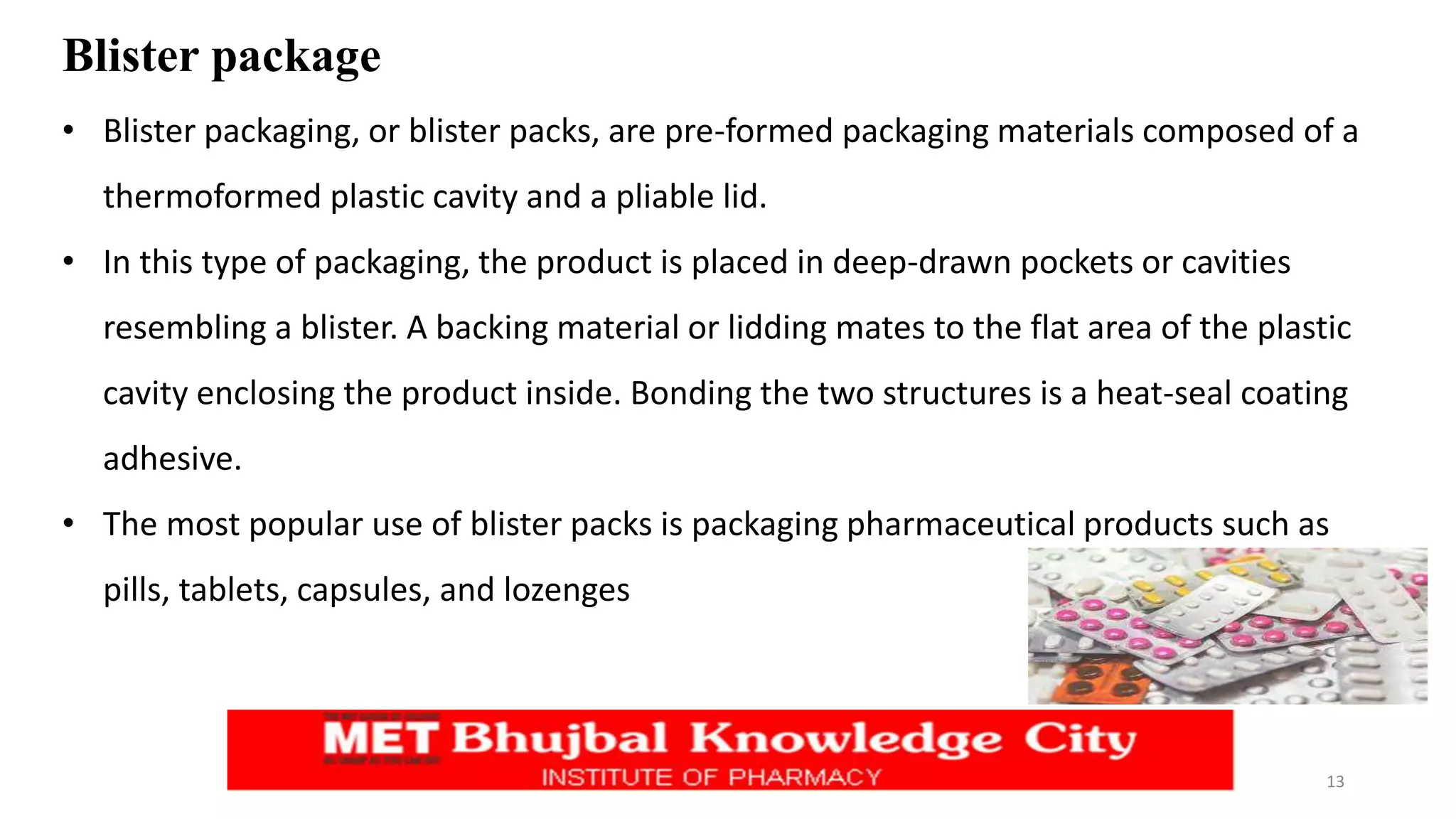
• Blister packaging, or blister packs, are pre-formed packaging materials composed of a
thermoformed plastic cavity and a pliable lid.
• In this type of packaging, the product is placed in deep-drawn pockets or cavities
resembling a blister. A backing material or lidding mates to the flat area of the plastic
cavity enclosing the product inside. Bonding the two structures is a heat-seal coating
adhesive.
• The most popular use of blister packs is packaging pharmaceutical products such as
pills, tablets, capsules, and lozenges
Strip package
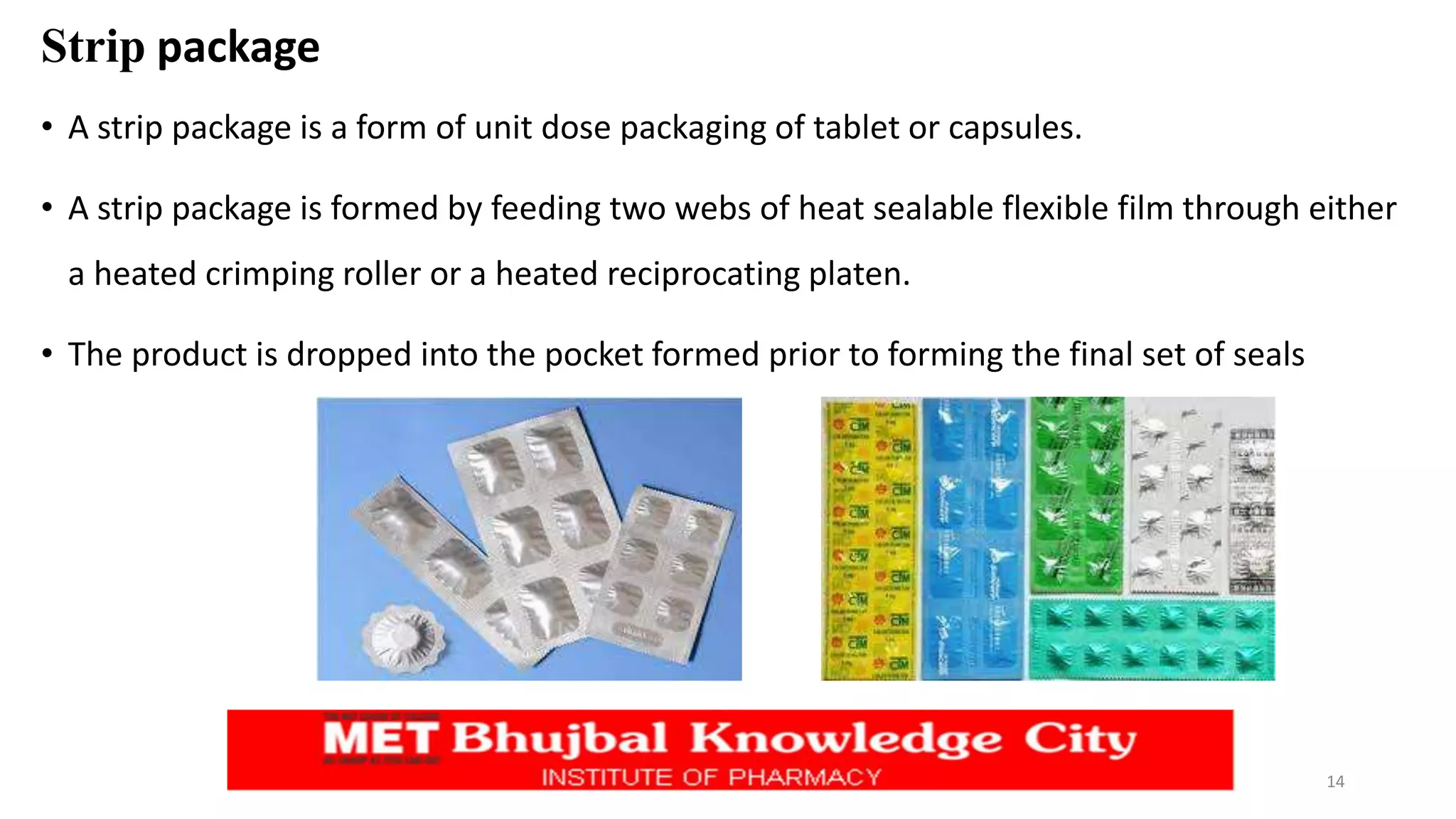
• A strip package is a form of unit dose packaging of tablet or capsules.
• A strip package is formed by feeding two webs of heat sealable flexible film through either
a heated crimping roller or a heated reciprocating platen.
• The product is dropped into the pocket formed prior to forming the final set of seals
14
15
Bubble packs
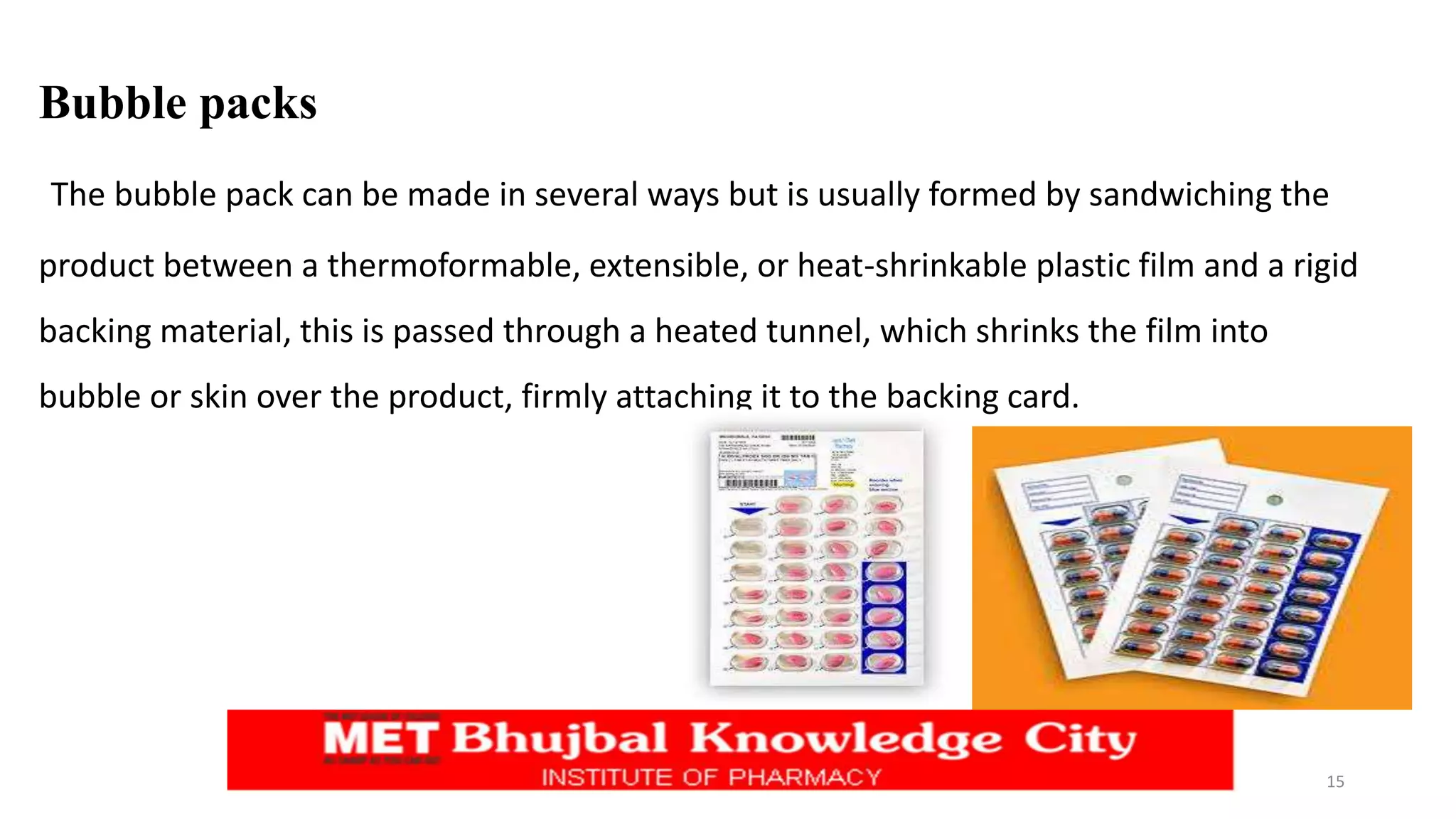
The bubble pack can be made in several ways but is usually formed by sandwiching the
product between a thermoformable, extensible, or heat-shrinkable plastic film and a rigid
backing material, this is passed through a heated tunnel, which shrinks the film into
bubble or skin over the product, firmly attaching it to the backing card.
16
Heat shrink bands or wrappers
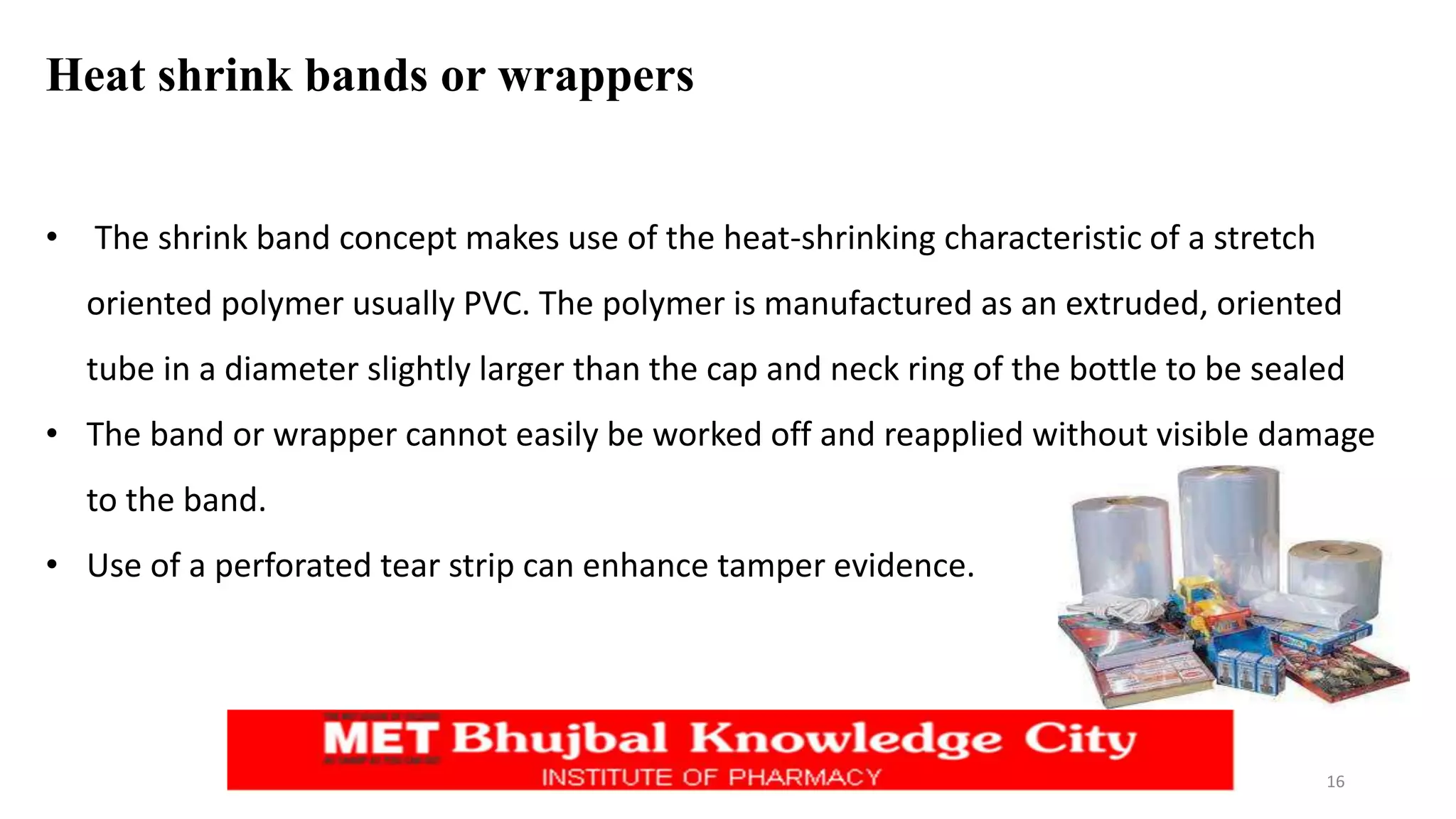
• The shrink band concept makes use of the heat-shrinking characteristic of a stretch
oriented polymer usually PVC. The polymer is manufactured as an extruded, oriented
tube in a diameter slightly larger than the cap and neck ring of the bottle to be sealed
• The band or wrapper cannot easily be worked off and reapplied without visible damage
to the band.
• Use of a perforated tear strip can enhance tamper evidence.
17
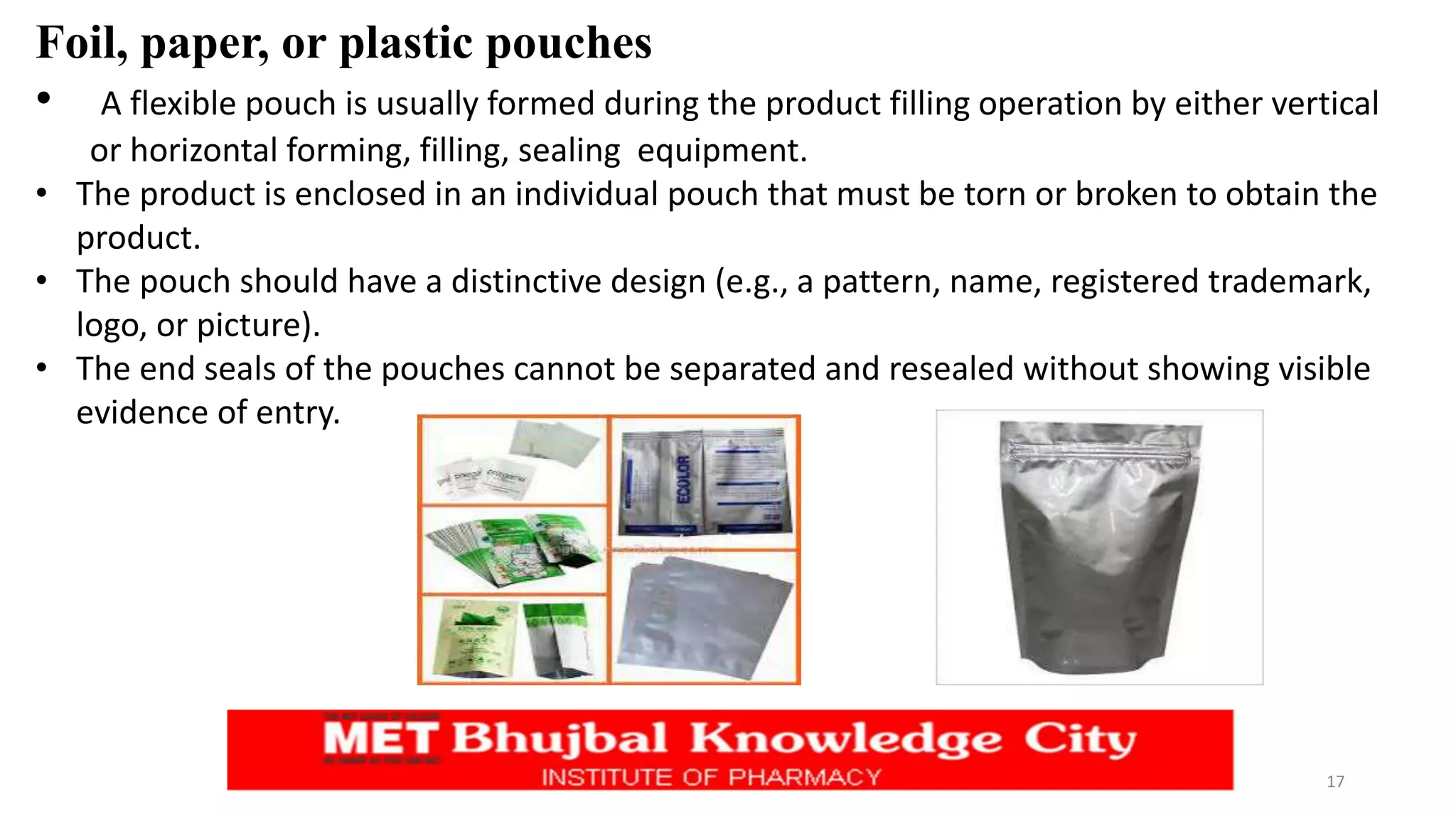
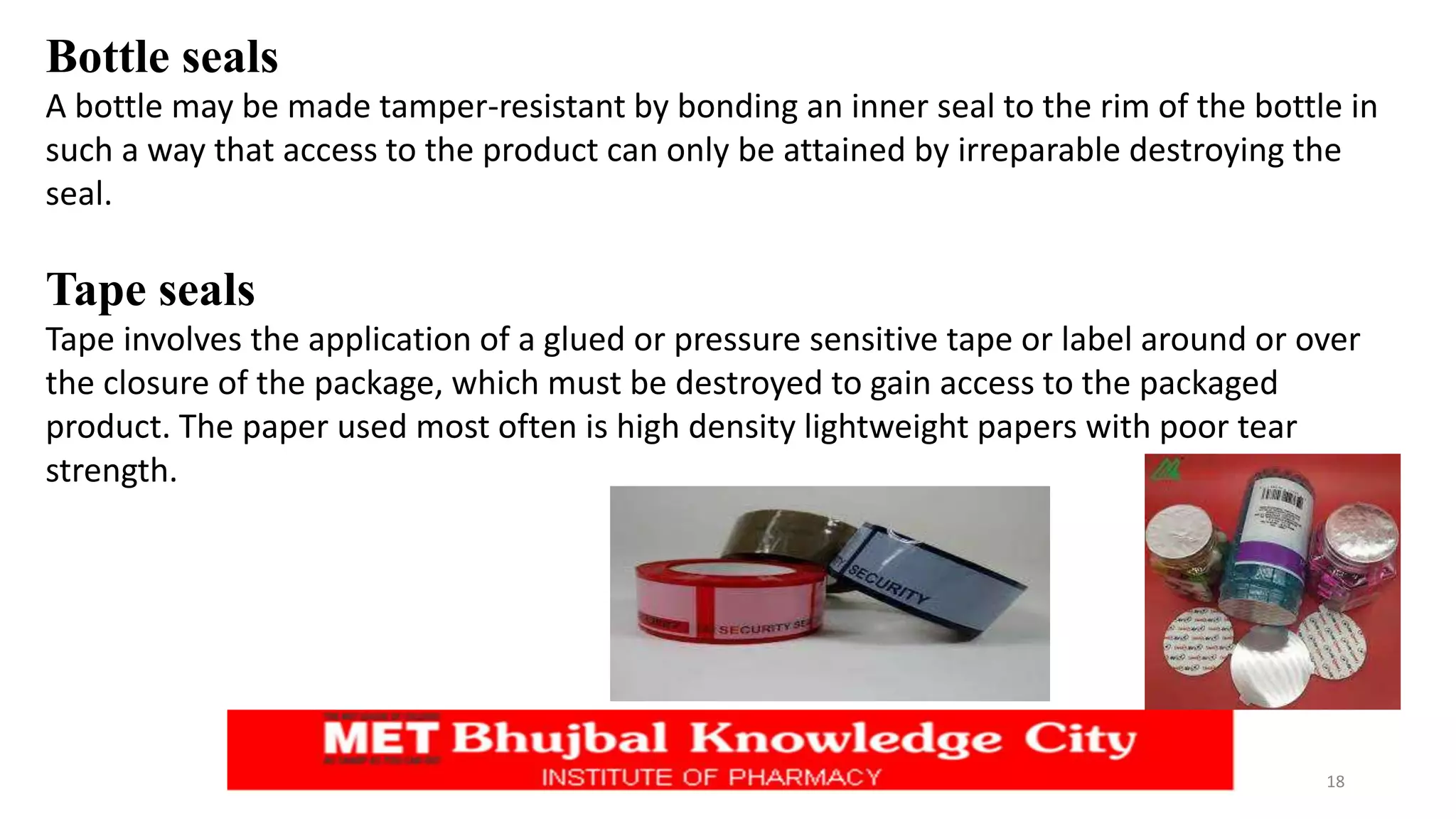
Foil, paper, or plastic pouches
• A flexible pouch is usually formed during the product filling operation by either vertical
or horizontal forming, filling, sealing equipment.
• The product is enclosed in an individual pouch that must be torn or broken to obtain the
product.
• The pouch should have a distinctive design (e.g., a pattern, name, registered trademark,
logo, or picture).
• The end seals of the pouches cannot be separated and resealed without showing visible
evidence of entry.
18
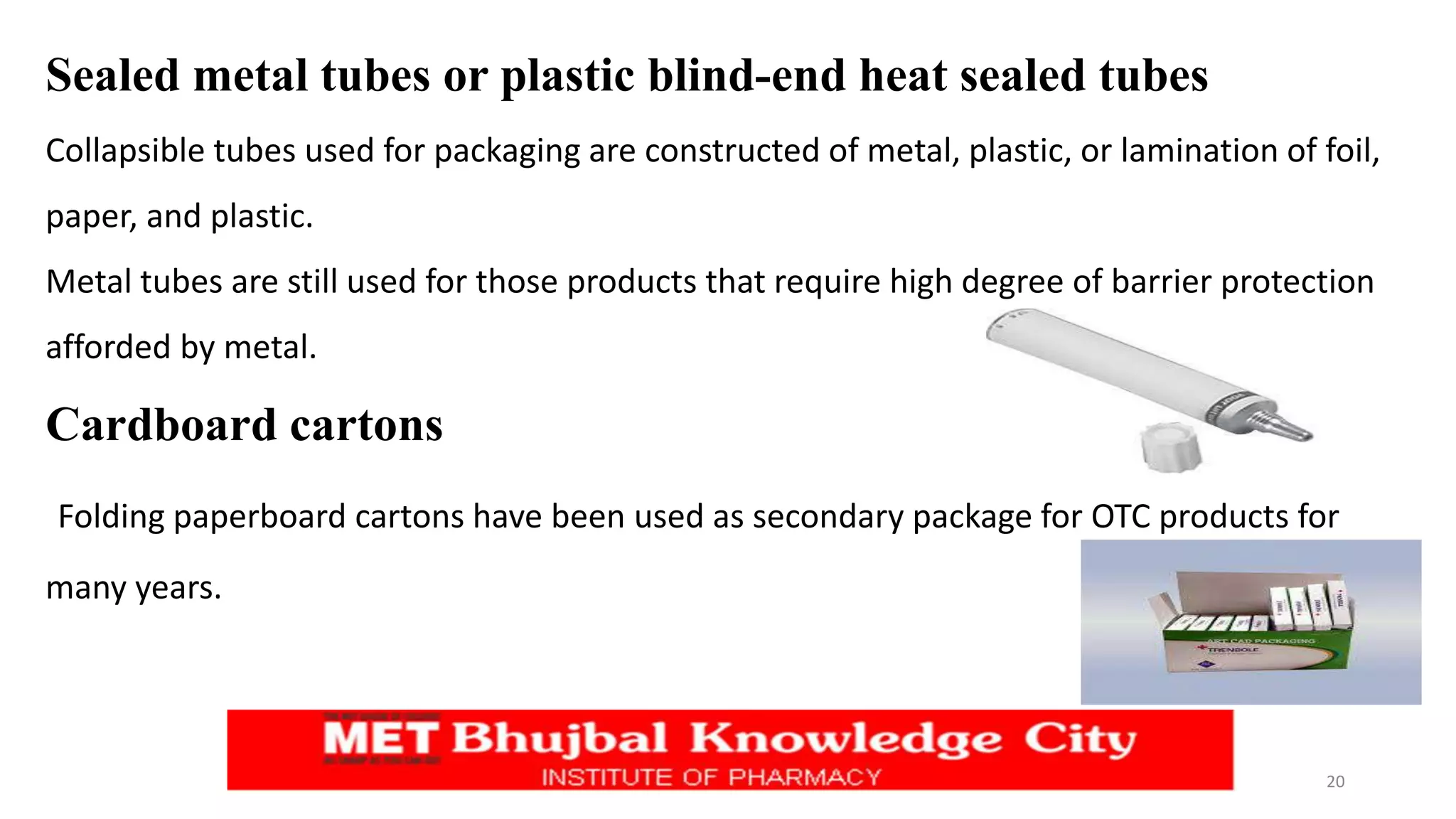
Bottle seals
A bottle may be made tamper-resistant by bonding an inner seal to the rim of the bottle in
such a way that access to the product can only be attained by irreparable destroying the
seal.
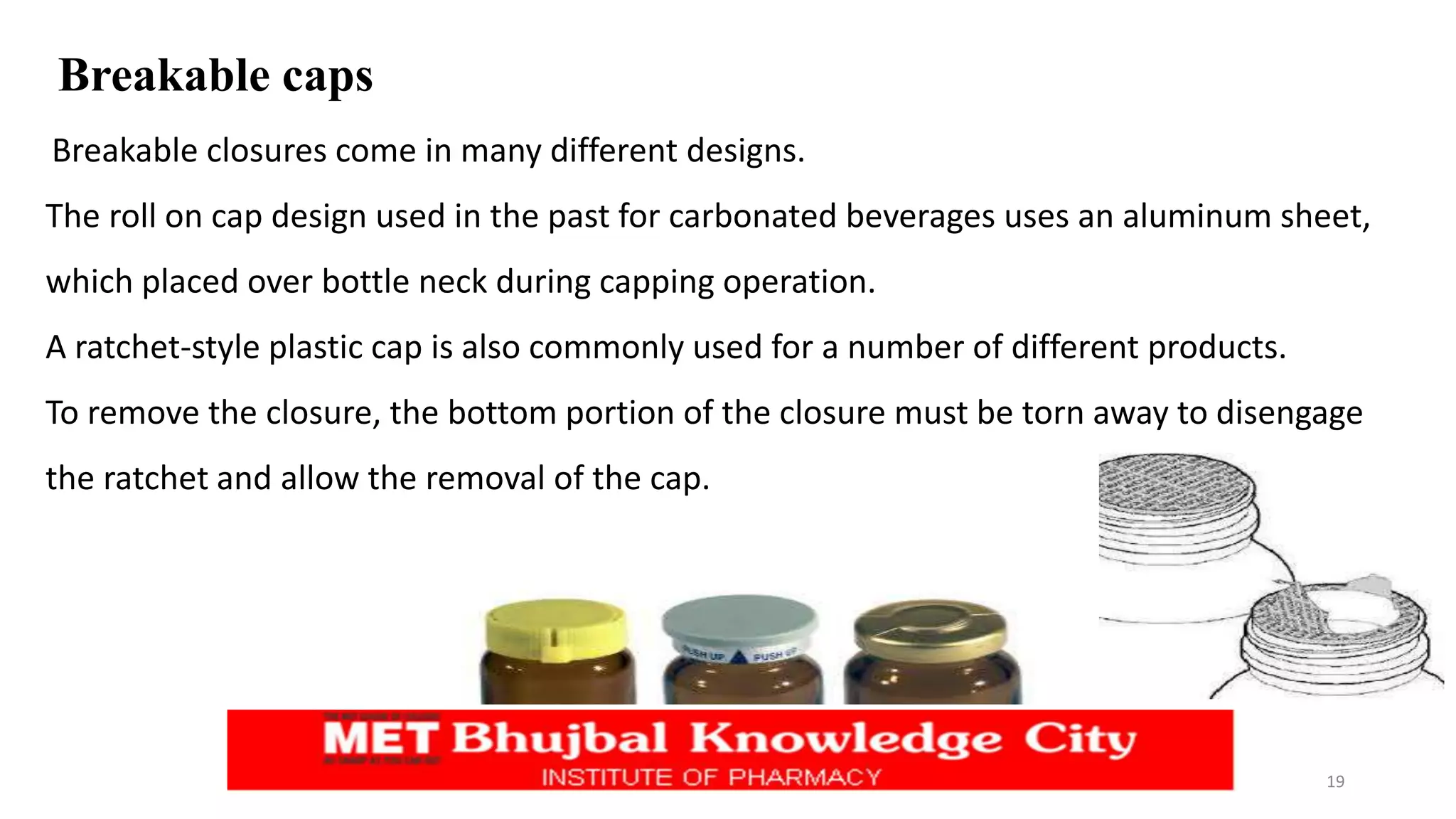
Tape seals
Tape involves the application of a glued or pressure sensitive tape or label around or over
the closure of the package, which must be destroyed to gain access to the packaged
product. The paper used most often is high density lightweight papers with poor tear
strength.
19
Breakable caps
Breakable closures come in many different designs.
The roll on cap design used in the past for carbonated beverages uses an aluminum sheet,
which placed over bottle neck during capping operation.
A ratchet-style plastic cap is also commonly used for a number of different products.
To remove the closure, the bottom portion of the closure must be torn away to disengage
the ratchet and allow the removal of the cap.
20
Sealed metal tubes or plastic blind-end heat sealed tubes
Collapsible tubes used for packaging are constructed of metal, plastic, or lamination of foil,
paper, and plastic.
Metal tubes are still used for those products that require high degree of barrier protection
afforded by metal.
Cardboard cartons
Folding paperboard cartons have been used as secondary package for OTC products for
many years.
21
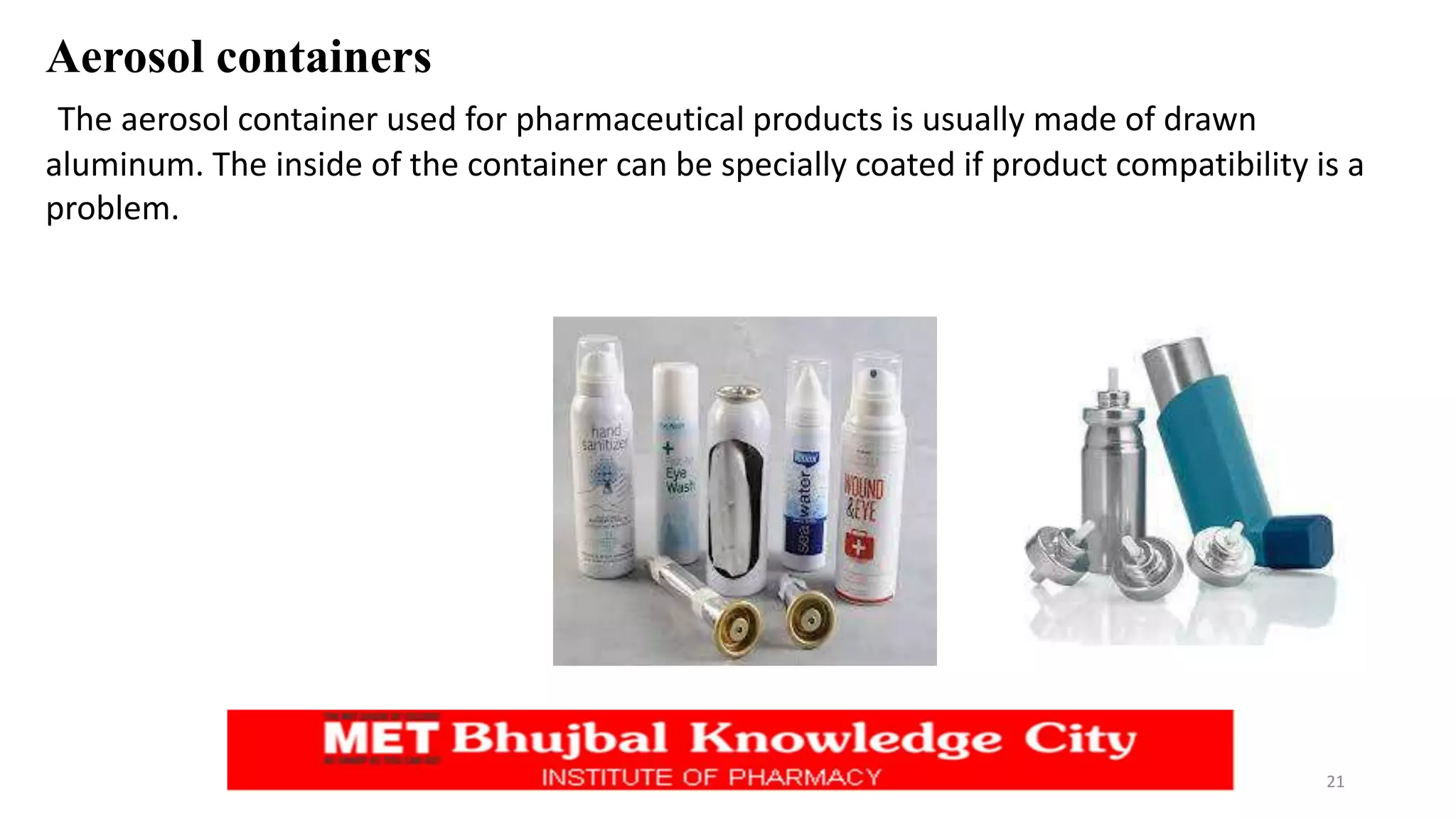
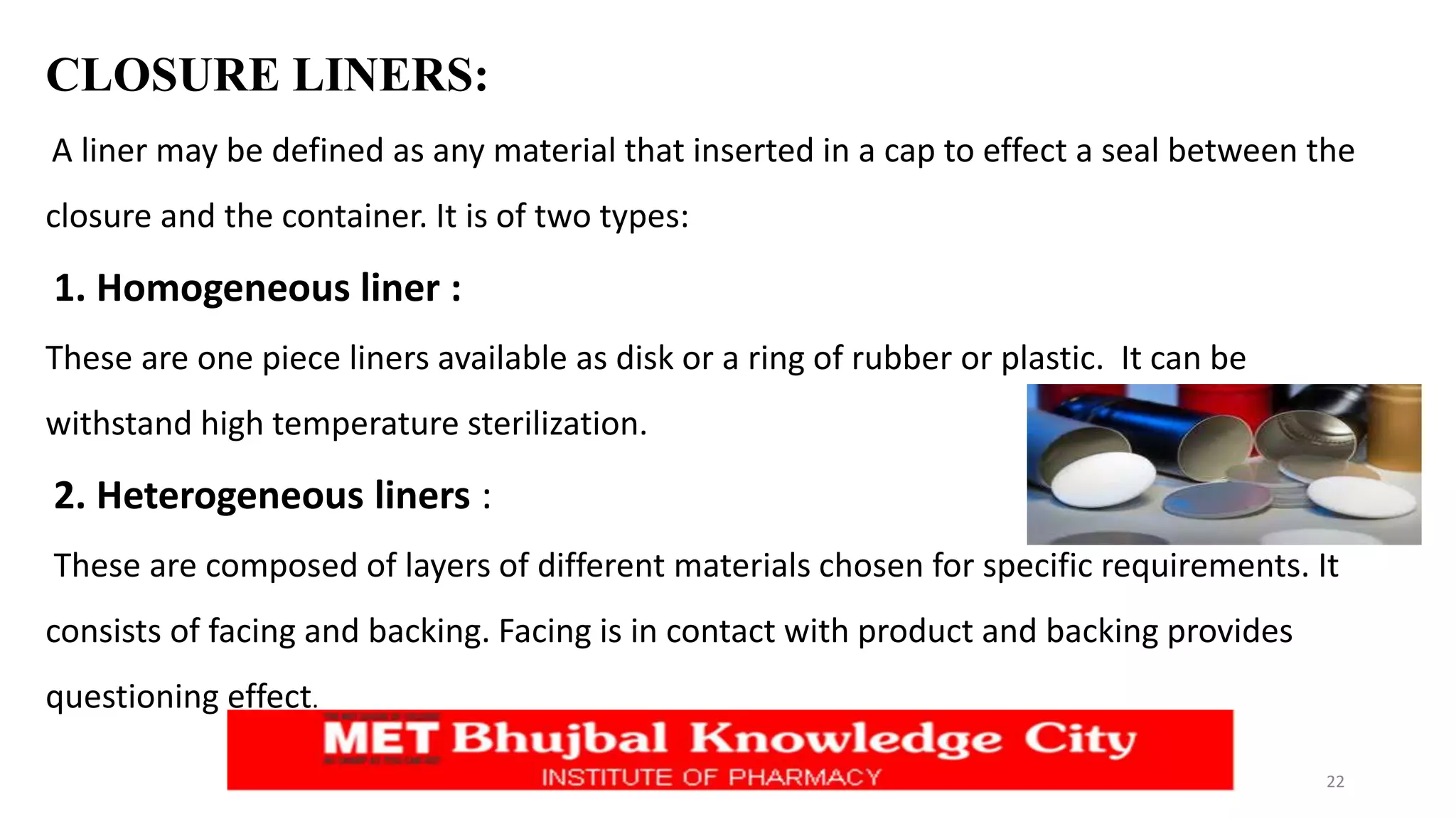
Aerosol containers
The aerosol container used for pharmaceutical products is usually made of drawn
aluminum. The inside of the container can be specially coated if product compatibility is a
problem.
22
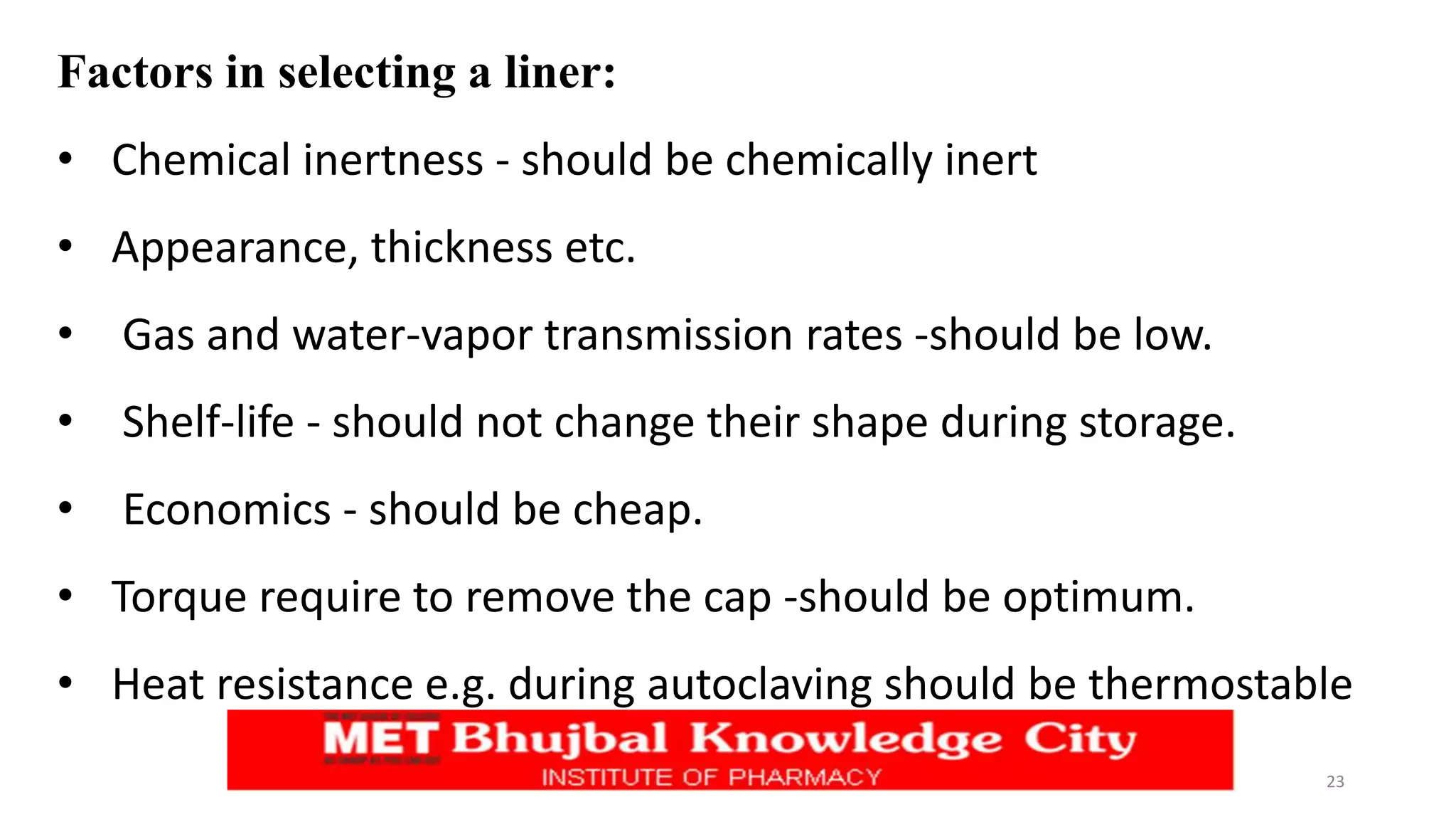
CLOSURE LINERS:
A liner may be defined as any material that inserted in a cap to effect a seal between the
closure and the container. It is of two types:
1. Homogeneous liner :
These are one piece liners available as disk or a ring of rubber or plastic. It can be
withstand high temperature sterilization.
2. Heterogeneous liners :
These are composed of layers of different materials chosen for specific requirements. It
consists of facing and backing. Facing is in contact with product and backing provides
questioning effect.
23
Factors in selecting a liner:
• Chemical inertness - should be chemically inert
• Appearance, thickness etc.
• Gas and water-vapor transmission rates -should be low.
• Shelf-life - should not change their shape during storage.
• Economics - should be cheap.
• Torque require to remove the cap -should be optimum.
• Heat resistance e.g. during autoclaving should be thermostable
Regulatory guidelines
• The agency must be firmly convinced that package for drug will preserve drug’s purity,
strength and quality.
• Under FDA, no standards are provided for containers and closure but it is responsibility of
manufacturer to prove safety of packaging material and approve it before using.
• GRAS(Generally Regarded As Safe) is published by FDA, it is list of substances which are safe
under conditions, material out of this list used for packaging must be tested by
manufacturer and data submitted to FDA.
24
• Part 133.9 “containers, closure or any packaging material to be suitable for intended use
must not be reactive ,additive or absorptive to an extent that its affect quality, purity and
efficacy of drug.
• The drug manufacturer must include the data of packaging material prior to marketing of
product. There should be no alteration in packaging material without prior FDA approval.
This data can be used as supportive document while filing application for NDA.
25
26
References:
1. Lachman., & Lieberman's. (2013). Industrial pharmacy ( IV ed.). CBS Publisher and
Distributors.1021-1032
2. Evans, E. R., & Halls, I. H. (2005). Pharmaceutical packaging technology. (D. A. Dean,
Ed.). Taylor & Francis. Chapter 11
3. Indian Pharmacopoeia, Goverment Of India Ministry Of Health And Family Welfare,
Ghaziabad.(2018). (8𝑡ℎ Ed., Vol. I). The Indian Pharmacopoeia Commission.1059-1060
4. https://en.wikipedia.org/wiki/Closure_(container)
5. https://www.pipelinepackaging.com/images/uploaded/Closure%20&%20Liner/Resourc
es%20-%20Closures%20and%20Liners.pdf

Types of closure and closure liners

  • 1.
    M. Pharm Sem-IIPresentations TITLE:TYPES OF CLOSURE AND CLOSURE LINERS SUBMITTED TO SAVITRIBAI PHULE, PUNE UNIVERSITY , PUNE FOR PARTIAL FULFILMENT OF REQUIREMENTS FOR THE AWARD OF MASTER OF PHARMACY IN THE SUBJECT Pharmaceutical Manufacturing Technology IN THE FACULTY OF SCIENCE AND TECHNOLOGY Bhujbal Knowledge City, MET’s Institute of Pharmacy, Adgaon, Nashik, 422003. Maharashtra, India Academic Year-2021-2022 1 Presented By-shaikh Saniya Zakir Guided By-Dr. Sapana Ahirrao
  • 2.
    CLOSURES: • Closures aredevices and methods for closing or sealing containers such as bottles, jugs, jars, tubes, cans, and so on. • A cap, cover, lid, plug, or other type of closure can be used. PURPOSE OF CLOSURE: • To retain or contain the contents • Assist in dispensing and use of product • Keep the product secure from undesired premature opening • Provide a barrier to dirt, oxygen, moisture • restricting ingress (odours, taints, moisture, oxygen, carbon dioxide, mould, bacteria, etc.) and egress (loss by evaporation, loss of moisture, perfume, flavourings, volatiles, etc.). 2
  • 3.
    Closures are availablein five basic designs: 1. Screw on, threaded or lug cap 2. Crimp on(crowns) 3. Press on(snap) 4. Roll on 5. Friction Many variations to this basic type exists: • Tamperproof • Child resistant • Dispenser applicator 3
  • 4.
    1. Threaded screwcap • It provides physical and chemical protection to the content being sealed • Commonly made up of plastic or metal • Metal used is tinplate or aluminum and in plastic thermoplastic or thermosetting materials are used • the threaded cap twists onto the neck and closes the appropriate object 4
  • 5.
    Lug cap • Thelug cap comes in either a flat or button top • It is simply an interrupted thread on the glass finish, instead of contiguous thread • It requires only a quarter turn unlike threaded one • It is the most commonly used closure especially in food industry 5
  • 6.
    2.Crown cap • Theseare friction fitting closure, contain compressible lining material for efficient closing • This style of cap is widely used as a crimped closures for beverage bottles, and it has remained unchanged for more than 50 years • Crown is made up of tin free steel and tinplate 6
  • 7.
    • 3.Roll onclosure • it is commonly used in packaging of bottles, and and pharmaceuticals • The roll in closures need a material which is easy to form such as aluminium or other light gauge metal • aluminium and pilfer proof types of roll on are available for use on glass or plastic bottles and jars 7
  • 8.
    8 Pilfer proof closure Thepilfer proof closure is similar to standard roll on closure except it has greater skirt length When pilfer proof closure is removed, the bridges break and bank remains in place on the neck of container Torque is necessary to remove the cap.
  • 9.
    4.Press-on Some closures snapon for opening, the top is designed to pry off, or break off, or have a built in dispenser. 9
  • 10.
    5.Friction fit • Theseclosures have a loose lid • A friction fit requires some force to close and open, providing additional security • Paints cans often have a friction foot plug 10
  • 11.
    Tamper resistant packaging •A tamper resistant package is provided with an indicator or barrier before entering the package, so that if this indicator or barrier is broken, the buyer immediately gets the evidence that the product has been opened or tampered. • The following packages are approved by FDA as tamper resistant packaging systems: 1) Film wrappers 7) Foils, paper or plastic pouches 2) Blister package 8) Bottle seals 3) Strip package 9) Tape seals 4) Bubble pack 10) Breakable caps 5) Shrink seals and bands 11) Sealed tubes 6) Aerosol containers 12) Sealed cartons. 11
  • 12.
    Film wrappers A transparentfilm with distinctive design is wrapped securely around the entire product container. The film must be cut or torn to remove the product. The wrapper must have an identifying characteristic (e.g. a pattern, name, registered trade mark, logo, or picture) that cannot be readily duplicated. Materials generally used are cellophane and polypropylene. It can be generally categorized in to following types: o Fin seal wrapper o End-folded wrapper o Shrink wrapper 12
  • 13.
    13 Blister package • Blisterpackaging, or blister packs, are pre-formed packaging materials composed of a thermoformed plastic cavity and a pliable lid. • In this type of packaging, the product is placed in deep-drawn pockets or cavities resembling a blister. A backing material or lidding mates to the flat area of the plastic cavity enclosing the product inside. Bonding the two structures is a heat-seal coating adhesive. • The most popular use of blister packs is packaging pharmaceutical products such as pills, tablets, capsules, and lozenges
  • 14.
    Strip package • Astrip package is a form of unit dose packaging of tablet or capsules. • A strip package is formed by feeding two webs of heat sealable flexible film through either a heated crimping roller or a heated reciprocating platen. • The product is dropped into the pocket formed prior to forming the final set of seals 14
  • 15.
    15 Bubble packs The bubblepack can be made in several ways but is usually formed by sandwiching the product between a thermoformable, extensible, or heat-shrinkable plastic film and a rigid backing material, this is passed through a heated tunnel, which shrinks the film into bubble or skin over the product, firmly attaching it to the backing card.
  • 16.
    16 Heat shrink bandsor wrappers • The shrink band concept makes use of the heat-shrinking characteristic of a stretch oriented polymer usually PVC. The polymer is manufactured as an extruded, oriented tube in a diameter slightly larger than the cap and neck ring of the bottle to be sealed • The band or wrapper cannot easily be worked off and reapplied without visible damage to the band. • Use of a perforated tear strip can enhance tamper evidence.
  • 17.
    17 Foil, paper, orplastic pouches • A flexible pouch is usually formed during the product filling operation by either vertical or horizontal forming, filling, sealing equipment. • The product is enclosed in an individual pouch that must be torn or broken to obtain the product. • The pouch should have a distinctive design (e.g., a pattern, name, registered trademark, logo, or picture). • The end seals of the pouches cannot be separated and resealed without showing visible evidence of entry.
  • 18.
    18 Bottle seals A bottlemay be made tamper-resistant by bonding an inner seal to the rim of the bottle in such a way that access to the product can only be attained by irreparable destroying the seal. Tape seals Tape involves the application of a glued or pressure sensitive tape or label around or over the closure of the package, which must be destroyed to gain access to the packaged product. The paper used most often is high density lightweight papers with poor tear strength.
  • 19.
    19 Breakable caps Breakable closurescome in many different designs. The roll on cap design used in the past for carbonated beverages uses an aluminum sheet, which placed over bottle neck during capping operation. A ratchet-style plastic cap is also commonly used for a number of different products. To remove the closure, the bottom portion of the closure must be torn away to disengage the ratchet and allow the removal of the cap.
  • 20.
    20 Sealed metal tubesor plastic blind-end heat sealed tubes Collapsible tubes used for packaging are constructed of metal, plastic, or lamination of foil, paper, and plastic. Metal tubes are still used for those products that require high degree of barrier protection afforded by metal. Cardboard cartons Folding paperboard cartons have been used as secondary package for OTC products for many years.
  • 21.
    21 Aerosol containers The aerosolcontainer used for pharmaceutical products is usually made of drawn aluminum. The inside of the container can be specially coated if product compatibility is a problem.
  • 22.
    22 CLOSURE LINERS: A linermay be defined as any material that inserted in a cap to effect a seal between the closure and the container. It is of two types: 1. Homogeneous liner : These are one piece liners available as disk or a ring of rubber or plastic. It can be withstand high temperature sterilization. 2. Heterogeneous liners : These are composed of layers of different materials chosen for specific requirements. It consists of facing and backing. Facing is in contact with product and backing provides questioning effect.
  • 23.
    23 Factors in selectinga liner: • Chemical inertness - should be chemically inert • Appearance, thickness etc. • Gas and water-vapor transmission rates -should be low. • Shelf-life - should not change their shape during storage. • Economics - should be cheap. • Torque require to remove the cap -should be optimum. • Heat resistance e.g. during autoclaving should be thermostable
  • 24.
    Regulatory guidelines • Theagency must be firmly convinced that package for drug will preserve drug’s purity, strength and quality. • Under FDA, no standards are provided for containers and closure but it is responsibility of manufacturer to prove safety of packaging material and approve it before using. • GRAS(Generally Regarded As Safe) is published by FDA, it is list of substances which are safe under conditions, material out of this list used for packaging must be tested by manufacturer and data submitted to FDA. 24
  • 25.
    • Part 133.9“containers, closure or any packaging material to be suitable for intended use must not be reactive ,additive or absorptive to an extent that its affect quality, purity and efficacy of drug. • The drug manufacturer must include the data of packaging material prior to marketing of product. There should be no alteration in packaging material without prior FDA approval. This data can be used as supportive document while filing application for NDA. 25
  • 26.
    26 References: 1. Lachman., &Lieberman's. (2013). Industrial pharmacy ( IV ed.). CBS Publisher and Distributors.1021-1032 2. Evans, E. R., & Halls, I. H. (2005). Pharmaceutical packaging technology. (D. A. Dean, Ed.). Taylor & Francis. Chapter 11 3. Indian Pharmacopoeia, Goverment Of India Ministry Of Health And Family Welfare, Ghaziabad.(2018). (8𝑡ℎ Ed., Vol. I). The Indian Pharmacopoeia Commission.1059-1060 4. https://en.wikipedia.org/wiki/Closure_(container) 5. https://www.pipelinepackaging.com/images/uploaded/Closure%20&%20Liner/Resourc es%20-%20Closures%20and%20Liners.pdf