TABLET TOOLING
BY NIMESH SHARMA
B.PHARM 3RD YEAR
HIMALAYAN PHARMACY INSTITUTE
What is it?
◦Tablet compression machines are made in keeping in view
the type of dies and punches will be used on them. The dies
and punches and their setup on compression machine is
called tooling.
NIMESH SHARMA 2
NIMESH SHARMA 3
NIMESH SHARMA 4
NIMESH SHARMA
5
NIMESH SHARMA
6
NIMESH SHARMA 7
8
TABLET TOOLING TYPES
There are following types of tooling available
‘B’ –Tooling
‘D’ –Tooling
‘BB’ –Tooling
‘DB’ –Tooling
NIMESH SHARMA 9
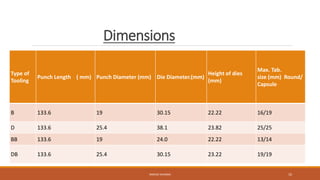
Dimensions
Type of
Tooling
Punch Length ( mm) Punch Diameter (mm) Die Diameter.(mm)
Height of dies
(mm)
Max. Tab.
size (mm) Round/
Capsule
B 133.6 19 30.15 22.22 16/19
D 133.6 25.4 38.1 23.82 25/25
BB 133.6 19 24.0 22.22 13/14
DB 133.6 25.4 30.15 23.22 19/19
NIMESH SHARMA 10
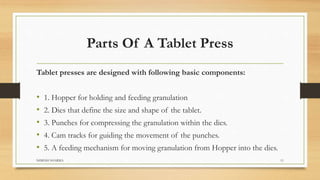
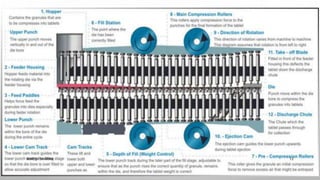
Parts Of A Tablet Press
Tablet presses are designed with following basic components:
• 1. Hopper for holding and feeding granulation
• 2. Dies that define the size and shape of the tablet.
• 3. Punches for compressing the granulation within the dies.
• 4. Cam tracks for guiding the movement of the punches.
• 5. A feeding mechanism for moving granulation from Hopper into the dies.
NIMESH SHARMA 11
NIMESH SHARMA 12
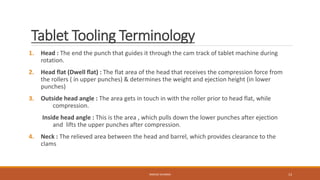
Tablet Tooling Terminology
1. Head : The end the punch that guides it through the cam track of tablet machine during
rotation.
2. Head flat (Dwell flat) : The flat area of the head that receives the compression force from
the rollers ( in upper punches) & determines the weight and ejection height (in lower
punches)
3. Outside head angle : The area gets in touch in with the roller prior to head flat, while
compression.
Inside head angle : This is the area , which pulls down the lower punches after ejection
and lifts the upper punches after compression.
4. Neck : The relieved area between the head and barrel, which provides clearance to the
clams
NIMESH SHARMA 13
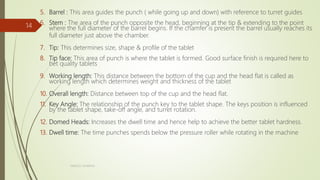
5. Barrel : This area guides the punch ( while going up and down) with reference to turret guides
6. Stem : The area of the punch opposite the head, beginning at the tip & extending to the point
where the full diameter of the barrel begins. If the chamfer is present the barrel usually reaches its
full diameter just above the chamber.
7. Tip: This determines size, shape & profile of the tablet
8. Tip face: This area of punch is where the tablet is formed. Good surface finish is required here to
bet quality tablets
9. Working length: This distance between the bottom of the cup and the head flat is called as
working length which determines weight and thickness of the tablet
10. Overall length: Distance between top of the cup and the head flat.
11. Key Angle: The relationship of the punch key to the tablet shape. The keys position is influenced
by the tablet shape, take-off angle, and turret rotation.
12. Domed Heads: Increases the dwell time and hence help to achieve the better tablet hardness.
13. Dwell time: The time punches spends below the pressure roller while rotating in the machine
NIMESH SHARMA
14
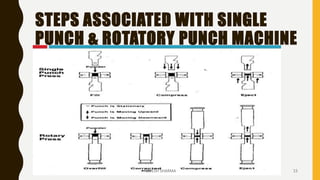
STEPS ASSOCIATED WITH SINGLE
PUNCH & ROTATORY PUNCH MACHINE
NIMESH SHARMA 15
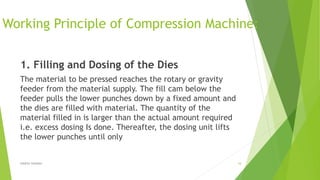
Working Principle of Compression Machine:
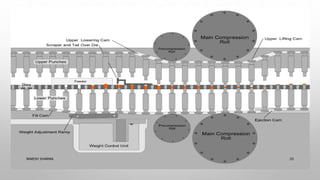
1. Filling and Dosing of the Dies
The material to be pressed reaches the rotary or gravity
feeder from the material supply. The fill cam below the
feeder pulls the lower punches down by a fixed amount and
the dies are filled with material. The quantity of the
material filled in is larger than the actual amount required
i.e. excess dosing Is done. Thereafter, the dosing unit lifts
the lower punches until only
NIMESH SHARMA 16
2. COMPRESSION OF THE TABLETS
AFTER THAT, THE UPPER CAM COURSE LOWERS THE
UPPER PUNCH UNTIL THE UPPER PUNCHES ARE
INSERTED INTO THE DIES. THE LOWER PUNCHES ARE
GUIDE TO THE PRE-COMPRESSION CAM. WHEN THE
PUNCHES PASS THE PRE-COMPRESSION CAM, THEY ARE
INSERTED A LITTLE MORE INTO THE DIES AND THE
MATERIAL IS PRE-COMPRESSED AND THE SLUGS ARE
FORMED. THEREAFTER, IN THE MAIN COMPRESSION
ROLLER, THE TABLETS REACH THEIR FINAL HEIGHT AND
HARDNESS.NIMESH SHARMA 17
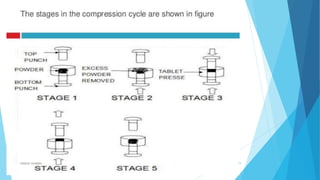
3. Ejection and Exit of the Tablets
• After the compression, the upper cam course pulls the upper
punches into their top position and simultaneously the ejection
device lifts the lower punches until the tablets are ejected from
the dies. The tablet stripping device strips the tablets off the
lower punches and passes them on to the discharge chute.
NIMESH SHARMA 18
NIMESH SHARMA 19
NIMESH SHARMA 20
NIMESH SHARMA
21

Tablet tooling

  • 1.
    TABLET TOOLING BY NIMESHSHARMA B.PHARM 3RD YEAR HIMALAYAN PHARMACY INSTITUTE
  • 2.
    What is it? ◦Tabletcompression machines are made in keeping in view the type of dies and punches will be used on them. The dies and punches and their setup on compression machine is called tooling. NIMESH SHARMA 2
  • 3.
  • 4.
  • 5.
  • 6.
  • 7.
  • 8.
  • 9.
    TABLET TOOLING TYPES Thereare following types of tooling available ‘B’ –Tooling ‘D’ –Tooling ‘BB’ –Tooling ‘DB’ –Tooling NIMESH SHARMA 9
  • 10.
    Dimensions Type of Tooling Punch Length( mm) Punch Diameter (mm) Die Diameter.(mm) Height of dies (mm) Max. Tab. size (mm) Round/ Capsule B 133.6 19 30.15 22.22 16/19 D 133.6 25.4 38.1 23.82 25/25 BB 133.6 19 24.0 22.22 13/14 DB 133.6 25.4 30.15 23.22 19/19 NIMESH SHARMA 10
  • 11.
    Parts Of ATablet Press Tablet presses are designed with following basic components: • 1. Hopper for holding and feeding granulation • 2. Dies that define the size and shape of the tablet. • 3. Punches for compressing the granulation within the dies. • 4. Cam tracks for guiding the movement of the punches. • 5. A feeding mechanism for moving granulation from Hopper into the dies. NIMESH SHARMA 11
  • 12.
  • 13.
    Tablet Tooling Terminology 1.Head : The end the punch that guides it through the cam track of tablet machine during rotation. 2. Head flat (Dwell flat) : The flat area of the head that receives the compression force from the rollers ( in upper punches) & determines the weight and ejection height (in lower punches) 3. Outside head angle : The area gets in touch in with the roller prior to head flat, while compression. Inside head angle : This is the area , which pulls down the lower punches after ejection and lifts the upper punches after compression. 4. Neck : The relieved area between the head and barrel, which provides clearance to the clams NIMESH SHARMA 13
  • 14.
    5. Barrel :This area guides the punch ( while going up and down) with reference to turret guides 6. Stem : The area of the punch opposite the head, beginning at the tip & extending to the point where the full diameter of the barrel begins. If the chamfer is present the barrel usually reaches its full diameter just above the chamber. 7. Tip: This determines size, shape & profile of the tablet 8. Tip face: This area of punch is where the tablet is formed. Good surface finish is required here to bet quality tablets 9. Working length: This distance between the bottom of the cup and the head flat is called as working length which determines weight and thickness of the tablet 10. Overall length: Distance between top of the cup and the head flat. 11. Key Angle: The relationship of the punch key to the tablet shape. The keys position is influenced by the tablet shape, take-off angle, and turret rotation. 12. Domed Heads: Increases the dwell time and hence help to achieve the better tablet hardness. 13. Dwell time: The time punches spends below the pressure roller while rotating in the machine NIMESH SHARMA 14
  • 15.
    STEPS ASSOCIATED WITHSINGLE PUNCH & ROTATORY PUNCH MACHINE NIMESH SHARMA 15
  • 16.
    Working Principle ofCompression Machine: 1. Filling and Dosing of the Dies The material to be pressed reaches the rotary or gravity feeder from the material supply. The fill cam below the feeder pulls the lower punches down by a fixed amount and the dies are filled with material. The quantity of the material filled in is larger than the actual amount required i.e. excess dosing Is done. Thereafter, the dosing unit lifts the lower punches until only NIMESH SHARMA 16
  • 17.
    2. COMPRESSION OFTHE TABLETS AFTER THAT, THE UPPER CAM COURSE LOWERS THE UPPER PUNCH UNTIL THE UPPER PUNCHES ARE INSERTED INTO THE DIES. THE LOWER PUNCHES ARE GUIDE TO THE PRE-COMPRESSION CAM. WHEN THE PUNCHES PASS THE PRE-COMPRESSION CAM, THEY ARE INSERTED A LITTLE MORE INTO THE DIES AND THE MATERIAL IS PRE-COMPRESSED AND THE SLUGS ARE FORMED. THEREAFTER, IN THE MAIN COMPRESSION ROLLER, THE TABLETS REACH THEIR FINAL HEIGHT AND HARDNESS.NIMESH SHARMA 17
  • 18.
    3. Ejection andExit of the Tablets • After the compression, the upper cam course pulls the upper punches into their top position and simultaneously the ejection device lifts the lower punches until the tablets are ejected from the dies. The tablet stripping device strips the tablets off the lower punches and passes them on to the discharge chute. NIMESH SHARMA 18
  • 19.
  • 20.
  • 21.