Homology Modeling
Limitations of Experimental Methods
Annotated proteins in the databank: ~ 100,000
Proteins with known structure: ~5,000 !
Total number including ORFs: ~ 700,000
Protein modeling
Provide a solid basis for,
 structure-based drug design
 analysis of protein function, interactions,
antigenic behavior
rational design of proteins with increased
stability or novel functions
Homology Modeling
Based on two major observations:
1) The structure of a protein is
determined by its amino acid sequence
2) Structure is much more conserved than sequence
during evolution
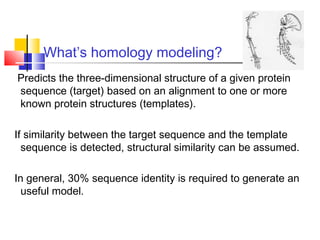
What’s homology modeling?
Predicts the three-dimensional structure of a given protein
sequence (target) based on an alignment to one or more
known protein structures (templates).
If similarity between the target sequence and the template
sequence is detected, structural similarity can be assumed.
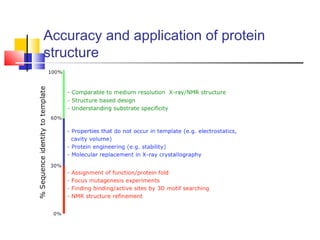
In general, 30% sequence identity is required to generate an
useful model.
Accuracy and application of protein
structure
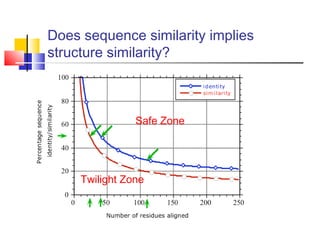
Does sequence similarity implies
structure similarity?
Safe Zone
Twilight Zone
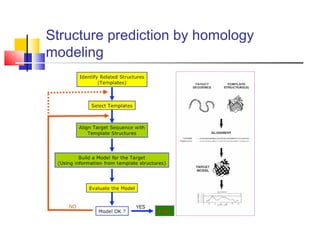
Structure prediction by homology
modeling
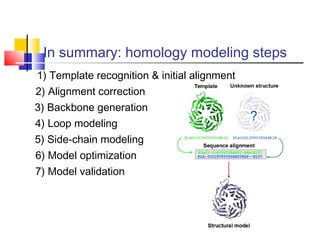
In summary: homology modeling steps
1) Template recognition & initial alignment
2) Alignment correction
3) Backbone generation
4) Loop modeling
5) Side-chain modeling
6) Model optimization
7) Model validation
Steps in Homology Modeling
Step 1: Template Recognition and Initial Alignment:-
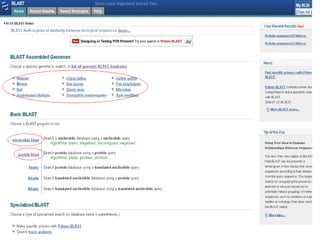
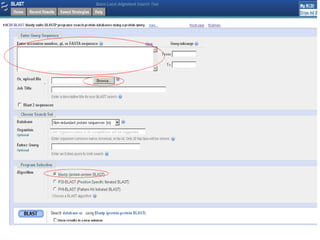
In practice, one just feeds the query
sequence to one of the countless BLAST
servers on the web, selects a search of the PDB,
and obtains a list of hits—the modeling templates
and corresponding alignments
BLAST
Basic Local Alignment Search Tool
Most widely used bioinformatics program
Emphasizes speed over sensitivity
(speed is vital to making the algorithm practical
on the huge genome databases)
Overview - METABOLISM
Sites of biotransformation
 where ever appropriate enzymes occur; plasma,
kidney, lung, gut wall and
LIVER
 the liver is ideally placed to intercept natural ingested
toxins (bypassed by injections etc) and has a major
role in biotransformation
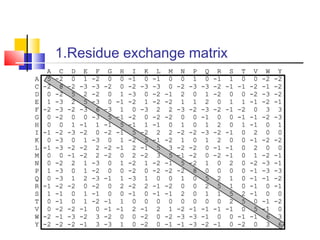
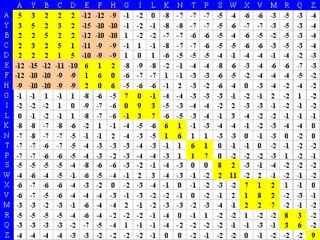
1.Residue exchange matrix
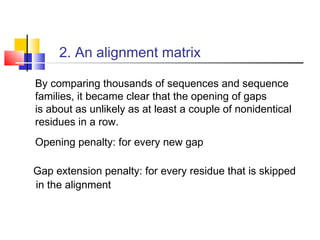
2. An alignment matrix
By comparing thousands of sequences and sequence
families, it became clear that the opening of gaps
is about as unlikely as at least a couple of nonidentical
residues in a row.
Opening penalty: for every new gap
Gap extension penalty: for every residue that is skipped
in the alignment
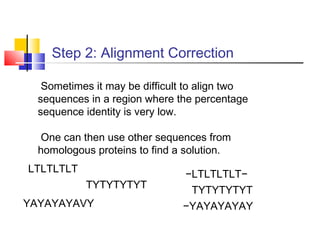
Step 2: Alignment Correction
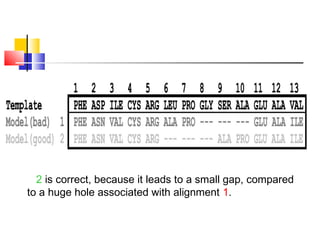
Sometimes it may be difficult to align two
sequences in a region where the percentage
sequence identity is very low.
One can then use other sequences from
homologous proteins to find a solution.
LTLTLTLT
YAYAYAYAVY
TYTYTYTYT
TYTYTYTYT
−LTLTLTLT−
−YAYAYAYAY
2 is correct, because it leads to a small gap, compared
to a huge hole associated with alignment 1.
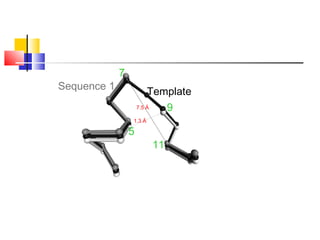
Template
Sequence 1
7
11
5
97.5 Å
1.3 Å
Step 3: Backbone Generation:-
One simply copies the coordinates of those template
residues that show up in the alignment with the
model sequence.
If two aligned residues differ, only the backbone
coordinates (N,Cα,C and O) can be copied.
If they are the same, one can also include the side
chain.
Step 4: Loop Modeling:-
There are two main approaches to loop modeling:-
1). Knowledge based: one searches the PDB for
known loops with endpoints that match the residues
between which the loop has to be inserted and simply
copies the loop conformation.
2). Energy based: as in true ab initio fold prediction,
an energy function is used to judge the quality of a
loop
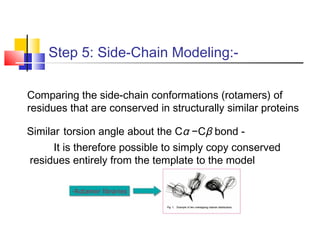
Step 5: Side-Chain Modeling:-
Comparing the side-chain conformations (rotamers) of
residues that are conserved in structurally similar proteins
Similar torsion angle about the Cα −Cβ bond -
It is therefore possible to simply copy conserved
residues entirely from the template to the model
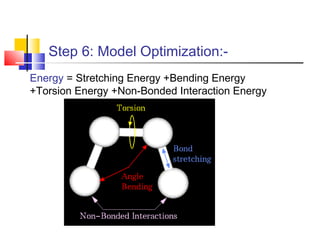
Step 6: Model Optimization:-
Energy = Stretching Energy +Bending Energy
+Torsion Energy +Non-Bonded Interaction Energy
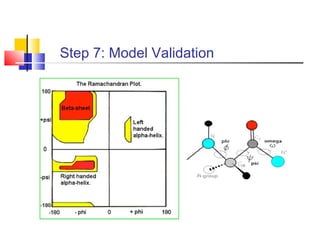
Step 7: Model Validation
Model should be evaluated for:
- correctness of the overall fold/structure
- errors over localized regions
- stereochemical parameters: bond lengths, angles, etc
Step 7: Model Validation
QUESTIONS?????
B.Satish Kumar M.Tech (bio-tech)
JNTU
Thank You

Homology modeling

  • 1.
  • 2.
    Limitations of ExperimentalMethods Annotated proteins in the databank: ~ 100,000 Proteins with known structure: ~5,000 ! Total number including ORFs: ~ 700,000
  • 3.
    Protein modeling Provide asolid basis for,  structure-based drug design  analysis of protein function, interactions, antigenic behavior rational design of proteins with increased stability or novel functions
  • 4.
    Homology Modeling Based ontwo major observations: 1) The structure of a protein is determined by its amino acid sequence 2) Structure is much more conserved than sequence during evolution
  • 5.
    What’s homology modeling? Predictsthe three-dimensional structure of a given protein sequence (target) based on an alignment to one or more known protein structures (templates). If similarity between the target sequence and the template sequence is detected, structural similarity can be assumed. In general, 30% sequence identity is required to generate an useful model.
  • 6.
    Accuracy and applicationof protein structure
  • 7.
    Does sequence similarityimplies structure similarity? Safe Zone Twilight Zone
  • 8.
    Structure prediction byhomology modeling
  • 9.
    In summary: homologymodeling steps 1) Template recognition & initial alignment 2) Alignment correction 3) Backbone generation 4) Loop modeling 5) Side-chain modeling 6) Model optimization 7) Model validation
  • 10.
    Steps in HomologyModeling Step 1: Template Recognition and Initial Alignment:- In practice, one just feeds the query sequence to one of the countless BLAST servers on the web, selects a search of the PDB, and obtains a list of hits—the modeling templates and corresponding alignments
  • 11.
    BLAST Basic Local AlignmentSearch Tool Most widely used bioinformatics program Emphasizes speed over sensitivity (speed is vital to making the algorithm practical on the huge genome databases)
  • 12.
  • 13.
    Sites of biotransformation where ever appropriate enzymes occur; plasma, kidney, lung, gut wall and LIVER  the liver is ideally placed to intercept natural ingested toxins (bypassed by injections etc) and has a major role in biotransformation
  • 14.
  • 16.
    2. An alignmentmatrix By comparing thousands of sequences and sequence families, it became clear that the opening of gaps is about as unlikely as at least a couple of nonidentical residues in a row. Opening penalty: for every new gap Gap extension penalty: for every residue that is skipped in the alignment
  • 17.
    Step 2: AlignmentCorrection Sometimes it may be difficult to align two sequences in a region where the percentage sequence identity is very low. One can then use other sequences from homologous proteins to find a solution. LTLTLTLT YAYAYAYAVY TYTYTYTYT TYTYTYTYT −LTLTLTLT− −YAYAYAYAY
  • 18.
    2 is correct,because it leads to a small gap, compared to a huge hole associated with alignment 1.
  • 19.
  • 20.
    Step 3: BackboneGeneration:- One simply copies the coordinates of those template residues that show up in the alignment with the model sequence. If two aligned residues differ, only the backbone coordinates (N,Cα,C and O) can be copied. If they are the same, one can also include the side chain.
  • 21.
    Step 4: LoopModeling:- There are two main approaches to loop modeling:- 1). Knowledge based: one searches the PDB for known loops with endpoints that match the residues between which the loop has to be inserted and simply copies the loop conformation. 2). Energy based: as in true ab initio fold prediction, an energy function is used to judge the quality of a loop
  • 22.
    Step 5: Side-ChainModeling:- Comparing the side-chain conformations (rotamers) of residues that are conserved in structurally similar proteins Similar torsion angle about the Cα −Cβ bond - It is therefore possible to simply copy conserved residues entirely from the template to the model
  • 23.
    Step 6: ModelOptimization:- Energy = Stretching Energy +Bending Energy +Torsion Energy +Non-Bonded Interaction Energy
  • 24.
    Step 7: ModelValidation Model should be evaluated for: - correctness of the overall fold/structure - errors over localized regions - stereochemical parameters: bond lengths, angles, etc
  • 25.
    Step 7: ModelValidation
  • 26.
  • 27.
    B.Satish Kumar M.Tech(bio-tech) JNTU Thank You

Editor's Notes