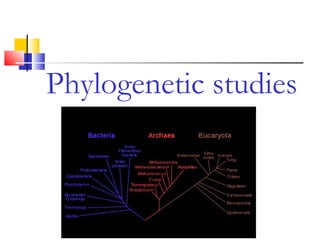
Phylogenetic studies
Problems in Phylogenetics
Fossil records are sporadic and less reliable
Only available data is genetic data
How evolution operates is used in the tree construction
Phylogenetics
Study of evolutionary relatedness among various groups of
organisms
Basis:
Molecular sequencing
Morphological data
*** Molecular data, protein and DNA sequences is the
basis for present methods
Major assumptions
 Sequences are homologous
 Phylogenetic divergence is bifurcating
 Each position in sequence evolved independently
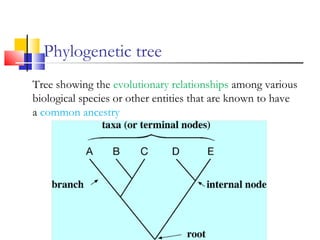
Phylogenetic tree
Tree showing the evolutionary relationships among various
biological species or other entities that are known to have
a common ancestry
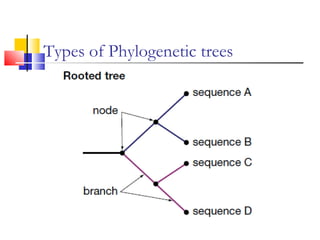
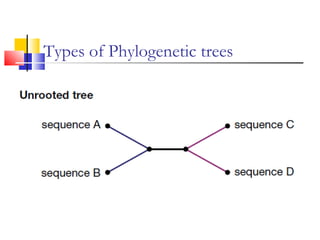
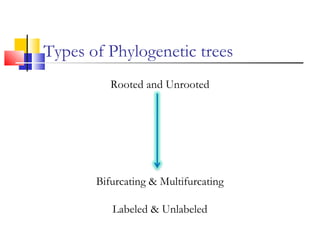
Types of Phylogenetic trees
Rooted and Unrooted
Bifurcating & Multifurcating
Labeled & Unlabeled
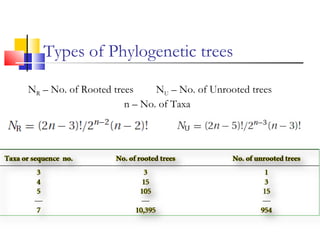
Types of Phylogenetic trees
NR – No. of Rooted trees NU – No. of Unrooted trees
n – No. of Taxa
Dendrogram
Cladogram
Phylogram
Chronogram or Ultrametric tree
Different representations
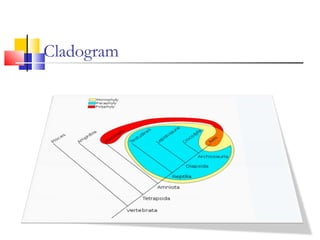
Cladogram
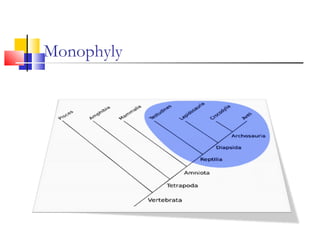
Monophyly
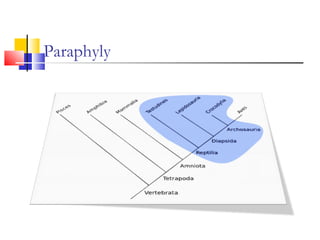
Paraphyly
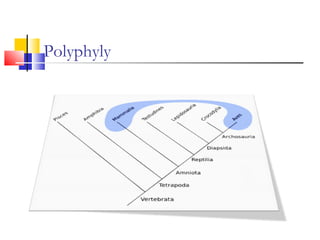
Polyphyly
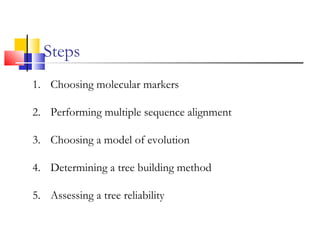
1. Choosing molecular markers
2. Performing multiple sequence alignment
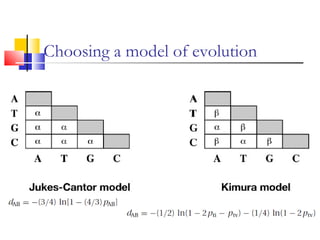
3. Choosing a model of evolution
4. Determining a tree building method
5. Assessing a tree reliability
Steps
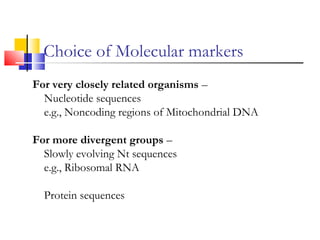
For very closely related organisms –
Nucleotide sequences
e.g., Noncoding regions of Mitochondrial DNA
For more divergent groups –
Slowly evolving Nt sequences
e.g., Ribosomal RNA
Protein sequences
Choice of Molecular markers
Choosing a model of evolution
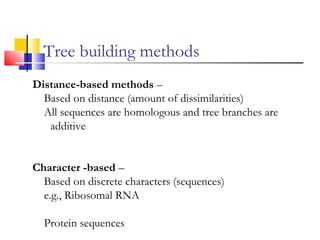
Distance-based methods –
Based on distance (amount of dissimilarities)
All sequences are homologous and tree branches are
additive
Character -based –
Based on discrete characters (sequences)
e.g., Ribosomal RNA
Protein sequences
Tree building methods
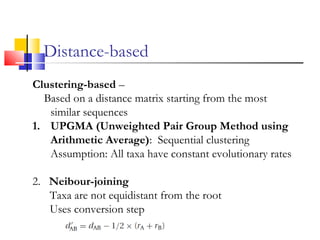
Clustering-based –
Based on a distance matrix starting from the most
similar sequences
1. UPGMA (Unweighted Pair Group Method using
Arithmetic Average): Sequential clustering
Assumption: All taxa have constant evolutionary rates
2. Neibour-joining
Taxa are not equidistant from the root
Uses conversion step
Distance-based
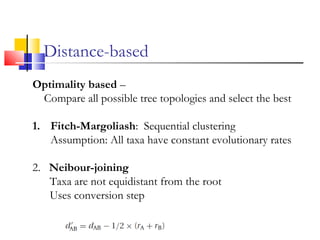
Optimality based –
Compare all possible tree topologies and select the best
1. Fitch-Margoliash: Sequential clustering
Assumption: All taxa have constant evolutionary rates
2. Neibour-joining
Taxa are not equidistant from the root
Uses conversion step
Distance-based
Distance methods:-
e.g. Neighbor joining, UPGMA clustering
Character-based:-
e.g. Maximum parsimony, Maximum likelihood
Methods
Efficiency
Power
Consistency
Falsifiability
Criteria for the selection

Phylogenetic studies