Equipments for Pellets
Submitted to Dr. Shweta Sharma
By: Ishpreet Singh
Amit Anand
Atul Garg
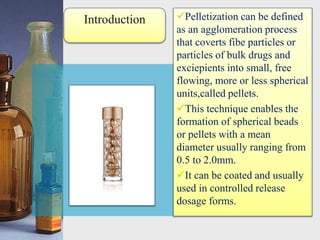
Pelletization can be defined
as an agglomeration process
that coverts fibe particles or
particles of bulk drugs and
exciepients into small, free
flowing, more or less spherical
units,called pellets.
This technique enables the
formation of spherical beads
or pellets with a mean
diameter usually ranging from
0.5 to 2.0mm.
It can be coated and usually
used in controlled release
dosage forms.
Introduction
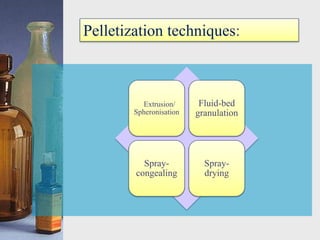
Extrusion/
Spheronisation
Fluid-bed
granulation
Spray-
congealing
Spray-
drying
Pelletization techniques:
Extrusion-Spheronization:-
Extrusion is necessary first step in the extrusion-
spheronization process.
The size of the sphere are determined by the
diameter of the extrudate used.
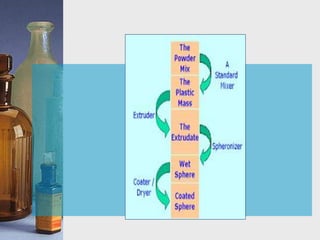
The extrusion-spheronization process can be broken
down into following steps:-
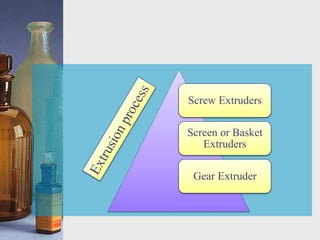
Screw Extruders
Screen or Basket
Extruders
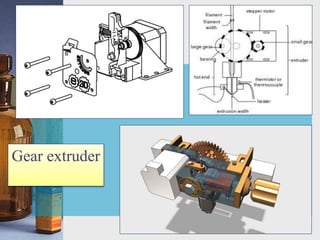
Gear Extruder
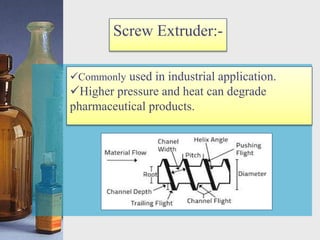
Commonly used in industrial application.
Higher pressure and heat can degrade
pharmaceutical products.
Screw Extruder:-
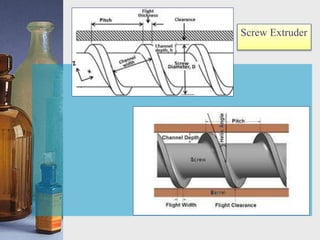
Screw Extruder
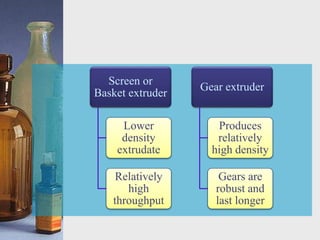
Screen or
Basket extruder
Lower
density
extrudate
Relatively
high
throughput
Gear extruder
Produces
relatively
high density
Gears are
robust and
last longer
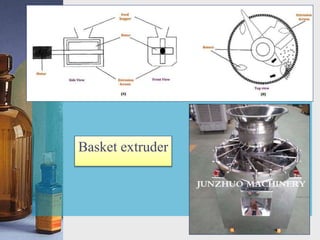
Basket extruder
Gear extruder
Spheronization
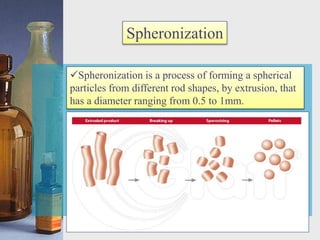
Spheronization is a process of forming a spherical
particles from different rod shapes, by extrusion, that
has a diameter ranging from 0.5 to 1mm.
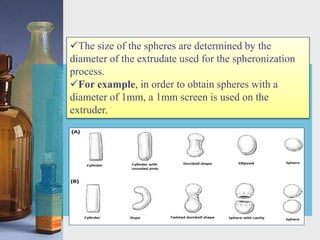
The size of the spheres are determined by the
diameter of the extrudate used for the spheronization
process.
For example, in order to obtain spheres with a
diameter of 1mm, a 1mm screen is used on the
extruder.
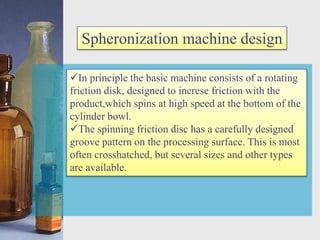
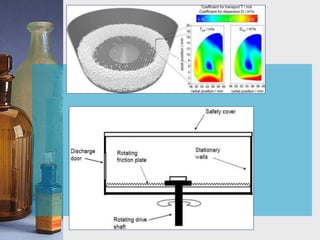
Spheronization machine design
In principle the basic machine consists of a rotating
friction disk, designed to increse friction with the
product,which spins at high speed at the bottom of the
cylinder bowl.
The spinning friction disc has a carefully designed
groove pattern on the processing surface. This is most
often crosshatched, but several sizes and other types
are available.
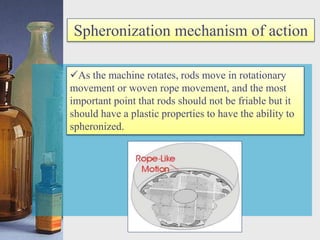
Spheronization mechanism of action
As the machine rotates, rods move in rotationary
movement or woven rope movement, and the most
important point that rods should not be friable but it
should have a plastic properties to have the ability to
spheronized.
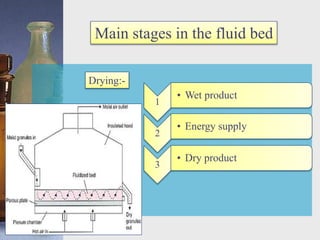
Main stages in the fluid bed
Drying:-
1
• Wet product
2
• Energy supply
3
• Dry product
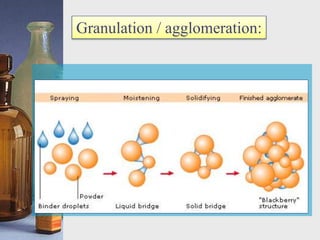
Granulation / agglomeration:
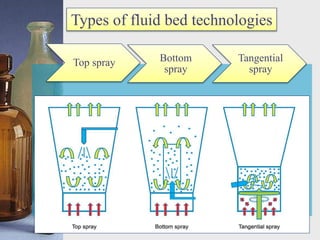
Types of fluid bed technologies
Top spray Bottom
spray
Tangential
spray
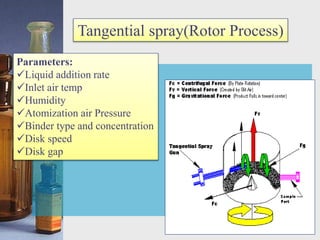
Tangential spray(Rotor Process)
Parameters:
Liquid addition rate
Inlet air temp
Humidity
Atomization air Pressure
Binder type and concentration
Disk speed
Disk gap
Rotogranulation
Rotogranulation is one of the most recent methods for the
production of spheroids.the singl unit spheronizing system can
be described using terms like centrifugal granulator, rotatory
fluidized-bed granulator, rotary fluid bed, rotary processor or
Rotor granulator:
The preblending of the formulation powder, including the
active ingredients, filters, disintegrants,in a flow of air.
The granulation of the mixture by spraying a suitable liquid
binder onto the fluidized powder bed.
The drying of the granulated product to the desired moisture
content.
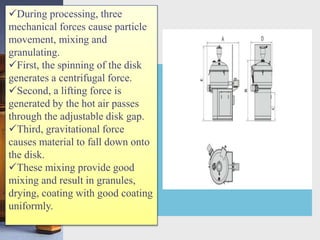
During processing, three
mechanical forces cause particle
movement, mixing and
granulating.
First, the spinning of the disk
generates a centrifugal force.
Second, a lifting force is
generated by the hot air passes
through the adjustable disk gap.
Third, gravitational force
causes material to fall down onto
the disk.
These mixing provide good
mixing and result in granules,
drying, coating with good coating
uniformly.
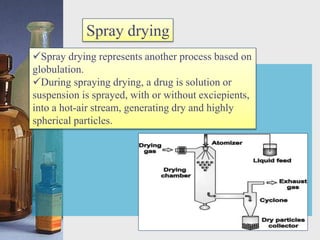
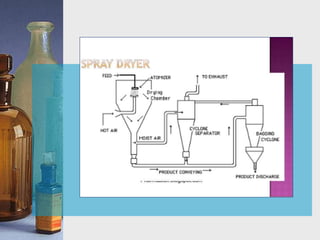
Spray drying
Spray drying represents another process based on
globulation.
During spraying drying, a drug is solution or
suspension is sprayed, with or without exciepients,
into a hot-air stream, generating dry and highly
spherical particles.
Spray congealing
In spray congealing the drug is allowed to melt,
disperse or dissolve in hot melts of gums, waxes, fatty
acids or other melting solids.
The dispersion is them sprayed into a stream of air
and other gases with a temperature below the melting
point of the formulation components, under
appropriate processing conditions, spherical congealed
pellets are obtained.
Spray congealing is similar to sparay drying it is
also called spray chilling.
Equipments for Pellets

Equipments for Pellets

  • 1.
    Equipments for Pellets Submittedto Dr. Shweta Sharma By: Ishpreet Singh Amit Anand Atul Garg
  • 2.
    Pelletization can bedefined as an agglomeration process that coverts fibe particles or particles of bulk drugs and exciepients into small, free flowing, more or less spherical units,called pellets. This technique enables the formation of spherical beads or pellets with a mean diameter usually ranging from 0.5 to 2.0mm. It can be coated and usually used in controlled release dosage forms. Introduction
  • 3.
  • 4.
    Extrusion-Spheronization:- Extrusion is necessaryfirst step in the extrusion- spheronization process. The size of the sphere are determined by the diameter of the extrudate used. The extrusion-spheronization process can be broken down into following steps:-
  • 6.
    Screw Extruders Screen orBasket Extruders Gear Extruder
  • 7.
    Commonly used inindustrial application. Higher pressure and heat can degrade pharmaceutical products. Screw Extruder:-
  • 8.
  • 9.
    Screen or Basket extruder Lower density extrudate Relatively high throughput Gearextruder Produces relatively high density Gears are robust and last longer
  • 10.
  • 11.
  • 12.
    Spheronization Spheronization is aprocess of forming a spherical particles from different rod shapes, by extrusion, that has a diameter ranging from 0.5 to 1mm.
  • 13.
    The size ofthe spheres are determined by the diameter of the extrudate used for the spheronization process. For example, in order to obtain spheres with a diameter of 1mm, a 1mm screen is used on the extruder.
  • 14.
    Spheronization machine design Inprinciple the basic machine consists of a rotating friction disk, designed to increse friction with the product,which spins at high speed at the bottom of the cylinder bowl. The spinning friction disc has a carefully designed groove pattern on the processing surface. This is most often crosshatched, but several sizes and other types are available.
  • 16.
    Spheronization mechanism ofaction As the machine rotates, rods move in rotationary movement or woven rope movement, and the most important point that rods should not be friable but it should have a plastic properties to have the ability to spheronized.
  • 17.
    Main stages inthe fluid bed Drying:- 1 • Wet product 2 • Energy supply 3 • Dry product
  • 18.
  • 19.
    Types of fluidbed technologies Top spray Bottom spray Tangential spray
  • 20.
    Tangential spray(Rotor Process) Parameters: Liquidaddition rate Inlet air temp Humidity Atomization air Pressure Binder type and concentration Disk speed Disk gap
  • 21.
    Rotogranulation Rotogranulation is oneof the most recent methods for the production of spheroids.the singl unit spheronizing system can be described using terms like centrifugal granulator, rotatory fluidized-bed granulator, rotary fluid bed, rotary processor or Rotor granulator: The preblending of the formulation powder, including the active ingredients, filters, disintegrants,in a flow of air. The granulation of the mixture by spraying a suitable liquid binder onto the fluidized powder bed. The drying of the granulated product to the desired moisture content.
  • 22.
    During processing, three mechanicalforces cause particle movement, mixing and granulating. First, the spinning of the disk generates a centrifugal force. Second, a lifting force is generated by the hot air passes through the adjustable disk gap. Third, gravitational force causes material to fall down onto the disk. These mixing provide good mixing and result in granules, drying, coating with good coating uniformly.
  • 23.
    Spray drying Spray dryingrepresents another process based on globulation. During spraying drying, a drug is solution or suspension is sprayed, with or without exciepients, into a hot-air stream, generating dry and highly spherical particles.
  • 24.
    Spray congealing In spraycongealing the drug is allowed to melt, disperse or dissolve in hot melts of gums, waxes, fatty acids or other melting solids. The dispersion is them sprayed into a stream of air and other gases with a temperature below the melting point of the formulation components, under appropriate processing conditions, spherical congealed pellets are obtained. Spray congealing is similar to sparay drying it is also called spray chilling.