Protein
Identification
&
Characterization
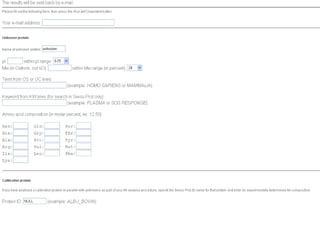
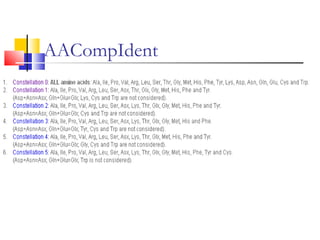
AACompIdent
AACompIdent
AACompIdent
AACompIdent
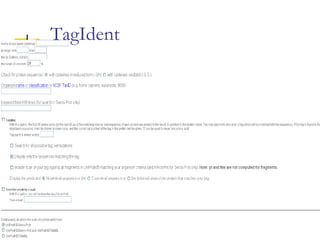
TagIdent
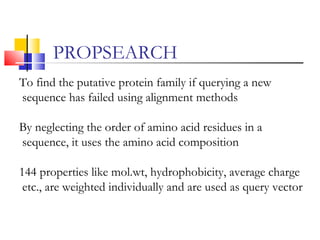
To find the putative protein family if querying a new
sequence has failed using alignment methods
By neglecting the order of amino acid residues in a
sequence, it uses the amino acid composition
144 properties like mol.wt, hydrophobicity, average charge
etc., are weighted individually and are used as query vector
PROPSEARCH
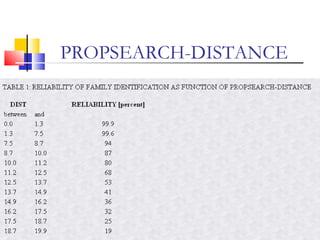
PROPSEARCH-DISTANCE
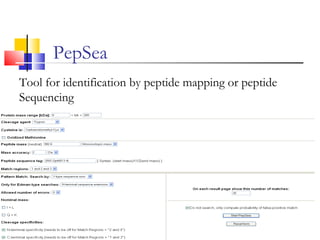
Tool for identification by peptide mapping or peptide
Sequencing
PepSea
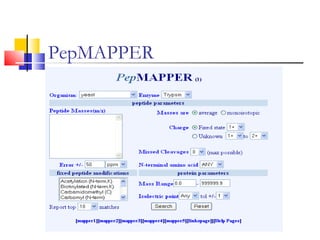
PepMAPPER: Takes peptide mass as the input
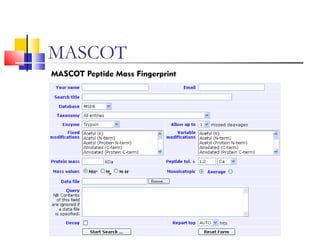
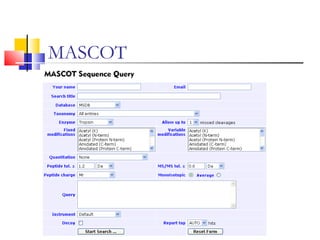
Mascot: Can take the following as input,
1) Peptide mass fingerprint
2) Sequence query
3) MS/MS ion search
Peptide mass fingerprinting tools
PepMAPPER
MASCOT
MASCOT
To identify peptides that from unspecific cleavage of
proteins from their experimental masses
Takes chemical modifications, post-translational
modifications(PTM) and protease autolytic cleavage in
account
Findpept
TMAP
TMHMM
TMPRED
TopPred2
PHDhtm
DAS
Transmembrane helices prediction
Compute pI/Mw: Calculates pI and mol.wt
ProtParam:
• Computation of physical and chemical parameters
for a protein sequence
• Computed parameters include, Mol.Wt, Theoretical pI,
amino acid composition, atomic composition, estimated
half-life etc.,
Primary structure analysis and
prediction
PHDacc: Simple hydrophobicity analysis
ProtScale:
• Computation of physical and chemical parameters
for a protein sequence
• Computed parameters include, Mol.Wt, Theoretical pI,
amino acid composition, atomic composition, estimated
half-life etc.,
Hydrophobicity prediction
Identifies possible PEST regions
PEST
Chou-Fasman method
GOR (Garnier, Osguthorpe and Robson) Method
Nearest Neighbour Mthod
Hidden Markov Models
Neural networks
SOPMA (self-Optimized Prediction method based on
MSA)
Secondary structure prediction
Relative frequencies of each Amino acid in different
secondary structures
Less accurate than GOR method
Amino acid propensities is the basis
Chou-Fasman method
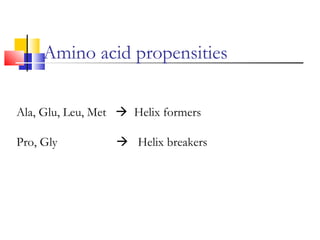
Ala, Glu, Leu, Met  Helix formers
Pro, Gly  Helix breakers
Amino acid propensities
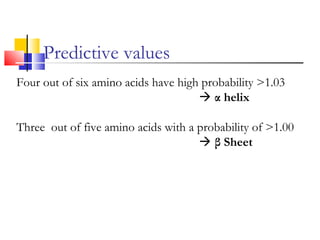
Four out of six amino acids have high probability >1.03
 α helix
Three out of five amino acids with a probability of >1.00
 β Sheet
Predictive values
Amino acid propensities & conditional probabilities
are the basis
GOR Method

Protein identication characterization

  • 1.
  • 2.
  • 3.
  • 4.
  • 5.
  • 6.
    To find theputative protein family if querying a new sequence has failed using alignment methods By neglecting the order of amino acid residues in a sequence, it uses the amino acid composition 144 properties like mol.wt, hydrophobicity, average charge etc., are weighted individually and are used as query vector PROPSEARCH
  • 7.
  • 8.
    Tool for identificationby peptide mapping or peptide Sequencing PepSea
  • 9.
    PepMAPPER: Takes peptidemass as the input Mascot: Can take the following as input, 1) Peptide mass fingerprint 2) Sequence query 3) MS/MS ion search Peptide mass fingerprinting tools
  • 10.
  • 11.
  • 12.
  • 13.
    To identify peptidesthat from unspecific cleavage of proteins from their experimental masses Takes chemical modifications, post-translational modifications(PTM) and protease autolytic cleavage in account Findpept
  • 14.
  • 15.
    Compute pI/Mw: CalculatespI and mol.wt ProtParam: • Computation of physical and chemical parameters for a protein sequence • Computed parameters include, Mol.Wt, Theoretical pI, amino acid composition, atomic composition, estimated half-life etc., Primary structure analysis and prediction
  • 16.
    PHDacc: Simple hydrophobicityanalysis ProtScale: • Computation of physical and chemical parameters for a protein sequence • Computed parameters include, Mol.Wt, Theoretical pI, amino acid composition, atomic composition, estimated half-life etc., Hydrophobicity prediction
  • 17.
  • 18.
    Chou-Fasman method GOR (Garnier,Osguthorpe and Robson) Method Nearest Neighbour Mthod Hidden Markov Models Neural networks SOPMA (self-Optimized Prediction method based on MSA) Secondary structure prediction
  • 19.
    Relative frequencies ofeach Amino acid in different secondary structures Less accurate than GOR method Amino acid propensities is the basis Chou-Fasman method
  • 20.
    Ala, Glu, Leu,Met  Helix formers Pro, Gly  Helix breakers Amino acid propensities
  • 21.
    Four out ofsix amino acids have high probability >1.03  α helix Three out of five amino acids with a probability of >1.00  β Sheet Predictive values
  • 22.
    Amino acid propensities& conditional probabilities are the basis GOR Method