PELLETIZATION TECHNOLOGY
-Kabin Maleku
(Researcher)
Summary
• Introduction
• Advantages and Limitations
• Pelletization Techniques
• Wruster technology
• Extrusion and spheronization
• Characterization
INTRODUCTION
• Pelletization:
• Pelletization can be defined as an agglomeration
(size- enlargement process that converts fine
powders or particles of bulk drugs and excipients
into small, free-flowing, more or less spherical units,
called pellets
• “Pelletization” involves the manufacture of
agglomerates with a narrow size range, usually with
mean size from 0.5 to 1.5 mm, named “pellets”
• Pellets have free-flowing properties
Advantages and Disadvantages
Advantages
• Uniformity of dose
• Excellent flow properties
• Prevention of dust formation
• Low surface area to volume ratio
• To deliver incompatible bioactive
agents
• Improvement of hardness and
friability
• Disperse freely throughout the GIT
• Limits localized build up of drug
• Reduce inter and intra patient
variability
• Less susceptible to dose dumping
Disadvantages
• Expensive process and /
or requires highly
specialized equipment
• Complicated with too
many process variables
as well as formulation
variables
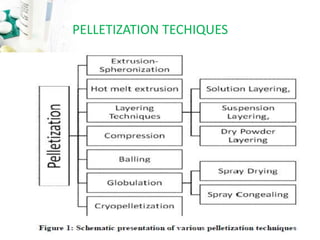
PELLETIZATION TECHIQUES
LAYERING TECHNIQUES
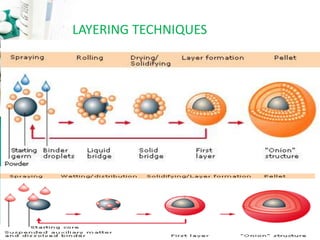
• Layering processes are the most well controlled and
straight forward
• Pelletization techniques. The layering process
comprises the deposition of successive layers of
drug entities from solution, suspension or dry
powder on nuclei which may be crystals or granules
of the same material or inert starter seeds.
They are classified into two categories:
• Solution/suspension layering and
• Powder layering
• Solution/suspension layering:
LAYERING TECHNIQUES
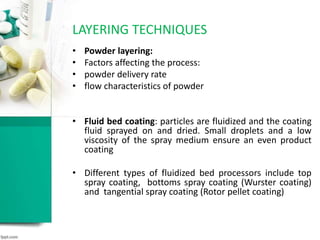
• Powder layering:
• Factors affecting the process:
• powder delivery rate
• flow characteristics of powder
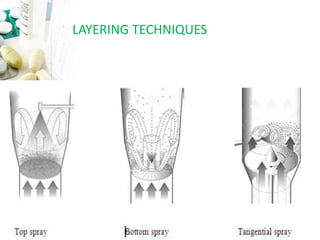
• Fluid bed coating: particles are fluidized and the coating
fluid sprayed on and dried. Small droplets and a low
viscosity of the spray medium ensure an even product
coating
• Different types of fluidized bed processors include top
spray coating, bottoms spray coating (Wurster coating)
and tangential spray coating (Rotor pellet coating)
LAYERING TECHNIQUES
LAYERING TECHNIQUES
WRUSTER PROCESS
VARIABLES
PROCESS VARIABLES
1. Fluidization Air Flow
2. Fluidization Air Humidity
3. Fluidization Air Temperature
4. Spray Rate
5. Column Height
6. Nozzle and Peristaltic pump
7. AtomiZation Air
8. Particle size
PRODUCT VARIABLES
1. Core particle
2. Particle surface
3. Particle size
4. Solution Viscosity and Solution/Solid
Concentration
EQUIPMENT VARIABLES
• BASEPLATE TYPE
• NOZZLE SIZE
• FILTERBAG TYPE
• MODEL OF THE EQUIPMENT
Extrusion–spheronization
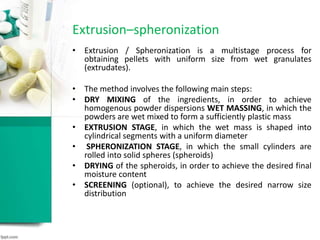
• Extrusion / Spheronization is a multistage process for
obtaining pellets with uniform size from wet granulates
(extrudates).
• The method involves the following main steps:
• DRY MIXING of the ingredients, in order to achieve
homogenous powder dispersions WET MASSING, in which the
powders are wet mixed to form a sufficiently plastic mass
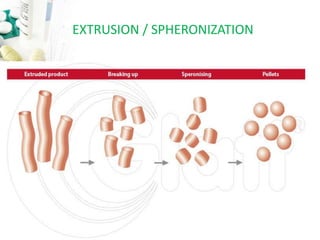
• EXTRUSION STAGE, in which the wet mass is shaped into
cylindrical segments with a uniform diameter
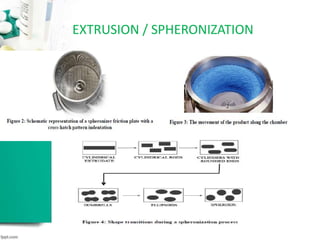
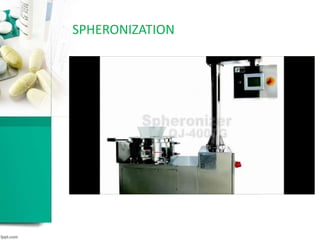
• SPHERONIZATION STAGE, in which the small cylinders are
rolled into solid spheres (spheroids)
• DRYING of the spheroids, in order to achieve the desired final
moisture content
• SCREENING (optional), to achieve the desired narrow size
distribution
EXTRUSION / SPHERONIZATION
SPHERONIZATION
Parameters Affecting Quality Of Pellets
In Extrusion- Spheronization Process
1. Equipment parameters
2. Process parameters
Equipment parameters
1. Mixer
2. Extruder
3. Friction plate
4. Extrusion screen
Process parameters
1. Extrusion speed
2. Extrusion temperature
3. Spheronizer load
4. Spheronization time
5. Spheronization speed
6. Drying method
CHARACTERIZATION OF PELLETS
1. Pellets size distribution
2. Pellets shape
3. Surface morphology (SEM)
4. Specific surface area
5. Friability
6. Disintegration Time
7. Dissolution
8. Density
9. Porosity
10.Tensile strength
REFRENCES
1. Isaac Ghebre-Sellassie, Multiparticulate oral drug delivery, informa
healthcare New York: Marcel Dekker (1994)
2. Mircea Hirjau, Anca Cecilia Nicoara,Victoria Hirjau, D. Lupuleasa,
Pelletization Techniques used in Pharmaceutical fields Practica Farmaceutică
– Vol. 4, Nr. 3-4, An 2011, 206-211
3. Harrison, P.J; Newton, J.M.; Rowe, R.C. The application of capillary rheometry
to the extrusion of wet powder masses Int. J. Pharm., 987, 35, 235-42
4. Devices GSI. Pharmaceutical Pelletization Technology. Vol. 37. Marcel
Dekker Inc.; 1989, pp. 30-100
5. Breitenbach J, Melt extrusion: from process to drug delivery technology,
European Journal of Pharmaceutics and Biopharmaceutics, 54, 2002,
107-117
6. Sagar Muley , Tanaji Nandgude, Sushilkumar Podda, Extrusion–
spheronization a promising pelletization technique: In-depth review, asian
journal of pharmaceutical sciences 11 (2016) 684–699
7. J.M.NewtonaS.R.ChapmanaR.C.Roweb, The influence of process variables on
the preparation and properties of spherical granules by the process of
extrusion and spheronisation, International Journal of Pharmaceutics,
Volume 120, Issue 1, 16 June 1995, Pages 101-109
THANK YOU
Pharmashastra

Pellet technology

  • 1.
  • 2.
    Summary • Introduction • Advantagesand Limitations • Pelletization Techniques • Wruster technology • Extrusion and spheronization • Characterization
  • 3.
    INTRODUCTION • Pelletization: • Pelletizationcan be defined as an agglomeration (size- enlargement process that converts fine powders or particles of bulk drugs and excipients into small, free-flowing, more or less spherical units, called pellets • “Pelletization” involves the manufacture of agglomerates with a narrow size range, usually with mean size from 0.5 to 1.5 mm, named “pellets” • Pellets have free-flowing properties
  • 4.
    Advantages and Disadvantages Advantages •Uniformity of dose • Excellent flow properties • Prevention of dust formation • Low surface area to volume ratio • To deliver incompatible bioactive agents • Improvement of hardness and friability • Disperse freely throughout the GIT • Limits localized build up of drug • Reduce inter and intra patient variability • Less susceptible to dose dumping Disadvantages • Expensive process and / or requires highly specialized equipment • Complicated with too many process variables as well as formulation variables
  • 5.
  • 6.
    LAYERING TECHNIQUES • Layeringprocesses are the most well controlled and straight forward • Pelletization techniques. The layering process comprises the deposition of successive layers of drug entities from solution, suspension or dry powder on nuclei which may be crystals or granules of the same material or inert starter seeds. They are classified into two categories: • Solution/suspension layering and • Powder layering • Solution/suspension layering:
  • 7.
    LAYERING TECHNIQUES • Powderlayering: • Factors affecting the process: • powder delivery rate • flow characteristics of powder • Fluid bed coating: particles are fluidized and the coating fluid sprayed on and dried. Small droplets and a low viscosity of the spray medium ensure an even product coating • Different types of fluidized bed processors include top spray coating, bottoms spray coating (Wurster coating) and tangential spray coating (Rotor pellet coating)
  • 8.
  • 9.
  • 10.
  • 11.
  • 12.
    PROCESS VARIABLES 1. FluidizationAir Flow 2. Fluidization Air Humidity 3. Fluidization Air Temperature 4. Spray Rate 5. Column Height 6. Nozzle and Peristaltic pump 7. AtomiZation Air 8. Particle size
  • 13.
    PRODUCT VARIABLES 1. Coreparticle 2. Particle surface 3. Particle size 4. Solution Viscosity and Solution/Solid Concentration
  • 14.
    EQUIPMENT VARIABLES • BASEPLATETYPE • NOZZLE SIZE • FILTERBAG TYPE • MODEL OF THE EQUIPMENT
  • 15.
    Extrusion–spheronization • Extrusion /Spheronization is a multistage process for obtaining pellets with uniform size from wet granulates (extrudates). • The method involves the following main steps: • DRY MIXING of the ingredients, in order to achieve homogenous powder dispersions WET MASSING, in which the powders are wet mixed to form a sufficiently plastic mass • EXTRUSION STAGE, in which the wet mass is shaped into cylindrical segments with a uniform diameter • SPHERONIZATION STAGE, in which the small cylinders are rolled into solid spheres (spheroids) • DRYING of the spheroids, in order to achieve the desired final moisture content • SCREENING (optional), to achieve the desired narrow size distribution
  • 16.
  • 17.
  • 18.
  • 19.
  • 20.
    Parameters Affecting QualityOf Pellets In Extrusion- Spheronization Process 1. Equipment parameters 2. Process parameters
  • 21.
    Equipment parameters 1. Mixer 2.Extruder 3. Friction plate 4. Extrusion screen
  • 22.
    Process parameters 1. Extrusionspeed 2. Extrusion temperature 3. Spheronizer load 4. Spheronization time 5. Spheronization speed 6. Drying method
  • 23.
    CHARACTERIZATION OF PELLETS 1.Pellets size distribution 2. Pellets shape 3. Surface morphology (SEM) 4. Specific surface area 5. Friability 6. Disintegration Time 7. Dissolution 8. Density 9. Porosity 10.Tensile strength
  • 24.
    REFRENCES 1. Isaac Ghebre-Sellassie,Multiparticulate oral drug delivery, informa healthcare New York: Marcel Dekker (1994) 2. Mircea Hirjau, Anca Cecilia Nicoara,Victoria Hirjau, D. Lupuleasa, Pelletization Techniques used in Pharmaceutical fields Practica Farmaceutică – Vol. 4, Nr. 3-4, An 2011, 206-211 3. Harrison, P.J; Newton, J.M.; Rowe, R.C. The application of capillary rheometry to the extrusion of wet powder masses Int. J. Pharm., 987, 35, 235-42 4. Devices GSI. Pharmaceutical Pelletization Technology. Vol. 37. Marcel Dekker Inc.; 1989, pp. 30-100 5. Breitenbach J, Melt extrusion: from process to drug delivery technology, European Journal of Pharmaceutics and Biopharmaceutics, 54, 2002, 107-117 6. Sagar Muley , Tanaji Nandgude, Sushilkumar Podda, Extrusion– spheronization a promising pelletization technique: In-depth review, asian journal of pharmaceutical sciences 11 (2016) 684–699 7. J.M.NewtonaS.R.ChapmanaR.C.Roweb, The influence of process variables on the preparation and properties of spherical granules by the process of extrusion and spheronisation, International Journal of Pharmaceutics, Volume 120, Issue 1, 16 June 1995, Pages 101-109
  • 25.