Tablet processing
problems and their
remedies
Baharul Islam
Dept. of Pharmacy, SUB
pharmbahar@gmail.com
Introduction
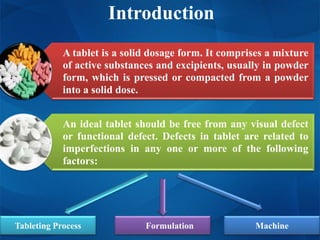
A tablet is a solid dosage form. It comprises a mixture
of active substances and excipients, usually in powder
form, which is pressed or compacted from a powder
into a solid dose.
An ideal tablet should be free from any visual defect
or functional defect. Defects in tablet are related to
imperfections in any one or more of the following
factors:
MachineFormulationTableting Process
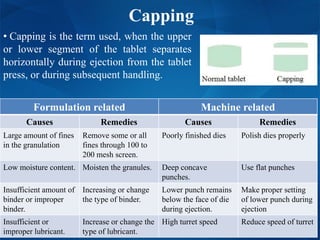
Tablet defects
Tablet
defects
Capping
Lamination
Cracking
Chipping
StickingPicking
Binding
Double
Impression
Mottling
Capping
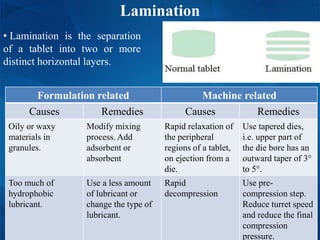
• Capping is the term used, when the upper
or lower segment of the tablet separates
horizontally during ejection from the tablet
press, or during subsequent handling.
Formulation related Machine related
Causes Remedies Causes Remedies
Large amount of fines
in the granulation
Remove some or all
fines through 100 to
200 mesh screen.
Poorly finished dies Polish dies properly
Low moisture content. Moisten the granules. Deep concave
punches.
Use flat punches
Insufficient amount of
binder or improper
binder.
Increasing or change
the type of binder.
Lower punch remains
below the face of die
during ejection.
Make proper setting
of lower punch during
ejection
Insufficient or
improper lubricant.
Increase or change the
type of lubricant.
High turret speed Reduce speed of turret
• Lamination is the separation
of a tablet into two or more
distinct horizontal layers.
Lamination
Formulation related Machine related
Causes Remedies Causes Remedies
Oily or waxy
materials in
granules.
Modify mixing
process. Add
adsorbent or
absorbent
Rapid relaxation of
the peripheral
regions of a tablet,
on ejection from a
die.
Use tapered dies,
i.e. upper part of
the die bore has an
outward taper of 3°
to 5°.
Too much of
hydrophobic
lubricant.
Use a less amount
of lubricant or
change the type of
lubricant.
Rapid
decompression
Use pre-
compression step.
Reduce turret speed
and reduce the final
compression
pressure.
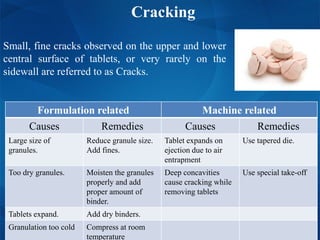
Cracking
Small, fine cracks observed on the upper and lower
central surface of tablets, or very rarely on the
sidewall are referred to as Cracks.
Formulation related Machine related
Causes Remedies Causes Remedies
Large size of
granules.
Reduce granule size.
Add fines.
Tablet expands on
ejection due to air
entrapment
Use tapered die.
Too dry granules. Moisten the granules
properly and add
proper amount of
binder.
Deep concavities
cause cracking while
removing tablets
Use special take-off
Tablets expand. Add dry binders.
Granulation too cold Compress at room
temperature
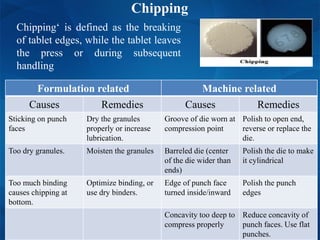
Chipping
Chipping‘ is defined as the breaking
of tablet edges, while the tablet leaves
the press or during subsequent
handling
Formulation related Machine related
Causes Remedies Causes Remedies
Sticking on punch
faces
Dry the granules
properly or increase
lubrication.
Groove of die worn at
compression point
Polish to open end,
reverse or replace the
die.
Too dry granules. Moisten the granules Barreled die (center
of the die wider than
ends)
Polish the die to make
it cylindrical
Too much binding
causes chipping at
bottom.
Optimize binding, or
use dry binders.
Edge of punch face
turned inside/inward
Polish the punch
edges
Concavity too deep to
compress properly
Reduce concavity of
punch faces. Use flat
punches.
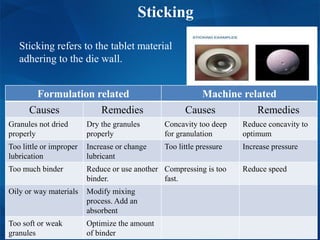
Sticking
Sticking refers to the tablet material
adhering to the die wall.
Formulation related Machine related
Causes Remedies Causes Remedies
Granules not dried
properly
Dry the granules
properly
Concavity too deep
for granulation
Reduce concavity to
optimum
Too little or improper
lubrication
Increase or change
lubricant
Too little pressure Increase pressure
Too much binder Reduce or use another
binder.
Compressing is too
fast.
Reduce speed
Oily or way materials Modify mixing
process. Add an
absorbent
Too soft or weak
granules
Optimize the amount
of binder
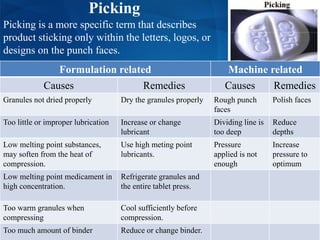
Picking is a more specific term that describes
product sticking only within the letters, logos, or
designs on the punch faces.
Picking
Formulation related Machine related
Causes Remedies Causes Remedies
Granules not dried properly Dry the granules properly Rough punch
faces
Polish faces
Too little or improper lubrication Increase or change
lubricant
Dividing line is
too deep
Reduce
depths
Low melting point substances,
may soften from the heat of
compression.
Use high meting point
lubricants.
Pressure
applied is not
enough
Increase
pressure to
optimum
Low melting point medicament in
high concentration.
Refrigerate granules and
the entire tablet press.
Too warm granules when
compressing
Cool sufficiently before
compression.
Too much amount of binder Reduce or change binder.
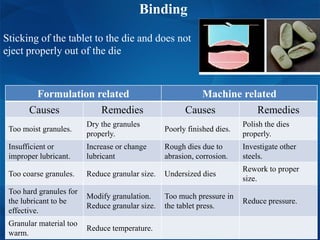
Binding
Sticking of the tablet to the die and does not
eject properly out of the die
Formulation related Machine related
Causes Remedies Causes Remedies
Too moist granules.
Dry the granules
properly.
Poorly finished dies.
Polish the dies
properly.
Insufficient or
improper lubricant.
Increase or change
lubricant
Rough dies due to
abrasion, corrosion.
Investigate other
steels.
Too coarse granules. Reduce granular size. Undersized dies
Rework to proper
size.
Too hard granules for
the lubricant to be
effective.
Modify granulation.
Reduce granular size.
Too much pressure in
the tablet press.
Reduce pressure.
Granular material too
warm.
Reduce temperature.
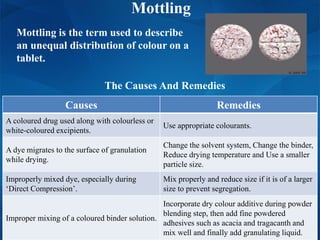
Mottling is the term used to describe
an unequal distribution of colour on a
tablet.
Mottling
The Causes And Remedies
Causes Remedies
A coloured drug used along with colourless or
white-coloured excipients.
Use appropriate colourants.
A dye migrates to the surface of granulation
while drying.
Change the solvent system, Change the binder,
Reduce drying temperature and Use a smaller
particle size.
Improperly mixed dye, especially during
‘Direct Compression’.
Mix properly and reduce size if it is of a larger
size to prevent segregation.
Improper mixing of a coloured binder solution.
Incorporate dry colour additive during powder
blending step, then add fine powdered
adhesives such as acacia and tragacanth and
mix well and finally add granulating liquid.
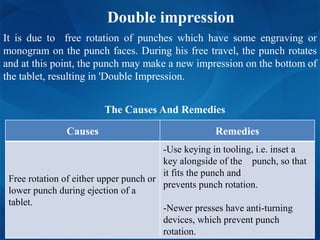
Double impression
It is due to free rotation of punches which have some engraving or
monogram on the punch faces. During his free travel, the punch rotates
and at this point, the punch may make a new impression on the bottom of
the tablet, resulting in 'Double Impression.
Causes Remedies
Free rotation of either upper punch or
lower punch during ejection of a
tablet.
-Use keying in tooling, i.e. inset a
key alongside of the punch, so that
it fits the punch and
prevents punch rotation.
-Newer presses have anti-turning
devices, which prevent punch
rotation.
The Causes And Remedies
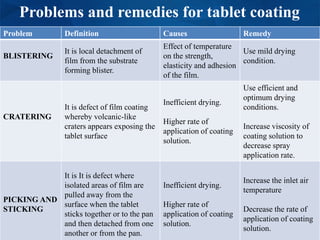
Problems and remedies for tablet coating
Problem Definition Causes Remedy
BLISTERING
It is local detachment of
film from the substrate
forming blister.
Effect of temperature
on the strength,
elasticity and adhesion
of the film.
Use mild drying
condition.
CRATERING
It is defect of film coating
whereby volcanic-like
craters appears exposing the
tablet surface
Inefficient drying.
Higher rate of
application of coating
solution.
Use efficient and
optimum drying
conditions.
Increase viscosity of
coating solution to
decrease spray
application rate.
PICKING AND
STICKING
It is It is defect where
isolated areas of film are
pulled away from the
surface when the tablet
sticks together or to the pan
and then detached from one
another or from the pan.
Inefficient drying.
Higher rate of
application of coating
solution.
Increase the inlet air
temperature
Decrease the rate of
application of coating
solution.
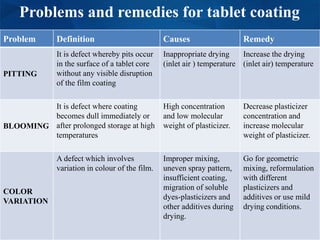
Problems and remedies for tablet coating
Problem Definition Causes Remedy
PITTING
It is defect whereby pits occur
in the surface of a tablet core
without any visible disruption
of the film coating
Inappropriate drying
(inlet air ) temperature
Increase the drying
(inlet air) temperature
BLOOMING
It is defect where coating
becomes dull immediately or
after prolonged storage at high
temperatures
High concentration
and low molecular
weight of plasticizer.
Decrease plasticizer
concentration and
increase molecular
weight of plasticizer.
COLOR
VARIATION
A defect which involves
variation in colour of the film.
Improper mixing,
uneven spray pattern,
insufficient coating,
migration of soluble
dyes-plasticizers and
other additives during
drying.
Go for geometric
mixing, reformulation
with different
plasticizers and
additives or use mild
drying conditions.
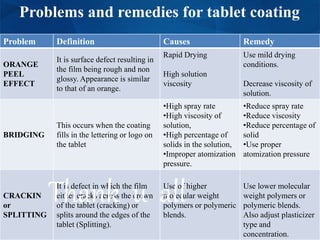
Problems and remedies for tablet coating
Problem Definition Causes Remedy
ORANGE
PEEL
EFFECT
It is surface defect resulting in
the film being rough and non
glossy. Appearance is similar
to that of an orange.
Rapid Drying
High solution
viscosity
Use mild drying
conditions.
Decrease viscosity of
solution.
BRIDGING
This occurs when the coating
fills in the lettering or logo on
the tablet
•High spray rate
•High viscosity of
solution,
•High percentage of
solids in the solution,
•Improper atomization
pressure.
•Reduce spray rate
•Reduce viscosity
•Reduce percentage of
solid
•Use proper
atomization pressure
CRACKIN
or
SPLITTING
It is defect in which the film
either cracks across the crown
of the tablet (cracking) or
splits around the edges of the
tablet (Splitting).
Use of higher
molecular weight
polymers or polymeric
blends.
Use lower molecular
weight polymers or
polymeric blends.
Also adjust plasticizer
type and
concentration.
Thank u all
Tablet processing problems and their remedies

Tablet processing problems and their remedies

  • 1.
    Tablet processing problems andtheir remedies Baharul Islam Dept. of Pharmacy, SUB pharmbahar@gmail.com
  • 2.
    Introduction A tablet isa solid dosage form. It comprises a mixture of active substances and excipients, usually in powder form, which is pressed or compacted from a powder into a solid dose. An ideal tablet should be free from any visual defect or functional defect. Defects in tablet are related to imperfections in any one or more of the following factors: MachineFormulationTableting Process
  • 3.
  • 4.
    Capping • Capping isthe term used, when the upper or lower segment of the tablet separates horizontally during ejection from the tablet press, or during subsequent handling. Formulation related Machine related Causes Remedies Causes Remedies Large amount of fines in the granulation Remove some or all fines through 100 to 200 mesh screen. Poorly finished dies Polish dies properly Low moisture content. Moisten the granules. Deep concave punches. Use flat punches Insufficient amount of binder or improper binder. Increasing or change the type of binder. Lower punch remains below the face of die during ejection. Make proper setting of lower punch during ejection Insufficient or improper lubricant. Increase or change the type of lubricant. High turret speed Reduce speed of turret
  • 5.
    • Lamination isthe separation of a tablet into two or more distinct horizontal layers. Lamination Formulation related Machine related Causes Remedies Causes Remedies Oily or waxy materials in granules. Modify mixing process. Add adsorbent or absorbent Rapid relaxation of the peripheral regions of a tablet, on ejection from a die. Use tapered dies, i.e. upper part of the die bore has an outward taper of 3° to 5°. Too much of hydrophobic lubricant. Use a less amount of lubricant or change the type of lubricant. Rapid decompression Use pre- compression step. Reduce turret speed and reduce the final compression pressure.
  • 6.
    Cracking Small, fine cracksobserved on the upper and lower central surface of tablets, or very rarely on the sidewall are referred to as Cracks. Formulation related Machine related Causes Remedies Causes Remedies Large size of granules. Reduce granule size. Add fines. Tablet expands on ejection due to air entrapment Use tapered die. Too dry granules. Moisten the granules properly and add proper amount of binder. Deep concavities cause cracking while removing tablets Use special take-off Tablets expand. Add dry binders. Granulation too cold Compress at room temperature
  • 7.
    Chipping Chipping‘ is definedas the breaking of tablet edges, while the tablet leaves the press or during subsequent handling Formulation related Machine related Causes Remedies Causes Remedies Sticking on punch faces Dry the granules properly or increase lubrication. Groove of die worn at compression point Polish to open end, reverse or replace the die. Too dry granules. Moisten the granules Barreled die (center of the die wider than ends) Polish the die to make it cylindrical Too much binding causes chipping at bottom. Optimize binding, or use dry binders. Edge of punch face turned inside/inward Polish the punch edges Concavity too deep to compress properly Reduce concavity of punch faces. Use flat punches.
  • 8.
    Sticking Sticking refers tothe tablet material adhering to the die wall. Formulation related Machine related Causes Remedies Causes Remedies Granules not dried properly Dry the granules properly Concavity too deep for granulation Reduce concavity to optimum Too little or improper lubrication Increase or change lubricant Too little pressure Increase pressure Too much binder Reduce or use another binder. Compressing is too fast. Reduce speed Oily or way materials Modify mixing process. Add an absorbent Too soft or weak granules Optimize the amount of binder
  • 9.
    Picking is amore specific term that describes product sticking only within the letters, logos, or designs on the punch faces. Picking Formulation related Machine related Causes Remedies Causes Remedies Granules not dried properly Dry the granules properly Rough punch faces Polish faces Too little or improper lubrication Increase or change lubricant Dividing line is too deep Reduce depths Low melting point substances, may soften from the heat of compression. Use high meting point lubricants. Pressure applied is not enough Increase pressure to optimum Low melting point medicament in high concentration. Refrigerate granules and the entire tablet press. Too warm granules when compressing Cool sufficiently before compression. Too much amount of binder Reduce or change binder.
  • 10.
    Binding Sticking of thetablet to the die and does not eject properly out of the die Formulation related Machine related Causes Remedies Causes Remedies Too moist granules. Dry the granules properly. Poorly finished dies. Polish the dies properly. Insufficient or improper lubricant. Increase or change lubricant Rough dies due to abrasion, corrosion. Investigate other steels. Too coarse granules. Reduce granular size. Undersized dies Rework to proper size. Too hard granules for the lubricant to be effective. Modify granulation. Reduce granular size. Too much pressure in the tablet press. Reduce pressure. Granular material too warm. Reduce temperature.
  • 11.
    Mottling is theterm used to describe an unequal distribution of colour on a tablet. Mottling The Causes And Remedies Causes Remedies A coloured drug used along with colourless or white-coloured excipients. Use appropriate colourants. A dye migrates to the surface of granulation while drying. Change the solvent system, Change the binder, Reduce drying temperature and Use a smaller particle size. Improperly mixed dye, especially during ‘Direct Compression’. Mix properly and reduce size if it is of a larger size to prevent segregation. Improper mixing of a coloured binder solution. Incorporate dry colour additive during powder blending step, then add fine powdered adhesives such as acacia and tragacanth and mix well and finally add granulating liquid.
  • 12.
    Double impression It isdue to free rotation of punches which have some engraving or monogram on the punch faces. During his free travel, the punch rotates and at this point, the punch may make a new impression on the bottom of the tablet, resulting in 'Double Impression. Causes Remedies Free rotation of either upper punch or lower punch during ejection of a tablet. -Use keying in tooling, i.e. inset a key alongside of the punch, so that it fits the punch and prevents punch rotation. -Newer presses have anti-turning devices, which prevent punch rotation. The Causes And Remedies
  • 13.
    Problems and remediesfor tablet coating Problem Definition Causes Remedy BLISTERING It is local detachment of film from the substrate forming blister. Effect of temperature on the strength, elasticity and adhesion of the film. Use mild drying condition. CRATERING It is defect of film coating whereby volcanic-like craters appears exposing the tablet surface Inefficient drying. Higher rate of application of coating solution. Use efficient and optimum drying conditions. Increase viscosity of coating solution to decrease spray application rate. PICKING AND STICKING It is It is defect where isolated areas of film are pulled away from the surface when the tablet sticks together or to the pan and then detached from one another or from the pan. Inefficient drying. Higher rate of application of coating solution. Increase the inlet air temperature Decrease the rate of application of coating solution.
  • 14.
    Problems and remediesfor tablet coating Problem Definition Causes Remedy PITTING It is defect whereby pits occur in the surface of a tablet core without any visible disruption of the film coating Inappropriate drying (inlet air ) temperature Increase the drying (inlet air) temperature BLOOMING It is defect where coating becomes dull immediately or after prolonged storage at high temperatures High concentration and low molecular weight of plasticizer. Decrease plasticizer concentration and increase molecular weight of plasticizer. COLOR VARIATION A defect which involves variation in colour of the film. Improper mixing, uneven spray pattern, insufficient coating, migration of soluble dyes-plasticizers and other additives during drying. Go for geometric mixing, reformulation with different plasticizers and additives or use mild drying conditions.
  • 15.
    Problems and remediesfor tablet coating Problem Definition Causes Remedy ORANGE PEEL EFFECT It is surface defect resulting in the film being rough and non glossy. Appearance is similar to that of an orange. Rapid Drying High solution viscosity Use mild drying conditions. Decrease viscosity of solution. BRIDGING This occurs when the coating fills in the lettering or logo on the tablet •High spray rate •High viscosity of solution, •High percentage of solids in the solution, •Improper atomization pressure. •Reduce spray rate •Reduce viscosity •Reduce percentage of solid •Use proper atomization pressure CRACKIN or SPLITTING It is defect in which the film either cracks across the crown of the tablet (cracking) or splits around the edges of the tablet (Splitting). Use of higher molecular weight polymers or polymeric blends. Use lower molecular weight polymers or polymeric blends. Also adjust plasticizer type and concentration. Thank u all