Structurally variable
regions
Loops, Insertions, Deletions complicate the process of
Modeling
A good guide for modeling the missing region can be
The structure of a segment of equivalent length in a
homologous protein
Loop search programs
Chosen segment may not fit properly into the existing
framework of the model
?
?
?
de novo prediction
o Identical residues or substituted residue pairs in homologous
proteins adopt similar conformations
If amino acids to be substituted are not related
Solution:
Rotamer libraries
Ex: Ponder and Richards library (67 rotamers of 17 amino
acids)
(Rotamers are conformers that differ by rotation about only a
sigma bond. i.e., only one dihedral angle will be different b/w
rotamers)
Side chain modeling
Offers the possibility to examine all the reference proteins
simultaneously to impose structural constraints
That in turn can be used to generate conformations consistent
with the data set
Distance geometry approach
Force fields used:
1. AMBER: United atom model and all-atom representations
can be applied
2. GROMOS: offers only united atom model
Molecular dynamics simulations:
United atom potential energy functions are used
SHAKE algorithm
Optimization
Model validation
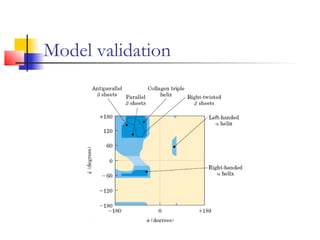
Stereochemical accuracy
- Torsion angles
- Planarity of peptide bonds
- Chirality of C-alpha atoms
- Bond lengths
- Bond angles
Example: PROCHECK
Model validation
Model validation
Packing Quality
- Interatomic distances
- Secondary structural elements
- Hydrophobicity
- Solvent accessible surface of amino acids
Model validation
Folding reliability
- 3D-comparison model/template structure
- 3D-1D profiles
- Energy based comparison

Protein modeling

  • 1.
  • 2.
    Loops, Insertions, Deletionscomplicate the process of Modeling A good guide for modeling the missing region can be The structure of a segment of equivalent length in a homologous protein Loop search programs
  • 3.
    Chosen segment maynot fit properly into the existing framework of the model ? ? ? de novo prediction
  • 4.
    o Identical residuesor substituted residue pairs in homologous proteins adopt similar conformations If amino acids to be substituted are not related Solution: Rotamer libraries Ex: Ponder and Richards library (67 rotamers of 17 amino acids) (Rotamers are conformers that differ by rotation about only a sigma bond. i.e., only one dihedral angle will be different b/w rotamers) Side chain modeling
  • 5.
    Offers the possibilityto examine all the reference proteins simultaneously to impose structural constraints That in turn can be used to generate conformations consistent with the data set Distance geometry approach
  • 6.
    Force fields used: 1.AMBER: United atom model and all-atom representations can be applied 2. GROMOS: offers only united atom model Molecular dynamics simulations: United atom potential energy functions are used SHAKE algorithm Optimization
  • 7.
    Model validation Stereochemical accuracy -Torsion angles - Planarity of peptide bonds - Chirality of C-alpha atoms - Bond lengths - Bond angles Example: PROCHECK
  • 8.
  • 9.
    Model validation Packing Quality -Interatomic distances - Secondary structural elements - Hydrophobicity - Solvent accessible surface of amino acids
  • 10.
    Model validation Folding reliability -3D-comparison model/template structure - 3D-1D profiles - Energy based comparison