Pulmonary Function Testing
The Basics of Interpretation
Dr. Radhwan Alkhashab
Consultant anaesthesia & ICU
2020
Objectives
• Definitions of PFT
 Identify the components of PFTs
 Describe the indications
 Develop a stepwise approach to
interpretation.
 Evaluation of the patients for lung resection.
Definition
• Pulmonary function tests are a group of
tests that measure how well the lungs take
in and release air and how well they move
gases such as oxygen from the
atmosphere into the body's circulation.
Description
 Spirometry
 Flow Volume Loop
 Bronchodilator response
 Lung volumes
 Diffusion capacity (DLCO)
 Bronchoprovocation testing.
Indications — Diagnosis
 Evaluation of signs and symptoms
- SOB, exertional dyspnea, chronic cough
 Screening at-risk populations
 Abnormal study
- CXR, ECG, ABG, hemoglobin
 Preoperative assessment
Preoperative assessment
1. Patients with any evidence of chronic pulmonary disease
2. Heavy smokers with history of persistent cough
3. Patients with wheezing or dyspnea on exertion
4. Patients with chest wall and spinal deformities
5. Morbidly obese patients
6. Patients with thoracic surgery
7. Elderly patients (>70 years of age)
8 .Patients who are to undergo upper abdominal surgery
Indications — Prognostic
■ Assess severity
■ Follow response to therapy
■ Determine further treatment goals
■ Referral for surgery
■ Disability
How The Test Is Performed
• In a spirometry test, you breath into a
mouthpiece that is connected to an instrument
called a spirometer. The spirometer records the
amount and the rate of air that you breath in and
out over a period of time.
• For some of the test measurements, you can
breath normally and quietly. Other tests require
forced inhalation or exhalation after a deep
breath.
Lung volume measurement can be done
The most accurate way is to sit in a sealed, clear box that
looks like a telephone booth (body plethysmograph) while
breathing in and out into a mouthpiece. Changes in
pressure inside the box help determine the lung volume.
Spirometry
 Simple, office-based
 Can determine:
- Forced expiratory volume in one second (FEV1)
- Forced vital capacity (FVC)
- FEV1/FVC
- Forced expiratory flow 25%-75% (FEF25-75)
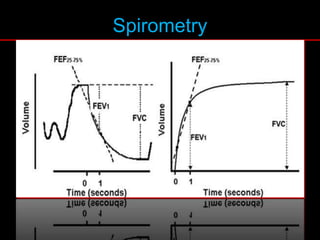
• FVC - Forced Vital Capacity - the volume of air which
can be forcibly and maximally exhaled out of the lungs
until no more can be expired. It is usually measured in
liters.
• FEV1 - Forced Expiration Value after 1 second - the
volume of air which can be forcibly exhaled from the
lungs in the first second of a forced expiratory maneuver.
It too is measured in liters.
• FEV1/FVC - Forced Expiration Value after 1 second as a
Percentage of Forced Vital Capacity – indicates what
percentage of the total FVC was expelled from the lungs
during the first second of forced exhalation.
VC & FVC
• If after a maximal inspiratory effort a subject exhales as
forcefully and rapidly as possible, the maneuver is
termed the forced VC (FVC).
• FVC tends to be less than the standard VC because
airways reach flow limitation early, and air trapping
occurs. In healthy subjects, the two maneuvers usually
result in nearly equal measured volumes. Because the
FVC maneuver is an artificial one, patients must be
instructed carefully and often require practice attempts
before performing the test adequately.
Note :-
The exhalation should take at least 4 seconds and
should not be interrupted by coughing, glottic
closure, or any mechanical obstruction.
FEV1
To identify airway obstruction, flow rates are
determined by calculation of the volume exhaled
during certain time intervals. Most commonly
measured is the volume exhaled in the first
second, or the forced expiratory volume in 1
second (FEV1 ). The FEV1 can be expressed as
absolute volume in liters
• The FEV1 provides an even better perspective
on the degree of airway obstruction when it is
expressed as a percentage of the FVC (FEV1
/FVC%).
• Normal healthy subjects can exhale 75 to 80
percent of the FVC in the first second; the
remaining volume is exhaled in two or three
additional seconds
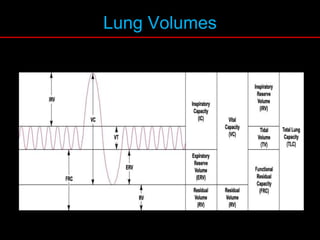
Lung Volumes
Spirometry
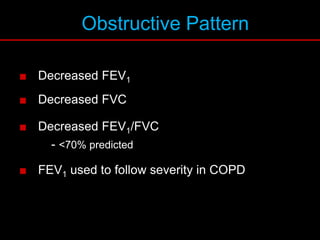
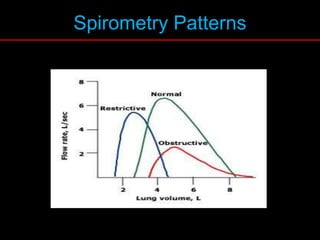
Obstructive Pattern
■ Decreased FEV1
■ Decreased FVC
■ Decreased FEV1/FVC
- <70% predicted
■ FEV1 used to follow severity in COPD
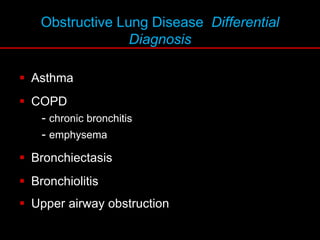
Obstructive Lung Disease Differential
Diagnosis
 Asthma
 COPD
- chronic bronchitis
- emphysema
 Bronchiectasis
 Bronchiolitis
 Upper airway obstruction
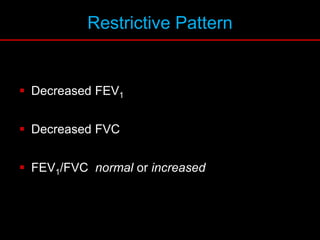
Restrictive Pattern
 Decreased FEV1
 Decreased FVC
 FEV1/FVC normal or increased
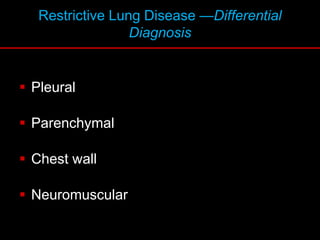
Restrictive Lung Disease —Differential
Diagnosis
 Pleural
 Parenchymal
 Chest wall
 Neuromuscular
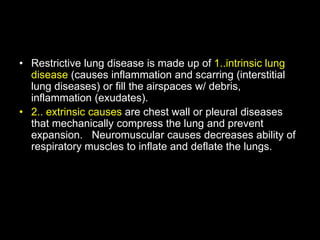
• Restrictive lung disease is made up of 1..intrinsic lung
disease (causes inflammation and scarring (interstitial
lung diseases) or fill the airspaces w/ debris,
inflammation (exudates).
• 2.. extrinsic causes are chest wall or pleural diseases
that mechanically compress the lung and prevent
expansion. Neuromuscular causes decreases ability of
respiratory muscles to inflate and deflate the lungs.
• The decreased VC associated with restrictive disease
may result from lung pathology, such as pneumonia,
atelectasis, and pulmonary fibrosis. It may also occur
with a loss of distensible lung tissue, such as that
following surgical excision. Decreased VC is also seen in
the absence of lung disease. In this case, muscle
weakness, abdominal swelling, or pain may prevent the
patient from obtaining either a full inspiration or a
maximum expiratory effort.
Spirometry Patterns
Bronchodilator Response
 Degree to which FEV1 improves with inhaled
bronchodilator
 Documents reversible airflow obstruction
 Significant response if:
- FEV1 increases by 12% and >200ml
 Request if obstructive pattern on spirometry
The response to bronchodilators is expressed as the
percentage change in FEV1 from a baseline value. Healthy
normal subjects and those with very mild obstruction
typically exhibit a minimal increase in FEV1 (<5%).
Likewise, patients with severe baseline obstruction respond
poorly because of accompanying secretions and airway
edema. The most dramatic improvement occurs in patients
with moderate obstruction such that response to
bronchodilators
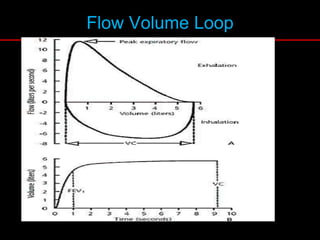
Flow Volume Loop
 “Spirogram”
 Measures forced inspiratory and expiratory flow
rate
 Augments spirometry results
 Indications: evaluation of upper airway
obstruction (stridor, unexplained dyspnea)
Flow-Volume Loops
• The finding of reduced peak flow and FEV1 without
additional clinical evidence of chronic obstructive lung
disease may indicate the presence of an obstructing
lesion of the upper airway, larynx, or trachea. In some
cases, this obstruction may be suspected by a careful
history and physical examination, but in many instances,
it may stimulate diffuse airway obstruction and may
suggest a marked degree of lung dysfunction.
• Flow-volume loops provide a graphic analysis of
flow at various lung volumes and have been
utilized to discriminate between patients with
upper obstructive lung lesions. Both flow and
volume are plotted simultaneously on an X-Y
recorder as subjects inhale fully to TLC and then
perform an FVC maneuver. This is followed
immediately by a maximal inspiration as quickly
as possible back to TLC
• Flow-volume loops not only aid in suspecting
upper airway obstruction but may also help to
localize the site and the nature of the
obstruction. Several characteristic patterns have
been described. Perhaps the most common
lesion is a fixed obstruction, such as a benign
stricture resulting from tracheostomy or tracheal
intubation. A tumor or mass such as a goiter
may also produce a similar picture.
Flow Volume Loop
Lung Volumes
 Indications:
- Diagnose restrictive component
- Differentiate chronic bronchitis from
emphysema
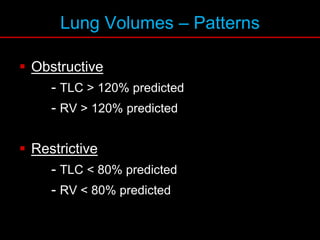
Lung Volumes – Patterns
 Obstructive
- TLC > 120% predicted
- RV > 120% predicted
 Restrictive
- TLC < 80% predicted
- RV < 80% predicted
Diffusing Capacity
 Diffusing capacity of lungs for CO
 Measures ability of lungs to transport inhaled gas
from alveoli to pulmonary capillaries
 Depends on:
- alveolar—capillary membrane
- hemoglobin concentration
- cardiac output
Diffusing Capacity
 Decreased DLCO
(<80% predicted)
 Obstructive lung disease
 Parenchymal disease
 Pulmonary vascular disease
 Anemia
 Low DLCO is also a major
predictor of desaturation during
exercise.
 Increased DLCO
(>120-140% predicted)
 Asthma
 Polycythemia
 Left to right shunt
DLCO — Indications
 Differentiate asthma from emphysema
 Evaluation and severity of restrictive lung
disease
 Early stages of pulmonary hypertension
Bronchoprovocation
 Useful for diagnosis of asthma in the
setting of normal pulmonary function tests
 Common agents:
- Methacholine, Histamine, others
 Diagnostic if: ≥20% decrease in FEV1
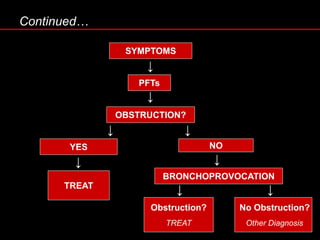
Continued…
↓
SYMPTOMS
PFTs
OBSTRUCTION?
YES NO
TREAT
BRONCHOPROVOCATION
Obstruction?
TREAT
No Obstruction?
Other Diagnosis
↓
↓
↓ ↓
↓
↓ ↓
PFT Interpretation Strategy
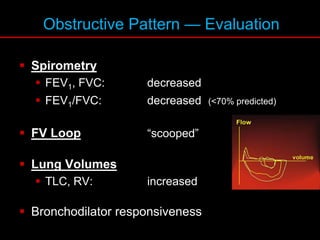
Obstructive Pattern — Evaluation
 Spirometry
 FEV1, FVC: decreased
 FEV1/FVC: decreased (<70% predicted)
 FV Loop “scooped”
 Lung Volumes
 TLC, RV: increased
 Bronchodilator responsiveness
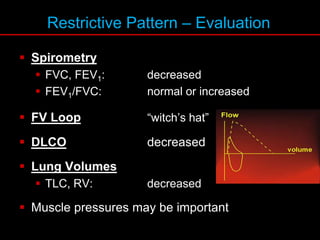
Restrictive Pattern – Evaluation
 Spirometry
 FVC, FEV1: decreased
 FEV1/FVC: normal or increased
 FV Loop “witch’s hat”
 DLCO decreased
 Lung Volumes
 TLC, RV: decreased
 Muscle pressures may be important
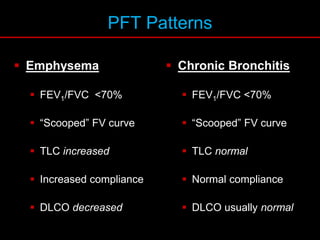
PFT Patterns
 Emphysema
 FEV1/FVC <70%
 “Scooped” FV curve
 TLC increased
 Increased compliance
 DLCO decreased
 Chronic Bronchitis
 FEV1/FVC <70%
 “Scooped” FV curve
 TLC normal
 Normal compliance
 DLCO usually normal
PFT Patterns
 Asthma
 FEV1/FVC normal or decreased
 DLCO normal or increased
But PFTs may be normal  bronchoprovocation
EVALUATION OF THE PATIENT FOR LUNG RESECTION
• Resection of lung disease results in a greater impairment in
postoperative lung function than most other types of surgery . Lung
resection in patients with pulmonary dysfunction is associated with a
high risk of postoperative complications, even the possibility of
death. These patients require a more extensive pulmonary
evaluation, particularly if removal of an entire lung is anticipated.
A major aim of the evaluation is to decide whether the
removal of lung tissue can be tolerated without
compromising pulmonary function to a degree that the
patient dies of pulmonary insufficiency or is severely
disabled. The long-term ability to withstand such lung
resection relates to the amount and the functional status of
the lung parenchyma removed and more importantly to the
function of the remaining lung tissue. Removal of lung from
an already compromised patient may be followed by
inadequate gas exchange, pulmonary hypertension, and
incapacitating dyspnea.
The pulmonary function studies must be viewed in light of
the patient's age, the status of the cardiovascular system,
and the patient's cooperation and motivation. Data in
pneumonectomy patients indicate that whole lung removal
is likely to be tolerated if the preoperative pulmonary
function meets the following criteria :
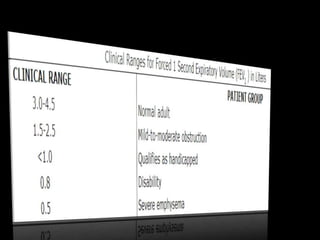
1. FEV1 greater than 2 L.
2. FEV1 /FVC ratio of at least 50 percent.
• If any of these criteria are not met, more sophisticated
testing of split lung function is indicated in order to
estimate the relative functional contribution of each lung.
Usually, split function testing consists of xenon
radiospirometry to assess ventilation and
macroaggregates of iodine or technetium to scan
perfusion. The relative contribution of each lung to either
total ventilation or perfusion can be used to predict
postoperative pulmonary function.
• Continued observations suggest that a patient's maximal oxygen
uptake during exercise (V O2 max) was an accurate
preoperative means of identifying patients likely to experience
postthoracotomy morbidity. The V O2 max is essentially a measure
of physical fitness and thus reflects the ability to survive the stresses
of the perioperative period and beyond. During exercise, the lung
must accommodate the increased ventilation and blood flow, much
like the remaining lung will experience after pneumonectomy.
Patients with V O2 max values of 20 mL/kg/min or more had minimal
morbidity. Those with a V O2 max of 15 mL/kg/min or less had
increased cardiopulmonary complications, whereas those whose V
O2 max was less than 10 mL/kg/min appeared to have an
unacceptably high risk and a mortality rate of greater than 30
percent in the short term.
• Insight into these V O2 max values is provided by
evidence that a two-flight stair climb (20 steps/min)
without dyspnea approximates a V O2 max of about 16
mL/kg/min.
• The ability to walk 180 feet in 1 minute corresponds to
about 12 mL/kg/min.
• It appears that resting pulmonary function testing does
not accurately predict exercise performance in patients
with more severe lung disease.
• Thus, cardiopulmonary exercise testing may be
necessary to evaluate the degree of impairment.
Exercise testing has become attractive because it
reflects gas exchange, ventilation, tissue oxygenation,
and cardiac output. When the latter is increased, blood
flow to the pulmonary vascular bed increases, much like
occurs when flow is diverted to the lung tissue remaining
after resection.
Preoperative measure to improve lung
function
• The therapy is carried out for 48 to 72 hours before
surgery. However, it is equally important that some of the
measures be continued after surgery as well.
• The treatment regimen is aimed largely at three
modalities: (1) smoking cessation, (2) mobilization of
secretions, (3) therapy for bronchospasm
Pulmonary function testing

Pulmonary function testing

  • 1.
    Pulmonary Function Testing TheBasics of Interpretation Dr. Radhwan Alkhashab Consultant anaesthesia & ICU 2020
  • 2.
    Objectives • Definitions ofPFT  Identify the components of PFTs  Describe the indications  Develop a stepwise approach to interpretation.  Evaluation of the patients for lung resection.
  • 3.
    Definition • Pulmonary functiontests are a group of tests that measure how well the lungs take in and release air and how well they move gases such as oxygen from the atmosphere into the body's circulation.
  • 4.
    Description  Spirometry  FlowVolume Loop  Bronchodilator response  Lung volumes  Diffusion capacity (DLCO)  Bronchoprovocation testing.
  • 5.
    Indications — Diagnosis Evaluation of signs and symptoms - SOB, exertional dyspnea, chronic cough  Screening at-risk populations  Abnormal study - CXR, ECG, ABG, hemoglobin  Preoperative assessment
  • 6.
    Preoperative assessment 1. Patientswith any evidence of chronic pulmonary disease 2. Heavy smokers with history of persistent cough 3. Patients with wheezing or dyspnea on exertion 4. Patients with chest wall and spinal deformities 5. Morbidly obese patients 6. Patients with thoracic surgery 7. Elderly patients (>70 years of age) 8 .Patients who are to undergo upper abdominal surgery
  • 7.
    Indications — Prognostic ■Assess severity ■ Follow response to therapy ■ Determine further treatment goals ■ Referral for surgery ■ Disability
  • 8.
    How The TestIs Performed • In a spirometry test, you breath into a mouthpiece that is connected to an instrument called a spirometer. The spirometer records the amount and the rate of air that you breath in and out over a period of time. • For some of the test measurements, you can breath normally and quietly. Other tests require forced inhalation or exhalation after a deep breath.
  • 9.
    Lung volume measurementcan be done The most accurate way is to sit in a sealed, clear box that looks like a telephone booth (body plethysmograph) while breathing in and out into a mouthpiece. Changes in pressure inside the box help determine the lung volume.
  • 10.
    Spirometry  Simple, office-based Can determine: - Forced expiratory volume in one second (FEV1) - Forced vital capacity (FVC) - FEV1/FVC - Forced expiratory flow 25%-75% (FEF25-75)
  • 11.
    • FVC -Forced Vital Capacity - the volume of air which can be forcibly and maximally exhaled out of the lungs until no more can be expired. It is usually measured in liters. • FEV1 - Forced Expiration Value after 1 second - the volume of air which can be forcibly exhaled from the lungs in the first second of a forced expiratory maneuver. It too is measured in liters. • FEV1/FVC - Forced Expiration Value after 1 second as a Percentage of Forced Vital Capacity – indicates what percentage of the total FVC was expelled from the lungs during the first second of forced exhalation.
  • 12.
    VC & FVC •If after a maximal inspiratory effort a subject exhales as forcefully and rapidly as possible, the maneuver is termed the forced VC (FVC). • FVC tends to be less than the standard VC because airways reach flow limitation early, and air trapping occurs. In healthy subjects, the two maneuvers usually result in nearly equal measured volumes. Because the FVC maneuver is an artificial one, patients must be instructed carefully and often require practice attempts before performing the test adequately.
  • 13.
    Note :- The exhalationshould take at least 4 seconds and should not be interrupted by coughing, glottic closure, or any mechanical obstruction.
  • 14.
    FEV1 To identify airwayobstruction, flow rates are determined by calculation of the volume exhaled during certain time intervals. Most commonly measured is the volume exhaled in the first second, or the forced expiratory volume in 1 second (FEV1 ). The FEV1 can be expressed as absolute volume in liters
  • 15.
    • The FEV1provides an even better perspective on the degree of airway obstruction when it is expressed as a percentage of the FVC (FEV1 /FVC%). • Normal healthy subjects can exhale 75 to 80 percent of the FVC in the first second; the remaining volume is exhaled in two or three additional seconds
  • 17.
  • 18.
  • 19.
    Obstructive Pattern ■ DecreasedFEV1 ■ Decreased FVC ■ Decreased FEV1/FVC - <70% predicted ■ FEV1 used to follow severity in COPD
  • 20.
    Obstructive Lung DiseaseDifferential Diagnosis  Asthma  COPD - chronic bronchitis - emphysema  Bronchiectasis  Bronchiolitis  Upper airway obstruction
  • 21.
    Restrictive Pattern  DecreasedFEV1  Decreased FVC  FEV1/FVC normal or increased
  • 22.
    Restrictive Lung Disease—Differential Diagnosis  Pleural  Parenchymal  Chest wall  Neuromuscular
  • 23.
    • Restrictive lungdisease is made up of 1..intrinsic lung disease (causes inflammation and scarring (interstitial lung diseases) or fill the airspaces w/ debris, inflammation (exudates). • 2.. extrinsic causes are chest wall or pleural diseases that mechanically compress the lung and prevent expansion. Neuromuscular causes decreases ability of respiratory muscles to inflate and deflate the lungs.
  • 24.
    • The decreasedVC associated with restrictive disease may result from lung pathology, such as pneumonia, atelectasis, and pulmonary fibrosis. It may also occur with a loss of distensible lung tissue, such as that following surgical excision. Decreased VC is also seen in the absence of lung disease. In this case, muscle weakness, abdominal swelling, or pain may prevent the patient from obtaining either a full inspiration or a maximum expiratory effort.
  • 25.
  • 26.
    Bronchodilator Response  Degreeto which FEV1 improves with inhaled bronchodilator  Documents reversible airflow obstruction  Significant response if: - FEV1 increases by 12% and >200ml  Request if obstructive pattern on spirometry
  • 27.
    The response tobronchodilators is expressed as the percentage change in FEV1 from a baseline value. Healthy normal subjects and those with very mild obstruction typically exhibit a minimal increase in FEV1 (<5%). Likewise, patients with severe baseline obstruction respond poorly because of accompanying secretions and airway edema. The most dramatic improvement occurs in patients with moderate obstruction such that response to bronchodilators
  • 28.
    Flow Volume Loop “Spirogram”  Measures forced inspiratory and expiratory flow rate  Augments spirometry results  Indications: evaluation of upper airway obstruction (stridor, unexplained dyspnea)
  • 29.
    Flow-Volume Loops • Thefinding of reduced peak flow and FEV1 without additional clinical evidence of chronic obstructive lung disease may indicate the presence of an obstructing lesion of the upper airway, larynx, or trachea. In some cases, this obstruction may be suspected by a careful history and physical examination, but in many instances, it may stimulate diffuse airway obstruction and may suggest a marked degree of lung dysfunction.
  • 30.
    • Flow-volume loopsprovide a graphic analysis of flow at various lung volumes and have been utilized to discriminate between patients with upper obstructive lung lesions. Both flow and volume are plotted simultaneously on an X-Y recorder as subjects inhale fully to TLC and then perform an FVC maneuver. This is followed immediately by a maximal inspiration as quickly as possible back to TLC
  • 31.
    • Flow-volume loopsnot only aid in suspecting upper airway obstruction but may also help to localize the site and the nature of the obstruction. Several characteristic patterns have been described. Perhaps the most common lesion is a fixed obstruction, such as a benign stricture resulting from tracheostomy or tracheal intubation. A tumor or mass such as a goiter may also produce a similar picture.
  • 32.
  • 33.
    Lung Volumes  Indications: -Diagnose restrictive component - Differentiate chronic bronchitis from emphysema
  • 34.
    Lung Volumes –Patterns  Obstructive - TLC > 120% predicted - RV > 120% predicted  Restrictive - TLC < 80% predicted - RV < 80% predicted
  • 35.
    Diffusing Capacity  Diffusingcapacity of lungs for CO  Measures ability of lungs to transport inhaled gas from alveoli to pulmonary capillaries  Depends on: - alveolar—capillary membrane - hemoglobin concentration - cardiac output
  • 36.
    Diffusing Capacity  DecreasedDLCO (<80% predicted)  Obstructive lung disease  Parenchymal disease  Pulmonary vascular disease  Anemia  Low DLCO is also a major predictor of desaturation during exercise.  Increased DLCO (>120-140% predicted)  Asthma  Polycythemia  Left to right shunt
  • 37.
    DLCO — Indications Differentiate asthma from emphysema  Evaluation and severity of restrictive lung disease  Early stages of pulmonary hypertension
  • 38.
    Bronchoprovocation  Useful fordiagnosis of asthma in the setting of normal pulmonary function tests  Common agents: - Methacholine, Histamine, others  Diagnostic if: ≥20% decrease in FEV1
  • 39.
  • 40.
  • 41.
    Obstructive Pattern —Evaluation  Spirometry  FEV1, FVC: decreased  FEV1/FVC: decreased (<70% predicted)  FV Loop “scooped”  Lung Volumes  TLC, RV: increased  Bronchodilator responsiveness
  • 42.
    Restrictive Pattern –Evaluation  Spirometry  FVC, FEV1: decreased  FEV1/FVC: normal or increased  FV Loop “witch’s hat”  DLCO decreased  Lung Volumes  TLC, RV: decreased  Muscle pressures may be important
  • 43.
    PFT Patterns  Emphysema FEV1/FVC <70%  “Scooped” FV curve  TLC increased  Increased compliance  DLCO decreased  Chronic Bronchitis  FEV1/FVC <70%  “Scooped” FV curve  TLC normal  Normal compliance  DLCO usually normal
  • 44.
    PFT Patterns  Asthma FEV1/FVC normal or decreased  DLCO normal or increased But PFTs may be normal  bronchoprovocation
  • 45.
    EVALUATION OF THEPATIENT FOR LUNG RESECTION • Resection of lung disease results in a greater impairment in postoperative lung function than most other types of surgery . Lung resection in patients with pulmonary dysfunction is associated with a high risk of postoperative complications, even the possibility of death. These patients require a more extensive pulmonary evaluation, particularly if removal of an entire lung is anticipated.
  • 46.
    A major aimof the evaluation is to decide whether the removal of lung tissue can be tolerated without compromising pulmonary function to a degree that the patient dies of pulmonary insufficiency or is severely disabled. The long-term ability to withstand such lung resection relates to the amount and the functional status of the lung parenchyma removed and more importantly to the function of the remaining lung tissue. Removal of lung from an already compromised patient may be followed by inadequate gas exchange, pulmonary hypertension, and incapacitating dyspnea.
  • 47.
    The pulmonary functionstudies must be viewed in light of the patient's age, the status of the cardiovascular system, and the patient's cooperation and motivation. Data in pneumonectomy patients indicate that whole lung removal is likely to be tolerated if the preoperative pulmonary function meets the following criteria : 1. FEV1 greater than 2 L. 2. FEV1 /FVC ratio of at least 50 percent.
  • 48.
    • If anyof these criteria are not met, more sophisticated testing of split lung function is indicated in order to estimate the relative functional contribution of each lung. Usually, split function testing consists of xenon radiospirometry to assess ventilation and macroaggregates of iodine or technetium to scan perfusion. The relative contribution of each lung to either total ventilation or perfusion can be used to predict postoperative pulmonary function.
  • 49.
    • Continued observationssuggest that a patient's maximal oxygen uptake during exercise (V O2 max) was an accurate preoperative means of identifying patients likely to experience postthoracotomy morbidity. The V O2 max is essentially a measure of physical fitness and thus reflects the ability to survive the stresses of the perioperative period and beyond. During exercise, the lung must accommodate the increased ventilation and blood flow, much like the remaining lung will experience after pneumonectomy. Patients with V O2 max values of 20 mL/kg/min or more had minimal morbidity. Those with a V O2 max of 15 mL/kg/min or less had increased cardiopulmonary complications, whereas those whose V O2 max was less than 10 mL/kg/min appeared to have an unacceptably high risk and a mortality rate of greater than 30 percent in the short term.
  • 50.
    • Insight intothese V O2 max values is provided by evidence that a two-flight stair climb (20 steps/min) without dyspnea approximates a V O2 max of about 16 mL/kg/min. • The ability to walk 180 feet in 1 minute corresponds to about 12 mL/kg/min.
  • 51.
    • It appearsthat resting pulmonary function testing does not accurately predict exercise performance in patients with more severe lung disease. • Thus, cardiopulmonary exercise testing may be necessary to evaluate the degree of impairment. Exercise testing has become attractive because it reflects gas exchange, ventilation, tissue oxygenation, and cardiac output. When the latter is increased, blood flow to the pulmonary vascular bed increases, much like occurs when flow is diverted to the lung tissue remaining after resection.
  • 52.
    Preoperative measure toimprove lung function • The therapy is carried out for 48 to 72 hours before surgery. However, it is equally important that some of the measures be continued after surgery as well. • The treatment regimen is aimed largely at three modalities: (1) smoking cessation, (2) mobilization of secretions, (3) therapy for bronchospasm