7We Care 
PULMONARY FUNCTION 
TESTS 
Speaker : Maj SR Jaiswal 
DNB Resident Medicine
7We Care 
Indications 
• Differential diagnosis of dyspnea 
• Provides objective assessment of symptoms 
versus severity 
• Determine fitness for surgery 
• To guide therapy 
• To follow the course of a disease
7We Care 
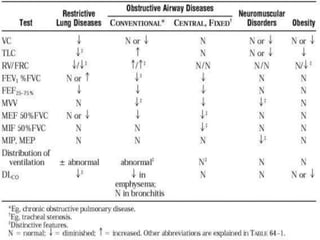
Physiologic classification of 
disease 
• Obstructive Impairment- Airway limitation due 
to the resistive properties of the respiratory 
system 
• Restrictive Impairment- Loss of volume 
capacity of the lung due to loss of air space 
units or inability to expand the respiratory 
system
7We Care 
Obstructive Processes 
• L ocal obstruction 
• A sthma 
• C hronic bronchitis (COPD) 
• E mphysema
7We Care 
Restrictive Processes 
• P leural disease 
• A lveolar filling processes 
• I nterstial lung disease 
• N euromuscular diseases 
• T horacic cage abnormailites
7We Care 
Spirometry 
• Most widely performed study and is important 
in initial screening of patients 
• Easily and quickly performed in many settings
7We Care 
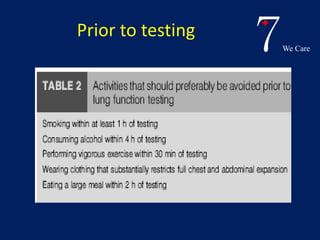
Prior to testing
7We Care 
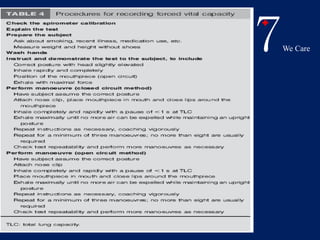
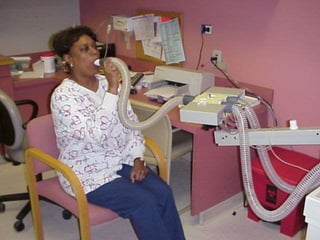
Performing the maneuver 
• It is a forced expiratory maneuver and the 
patient must be sitting upright in a chair with lips 
around a mouthpiece 
• After a maximal inspiration, a forced and rapid 
expiration is made 
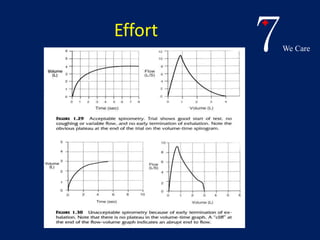
• Quality of the maneuver needs to be assessed 
noting that the patient started at zero, had a 
maximal initial efffort and lasted 6 seconds.
7We Care
7We Care 
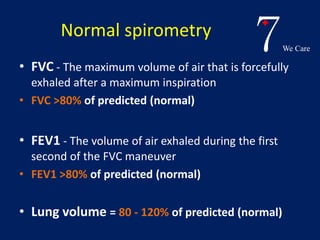
Normal spirometry 
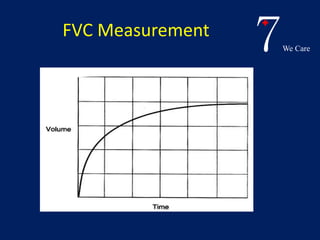
• FVC - The maximum volume of air that is forcefully 
exhaled after a maximum inspiration 
• FVC >80% of predicted (normal) 
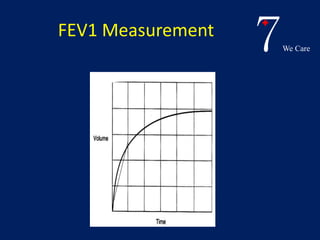
• FEV1 - The volume of air exhaled during the first 
second of the FVC maneuver 
• FEV1 >80% of predicted (normal) 
• Lung volume = 80 - 120% of predicted (normal)
7We Care 
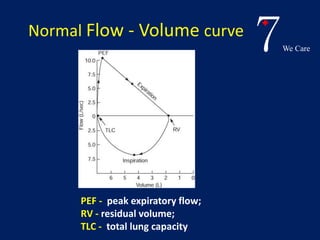
Normal Flow - Volume curve 
PEF - peak expiratory flow; 
RV - residual volume; 
TLC - total lung capacity
7We Care
7We Care 
Measurements 
• FVC 
• FEV1 
• FEV1/FVC
7We Care 
FVC Measurement
7We Care 
FEV1 Measurement
7We Care 
Effort
7We Care 
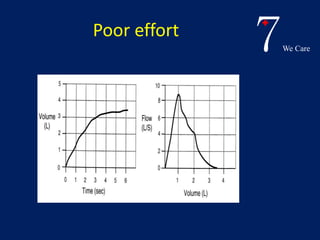
Poor effort
7We Care 
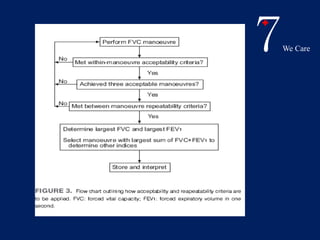
Acceptability 
• Test acceptability is best determined by 
studying the flow-volume loops 
• Criteria 
– Freedom from artifacts 
– Good starts 
– Satisfactory expiratory time
7We Care 
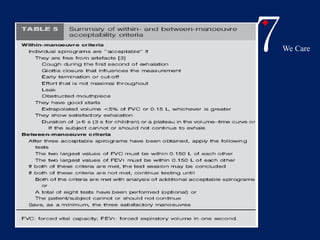
Reproducibility of data 
• Criteria 
– The two largest forced vital capacity (FVC) – 
0.2 L or 5% of each other 
– The two largest FEV1 – 
0.2 L or 5% of each other 
Up to eight efforts may be performed
7We Care
7We Care
7We Care 
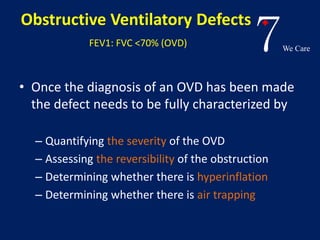
Obstructive Ventilatory Defects 
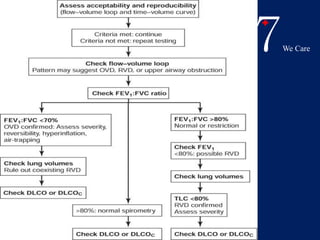
FEV1: FVC <70% (OVD) 
• Once the diagnosis of an OVD has been made 
the defect needs to be fully characterized by 
– Quantifying the severity of the OVD 
– Assessing the reversibility of the obstruction 
– Determining whether there is hyperinflation 
– Determining whether there is air trapping
7We Care 
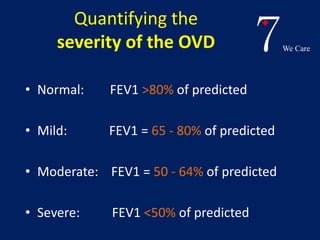
Quantifying the 
severity of the OVD 
• Normal: FEV1 >80% of predicted 
• Mild: FEV1 = 65 - 80% of predicted 
• Moderate: FEV1 = 50 - 64% of predicted 
• Severe: FEV1 <50% of predicted
7We Care 
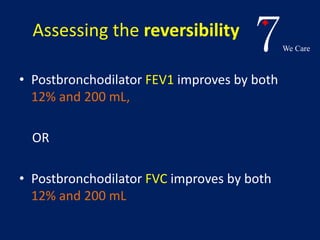
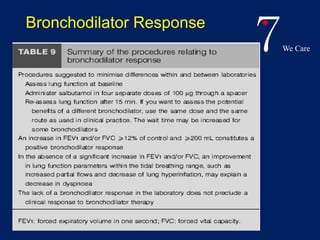
Assessing the reversibility 
• Postbronchodilator FEV1 improves by both 
12% and 200 mL, 
OR 
• Postbronchodilator FVC improves by both 
12% and 200 mL
7We Care 
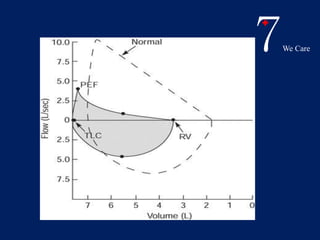
Hyperinflation 
• TLC >120% of predicted, 
OR 
• RV >120% of predicted
7We Care 
Air trapping 
• SVC > FVC by both 12% and 200 mL
7We Care
7We Care 
The methacholine challenge test 
• Asthma - reversible obstructive airway disease 
• Multiple pfts may only demonstrate normal spirometry 
• Bronchial provocation testing
7We Care 
• The administration of a sterile saline aerosol 
• FEV1 after 3 - 5 mins 
• Increasing concentrations of methacholine 
at 5-min intervals 
(0.003 mg/mL to 16 mg/mL) 
• FEV1 is measured 3 - 5 mins 
• Decrease in FEV1 >20% is a positive response
7We Care 
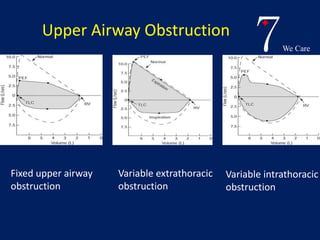
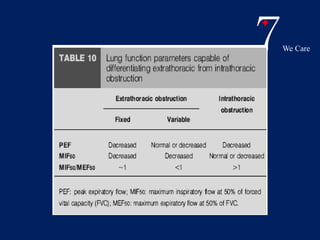
Upper Airway Obstruction 
Variable extrathoracic 
obstruction 
Variable intrathoracic 
obstruction 
Fixed upper airway 
obstruction
7We Care
7We Care 
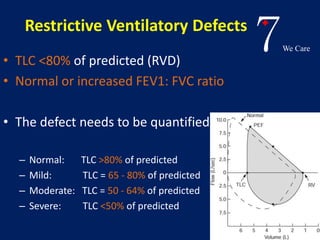
Restrictive Ventilatory Defects 
• TLC <80% of predicted (RVD) 
• Normal or increased FEV1: FVC ratio 
• The defect needs to be quantified 
– Normal: TLC >80% of predicted 
– Mild: TLC = 65 - 80% of predicted 
– Moderate: TLC = 50 - 64% of predicted 
– Severe: TLC <50% of predicted
7We Care 
Bronchodilator Response
7We Care 
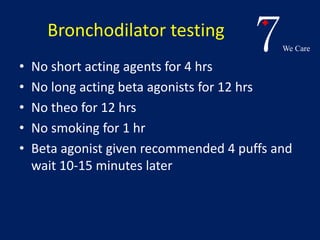
Bronchodilator testing 
• No short acting agents for 4 hrs 
• No long acting beta agonists for 12 hrs 
• No theo for 12 hrs 
• No smoking for 1 hr 
• Beta agonist given recommended 4 puffs and 
wait 10-15 minutes later
7We Care 
Lung Volumes 
• May be measured by multiple methods 
• Is important to understand what volumes the 
lung is composed of 
• The total volume of the lung is TLC 
• The subdivisions include ERV, IRV, TV,and RV 
• Capacities are composed of 2 or more volumes.
7We Care 
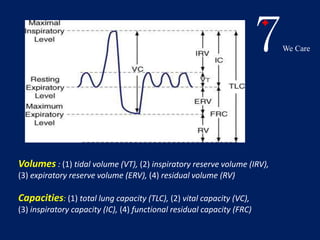
Volumes : (1) tidal volume (VT), (2) inspiratory reserve volume (IRV), 
(3) expiratory reserve volume (ERV), (4) residual volume (RV) 
Capacities: (1) total lung capacity (TLC), (2) vital capacity (VC), 
(3) inspiratory capacity (IC), (4) functional residual capacity (FRC)
7We Care 
Methods 
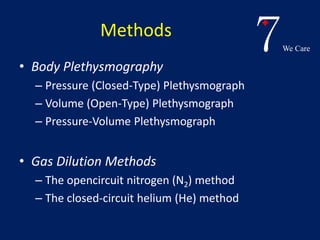
• Body Plethysmography 
– Pressure (Closed-Type) Plethysmograph 
– Volume (Open-Type) Plethysmograph 
– Pressure-Volume Plethysmograph 
• Gas Dilution Methods 
– The opencircuit nitrogen (N2) method 
– The closed-circuit helium (He) method
7We Care 
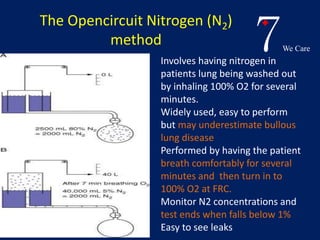
The Opencircuit Nitrogen (N2) 
method 
Involves having nitrogen in 
patients lung being washed out 
by inhaling 100% O2 for several 
minutes. 
Widely used, easy to perform 
but may underestimate bullous 
lung disease 
Performed by having the patient 
breath comfortably for several 
minutes and then turn in to 
100% O2 at FRC. 
Monitor N2 concentrations and 
test ends when falls below 1% 
Easy to see leaks
7We Care 
Nitrogen Washout 
• Concept is C1V1= C2V2 
– C1 = Nitrogen concentration at the start of the 
test 
– V1 = FRC volume 
– C2 =N2 concentration in exhaled volume 
– V2 = Total exhaled volume during O2 breathing 
period 
– Nitrogen is measured by photoelectric principle
7We Care 
The closed-circuit helium (He) 
method 
• Uses an inert gas, helium and by a closed 
circuit technique, allow it to come to 
equilibrium and FRC is measured 
• May underestimate lung volumes in bullous 
lung disease
7We Care 
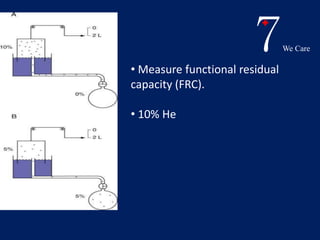
• Measure functional residual 
capacity (FRC). 
• 10% He
7We Care 
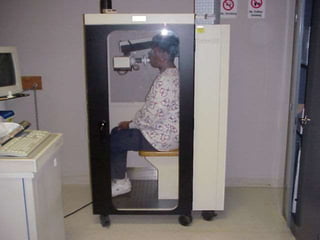
Body Plethsymography 
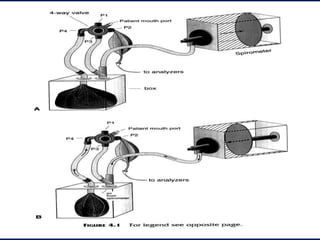
• Is a sealed box with a fixed volume 
• Uses Boyle’s Law that changes in pressure are 
brought about by changes in volume and 
pressure for the person seated in the box 
• P1V1= P2V2
7We Care 
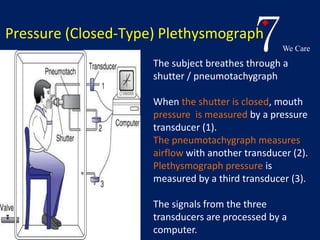
Pressure (Closed-Type) Plethysmograph 
The subject breathes through a 
shutter / pneumotachygraph 
When the shutter is closed, mouth 
pressure is measured by a pressure 
transducer (1). 
The pneumotachygraph measures 
airflow with another transducer (2). 
Plethysmograph pressure is 
measured by a third transducer (3). 
The signals from the three 
transducers are processed by a 
computer.
7We Care 
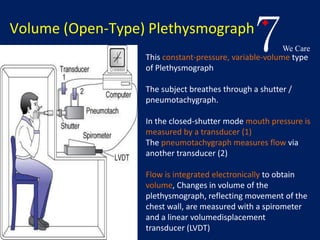
Volume (Open-Type) Plethysmograph 
This constant-pressure, variable-volume type 
of Plethysmograph 
The subject breathes through a shutter / 
pneumotachygraph. 
In the closed-shutter mode mouth pressure is 
measured by a transducer (1) 
The pneumotachygraph measures flow via 
another transducer (2) 
Flow is integrated electronically to obtain 
volume, Changes in volume of the 
plethysmograph, reflecting movement of the 
chest wall, are measured with a spirometer 
and a linear volumedisplacement 
transducer (LVDT)
7We Care 
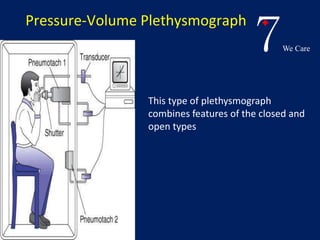
Pressure-Volume Plethysmograph 
This type of plethysmograph 
combines features of the closed and 
open types
7We Care
7We Care 
Lung volume measurements 
• FRC is directly measured as well as SVC 
• Other volumes and capacities can be calculated 
• Lung volume measurements are important to 
confirm RLD 
• TLC and RV the usual volumes assessed
7We Care 
Interpretation 
• RLD 
– TLC is reduced in all 
– Predicted values and 
interpret same as FVC 
and FEV1 
• OLD 
– TLC can be increased 
and is then called 
hyperinflation (120%) 
– RV can be increased in 
asthma and COPD 
indicating air trapping
7We Care 
Lung Elastic Recoil 
• Lung elastic recoil pressure, or transpulmonary pressure (PL) 
• PL = Palv – PPl 
– Palv - the alveolar pressure, 
– Ppl - the pleural pressure 
• The muscles of inspiration must maintain a pleural pressure of 
about 12 cm H2O below atmospheric pressure (pPl = -12 cm 
H2O). 
• Under conditions of no flow, pressure at the mouth, alveoli, 
and atmosphere are equal: pL = 0 - (-12 cm h2o) 
• PPl rises from -12 to 0 cm H2O and palv from 0 to +12 cm H2O 
at the instant before flow begins
7We Care 
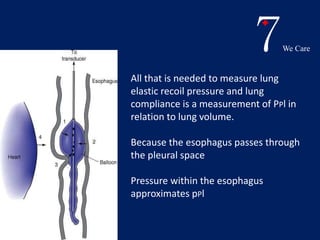
All that is needed to measure lung 
elastic recoil pressure and lung 
compliance is a measurement of PPl in 
relation to lung volume. 
Because the esophagus passes through 
the pleural space 
Pressure within the esophagus 
approximates pPl
7We Care 
Diffusing Capacity 
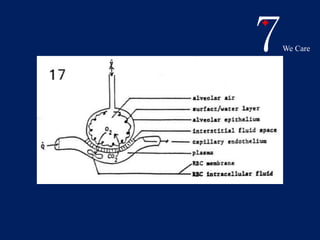
• Provides information about the transfer of gas 
between the alveoli and the pulmonary capillary bed 
• It is the only noninvasive test of gas exchange 
• Performed by a single breath technique and uses CO 
as the inert gas
7We Care
7We Care 
Diffusing Capacity 
• Diffusion of a gas is dependent of the area, the 
concentrations, the thickness of the membrane and 
the diffusing properties of the gas 
• Diffusion is the rate at which a gas is transferred 
across the alveolar capillary membrane, the plasma, 
the RBC and ultimately combined with Hgb
7We Care 
Diffusing Capacity 
• CO is typically used because it is freely diffusable 
• It usually is not present in significant amounts in the 
blood except in some heavy smokers 
• Helium or methane is also used to measure volume 
• A single maximal inspiration is taken and held for 10 
sec
7We Care
7We Care 
Diffusing Capacity 
• Normal result is >80% 
• Can be reduced in interstitial diseases such as sarcoid 
or asbestosis 
• Can be reduced also in emphysema or pulmonary 
vascular diseases 
• False low measurements in anemia or lung resection 
and elevated in alveolar hemm
7We Care
7We Care 
Bedside evaluation of 
Pulmonary Function 
• Snider’s match blowing test 
• Modified Snider’s test 
• Seberese’s single breath count 
• Seberese’s breath holding test 
• Cough test 
• De Bono’s Whistle test 
• Wright’s peak flow meter test 
• Bed side pulse oximetry 
• Blow against the hand
7We Care 
Snider’s match blowing test 
• Mouth wide open 
• Match held at 15 cm distance 
• Chin is supported 
• No head tilting 
• Match stick and mouth at the 
same level 
• Cannot blow out a match 
– MBC < 60 L / min 
– FEV1 < 1.6 L 
• Able to blow out a match 
– MBC > 60 L / min 
– FEV1 > 1.6 L 
Modified Snider’s test 
• When the Match is placed 
at a distance of 
– 3 inches – MBC > 40 L / min 
– 6 inches – MBC > 60 L / min 
– 9 inches – MBC > 150 L min
7We Care 
Seberese’s single breath count 
• Deep breath followed by 
cunting 1,2,3,…….. Till the 
time the subject cannot hold 
the breath 
• Shows treands of 
deterioration / improving 
pulmonary function in pre 
and post op patients 
Seberese’s breath holding test 
• Subject is asked to take a 
normal tidal inspiration and 
hold the breath 
– Normal ->= 40 sec 
– < 15 sec is a C/I for elective 
surgery
7We Care 
Cough Test 
• Observe for ability to 
cough,strength and 
effectiveness 
• Wet productive cough 
candidate for pulmonary 
complications 
• Inadequate cough 
FVC < 20 ml / kg 
De Bono’s whistle test 
• Ability to blow into the 
whistle is tested
7We Care 
Wright’s peak flow meter 
• Volume < 200 L / min in surgical 
candidate suggest impaired 
cough efficiency 
• Normal males 450 – 700 L / min 
• Normal females 300 –500 L/min 
Blow against the closed hand 
• Check I : E ratio
7We Care 
Summary 
• Spirometry- Most commonly performed and useful 
screening test. 
• Lung volumes- Can be measured several different 
ways. Are used to evaluate for restrictive disease and 
will also show air trapping 
• Diffusing Capacity - Transfer of gas across the 
alveolar membrane
7We Care
7We Care 
References 
• Murray & Nadel's Textbook of Respiratory 
Medicine, 4th ed 
• Washington Manual(R) Pulmonary Medicine 
Subspecialty Consult 
• Oxford Handbook of Respiratory Medicine 
• Current recommendation is NHANES III

Pulmonary function tests for PGs

  • 1.
    7We Care PULMONARYFUNCTION TESTS Speaker : Maj SR Jaiswal DNB Resident Medicine
  • 2.
    7We Care Indications • Differential diagnosis of dyspnea • Provides objective assessment of symptoms versus severity • Determine fitness for surgery • To guide therapy • To follow the course of a disease
  • 3.
    7We Care Physiologicclassification of disease • Obstructive Impairment- Airway limitation due to the resistive properties of the respiratory system • Restrictive Impairment- Loss of volume capacity of the lung due to loss of air space units or inability to expand the respiratory system
  • 4.
    7We Care ObstructiveProcesses • L ocal obstruction • A sthma • C hronic bronchitis (COPD) • E mphysema
  • 5.
    7We Care RestrictiveProcesses • P leural disease • A lveolar filling processes • I nterstial lung disease • N euromuscular diseases • T horacic cage abnormailites
  • 6.
    7We Care Spirometry • Most widely performed study and is important in initial screening of patients • Easily and quickly performed in many settings
  • 7.
    7We Care Priorto testing
  • 8.
    7We Care Performingthe maneuver • It is a forced expiratory maneuver and the patient must be sitting upright in a chair with lips around a mouthpiece • After a maximal inspiration, a forced and rapid expiration is made • Quality of the maneuver needs to be assessed noting that the patient started at zero, had a maximal initial efffort and lasted 6 seconds.
  • 9.
  • 10.
    7We Care Normalspirometry • FVC - The maximum volume of air that is forcefully exhaled after a maximum inspiration • FVC >80% of predicted (normal) • FEV1 - The volume of air exhaled during the first second of the FVC maneuver • FEV1 >80% of predicted (normal) • Lung volume = 80 - 120% of predicted (normal)
  • 11.
    7We Care NormalFlow - Volume curve PEF - peak expiratory flow; RV - residual volume; TLC - total lung capacity
  • 12.
  • 13.
    7We Care Measurements • FVC • FEV1 • FEV1/FVC
  • 14.
    7We Care FVCMeasurement
  • 15.
    7We Care FEV1Measurement
  • 16.
  • 17.
  • 18.
    7We Care Acceptability • Test acceptability is best determined by studying the flow-volume loops • Criteria – Freedom from artifacts – Good starts – Satisfactory expiratory time
  • 19.
    7We Care Reproducibilityof data • Criteria – The two largest forced vital capacity (FVC) – 0.2 L or 5% of each other – The two largest FEV1 – 0.2 L or 5% of each other Up to eight efforts may be performed
  • 20.
  • 21.
  • 22.
    7We Care ObstructiveVentilatory Defects FEV1: FVC <70% (OVD) • Once the diagnosis of an OVD has been made the defect needs to be fully characterized by – Quantifying the severity of the OVD – Assessing the reversibility of the obstruction – Determining whether there is hyperinflation – Determining whether there is air trapping
  • 23.
    7We Care Quantifyingthe severity of the OVD • Normal: FEV1 >80% of predicted • Mild: FEV1 = 65 - 80% of predicted • Moderate: FEV1 = 50 - 64% of predicted • Severe: FEV1 <50% of predicted
  • 24.
    7We Care Assessingthe reversibility • Postbronchodilator FEV1 improves by both 12% and 200 mL, OR • Postbronchodilator FVC improves by both 12% and 200 mL
  • 25.
    7We Care Hyperinflation • TLC >120% of predicted, OR • RV >120% of predicted
  • 26.
    7We Care Airtrapping • SVC > FVC by both 12% and 200 mL
  • 27.
  • 28.
    7We Care Themethacholine challenge test • Asthma - reversible obstructive airway disease • Multiple pfts may only demonstrate normal spirometry • Bronchial provocation testing
  • 29.
    7We Care •The administration of a sterile saline aerosol • FEV1 after 3 - 5 mins • Increasing concentrations of methacholine at 5-min intervals (0.003 mg/mL to 16 mg/mL) • FEV1 is measured 3 - 5 mins • Decrease in FEV1 >20% is a positive response
  • 30.
    7We Care UpperAirway Obstruction Variable extrathoracic obstruction Variable intrathoracic obstruction Fixed upper airway obstruction
  • 31.
  • 32.
    7We Care RestrictiveVentilatory Defects • TLC <80% of predicted (RVD) • Normal or increased FEV1: FVC ratio • The defect needs to be quantified – Normal: TLC >80% of predicted – Mild: TLC = 65 - 80% of predicted – Moderate: TLC = 50 - 64% of predicted – Severe: TLC <50% of predicted
  • 33.
  • 34.
    7We Care Bronchodilatortesting • No short acting agents for 4 hrs • No long acting beta agonists for 12 hrs • No theo for 12 hrs • No smoking for 1 hr • Beta agonist given recommended 4 puffs and wait 10-15 minutes later
  • 35.
    7We Care LungVolumes • May be measured by multiple methods • Is important to understand what volumes the lung is composed of • The total volume of the lung is TLC • The subdivisions include ERV, IRV, TV,and RV • Capacities are composed of 2 or more volumes.
  • 36.
    7We Care Volumes: (1) tidal volume (VT), (2) inspiratory reserve volume (IRV), (3) expiratory reserve volume (ERV), (4) residual volume (RV) Capacities: (1) total lung capacity (TLC), (2) vital capacity (VC), (3) inspiratory capacity (IC), (4) functional residual capacity (FRC)
  • 37.
    7We Care Methods • Body Plethysmography – Pressure (Closed-Type) Plethysmograph – Volume (Open-Type) Plethysmograph – Pressure-Volume Plethysmograph • Gas Dilution Methods – The opencircuit nitrogen (N2) method – The closed-circuit helium (He) method
  • 38.
    7We Care TheOpencircuit Nitrogen (N2) method Involves having nitrogen in patients lung being washed out by inhaling 100% O2 for several minutes. Widely used, easy to perform but may underestimate bullous lung disease Performed by having the patient breath comfortably for several minutes and then turn in to 100% O2 at FRC. Monitor N2 concentrations and test ends when falls below 1% Easy to see leaks
  • 39.
    7We Care NitrogenWashout • Concept is C1V1= C2V2 – C1 = Nitrogen concentration at the start of the test – V1 = FRC volume – C2 =N2 concentration in exhaled volume – V2 = Total exhaled volume during O2 breathing period – Nitrogen is measured by photoelectric principle
  • 40.
    7We Care Theclosed-circuit helium (He) method • Uses an inert gas, helium and by a closed circuit technique, allow it to come to equilibrium and FRC is measured • May underestimate lung volumes in bullous lung disease
  • 41.
    7We Care •Measure functional residual capacity (FRC). • 10% He
  • 42.
    7We Care BodyPlethsymography • Is a sealed box with a fixed volume • Uses Boyle’s Law that changes in pressure are brought about by changes in volume and pressure for the person seated in the box • P1V1= P2V2
  • 43.
    7We Care Pressure(Closed-Type) Plethysmograph The subject breathes through a shutter / pneumotachygraph When the shutter is closed, mouth pressure is measured by a pressure transducer (1). The pneumotachygraph measures airflow with another transducer (2). Plethysmograph pressure is measured by a third transducer (3). The signals from the three transducers are processed by a computer.
  • 44.
    7We Care Volume(Open-Type) Plethysmograph This constant-pressure, variable-volume type of Plethysmograph The subject breathes through a shutter / pneumotachygraph. In the closed-shutter mode mouth pressure is measured by a transducer (1) The pneumotachygraph measures flow via another transducer (2) Flow is integrated electronically to obtain volume, Changes in volume of the plethysmograph, reflecting movement of the chest wall, are measured with a spirometer and a linear volumedisplacement transducer (LVDT)
  • 45.
    7We Care Pressure-VolumePlethysmograph This type of plethysmograph combines features of the closed and open types
  • 46.
  • 47.
    7We Care Lungvolume measurements • FRC is directly measured as well as SVC • Other volumes and capacities can be calculated • Lung volume measurements are important to confirm RLD • TLC and RV the usual volumes assessed
  • 48.
    7We Care Interpretation • RLD – TLC is reduced in all – Predicted values and interpret same as FVC and FEV1 • OLD – TLC can be increased and is then called hyperinflation (120%) – RV can be increased in asthma and COPD indicating air trapping
  • 49.
    7We Care LungElastic Recoil • Lung elastic recoil pressure, or transpulmonary pressure (PL) • PL = Palv – PPl – Palv - the alveolar pressure, – Ppl - the pleural pressure • The muscles of inspiration must maintain a pleural pressure of about 12 cm H2O below atmospheric pressure (pPl = -12 cm H2O). • Under conditions of no flow, pressure at the mouth, alveoli, and atmosphere are equal: pL = 0 - (-12 cm h2o) • PPl rises from -12 to 0 cm H2O and palv from 0 to +12 cm H2O at the instant before flow begins
  • 50.
    7We Care Allthat is needed to measure lung elastic recoil pressure and lung compliance is a measurement of PPl in relation to lung volume. Because the esophagus passes through the pleural space Pressure within the esophagus approximates pPl
  • 51.
    7We Care DiffusingCapacity • Provides information about the transfer of gas between the alveoli and the pulmonary capillary bed • It is the only noninvasive test of gas exchange • Performed by a single breath technique and uses CO as the inert gas
  • 52.
  • 53.
    7We Care DiffusingCapacity • Diffusion of a gas is dependent of the area, the concentrations, the thickness of the membrane and the diffusing properties of the gas • Diffusion is the rate at which a gas is transferred across the alveolar capillary membrane, the plasma, the RBC and ultimately combined with Hgb
  • 54.
    7We Care DiffusingCapacity • CO is typically used because it is freely diffusable • It usually is not present in significant amounts in the blood except in some heavy smokers • Helium or methane is also used to measure volume • A single maximal inspiration is taken and held for 10 sec
  • 55.
  • 56.
    7We Care DiffusingCapacity • Normal result is >80% • Can be reduced in interstitial diseases such as sarcoid or asbestosis • Can be reduced also in emphysema or pulmonary vascular diseases • False low measurements in anemia or lung resection and elevated in alveolar hemm
  • 57.
  • 58.
    7We Care Bedsideevaluation of Pulmonary Function • Snider’s match blowing test • Modified Snider’s test • Seberese’s single breath count • Seberese’s breath holding test • Cough test • De Bono’s Whistle test • Wright’s peak flow meter test • Bed side pulse oximetry • Blow against the hand
  • 59.
    7We Care Snider’smatch blowing test • Mouth wide open • Match held at 15 cm distance • Chin is supported • No head tilting • Match stick and mouth at the same level • Cannot blow out a match – MBC < 60 L / min – FEV1 < 1.6 L • Able to blow out a match – MBC > 60 L / min – FEV1 > 1.6 L Modified Snider’s test • When the Match is placed at a distance of – 3 inches – MBC > 40 L / min – 6 inches – MBC > 60 L / min – 9 inches – MBC > 150 L min
  • 60.
    7We Care Seberese’ssingle breath count • Deep breath followed by cunting 1,2,3,…….. Till the time the subject cannot hold the breath • Shows treands of deterioration / improving pulmonary function in pre and post op patients Seberese’s breath holding test • Subject is asked to take a normal tidal inspiration and hold the breath – Normal ->= 40 sec – < 15 sec is a C/I for elective surgery
  • 61.
    7We Care CoughTest • Observe for ability to cough,strength and effectiveness • Wet productive cough candidate for pulmonary complications • Inadequate cough FVC < 20 ml / kg De Bono’s whistle test • Ability to blow into the whistle is tested
  • 62.
    7We Care Wright’speak flow meter • Volume < 200 L / min in surgical candidate suggest impaired cough efficiency • Normal males 450 – 700 L / min • Normal females 300 –500 L/min Blow against the closed hand • Check I : E ratio
  • 63.
    7We Care Summary • Spirometry- Most commonly performed and useful screening test. • Lung volumes- Can be measured several different ways. Are used to evaluate for restrictive disease and will also show air trapping • Diffusing Capacity - Transfer of gas across the alveolar membrane
  • 64.
  • 65.
    7We Care References • Murray & Nadel's Textbook of Respiratory Medicine, 4th ed • Washington Manual(R) Pulmonary Medicine Subspecialty Consult • Oxford Handbook of Respiratory Medicine • Current recommendation is NHANES III