Imaging the Mediastinum
Gamal Agmy, MD , FCCP
Professor of Chest Diseases, Assiut University
Objectives
① CT anatomy of mediastinum
② Pneumomediastinum
③ Mediastinal lymphadenopathy
④ Radiological description of mediastinal compartments
⑤ Differential diagnosis of mediastinal disease
⑥ Interventional supply
Gamal Agmy
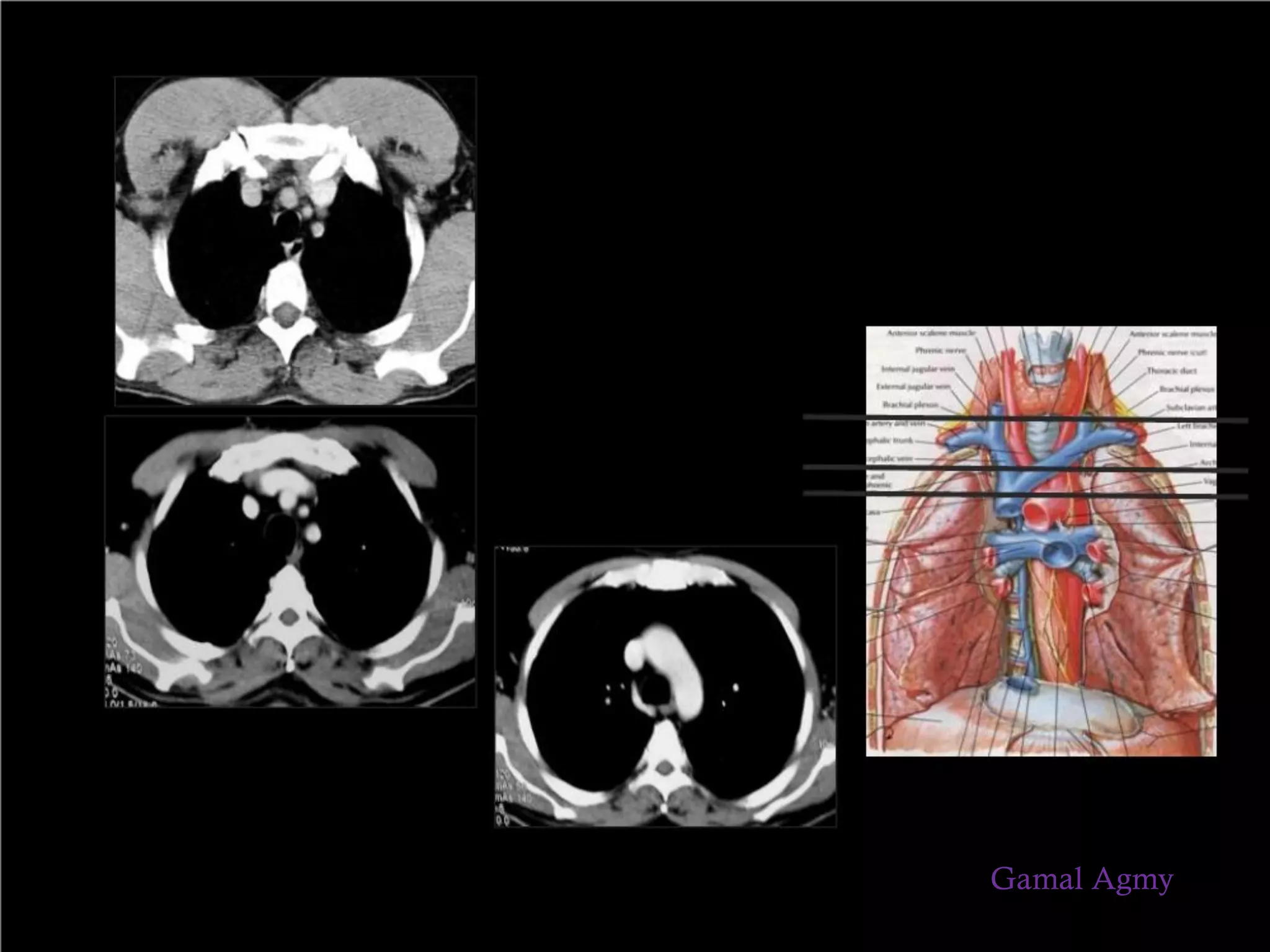
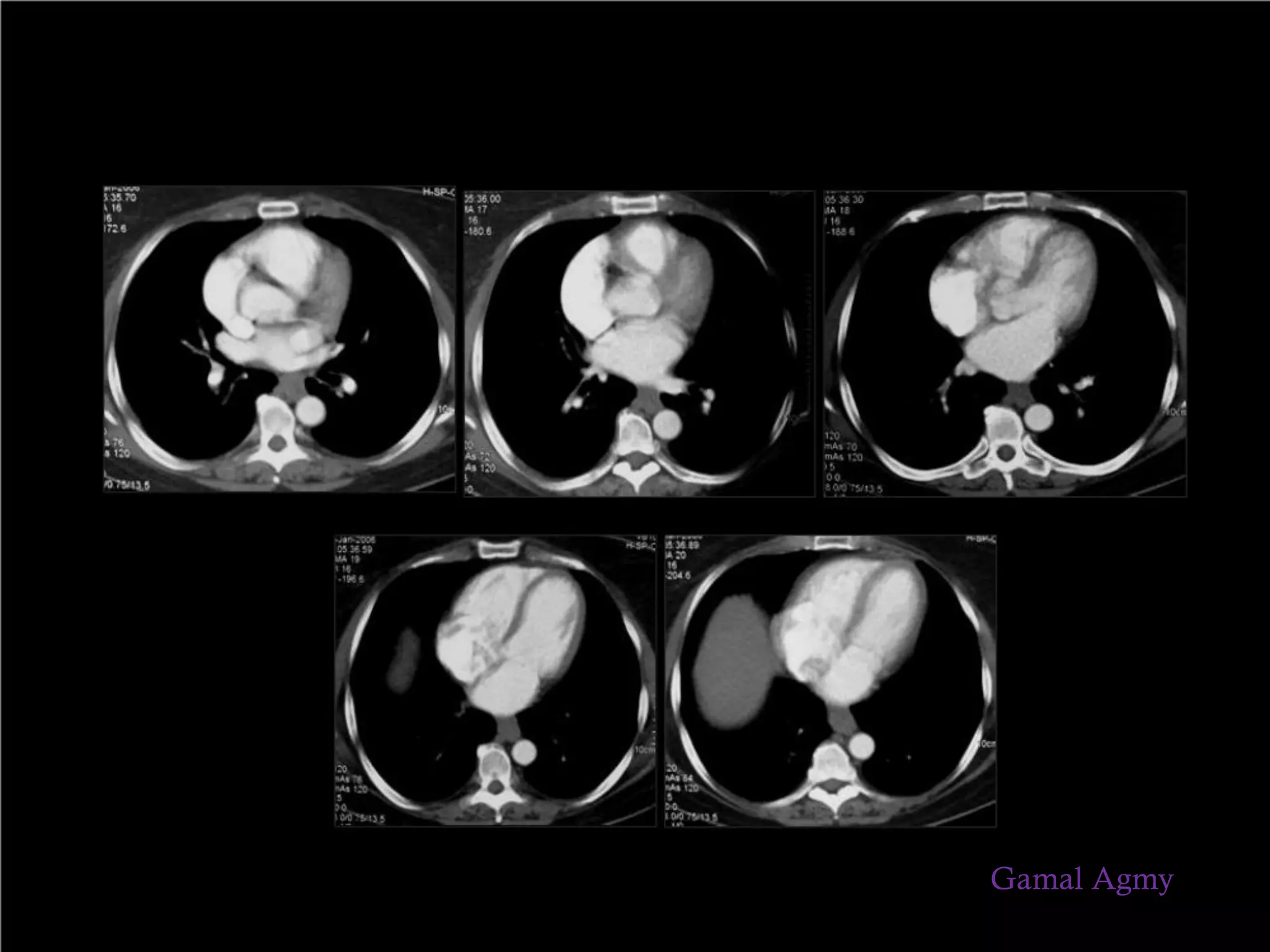
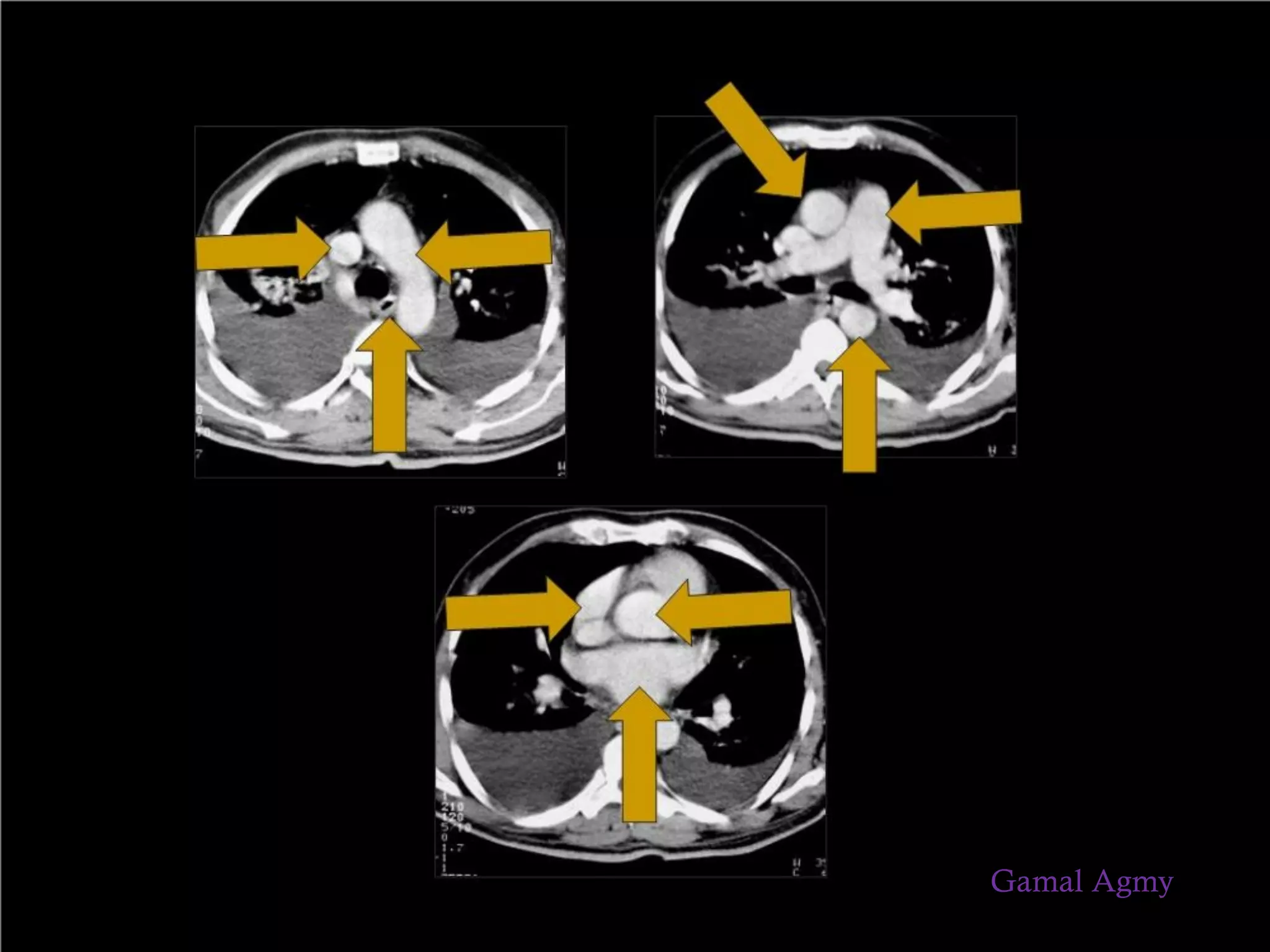
CT anatomy
4
Gamal Agmy
Gamal Agmy
Gamal Agmy
Gamal Agmy
Gamal Agmy
Gamal Agmy
Gamal Agmy
Gamal Agmy
Gamal Agmy
Mediastinal
origin?
 The main bulk of the lesion is present in the mediastinum
 Lesion arising from a mediastinal structure
 Obtuse angle of interface with the mediastinal border
Gamal Agmy
Pneumomediastinum
Gamal Agmy
Figure 9a. Thymic sail sign in a 4-year-old patient who had inhaled gasoline fumes. (a) InitialFigure 12b. Double bronchial wall sign. (a) Radiograph obtained in a 35-year-old asthmatic patientFigure 11a. Tubular artery sign in a 28-year-old man who sustained blunt trauma. (a)
Gamal Agmy
Gamal Agmy
Mediastinal lymphadenopathy
Gamal Agmy
Lymph
nodes Anatomic Considerations
Retrosternal
Prevascular
Retrocaval
Aortic window
Carinal
Subcarinal
Hilar
Z-esophageal
Circm-cardiac
3
3
Gamal Agmy
Lymph
nodes
Anatomic Considerations
Retrosternal
Prevascular
Retrocaval
Aortic window
Carinal
Subcarinal
Hilar
Z-esophageal
Circm-cardiac
6
5 Gamal Agmy
Lymph
nodes
Anatomic Considerations
Retrosternal
Prevascular
Retrocaval
Aortic window
Carinal
Subcarinal
Hilar
Z-esophageal
Circm-cardiac
7
7
8
9
Gamal Agmy
Lymph
nodes
X-Rays
Enlarged hilar shadow with lobulated outlines
Normal
Gamal Agmy
Lymph
nodes
CT
MRI
Multiple masses at the anatomic locations of lymph nodes
Gamal Agmy
Lymph
nodes
Nodes with necrotic center = inflammatory, metastatic
Bulky nodes = lymphoma
Calcifications seen in TB, sarcoid, silicosis
Calcification is rare in malignant nodes [chondro /
osteosarcoma]
General Rules
Gamal Agmy
•
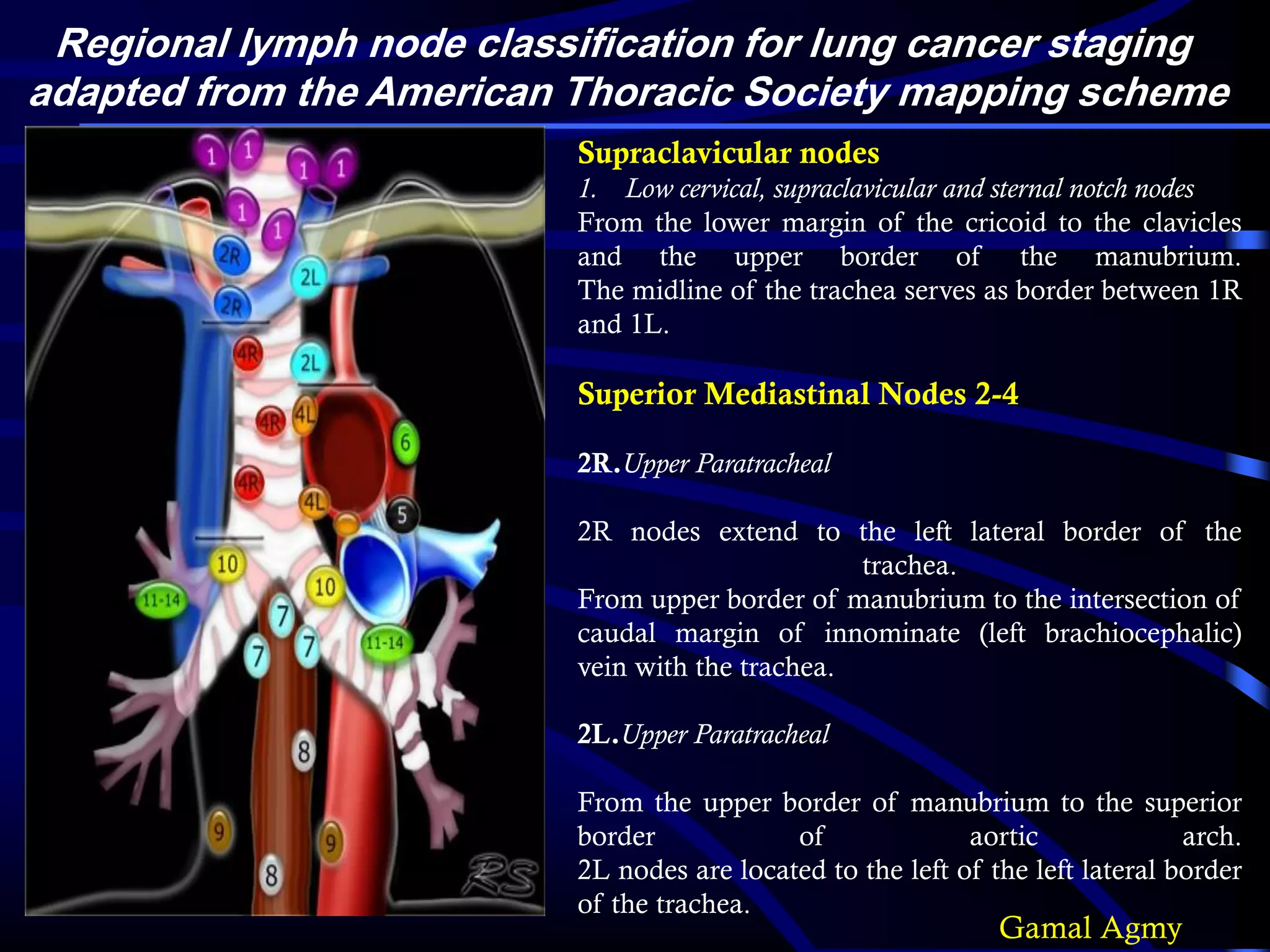
Regional lymph node classification for lung cancer staging
adapted from the American Thoracic Society mapping scheme
Supraclavicular nodes
1. Low cervical, supraclavicular and sternal notch nodes
From the lower margin of the cricoid to the clavicles
and the upper border of the manubrium.
The midline of the trachea serves as border between 1R
and 1L.
Superior Mediastinal Nodes 2-4
2R.Upper Paratracheal
2R nodes extend to the left lateral border of the
trachea.
From upper border of manubrium to the intersection of
caudal margin of innominate (left brachiocephalic)
vein with the trachea.
2L.Upper Paratracheal
From the upper border of manubrium to the superior
border of aortic arch.
2L nodes are located to the left of the left lateral border
of the trachea.
Gamal Agmy
•
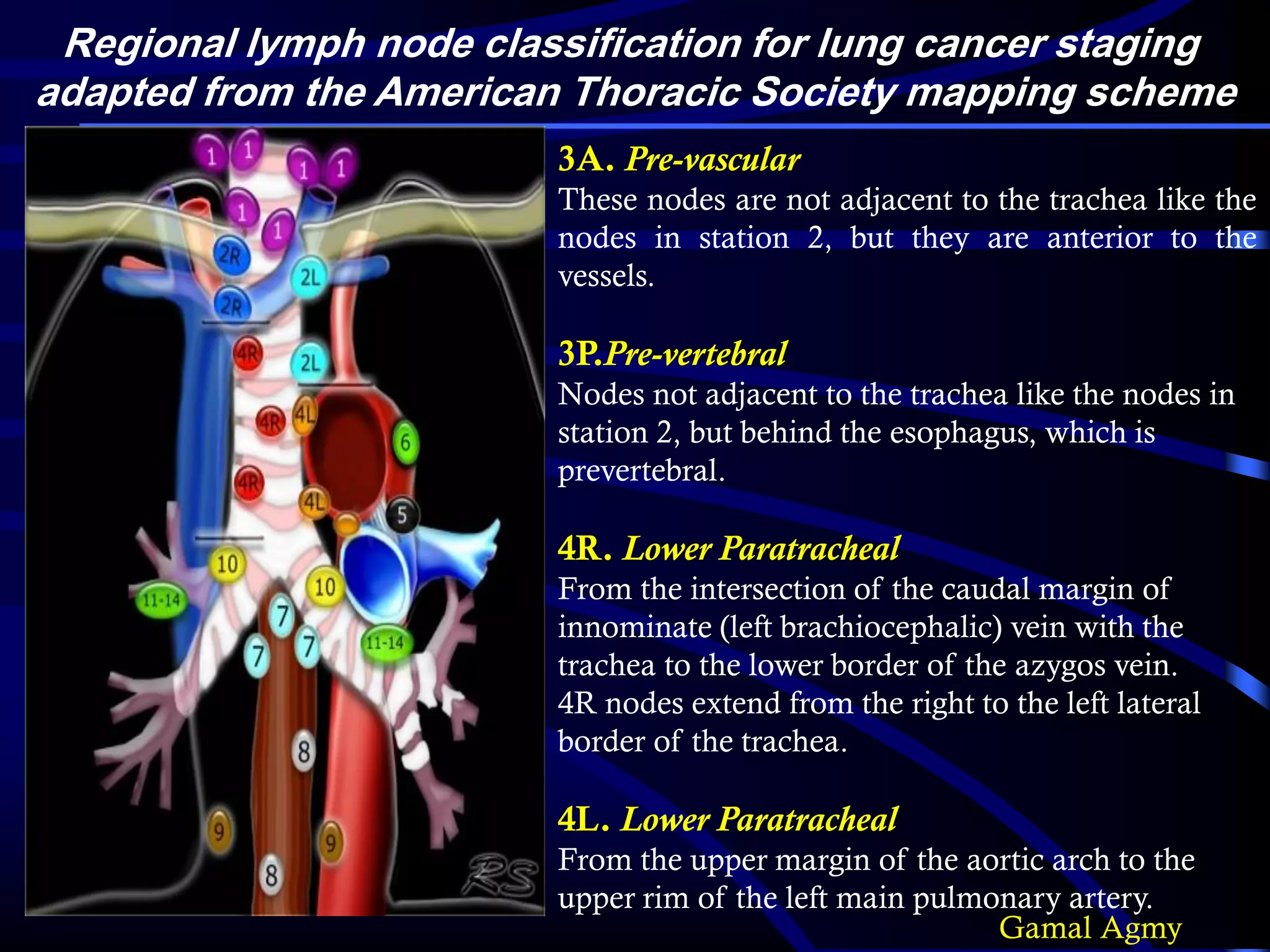
Regional lymph node classification for lung cancer staging
adapted from the American Thoracic Society mapping scheme
3A. Pre-vascular
These nodes are not adjacent to the trachea like the
nodes in station 2, but they are anterior to the
vessels.
3P.Pre-vertebral
Nodes not adjacent to the trachea like the nodes in
station 2, but behind the esophagus, which is
prevertebral.
4R. Lower Paratracheal
From the intersection of the caudal margin of
innominate (left brachiocephalic) vein with the
trachea to the lower border of the azygos vein.
4R nodes extend from the right to the left lateral
border of the trachea.
4L. Lower Paratracheal
From the upper margin of the aortic arch to the
upper rim of the left main pulmonary artery.
Gamal Agmy
•
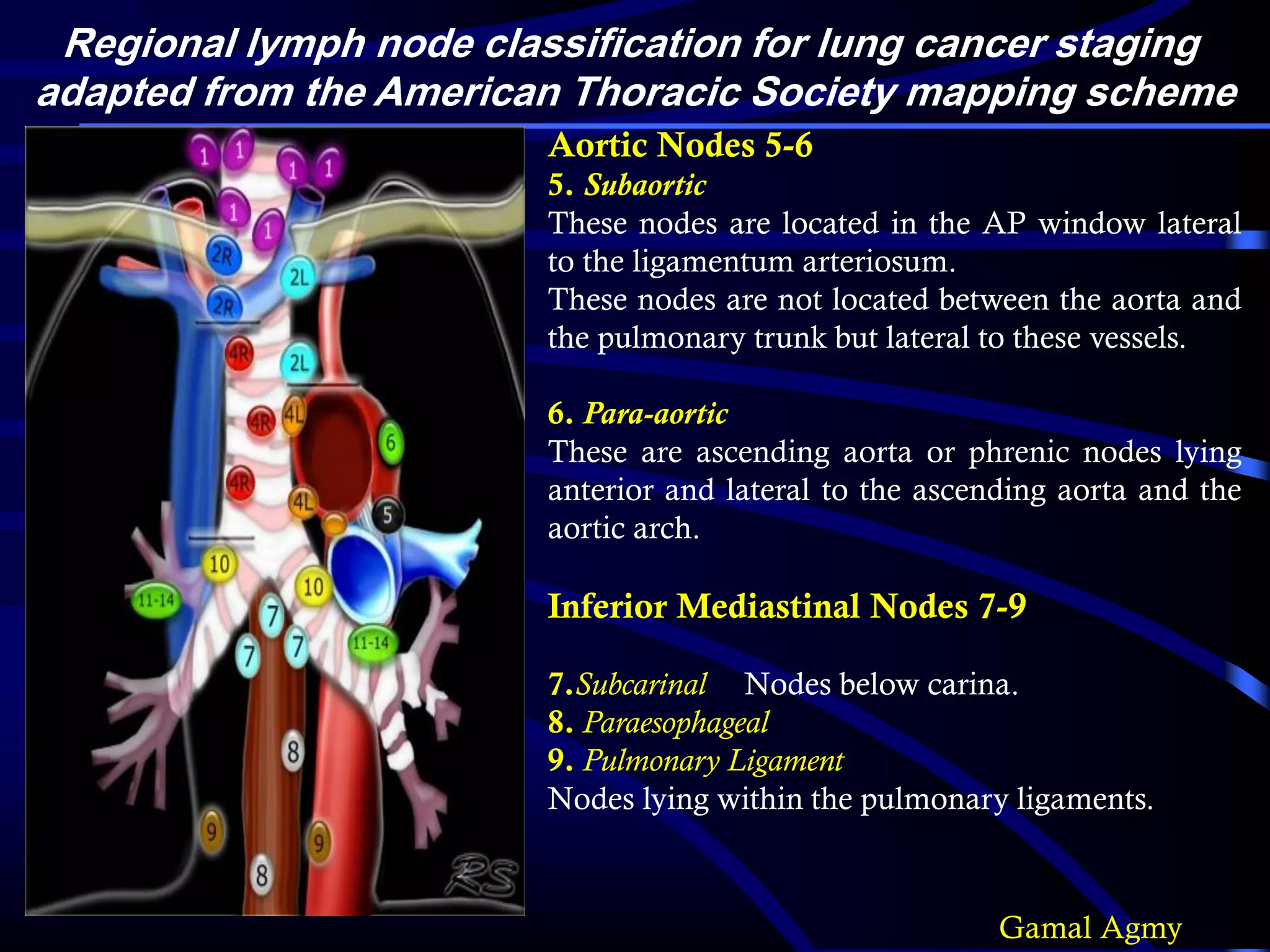
Regional lymph node classification for lung cancer staging
adapted from the American Thoracic Society mapping scheme
Aortic Nodes 5-6
5. Subaortic
These nodes are located in the AP window lateral
to the ligamentum arteriosum.
These nodes are not located between the aorta and
the pulmonary trunk but lateral to these vessels.
6. Para-aortic
These are ascending aorta or phrenic nodes lying
anterior and lateral to the ascending aorta and the
aortic arch.
Inferior Mediastinal Nodes 7-9
7.Subcarinal Nodes below carina.
8. Paraesophageal
9. Pulmonary Ligament
Nodes lying within the pulmonary ligaments.
Gamal Agmy
Regional lymph node classification for lung cancer staging
adapted from the American Thoracic Society mapping scheme
Hilar, Lobar and (sub)segmental Nodes
10-14
These are all N1-nodes.
10. Hilar nodes
These include nodes adjacent to the main stem
bronchus and hilar vessels.
On the right they extend from the lower rim of
the azygos vein to the interlobar region.
On the left from the upper rim of the
pulmonary artery to the interlobar region.
Gamal Agmy
1. Supraclavicular zone nodes
These include low cervical,
supraclavicular and sternal
notch nodes.
Upper border: lower margin of
cricoid.
Lower border: clavicles and upper
border of manubrium.
The midline of the trachea
serves as border between 1R and
1L.
Gamal Agmy
2R. Right Upper Paratracheal
2R nodes extend to the left lateral
border of the trachea.
Upper border: upper border of
manubrium.
Lower border: intersection of caudal
margin of innominate (left
brachiocephalic) vein with the
trachea.
2L. Left Upper Paratracheal
Upper border: upper border of
manubrium.
Lower border: superior border of
aortic arch.
On the left a station 2 node in front
of the trachea, i.e. a 2R-node.
There is also a small prevascular
node, i.e. a station 3A node
Gamal Agmy
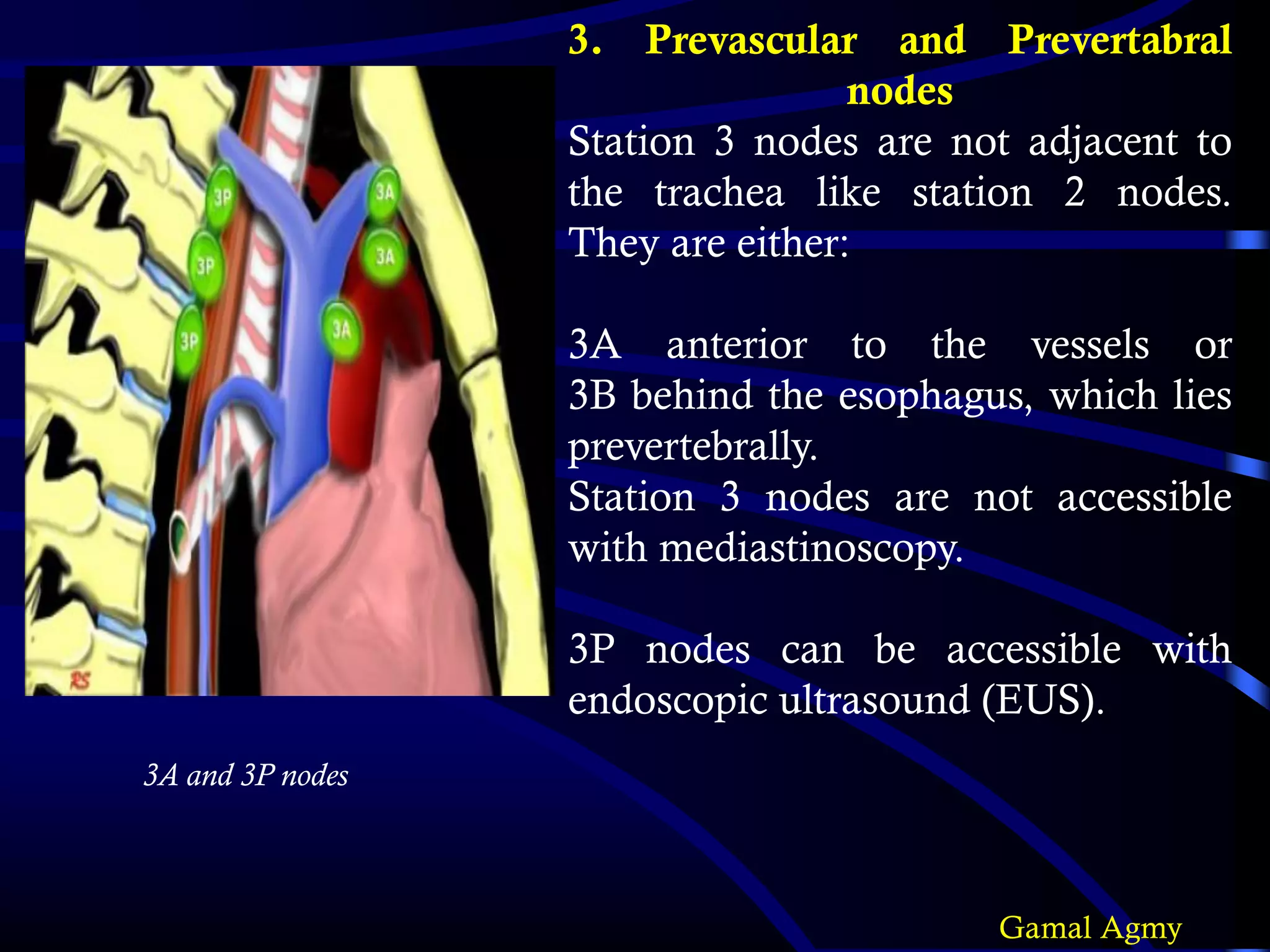
3. Prevascular and Prevertabral
nodes
Station 3 nodes are not adjacent to
the trachea like station 2 nodes.
They are either:
3A anterior to the vessels or
3B behind the esophagus, which lies
prevertebrally.
Station 3 nodes are not accessible
with mediastinoscopy.
3P nodes can be accessible with
endoscopic ultrasound (EUS).
3A and 3P nodes
Gamal Agmy
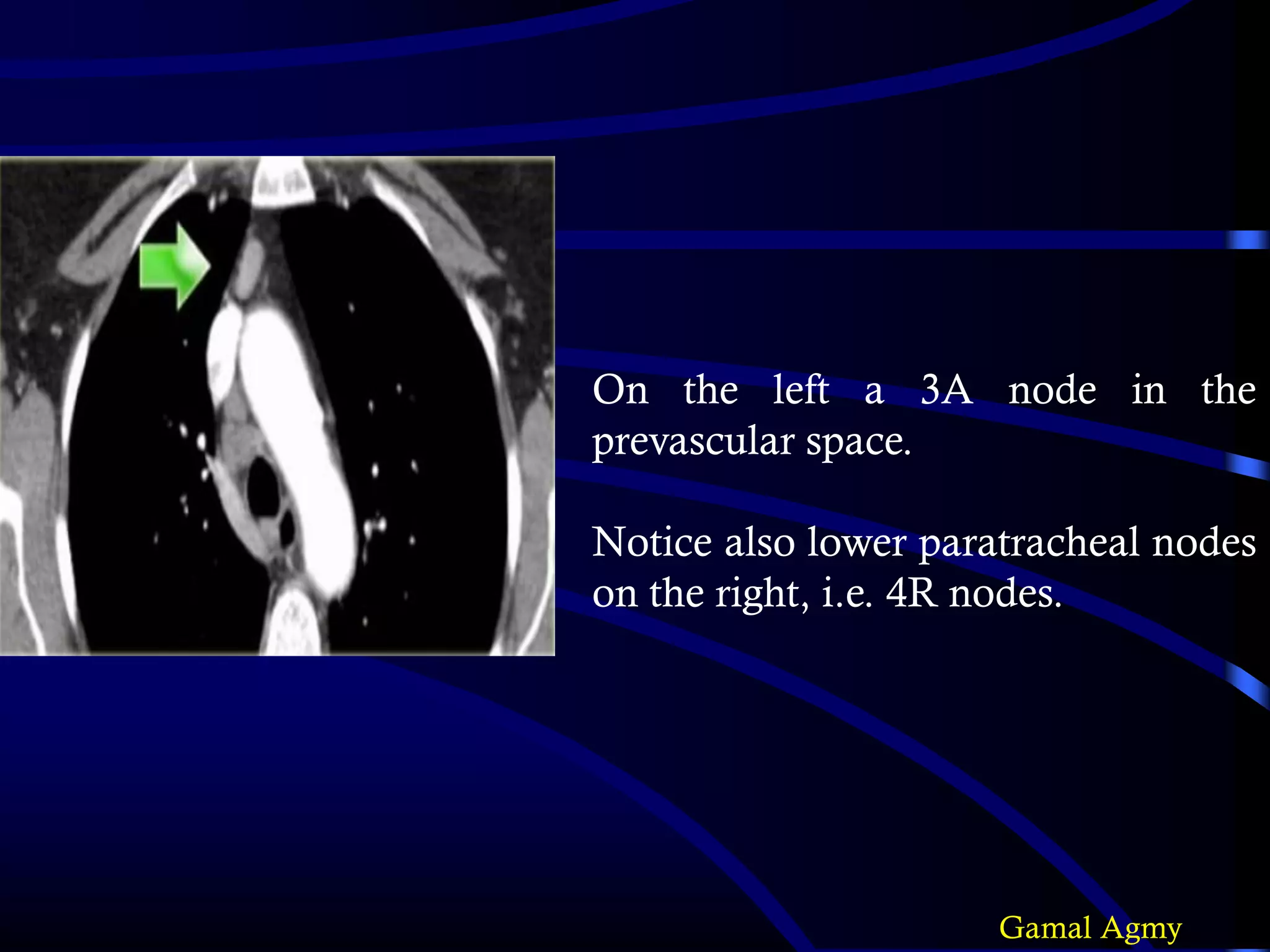
On the left a 3A node in the
prevascular space.
Notice also lower paratracheal nodes
on the right, i.e. 4R nodes.
Gamal Agmy
4R. Right Lower Paratracheal
Upper border: intersection of caudal
margin of innominate (left
brachiocephalic) vein with the
trachea.
Lower border:lower border of azygos
vein.
4R nodes extend to the left lateral
border of the trachea.
Gamal Agmy
On the left we see 4R
paratracheal nodes.
In addition there is an aortic
node lateral to the aortic arch,
i.e. station 6 node.
Gamal Agmy
4L. Left Lower Paratracheal
4L nodes are lower paratracheal nodes
that are located to the left of the left tracheal
border, between a horizontal line drawn
tangentially to the upper margin of the
aortic arch and a line extending across the
left main bronchus at the level of the
upper margin of the left upper lobe
bronchus.
These include paratracheal nodes that are
located medially to the ligamentum
arteriosum.
Station 5 (AP-window) nodes are located
laterally to the ligamentum arteriosum.
Gamal Agmy
On the left an image just above the level of the
pulmonary trunk demonstrating lower
paratracheal nodes on the left and on the right.
In addition there are also station 3 and 5 nodes
Gamal Agmy
On the left an image at the level of the lower trachea just above
the carina.
To the left of the trachea 4L nodes.
Notice that these 4L nodes are between the pulmonary trunk and
the aorta, but are not located in the AP-window, because they lie
medially to the ligamentum arteriosum.
The node lateral to the pulmonary trunk is a station 5 node.
Gamal Agmy
5. Subaortic nodes
Subaortic or aorto-pulmonary window nodes are lateral to the ligamentum
arteriosum or the aorta or left pulmonary artery and proximal to the first
branch of the left pulmonary artery and lie within the mediastinal pleural
envelope.
6. Para-aortic nodes
Para-aortic (ascending aorta or phrenic) nodes are located anteriorly and
laterally to the ascending aorta and the aortic arch from the upper margin to
the lower margin of the aortic arch.
Gamal Agmy
7. Subcarinal nodes
These nodes are located caudally to the carina of the trachea, but are not
associated with the lower lobe bronchi or arteries within the lung.
On the right they extend caudally to the lower border of the bronchus
intermedius.
On the left they extend caudally to the upper border of the lower lobe
bronchus.
On the left a station 7 subcarinal node to the right of the esophagus.
Gamal Agmy
8 Paraesophageal nodes
These nodes are below the carinal nodes and extend caudally to
the diaphragm.
On the left an image below the carina.
To the right of the esophagus a station 8 node.
Gamal Agmy
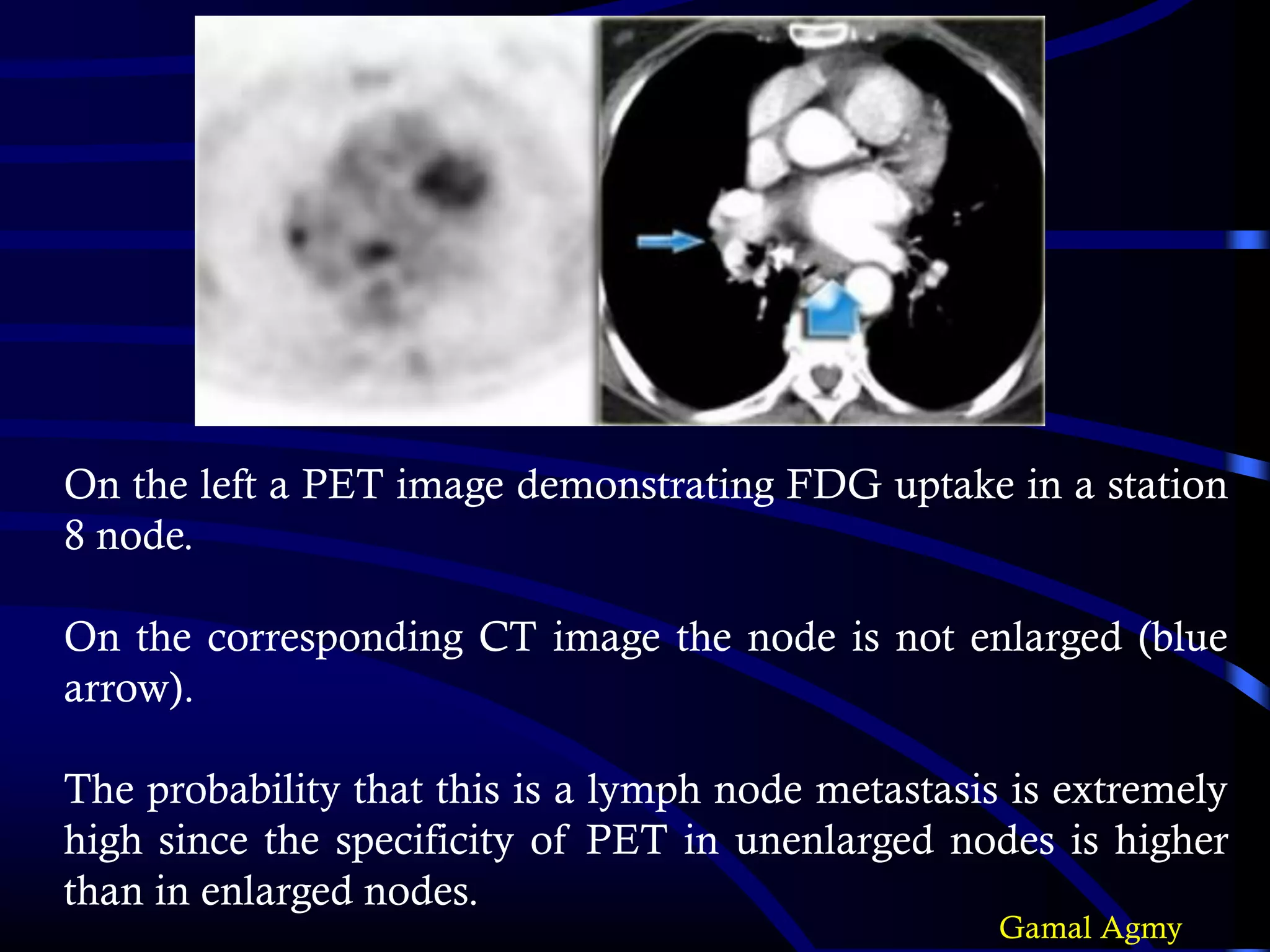
On the left a PET image demonstrating FDG uptake in a station
8 node.
On the corresponding CT image the node is not enlarged (blue
arrow).
The probability that this is a lymph node metastasis is extremely
high since the specificity of PET in unenlarged nodes is higher
than in enlarged nodes.
Gamal Agmy
9. Pulmonary ligament nodes
Pulmonary ligament nodes are lying within the pulmonary
ligament, including those in the posterior wall and lower part of
the inferior pulmonary vein.
The pulmonary ligament is the inferior extension of the
mediastinal pleural reflections that surround the hila.
Gamal Agmy
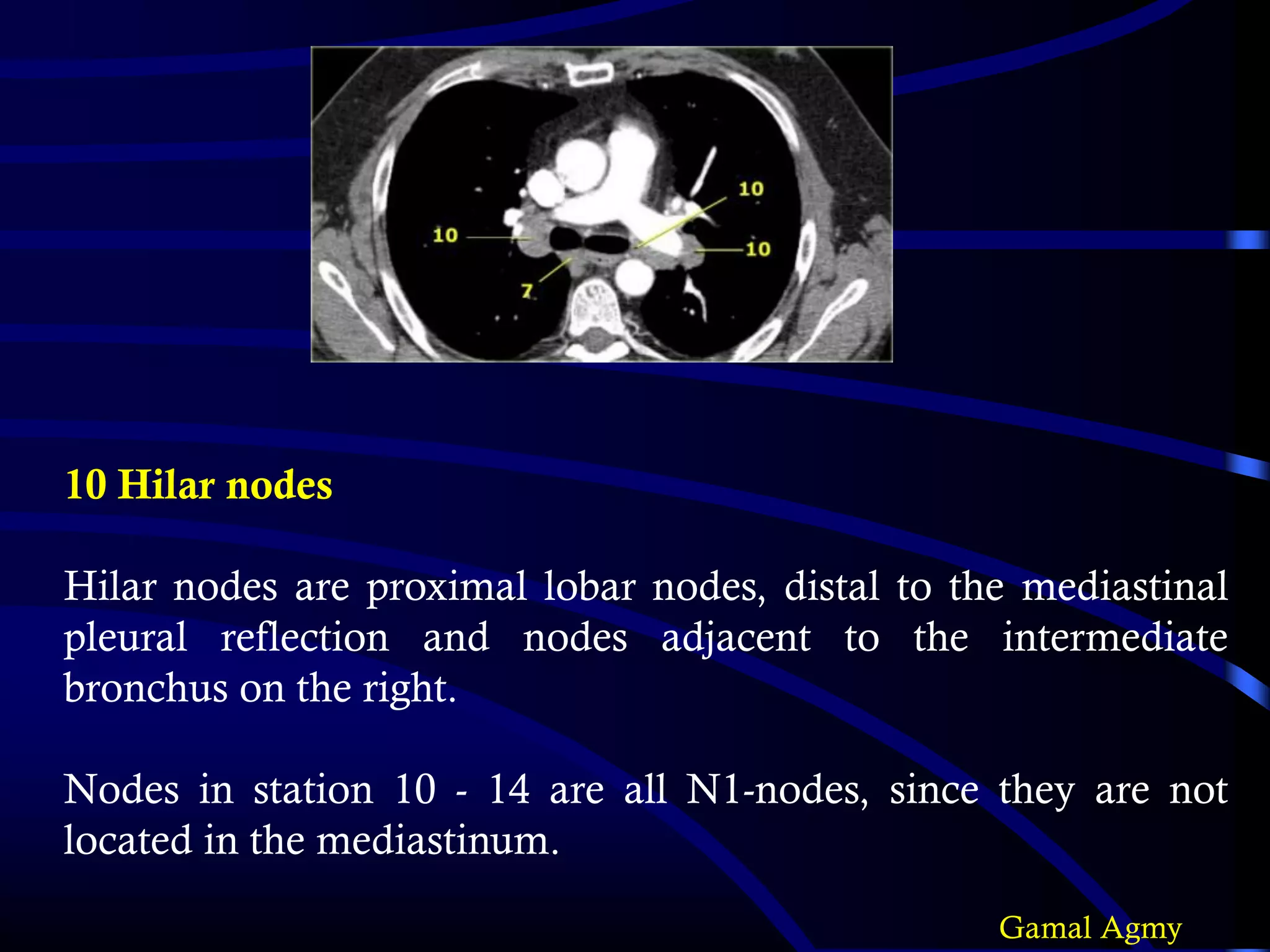
10 Hilar nodes
Hilar nodes are proximal lobar nodes, distal to the mediastinal
pleural reflection and nodes adjacent to the intermediate
bronchus on the right.
Nodes in station 10 - 14 are all N1-nodes, since they are not
located in the mediastinum.
Gamal Agmy
10 Hilar nodes
Hilar nodes are proximal lobar nodes, distal to the mediastinal
pleural reflection and nodes adjacent to the intermediate
bronchus on the right.
Nodes in station 10 - 14 are all N1-nodes, since they are not
located in the mediastinum.
Gamal Agmy
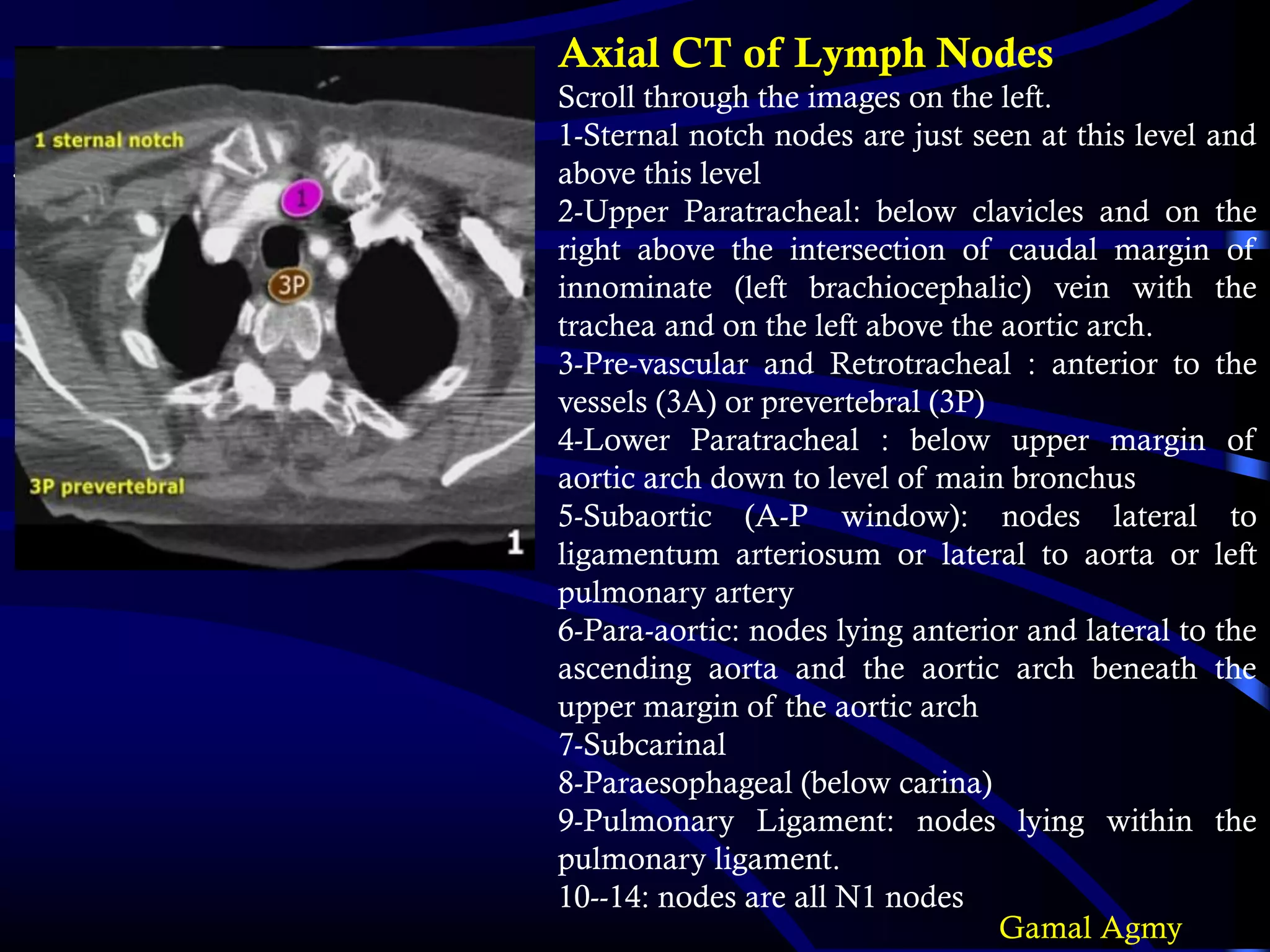
Axial CT of Lymph Nodes
Scroll through the images on the left.
1-Sternal notch nodes are just seen at this level and
above this level
2-Upper Paratracheal: below clavicles and on the
right above the intersection of caudal margin of
innominate (left brachiocephalic) vein with the
trachea and on the left above the aortic arch.
3-Pre-vascular and Retrotracheal : anterior to the
vessels (3A) or prevertebral (3P)
4-Lower Paratracheal : below upper margin of
aortic arch down to level of main bronchus
5-Subaortic (A-P window): nodes lateral to
ligamentum arteriosum or lateral to aorta or left
pulmonary artery
6-Para-aortic: nodes lying anterior and lateral to the
ascending aorta and the aortic arch beneath the
upper margin of the aortic arch
7-Subcarinal
8-Paraesophageal (below carina)
9-Pulmonary Ligament: nodes lying within the
pulmonary ligament.
10--14: nodes are all N1 nodes
•
Gamal Agmy
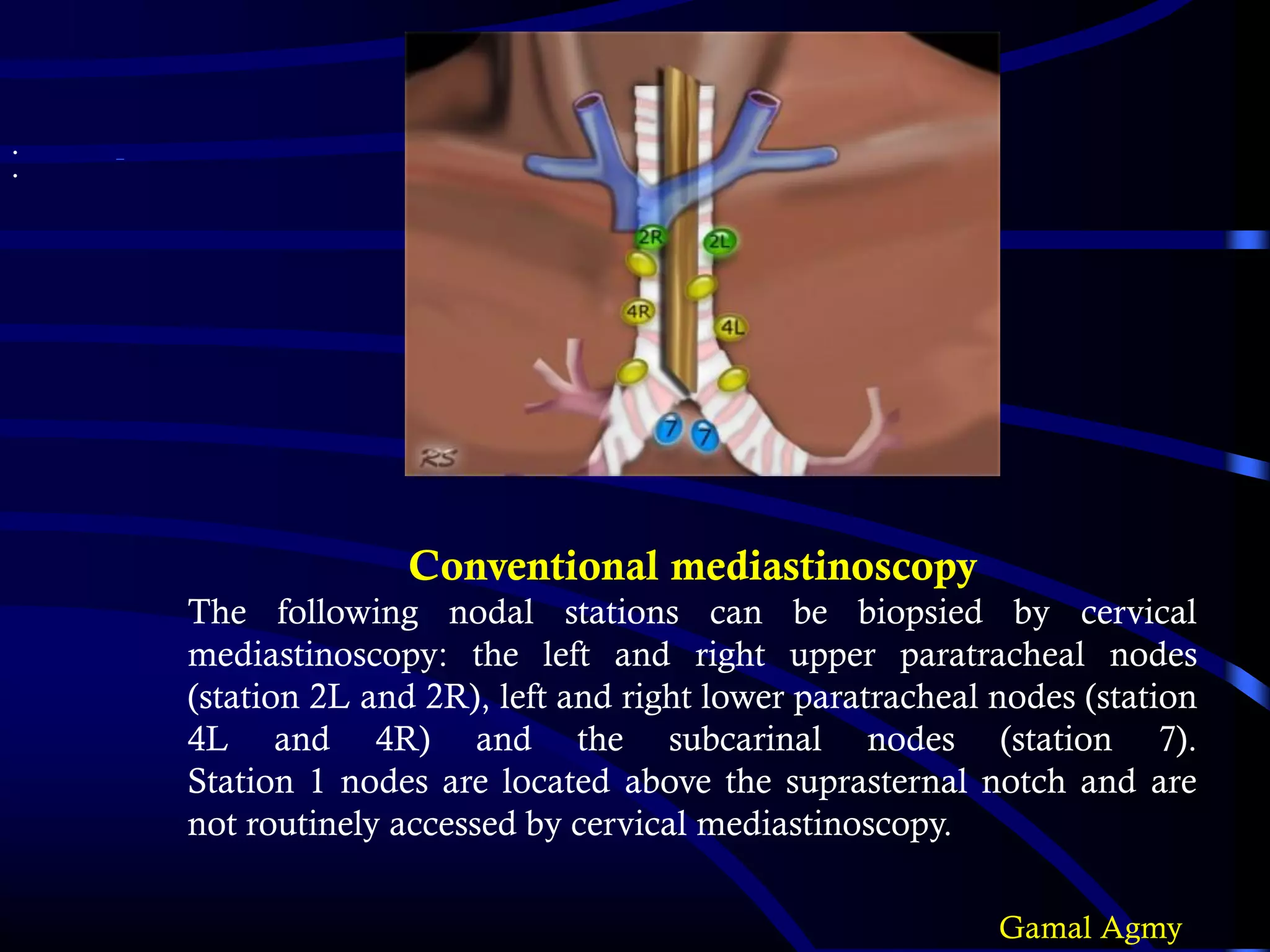
Conventional mediastinoscopy
The following nodal stations can be biopsied by cervical
mediastinoscopy: the left and right upper paratracheal nodes
(station 2L and 2R), left and right lower paratracheal nodes (station
4L and 4R) and the subcarinal nodes (station 7).
Station 1 nodes are located above the suprasternal notch and are
not routinely accessed by cervical mediastinoscopy.
•
•
Gamal Agmy
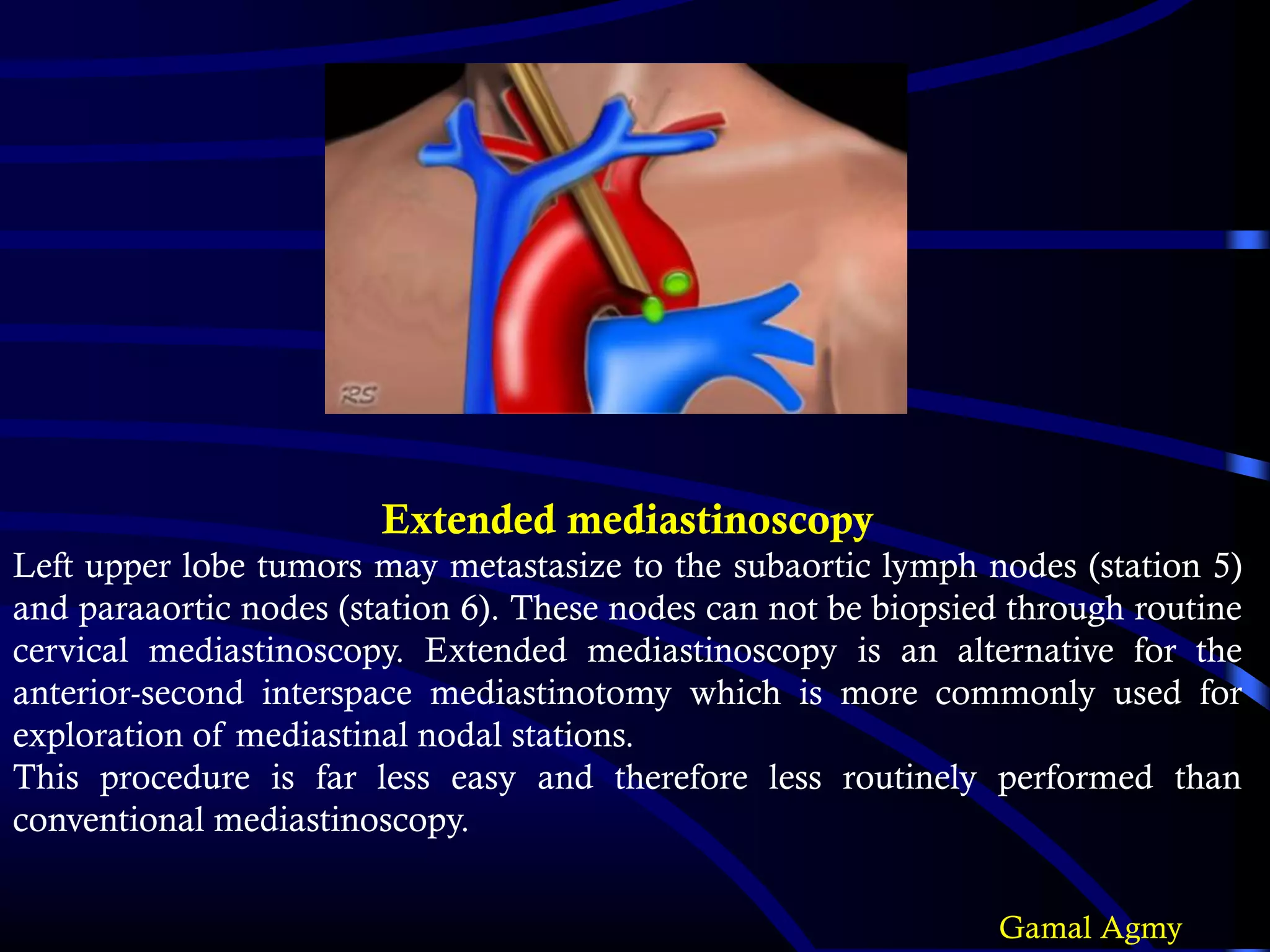
Extended mediastinoscopy
Left upper lobe tumors may metastasize to the subaortic lymph nodes (station 5)
and paraaortic nodes (station 6). These nodes can not be biopsied through routine
cervical mediastinoscopy. Extended mediastinoscopy is an alternative for the
anterior-second interspace mediastinotomy which is more commonly used for
exploration of mediastinal nodal stations.
This procedure is far less easy and therefore less routinely performed than
conventional mediastinoscopy.
Gamal Agmy
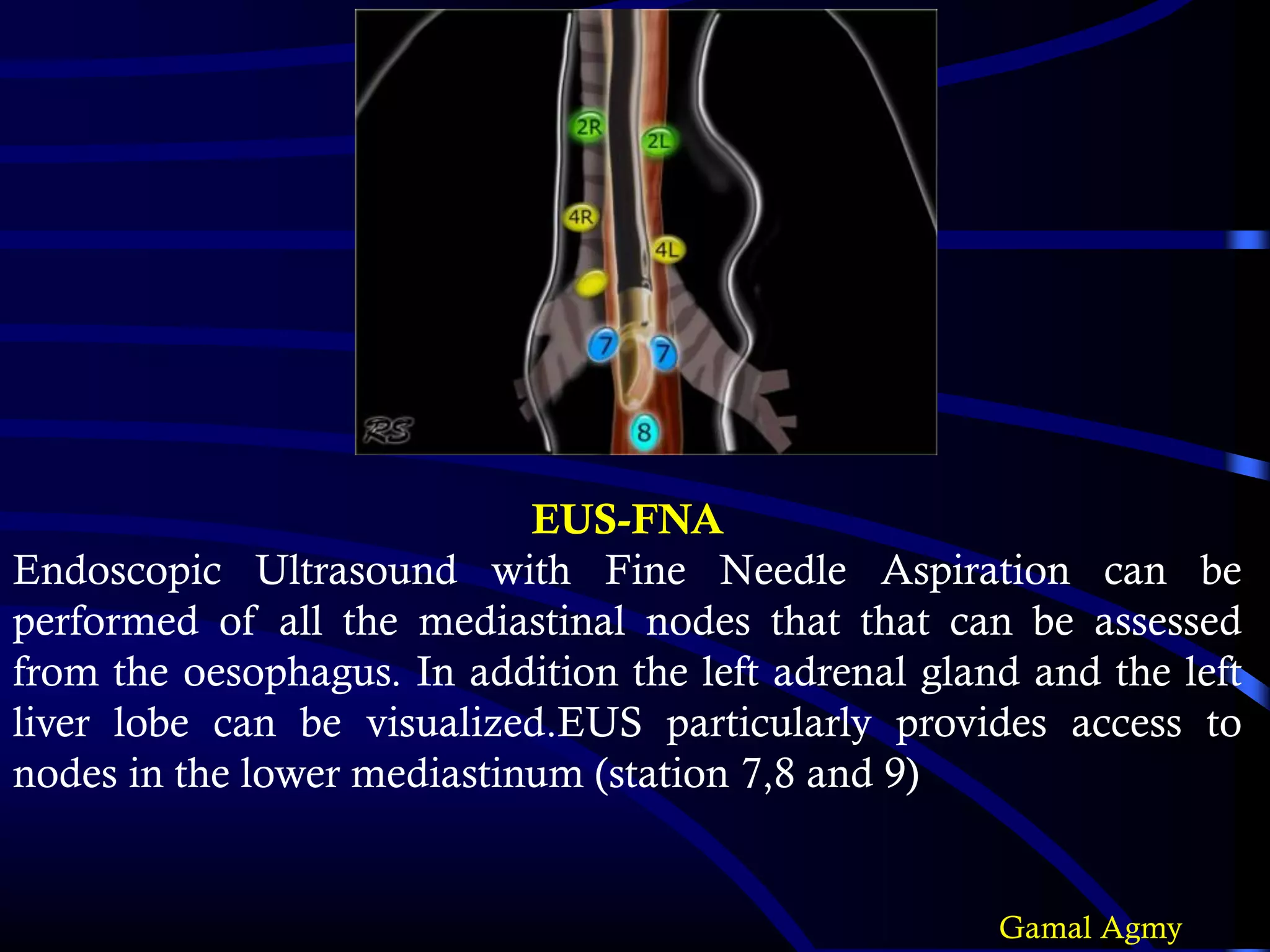
EUS-FNA
Endoscopic Ultrasound with Fine Needle Aspiration can be
performed of all the mediastinal nodes that that can be assessed
from the oesophagus. In addition the left adrenal gland and the left
liver lobe can be visualized.EUS particularly provides access to
nodes in the lower mediastinum (station 7,8 and 9)
Gamal Agmy
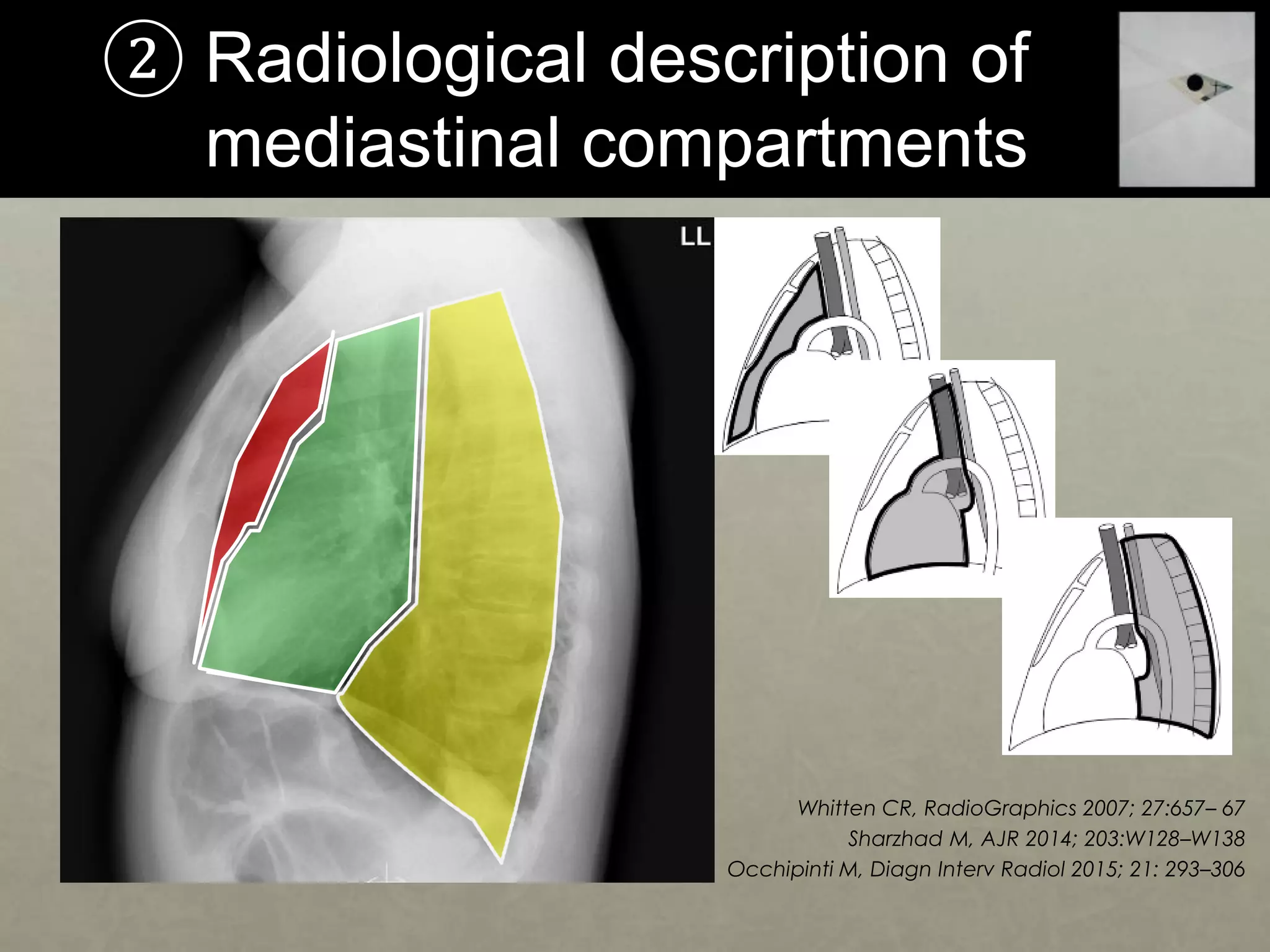
② Radiological description of
mediastinal compartments
Whitten CR, RadioGraphics 2007; 27:657– 67
Sharzhad M, AJR 2014; 203:W128–W138
Occhipinti M, Diagn Interv Radiol 2015; 21: 293–306
② Radiological description of
mediastinal compartments
Whitten CR, RadioGraphics 2007; 27:657– 67
Sharzhad M, AJR 2014; 203:W128–W138
Occhipinti M, Diagn Interv Radiol 2015; 21: 293–306
Gamal Agmy
② Radiological description of
mediastinal compartments
Whitten CR, RadioGraphics 2007; 27:657– 67
Sharzhad M, AJR 2014; 203:W128–W138
Occhipinti M, Diagn Interv Radiol 2015; 21: 293–306
Gamal Agmy
② Radiological description of
mediastinal compartments
Kim TJ, RadioGraphics 2007; 27:409 – 429
Young CA, RadioGraphics 2008; 28:1541–1553
Katabathina VS, RadioGraphics 2011; 31:1141–1160
Emergencies
• Acute aortic syndrome
• Acute mediastinitis
• Esophagus
• Tension pneumomediastinum
• Radiation therapy
Gamal Agmy
Objectives
① Imaging techniques
② Radiological description of mediastinal
compartments
③Differential diagnosis of mediastinal disease
④ Interventional supply
Gamal Agmy
③ Differential diagnosis of
mediastinal disease - Anterior
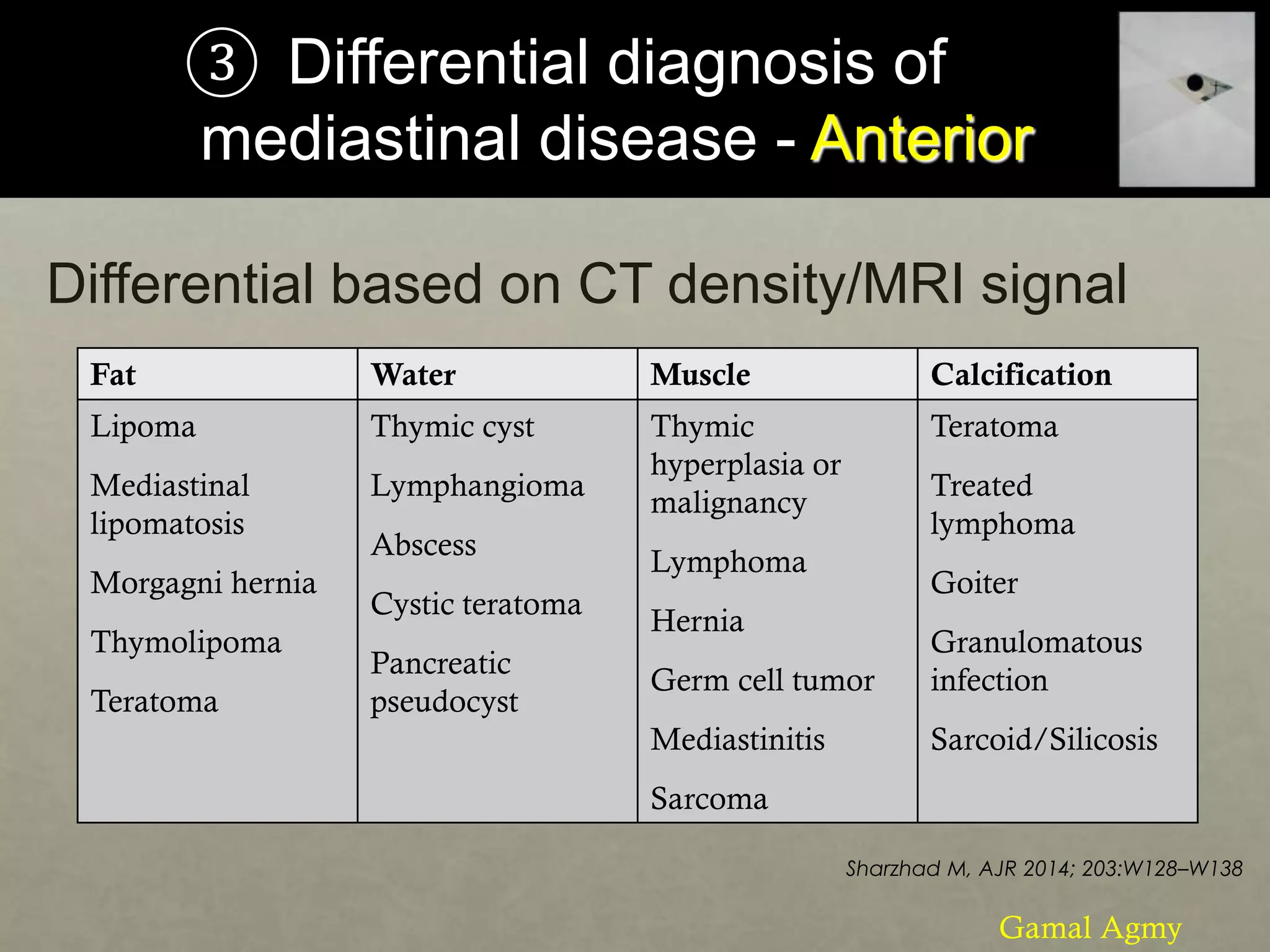
Differential based on CT density/MRI signal
Fat Water Muscle Calcification
Lipoma
Mediastinal
lipomatosis
Morgagni hernia
Thymolipoma
Teratoma
Thymic cyst
Lymphangioma
Abscess
Cystic teratoma
Pancreatic
pseudocyst
Thymic
hyperplasia or
malignancy
Lymphoma
Hernia
Germ cell tumor
Mediastinitis
Sarcoma
Teratoma
Treated
lymphoma
Goiter
Granulomatous
infection
Sarcoid/Silicosis
Sharzhad M, AJR 2014; 203:W128–W138
Gamal Agmy
③ Differential diagnosis of
mediastinal disease - Anterior
Fat attenuation: low likelihood of malignancy
Pineda V, RadioGraphics 2007; 27:19 –32
Molinari F, AJR 2011; 197:W795–W813
Morgagni HerniaLiposarcoma
Gamal Agmy
③ Differential diagnosis of
mediastinal disease - Anterior
Molinari F, AJR 2011; 197:W795–W813
Sharzhad M, AJR 2014; 203:W128–W138
Lipoma
Mediastinal
lipomatosis
Gamal Agmy
③ Differential diagnosis of
mediastinal disease - Anterior
Sharzhad M, AJR 2014; 203:W128–W138
Teratoma Goiter
Gamal Agmy
③ Differential diagnosis of
mediastinal disease - Anterior
Nasseri F, RadioGraphics 2010; 30:413–428
Molinari F, AJR 2011; 197:W795–W813
Rebound
hyperplasia
Thymus
Gamal Agmy
③ Differential diagnosis of
mediastinal disease - Anterior
Pineda V, RadioGraphics 2007; 27:19 –32
Benveniste MFK, RadioGraphics 2011; 31:1847–1861
Thymoma
(Masaoka-Koga staging system)
Gamal Agmy
③ Differential diagnosis of
mediastinal disease - Anterior
Falkson CB, J Thorac Oncol 2009;4(7):911–919
Benveniste MFK, RadioGraphics 2011; 31:1847–1861
Thymoma: treatment based on Masaoka-Koga staging system
Stage Macro & Microscopic Features Treatment
I Complete encapsulation Surgery
IIa Microscopic invasion of capsula
Surgery + Optional RT
IIb Macroscopic invasion of capsula
III Invasion of adjacent organ
(pericardium, great vessels, or lung) Neoadjuvant ChT + Surgery
+ Optional RT
IVa Pleural or pericardial dissemination
IVb Lymphatic-hematogenous metastasis Palliative ChT
Gamal Agmy
③ Differential diagnosis of
mediastinal disease - Anterior
Lymphoma
Gamal Agmy
③ Differential diagnosis of
mediastinal disease - Anterior
Lymphoma: diffuse disease of mediastinum
Gamal Agmy
③ Differential diagnosis of
mediastinal disease - Anterior
Lymphoma: after treatment
Courtesy of Dr Francesco Molinari
Gamal Agmy
③ Differential diagnosis of
mediastinal disease - Anterior
Calcified pattern: differential
Treated
lymphoma
Post-traumatic pericardial
cyst (prisoner)
Echinococcus
Polat P, RadioGraphics 2003; 23:475– 494
Gamal Agmy
③ Differential diagnosis of
mediastinal disease - Anterior
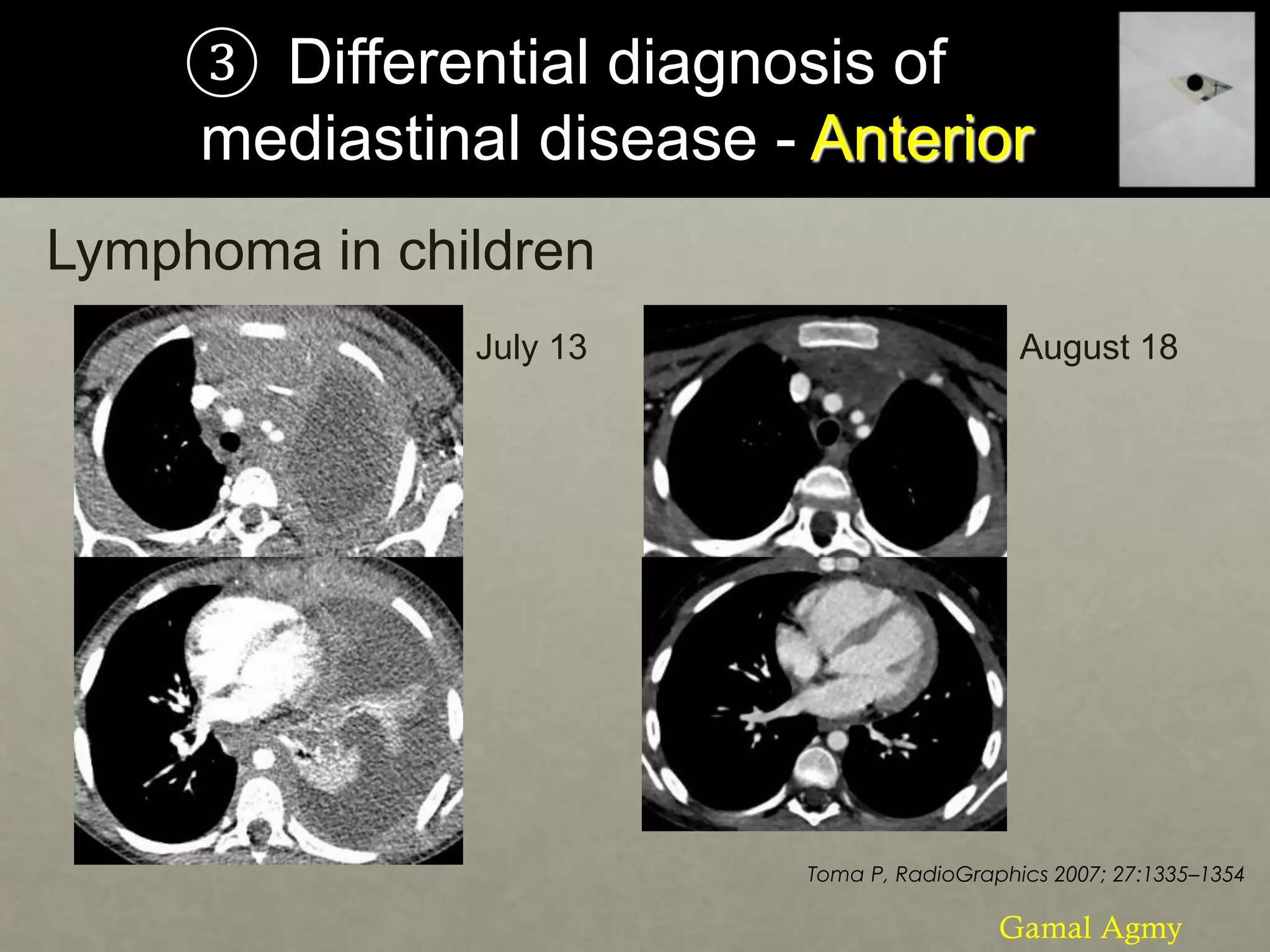
Lymphoma in children
Toma P, RadioGraphics 2007; 27:1335–1354
July 13 August 18
Gamal Agmy
③ Differential diagnosis of
mediastinal disease - Anterior
Cardiophrenic space
Jeung MY, RadioGraphics 2002; 22:S79 –S93
Pineda V, RadioGraphics 2007; 27:19 –32
Gamal Agmy
③ Differential diagnosis of
mediastinal disease - Anterior
Cardiophrenic space – Cystic
Jeung MY, RadioGraphics 2002; 22:S79 –S93
Pineda V, RadioGraphics 2007; 27:19 –32
Gamal Agmy
③ Differential diagnosis of
mediastinal disease - Anterior
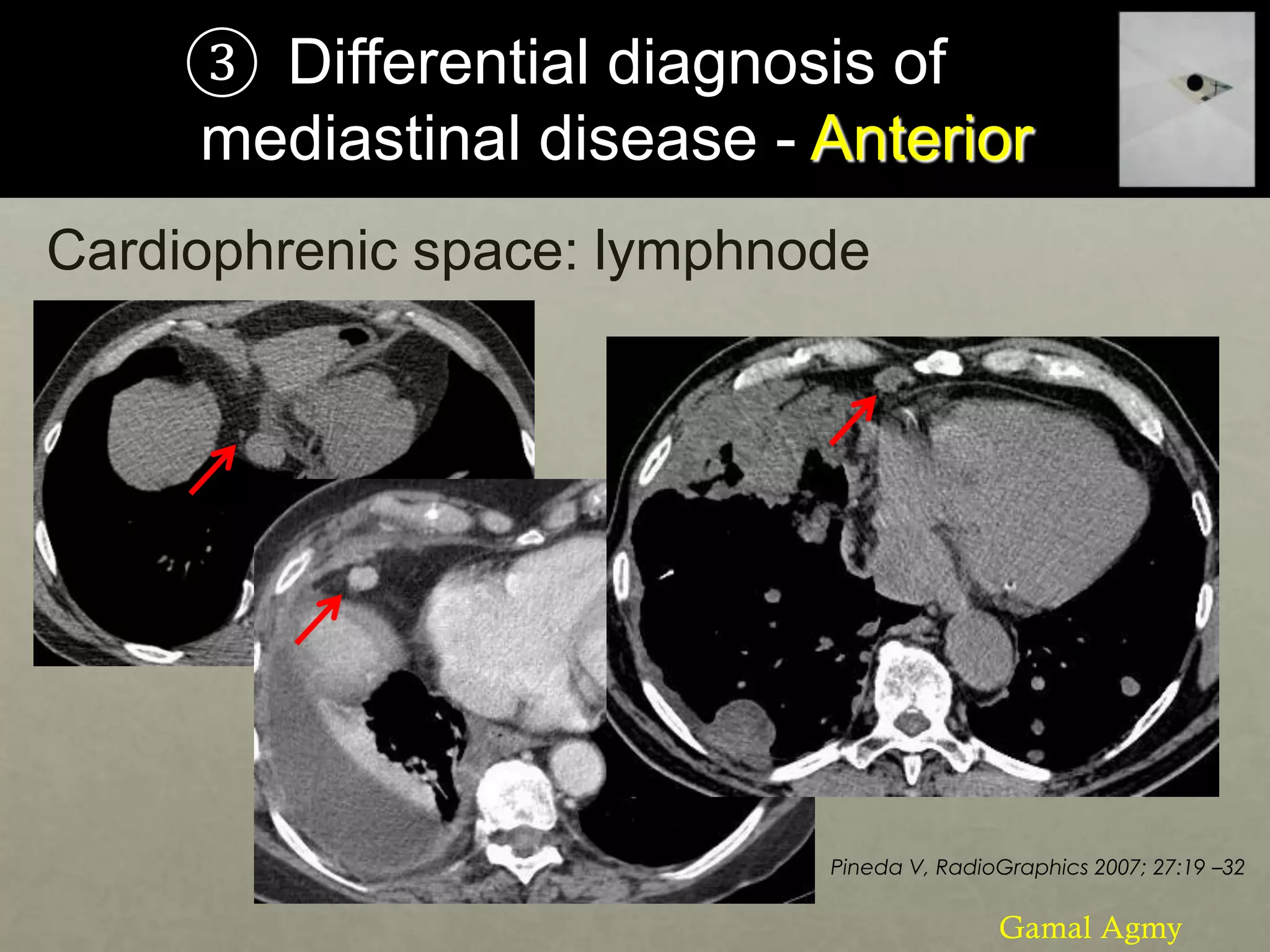
Cardiophrenic space: lymphnode
Pineda V, RadioGraphics 2007; 27:19 –32
Gamal Agmy
③ Differential diagnosis of
mediastinal disease - Middle
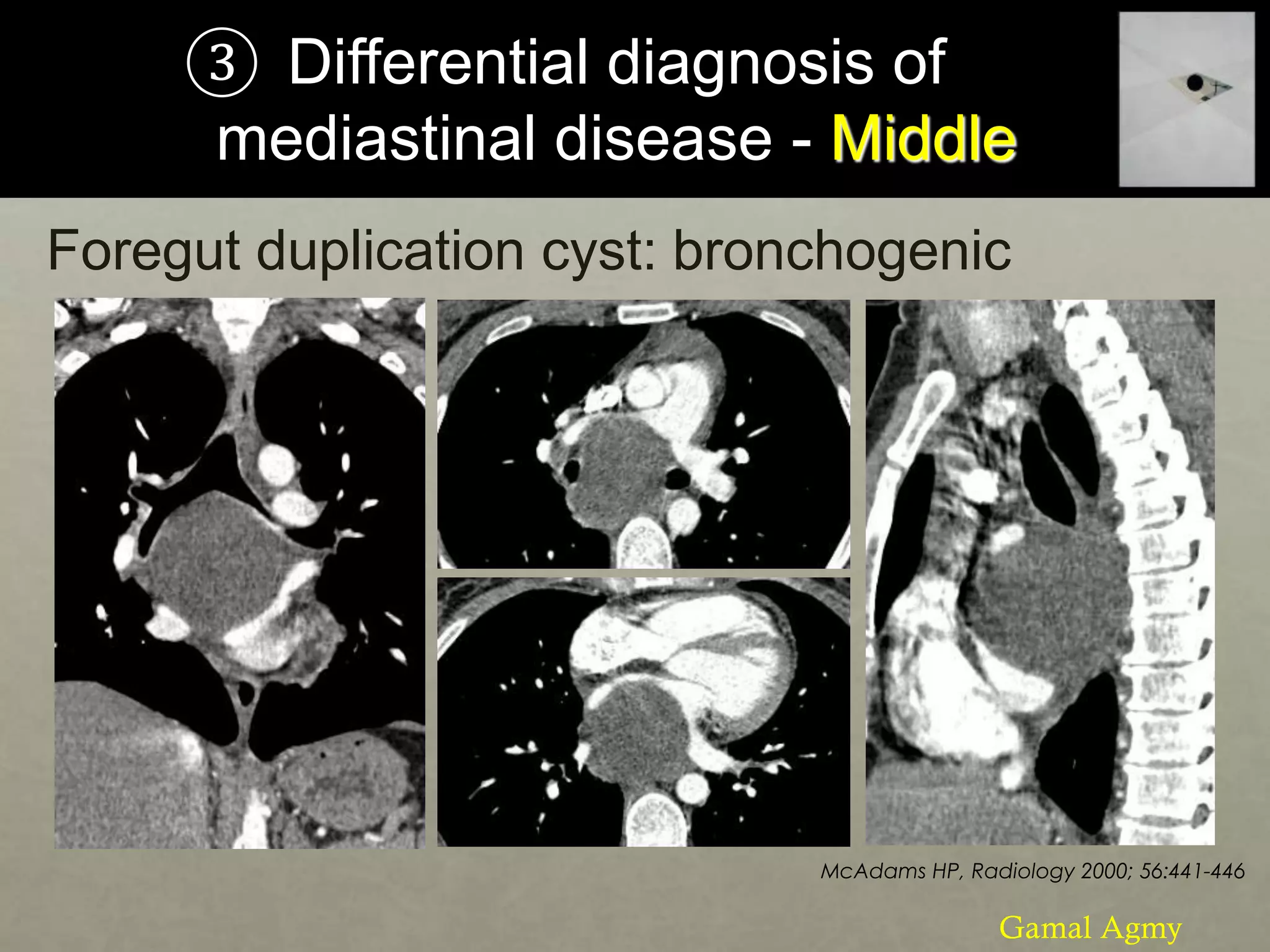
Foregut duplication cyst: bronchogenic
Berrocal T, RadioGraphics 2004 Volume 24, Issue 1
Gamal Agmy
③ Differential diagnosis of
mediastinal disease - Middle
Foregut duplication cyst: bronchogenic
McAdams HP, Radiology 2000; 56:441-446
Gamal Agmy
③ Differential diagnosis of
mediastinal disease - Middle
Tuberculosis
June 1, 2015 April 22, 2015
Gamal Agmy
③ Differential diagnosis of
mediastinal disease - Middle
Tuberculosis
June 1, 2015 August 11, 2015
Gamal Agmy
③ Differential diagnosis of
mediastinal disease - Middle
Differential: TB – Lymphoma – Others?
Tuberculosis Lymphoma Others?
T0
T1
Gamal Agmy
③ Differential diagnosis of
mediastinal disease - Middle
Small Cell Lung Cancer (SCLC)
mariosilvamed@gmail.com ERS 2015: Course of Thoracic Imaging – Barcelona 2015, October 22 – 24
③ Differential diagnosis of
mediastinal disease - Middle
Lymph node enlargement: granulomatous diseases
Silva M, Clinic Rev Allerg Immunol 2015 Aug;49(1):45-53
mariosilvamed@gmail.com ERS 2015: Course of Thoracic Imaging – Barcelona 2015, October 22 – 24
③ Differential diagnosis of
mediastinal disease - Middle
Sarcoidosis
Gamal Agmy
③ Differential diagnosis of
mediastinal disease - Middle
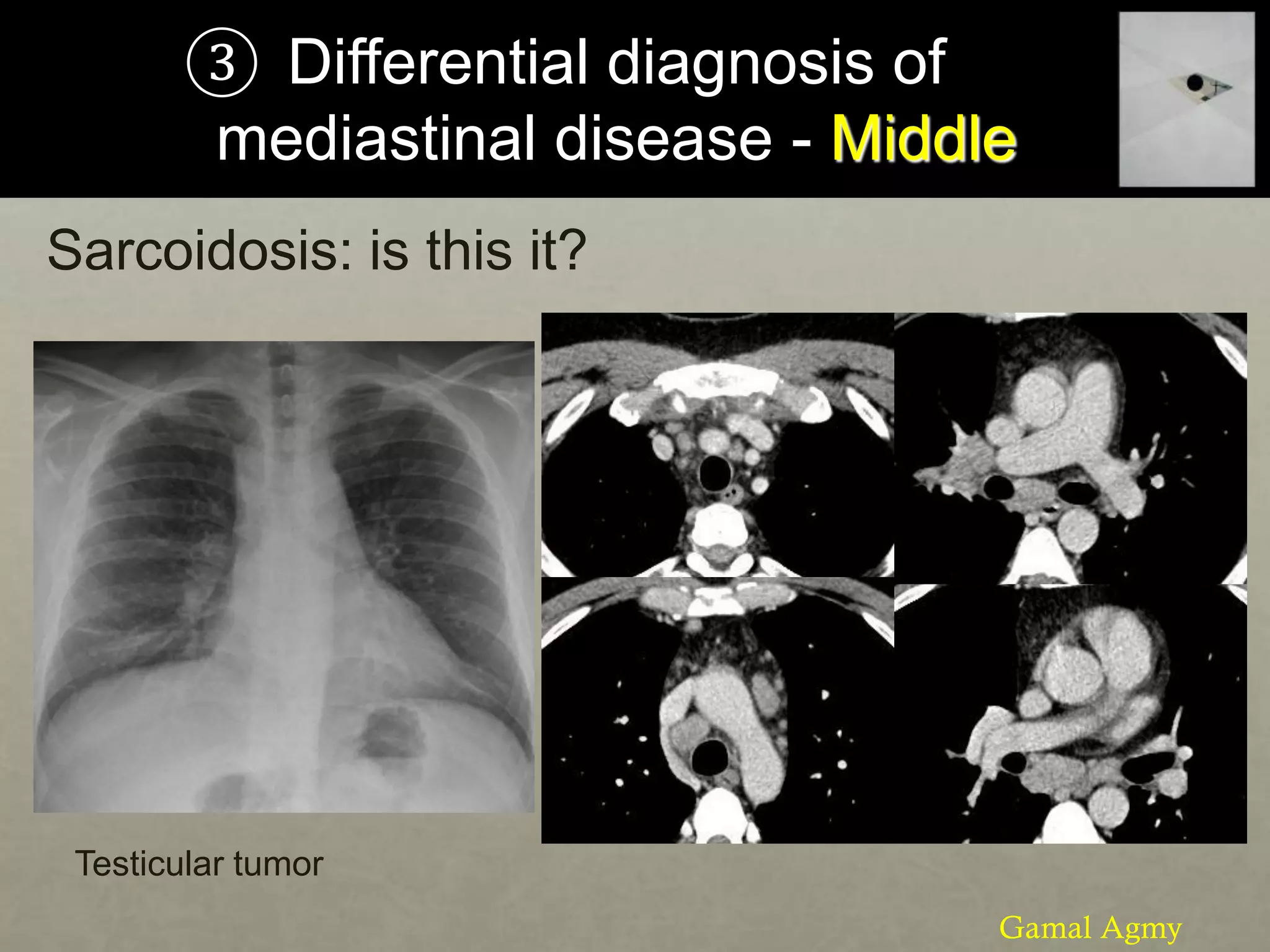
Sarcoidosis: is this it?
Testicular tumor
Gamal Agmy
③ Differential diagnosis of
mediastinal disease - Middle
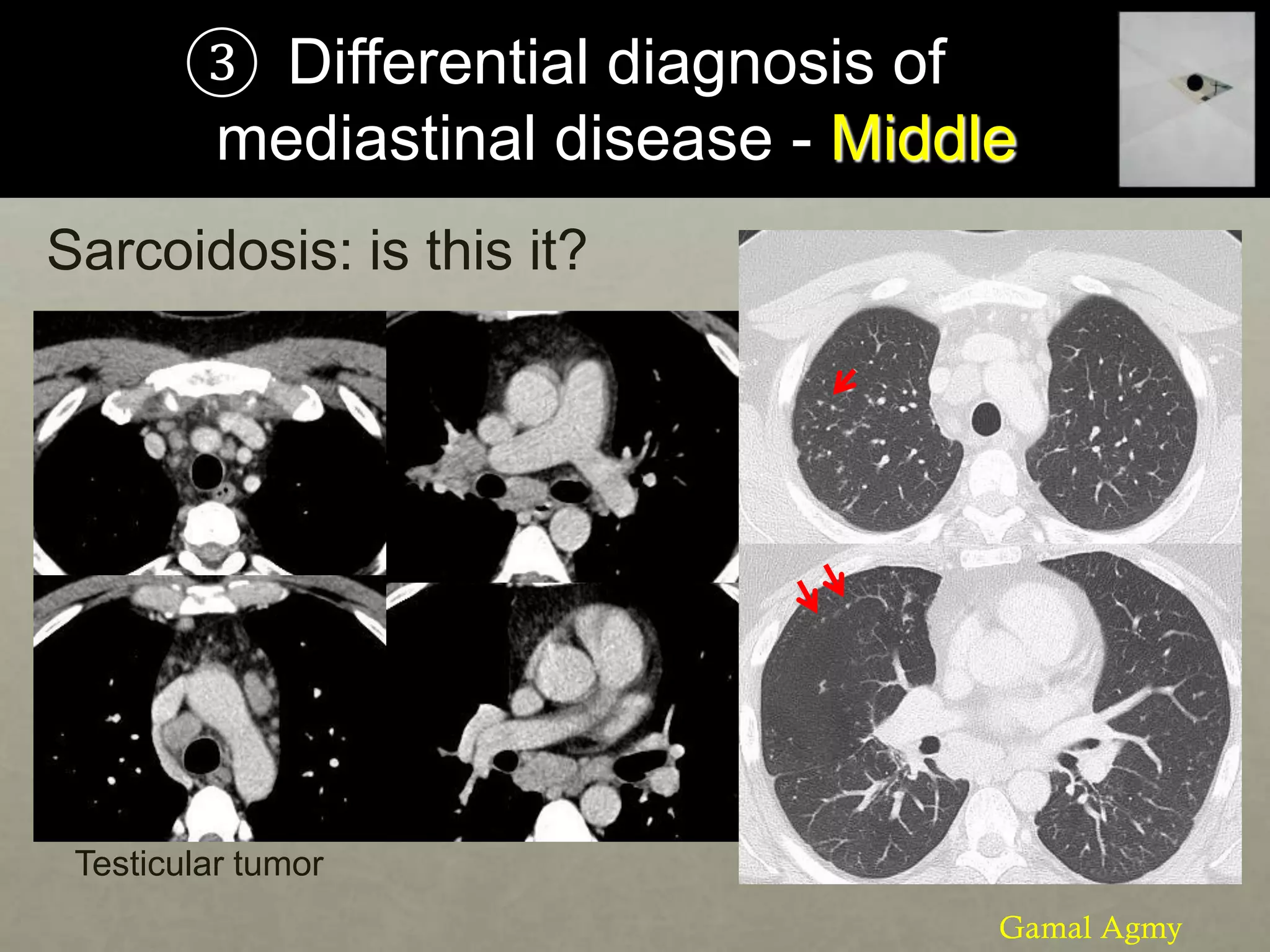
Sarcoidosis: is this it?
Testicular tumor
Gamal Agmy
③ Differential diagnosis of
mediastinal disease - Middle
Silicosis
Gamal Agmy
③ Differential diagnosis of
mediastinal disease - Middle
Vascular abnormalities
Gamal Agmy
③ Differential diagnosis of
mediastinal disease - Middle
Vascular abnormalities
Gamal Agmy
③ Differential diagnosis of
mediastinal disease - Middle
Vascular abnormalities
Gamal Agmy
③ Differential diagnosis of
mediastinal disease - Middle
Neuroendocrine tumor: Pheochromocytoma
Courtesy of Dr Francesco Molinari
Assumpcao-Morales M, IJCRI 2013;4(11):627–630
Goldstein RE, ANNALS OF SURGERY Vol. 229;6, 755–766
Gamal Agmy
③ Differential diagnosis of
mediastinal disease - Posterior
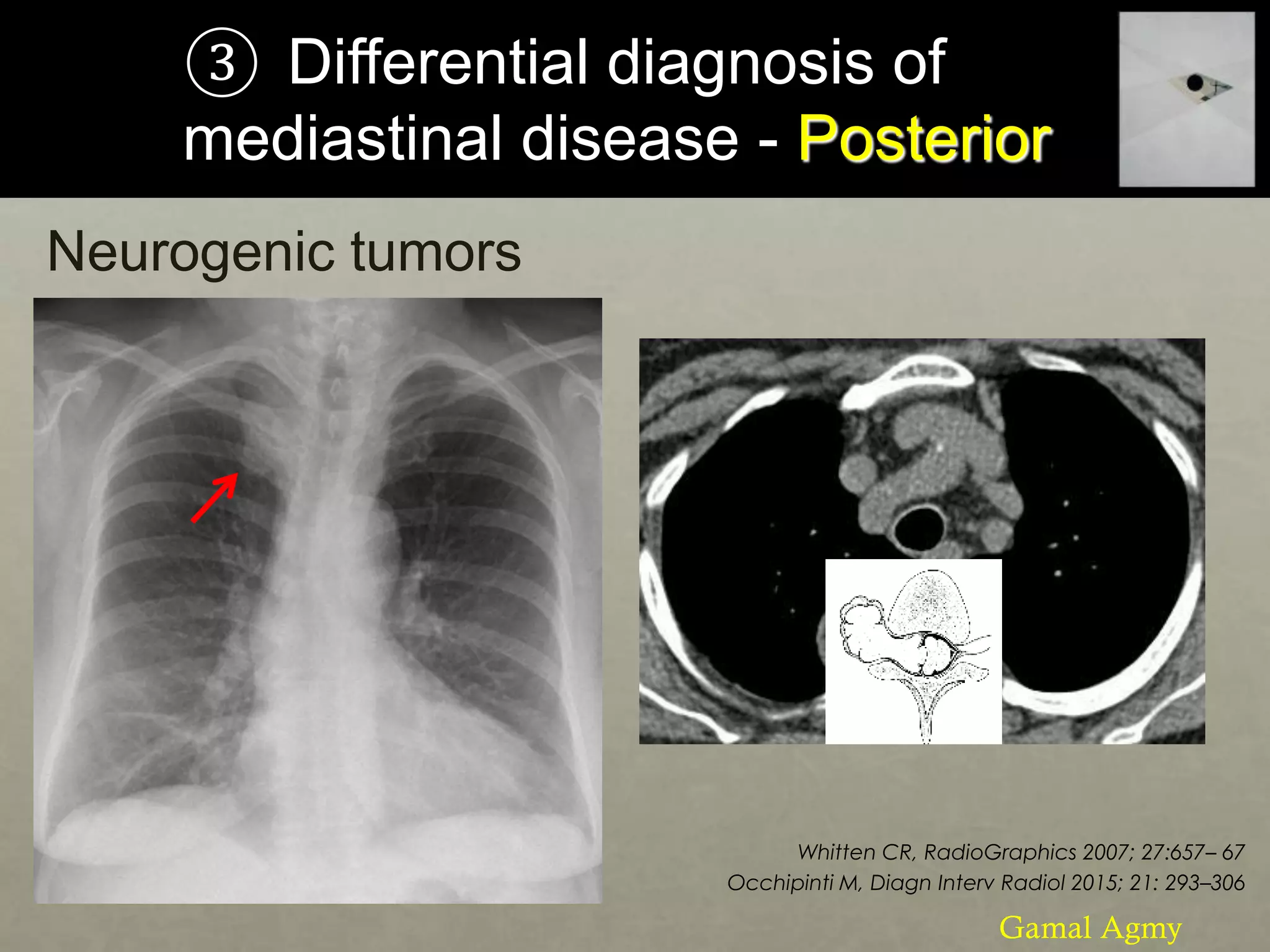
Neurogenic tumors
Whitten CR, RadioGraphics 2007; 27:657– 67
Occhipinti M, Diagn Interv Radiol 2015; 21: 293–306
Gamal Agmy
③ Differential diagnosis of
mediastinal disease - Posterior
Neurogenic tumors
Whitten CR, RadioGraphics 2007; 27:657– 67
Occhipinti M, Diagn Interv Radiol 2015; 21: 293–306
Courtesy of Dr Francesco Molinari
Gamal Agmy
③ Differential diagnosis of
mediastinal disease - Posterior
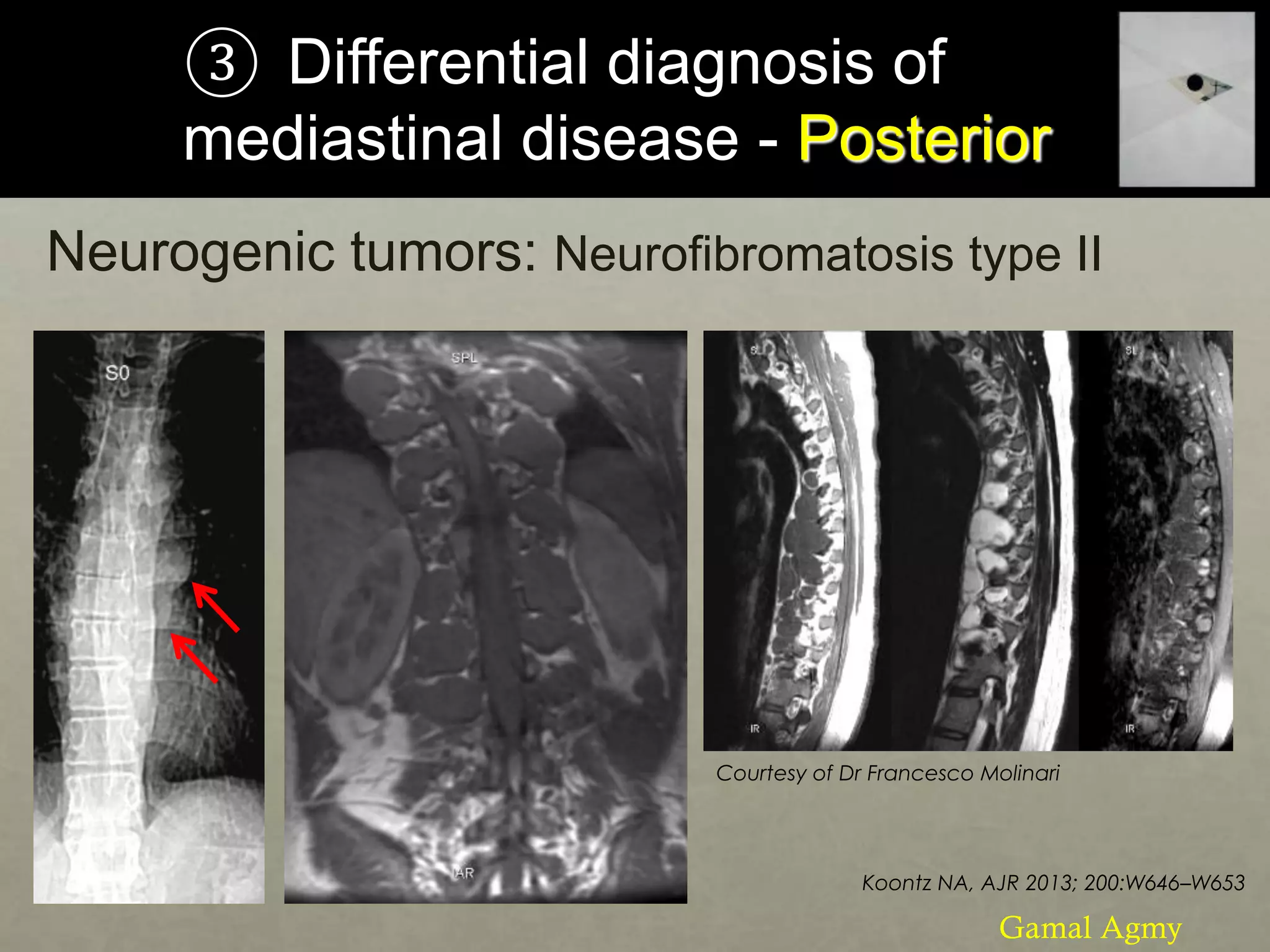
Neurogenic tumors: Neurofibromatosis type II
Koontz NA, AJR 2013; 200:W646–W653
Courtesy of Dr Francesco Molinari
Gamal Agmy
③ Differential diagnosis of
mediastinal disease - Posterior
Neurogenic tumors: paraganglioma
Whitten CR, RadioGraphics 2007; 27:657– 67
Occhipinti M, Diagn Interv Radiol 2015; 21: 293–306
Courtesy of Dr Francesco Molinari
Gamal Agmy
③ Differential diagnosis of
mediastinal disease - Posterior
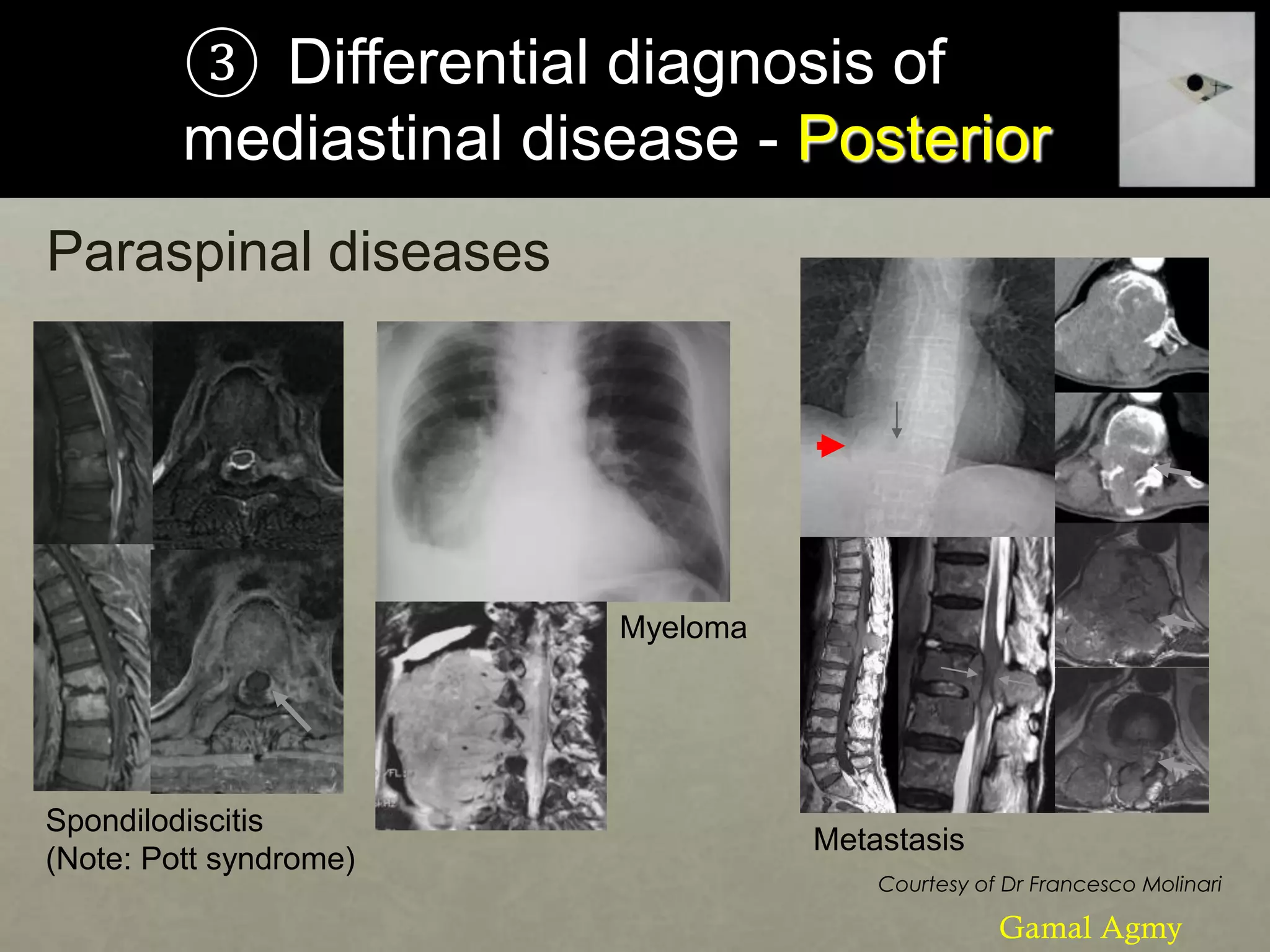
Paraspinal diseases
Courtesy of Dr Francesco Molinari
Spondilodiscitis
(Note: Pott syndrome)
Myeloma
Metastasis
Gamal Agmy
③ Differential diagnosis of
mediastinal disease - Posterior
Esophageal neoplasm
Hong SJ, RadioGraphics 2014; 34:1722–1740
Gamal Agmy
③ Mediastinal Emergencies
Esophageal neoplasm bleeding
Gamal Agmy
③ Mediastinal Emergencies
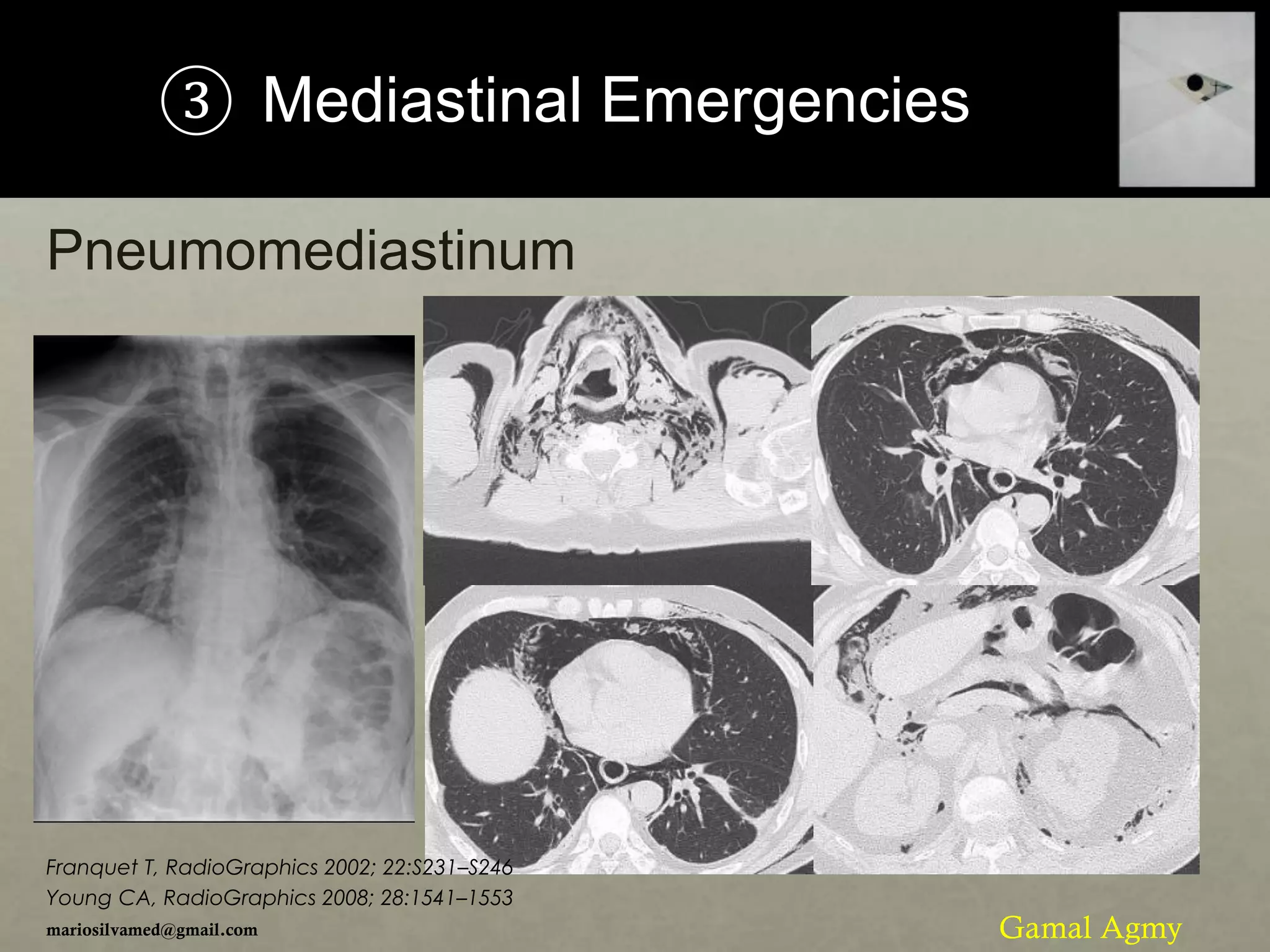
Pneumomediastinum
mariosilvamed@gmail.com
Franquet T, RadioGraphics 2002; 22:S231–S246
Young CA, RadioGraphics 2008; 28:1541–1553
Gamal Agmy
③ Mediastinal Emergencies
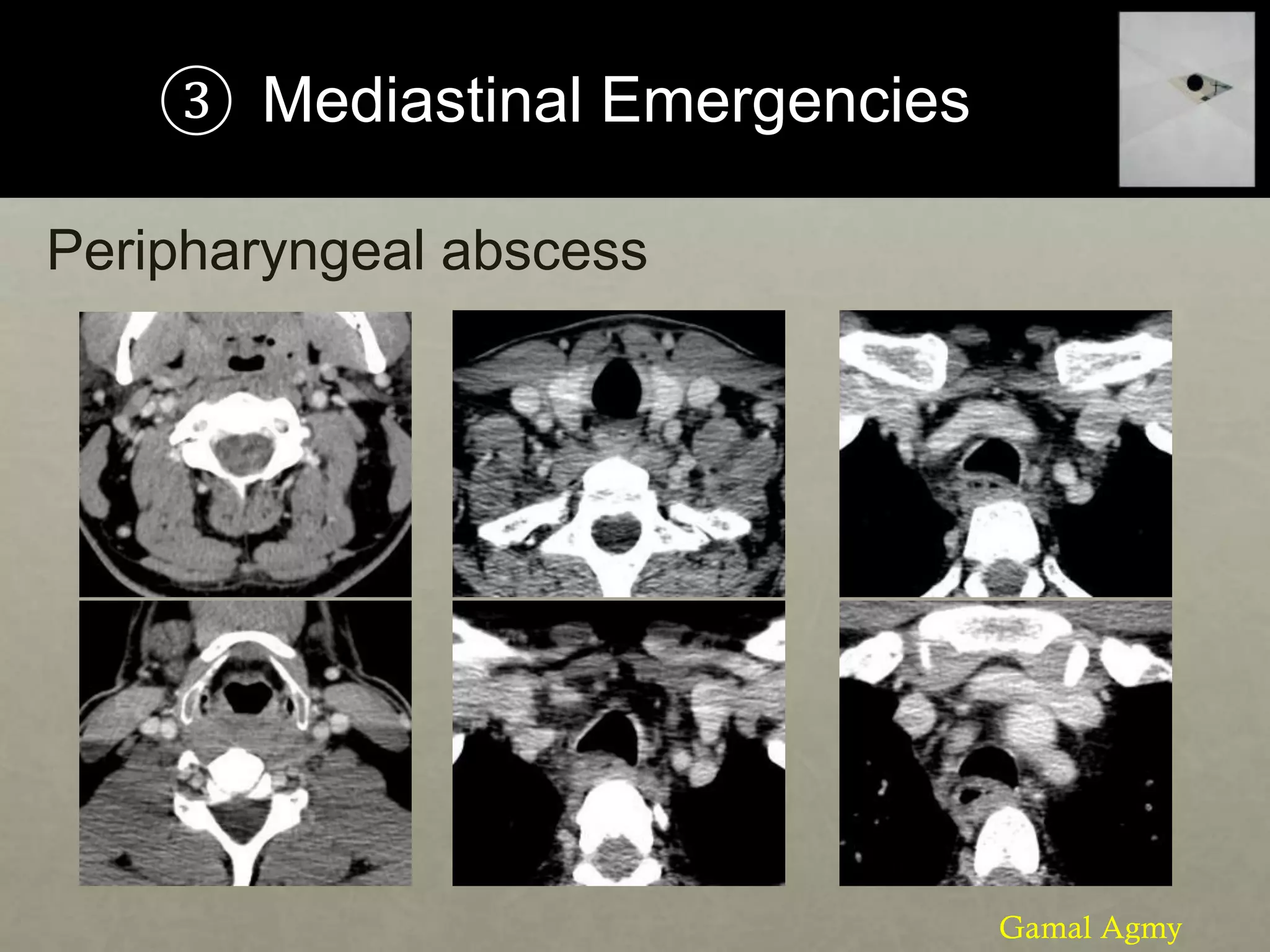
Peripharyngeal abscess
Gamal Agmy
Objectives
① Imaging techniques
② Radiological description of mediastinal
compartments
③Differential diagnosis of mediastinal disease
④ Interventional supply
Gamal Agmy
④ Interventional supply
Transthoracic biopsy: anterior approach
Gupta S, RadioGraphics 2005; 25:763–788
Parasternal Transsternal
Suprasternal
Gamal Agmy
④ Interventional supply
Transthoracic biopsy: anterior approach
Gupta S, RadioGraphics 2005; 25:763–788
Parasternal
Size
Location
Lateral
decubitus
Gamal Agmy
④ Interventional supply
Transthoracic biopsy: anterior approach
Gupta S, RadioGraphics 2005; 25:763–788
Suprasternal
Transsternal
Gamal Agmy
④ Interventional supply
Transthoracic biopsy: paravertebral approach
Gupta S, RadioGraphics 2005; 25:763–788
Saline Injection   
Gamal Agmy
• Mediastinal masses can be categorized at imaging according to location
among 3 mediastinal compartments
• Radiography has several limitation in identifying mediastinal disease,
notably in case of minor abnormalities
• CT with contrast agent and MRI allow for tissue characterization of any-
size mediastinal mass, along with specific description of adjacent
structures
• Multimodality approach and imaging guided sampling (CT, EUS, EBUS)
are suggested to achieve final diagnosis and plan therapeutic approach
Summary
Gamal Agmy
Gamal Agmy

Imaging of Mediastinum

  • 2.
    Imaging the Mediastinum GamalAgmy, MD , FCCP Professor of Chest Diseases, Assiut University
  • 3.
    Objectives ① CT anatomyof mediastinum ② Pneumomediastinum ③ Mediastinal lymphadenopathy ④ Radiological description of mediastinal compartments ⑤ Differential diagnosis of mediastinal disease ⑥ Interventional supply Gamal Agmy
  • 4.
  • 5.
  • 6.
  • 7.
  • 8.
  • 9.
  • 10.
  • 11.
  • 12.
  • 13.
    Mediastinal origin?  The mainbulk of the lesion is present in the mediastinum  Lesion arising from a mediastinal structure  Obtuse angle of interface with the mediastinal border Gamal Agmy
  • 14.
  • 15.
    Figure 9a. Thymicsail sign in a 4-year-old patient who had inhaled gasoline fumes. (a) InitialFigure 12b. Double bronchial wall sign. (a) Radiograph obtained in a 35-year-old asthmatic patientFigure 11a. Tubular artery sign in a 28-year-old man who sustained blunt trauma. (a) Gamal Agmy
  • 16.
  • 17.
  • 18.
    Lymph nodes Anatomic Considerations Retrosternal Prevascular Retrocaval Aorticwindow Carinal Subcarinal Hilar Z-esophageal Circm-cardiac 3 3 Gamal Agmy
  • 19.
  • 20.
  • 21.
    Lymph nodes X-Rays Enlarged hilar shadowwith lobulated outlines Normal Gamal Agmy
  • 22.
    Lymph nodes CT MRI Multiple masses atthe anatomic locations of lymph nodes Gamal Agmy
  • 23.
    Lymph nodes Nodes with necroticcenter = inflammatory, metastatic Bulky nodes = lymphoma Calcifications seen in TB, sarcoid, silicosis Calcification is rare in malignant nodes [chondro / osteosarcoma] General Rules Gamal Agmy
  • 24.
    • Regional lymph nodeclassification for lung cancer staging adapted from the American Thoracic Society mapping scheme Supraclavicular nodes 1. Low cervical, supraclavicular and sternal notch nodes From the lower margin of the cricoid to the clavicles and the upper border of the manubrium. The midline of the trachea serves as border between 1R and 1L. Superior Mediastinal Nodes 2-4 2R.Upper Paratracheal 2R nodes extend to the left lateral border of the trachea. From upper border of manubrium to the intersection of caudal margin of innominate (left brachiocephalic) vein with the trachea. 2L.Upper Paratracheal From the upper border of manubrium to the superior border of aortic arch. 2L nodes are located to the left of the left lateral border of the trachea. Gamal Agmy
  • 25.
    • Regional lymph nodeclassification for lung cancer staging adapted from the American Thoracic Society mapping scheme 3A. Pre-vascular These nodes are not adjacent to the trachea like the nodes in station 2, but they are anterior to the vessels. 3P.Pre-vertebral Nodes not adjacent to the trachea like the nodes in station 2, but behind the esophagus, which is prevertebral. 4R. Lower Paratracheal From the intersection of the caudal margin of innominate (left brachiocephalic) vein with the trachea to the lower border of the azygos vein. 4R nodes extend from the right to the left lateral border of the trachea. 4L. Lower Paratracheal From the upper margin of the aortic arch to the upper rim of the left main pulmonary artery. Gamal Agmy
  • 26.
    • Regional lymph nodeclassification for lung cancer staging adapted from the American Thoracic Society mapping scheme Aortic Nodes 5-6 5. Subaortic These nodes are located in the AP window lateral to the ligamentum arteriosum. These nodes are not located between the aorta and the pulmonary trunk but lateral to these vessels. 6. Para-aortic These are ascending aorta or phrenic nodes lying anterior and lateral to the ascending aorta and the aortic arch. Inferior Mediastinal Nodes 7-9 7.Subcarinal Nodes below carina. 8. Paraesophageal 9. Pulmonary Ligament Nodes lying within the pulmonary ligaments. Gamal Agmy
  • 27.
    Regional lymph nodeclassification for lung cancer staging adapted from the American Thoracic Society mapping scheme Hilar, Lobar and (sub)segmental Nodes 10-14 These are all N1-nodes. 10. Hilar nodes These include nodes adjacent to the main stem bronchus and hilar vessels. On the right they extend from the lower rim of the azygos vein to the interlobar region. On the left from the upper rim of the pulmonary artery to the interlobar region. Gamal Agmy
  • 28.
    1. Supraclavicular zonenodes 1. Supraclavicular zone nodes These include low cervical, supraclavicular and sternal notch nodes. Upper border: lower margin of cricoid. Lower border: clavicles and upper border of manubrium. The midline of the trachea serves as border between 1R and 1L. Gamal Agmy
  • 29.
    2R. Right UpperParatracheal 2R nodes extend to the left lateral border of the trachea. Upper border: upper border of manubrium. Lower border: intersection of caudal margin of innominate (left brachiocephalic) vein with the trachea. 2L. Left Upper Paratracheal Upper border: upper border of manubrium. Lower border: superior border of aortic arch. On the left a station 2 node in front of the trachea, i.e. a 2R-node. There is also a small prevascular node, i.e. a station 3A node Gamal Agmy
  • 30.
    3. Prevascular andPrevertabral nodes Station 3 nodes are not adjacent to the trachea like station 2 nodes. They are either: 3A anterior to the vessels or 3B behind the esophagus, which lies prevertebrally. Station 3 nodes are not accessible with mediastinoscopy. 3P nodes can be accessible with endoscopic ultrasound (EUS). 3A and 3P nodes Gamal Agmy
  • 31.
    On the lefta 3A node in the prevascular space. Notice also lower paratracheal nodes on the right, i.e. 4R nodes. Gamal Agmy
  • 32.
    4R. Right LowerParatracheal Upper border: intersection of caudal margin of innominate (left brachiocephalic) vein with the trachea. Lower border:lower border of azygos vein. 4R nodes extend to the left lateral border of the trachea. Gamal Agmy
  • 33.
    On the leftwe see 4R paratracheal nodes. In addition there is an aortic node lateral to the aortic arch, i.e. station 6 node. Gamal Agmy
  • 34.
    4L. Left LowerParatracheal 4L nodes are lower paratracheal nodes that are located to the left of the left tracheal border, between a horizontal line drawn tangentially to the upper margin of the aortic arch and a line extending across the left main bronchus at the level of the upper margin of the left upper lobe bronchus. These include paratracheal nodes that are located medially to the ligamentum arteriosum. Station 5 (AP-window) nodes are located laterally to the ligamentum arteriosum. Gamal Agmy
  • 35.
    On the leftan image just above the level of the pulmonary trunk demonstrating lower paratracheal nodes on the left and on the right. In addition there are also station 3 and 5 nodes Gamal Agmy
  • 36.
    On the leftan image at the level of the lower trachea just above the carina. To the left of the trachea 4L nodes. Notice that these 4L nodes are between the pulmonary trunk and the aorta, but are not located in the AP-window, because they lie medially to the ligamentum arteriosum. The node lateral to the pulmonary trunk is a station 5 node. Gamal Agmy
  • 37.
    5. Subaortic nodes Subaorticor aorto-pulmonary window nodes are lateral to the ligamentum arteriosum or the aorta or left pulmonary artery and proximal to the first branch of the left pulmonary artery and lie within the mediastinal pleural envelope. 6. Para-aortic nodes Para-aortic (ascending aorta or phrenic) nodes are located anteriorly and laterally to the ascending aorta and the aortic arch from the upper margin to the lower margin of the aortic arch. Gamal Agmy
  • 38.
    7. Subcarinal nodes Thesenodes are located caudally to the carina of the trachea, but are not associated with the lower lobe bronchi or arteries within the lung. On the right they extend caudally to the lower border of the bronchus intermedius. On the left they extend caudally to the upper border of the lower lobe bronchus. On the left a station 7 subcarinal node to the right of the esophagus. Gamal Agmy
  • 39.
    8 Paraesophageal nodes Thesenodes are below the carinal nodes and extend caudally to the diaphragm. On the left an image below the carina. To the right of the esophagus a station 8 node. Gamal Agmy
  • 40.
    On the lefta PET image demonstrating FDG uptake in a station 8 node. On the corresponding CT image the node is not enlarged (blue arrow). The probability that this is a lymph node metastasis is extremely high since the specificity of PET in unenlarged nodes is higher than in enlarged nodes. Gamal Agmy
  • 41.
    9. Pulmonary ligamentnodes Pulmonary ligament nodes are lying within the pulmonary ligament, including those in the posterior wall and lower part of the inferior pulmonary vein. The pulmonary ligament is the inferior extension of the mediastinal pleural reflections that surround the hila. Gamal Agmy
  • 42.
    10 Hilar nodes Hilarnodes are proximal lobar nodes, distal to the mediastinal pleural reflection and nodes adjacent to the intermediate bronchus on the right. Nodes in station 10 - 14 are all N1-nodes, since they are not located in the mediastinum. Gamal Agmy
  • 43.
    10 Hilar nodes Hilarnodes are proximal lobar nodes, distal to the mediastinal pleural reflection and nodes adjacent to the intermediate bronchus on the right. Nodes in station 10 - 14 are all N1-nodes, since they are not located in the mediastinum. Gamal Agmy
  • 44.
    Axial CT ofLymph Nodes Scroll through the images on the left. 1-Sternal notch nodes are just seen at this level and above this level 2-Upper Paratracheal: below clavicles and on the right above the intersection of caudal margin of innominate (left brachiocephalic) vein with the trachea and on the left above the aortic arch. 3-Pre-vascular and Retrotracheal : anterior to the vessels (3A) or prevertebral (3P) 4-Lower Paratracheal : below upper margin of aortic arch down to level of main bronchus 5-Subaortic (A-P window): nodes lateral to ligamentum arteriosum or lateral to aorta or left pulmonary artery 6-Para-aortic: nodes lying anterior and lateral to the ascending aorta and the aortic arch beneath the upper margin of the aortic arch 7-Subcarinal 8-Paraesophageal (below carina) 9-Pulmonary Ligament: nodes lying within the pulmonary ligament. 10--14: nodes are all N1 nodes • Gamal Agmy
  • 45.
    Conventional mediastinoscopy The followingnodal stations can be biopsied by cervical mediastinoscopy: the left and right upper paratracheal nodes (station 2L and 2R), left and right lower paratracheal nodes (station 4L and 4R) and the subcarinal nodes (station 7). Station 1 nodes are located above the suprasternal notch and are not routinely accessed by cervical mediastinoscopy. • • Gamal Agmy
  • 46.
    Extended mediastinoscopy Left upperlobe tumors may metastasize to the subaortic lymph nodes (station 5) and paraaortic nodes (station 6). These nodes can not be biopsied through routine cervical mediastinoscopy. Extended mediastinoscopy is an alternative for the anterior-second interspace mediastinotomy which is more commonly used for exploration of mediastinal nodal stations. This procedure is far less easy and therefore less routinely performed than conventional mediastinoscopy. Gamal Agmy
  • 47.
    EUS-FNA Endoscopic Ultrasound withFine Needle Aspiration can be performed of all the mediastinal nodes that that can be assessed from the oesophagus. In addition the left adrenal gland and the left liver lobe can be visualized.EUS particularly provides access to nodes in the lower mediastinum (station 7,8 and 9) Gamal Agmy
  • 48.
    ② Radiological descriptionof mediastinal compartments Whitten CR, RadioGraphics 2007; 27:657– 67 Sharzhad M, AJR 2014; 203:W128–W138 Occhipinti M, Diagn Interv Radiol 2015; 21: 293–306
  • 49.
    ② Radiological descriptionof mediastinal compartments Whitten CR, RadioGraphics 2007; 27:657– 67 Sharzhad M, AJR 2014; 203:W128–W138 Occhipinti M, Diagn Interv Radiol 2015; 21: 293–306 Gamal Agmy
  • 50.
    ② Radiological descriptionof mediastinal compartments Whitten CR, RadioGraphics 2007; 27:657– 67 Sharzhad M, AJR 2014; 203:W128–W138 Occhipinti M, Diagn Interv Radiol 2015; 21: 293–306 Gamal Agmy
  • 51.
    ② Radiological descriptionof mediastinal compartments Kim TJ, RadioGraphics 2007; 27:409 – 429 Young CA, RadioGraphics 2008; 28:1541–1553 Katabathina VS, RadioGraphics 2011; 31:1141–1160 Emergencies • Acute aortic syndrome • Acute mediastinitis • Esophagus • Tension pneumomediastinum • Radiation therapy Gamal Agmy
  • 52.
    Objectives ① Imaging techniques ②Radiological description of mediastinal compartments ③Differential diagnosis of mediastinal disease ④ Interventional supply Gamal Agmy
  • 53.
    ③ Differential diagnosisof mediastinal disease - Anterior Differential based on CT density/MRI signal Fat Water Muscle Calcification Lipoma Mediastinal lipomatosis Morgagni hernia Thymolipoma Teratoma Thymic cyst Lymphangioma Abscess Cystic teratoma Pancreatic pseudocyst Thymic hyperplasia or malignancy Lymphoma Hernia Germ cell tumor Mediastinitis Sarcoma Teratoma Treated lymphoma Goiter Granulomatous infection Sarcoid/Silicosis Sharzhad M, AJR 2014; 203:W128–W138 Gamal Agmy
  • 54.
    ③ Differential diagnosisof mediastinal disease - Anterior Fat attenuation: low likelihood of malignancy Pineda V, RadioGraphics 2007; 27:19 –32 Molinari F, AJR 2011; 197:W795–W813 Morgagni HerniaLiposarcoma Gamal Agmy
  • 55.
    ③ Differential diagnosisof mediastinal disease - Anterior Molinari F, AJR 2011; 197:W795–W813 Sharzhad M, AJR 2014; 203:W128–W138 Lipoma Mediastinal lipomatosis Gamal Agmy
  • 56.
    ③ Differential diagnosisof mediastinal disease - Anterior Sharzhad M, AJR 2014; 203:W128–W138 Teratoma Goiter Gamal Agmy
  • 57.
    ③ Differential diagnosisof mediastinal disease - Anterior Nasseri F, RadioGraphics 2010; 30:413–428 Molinari F, AJR 2011; 197:W795–W813 Rebound hyperplasia Thymus Gamal Agmy
  • 58.
    ③ Differential diagnosisof mediastinal disease - Anterior Pineda V, RadioGraphics 2007; 27:19 –32 Benveniste MFK, RadioGraphics 2011; 31:1847–1861 Thymoma (Masaoka-Koga staging system) Gamal Agmy
  • 59.
    ③ Differential diagnosisof mediastinal disease - Anterior Falkson CB, J Thorac Oncol 2009;4(7):911–919 Benveniste MFK, RadioGraphics 2011; 31:1847–1861 Thymoma: treatment based on Masaoka-Koga staging system Stage Macro & Microscopic Features Treatment I Complete encapsulation Surgery IIa Microscopic invasion of capsula Surgery + Optional RT IIb Macroscopic invasion of capsula III Invasion of adjacent organ (pericardium, great vessels, or lung) Neoadjuvant ChT + Surgery + Optional RT IVa Pleural or pericardial dissemination IVb Lymphatic-hematogenous metastasis Palliative ChT Gamal Agmy
  • 60.
    ③ Differential diagnosisof mediastinal disease - Anterior Lymphoma Gamal Agmy
  • 61.
    ③ Differential diagnosisof mediastinal disease - Anterior Lymphoma: diffuse disease of mediastinum Gamal Agmy
  • 62.
    ③ Differential diagnosisof mediastinal disease - Anterior Lymphoma: after treatment Courtesy of Dr Francesco Molinari Gamal Agmy
  • 63.
    ③ Differential diagnosisof mediastinal disease - Anterior Calcified pattern: differential Treated lymphoma Post-traumatic pericardial cyst (prisoner) Echinococcus Polat P, RadioGraphics 2003; 23:475– 494 Gamal Agmy
  • 64.
    ③ Differential diagnosisof mediastinal disease - Anterior Lymphoma in children Toma P, RadioGraphics 2007; 27:1335–1354 July 13 August 18 Gamal Agmy
  • 65.
    ③ Differential diagnosisof mediastinal disease - Anterior Cardiophrenic space Jeung MY, RadioGraphics 2002; 22:S79 –S93 Pineda V, RadioGraphics 2007; 27:19 –32 Gamal Agmy
  • 66.
    ③ Differential diagnosisof mediastinal disease - Anterior Cardiophrenic space – Cystic Jeung MY, RadioGraphics 2002; 22:S79 –S93 Pineda V, RadioGraphics 2007; 27:19 –32 Gamal Agmy
  • 67.
    ③ Differential diagnosisof mediastinal disease - Anterior Cardiophrenic space: lymphnode Pineda V, RadioGraphics 2007; 27:19 –32 Gamal Agmy
  • 68.
    ③ Differential diagnosisof mediastinal disease - Middle Foregut duplication cyst: bronchogenic Berrocal T, RadioGraphics 2004 Volume 24, Issue 1 Gamal Agmy
  • 69.
    ③ Differential diagnosisof mediastinal disease - Middle Foregut duplication cyst: bronchogenic McAdams HP, Radiology 2000; 56:441-446 Gamal Agmy
  • 70.
    ③ Differential diagnosisof mediastinal disease - Middle Tuberculosis June 1, 2015 April 22, 2015 Gamal Agmy
  • 71.
    ③ Differential diagnosisof mediastinal disease - Middle Tuberculosis June 1, 2015 August 11, 2015 Gamal Agmy
  • 72.
    ③ Differential diagnosisof mediastinal disease - Middle Differential: TB – Lymphoma – Others? Tuberculosis Lymphoma Others? T0 T1 Gamal Agmy
  • 73.
    ③ Differential diagnosisof mediastinal disease - Middle Small Cell Lung Cancer (SCLC) mariosilvamed@gmail.com ERS 2015: Course of Thoracic Imaging – Barcelona 2015, October 22 – 24
  • 74.
    ③ Differential diagnosisof mediastinal disease - Middle Lymph node enlargement: granulomatous diseases Silva M, Clinic Rev Allerg Immunol 2015 Aug;49(1):45-53 mariosilvamed@gmail.com ERS 2015: Course of Thoracic Imaging – Barcelona 2015, October 22 – 24
  • 75.
    ③ Differential diagnosisof mediastinal disease - Middle Sarcoidosis Gamal Agmy
  • 76.
    ③ Differential diagnosisof mediastinal disease - Middle Sarcoidosis: is this it? Testicular tumor Gamal Agmy
  • 77.
    ③ Differential diagnosisof mediastinal disease - Middle Sarcoidosis: is this it? Testicular tumor Gamal Agmy
  • 78.
    ③ Differential diagnosisof mediastinal disease - Middle Silicosis Gamal Agmy
  • 79.
    ③ Differential diagnosisof mediastinal disease - Middle Vascular abnormalities Gamal Agmy
  • 80.
    ③ Differential diagnosisof mediastinal disease - Middle Vascular abnormalities Gamal Agmy
  • 81.
    ③ Differential diagnosisof mediastinal disease - Middle Vascular abnormalities Gamal Agmy
  • 82.
    ③ Differential diagnosisof mediastinal disease - Middle Neuroendocrine tumor: Pheochromocytoma Courtesy of Dr Francesco Molinari Assumpcao-Morales M, IJCRI 2013;4(11):627–630 Goldstein RE, ANNALS OF SURGERY Vol. 229;6, 755–766 Gamal Agmy
  • 83.
    ③ Differential diagnosisof mediastinal disease - Posterior Neurogenic tumors Whitten CR, RadioGraphics 2007; 27:657– 67 Occhipinti M, Diagn Interv Radiol 2015; 21: 293–306 Gamal Agmy
  • 84.
    ③ Differential diagnosisof mediastinal disease - Posterior Neurogenic tumors Whitten CR, RadioGraphics 2007; 27:657– 67 Occhipinti M, Diagn Interv Radiol 2015; 21: 293–306 Courtesy of Dr Francesco Molinari Gamal Agmy
  • 85.
    ③ Differential diagnosisof mediastinal disease - Posterior Neurogenic tumors: Neurofibromatosis type II Koontz NA, AJR 2013; 200:W646–W653 Courtesy of Dr Francesco Molinari Gamal Agmy
  • 86.
    ③ Differential diagnosisof mediastinal disease - Posterior Neurogenic tumors: paraganglioma Whitten CR, RadioGraphics 2007; 27:657– 67 Occhipinti M, Diagn Interv Radiol 2015; 21: 293–306 Courtesy of Dr Francesco Molinari Gamal Agmy
  • 87.
    ③ Differential diagnosisof mediastinal disease - Posterior Paraspinal diseases Courtesy of Dr Francesco Molinari Spondilodiscitis (Note: Pott syndrome) Myeloma Metastasis Gamal Agmy
  • 88.
    ③ Differential diagnosisof mediastinal disease - Posterior Esophageal neoplasm Hong SJ, RadioGraphics 2014; 34:1722–1740 Gamal Agmy
  • 89.
    ③ Mediastinal Emergencies Esophagealneoplasm bleeding Gamal Agmy
  • 90.
    ③ Mediastinal Emergencies Pneumomediastinum mariosilvamed@gmail.com FranquetT, RadioGraphics 2002; 22:S231–S246 Young CA, RadioGraphics 2008; 28:1541–1553 Gamal Agmy
  • 91.
  • 92.
    Objectives ① Imaging techniques ②Radiological description of mediastinal compartments ③Differential diagnosis of mediastinal disease ④ Interventional supply Gamal Agmy
  • 93.
    ④ Interventional supply Transthoracicbiopsy: anterior approach Gupta S, RadioGraphics 2005; 25:763–788 Parasternal Transsternal Suprasternal Gamal Agmy
  • 94.
    ④ Interventional supply Transthoracicbiopsy: anterior approach Gupta S, RadioGraphics 2005; 25:763–788 Parasternal Size Location Lateral decubitus Gamal Agmy
  • 95.
    ④ Interventional supply Transthoracicbiopsy: anterior approach Gupta S, RadioGraphics 2005; 25:763–788 Suprasternal Transsternal Gamal Agmy
  • 96.
    ④ Interventional supply Transthoracicbiopsy: paravertebral approach Gupta S, RadioGraphics 2005; 25:763–788 Saline Injection    Gamal Agmy
  • 97.
    • Mediastinal massescan be categorized at imaging according to location among 3 mediastinal compartments • Radiography has several limitation in identifying mediastinal disease, notably in case of minor abnormalities • CT with contrast agent and MRI allow for tissue characterization of any- size mediastinal mass, along with specific description of adjacent structures • Multimodality approach and imaging guided sampling (CT, EUS, EBUS) are suggested to achieve final diagnosis and plan therapeutic approach Summary Gamal Agmy
  • 98.