SPIROMETRY
Dr. Navin Adhikari
IM Resident
INTRODUCTION
• Spirometry is one of the pulmonary function test that
measure volume or change in volume versus time .
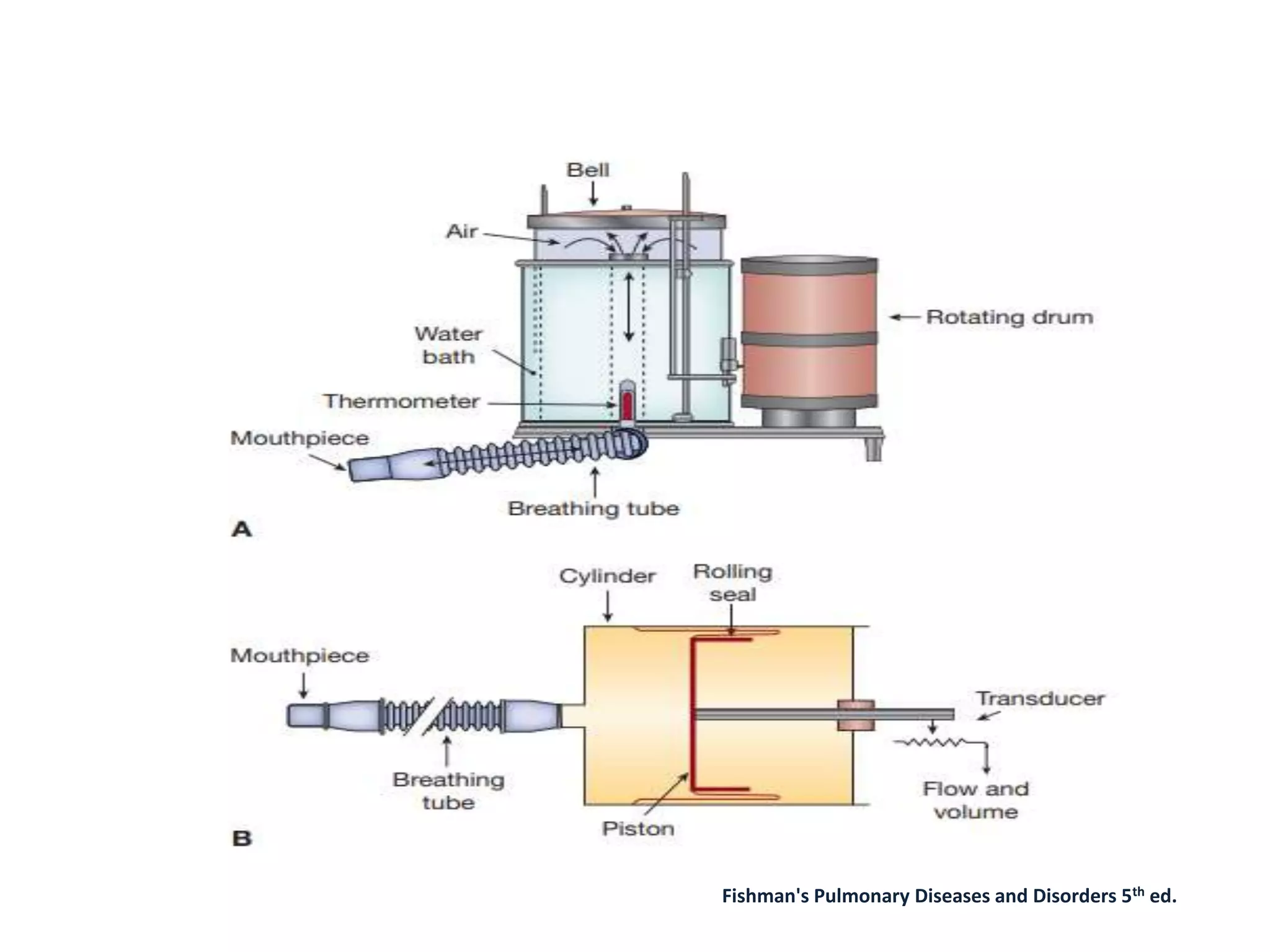
• water-sealed spirometer and dry, rolling-seal spirometer
were used previously
• Now, most pulmonary function laboratories utilize flow
type spirometers using pneumotachographs or rotating
turbines to determine airflow.
• Two types of pneumotachographs are in general use: hot
wire and flow resistive.
Fishman's Pulmonary Diseases and Disorders 5th ed.
TEXTBOOK OF MEDICAL PHYSIOLOGY (GUYTON _ HALL ) 11TH EDITION
PULMONARY VOLUMES
• Tidal volume: Volume of air inspired or expired with each
normal breath – about 500 milliliters.
• Inspiratory reserve volume: Extra volume of air that can
be inspired over and above the normal tidal volume
when the person inspires with full force – about 3000
milliliters.
• Expiratory reserve volume: Maximum extra volume of
air that can be expired by forceful expiration after the
end of a normal tidal expiration – about 1100 milliliters.
• Residual volume : Volume of air remaining in the lungs
after the most forceful expiration – 1200 milliliters.
TEXTBOOK OF MEDICAL PHYSIOLOGY (GUYTON _ HALL ) 11TH EDITION
PULMONARY CAPACITIES
• Inspiratory capacity: Amount of air that can breathe in,
beginning at the normal expiratory level and distending
the lungs to the maximum amount-equals the tidal
volume plus the inspiratory reserve volume- is about
3500 milliliters .
• The functional residual capacity-This is the amount of air
that remains in the lungs at the end of normal expiration
, equals the expiratory reserve volume plus the residual
volume- (about 2300 milliliters).
TEXTBOOK OF MEDICAL PHYSIOLOGY (GUYTON _ HALL ) 11TH EDITION
• Vital capacity - maximum amount of air a person can
expel from the lungs after first filling the lungs to their
maximum extent and then expiring to the maximum
extent equals the inspiratory reserve volume plus the
tidal volume plus the expiratory reserve volume- (about
4600 milliliters).
• Total lung capacity - maximum volume to which the
lungs can be expanded with the greatest possible effort -
equal to the vital capacity plus the residual volume-
(about 5800 milliliters)
TEXTBOOK OF MEDICAL PHYSIOLOGY (GUYTON _ HALL ) 11TH EDITION
FLOW - VOLUME LOOP
• During the maximal expiration, the rate of airflow peaks at a
lung volume that is close to the TLC; as the lung volume
decreases and intrathoracic airways narrow, airway resistance
increases, and the rate of airflow decreases progressively.
• During maximal inspiration, the pattern of airflow is different.
Because of the markedly negative pleural pressure and large
transmural airway pressure, the bronchi are wide, and their
calibers increase further as lung volume increases.
Consequently, inspiratory flow becomes high while the lung
volume is still low and remains high over much of the vital
capacity, even though the force generated by the inspiratory
muscles decreases as they shorten.
MURRAY & NADEL’S TEXTBOOK OF RESPIRATORY MEDICINE, 6TH ED.
FLOW - VOLUME LOOP
MURRAY & NADEL’S TEXTBOOK OF RESPIRATORY MEDICINE, 6TH ED.
FEV1
• is the maximal volume of air exhaled in the first second
of a forced exhalation that follows a full inspiration.
• reflects the average flow rate during the first second of
the FVC maneuver.
• most important spirometric variable for assessment of
the severity of airflow obstruction .
• The highest FEV1 from the three acceptable forced
expiratory maneuvers is used for interpretation, even if it
does not come from the maneuver with the highest FVC .
• FEV1% predicted, which is defined as FEV1% of the
patient divided by the average FEV1% in the population
for any person of similar age, sex, and body composition
2021 UPTODATE®
FVC
• also known as the forced expiratory volume .
• is the maximal volume of air exhaled with a maximally
forced effort from a position of full inspiration .
• The FVC may be reduced by suboptimal patient effort,
airflow limitation, restriction (eg, from lung
parenchymal, pleural, or thoracic cage disease), or a
combination of these.
2021 UPTODATE®
MURRAY & NADEL’S TEXTBOOK OF RESPIRATORY MEDICINE, 6TH ED.
INDICATIONS
DIAGNOSTIC INDICATIONS
• Evaluation of the signs and symptoms of a patient or their
abnormal investigations and lab tests
• Evaluation of the effect a certain disease has on pulmonary
function
• Screening and early detection of individuals who are at risk
of pulmonary disease
• Assessing surgical patients for preoperative risk
• Assessing the severity and the prognosis of a pulmonary
disease.
HTTP://WWW.NCBI.NLM.NIH.GOV/BOOKS/NBK560526/
MONITORING INDICATIONS
• Assessment of the efficiency of a therapeutic intervention
such as bronchodilator therapy
• Describing the course and progression of a disease that is
affecting pulmonary function such as interstitial lung disease
or obstructive lung disease
• Monitoring pulmonary function in individuals with high-risk
jobs
HTTP://WWW.NCBI.NLM.NIH.GOV/BOOKS/NBK560526/
CONTRAINDICATION
ABSOLUTE CONTRAINDICATIONS
• Hemodynamic instability
• Recent myocardial infarction or acute coronary
syndrome
• Respiratory infection, a recent pneumothorax or a
pulmonary embolism
• A growing or large (>6 cm) aneurysm of the thoracic,
abdominal aorta
• Hemoptysis of acute onset
• Intracranial hypertension
• Retinal detachment
HTTP://WWW.NCBI.NLM.NIH.GOV/BOOKS/NBK560526/
RELATIVE CONTRAINDICATIONS
• Patients who cannot be instructed to use the device
properly and are at risk of using the device
inappropriately such as children and patients with
dementia
• Conditions that make it difficult to hold the
mouthpiece such as facial pain
• Recent abdominal, thoracic, brain, eye, ear, nose or
throat surgeries
• Hypertensive crisis
HTTP://WWW.NCBI.NLM.NIH.GOV/BOOKS/NBK560526/
PROCEDURE
Three phases
• Phase 1: Coach the patient to take as deep a breath as
possible
• Phase 2: Strongly prompt the patient to blast out the air
into the spirometer without hesitation after reaching a full
inspiration
• Phase 3: Encourage the patient to continue exhaling until a
plateau in exhaled volume or 15 seconds is reached, unless
just measuring FEV6 in which case the exhalation should
last at least six seconds (three seconds for children)
2021 UPTODATE®
2021 UPTODATE®
ADEQUACY OF TEST
• requires three acceptable and repeatable forced vital
capacity (FVC) maneuvers.
• Detection of poorly performed maneuvers by direct
inspection of both flow-volume curves and volume-time
spirograms .
• An acceptable maneuver requires a sharp peak in the
flow curve and an expiratory duration that reaches a
plateau of exhaled volume.
• At least three acceptable maneuvers should be available.
• Repeatability is determined by comparing the FVC and
FEV1 values of the maneuvers. The two highest values for
FVC and for FEV1 should be within 0.15 L of each other
(for adults; the limit is 0.10 L for children). 2021 UPTODATE®
2021 UPTODATE®
INTERPRETATION
Step 1: Determine If the FEV1/FVC Ratio Is Low
Step 2: Determine If the FVC Is Low
Step 3: Confirm the Restrictive Pattern
Step 4: Grade the Severity of the Abnormality
Step 5: Determine Reversibility of the Obstructive Defect
Step 6: Bronchoprovocation
Step 7: Establish the Differential Diagnosis
Step 8: Compare Current and Prior Results
Stepwise Approach to the Interpretation of Pulmonary Function Tests,
www.aafp.org
FEV1/FVC RATIO
• The FEV1/FVC ratio is the fraction of the forced vital
capacity that can be exhaled in the first second.
• important parameter for detecting airflow limitation in
diseases like asthma and COPD
• ratio is not useful for gauging severity of disease, since
the FVC also tends to decrease with increasing
obstruction.
Stepwise Approach to the Interpretation of Pulmonary Function Tests,
www.aafp.org
• (FEV1/FVC) ratio is low, indicating an obstructive defect
• GOLD criteria, which use a cutoff of less than 70%
• the ATS criteria, which use the lower limit of normal
(LLN) as the cutoff for adults.The LLN is a measurement
less than the fifth percentile of spirometry data obtained
from the Third National Health and Nutrition
Examination Survey (NHANES III)
Stepwise Approach to the Interpretation of Pulmonary Function Tests,
www.aafp.org
GOLD VS. ATS CRITERIA
• Studies has shown that the GOLD criteria is better to
diagnose obstructive lung disease in patients 65 years
and older with respiratory symptoms who are at risk of
COPD (i.e., current or previous smoker).
• And the ATS criteria is better in diagnosing obstructive
lung disease in patients younger than 65 years regardless
of smoking status, and in nonsmokers who are 65 years
and older.
Stepwise Approach to the Interpretation of Pulmonary Function Tests,
www.aafp.org
DETERMINE FVC
• less than the LLN for adults or less than 80% of
predicted for those five to 18 years of age, indicates a
restrictive pattern.
• restrictive pattern can indicate restrictive lung disease, a
mixed pattern (if a patient has an obstructive defect and a
restrictive pattern), or pure obstructive lung disease with
air trapping.
Stepwise Approach to the Interpretation of Pulmonary Function Tests,
www.aafp.org
.Interpreting Lung Function Tests: A Step-by Step Guide 1st ed.
Interpreting Lung Function Tests: A Step-by Step Guide 1st ed.
Confirm the Restrictive Pattern
• Full PFTs with DLCO testing
• The restrictive pattern is confirmed as a true restrictive
defect if the total lung capacity is less than 80% of
predicted in patients five to 18 years of age, or less than
the LLN in adults.
• If full PFTs cannot be obtained, the FVC can be used to
infer a restrictive defect; however, FVC has a poor
positive predictive value
Stepwise Approach to the Interpretation of Pulmonary Function Tests,
www.aafp.org
GRADING THE SEVERITY
Fishman's Pulmonary Diseases and Disorders 5th ed.
Determine Reversibility of the
Obstructive Defect
• If obstructive defect, determine if it is reversible based on the
increase in FEV1 or FVC after bronchodilator treatment (i.e.,
increase of more than 12% in patients five to 18 years of age,
or more than 12% and more than 200 mL in adult.
• If spirometry returns to within normal limits (FEV1/(F)VC,
FEV1 and (F)VC within the normal range), then there is
complete reversibility of airflow limitation.
• If obstruction remains apparent after inhaled bronchodilator,
then there is incomplete reversibility of airflow limitation.
Stepwise Approach to the Interpretation of Pulmonary Function Tests,
www.aafp.org
Bronchoprovocation
• If Spirometry results are normal but there is still
suspicion of exercise- or allergen-induced asthma, the
next step is bronchoprovocation, such as a methacholine
challenge, a mannitol inhalation challenge, exercise
testing.
• A positive methacholine challenge result is defined as a
greater than 20% reduction in FEV1 at or before
administration of 4 mg per mL of inhaled
methacholine.15 The result is considered borderline if
the FEV1 drops by 20% at a dose between 4 and 16 mg
per mL.
Stepwise Approach to the Interpretation of Pulmonary Function Tests,
www.aafp.org
Establish the Differential Diagnosis
Interpreting Lung Function Tests: A Step-by Step Guide 1st ed.
Stepwise Approach to the Interpretation of Pulmonary Function Tests,
www.aafp.org
Compare Current and Prior PFT
Results
• If prior spirometry results are available, they should be
compared with the current results to determine the
course of the disease or effects of treatment.
FLOW-VOLUME LOOP
DISORDERS
CLINICAL USE OF FLOW-VOLUME LOOP
• detection of obstruction of the upper airway
Three distinct patterns:
• variable extrathoracic obstruction,
• variable intrathoracic obstruction, and
• fixed obstruction
• the contour of the flow-volume loop can provide additional
information about the location of airway constriction,
• the sensitivity is low for mild obstruction and interpretation
can be hampered by overlapping diseases (eg, chronic
obstructive pulmonary disease [COPD] and tracheal stenosis).
• Thus, positive and negative findings should be confirmed with
imaging and/or direct visualization. 2021 UPTODATE®
2021 UPTODATE®
2021 UPTODATE®
2021 UPTODATE®
EXAMPLES
Interpreting Lung Function Tests: A Step-by Step Guide 1st ed.
REFERENCES
1. 2021 UPTODATE®
2. FISHMAN'S PULMONARY DISEASES AND DISORDERS 5TH
ED.
3. MURRAY & NADEL’S TEXTBOOK OF RESPIRATORY
MEDICINE, 6TH ED.
4. STEPWISE APPROACH TO THE INTERPRETATION OF
PULMONARY FUNCTION TESTS, WWW.AAFP.ORG
5. HTTP://WWW.NCBI.NLM.NIH.GOV/BOOKS/NBK560526/
6. TEXTBOOK OF MEDICAL PHYSIOLOGY (GUYTON _ HALL )
11TH EDITION
7. INTERPRETING LUNG FUNCTION TESTS: A STEP-BY STEP
GUIDE 1ST ED.
THANK YOU

Spirometry

  • 1.
  • 2.
    INTRODUCTION • Spirometry isone of the pulmonary function test that measure volume or change in volume versus time . • water-sealed spirometer and dry, rolling-seal spirometer were used previously • Now, most pulmonary function laboratories utilize flow type spirometers using pneumotachographs or rotating turbines to determine airflow. • Two types of pneumotachographs are in general use: hot wire and flow resistive. Fishman's Pulmonary Diseases and Disorders 5th ed.
  • 3.
    Fishman's Pulmonary Diseasesand Disorders 5th ed.
  • 4.
    Fishman's Pulmonary Diseasesand Disorders 5th ed.
  • 5.
    TEXTBOOK OF MEDICALPHYSIOLOGY (GUYTON _ HALL ) 11TH EDITION
  • 6.
    PULMONARY VOLUMES • Tidalvolume: Volume of air inspired or expired with each normal breath – about 500 milliliters. • Inspiratory reserve volume: Extra volume of air that can be inspired over and above the normal tidal volume when the person inspires with full force – about 3000 milliliters. • Expiratory reserve volume: Maximum extra volume of air that can be expired by forceful expiration after the end of a normal tidal expiration – about 1100 milliliters. • Residual volume : Volume of air remaining in the lungs after the most forceful expiration – 1200 milliliters. TEXTBOOK OF MEDICAL PHYSIOLOGY (GUYTON _ HALL ) 11TH EDITION
  • 7.
    PULMONARY CAPACITIES • Inspiratorycapacity: Amount of air that can breathe in, beginning at the normal expiratory level and distending the lungs to the maximum amount-equals the tidal volume plus the inspiratory reserve volume- is about 3500 milliliters . • The functional residual capacity-This is the amount of air that remains in the lungs at the end of normal expiration , equals the expiratory reserve volume plus the residual volume- (about 2300 milliliters). TEXTBOOK OF MEDICAL PHYSIOLOGY (GUYTON _ HALL ) 11TH EDITION
  • 8.
    • Vital capacity- maximum amount of air a person can expel from the lungs after first filling the lungs to their maximum extent and then expiring to the maximum extent equals the inspiratory reserve volume plus the tidal volume plus the expiratory reserve volume- (about 4600 milliliters). • Total lung capacity - maximum volume to which the lungs can be expanded with the greatest possible effort - equal to the vital capacity plus the residual volume- (about 5800 milliliters) TEXTBOOK OF MEDICAL PHYSIOLOGY (GUYTON _ HALL ) 11TH EDITION
  • 9.
    FLOW - VOLUMELOOP • During the maximal expiration, the rate of airflow peaks at a lung volume that is close to the TLC; as the lung volume decreases and intrathoracic airways narrow, airway resistance increases, and the rate of airflow decreases progressively. • During maximal inspiration, the pattern of airflow is different. Because of the markedly negative pleural pressure and large transmural airway pressure, the bronchi are wide, and their calibers increase further as lung volume increases. Consequently, inspiratory flow becomes high while the lung volume is still low and remains high over much of the vital capacity, even though the force generated by the inspiratory muscles decreases as they shorten. MURRAY & NADEL’S TEXTBOOK OF RESPIRATORY MEDICINE, 6TH ED.
  • 10.
    FLOW - VOLUMELOOP MURRAY & NADEL’S TEXTBOOK OF RESPIRATORY MEDICINE, 6TH ED.
  • 11.
    FEV1 • is themaximal volume of air exhaled in the first second of a forced exhalation that follows a full inspiration. • reflects the average flow rate during the first second of the FVC maneuver. • most important spirometric variable for assessment of the severity of airflow obstruction . • The highest FEV1 from the three acceptable forced expiratory maneuvers is used for interpretation, even if it does not come from the maneuver with the highest FVC . • FEV1% predicted, which is defined as FEV1% of the patient divided by the average FEV1% in the population for any person of similar age, sex, and body composition 2021 UPTODATE®
  • 12.
    FVC • also knownas the forced expiratory volume . • is the maximal volume of air exhaled with a maximally forced effort from a position of full inspiration . • The FVC may be reduced by suboptimal patient effort, airflow limitation, restriction (eg, from lung parenchymal, pleural, or thoracic cage disease), or a combination of these. 2021 UPTODATE®
  • 13.
    MURRAY & NADEL’STEXTBOOK OF RESPIRATORY MEDICINE, 6TH ED.
  • 14.
    INDICATIONS DIAGNOSTIC INDICATIONS • Evaluationof the signs and symptoms of a patient or their abnormal investigations and lab tests • Evaluation of the effect a certain disease has on pulmonary function • Screening and early detection of individuals who are at risk of pulmonary disease • Assessing surgical patients for preoperative risk • Assessing the severity and the prognosis of a pulmonary disease. HTTP://WWW.NCBI.NLM.NIH.GOV/BOOKS/NBK560526/
  • 15.
    MONITORING INDICATIONS • Assessmentof the efficiency of a therapeutic intervention such as bronchodilator therapy • Describing the course and progression of a disease that is affecting pulmonary function such as interstitial lung disease or obstructive lung disease • Monitoring pulmonary function in individuals with high-risk jobs HTTP://WWW.NCBI.NLM.NIH.GOV/BOOKS/NBK560526/
  • 16.
    CONTRAINDICATION ABSOLUTE CONTRAINDICATIONS • Hemodynamicinstability • Recent myocardial infarction or acute coronary syndrome • Respiratory infection, a recent pneumothorax or a pulmonary embolism • A growing or large (>6 cm) aneurysm of the thoracic, abdominal aorta • Hemoptysis of acute onset • Intracranial hypertension • Retinal detachment HTTP://WWW.NCBI.NLM.NIH.GOV/BOOKS/NBK560526/
  • 17.
    RELATIVE CONTRAINDICATIONS • Patientswho cannot be instructed to use the device properly and are at risk of using the device inappropriately such as children and patients with dementia • Conditions that make it difficult to hold the mouthpiece such as facial pain • Recent abdominal, thoracic, brain, eye, ear, nose or throat surgeries • Hypertensive crisis HTTP://WWW.NCBI.NLM.NIH.GOV/BOOKS/NBK560526/
  • 18.
    PROCEDURE Three phases • Phase1: Coach the patient to take as deep a breath as possible • Phase 2: Strongly prompt the patient to blast out the air into the spirometer without hesitation after reaching a full inspiration • Phase 3: Encourage the patient to continue exhaling until a plateau in exhaled volume or 15 seconds is reached, unless just measuring FEV6 in which case the exhalation should last at least six seconds (three seconds for children) 2021 UPTODATE®
  • 19.
  • 20.
    ADEQUACY OF TEST •requires three acceptable and repeatable forced vital capacity (FVC) maneuvers. • Detection of poorly performed maneuvers by direct inspection of both flow-volume curves and volume-time spirograms . • An acceptable maneuver requires a sharp peak in the flow curve and an expiratory duration that reaches a plateau of exhaled volume. • At least three acceptable maneuvers should be available. • Repeatability is determined by comparing the FVC and FEV1 values of the maneuvers. The two highest values for FVC and for FEV1 should be within 0.15 L of each other (for adults; the limit is 0.10 L for children). 2021 UPTODATE®
  • 21.
  • 22.
    INTERPRETATION Step 1: DetermineIf the FEV1/FVC Ratio Is Low Step 2: Determine If the FVC Is Low Step 3: Confirm the Restrictive Pattern Step 4: Grade the Severity of the Abnormality Step 5: Determine Reversibility of the Obstructive Defect Step 6: Bronchoprovocation Step 7: Establish the Differential Diagnosis Step 8: Compare Current and Prior Results Stepwise Approach to the Interpretation of Pulmonary Function Tests, www.aafp.org
  • 23.
    FEV1/FVC RATIO • TheFEV1/FVC ratio is the fraction of the forced vital capacity that can be exhaled in the first second. • important parameter for detecting airflow limitation in diseases like asthma and COPD • ratio is not useful for gauging severity of disease, since the FVC also tends to decrease with increasing obstruction. Stepwise Approach to the Interpretation of Pulmonary Function Tests, www.aafp.org
  • 24.
    • (FEV1/FVC) ratiois low, indicating an obstructive defect • GOLD criteria, which use a cutoff of less than 70% • the ATS criteria, which use the lower limit of normal (LLN) as the cutoff for adults.The LLN is a measurement less than the fifth percentile of spirometry data obtained from the Third National Health and Nutrition Examination Survey (NHANES III) Stepwise Approach to the Interpretation of Pulmonary Function Tests, www.aafp.org
  • 25.
    GOLD VS. ATSCRITERIA • Studies has shown that the GOLD criteria is better to diagnose obstructive lung disease in patients 65 years and older with respiratory symptoms who are at risk of COPD (i.e., current or previous smoker). • And the ATS criteria is better in diagnosing obstructive lung disease in patients younger than 65 years regardless of smoking status, and in nonsmokers who are 65 years and older. Stepwise Approach to the Interpretation of Pulmonary Function Tests, www.aafp.org
  • 26.
    DETERMINE FVC • lessthan the LLN for adults or less than 80% of predicted for those five to 18 years of age, indicates a restrictive pattern. • restrictive pattern can indicate restrictive lung disease, a mixed pattern (if a patient has an obstructive defect and a restrictive pattern), or pure obstructive lung disease with air trapping. Stepwise Approach to the Interpretation of Pulmonary Function Tests, www.aafp.org
  • 27.
    .Interpreting Lung FunctionTests: A Step-by Step Guide 1st ed.
  • 28.
    Interpreting Lung FunctionTests: A Step-by Step Guide 1st ed.
  • 29.
    Confirm the RestrictivePattern • Full PFTs with DLCO testing • The restrictive pattern is confirmed as a true restrictive defect if the total lung capacity is less than 80% of predicted in patients five to 18 years of age, or less than the LLN in adults. • If full PFTs cannot be obtained, the FVC can be used to infer a restrictive defect; however, FVC has a poor positive predictive value Stepwise Approach to the Interpretation of Pulmonary Function Tests, www.aafp.org
  • 30.
    GRADING THE SEVERITY Fishman'sPulmonary Diseases and Disorders 5th ed.
  • 31.
    Determine Reversibility ofthe Obstructive Defect • If obstructive defect, determine if it is reversible based on the increase in FEV1 or FVC after bronchodilator treatment (i.e., increase of more than 12% in patients five to 18 years of age, or more than 12% and more than 200 mL in adult. • If spirometry returns to within normal limits (FEV1/(F)VC, FEV1 and (F)VC within the normal range), then there is complete reversibility of airflow limitation. • If obstruction remains apparent after inhaled bronchodilator, then there is incomplete reversibility of airflow limitation. Stepwise Approach to the Interpretation of Pulmonary Function Tests, www.aafp.org
  • 32.
    Bronchoprovocation • If Spirometryresults are normal but there is still suspicion of exercise- or allergen-induced asthma, the next step is bronchoprovocation, such as a methacholine challenge, a mannitol inhalation challenge, exercise testing. • A positive methacholine challenge result is defined as a greater than 20% reduction in FEV1 at or before administration of 4 mg per mL of inhaled methacholine.15 The result is considered borderline if the FEV1 drops by 20% at a dose between 4 and 16 mg per mL. Stepwise Approach to the Interpretation of Pulmonary Function Tests, www.aafp.org
  • 33.
    Establish the DifferentialDiagnosis Interpreting Lung Function Tests: A Step-by Step Guide 1st ed.
  • 34.
    Stepwise Approach tothe Interpretation of Pulmonary Function Tests, www.aafp.org
  • 35.
    Compare Current andPrior PFT Results • If prior spirometry results are available, they should be compared with the current results to determine the course of the disease or effects of treatment.
  • 36.
  • 37.
    CLINICAL USE OFFLOW-VOLUME LOOP • detection of obstruction of the upper airway Three distinct patterns: • variable extrathoracic obstruction, • variable intrathoracic obstruction, and • fixed obstruction • the contour of the flow-volume loop can provide additional information about the location of airway constriction, • the sensitivity is low for mild obstruction and interpretation can be hampered by overlapping diseases (eg, chronic obstructive pulmonary disease [COPD] and tracheal stenosis). • Thus, positive and negative findings should be confirmed with imaging and/or direct visualization. 2021 UPTODATE®
  • 38.
  • 39.
  • 40.
  • 41.
  • 42.
    Interpreting Lung FunctionTests: A Step-by Step Guide 1st ed.
  • 43.
    Interpreting Lung FunctionTests: A Step-by Step Guide 1st ed.
  • 44.
    Interpreting Lung FunctionTests: A Step-by Step Guide 1st ed.
  • 45.
    Interpreting Lung FunctionTests: A Step-by Step Guide 1st ed.
  • 46.
    Interpreting Lung FunctionTests: A Step-by Step Guide 1st ed.
  • 47.
    REFERENCES 1. 2021 UPTODATE® 2.FISHMAN'S PULMONARY DISEASES AND DISORDERS 5TH ED. 3. MURRAY & NADEL’S TEXTBOOK OF RESPIRATORY MEDICINE, 6TH ED. 4. STEPWISE APPROACH TO THE INTERPRETATION OF PULMONARY FUNCTION TESTS, WWW.AAFP.ORG 5. HTTP://WWW.NCBI.NLM.NIH.GOV/BOOKS/NBK560526/ 6. TEXTBOOK OF MEDICAL PHYSIOLOGY (GUYTON _ HALL ) 11TH EDITION 7. INTERPRETING LUNG FUNCTION TESTS: A STEP-BY STEP GUIDE 1ST ED.
  • 48.