Bed side Pulmonary Function Tests 
dr.rajasekharr@gmail.com 1
• Pulmonary function tests have been used traditionally in 
the preoperative assessment before any major surgery. 
INDICATIONS 
 To predict the presence of pulmonary dysfunction 
 To know the functional nature of disease (obstructive or 
restrictive. ) 
 To assess the severity of disease 
 To assess the progression of disease 
 To assess the response to treatment 
 To identify patients at increased risk of morbidity and 
mortality, undergoing pulmonary resection. 
dr.rajasekharr@gmail.com 2
 To identify patients at perioperative risk of pulmonary 
complications 
 Degree and severity of impairment 
 Identify the site of airway obstruction 
dr.rajasekharr@gmail.com 3
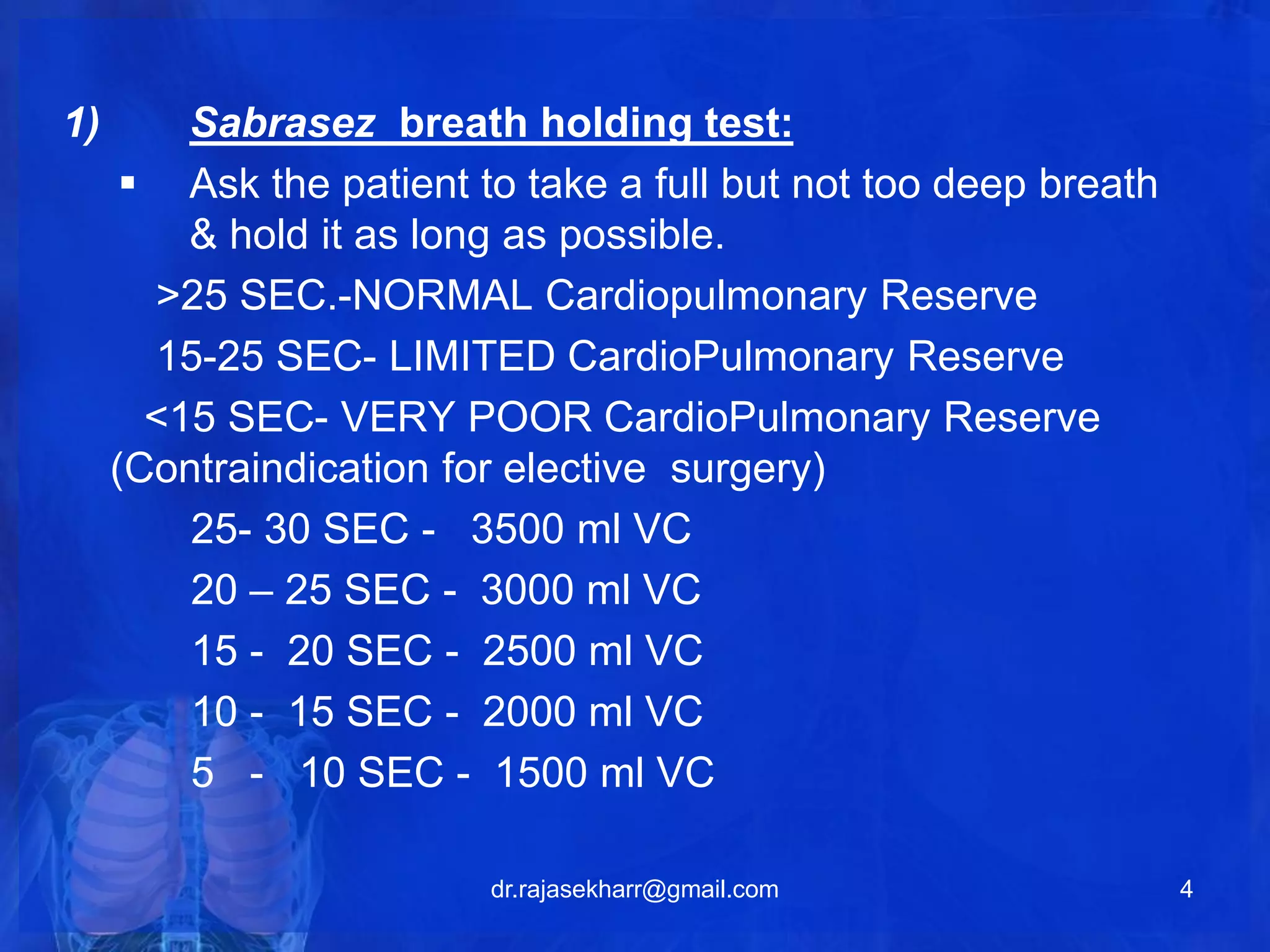
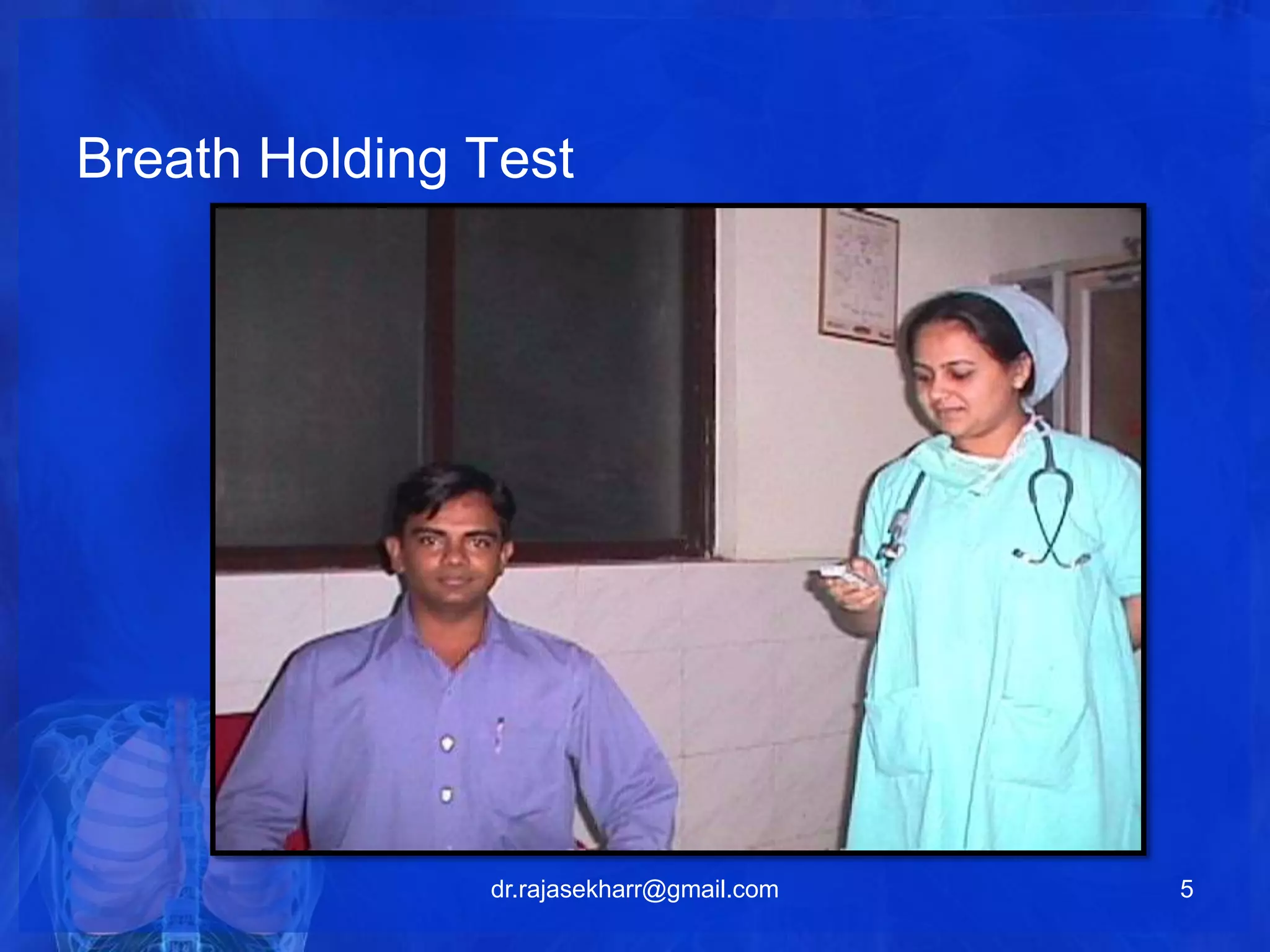
1) Sabrasez breath holding test: 
 Ask the patient to take a full but not too deep breath 
& hold it as long as possible. 
>25 SEC.-NORMAL Cardiopulmonary Reserve 
15-25 SEC- LIMITED CardioPulmonary Reserve 
<15 SEC- VERY POOR CardioPulmonary Reserve 
(Contraindication for elective surgery) 
25- 30 SEC - 3500 ml VC 
20 – 25 SEC - 3000 ml VC 
15 - 20 SEC - 2500 ml VC 
10 - 15 SEC - 2000 ml VC 
5 - 10 SEC - 1500 ml VC 
dr.rajasekharr@gmail.com 4
Breath Holding Test 
dr.rajasekharr@gmail.com 5
2) Single breath count: 
After deep breath, hold it and start counting till the next 
breath. 
 Normal- 30-40 COUNT 
 Indicates vital capacity 
dr.rajasekharr@gmail.com 6
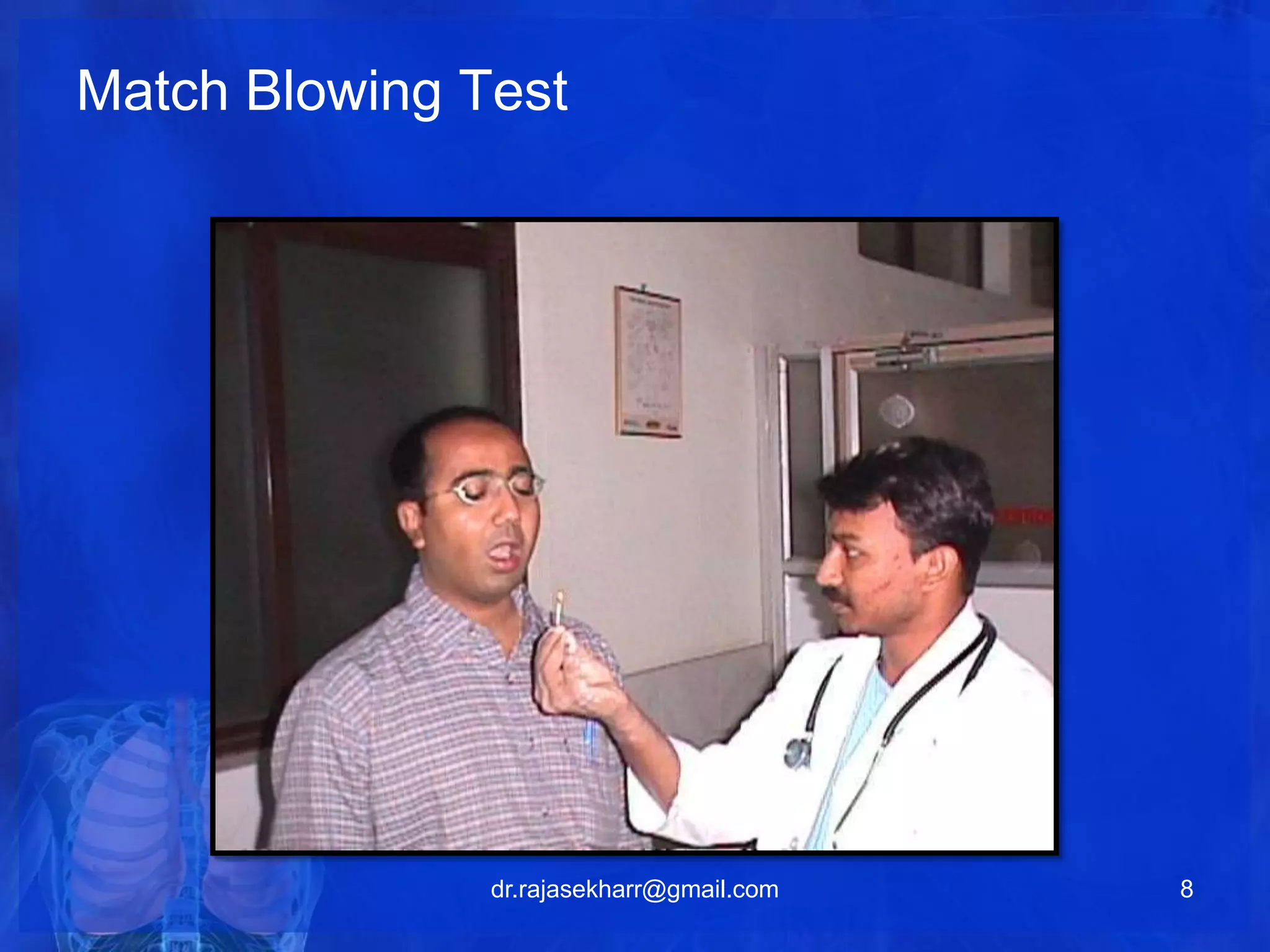
3) SNIDER’SMATCH BLOWING TEST: 
Measures Maximum Breathing Capacity. 
Should take 6 attempts 
Ask to blow a match stick from a distance of 6” (15 
cms) with 
 Mouth wide open 
 Chin rested/supported 
 No pursed lips 
 No head movement 
 No air movement in the room 
 Mouth and match stick at the same level 
dr.rajasekharr@gmail.com 7
Match Blowing Test 
dr.rajasekharr@gmail.com 8
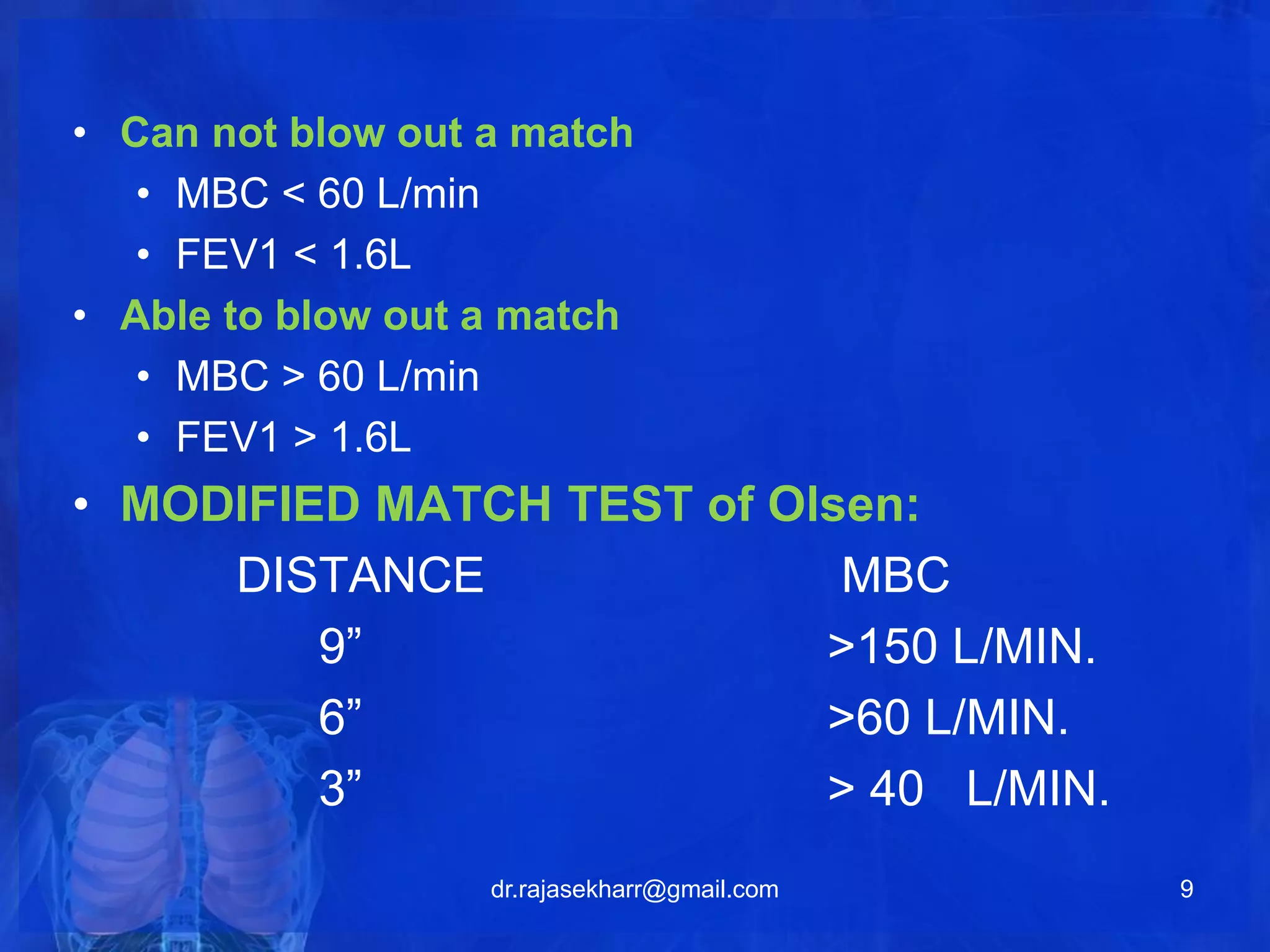
• Can not blow out a match 
• MBC < 60 L/min 
• FEV1 < 1.6L 
• Able to blow out a match 
• MBC > 60 L/min 
• FEV1 > 1.6L 
• MODIFIED MATCH TEST of Olsen: 
DISTANCE MBC 
9” >150 L/MIN. 
6” >60 L/MIN. 
3” > 40 L/MIN. 
dr.rajasekharr@gmail.com 9
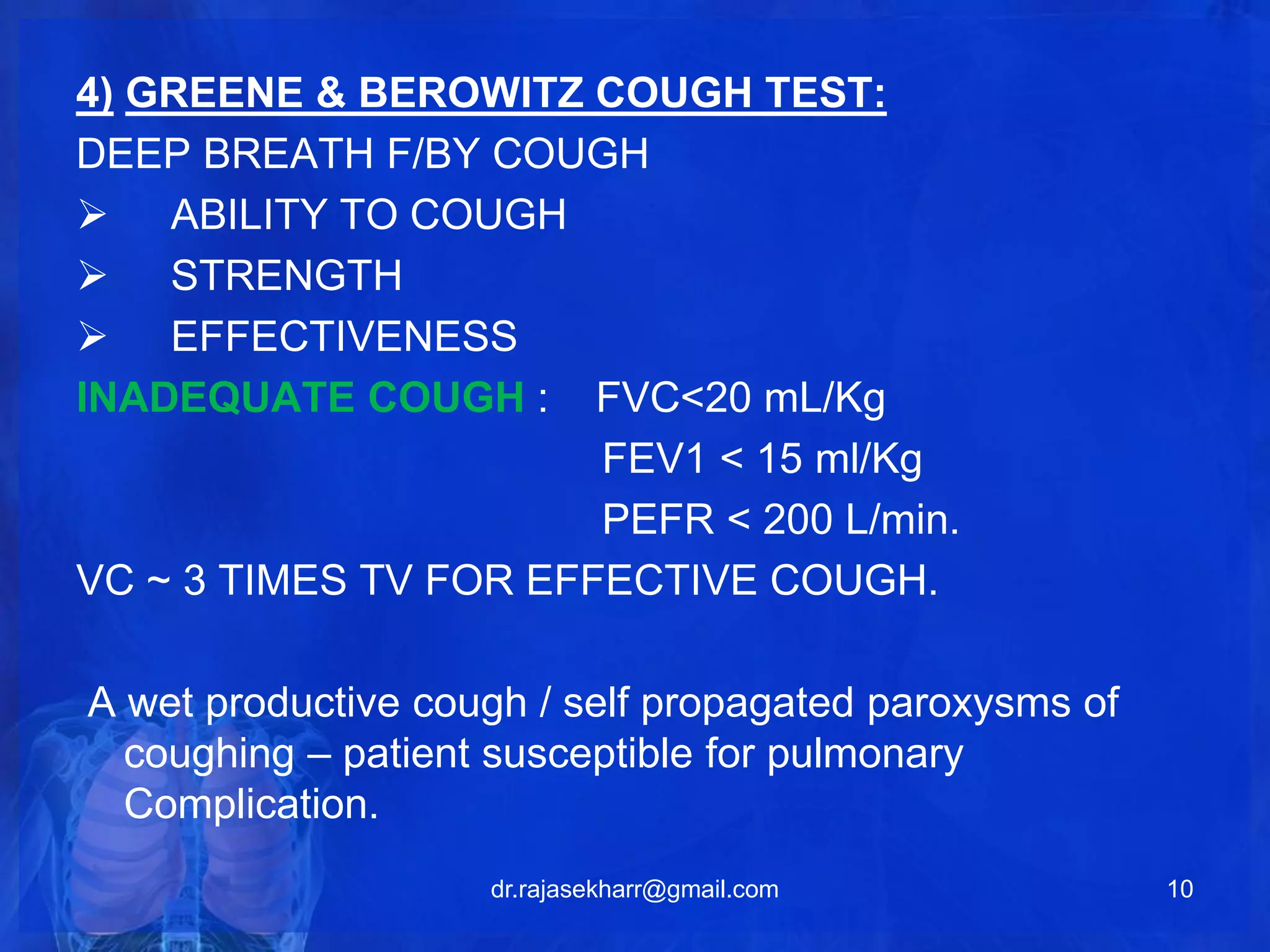
4) GREENE & BEROWITZ COUGH TEST: 
DEEP BREATH F/BY COUGH 
 ABILITY TO COUGH 
 STRENGTH 
 EFFECTIVENESS 
INADEQUATE COUGH : FVC<20 mL/Kg 
FEV1 < 15 ml/Kg 
PEFR < 200 L/min. 
VC ~ 3 TIMES TV FOR EFFECTIVE COUGH. 
A wet productive cough / self propagated paroxysms of 
coughing – patient susceptible for pulmonary 
Complication. 
dr.rajasekharr@gmail.com 10
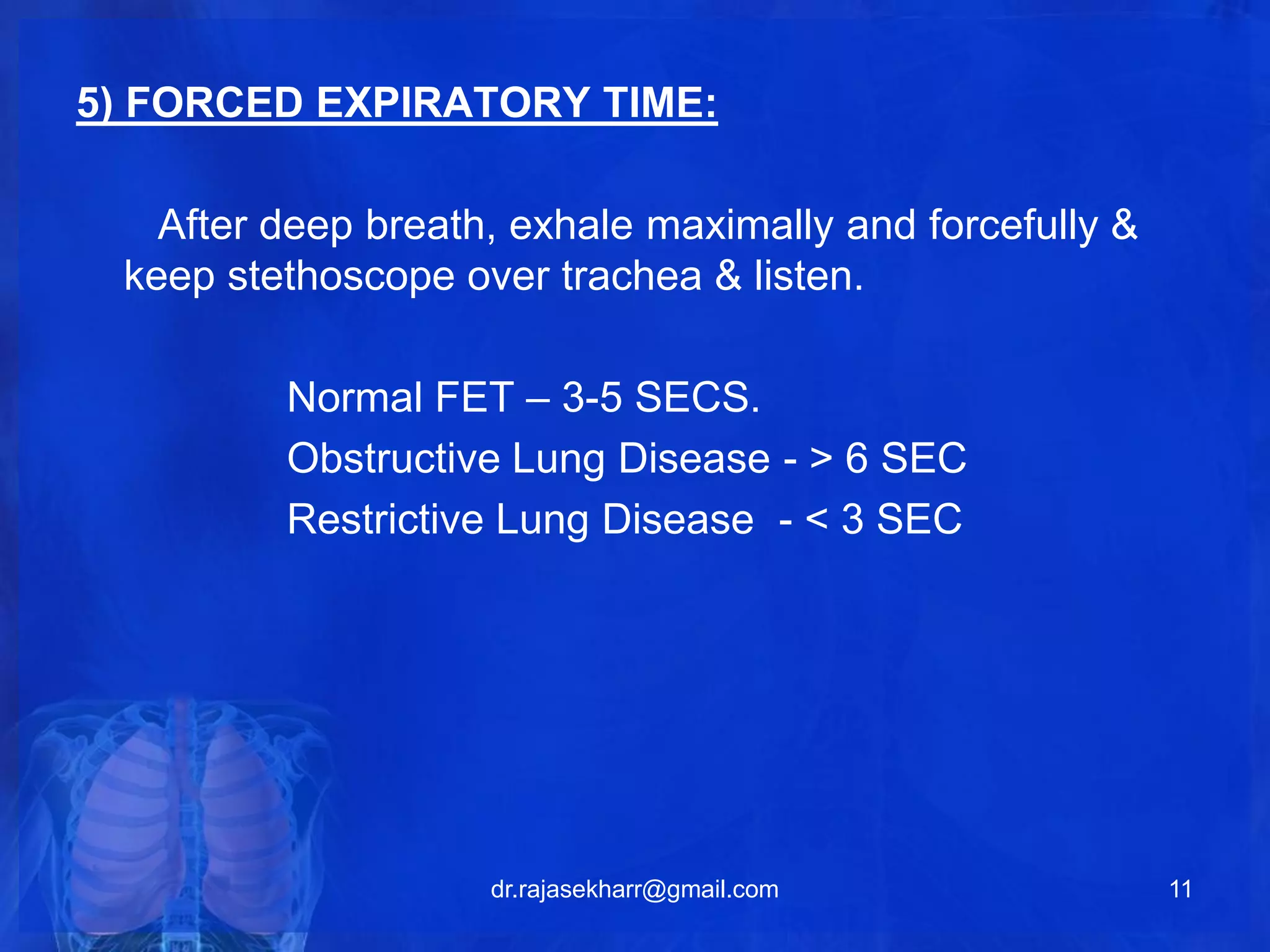
5) FORCED EXPIRATORY TIME: 
After deep breath, exhale maximally and forcefully & 
keep stethoscope over trachea & listen. 
Normal FET – 3-5 SECS. 
Obstructive Lung Disease - > 6 SEC 
Restrictive Lung Disease - < 3 SEC 
dr.rajasekharr@gmail.com 11
Auscultation over Trachea 
dr.rajasekharr@gmail.com 12
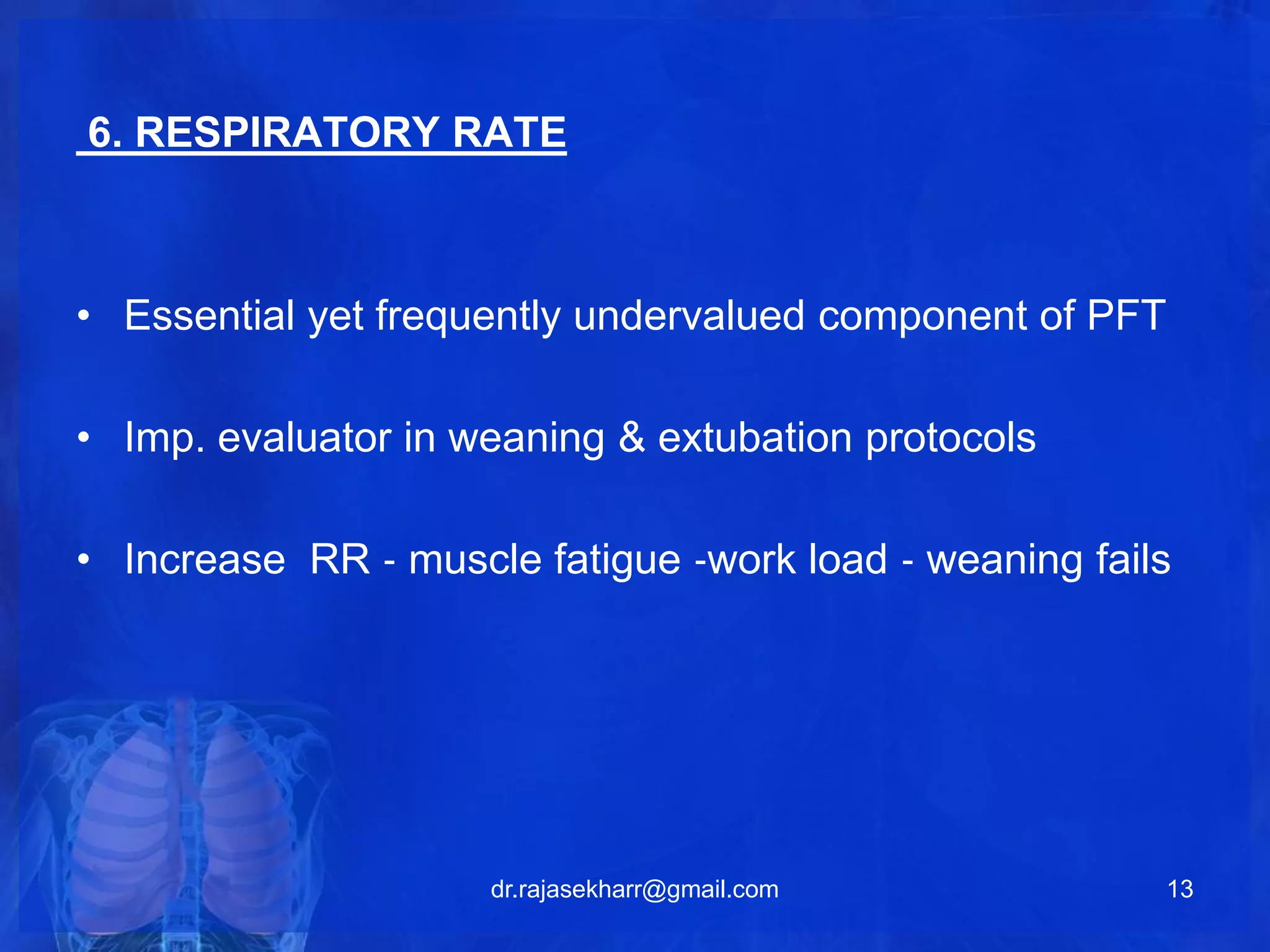
6. RESPIRATORY RATE 
• Essential yet frequently undervalued component of PFT 
• Imp. evaluator in weaning & extubation protocols 
• Increase RR ‐ muscle fatigue ‐work load ‐ weaning fails 
dr.rajasekharr@gmail.com 13
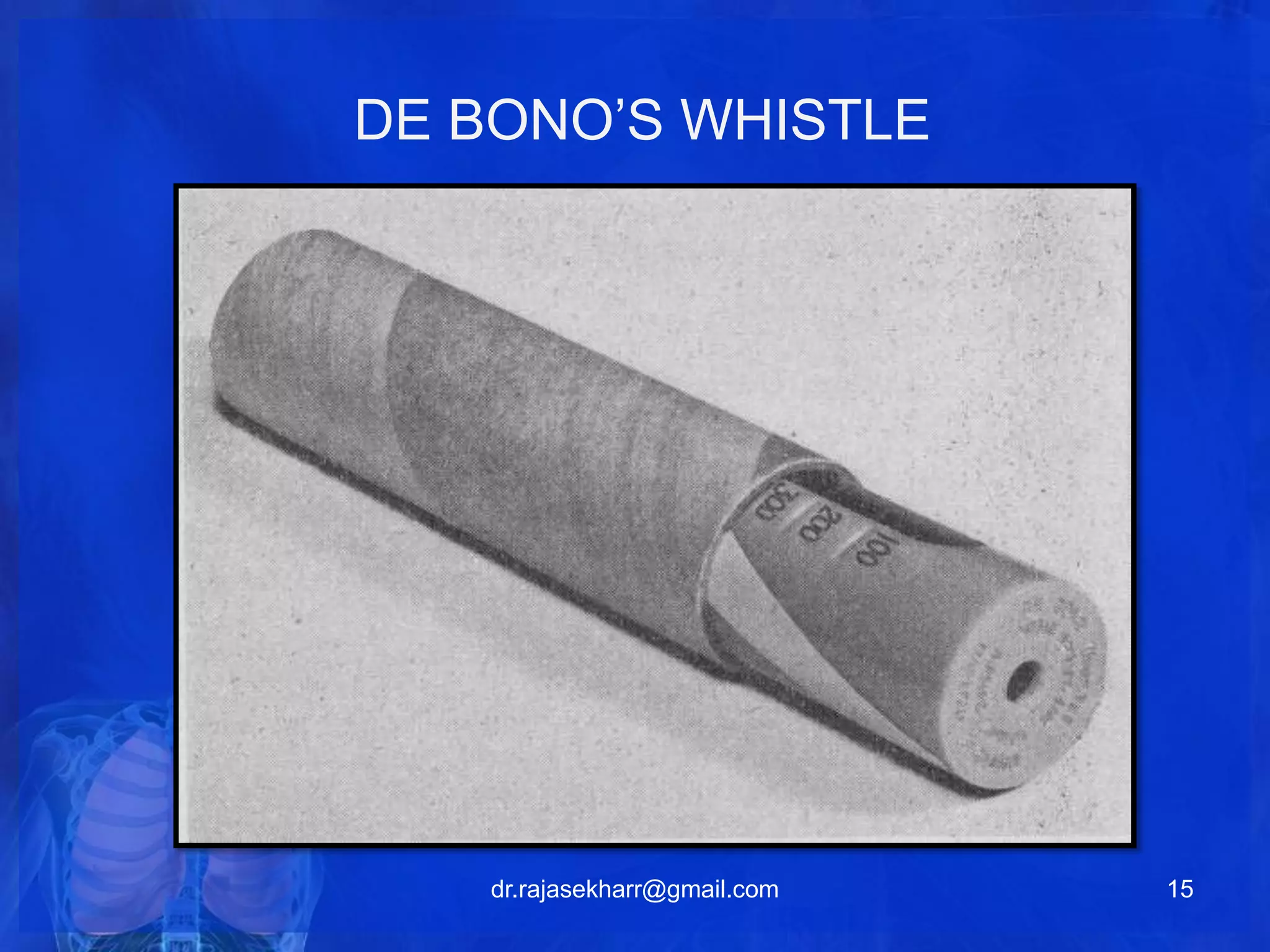
7) DE BONO’S WHISTLE BLOWING TEST: 
MEASURES PEFR. 
Patient blows down a wide bore tube at the end of which 
is a whistle, on the side is a hole with adjustable knob. 
As subject blows → whistle blows, leak hole is gradually 
increased till the intensity of whistle disappears. 
At the last position at which the whistle can be blown , 
the PEFR can be read off the scale. 
dr.rajasekharr@gmail.com 14
DE BONO’S WHISTLE 
dr.rajasekharr@gmail.com 15
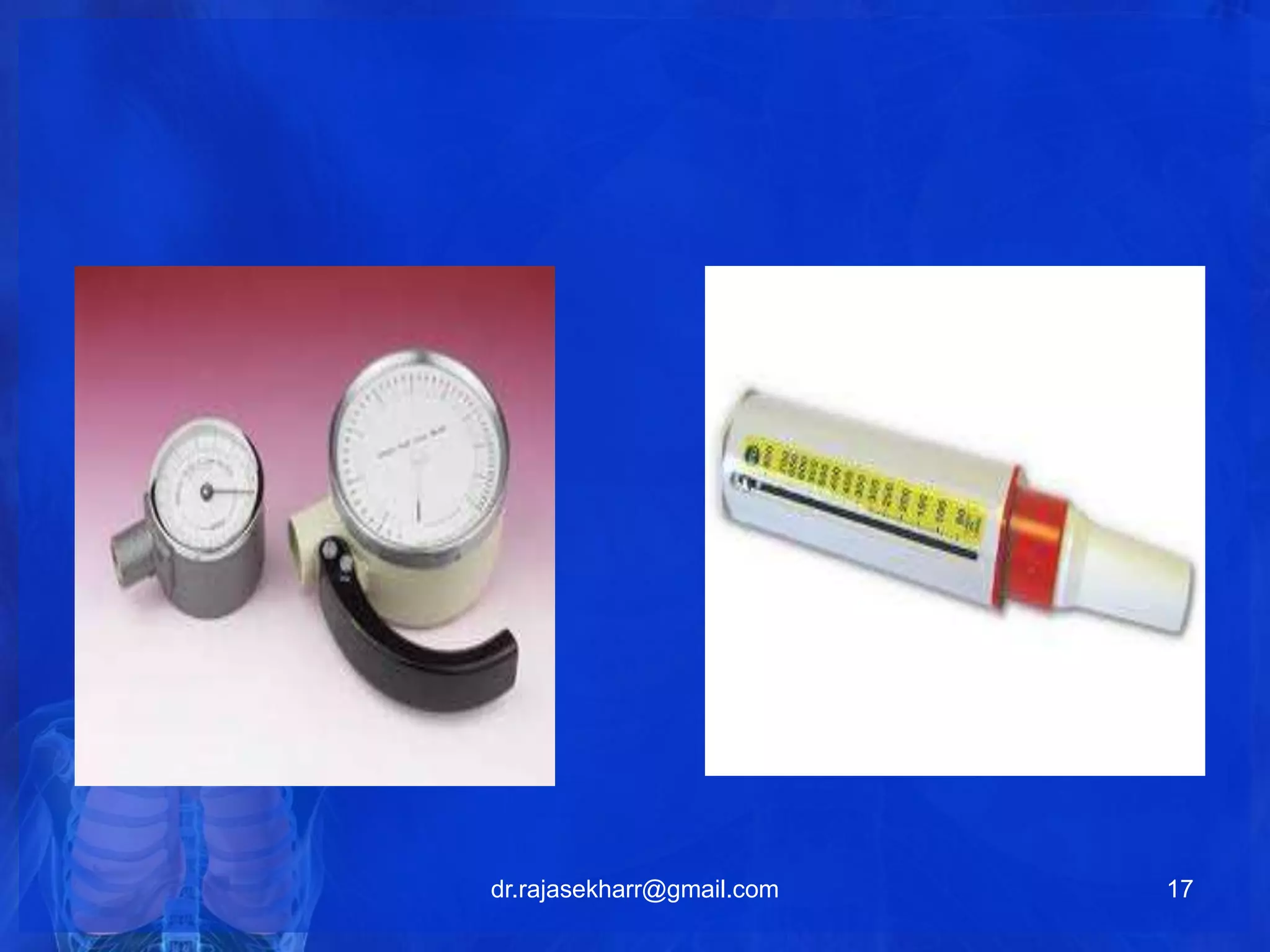
8)Wright ‘s Respirometer : 
measures VT and minute volume 
 Simple and rapid 
 Instrument- compact, light and portable. 
 Disadvantage: It under- reads at low flow rates and over-reads 
at high flow rates. 
 Can be connected to endo tracheal tube or face mask 
 Prior explanation to patient is needed. 
dr.rajasekharr@gmail.com 16
dr.rajasekharr@gmail.com 17
Contd… 
 Ideally done in sitting position. 
 MV- instrument record for 1 min. And read directly 
 VT-calculated and dividing MV by counting Respiratory 
Rate. 
 Accurate measurement in the range of 3.7-20 
L/min.(±10%) 
 USES: 1)Bedside PFT 
2) ICU – Weaning Pts. from Ventilator. 
dr.rajasekharr@gmail.com 18
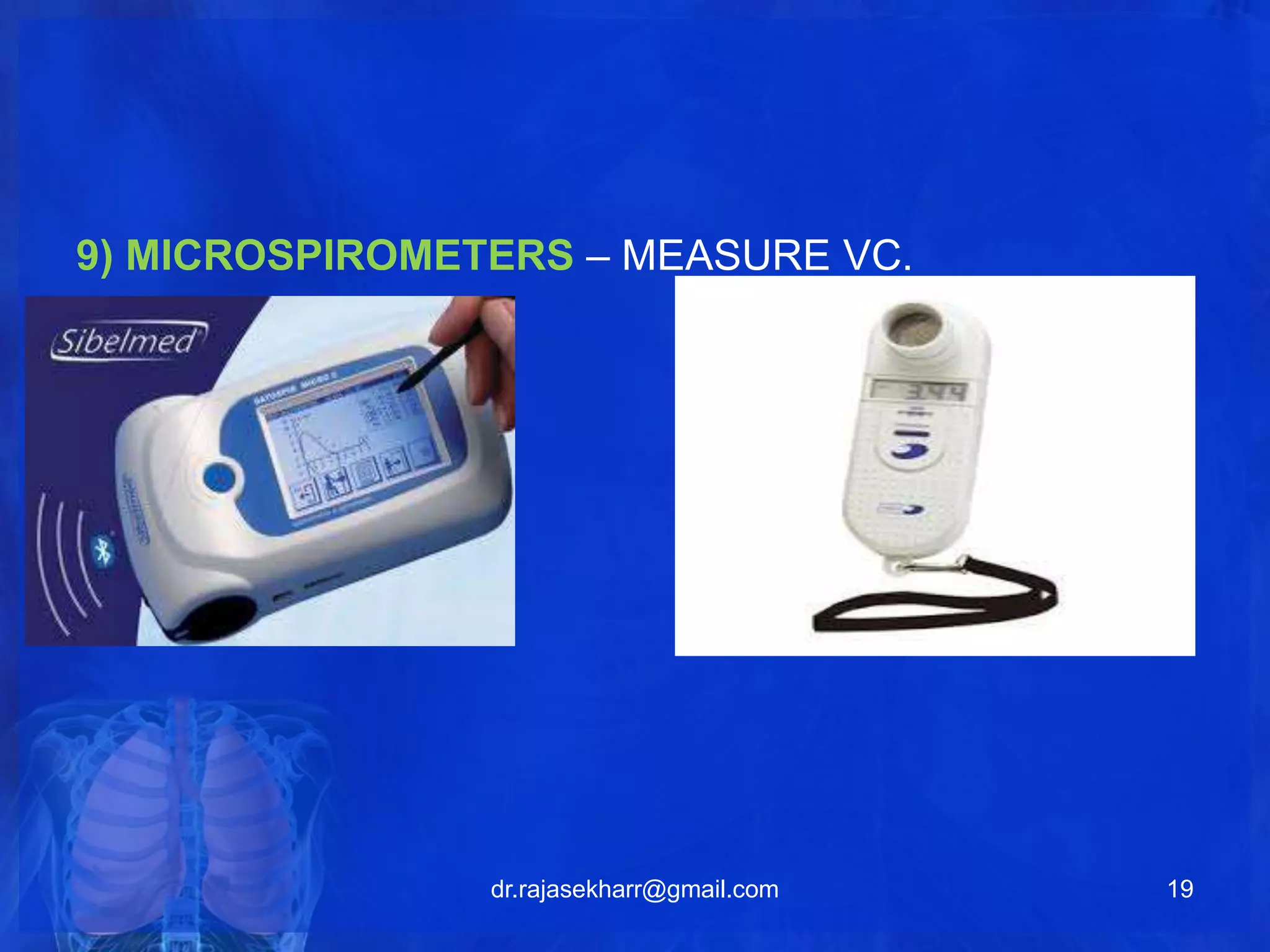
9) MICROSPIROMETERS – MEASURE VC. 
dr.rajasekharr@gmail.com 19
10) BED SIDE PULSE OXIMETRY 
11) ABG. 
dr.rajasekharr@gmail.com 20
References 
1) SNIDER,T. H.Simple Bedside Test of Respiratory Function. J. Am. Med. Assoc. 
170:1631, 1959. 
2) CARILLI, A. D. and J. R. HENDERSON. Estimation of Ventilatory Function by 
Blowing Out a Match. Am. Rev. Resp. Dis. 89:680, 1964. 
3) OLSEN, C. R. The Match Test: A Measure of Ventilatory Function. Am. Rev. Resp. 
Dis. 86:37,1962. 
4) WRIGHT, B. M. and C. B. McKERROW. Maximum Forced Expiratory Flow Rate as a 
Measure of Ventilatory Capacity. Br. Med. J. 2:1041, 1959. 
5) DE BONO, E. F. A Whistle for Testing Lung Function. Lancet 2:1146, 1963. 
dr.rajasekharr@gmail.com 21
dr.rajasekharr@gmail.com 22

Bed side pulmonary function tests 7

  • 1.
    Bed side PulmonaryFunction Tests dr.rajasekharr@gmail.com 1
  • 2.
    • Pulmonary functiontests have been used traditionally in the preoperative assessment before any major surgery. INDICATIONS  To predict the presence of pulmonary dysfunction  To know the functional nature of disease (obstructive or restrictive. )  To assess the severity of disease  To assess the progression of disease  To assess the response to treatment  To identify patients at increased risk of morbidity and mortality, undergoing pulmonary resection. dr.rajasekharr@gmail.com 2
  • 3.
     To identifypatients at perioperative risk of pulmonary complications  Degree and severity of impairment  Identify the site of airway obstruction dr.rajasekharr@gmail.com 3
  • 4.
    1) Sabrasez breathholding test:  Ask the patient to take a full but not too deep breath & hold it as long as possible. >25 SEC.-NORMAL Cardiopulmonary Reserve 15-25 SEC- LIMITED CardioPulmonary Reserve <15 SEC- VERY POOR CardioPulmonary Reserve (Contraindication for elective surgery) 25- 30 SEC - 3500 ml VC 20 – 25 SEC - 3000 ml VC 15 - 20 SEC - 2500 ml VC 10 - 15 SEC - 2000 ml VC 5 - 10 SEC - 1500 ml VC dr.rajasekharr@gmail.com 4
  • 5.
    Breath Holding Test dr.rajasekharr@gmail.com 5
  • 6.
    2) Single breathcount: After deep breath, hold it and start counting till the next breath.  Normal- 30-40 COUNT  Indicates vital capacity dr.rajasekharr@gmail.com 6
  • 7.
    3) SNIDER’SMATCH BLOWINGTEST: Measures Maximum Breathing Capacity. Should take 6 attempts Ask to blow a match stick from a distance of 6” (15 cms) with  Mouth wide open  Chin rested/supported  No pursed lips  No head movement  No air movement in the room  Mouth and match stick at the same level dr.rajasekharr@gmail.com 7
  • 8.
    Match Blowing Test dr.rajasekharr@gmail.com 8
  • 9.
    • Can notblow out a match • MBC < 60 L/min • FEV1 < 1.6L • Able to blow out a match • MBC > 60 L/min • FEV1 > 1.6L • MODIFIED MATCH TEST of Olsen: DISTANCE MBC 9” >150 L/MIN. 6” >60 L/MIN. 3” > 40 L/MIN. dr.rajasekharr@gmail.com 9
  • 10.
    4) GREENE &BEROWITZ COUGH TEST: DEEP BREATH F/BY COUGH  ABILITY TO COUGH  STRENGTH  EFFECTIVENESS INADEQUATE COUGH : FVC<20 mL/Kg FEV1 < 15 ml/Kg PEFR < 200 L/min. VC ~ 3 TIMES TV FOR EFFECTIVE COUGH. A wet productive cough / self propagated paroxysms of coughing – patient susceptible for pulmonary Complication. dr.rajasekharr@gmail.com 10
  • 11.
    5) FORCED EXPIRATORYTIME: After deep breath, exhale maximally and forcefully & keep stethoscope over trachea & listen. Normal FET – 3-5 SECS. Obstructive Lung Disease - > 6 SEC Restrictive Lung Disease - < 3 SEC dr.rajasekharr@gmail.com 11
  • 12.
    Auscultation over Trachea dr.rajasekharr@gmail.com 12
  • 13.
    6. RESPIRATORY RATE • Essential yet frequently undervalued component of PFT • Imp. evaluator in weaning & extubation protocols • Increase RR ‐ muscle fatigue ‐work load ‐ weaning fails dr.rajasekharr@gmail.com 13
  • 14.
    7) DE BONO’SWHISTLE BLOWING TEST: MEASURES PEFR. Patient blows down a wide bore tube at the end of which is a whistle, on the side is a hole with adjustable knob. As subject blows → whistle blows, leak hole is gradually increased till the intensity of whistle disappears. At the last position at which the whistle can be blown , the PEFR can be read off the scale. dr.rajasekharr@gmail.com 14
  • 15.
    DE BONO’S WHISTLE dr.rajasekharr@gmail.com 15
  • 16.
    8)Wright ‘s Respirometer: measures VT and minute volume  Simple and rapid  Instrument- compact, light and portable.  Disadvantage: It under- reads at low flow rates and over-reads at high flow rates.  Can be connected to endo tracheal tube or face mask  Prior explanation to patient is needed. dr.rajasekharr@gmail.com 16
  • 17.
  • 18.
    Contd…  Ideallydone in sitting position.  MV- instrument record for 1 min. And read directly  VT-calculated and dividing MV by counting Respiratory Rate.  Accurate measurement in the range of 3.7-20 L/min.(±10%)  USES: 1)Bedside PFT 2) ICU – Weaning Pts. from Ventilator. dr.rajasekharr@gmail.com 18
  • 19.
    9) MICROSPIROMETERS –MEASURE VC. dr.rajasekharr@gmail.com 19
  • 20.
    10) BED SIDEPULSE OXIMETRY 11) ABG. dr.rajasekharr@gmail.com 20
  • 21.
    References 1) SNIDER,T.H.Simple Bedside Test of Respiratory Function. J. Am. Med. Assoc. 170:1631, 1959. 2) CARILLI, A. D. and J. R. HENDERSON. Estimation of Ventilatory Function by Blowing Out a Match. Am. Rev. Resp. Dis. 89:680, 1964. 3) OLSEN, C. R. The Match Test: A Measure of Ventilatory Function. Am. Rev. Resp. Dis. 86:37,1962. 4) WRIGHT, B. M. and C. B. McKERROW. Maximum Forced Expiratory Flow Rate as a Measure of Ventilatory Capacity. Br. Med. J. 2:1041, 1959. 5) DE BONO, E. F. A Whistle for Testing Lung Function. Lancet 2:1146, 1963. dr.rajasekharr@gmail.com 21
  • 22.