ANESTHESIA FOR PNEUMONECTOMY
Presenter- Dr. Vaishali Agrawal
Moderator- Dr. Virendra
FLOW OF PRESENTATION
 Pre operative Assessment
 Pre operative Preparation
 Intra operative management
Induction and maintenance
Monitoring
Positioning
 Lung isolation technique
 Post operative Management
 Postop Analgesia
 Postop Complications
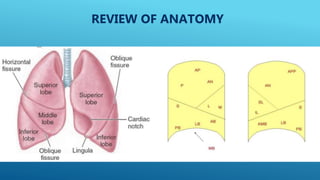
REVIEW OF ANATOMY
PRE OPERATIVE ASSESSMENT
AIM
 Identify patients who are at risk
 Use that risk assessment to stratify periop management and focus on high risk
patients to improve their outcome
ASSESSMENT OF RESPIRATORY FUNCTION
 Detailed history
 Baseline spirometry
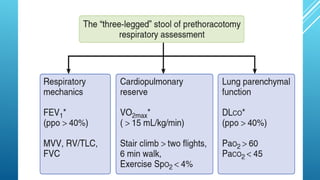
 Respiratory mechanics
 Lung parenchymal function
 Cardiopulmonary interaction
History
 Age
 Dyspnoea and cough
 Characteristics of sputum produced
 Coexisting disease
 Patient functional status
 Chest pain
 Smoking
 Exposure to Asbestos or radiation
 Current medication
Baseline Spirometry
 FEV1
 VITAL CAPACITY
 FEV1/VC
 RESIDUAL VOLUME/TLC
 Maximum Voluantary Ventilation (FEV1 X 35)
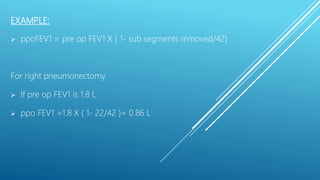
EXAMPLE:
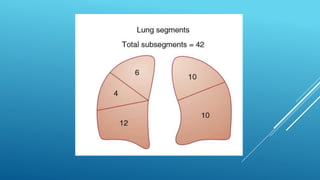
 ppoFEV1 = pre op FEV1 X ( 1- sub segments removed/42)
For right pneumonectomy
 If pre op FEV1 is 1.8 L
 ppo FEV1 =1.8 X ( 1- 22/42 )= 0.86 L
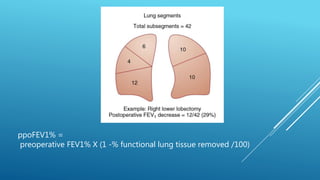
ppoFEV1% =
preoperative FEV1% X (1 -% functional lung tissue removed /100)
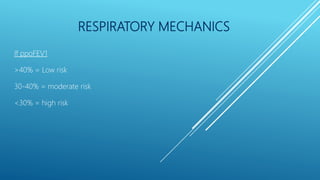
RESPIRATORY MECHANICS
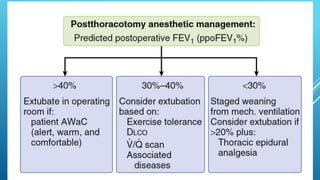
If ppoFEV1
>40% = Low risk
30-40% = moderate risk
<30% = high risk
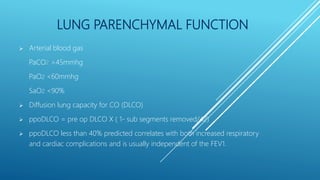
LUNG PARENCHYMAL FUNCTION
 Arterial blood gas
PaCO2 >45mmhg
PaO2 <60mmhg
SaO2 <90%
 Diffusion lung capacity for CO (DLCO)
 ppoDLCO = pre op DLCO X ( 1- sub segments removed/42)
 ppoDLCO less than 40% predicted correlates with both increased respiratory
and cardiac complications and is usually independent of the FEV1.
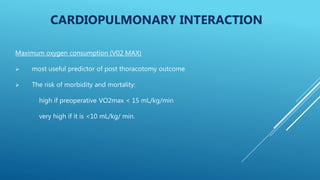
CARDIOPULMONARY INTERACTION
Maximum oxygen consumption (V02 MAX)
 most useful predictor of post thoracotomy outcome
 The risk of morbidity and mortality:
high if preoperative VO2max < 15 mL/kg/min
very high if it is <10 mL/kg/ min.
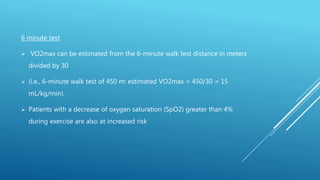
6 minute test
 VO2max can be estimated from the 6-minute walk test distance in meters
divided by 30
 (i.e., 6-minute walk test of 450 m: estimated VO2max = 450/30 = 15
mL/kg/min).
 Patients with a decrease of oxygen saturation (SpO2) greater than 4%
during exercise are also at increased risk
Stair climbing
 5 flights VO2 max >20ml/kg/min
 3 flights VO2 max >15ml/kg/min
 2 flights VO2 max = 12ml/kg/min
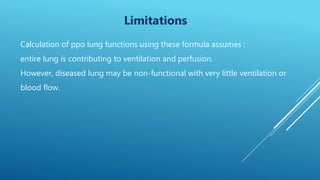
Limitations
Calculation of ppo lung functions using these formula assumes :
entire lung is contributing to ventilation and perfusion.
However, diseased lung may be non-functional with very little ventilation or
blood flow.
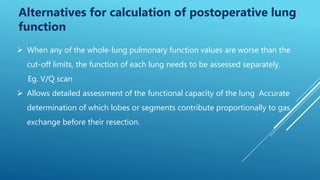
Alternatives for calculation of postoperative lung
function
 When any of the whole-lung pulmonary function values are worse than the
cut-off limits, the function of each lung needs to be assessed separately.
Eg. V/Q scan
 Allows detailed assessment of the functional capacity of the lung Accurate
determination of which lobes or segments contribute proportionally to gas
exchange before their resection.
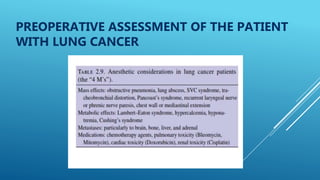
PREOPERATIVE ASSESSMENT OF THE PATIENT
WITH LUNG CANCER
PREOPERATIVE OPTIMIZATION
 Stop smoking, avoid industrial pollutants
 Bronchodilator therapy
 Loosening of secretion
 Removing secretions
 Incentive spirometry
 Education , motivation
 Facilitation of postoperative care
ANESTHETIC TECHNIQUE
 GA with controlled ventilation with thoracic epidural analgesia
Induction
 Propofol
 Etomidate if elderly and cardiac unstable
NMB
 Intermediate Non depolarizer
 Sch if difficult intubation anticipated
Maintenance
 Avoid halothane which inhibit Hypoxic pulmonary ventilation (HPV)
 Isoflurane: minimal effect on HPV with valvues < 1 MAC
Hypoxic pulmonary vasoconstriction (HPV)
 A physiological local response of pulmonary vascular smooth muscle (PVSM) to
alveolar hypoxia.
 This effect occurs when there is a reduction in alveolar PO2 between 4 and 8 kpa.
 Decreases blood flow to the area of lung where a low alveolar oxygen pressure is
sensed and redistributes pulmonary blood flow from areas of low oxygen partial
pressure to areas of high oxygen availability (minimize’s the shunt fraction ).
 Results in a 50% reduction in blood flow to non depedendent non ventilated lung.
Hypoxic pulmonary vasoconstriction(contd….)
 Intrinsic response of lung, no neuronal control.(immediately present in
transplanted lung).
 The mechanism of HPV is not completely understood. Vasoactive substances
released by hypoxia or hypoxia itself (K+ channel) cause pulmonary artery smooth
muscle contraction.
 All pulmonary arteries and veins vasoconstrict in response to hypoxia, but greatest
effect is to small pulmonary arteries.
Hypoxic pulmonary vasoconstriction(contd….)
 HPV aids in keeping a normal V/Q relationship by diversion of blood from
underventilated areas, responsible for the most lung perfusion redistribution in
OLV.
 HPV is graded and limited, of greatest benefit when 30% to 70% of the lung is made
hypoxic.
 But effective only when there are normoxic areas of the lung available to receive
the diverted blood flow.
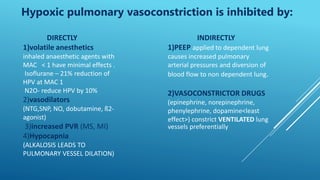
Hypoxic pulmonary vasoconstriction is inhibited by:
DIRECTLY
1)volatile anesthetics
inhaled anaesthetic agents with
MAC < 1 have minimal effects .
Isoflurane – 21% reduction of
HPV at MAC 1
N2O- reduce HPV by 10%
2)vasodilators
(NTG,SNP, NO, dobutamine, ß2-
agonist)
3)increased PVR (MS, MI)
4)Hypocapnia
(ALKALOSIS LEADS TO
PULMONARY VESSEL DILATION)
INDIRECTLY
1)PEEP applied to dependent lung
causes increased pulmonary
arterial pressures and diversion of
blood flow to non dependent lung.
2)VASOCONSTRICTOR DRUGS
(epinephrine, norepinephrine,
phenylephrine, dopamine<least
effect>) constrict VENTILATED lung
vessels preferentially
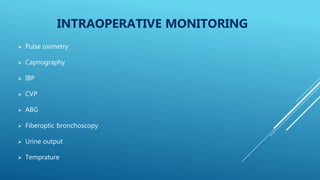
INTRAOPERATIVE MONITORING
 Pulse oximetry
 Capnography
 IBP
 CVP
 ABG
 Fiberoptic bronchoscopy
 Urine output
 Temprature
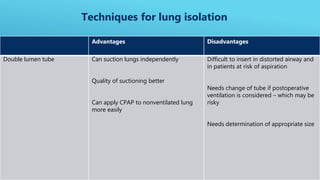
Techniques for lung isolation
Advantages Disadvantages
Double lumen tube Can suction lungs independently
Quality of suctioning better
Can apply CPAP to nonventilated lung
more easily
Difficult to insert in distorted airway and
in patients at risk of aspiration
Needs change of tube if postoperative
ventilation is considered – which may be
risky
Needs determination of appropriate size
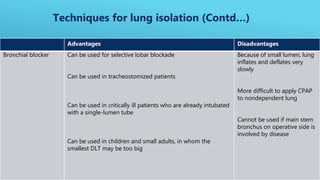
Advantages Disadvantages
Bronchial blocker Can be used for selective lobar blockade
Can be used in tracheostomized patients
Can be used in critically ill patients who are already intubated
with a single-lumen tube
Can be used in children and small adults, in whom the
smallest DLT may be too big
Because of small lumen, lung
inflates and deflates very
slowly
More difficult to apply CPAP
to nondependent lung
Cannot be used if main stem
bronchus on operative side is
involved by disease
Techniques for lung isolation (Contd…)
Advantages Disadvantages
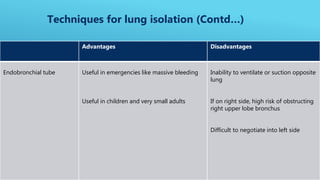
Endobronchial tube Useful in emergencies like massive bleeding
Useful in children and very small adults
Inability to ventilate or suction opposite
lung
If on right side, high risk of obstructing
right upper lobe bronchus
Difficult to negotiate into left side
Techniques for lung isolation (Contd…)
Positioning
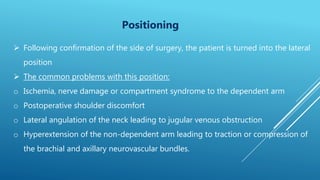
 Following confirmation of the side of surgery, the patient is turned into the lateral
position
 The common problems with this position:
o Ischemia, nerve damage or compartment syndrome to the dependent arm
o Postoperative shoulder discomfort
o Lateral angulation of the neck leading to jugular venous obstruction
o Hyperextension of the non-dependent arm leading to traction or compression of
the brachial and axillary neurovascular bundles.
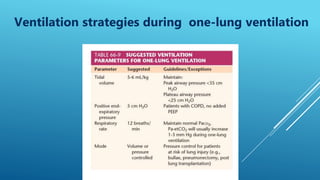
Ventilation strategies during one-lung ventilation
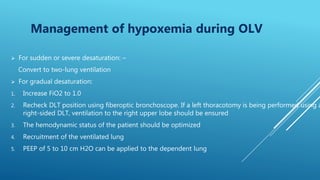
 For sudden or severe desaturation: –
Convert to two-lung ventilation
 For gradual desaturation:
1. Increase FiO2 to 1.0
2. Recheck DLT position using fiberoptic bronchoscope. If a left thoracotomy is being performed using a
right-sided DLT, ventilation to the right upper lobe should be ensured
3. The hemodynamic status of the patient should be optimized
4. Recruitment of the ventilated lung
5. PEEP of 5 to 10 cm H2O can be applied to the dependent lung
Management of hypoxemia during OLV
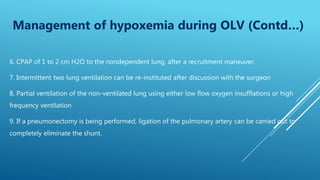
6. CPAP of 1 to 2 cm H2O to the nondependent lung, after a recruitment maneuver.
7. Intermittent two lung ventilation can be re-instituted after discussion with the surgeon
8. Partial ventilation of the non-ventilated lung using either low flow oxygen insufflations or high
frequency ventilation
9. If a pneumonectomy is being performed, ligation of the pulmonary artery can be carried out to
completely eliminate the shunt.
Management of hypoxemia during OLV (Contd…)
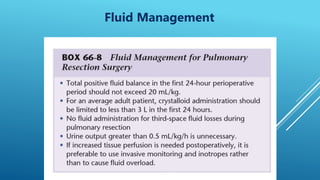
Fluid Management
 IV fluids may contribute to intrapulmonary shunting in lateral decubitus position by:
 Lower lung syndrome- may occur with excessive fluid administration in the lateral
decubitus position
 Lower lung syndrome is gravity dependent transudation of fluid in to the dependent
lung
 The collapsed lung may be prone to edema following re-expansion secondary to surgical
retraction
Fluid Management (Contd…)
Local anesthetics/ Nerve blocks
 Thoracic epidural analgesia
 Intercostal nerve blocks
 Interpleural analgesia
 Paravertebral block
Systemic analgesia
 Opiods
 NSAID’S
 Dexmedetomidine
Postoperative pain management
POSTOPERATIVE COMPLICATIONS
Early
 Respiratory failure
 Dehiscence of bronchial stump
 Hemorrhage from major vessel
 Mediastinal shift
 Post pneumonectomy pulmonary edema
 Arrhythmias
 Vocal cord dysfunction
 Cardiac herniation
Delayed
 Post pneumonectomy syndrome
 Atelectasis
 Pulmonary infarction
 Bronchopleural fistula
 Miller’s ANAESTHESIA 8th edition
 Barasch clinical anaesthesia 8th edition
 Morgan and Mikhail’s clinical anaesthesiology 5th edition
References
Pneumonectomy

Pneumonectomy

  • 1.
    ANESTHESIA FOR PNEUMONECTOMY Presenter-Dr. Vaishali Agrawal Moderator- Dr. Virendra
  • 2.
    FLOW OF PRESENTATION Pre operative Assessment  Pre operative Preparation  Intra operative management Induction and maintenance Monitoring Positioning  Lung isolation technique  Post operative Management  Postop Analgesia  Postop Complications
  • 3.
  • 5.
    PRE OPERATIVE ASSESSMENT AIM Identify patients who are at risk  Use that risk assessment to stratify periop management and focus on high risk patients to improve their outcome
  • 6.
    ASSESSMENT OF RESPIRATORYFUNCTION  Detailed history  Baseline spirometry  Respiratory mechanics  Lung parenchymal function  Cardiopulmonary interaction
  • 7.
    History  Age  Dyspnoeaand cough  Characteristics of sputum produced  Coexisting disease  Patient functional status  Chest pain  Smoking  Exposure to Asbestos or radiation  Current medication
  • 8.
    Baseline Spirometry  FEV1 VITAL CAPACITY  FEV1/VC  RESIDUAL VOLUME/TLC  Maximum Voluantary Ventilation (FEV1 X 35)
  • 9.
    EXAMPLE:  ppoFEV1 =pre op FEV1 X ( 1- sub segments removed/42) For right pneumonectomy  If pre op FEV1 is 1.8 L  ppo FEV1 =1.8 X ( 1- 22/42 )= 0.86 L
  • 10.
    ppoFEV1% = preoperative FEV1%X (1 -% functional lung tissue removed /100)
  • 11.
    RESPIRATORY MECHANICS If ppoFEV1 >40%= Low risk 30-40% = moderate risk <30% = high risk
  • 12.
    LUNG PARENCHYMAL FUNCTION Arterial blood gas PaCO2 >45mmhg PaO2 <60mmhg SaO2 <90%  Diffusion lung capacity for CO (DLCO)  ppoDLCO = pre op DLCO X ( 1- sub segments removed/42)  ppoDLCO less than 40% predicted correlates with both increased respiratory and cardiac complications and is usually independent of the FEV1.
  • 13.
    CARDIOPULMONARY INTERACTION Maximum oxygenconsumption (V02 MAX)  most useful predictor of post thoracotomy outcome  The risk of morbidity and mortality: high if preoperative VO2max < 15 mL/kg/min very high if it is <10 mL/kg/ min.
  • 14.
    6 minute test VO2max can be estimated from the 6-minute walk test distance in meters divided by 30  (i.e., 6-minute walk test of 450 m: estimated VO2max = 450/30 = 15 mL/kg/min).  Patients with a decrease of oxygen saturation (SpO2) greater than 4% during exercise are also at increased risk
  • 15.
    Stair climbing  5flights VO2 max >20ml/kg/min  3 flights VO2 max >15ml/kg/min  2 flights VO2 max = 12ml/kg/min
  • 16.
    Limitations Calculation of ppolung functions using these formula assumes : entire lung is contributing to ventilation and perfusion. However, diseased lung may be non-functional with very little ventilation or blood flow.
  • 17.
    Alternatives for calculationof postoperative lung function  When any of the whole-lung pulmonary function values are worse than the cut-off limits, the function of each lung needs to be assessed separately. Eg. V/Q scan  Allows detailed assessment of the functional capacity of the lung Accurate determination of which lobes or segments contribute proportionally to gas exchange before their resection.
  • 20.
    PREOPERATIVE ASSESSMENT OFTHE PATIENT WITH LUNG CANCER
  • 21.
    PREOPERATIVE OPTIMIZATION  Stopsmoking, avoid industrial pollutants  Bronchodilator therapy  Loosening of secretion  Removing secretions  Incentive spirometry  Education , motivation  Facilitation of postoperative care
  • 22.
    ANESTHETIC TECHNIQUE  GAwith controlled ventilation with thoracic epidural analgesia Induction  Propofol  Etomidate if elderly and cardiac unstable NMB  Intermediate Non depolarizer  Sch if difficult intubation anticipated Maintenance  Avoid halothane which inhibit Hypoxic pulmonary ventilation (HPV)  Isoflurane: minimal effect on HPV with valvues < 1 MAC
  • 23.
    Hypoxic pulmonary vasoconstriction(HPV)  A physiological local response of pulmonary vascular smooth muscle (PVSM) to alveolar hypoxia.  This effect occurs when there is a reduction in alveolar PO2 between 4 and 8 kpa.  Decreases blood flow to the area of lung where a low alveolar oxygen pressure is sensed and redistributes pulmonary blood flow from areas of low oxygen partial pressure to areas of high oxygen availability (minimize’s the shunt fraction ).  Results in a 50% reduction in blood flow to non depedendent non ventilated lung.
  • 24.
    Hypoxic pulmonary vasoconstriction(contd….) Intrinsic response of lung, no neuronal control.(immediately present in transplanted lung).  The mechanism of HPV is not completely understood. Vasoactive substances released by hypoxia or hypoxia itself (K+ channel) cause pulmonary artery smooth muscle contraction.  All pulmonary arteries and veins vasoconstrict in response to hypoxia, but greatest effect is to small pulmonary arteries.
  • 25.
    Hypoxic pulmonary vasoconstriction(contd….) HPV aids in keeping a normal V/Q relationship by diversion of blood from underventilated areas, responsible for the most lung perfusion redistribution in OLV.  HPV is graded and limited, of greatest benefit when 30% to 70% of the lung is made hypoxic.  But effective only when there are normoxic areas of the lung available to receive the diverted blood flow.
  • 26.
    Hypoxic pulmonary vasoconstrictionis inhibited by: DIRECTLY 1)volatile anesthetics inhaled anaesthetic agents with MAC < 1 have minimal effects . Isoflurane – 21% reduction of HPV at MAC 1 N2O- reduce HPV by 10% 2)vasodilators (NTG,SNP, NO, dobutamine, ß2- agonist) 3)increased PVR (MS, MI) 4)Hypocapnia (ALKALOSIS LEADS TO PULMONARY VESSEL DILATION) INDIRECTLY 1)PEEP applied to dependent lung causes increased pulmonary arterial pressures and diversion of blood flow to non dependent lung. 2)VASOCONSTRICTOR DRUGS (epinephrine, norepinephrine, phenylephrine, dopamine<least effect>) constrict VENTILATED lung vessels preferentially
  • 27.
    INTRAOPERATIVE MONITORING  Pulseoximetry  Capnography  IBP  CVP  ABG  Fiberoptic bronchoscopy  Urine output  Temprature
  • 28.
    Techniques for lungisolation Advantages Disadvantages Double lumen tube Can suction lungs independently Quality of suctioning better Can apply CPAP to nonventilated lung more easily Difficult to insert in distorted airway and in patients at risk of aspiration Needs change of tube if postoperative ventilation is considered – which may be risky Needs determination of appropriate size
  • 29.
    Advantages Disadvantages Bronchial blockerCan be used for selective lobar blockade Can be used in tracheostomized patients Can be used in critically ill patients who are already intubated with a single-lumen tube Can be used in children and small adults, in whom the smallest DLT may be too big Because of small lumen, lung inflates and deflates very slowly More difficult to apply CPAP to nondependent lung Cannot be used if main stem bronchus on operative side is involved by disease Techniques for lung isolation (Contd…)
  • 30.
    Advantages Disadvantages Endobronchial tubeUseful in emergencies like massive bleeding Useful in children and very small adults Inability to ventilate or suction opposite lung If on right side, high risk of obstructing right upper lobe bronchus Difficult to negotiate into left side Techniques for lung isolation (Contd…)
  • 31.
    Positioning  Following confirmationof the side of surgery, the patient is turned into the lateral position  The common problems with this position: o Ischemia, nerve damage or compartment syndrome to the dependent arm o Postoperative shoulder discomfort o Lateral angulation of the neck leading to jugular venous obstruction o Hyperextension of the non-dependent arm leading to traction or compression of the brachial and axillary neurovascular bundles.
  • 32.
    Ventilation strategies duringone-lung ventilation
  • 33.
     For suddenor severe desaturation: – Convert to two-lung ventilation  For gradual desaturation: 1. Increase FiO2 to 1.0 2. Recheck DLT position using fiberoptic bronchoscope. If a left thoracotomy is being performed using a right-sided DLT, ventilation to the right upper lobe should be ensured 3. The hemodynamic status of the patient should be optimized 4. Recruitment of the ventilated lung 5. PEEP of 5 to 10 cm H2O can be applied to the dependent lung Management of hypoxemia during OLV
  • 34.
    6. CPAP of1 to 2 cm H2O to the nondependent lung, after a recruitment maneuver. 7. Intermittent two lung ventilation can be re-instituted after discussion with the surgeon 8. Partial ventilation of the non-ventilated lung using either low flow oxygen insufflations or high frequency ventilation 9. If a pneumonectomy is being performed, ligation of the pulmonary artery can be carried out to completely eliminate the shunt. Management of hypoxemia during OLV (Contd…)
  • 35.
  • 36.
     IV fluidsmay contribute to intrapulmonary shunting in lateral decubitus position by:  Lower lung syndrome- may occur with excessive fluid administration in the lateral decubitus position  Lower lung syndrome is gravity dependent transudation of fluid in to the dependent lung  The collapsed lung may be prone to edema following re-expansion secondary to surgical retraction Fluid Management (Contd…)
  • 37.
    Local anesthetics/ Nerveblocks  Thoracic epidural analgesia  Intercostal nerve blocks  Interpleural analgesia  Paravertebral block Systemic analgesia  Opiods  NSAID’S  Dexmedetomidine Postoperative pain management
  • 38.
    POSTOPERATIVE COMPLICATIONS Early  Respiratoryfailure  Dehiscence of bronchial stump  Hemorrhage from major vessel  Mediastinal shift  Post pneumonectomy pulmonary edema  Arrhythmias  Vocal cord dysfunction  Cardiac herniation
  • 39.
    Delayed  Post pneumonectomysyndrome  Atelectasis  Pulmonary infarction  Bronchopleural fistula
  • 40.
     Miller’s ANAESTHESIA8th edition  Barasch clinical anaesthesia 8th edition  Morgan and Mikhail’s clinical anaesthesiology 5th edition References