

Spirometry of ObstructiveLung Diseases
Pulmonary Disorders Effects onPulmonary Function 
Obstructive: 
Any process that interferes with air flow either into or out of the lungs. 
Large or small airways. 
Restrictive: 
Any process that interferes with the bellows action of the lungs or chest wall. 
Reduced lung volumes.
Differential Diagnosis: COPD and Asthma 
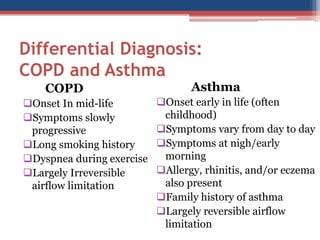
COPD 
Onset In mid-life 
Symptoms slowly progressive 
Long smoking history 
Dyspnea during exercise 
Largely Irreversible airflow limitation 
Asthma 
Onset early in life (often childhood) 
Symptoms vary from day to day 
Symptoms at nigh/early morning 
Allergy, rhinitis, and/or eczema also present 
Family history of asthma 
Largely reversible airflow limitation
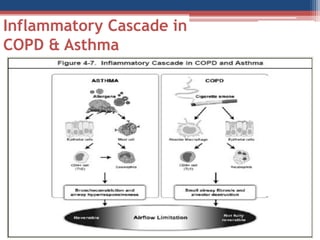
Inflammatory Cascade inCOPD & Asthma
Measures of Assessment andMonitoring of Asthma 
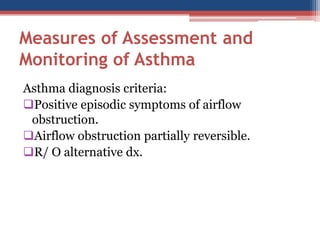
Asthma diagnosis criteria: 
Positive episodic symptoms of airflow obstruction. 
Airflow obstruction partially reversible. 
R/ O alternative dx.
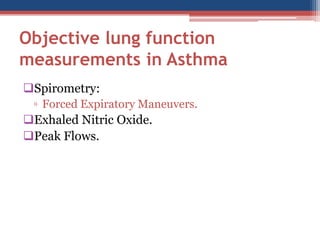
Objective lung functionmeasurements in Asthma 
Spirometry: 
▫Forced Expiratory Maneuvers. 
Exhaled Nitric Oxide. 
Peak Flows.
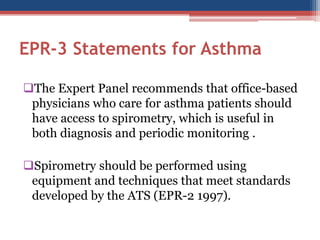
EPR-3 Statements for Asthma 
The Expert Panel recommends that office-based physicians who care for asthma patients should have access to spirometry, which is useful in both diagnosis and periodic monitoring . 
Spirometryshould be performed using equipment and techniques that meet standards developed by the ATS (EPR-2 1997).
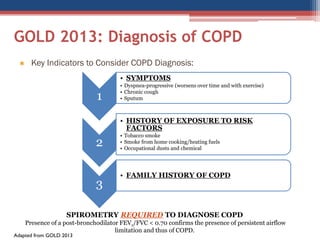
GOLD 2013: Diagnosis of COPD 
SPIROMETRY REQUIREDTO DIAGNOSE COPD 
Presence of a post-bronchodilator FEV1/FVC < 0.70 confirms the presence of persistent airflow limitation and thus of COPD. 
Key Indicators to Consider COPD Diagnosis: 
1 
•SYMPTOMS 
•Dyspnea-progressive (worsens over time and with exercise) 
•Chronic cough 
•Sputum 
2 
•HISTORY OF EXPOSURE TO RISK FACTORS 
•Tobacco smoke 
•Smoke from home cooking/heating fuels 
•Occupational dusts and chemical 
3 
•FAMILY HISTORY OF COPD 
Adapted from GOLD 2013
Spirometry 
Spirometryshould be performed after the administration of an adequate dose of a short acting inhaled bronchodilator (e.g. 400 ᶙg salbutamol) to minimize variability. 
A post-bronchodilator FEV 1/FVC <0.70 confirms the presence of airflow limitation that is not fully reversible. 
Where possible, values should be compared to age-related normal values to avoid over- diagnosis of COPD In the elderly.
Why Do We Need Spirometryin COPD? 
Spirometryis useful for: 
Screen individuals at risk for pulmonary disease. 
Confirmation of COPD diagnosis. 
Assessing severity of pulmonary dysfunction. 
Guiding selection of treatment. 
Assessing the effects of therapeutic interventions.
Who Should Be Screened forCOPD? 
Consider COPD, and perform spirometry, if any of these indicators are present in an individual over age 40. 
▫Dyspnea that is progressive, usually worse with exercise, and persistent. 
▫Chronic cough (may be intermittent and unproductive). 
▫Chronic sputum. 
▫History of tobacco smoke exposure. 
▫Exposure to occupational dusts and chemicals. 
▫Risk factors. 
▫Exposure to smoke from home cooking and heating fuels.
SpirometryOrigin 
Most basic of Pulmonary Function Tests 
Clinical Tools Origin -Mid 1800' s 
▫John Hutchinson. 
▫Water-sealed spirometryto measure vital capacity (VC).
Reasons for PerformingSpirometry 
Diagnostic Purposes. 
Monitoring Lung Disease. 
Assessing Disability.
Spirometry 
Spirometrywith flow volume loops assesses the mechanical properties of the respiratory system by measuring expiratory volumes and flow rates. 
▫Maximal inspiratory and expiratory effort. 
▫At least 3 tests of acceptable effort are performed to ensure reproducibility.
21st Century Spirometry 
Measurements of: 
Forced Vital Capacity (FVC). 
Forced Expiratory Volume in one second (FEV1). 
Forced Expiratory Volume in six seconds (FEV6). 
Forced Expiratory Flow over various Intervals (FEFx). 
Peak Expiratory Flow (PEF).
Definitions and Terms 
FEV1 -forced expiratory volume 1 -the volume of air that is forcefully exhaled in one second. 
FEV6 -forced expiratory volume 6 -the volume of air that Is forcefully exhaled in six seconds. 
FVC-forced vital capacity-the volume of air that can be maximally forcefully exhaled. 
FEV/FVC-ratio of FEV1 to FVC, expressed as a percentage.
Definitions and Terms 
FEV/FVC-ratio of FEV6 to FVC, expressed as a percentage. 
FEF25 -75 -forced expiratory flow -the average forced expiratory flow during the mid (25 -75%) portion of the FVC. 
PEF-peak expiratory flow rate -the peak flow rate during expiration.
Spirometry 
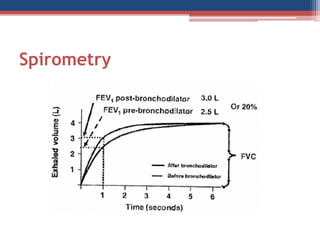
Flow volume loops provide a graphic illustration of a patient's spirometricefforts. 
Flow is plotted against volume to display a continuous loop from inspiration to expiration. 
The volume versus time curve is a an alternative way of plotting spirometricresults. 
The overall shape of the flow volume loop is important in Interpreting spirometricresults.
Acceptability & Repeatability
Acceptability 
At least three (3) acceptable maneuvers 
Good start to the test. 
No hesitation or coughing for the 1stsecond. 
FVC lasts at least 6 seconds with a plateau of at least 1 second. 
No valsalvamaneuver or obstruction of the mouthpiece. 
FIVC shows apparent maximal effort.
Repeatability 
Repeatability criteria act as guideline to determine need for additional efforts. 
▫Largest and 2nd largest FVC must be within 150 mL. 
▫Largest and 2nd largest FEV 1 must be 150 mL. 
▫PEF values may be variable (within 15%). 
If three acceptable reproducible maneuvers are not recorded, up to B attempts may be recorded.
SpirometryValue 
Spirometryis typically reported in both absolute values and as a predicted percentage of normal. 
Normal values vary and are dependent on: 
▫Gender, 
▫Race, 
▫Age, and 
▫Height.
Reporting Standards 
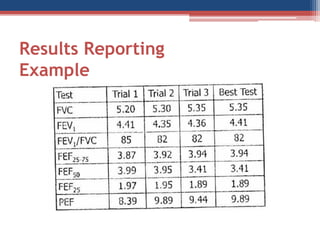
Largest FVC obtained from all acceptable efforts should be reported. 
Largest FEV1 obtained from all acceptable trials should be reported. 
May or may not come from largest FVC effort. 
All other flows, should come from the effort with the largest sum of FEV 1 & FVC. 
PEF should be the largest value obtained from at least 3 acceptable maneuvers.
Results ReportingExample
Report Format 
Report should also include: 
▫Age on testing day. 
▫Height (standing without shoes). 
▫Weight (without shoes). 
▫Gender. 
▫Race or ethnic origin. 
▫Technologist comment section.
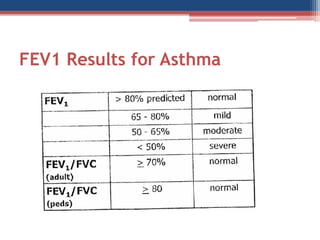
FEV1 Results for Asthma
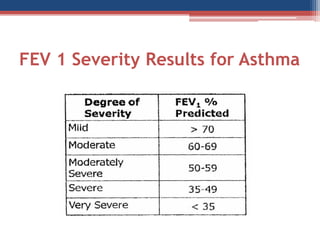
FEV 1 Severity Results for Asthma
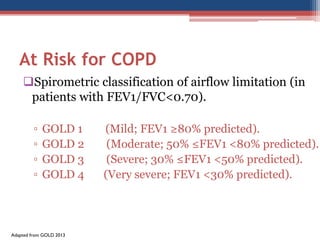
At Risk for COPD 
Spirometricclassification of airflow limitation (in patients with FEV1/FVC<0.70). 
▫GOLD 1(Mild; FEV1 ≥80% predicted). 
▫GOLD 2 (Moderate; 50% ≤FEV1 <80% predicted). 
▫GOLD 3 (Severe; 30% ≤FEV1 <50% predicted). 
▫GOLD 4 (Very severe; FEV1 <30% predicted). 
Adapted from GOLD 2013
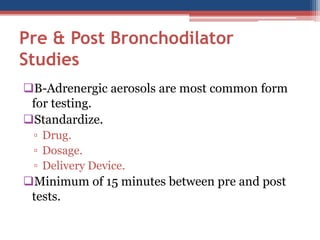
Pre & Post BronchodilatorStudies 
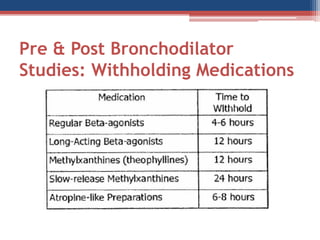
B-Adrenergic aerosols are most common form for testing. 
Standardize. 
▫Drug. 
▫Dosage. 
▫Delivery Device. 
Minimum of 15 minutes between pre and post tests.
Pre & Post Bronchodilator Studies: Withholding Medications
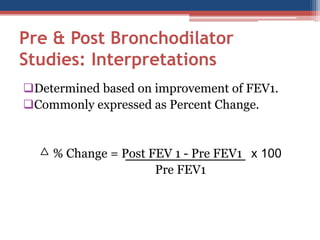
Pre & Post BronchodilatorStudies: Interpretations 
Determined based on improvement of FEV1. 
Commonly expressed as Percent Change. 
% Change = Post FEV 1 -Pre FEV1 x 100 
Pre FEV1
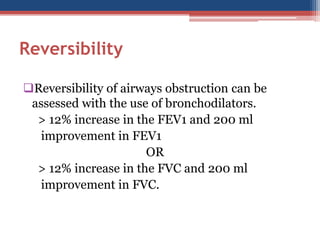
Reversibility 
Reversibility of airways obstruction can be assessed with the use of bronchodilators. 
> 12% increase in the FEV1 and 200 ml 
improvement in FEV1 
OR 
> 12% increase in the FVC and 200 ml 
improvement in FVC.
Spirometry
Asthma Challenge Testing 
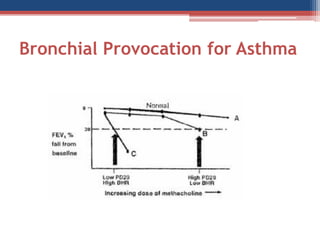
Spirometrycan be used to detect the bronchial hyperreactivitythat characterizes asthma. 
Increasing concentrations of histamine or methacholine. 
Patients with asthma will demonstrate symptoms and produce spirometricresults consistent with airways obstruction at much lower threshold concentration than normals.
Bronchial Provocation for Asthma
Other Diagnostic Tests 
Sputum Induction 
6-Minute Walks 
Impulse Oscillometry 
Exhaled Nitric Oxide 
Exhaled Breath Condensate
References
COPD Lecture 9  spirometry of obstructive lung diseases

COPD Lecture 9 spirometry of obstructive lung diseases

  • 1.
  • 2.
    Pulmonary Disorders EffectsonPulmonary Function Obstructive: Any process that interferes with air flow either into or out of the lungs. Large or small airways. Restrictive: Any process that interferes with the bellows action of the lungs or chest wall. Reduced lung volumes.
  • 3.
    Differential Diagnosis: COPDand Asthma COPD Onset In mid-life Symptoms slowly progressive Long smoking history Dyspnea during exercise Largely Irreversible airflow limitation Asthma Onset early in life (often childhood) Symptoms vary from day to day Symptoms at nigh/early morning Allergy, rhinitis, and/or eczema also present Family history of asthma Largely reversible airflow limitation
  • 4.
  • 5.
    Measures of AssessmentandMonitoring of Asthma Asthma diagnosis criteria: Positive episodic symptoms of airflow obstruction. Airflow obstruction partially reversible. R/ O alternative dx.
  • 6.
    Objective lung functionmeasurementsin Asthma Spirometry: ▫Forced Expiratory Maneuvers. Exhaled Nitric Oxide. Peak Flows.
  • 7.
    EPR-3 Statements forAsthma The Expert Panel recommends that office-based physicians who care for asthma patients should have access to spirometry, which is useful in both diagnosis and periodic monitoring . Spirometryshould be performed using equipment and techniques that meet standards developed by the ATS (EPR-2 1997).
  • 8.
    GOLD 2013: Diagnosisof COPD SPIROMETRY REQUIREDTO DIAGNOSE COPD Presence of a post-bronchodilator FEV1/FVC < 0.70 confirms the presence of persistent airflow limitation and thus of COPD. Key Indicators to Consider COPD Diagnosis: 1 •SYMPTOMS •Dyspnea-progressive (worsens over time and with exercise) •Chronic cough •Sputum 2 •HISTORY OF EXPOSURE TO RISK FACTORS •Tobacco smoke •Smoke from home cooking/heating fuels •Occupational dusts and chemical 3 •FAMILY HISTORY OF COPD Adapted from GOLD 2013
  • 9.
    Spirometry Spirometryshould beperformed after the administration of an adequate dose of a short acting inhaled bronchodilator (e.g. 400 ᶙg salbutamol) to minimize variability. A post-bronchodilator FEV 1/FVC <0.70 confirms the presence of airflow limitation that is not fully reversible. Where possible, values should be compared to age-related normal values to avoid over- diagnosis of COPD In the elderly.
  • 10.
    Why Do WeNeed Spirometryin COPD? Spirometryis useful for: Screen individuals at risk for pulmonary disease. Confirmation of COPD diagnosis. Assessing severity of pulmonary dysfunction. Guiding selection of treatment. Assessing the effects of therapeutic interventions.
  • 11.
    Who Should BeScreened forCOPD? Consider COPD, and perform spirometry, if any of these indicators are present in an individual over age 40. ▫Dyspnea that is progressive, usually worse with exercise, and persistent. ▫Chronic cough (may be intermittent and unproductive). ▫Chronic sputum. ▫History of tobacco smoke exposure. ▫Exposure to occupational dusts and chemicals. ▫Risk factors. ▫Exposure to smoke from home cooking and heating fuels.
  • 12.
    SpirometryOrigin Most basicof Pulmonary Function Tests Clinical Tools Origin -Mid 1800' s ▫John Hutchinson. ▫Water-sealed spirometryto measure vital capacity (VC).
  • 13.
    Reasons for PerformingSpirometry Diagnostic Purposes. Monitoring Lung Disease. Assessing Disability.
  • 14.
    Spirometry Spirometrywith flowvolume loops assesses the mechanical properties of the respiratory system by measuring expiratory volumes and flow rates. ▫Maximal inspiratory and expiratory effort. ▫At least 3 tests of acceptable effort are performed to ensure reproducibility.
  • 15.
    21st Century Spirometry Measurements of: Forced Vital Capacity (FVC). Forced Expiratory Volume in one second (FEV1). Forced Expiratory Volume in six seconds (FEV6). Forced Expiratory Flow over various Intervals (FEFx). Peak Expiratory Flow (PEF).
  • 16.
    Definitions and Terms FEV1 -forced expiratory volume 1 -the volume of air that is forcefully exhaled in one second. FEV6 -forced expiratory volume 6 -the volume of air that Is forcefully exhaled in six seconds. FVC-forced vital capacity-the volume of air that can be maximally forcefully exhaled. FEV/FVC-ratio of FEV1 to FVC, expressed as a percentage.
  • 17.
    Definitions and Terms FEV/FVC-ratio of FEV6 to FVC, expressed as a percentage. FEF25 -75 -forced expiratory flow -the average forced expiratory flow during the mid (25 -75%) portion of the FVC. PEF-peak expiratory flow rate -the peak flow rate during expiration.
  • 18.
    Spirometry Flow volumeloops provide a graphic illustration of a patient's spirometricefforts. Flow is plotted against volume to display a continuous loop from inspiration to expiration. The volume versus time curve is a an alternative way of plotting spirometricresults. The overall shape of the flow volume loop is important in Interpreting spirometricresults.
  • 19.
  • 20.
    Acceptability At leastthree (3) acceptable maneuvers Good start to the test. No hesitation or coughing for the 1stsecond. FVC lasts at least 6 seconds with a plateau of at least 1 second. No valsalvamaneuver or obstruction of the mouthpiece. FIVC shows apparent maximal effort.
  • 21.
    Repeatability Repeatability criteriaact as guideline to determine need for additional efforts. ▫Largest and 2nd largest FVC must be within 150 mL. ▫Largest and 2nd largest FEV 1 must be 150 mL. ▫PEF values may be variable (within 15%). If three acceptable reproducible maneuvers are not recorded, up to B attempts may be recorded.
  • 22.
    SpirometryValue Spirometryis typicallyreported in both absolute values and as a predicted percentage of normal. Normal values vary and are dependent on: ▫Gender, ▫Race, ▫Age, and ▫Height.
  • 23.
    Reporting Standards LargestFVC obtained from all acceptable efforts should be reported. Largest FEV1 obtained from all acceptable trials should be reported. May or may not come from largest FVC effort. All other flows, should come from the effort with the largest sum of FEV 1 & FVC. PEF should be the largest value obtained from at least 3 acceptable maneuvers.
  • 24.
  • 25.
    Report Format Reportshould also include: ▫Age on testing day. ▫Height (standing without shoes). ▫Weight (without shoes). ▫Gender. ▫Race or ethnic origin. ▫Technologist comment section.
  • 26.
  • 27.
    FEV 1 SeverityResults for Asthma
  • 28.
    At Risk forCOPD Spirometricclassification of airflow limitation (in patients with FEV1/FVC<0.70). ▫GOLD 1(Mild; FEV1 ≥80% predicted). ▫GOLD 2 (Moderate; 50% ≤FEV1 <80% predicted). ▫GOLD 3 (Severe; 30% ≤FEV1 <50% predicted). ▫GOLD 4 (Very severe; FEV1 <30% predicted). Adapted from GOLD 2013
  • 29.
    Pre & PostBronchodilatorStudies B-Adrenergic aerosols are most common form for testing. Standardize. ▫Drug. ▫Dosage. ▫Delivery Device. Minimum of 15 minutes between pre and post tests.
  • 30.
    Pre & PostBronchodilator Studies: Withholding Medications
  • 31.
    Pre & PostBronchodilatorStudies: Interpretations Determined based on improvement of FEV1. Commonly expressed as Percent Change. % Change = Post FEV 1 -Pre FEV1 x 100 Pre FEV1
  • 32.
    Reversibility Reversibility ofairways obstruction can be assessed with the use of bronchodilators. > 12% increase in the FEV1 and 200 ml improvement in FEV1 OR > 12% increase in the FVC and 200 ml improvement in FVC.
  • 33.
  • 34.
    Asthma Challenge Testing Spirometrycan be used to detect the bronchial hyperreactivitythat characterizes asthma. Increasing concentrations of histamine or methacholine. Patients with asthma will demonstrate symptoms and produce spirometricresults consistent with airways obstruction at much lower threshold concentration than normals.
  • 35.
  • 36.
    Other Diagnostic Tests Sputum Induction 6-Minute Walks Impulse Oscillometry Exhaled Nitric Oxide Exhaled Breath Condensate
  • 37.