ABG in Clinical Practice
Soumya Ranjan Parida
Basic B.Sc. Nursing 4th
year
Sum Nursing College
• Why should I learn ?
• What should I know ?
• When to ask for ABG ?
• Hasn’t Pulse oximeter replaced ABG ?
• Factors in interpretation.
• Rules (Commandments)
ABG in Clinical Practice
• Why should I learn ?
• What should I know ?
– Principles of Acid-Base Balance
– Recognize simple disorders
– Recognize it is not a simple disorder
• When to ask for ABG ?
• Hasn’t Pulse oximeter replaced ABG ?
• Factors in interpretation.
• Rules (Commandments)
• Why should I learn ?
– More insight into the pathophysiology of any
disease
– Hypoxia can be picked up from pulse oximetery
but hypercarbia cannot
– Metabolic acidosis
– Metabolic alkalosis
ABG in Clinical Practice
• Why should I learn ?
• What should I know ?
– Principles of Acid-Base Balance
– Recognize simple disorders
– Recognize it is not a simple disorder
• When to ask for ABG ?
• Hasn’t Pulse oximeter replaced ABG ?
• Factors in interpretation.
• Rules (Commandments)
ABG in Clinical Practice
• Why should I learn ?
• What should I know ?
– Principles of Acid-Base Balance
– Recognize simple disorders
– Recognize it is not a simple disorder
• When to ask for ABG ?
• Hasn’t Pulse oximeter replaced ABG ?
• Factors in interpretation.
• Rules (Commandments)
ACIDOSIS
pH pCO2 HCO3 Compenstn
Respiratory
Metabolic
N HCO3
N CO2
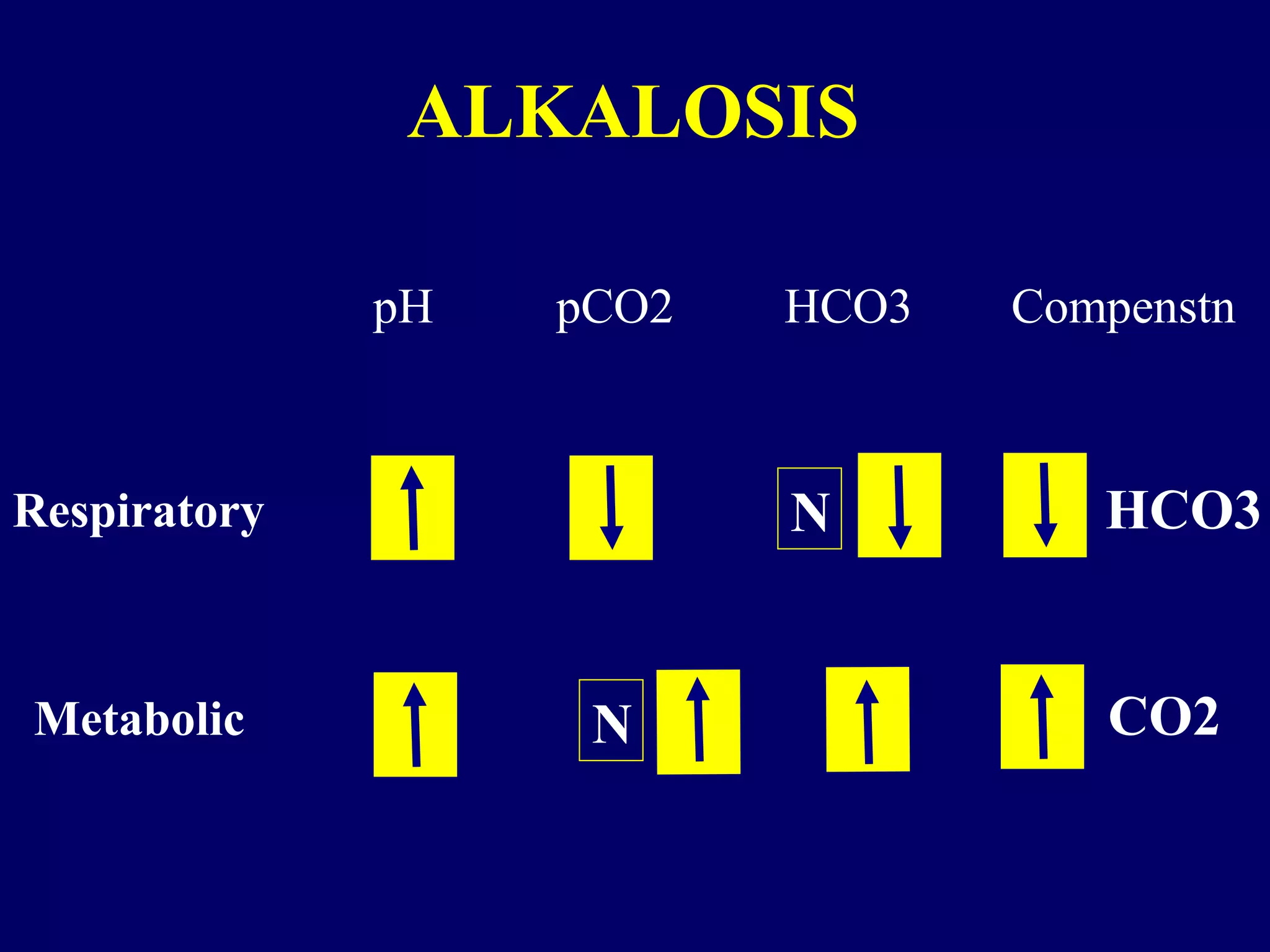
ALKALOSIS
pH pCO2 HCO3 Compenstn
Respiratory
Metabolic
N
N
HCO3
CO2
COMPENSATION
Time Frame
• Respiratory Compensation
– Starts immediately
– Complete within 4-6 hrs
• Metabolic Compensation
– Starts after 10-12 hrs
– May take 3-7 days
NOMENCLATURE
pH Pco2 HCO3 BE
• Respiratory acidosis
Uncompen (acute)
Partly compen(subacute)
Compen (chronic)
• Respiratory alkalosis
Uncompen (acute)
Partly compen (subacute)
Compen (chronic)
N N
N
N
NN
ABG in Clinical Practice
• Why should I learn ?
• What should I know ?
– Principles of Acid-Base Balance
– Recognize simple disorders
– Recognize it is not a simple disorder
• When to ask for ABG ?
• Hasn’t Pulse oximeter replaced ABG ?
• Factors in interpretation.
• Rules (Commandments)
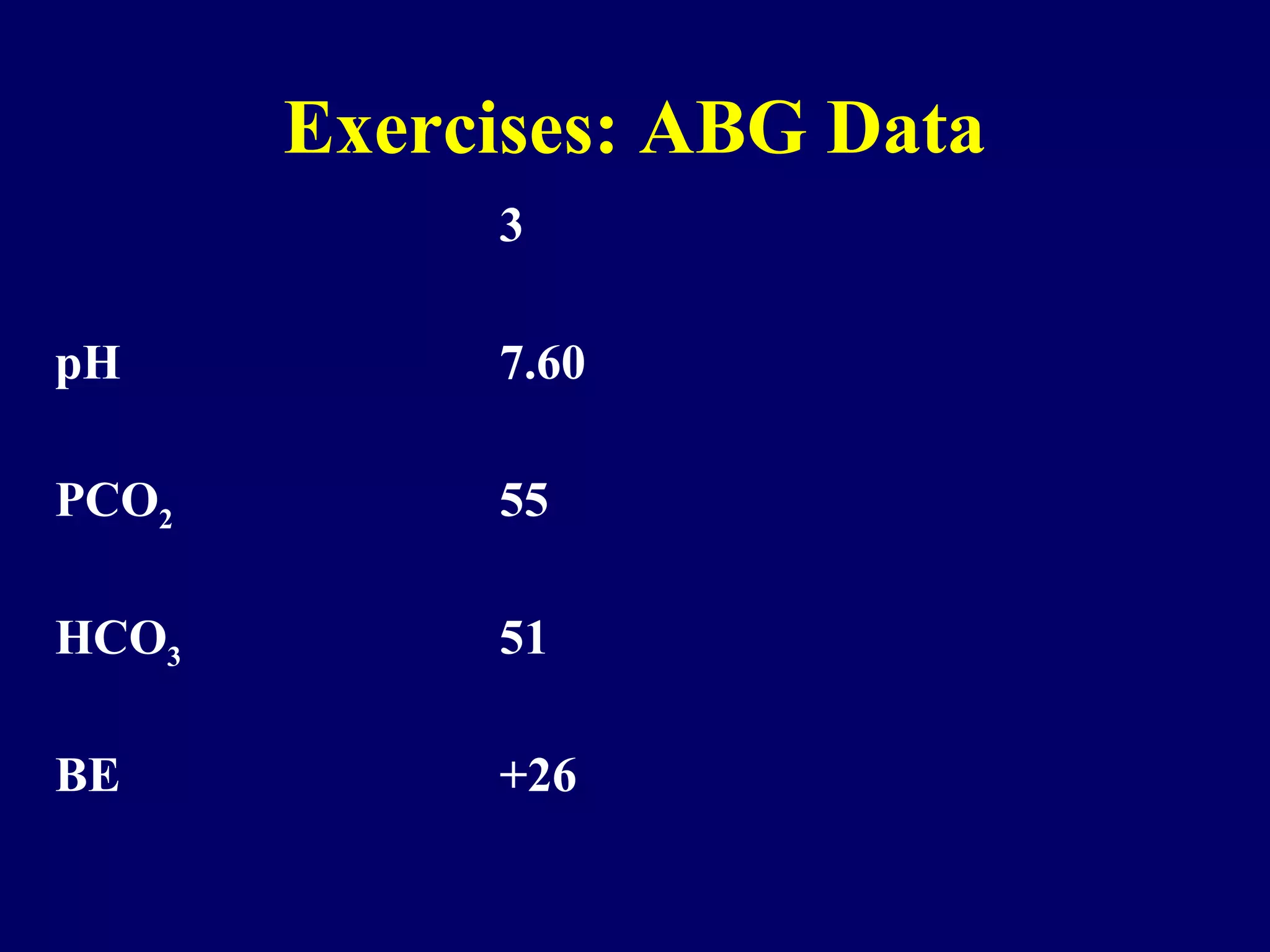
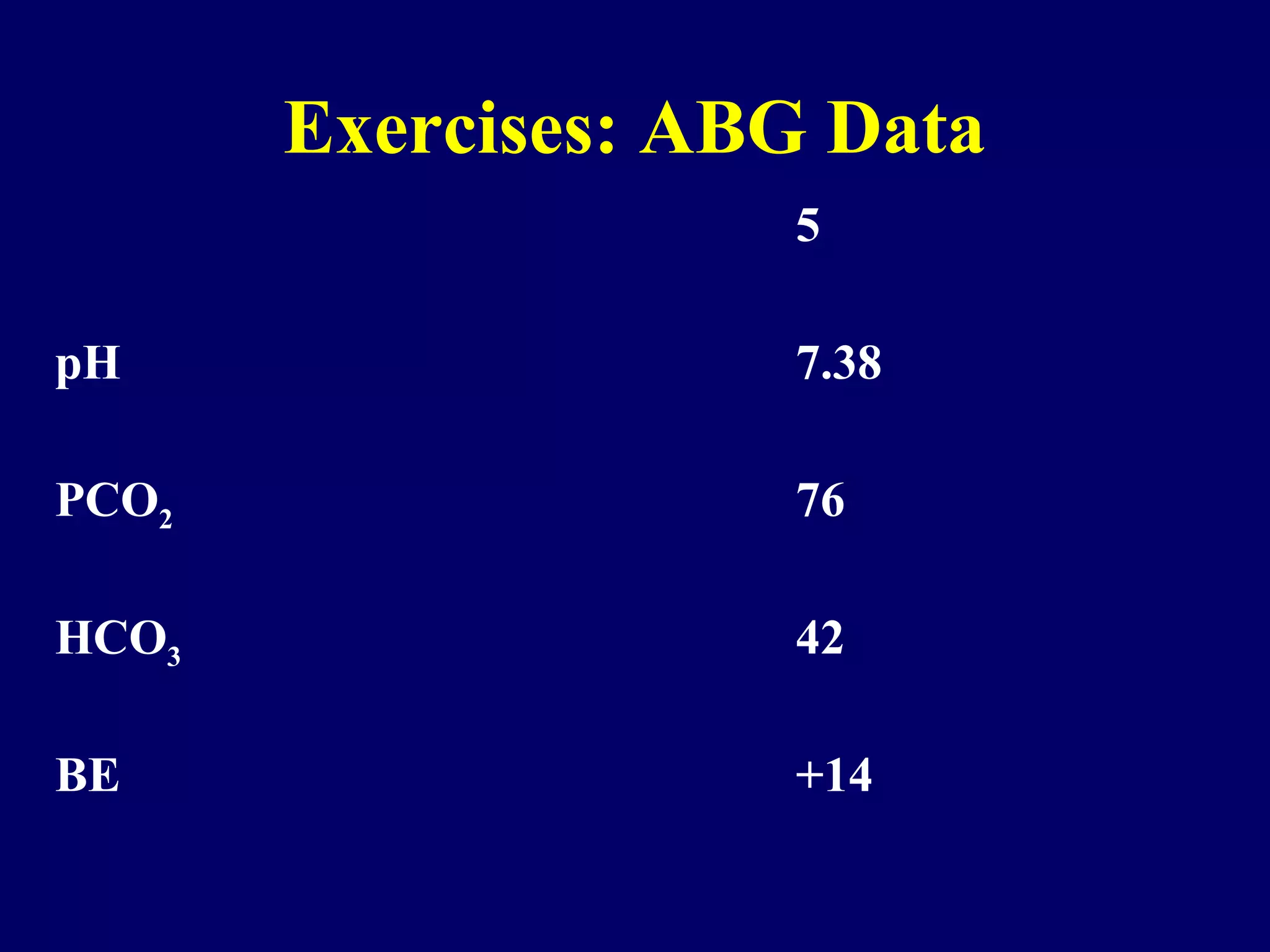
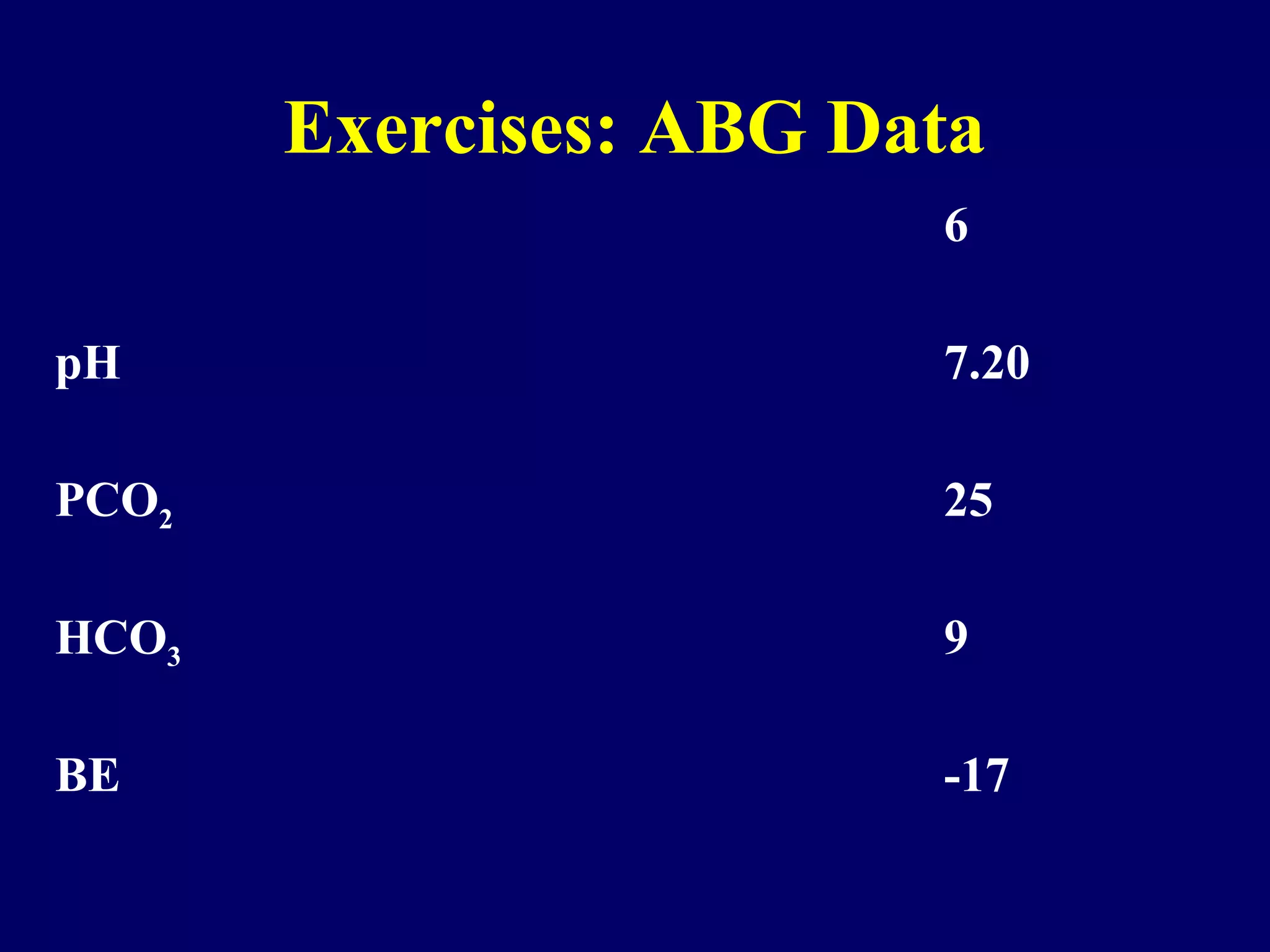
Exercises: ABG Data
1 2 3 4 5 6 7
pH 7.26 7.52 7.60 7.44 7.38 7.20 7.56
PCO2 56 28 55 24 76 25 44
HCO3 24 22 51 16 42 9 38
BE -4 +1 +26 -6 +14 -17 +14
Exercises: ABG Data
1 2 3 4 5 6 7
pH 7.26 7.52 7.60 7.44 7.38 7.20 7.56
PCO2 56 28 55 24 76 25 44
HCO3 24 22 51 16 42 9 38
BE -4 +1 +26 -6 +14 -17 +14
Exercises: ABG Data
1 2 3 4 5 6 7
pH 7.26 7.52 7.60 7.44 7.38 7.20 7.56
PCO2 56 28 55 24 76 25 44
HCO3 24 22 51 16 42 9 38
BE -4 +1 +26 -6 +14 -17 +14
Exercises: ABG Data
1 2 3 4 5 6 7
pH 7.26 7.52 7.60 7.44 7.38 7.20 7.56
PCO2 56 28 55 24 76 25 44
HCO3 24 22 51 16 42 9 38
BE -4 +1 +26 -6 +14 -17 +14
Exercises: ABG Data
1 2 3 4 5 6 7
pH 7.26 7.52 7.60 7.44 7.38 7.20 7.56
PCO2 56 28 55 24 76 25 44
HCO3 24 22 51 16 42 9 38
BE -4 +1 +26 -6 +14 -17 +14
Exercises: ABG Data
1 2 3 4 5 6 7
pH 7.26 7.52 7.60 7.44 7.38 7.20 7.56
PCO2 56 28 55 24 76 25 44
HCO3 24 22 51 16 42 9 38
BE -4 +1 +26 -6 +14 -17 +14
Exercises: ABG Data
1 2 3 4 5 6 7
pH 7.26 7.52 7.60 7.44 7.38 7.20 7.56
PCO2 56 28 55 24 76 25 44
HCO3 24 22 51 16 42 9 38
BE -4 +1 +26 -6 +14 -17 +14
COMPENSATION
• Resp. Acute
↑ CO2 by 10 ↑ HCO3 by 1
↓ CO2 by 10 ↓ HCO3 by 2
• Resp. Chronic
↑ CO2 by 10 ↑ HCO3 by 3-4
↓ CO2 by 10 ↑ HCO3 by 3-5
• Metabolic
↓ HCO3 by 1 ↓ CO2 by 1-1.5
↑ HCO3 by 1 ↑ CO2 by 0.2-1
BODY NEVER OVERCOMPENSATES !
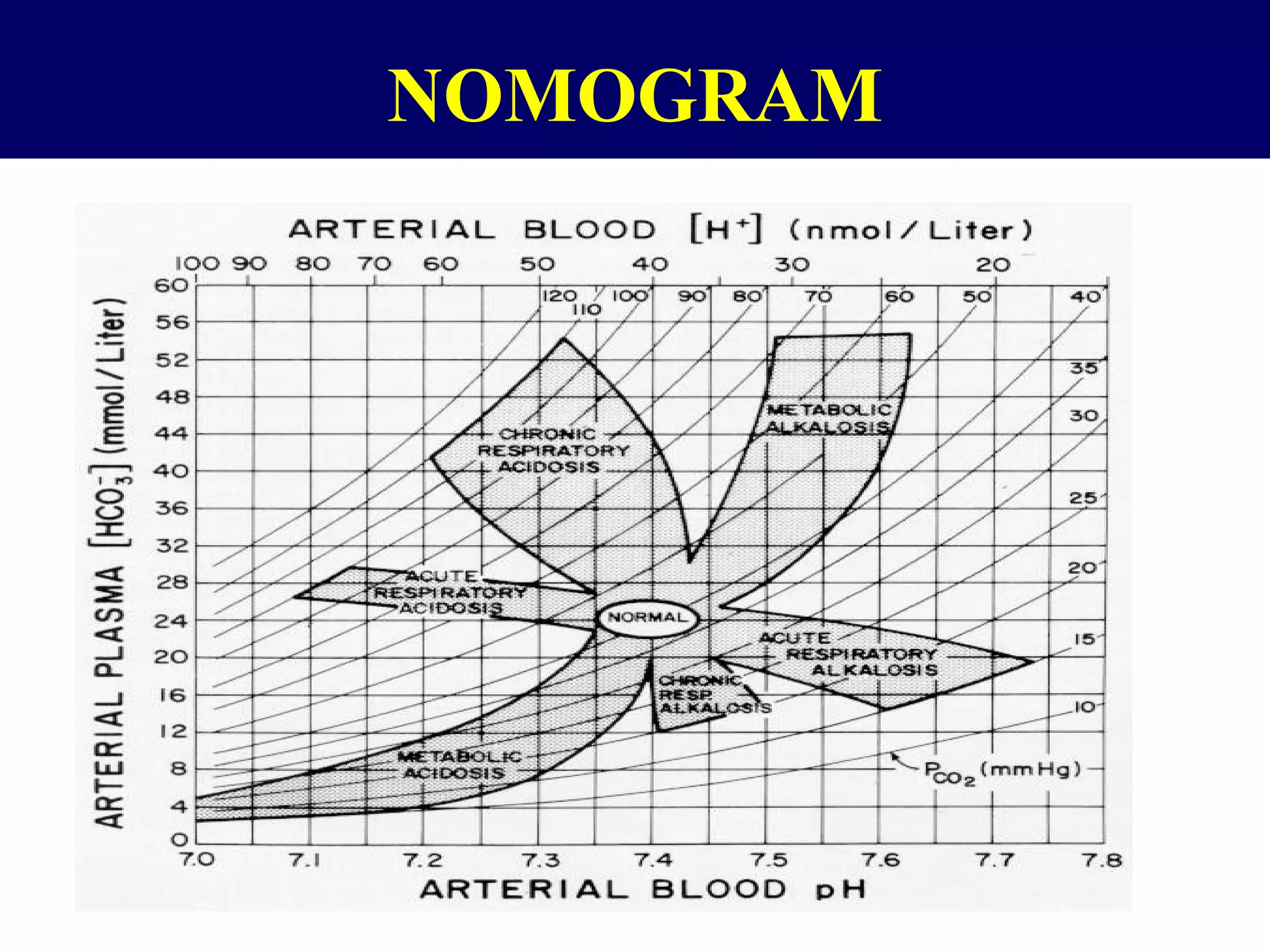
NOMOGRAM
ABG in Clinical Practice
• Why should I learn ?
• What should I know ?
– Principles of Acid-Base Balance
– Recognize simple disorders
– Recognize it is not a simple disorder
• When to ask for ABG ?
• Hasn’t Pulse oximeter replaced ABG ?
• Factors in interpretation.
• Rules (Commandments)
• A child with Persistent Pneumonia is shifted from
other hospital. ABG at admission
– pH - 7.47 PCO2 - 108
– HCO3 - 51 BE - + 24
• Interpretation
– ? Is this Metabolic Alkalosis
– ? Is this Bicarbonate administation
– Treatment ?
Case History
Case History
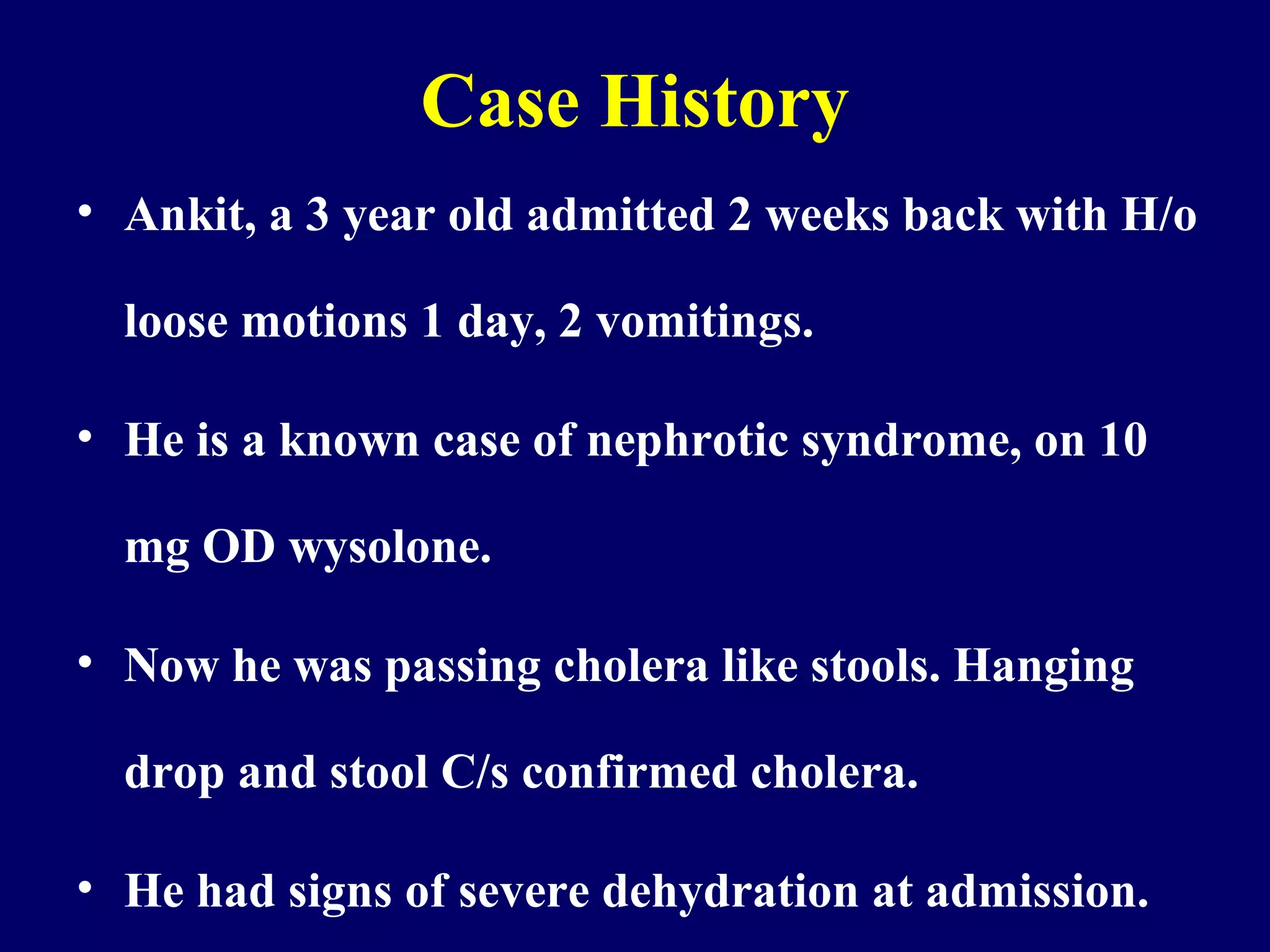
• Ankit, a 3 year old admitted 2 weeks back with H/o
loose motions 1 day, 2 vomitings.
• He is a known case of nephrotic syndrome, on 10
mg OD wysolone.
• Now he was passing cholera like stools. Hanging
drop and stool C/s confirmed cholera.
• He had signs of severe dehydration at admission.
Case History
• His labs were –
– pH - 7.13 Na - 121
– PCO2 - 31.1 K - 4.0
– PaO2 - 146.9 (under O2) Cl - 106
– HCO3 - 10.2
– BE - -17.3
• Weight – 12 kg
• What is your diagnosis –
Cholera + Severe dehydration + Hyponatremia + ?
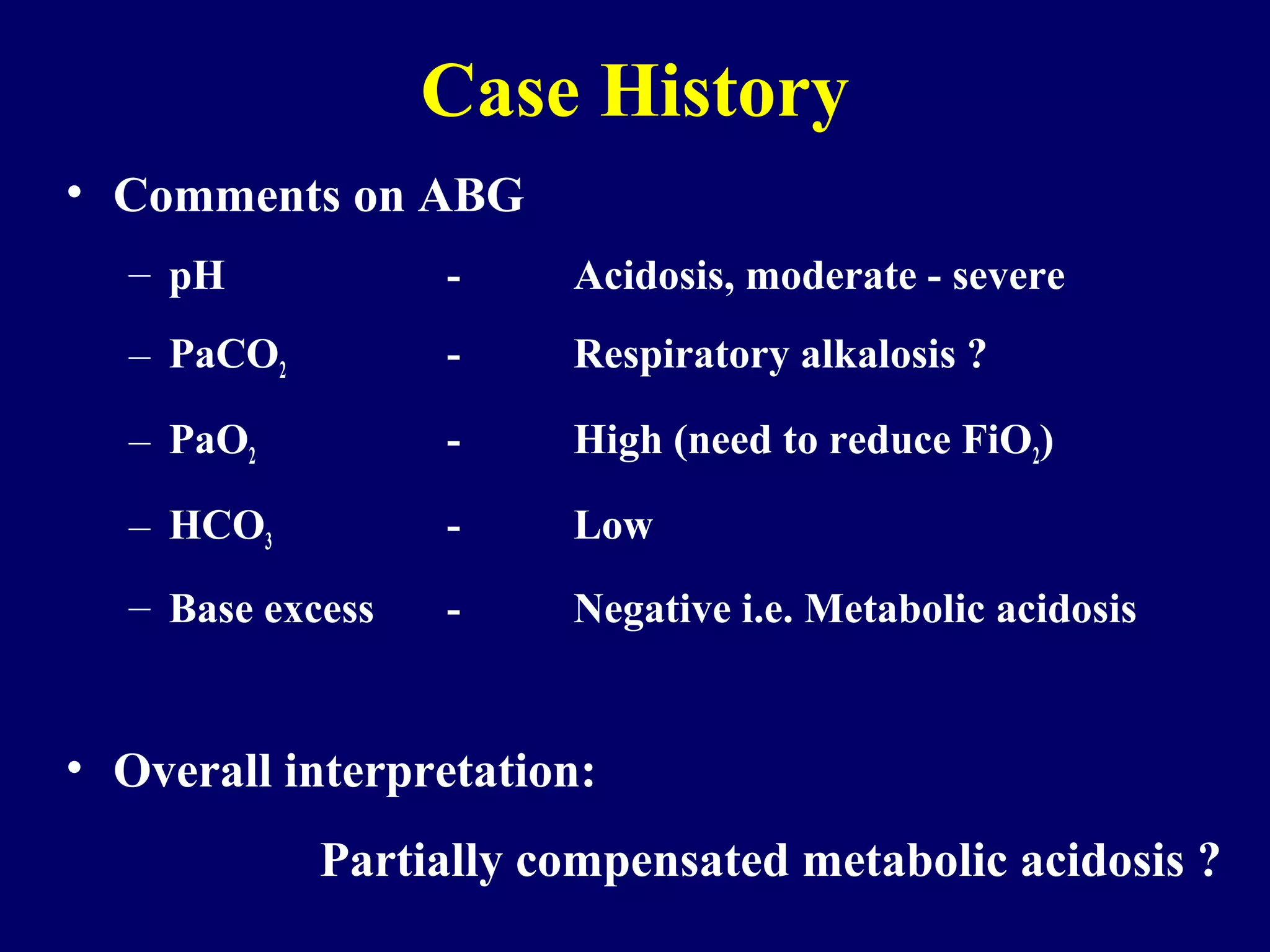
• Comments on ABG
– pH - Acidosis, moderate - severe
– PaCO2 - Respiratory alkalosis ?
– PaO2 - High (need to reduce FiO2)
– HCO3 - Low
– Base excess - Negative i.e. Metabolic acidosis
• Overall interpretation:
Partially compensated metabolic acidosis ?
Case History
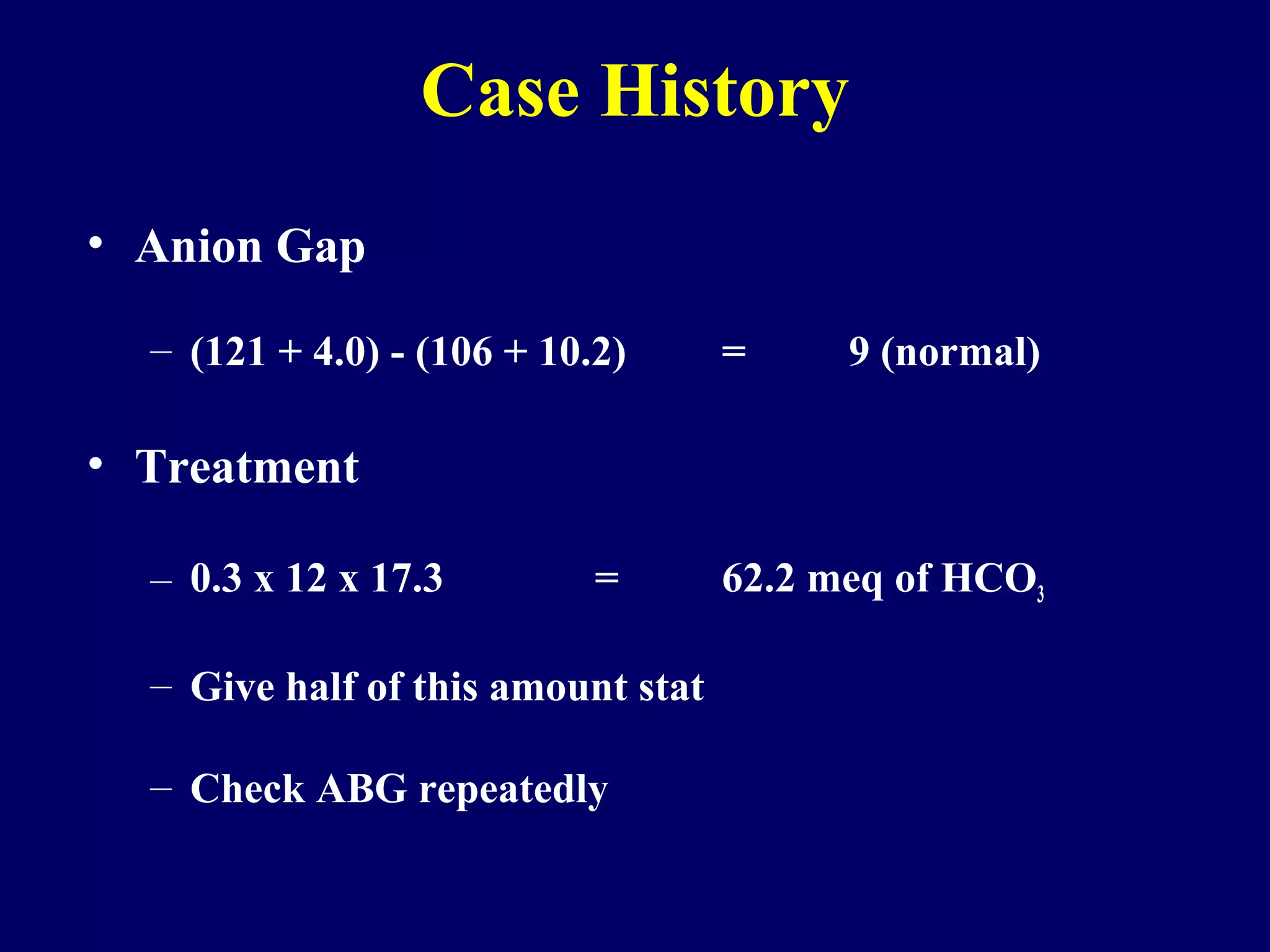
• Anion Gap
– (121 + 4.0) - (106 + 10.2) = 9 (normal)
• Treatment
– 0.3 x 12 x 17.3 = 62.2 meq of HCO3
– Give half of this amount stat
– Check ABG repeatedly
Case History
ABG in Clinical Practice
• Why should I learn ?
• What should I know ?
– Principles of Acid-Base Balance
– Recognize simple disorders
– Recognize it is not a simple disorder
• When to ask for ABG ?
• Hasn’t Pulse oximeter replaced ABG ?
• Factors in interpretation.
• Rules (Commandments)
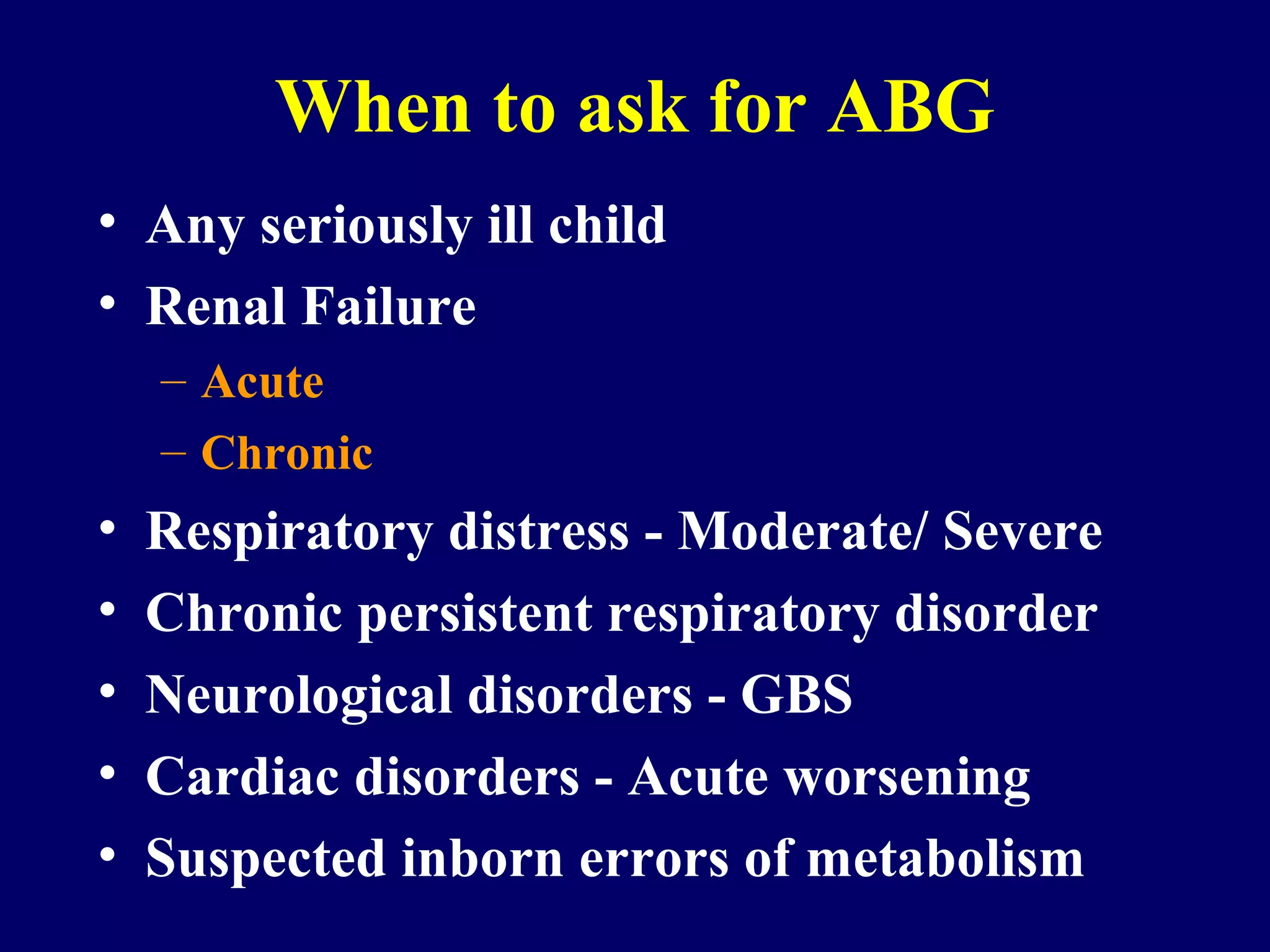
When to ask for ABG
• Any seriously ill child
• Renal Failure
– Acute
– Chronic
• Respiratory distress - Moderate/ Severe
• Chronic persistent respiratory disorder
• Neurological disorders - GBS
• Cardiac disorders - Acute worsening
• Suspected inborn errors of metabolism
ABG in Clinical Practice
• Why should I learn ?
• What should I know ?
– Principles of Acid-Base Balance
– Recognize simple disorders
– Recognize it is not a simple disorder
• When to ask for ABG ?
• Hasn’t Pulse oximeter replaced ABG ?
• Factors in interpretation.
• Rules (Commandments)
PULSE Ox versus ABG
• Non invasive
• Continuous
• O2 saturation (SaO2)
• Measures
oxygenation
• Bed side monitor
• Invasive
• Intermittent
• Partial pressure of O2
• Measures O2, pH,
CO2, HCO3
• Gold standard
Hence both may be required
ABG in Clinical Practice
• Why should I learn ?
• What should I know ?
– Principles of Acid-Base Balance
– Recognize simple disorders
– Recognize it is not a simple disorder
• When to ask for ABG ?
• Hasn’t Pulse oximeter replaced ABG ?
• Factors in interpretation.
• Rules (Commandments)
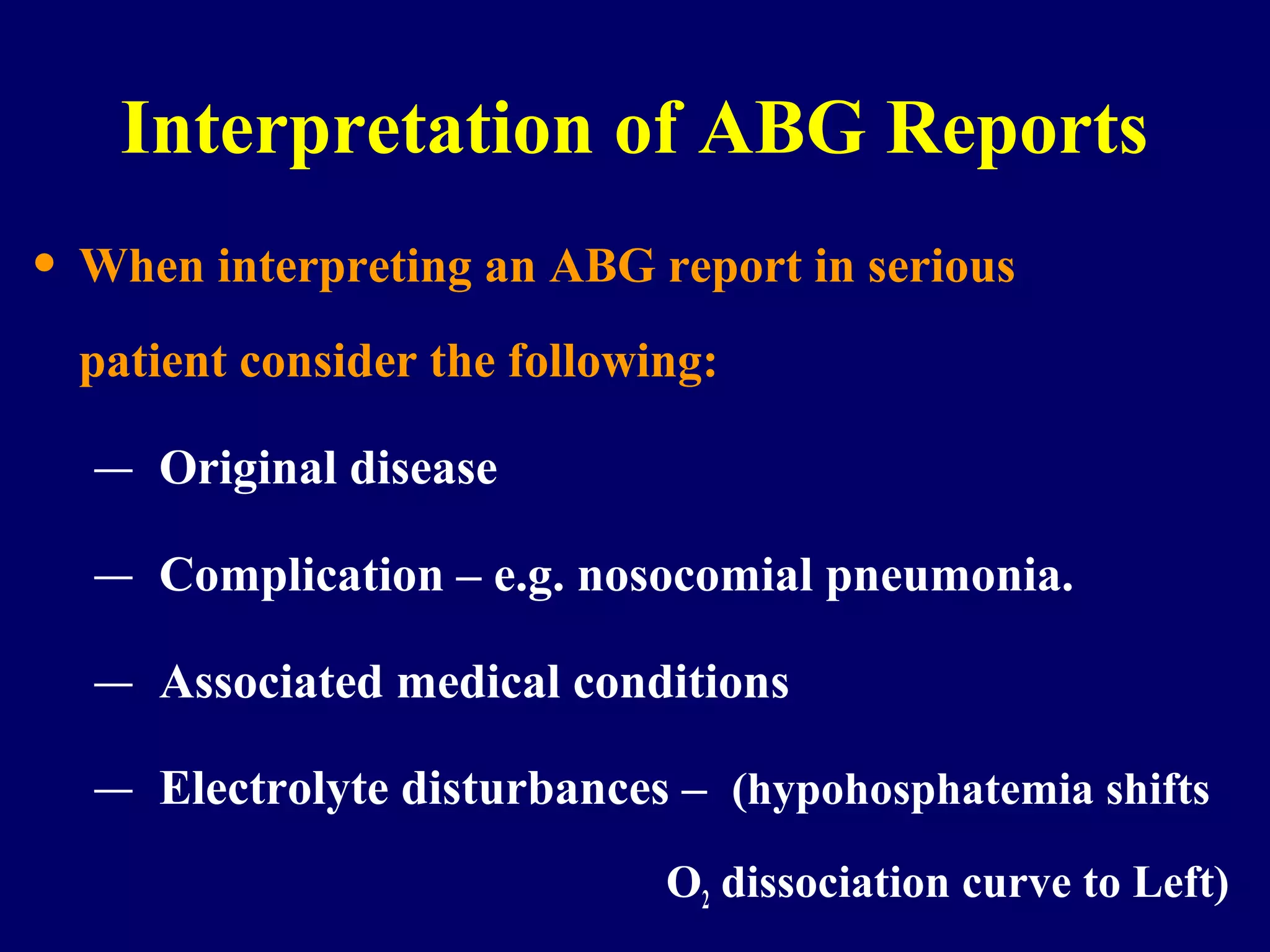
Interpretation of ABG Reports
• When interpreting an ABG report in serious
patient consider the following:
– Original disease
– Complication – e.g. nosocomial pneumonia.
– Associated medical conditions
– Electrolyte disturbances – (hypohosphatemia shifts
O2 dissociation curve to Left)
Interpretation of ABG Reports
• Therapeutic interventions
– type of IV fluids
– ventilator settings
– blood transfusions
– NG aspiration/diarrhea
– drugs
– TPN
– NaHCO3 administration
• Compensatory mechanisms
– time factor
– ability of kidney / lungs.
ABG in Clinical Practice
• Why should I learn ?
• What should I know ?
– Principles of Acid-Base Balance
– Recognize simple disorders
– Recognize it is not a simple disorder
• When to ask for ABG ?
• Hasn’t Pulse oximeter replaced ABG ?
• Factors in interpretation.
• Rules ( 10 Commandments)
Case: 1
ABG Values in a 1 yr old with mild
respiratory distress, done as a part
of routine workup:
pH 7.38
pCO2 42
pO2 47
Commandment I
Thou shalt not…..
I shall confirm that the
sample sent is arterial and
not venous
Case: 2
A 7 yr old was admitted with encephalitis.
Two hours later, when clinically she was
deteriorating, a repeat ABG was done to
decide about mechanical ventilation:
at admiss. 2 hr. later
pH 7.4 pH 7.39
pCO2 42 pCO2 10
pO2 82 pO2 148
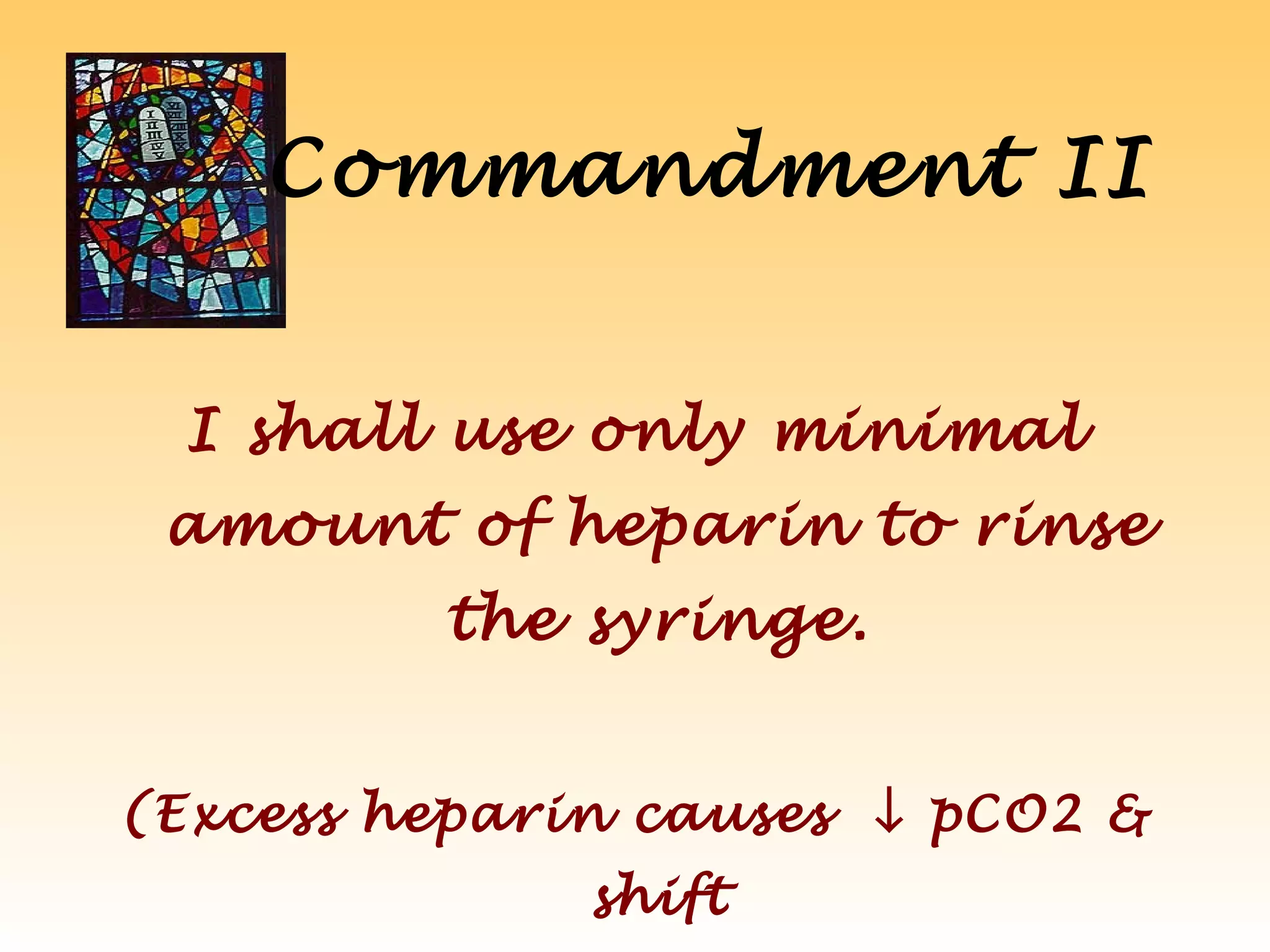
Commandment II
I shall use only minimal
amount of heparin to rinse
the syringe.
(Excess heparin causes ↓ pCO2 &
shift
Case: 3
ABG values of a child with
cyanotic heart disease in spell:
pH 7.54
pCO2 21
pO2 88
Commandment III
I shall ensure there are no air
bubbles in the blood
samples.
Case: 4
ABG values in a child with staph pneumonia
with improving respiratory distress:
At present 12 hrs earlier
pH 7.32 pH 7.38
pCO2 46 pCO2 40
pO2 63 pO2 78
Hb- 6.2 gm%, TLC-32000/ mm3
, Polys- 84%
Commandment IV
I shall send the sample in ice
and
analyze it quickly, … and keep
the
Case: 5
Bronchiolitis, moderate respiratory distress,
on arrival from another hospital-
pH 7.62
pCO2 60
pO2 76
HCO3
-
48
Commandment V
I shall always take the history of
sodium bicarbonate administration
even in respiratory cases.
Case: 6
Case of Bronchiolitis, not improving inspite of
aggressive management in a hospital. Now,
transferred to you-
pH 7.51
pCO2 45
pO2 68
HCO3
-
38
Hb- 10.4gm%, TLC- 9600/ mm3
, Na+
- 138, K+
- 1.8
Commandment VI
I shall always consider the
effects of furosemide,
steroids, salbutamol, blood
transfusion and
Case: 7
5 year old with severe bilateral pneumonia.
Clinically worsening inspite of your treatment
with oxygen etc.:
On admiss Next day
pH 7.34 7.31
pCO2 42 47
pO2 66 88
Commandment VII
I shall always take FiO2 into
consideration when
interpreting pO2 values. I
shall also look at the pCO2
values carefully.
Case: 8
A 5 month old cerebral palsy child is brought in
with respiratory distress since 1 month age due
to recurrent aspiration pneumonia. ABG values
are:
pH 7.36
pCO2 62
pO2 60
MV- pressure limited / volume limited?
Commandment VIII
I shall take the history into
consideration before
instituting therapy for
Chronic respiratory failure
Case: 9
A patient of GBS on MV suddenly
deteriorates with ↓ SpO2 & ↑ EtCO2.
ABGs are:
Initial 15 mt later
pH 7.37 7.19
pCO2 35 58
pO 88 47
Commandment IX
I shall always remember the
acronym “ DOPE “ in such
situations-
D - Displacement
O - Obstruction
P - Pneumothorax
Case: 10
A 3 year old with septicemia, MOSF & ARDS
has the following ABG when clinically stable
on high PIP & PEEP:
pH 7.36
pCO2 44
pO2 58
Both PIP and PEEP were increased.
Commandment X
I shall practice gentle
mechanical ventilation
and not try to bring
ABG to perfect normal.
Thank You !

Abg in clinical practice

  • 1.
    ABG in ClinicalPractice Soumya Ranjan Parida Basic B.Sc. Nursing 4th year Sum Nursing College
  • 2.
    • Why shouldI learn ? • What should I know ? • When to ask for ABG ? • Hasn’t Pulse oximeter replaced ABG ? • Factors in interpretation. • Rules (Commandments) ABG in Clinical Practice
  • 3.
    ABG in ClinicalPractice • Why should I learn ? • What should I know ? – Principles of Acid-Base Balance – Recognize simple disorders – Recognize it is not a simple disorder • When to ask for ABG ? • Hasn’t Pulse oximeter replaced ABG ? • Factors in interpretation. • Rules (Commandments)
  • 4.
    • Why shouldI learn ? – More insight into the pathophysiology of any disease – Hypoxia can be picked up from pulse oximetery but hypercarbia cannot – Metabolic acidosis – Metabolic alkalosis ABG in Clinical Practice
  • 5.
    ABG in ClinicalPractice • Why should I learn ? • What should I know ? – Principles of Acid-Base Balance – Recognize simple disorders – Recognize it is not a simple disorder • When to ask for ABG ? • Hasn’t Pulse oximeter replaced ABG ? • Factors in interpretation. • Rules (Commandments)
  • 6.
    ABG in ClinicalPractice • Why should I learn ? • What should I know ? – Principles of Acid-Base Balance – Recognize simple disorders – Recognize it is not a simple disorder • When to ask for ABG ? • Hasn’t Pulse oximeter replaced ABG ? • Factors in interpretation. • Rules (Commandments)
  • 7.
    ACIDOSIS pH pCO2 HCO3Compenstn Respiratory Metabolic N HCO3 N CO2
  • 8.
    ALKALOSIS pH pCO2 HCO3Compenstn Respiratory Metabolic N N HCO3 CO2
  • 9.
    COMPENSATION Time Frame • RespiratoryCompensation – Starts immediately – Complete within 4-6 hrs • Metabolic Compensation – Starts after 10-12 hrs – May take 3-7 days
  • 10.
    NOMENCLATURE pH Pco2 HCO3BE • Respiratory acidosis Uncompen (acute) Partly compen(subacute) Compen (chronic) • Respiratory alkalosis Uncompen (acute) Partly compen (subacute) Compen (chronic) N N N N NN
  • 11.
    ABG in ClinicalPractice • Why should I learn ? • What should I know ? – Principles of Acid-Base Balance – Recognize simple disorders – Recognize it is not a simple disorder • When to ask for ABG ? • Hasn’t Pulse oximeter replaced ABG ? • Factors in interpretation. • Rules (Commandments)
  • 12.
    Exercises: ABG Data 12 3 4 5 6 7 pH 7.26 7.52 7.60 7.44 7.38 7.20 7.56 PCO2 56 28 55 24 76 25 44 HCO3 24 22 51 16 42 9 38 BE -4 +1 +26 -6 +14 -17 +14
  • 13.
    Exercises: ABG Data 12 3 4 5 6 7 pH 7.26 7.52 7.60 7.44 7.38 7.20 7.56 PCO2 56 28 55 24 76 25 44 HCO3 24 22 51 16 42 9 38 BE -4 +1 +26 -6 +14 -17 +14
  • 14.
    Exercises: ABG Data 12 3 4 5 6 7 pH 7.26 7.52 7.60 7.44 7.38 7.20 7.56 PCO2 56 28 55 24 76 25 44 HCO3 24 22 51 16 42 9 38 BE -4 +1 +26 -6 +14 -17 +14
  • 15.
    Exercises: ABG Data 12 3 4 5 6 7 pH 7.26 7.52 7.60 7.44 7.38 7.20 7.56 PCO2 56 28 55 24 76 25 44 HCO3 24 22 51 16 42 9 38 BE -4 +1 +26 -6 +14 -17 +14
  • 16.
    Exercises: ABG Data 12 3 4 5 6 7 pH 7.26 7.52 7.60 7.44 7.38 7.20 7.56 PCO2 56 28 55 24 76 25 44 HCO3 24 22 51 16 42 9 38 BE -4 +1 +26 -6 +14 -17 +14
  • 17.
    Exercises: ABG Data 12 3 4 5 6 7 pH 7.26 7.52 7.60 7.44 7.38 7.20 7.56 PCO2 56 28 55 24 76 25 44 HCO3 24 22 51 16 42 9 38 BE -4 +1 +26 -6 +14 -17 +14
  • 18.
    Exercises: ABG Data 12 3 4 5 6 7 pH 7.26 7.52 7.60 7.44 7.38 7.20 7.56 PCO2 56 28 55 24 76 25 44 HCO3 24 22 51 16 42 9 38 BE -4 +1 +26 -6 +14 -17 +14
  • 19.
    COMPENSATION • Resp. Acute ↑CO2 by 10 ↑ HCO3 by 1 ↓ CO2 by 10 ↓ HCO3 by 2 • Resp. Chronic ↑ CO2 by 10 ↑ HCO3 by 3-4 ↓ CO2 by 10 ↑ HCO3 by 3-5 • Metabolic ↓ HCO3 by 1 ↓ CO2 by 1-1.5 ↑ HCO3 by 1 ↑ CO2 by 0.2-1 BODY NEVER OVERCOMPENSATES !
  • 20.
  • 21.
    ABG in ClinicalPractice • Why should I learn ? • What should I know ? – Principles of Acid-Base Balance – Recognize simple disorders – Recognize it is not a simple disorder • When to ask for ABG ? • Hasn’t Pulse oximeter replaced ABG ? • Factors in interpretation. • Rules (Commandments)
  • 22.
    • A childwith Persistent Pneumonia is shifted from other hospital. ABG at admission – pH - 7.47 PCO2 - 108 – HCO3 - 51 BE - + 24 • Interpretation – ? Is this Metabolic Alkalosis – ? Is this Bicarbonate administation – Treatment ? Case History
  • 23.
    Case History • Ankit,a 3 year old admitted 2 weeks back with H/o loose motions 1 day, 2 vomitings. • He is a known case of nephrotic syndrome, on 10 mg OD wysolone. • Now he was passing cholera like stools. Hanging drop and stool C/s confirmed cholera. • He had signs of severe dehydration at admission.
  • 24.
    Case History • Hislabs were – – pH - 7.13 Na - 121 – PCO2 - 31.1 K - 4.0 – PaO2 - 146.9 (under O2) Cl - 106 – HCO3 - 10.2 – BE - -17.3 • Weight – 12 kg • What is your diagnosis – Cholera + Severe dehydration + Hyponatremia + ?
  • 25.
    • Comments onABG – pH - Acidosis, moderate - severe – PaCO2 - Respiratory alkalosis ? – PaO2 - High (need to reduce FiO2) – HCO3 - Low – Base excess - Negative i.e. Metabolic acidosis • Overall interpretation: Partially compensated metabolic acidosis ? Case History
  • 26.
    • Anion Gap –(121 + 4.0) - (106 + 10.2) = 9 (normal) • Treatment – 0.3 x 12 x 17.3 = 62.2 meq of HCO3 – Give half of this amount stat – Check ABG repeatedly Case History
  • 27.
    ABG in ClinicalPractice • Why should I learn ? • What should I know ? – Principles of Acid-Base Balance – Recognize simple disorders – Recognize it is not a simple disorder • When to ask for ABG ? • Hasn’t Pulse oximeter replaced ABG ? • Factors in interpretation. • Rules (Commandments)
  • 28.
    When to askfor ABG • Any seriously ill child • Renal Failure – Acute – Chronic • Respiratory distress - Moderate/ Severe • Chronic persistent respiratory disorder • Neurological disorders - GBS • Cardiac disorders - Acute worsening • Suspected inborn errors of metabolism
  • 29.
    ABG in ClinicalPractice • Why should I learn ? • What should I know ? – Principles of Acid-Base Balance – Recognize simple disorders – Recognize it is not a simple disorder • When to ask for ABG ? • Hasn’t Pulse oximeter replaced ABG ? • Factors in interpretation. • Rules (Commandments)
  • 30.
    PULSE Ox versusABG • Non invasive • Continuous • O2 saturation (SaO2) • Measures oxygenation • Bed side monitor • Invasive • Intermittent • Partial pressure of O2 • Measures O2, pH, CO2, HCO3 • Gold standard Hence both may be required
  • 31.
    ABG in ClinicalPractice • Why should I learn ? • What should I know ? – Principles of Acid-Base Balance – Recognize simple disorders – Recognize it is not a simple disorder • When to ask for ABG ? • Hasn’t Pulse oximeter replaced ABG ? • Factors in interpretation. • Rules (Commandments)
  • 32.
    Interpretation of ABGReports • When interpreting an ABG report in serious patient consider the following: – Original disease – Complication – e.g. nosocomial pneumonia. – Associated medical conditions – Electrolyte disturbances – (hypohosphatemia shifts O2 dissociation curve to Left)
  • 33.
    Interpretation of ABGReports • Therapeutic interventions – type of IV fluids – ventilator settings – blood transfusions – NG aspiration/diarrhea – drugs – TPN – NaHCO3 administration • Compensatory mechanisms – time factor – ability of kidney / lungs.
  • 34.
    ABG in ClinicalPractice • Why should I learn ? • What should I know ? – Principles of Acid-Base Balance – Recognize simple disorders – Recognize it is not a simple disorder • When to ask for ABG ? • Hasn’t Pulse oximeter replaced ABG ? • Factors in interpretation. • Rules ( 10 Commandments)
  • 37.
    Case: 1 ABG Valuesin a 1 yr old with mild respiratory distress, done as a part of routine workup: pH 7.38 pCO2 42 pO2 47
  • 38.
    Commandment I Thou shaltnot….. I shall confirm that the sample sent is arterial and not venous
  • 39.
    Case: 2 A 7yr old was admitted with encephalitis. Two hours later, when clinically she was deteriorating, a repeat ABG was done to decide about mechanical ventilation: at admiss. 2 hr. later pH 7.4 pH 7.39 pCO2 42 pCO2 10 pO2 82 pO2 148
  • 40.
    Commandment II I shalluse only minimal amount of heparin to rinse the syringe. (Excess heparin causes ↓ pCO2 & shift
  • 41.
    Case: 3 ABG valuesof a child with cyanotic heart disease in spell: pH 7.54 pCO2 21 pO2 88
  • 42.
    Commandment III I shallensure there are no air bubbles in the blood samples.
  • 43.
    Case: 4 ABG valuesin a child with staph pneumonia with improving respiratory distress: At present 12 hrs earlier pH 7.32 pH 7.38 pCO2 46 pCO2 40 pO2 63 pO2 78 Hb- 6.2 gm%, TLC-32000/ mm3 , Polys- 84%
  • 44.
    Commandment IV I shallsend the sample in ice and analyze it quickly, … and keep the
  • 45.
    Case: 5 Bronchiolitis, moderaterespiratory distress, on arrival from another hospital- pH 7.62 pCO2 60 pO2 76 HCO3 - 48
  • 46.
    Commandment V I shallalways take the history of sodium bicarbonate administration even in respiratory cases.
  • 47.
    Case: 6 Case ofBronchiolitis, not improving inspite of aggressive management in a hospital. Now, transferred to you- pH 7.51 pCO2 45 pO2 68 HCO3 - 38 Hb- 10.4gm%, TLC- 9600/ mm3 , Na+ - 138, K+ - 1.8
  • 48.
    Commandment VI I shallalways consider the effects of furosemide, steroids, salbutamol, blood transfusion and
  • 49.
    Case: 7 5 yearold with severe bilateral pneumonia. Clinically worsening inspite of your treatment with oxygen etc.: On admiss Next day pH 7.34 7.31 pCO2 42 47 pO2 66 88
  • 50.
    Commandment VII I shallalways take FiO2 into consideration when interpreting pO2 values. I shall also look at the pCO2 values carefully.
  • 51.
    Case: 8 A 5month old cerebral palsy child is brought in with respiratory distress since 1 month age due to recurrent aspiration pneumonia. ABG values are: pH 7.36 pCO2 62 pO2 60 MV- pressure limited / volume limited?
  • 52.
    Commandment VIII I shalltake the history into consideration before instituting therapy for Chronic respiratory failure
  • 53.
    Case: 9 A patientof GBS on MV suddenly deteriorates with ↓ SpO2 & ↑ EtCO2. ABGs are: Initial 15 mt later pH 7.37 7.19 pCO2 35 58 pO 88 47
  • 54.
    Commandment IX I shallalways remember the acronym “ DOPE “ in such situations- D - Displacement O - Obstruction P - Pneumothorax
  • 55.
    Case: 10 A 3year old with septicemia, MOSF & ARDS has the following ABG when clinically stable on high PIP & PEEP: pH 7.36 pCO2 44 pO2 58 Both PIP and PEEP were increased.
  • 56.
    Commandment X I shallpractice gentle mechanical ventilation and not try to bring ABG to perfect normal.
  • 57.