SPIROMETRY Dr.Tasleem Arif Dept.of Chest Medicine SKIMS MC/H Bemina   By
What  is  Spirometry?  Spirometry  is a method of assessing lung function by measuring the volume of air the patient can expel from the lungs after a maximal expiration.
Why Perform Spirometry? Measure airflow obstruction  to help make a  definitive diagnosis  of COPD Confirm presence  of airway obstruction  Assess severity  of airflow obstruction in COPD Detect airflow obstruction  in smokers who may have few  or no  symptoms Monitor disease progression  in COPD Assess fitness in divers Assess   prognosis (FEV 1 )  in COPD Perform pre-operative assessment
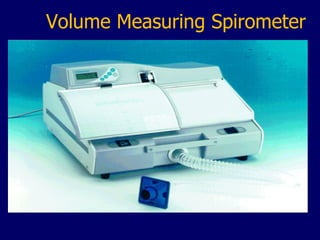
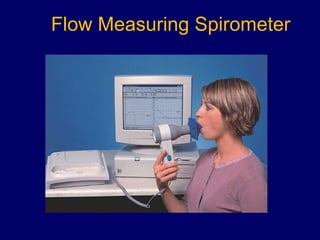
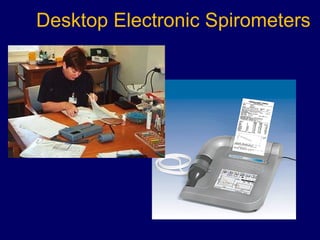
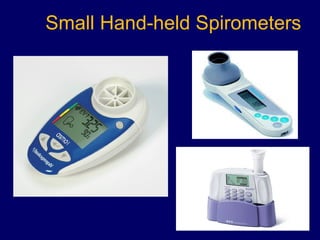
Types of Spirometers Bellows spirometers: Measure volume; mainly in lung  function units Electronic desk top spirometers: Measure flow and volume with real  time display Small hand-held spirometers: Inexpensive and quick to use but no  print out
Volume Measuring Spirometer
Flow Measuring Spirometer
Desktop Electronic Spirometers
Small Hand-held Spirometers
Standard Spirometric Indicies FEV 1  -  Forced expiratory volume in one second:  The volume of air expired in the first second of the blow FVC   -  Forced vital capacity: The total volume of air that can be forcibly exhaled in one breath FEV 1 /FVC  ratio: T he fraction of air exhaled in the first second relative to the total volume exhaled
Additional Spirometric Indicies VC  -  Vital capacity: A  volume of a  full breath exhaled in the patient’s own time and not forced. Often slightly greater than the FVC, particularly in COPD FEV 6  –  Forced expired volume in six seconds: Often approximates the FVC.  Easier to perform in older and COPD patients but role in COPD diagnosis remains under investigation MEFR  – Mid-expiratory flow rates: Derived from the mid portion of the flow volume curve but is not useful for COPD diagnosis
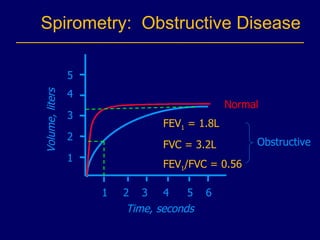
Spirogram Patterns Normal Obstructive Restrictive Mixed Obstructive and Restrictive
Predicted Normal Values Age Height  Sex Ethnic Origin Affected by:
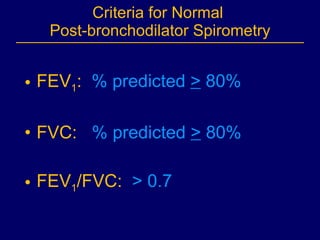
Criteria for Normal  Post-bronchodilator Spirometry FEV 1 :   % predicted  >  80% FVC:   % predicted  >  80% FEV 1 /FVC:   > 0.7
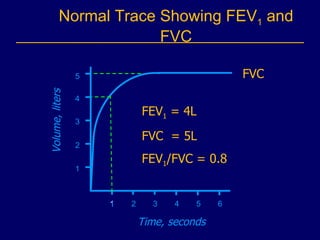
Normal Trace Showing FEV 1  and FVC 1 2 3 4 5 6 1 2 3 4 Volume, liters Time, seconds FVC 5 1 FEV 1  = 4L FVC  = 5L FEV 1 /FVC = 0.8
SPIROMETRY OBSTRUCTIVE DISEASE
Spirometry:  Obstructive Disease Volume, liters Time, seconds 5 4 3 2 1 1 2 3 4 5 6 FEV 1  = 1.8L FVC = 3.2L FEV 1 /FVC = 0.56 Normal Obstructive
Spirometric Diagnosis of COPD  COPD is confirmed by post–bronchodilator FEV 1 /FVC < 0.7 Post-bronchodilator FEV 1 /FVC measured 15 minutes after 400µg salbutamol or equivalent
Bronchodilator Reversibility Testing Provides the best achievable FEV 1   (and FVC) Helps to differentiate COPD from asthma Must be interpreted with clinical history - neither asthma nor COPD are diagnosed on spirometry alone
Figure 5.1-6.  Bronchodilator Reversibility Testing in COPD Preparation  Tests should be performed when patients are clinically stable and free from respiratory infection Patients should not have taken:  inhaled short-acting bronchodilators in the previous six hours long-acting bronchodilator in the previous 12 hours  sustained-release theophylline in the previous 24 hours
Figure 5.1-6.  Bronchodilator Reversibility Testing in COPD Spirometry FEV 1  should be measured (minimum twice, within 5%) before a bronchodilator is given The bronchodilator should be given by metered dose inhaler through a spacer device or by nebulizer to be certain it has been inhaled The bronchodilator dose should be selected to be high on the dose/response curve (…..continued)
Figure 5.1-6.  Bronchodilator Reversibility Testing in COPD Spirometry (continued) Possible dosage protocols:  400 µg  β 2 -agonist,  or 80-160 µg anticholinergic,  or   the two combined  FEV 1  should be measured again:  10-15 minutes after a short-acting   2 -agonist  30-45 minutes after the combination
Figure 5.1-6.  Bronchodilator Reversibility Testing in COPD  Results An increase in FEV 1  that is  both  greater than  200 ml  and  12% above  the pre-bronchodilator FEV 1  (baseline value) is considered significant It is usually helpful to report the absolute change  (in ml)  as well as the % change from baseline to set the improvement in a clinical context
SPIROMETRY RESTRICTIVE DISEASE
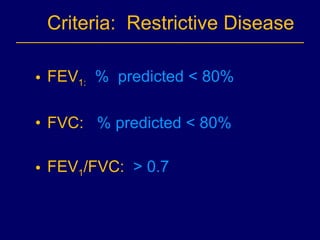
Criteria:  Restrictive Disease FEV 1:   %  predicted < 80% FVC:  % predicted < 80% FEV 1 /FVC:  > 0.7
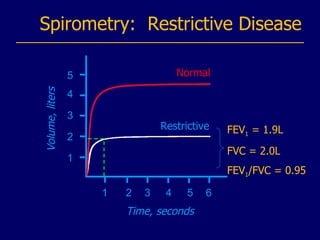
Volume, liters Time, seconds FEV 1  = 1. 9 L FVC = 2 .0 L FEV 1 /FVC = 0. 95 1 2 3 4 5 6 5 4 3 2 1 Spirometry:  Restrictive Disease Normal Restrictive
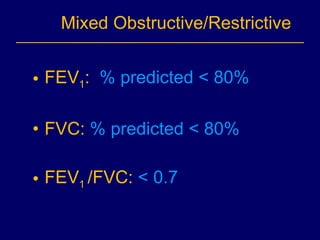
Mixed Obstructive/Restrictive FEV 1 :  % predicted < 80% FVC:  % predicted < 80% FEV 1  /FVC:  < 0.7
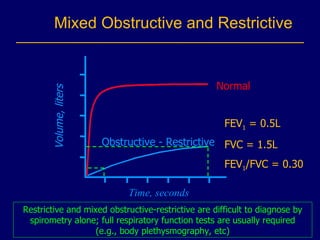
Mixed Obstructive and Restrictive Volume, liters Time, seconds Restrictive and mixed obstructive-restrictive are difficult to diagnose by spirometry alone; full respiratory function tests are usually required ( e.g.,  body   plethysmography, etc) FEV 1  =  0.5 L FVC =  1.5 L FEV 1 /FVC = 0. 30 Normal Obstructive - Restrictive
PRACTICAL  SESSION Performing Spirometry
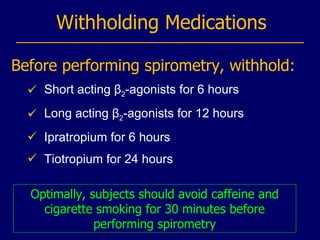
Withholding Medications Before performing spirometry, withhold: Short acting  β 2 -agonists for  6  hours Long acting  β 2 -agonists for 12 hours Ipratropium for 6 hours Tiotropium for 24 hours Optimally, subjects should avoid caffeine and cigarette smoking for 30 minutes   before performing spirometry
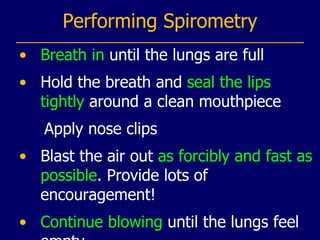
Performing Spirometry Breath in  until the lungs are full Hold the breath and  seal the lips tightly  around a clean mouthpiece Apply nose clips Blast the air out  as forcibly and fast as possible . Provide lots of encouragement! Continue blowing  until the lungs feel empty
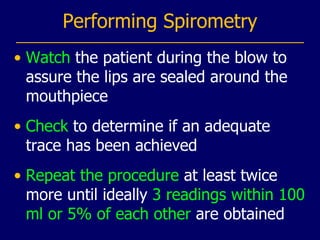
Watch  the patient during the blow to assure the lips are sealed around the mouthpiece Check  to determine if an adequate trace has been achieved Repeat the procedure  at least twice more until ideally  3 readings within 100   ml or 5% of each other  are obtained  Performing Spirometry
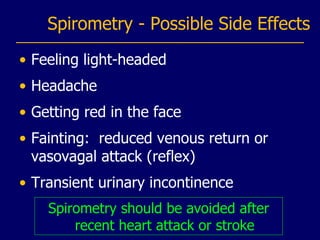
Spirometry - Possible Side Effects Feeling light-headed Headache Getting red in the face Fainting:  reduced venous return or vasovagal attack  (reflex) Tran s ient u rinary incontinence Spirometry should be avoided after recent heart attack or stroke
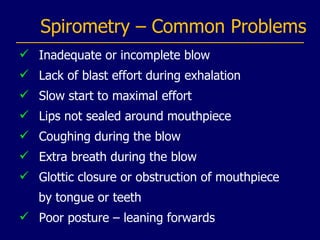
Spirometry – Common Problems Inadequate or incomplete blow Lack of blast effort during exhalation Slow start to maximal effort Lips not sealed around mouthpiece Coughing during the blow Extra breath during the blow Glottic closure or obstruction of mouthpiece by tongue or teeth Poor posture – leaning forwards
THANKS

Spirometry by dr tasleem

  • 1.
    SPIROMETRY Dr.Tasleem ArifDept.of Chest Medicine SKIMS MC/H Bemina By
  • 2.
    What is Spirometry? Spirometry is a method of assessing lung function by measuring the volume of air the patient can expel from the lungs after a maximal expiration.
  • 3.
    Why Perform Spirometry?Measure airflow obstruction to help make a definitive diagnosis of COPD Confirm presence of airway obstruction Assess severity of airflow obstruction in COPD Detect airflow obstruction in smokers who may have few or no symptoms Monitor disease progression in COPD Assess fitness in divers Assess prognosis (FEV 1 ) in COPD Perform pre-operative assessment
  • 4.
    Types of SpirometersBellows spirometers: Measure volume; mainly in lung function units Electronic desk top spirometers: Measure flow and volume with real time display Small hand-held spirometers: Inexpensive and quick to use but no print out
  • 5.
  • 6.
  • 7.
  • 8.
  • 9.
    Standard Spirometric IndiciesFEV 1 - Forced expiratory volume in one second: The volume of air expired in the first second of the blow FVC - Forced vital capacity: The total volume of air that can be forcibly exhaled in one breath FEV 1 /FVC ratio: T he fraction of air exhaled in the first second relative to the total volume exhaled
  • 10.
    Additional Spirometric IndiciesVC - Vital capacity: A volume of a full breath exhaled in the patient’s own time and not forced. Often slightly greater than the FVC, particularly in COPD FEV 6 – Forced expired volume in six seconds: Often approximates the FVC. Easier to perform in older and COPD patients but role in COPD diagnosis remains under investigation MEFR – Mid-expiratory flow rates: Derived from the mid portion of the flow volume curve but is not useful for COPD diagnosis
  • 11.
    Spirogram Patterns NormalObstructive Restrictive Mixed Obstructive and Restrictive
  • 12.
    Predicted Normal ValuesAge Height Sex Ethnic Origin Affected by:
  • 13.
    Criteria for Normal Post-bronchodilator Spirometry FEV 1 : % predicted > 80% FVC: % predicted > 80% FEV 1 /FVC: > 0.7
  • 14.
    Normal Trace ShowingFEV 1 and FVC 1 2 3 4 5 6 1 2 3 4 Volume, liters Time, seconds FVC 5 1 FEV 1 = 4L FVC = 5L FEV 1 /FVC = 0.8
  • 15.
  • 16.
    Spirometry: ObstructiveDisease Volume, liters Time, seconds 5 4 3 2 1 1 2 3 4 5 6 FEV 1 = 1.8L FVC = 3.2L FEV 1 /FVC = 0.56 Normal Obstructive
  • 17.
    Spirometric Diagnosis ofCOPD COPD is confirmed by post–bronchodilator FEV 1 /FVC < 0.7 Post-bronchodilator FEV 1 /FVC measured 15 minutes after 400µg salbutamol or equivalent
  • 18.
    Bronchodilator Reversibility TestingProvides the best achievable FEV 1 (and FVC) Helps to differentiate COPD from asthma Must be interpreted with clinical history - neither asthma nor COPD are diagnosed on spirometry alone
  • 19.
    Figure 5.1-6. Bronchodilator Reversibility Testing in COPD Preparation Tests should be performed when patients are clinically stable and free from respiratory infection Patients should not have taken: inhaled short-acting bronchodilators in the previous six hours long-acting bronchodilator in the previous 12 hours sustained-release theophylline in the previous 24 hours
  • 20.
    Figure 5.1-6. Bronchodilator Reversibility Testing in COPD Spirometry FEV 1 should be measured (minimum twice, within 5%) before a bronchodilator is given The bronchodilator should be given by metered dose inhaler through a spacer device or by nebulizer to be certain it has been inhaled The bronchodilator dose should be selected to be high on the dose/response curve (…..continued)
  • 21.
    Figure 5.1-6. Bronchodilator Reversibility Testing in COPD Spirometry (continued) Possible dosage protocols: 400 µg β 2 -agonist, or 80-160 µg anticholinergic, or the two combined FEV 1 should be measured again: 10-15 minutes after a short-acting  2 -agonist 30-45 minutes after the combination
  • 22.
    Figure 5.1-6. Bronchodilator Reversibility Testing in COPD Results An increase in FEV 1 that is both greater than 200 ml and 12% above the pre-bronchodilator FEV 1 (baseline value) is considered significant It is usually helpful to report the absolute change (in ml) as well as the % change from baseline to set the improvement in a clinical context
  • 23.
  • 24.
    Criteria: RestrictiveDisease FEV 1: % predicted < 80% FVC: % predicted < 80% FEV 1 /FVC: > 0.7
  • 25.
    Volume, liters Time,seconds FEV 1 = 1. 9 L FVC = 2 .0 L FEV 1 /FVC = 0. 95 1 2 3 4 5 6 5 4 3 2 1 Spirometry: Restrictive Disease Normal Restrictive
  • 26.
    Mixed Obstructive/Restrictive FEV1 : % predicted < 80% FVC: % predicted < 80% FEV 1 /FVC: < 0.7
  • 27.
    Mixed Obstructive andRestrictive Volume, liters Time, seconds Restrictive and mixed obstructive-restrictive are difficult to diagnose by spirometry alone; full respiratory function tests are usually required ( e.g., body plethysmography, etc) FEV 1 = 0.5 L FVC = 1.5 L FEV 1 /FVC = 0. 30 Normal Obstructive - Restrictive
  • 28.
    PRACTICAL SESSIONPerforming Spirometry
  • 29.
    Withholding Medications Beforeperforming spirometry, withhold: Short acting β 2 -agonists for 6 hours Long acting β 2 -agonists for 12 hours Ipratropium for 6 hours Tiotropium for 24 hours Optimally, subjects should avoid caffeine and cigarette smoking for 30 minutes before performing spirometry
  • 30.
    Performing Spirometry Breathin until the lungs are full Hold the breath and seal the lips tightly around a clean mouthpiece Apply nose clips Blast the air out as forcibly and fast as possible . Provide lots of encouragement! Continue blowing until the lungs feel empty
  • 31.
    Watch thepatient during the blow to assure the lips are sealed around the mouthpiece Check to determine if an adequate trace has been achieved Repeat the procedure at least twice more until ideally 3 readings within 100 ml or 5% of each other are obtained Performing Spirometry
  • 32.
    Spirometry - PossibleSide Effects Feeling light-headed Headache Getting red in the face Fainting: reduced venous return or vasovagal attack (reflex) Tran s ient u rinary incontinence Spirometry should be avoided after recent heart attack or stroke
  • 33.
    Spirometry – CommonProblems Inadequate or incomplete blow Lack of blast effort during exhalation Slow start to maximal effort Lips not sealed around mouthpiece Coughing during the blow Extra breath during the blow Glottic closure or obstruction of mouthpiece by tongue or teeth Poor posture – leaning forwards
  • 34.