Pulmonary Function Testing
Sid Kaithakkoden MD
MBBS,DCH,DipNB,MD,MRCPCH,FCPS
alavisaid@aol.com
Introduction
• Lung function is physiologically divided into four
volumes:
– expiratory reserve volume
– inspiratory reserve volume
– residual volume
– tidal volume.
• Together, the four lung volumes equal the total
lung capacity (TLC)
• Lung volumes and their combinations measure
various lung capacities such as functional
residual capacity (FRC), inspiratory capacity,
and VC
Spirometric values
• FVC-Forced vital capacity;
– the total volume of air that can be exhaled during a maximal forced
expiration effort.
• FEV1-Forced expiratory volume in one second;
– the volume of air exhaled in the first second under force after a
maximal inhalation.
• FEV1/FVC ratio-
– The percentage of the FVC expired in one second.
• FEV6-Forced expiratory volume in six seconds.
• FEF25-75%-Forced expiratory flow over the middle one half of the
FVC;
– the average flow from the point at which 25 percent of the FVC has
been exhaled to the point at which 75 percent of the FVC has been
exhaled.
• MVV-Maximal voluntary ventilation
Lung volumes
• ERV-Expiratory reserve volume;
– the maximal volume of air exhaled from end-
expiration.
• IRV-Inspiratory reserve volume;
– the maximal volume of air inhaled from end-
inspiration.
• RV-Residual volume;
– the volume of air remaining in the lungs after a
maximal exhalation.
• VT-Tidal volume;
– the volume of air inhaled or exhaled during each
respiratory cycle
Lung capacities
• FRC-Functional residual capacity;
– the volume of air in the lungs at resting end-
expiration.
• IC-Inspiratory capacity;
– the maximal volume of air that can be inhaled from
the resting expiratory level.
• TLC-Total lung capacity;
– the volume of air in the lungs at maximal inflation.
• VC-Vital capacity;
– the largest volume measured on complete exhalation
after full inspiration
Lung volumes and Capacities
Pulmonary function test Normal value (95 percent confidence interval)
FEV1
80% to 120%
FVC 80% to 120%
Absolute FEV1
/FVC ratio Within 5% of the predicted ratio
TLC 80% to 120%
FRC 75% to 120%
RV 75% to 120%
Dlco >60% to <120%
Normal Values of Pulmonary Function Tests
Dlco = diffusing capacity of lung for carbon
Spirometry
• Spirometry- the measuring of breath, the most
common of the Pulmonary Function Tests
• measurement of the amount (volume) and
speed (flow) of air that can be inhaled and
exhaled
• Spirometry is important tool used for generating
a pneumotachograph
• A valuable tool in assessing conditions such
asthma and cystic fibrosis
• Spirometry measures the rate at which the lung
changes volume during forced breathing
maneuvers
• Spirometry begins with a full inhalation, followed
by a forced expiration that rapidly empties the
lungs
• Expiration is continued for as long as possible or
until a plateau in exhaled volume is reached
• These efforts are recorded and graphed
Objective
• Measurements for obstructive defects (those
related to resistance to flow)
• Measurements for restrictive defects (those
related to decrease in functional lung volume)
• Measurements of diffusion defects (those that
impair diffusion of gas through the alveolar-
capillary membrane)
• Measurement of respiratory muscle function
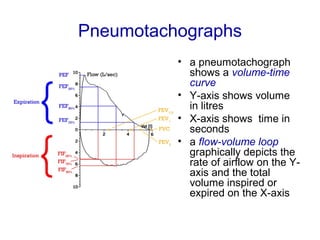
Pneumotachographs
• a pneumotachograph
shows a volume-time
curve
• Y-axis shows volume
in litres
• X-axis shows time in
seconds
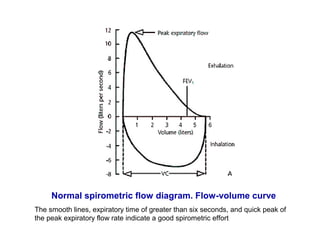
• a flow-volume loop
graphically depicts the
rate of airflow on the Y-
axis and the total
volume inspired or
expired on the X-axis
Normal spirometric flow diagram. Flow-volume curve
The smooth lines, expiratory time of greater than six seconds, and quick peak of
the peak expiratory flow rate indicate a good spirometric effort
FEV1
Forced Expiratory Volume
in 1 second
The amount of air forcibly exhaled
in 1 second measured in litres and
expressed as a percentage of
predicted normal for that person.
Should be >80% predicted
Reduced in resistrictive
disease and obstructed
disease if air trapping
occurs
FVC
Forced Vital Capacity
The volume of the lungs from full
inspiration to full forced expiration in
litres and expressed as a
percentage of predicted normal for
that person
Reduced in recitative and
obstructed disease. Most
closely relating to presence
of secretions andis a
predictor of morbidity and
mortality.
FEF 25-75 %
Forced Expiratory Flow
25-75 %
MMEF
Maximum Mid Expiratory
Flow
Average speed of airflow in the mid
range of expiration.
A good indicator of disease
in the middle and lower
respiratory tract.
Normal in restrictive disease
PEF
Peak Expiratory Flow
Speed of air flow generated
l/min
Does not distinguish
between obstructed and
restrictive disease and may
seriously underestimate the
degree of airflow obstruction
Technique
• Precede the test by a period of quiet tidal
volume breathing through the mouthpiece
usually x3 breaths
• Followed by a maximal inspiratory breath. The
volume inspired directly affects the results of the
test.
• Then exhale through the sensor as hard as
possible, for as long as possible. Initial effort can
be turned into gentle effective effort to achieve
maximal expiration.
• Maintain the seal on the mouthpiece for
inspiration
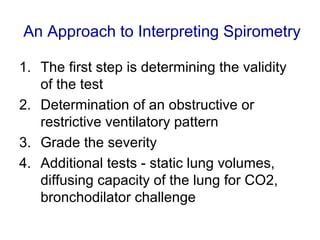
An Approach to Interpreting Spirometry
1. The first step is determining the validity
of the test
2. Determination of an obstructive or
restrictive ventilatory pattern
3. Grade the severity
4. Additional tests - static lung volumes,
diffusing capacity of the lung for CO2,
bronchodilator challenge
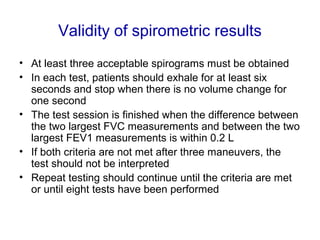
Validity of spirometric results
• At least three acceptable spirograms must be obtained
• In each test, patients should exhale for at least six
seconds and stop when there is no volume change for
one second
• The test session is finished when the difference between
the two largest FVC measurements and between the two
largest FEV1 measurements is within 0.2 L
• If both criteria are not met after three maneuvers, the
test should not be interpreted
• Repeat testing should continue until the criteria are met
or until eight tests have been performed
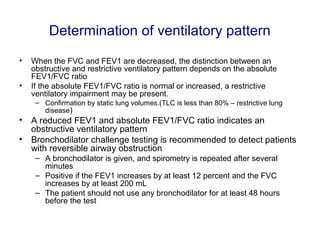
Determination of ventilatory pattern
• When the FVC and FEV1 are decreased, the distinction between an
obstructive and restrictive ventilatory pattern depends on the absolute
FEV1/FVC ratio
• If the absolute FEV1/FVC ratio is normal or increased, a restrictive
ventilatory impairment may be present.
– Confirmation by static lung volumes.(TLC is less than 80% – restrictive lung
disease)
• A reduced FEV1 and absolute FEV1/FVC ratio indicates an
obstructive ventilatory pattern
• Bronchodilator challenge testing is recommended to detect patients
with reversible airway obstruction
– A bronchodilator is given, and spirometry is repeated after several
minutes
– Positive if the FEV1 increases by at least 12 percent and the FVC
increases by at least 200 mL
– The patient should not use any bronchodilator for at least 48 hours
before the test
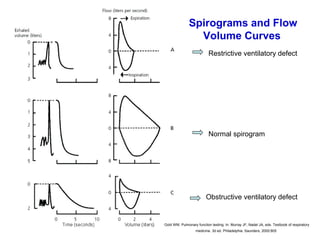
Spirograms and Flow
Volume Curves
Gold WM. Pulmonary function testing. In: Murray JF, Nadel JA, eds. Textbook of respiratory
medicine. 3d ed. Philadelphia: Saunders, 2000:805
Restrictive ventilatory defect
Normal spirogram
Obstructive ventilatory defect
Limitations
• The manoeuvre is highly dependent on patient
cooperation and effort
• Normally repeated at least three times to ensure
reproducibility
• Since results are dependent on patient
cooperation, FEV1 and FVC can only be
underestimated, never overestimated
• Spirometry will only be useful when children are
old enough to comprehend and follow the
instructions given, typically about 4-5 years old
Contraindications to
use of Spirometry
• Acute disorders affecting test performance (e.g.,
vomiting, nausea, vertigo)
• Hemoptysis of unknown origin (FVC maneuver may
aggravate underlying condition.)
• Pneumothorax
• Recent abdominal or thoracic surgery
• Recent eye surgery (increases in intraocular pressure
during spirometry)
• Recent myocardial infarction or unstable angina
• Thoracic aneurysms (risk of rupture because of
increased thoracic pressure)
Interpreting Spirometry Results
Indications of Spirometry
• Detecting pulmonary disease
• History of pulmonary symptoms
• Chest pain or orthopnea
• Cough or phlegm production
• Dyspnea or wheezing
• Chest wall abnormalities
• Cyanosis
• Decreased breath sounds
• Finger clubbing
• Chest radiograph
• Assessing severity or progression of
disease
• Pulmonary diseases
• Chronic obstructive pulmonary disease
• Cystic fibrosis
• Interstitial lung diseases
• Sarcoidosis
• Cardiac diseases
• Congestive heart failure
• Congenital heart disease
• Pulmonary hypertension
• Neuromuscular diseases
• Amyotrophic lateral sclerosis
• Guillain-Barré syndrome
• Multiple sclerosis
• Myasthenia gravis
• Risk stratification of patients for surgery
• Thoracic surgeries
• Lobectomy
• Pneumonectomy
• Cardiac surgeries
• Coronary bypass
• Correction of congenital abnormalities
• Valvular surgery
• Organ transplantation
• General surgical procedures
• Cholecystectomy
• Gastric bypass
• Evaluating disability or impairment

Lung fuction tests

  • 1.
    Pulmonary Function Testing SidKaithakkoden MD MBBS,DCH,DipNB,MD,MRCPCH,FCPS alavisaid@aol.com
  • 2.
    Introduction • Lung functionis physiologically divided into four volumes: – expiratory reserve volume – inspiratory reserve volume – residual volume – tidal volume. • Together, the four lung volumes equal the total lung capacity (TLC) • Lung volumes and their combinations measure various lung capacities such as functional residual capacity (FRC), inspiratory capacity, and VC
  • 3.
    Spirometric values • FVC-Forcedvital capacity; – the total volume of air that can be exhaled during a maximal forced expiration effort. • FEV1-Forced expiratory volume in one second; – the volume of air exhaled in the first second under force after a maximal inhalation. • FEV1/FVC ratio- – The percentage of the FVC expired in one second. • FEV6-Forced expiratory volume in six seconds. • FEF25-75%-Forced expiratory flow over the middle one half of the FVC; – the average flow from the point at which 25 percent of the FVC has been exhaled to the point at which 75 percent of the FVC has been exhaled. • MVV-Maximal voluntary ventilation
  • 4.
    Lung volumes • ERV-Expiratoryreserve volume; – the maximal volume of air exhaled from end- expiration. • IRV-Inspiratory reserve volume; – the maximal volume of air inhaled from end- inspiration. • RV-Residual volume; – the volume of air remaining in the lungs after a maximal exhalation. • VT-Tidal volume; – the volume of air inhaled or exhaled during each respiratory cycle
  • 5.
    Lung capacities • FRC-Functionalresidual capacity; – the volume of air in the lungs at resting end- expiration. • IC-Inspiratory capacity; – the maximal volume of air that can be inhaled from the resting expiratory level. • TLC-Total lung capacity; – the volume of air in the lungs at maximal inflation. • VC-Vital capacity; – the largest volume measured on complete exhalation after full inspiration
  • 6.
    Lung volumes andCapacities
  • 7.
    Pulmonary function testNormal value (95 percent confidence interval) FEV1 80% to 120% FVC 80% to 120% Absolute FEV1 /FVC ratio Within 5% of the predicted ratio TLC 80% to 120% FRC 75% to 120% RV 75% to 120% Dlco >60% to <120% Normal Values of Pulmonary Function Tests Dlco = diffusing capacity of lung for carbon
  • 8.
    Spirometry • Spirometry- themeasuring of breath, the most common of the Pulmonary Function Tests • measurement of the amount (volume) and speed (flow) of air that can be inhaled and exhaled • Spirometry is important tool used for generating a pneumotachograph • A valuable tool in assessing conditions such asthma and cystic fibrosis
  • 9.
    • Spirometry measuresthe rate at which the lung changes volume during forced breathing maneuvers • Spirometry begins with a full inhalation, followed by a forced expiration that rapidly empties the lungs • Expiration is continued for as long as possible or until a plateau in exhaled volume is reached • These efforts are recorded and graphed
  • 10.
    Objective • Measurements forobstructive defects (those related to resistance to flow) • Measurements for restrictive defects (those related to decrease in functional lung volume) • Measurements of diffusion defects (those that impair diffusion of gas through the alveolar- capillary membrane) • Measurement of respiratory muscle function
  • 11.
    Pneumotachographs • a pneumotachograph showsa volume-time curve • Y-axis shows volume in litres • X-axis shows time in seconds • a flow-volume loop graphically depicts the rate of airflow on the Y- axis and the total volume inspired or expired on the X-axis
  • 13.
    Normal spirometric flowdiagram. Flow-volume curve The smooth lines, expiratory time of greater than six seconds, and quick peak of the peak expiratory flow rate indicate a good spirometric effort
  • 15.
    FEV1 Forced Expiratory Volume in1 second The amount of air forcibly exhaled in 1 second measured in litres and expressed as a percentage of predicted normal for that person. Should be >80% predicted Reduced in resistrictive disease and obstructed disease if air trapping occurs FVC Forced Vital Capacity The volume of the lungs from full inspiration to full forced expiration in litres and expressed as a percentage of predicted normal for that person Reduced in recitative and obstructed disease. Most closely relating to presence of secretions andis a predictor of morbidity and mortality. FEF 25-75 % Forced Expiratory Flow 25-75 % MMEF Maximum Mid Expiratory Flow Average speed of airflow in the mid range of expiration. A good indicator of disease in the middle and lower respiratory tract. Normal in restrictive disease PEF Peak Expiratory Flow Speed of air flow generated l/min Does not distinguish between obstructed and restrictive disease and may seriously underestimate the degree of airflow obstruction
  • 16.
    Technique • Precede thetest by a period of quiet tidal volume breathing through the mouthpiece usually x3 breaths • Followed by a maximal inspiratory breath. The volume inspired directly affects the results of the test. • Then exhale through the sensor as hard as possible, for as long as possible. Initial effort can be turned into gentle effective effort to achieve maximal expiration. • Maintain the seal on the mouthpiece for inspiration
  • 17.
    An Approach toInterpreting Spirometry 1. The first step is determining the validity of the test 2. Determination of an obstructive or restrictive ventilatory pattern 3. Grade the severity 4. Additional tests - static lung volumes, diffusing capacity of the lung for CO2, bronchodilator challenge
  • 18.
    Validity of spirometricresults • At least three acceptable spirograms must be obtained • In each test, patients should exhale for at least six seconds and stop when there is no volume change for one second • The test session is finished when the difference between the two largest FVC measurements and between the two largest FEV1 measurements is within 0.2 L • If both criteria are not met after three maneuvers, the test should not be interpreted • Repeat testing should continue until the criteria are met or until eight tests have been performed
  • 19.
    Determination of ventilatorypattern • When the FVC and FEV1 are decreased, the distinction between an obstructive and restrictive ventilatory pattern depends on the absolute FEV1/FVC ratio • If the absolute FEV1/FVC ratio is normal or increased, a restrictive ventilatory impairment may be present. – Confirmation by static lung volumes.(TLC is less than 80% – restrictive lung disease) • A reduced FEV1 and absolute FEV1/FVC ratio indicates an obstructive ventilatory pattern • Bronchodilator challenge testing is recommended to detect patients with reversible airway obstruction – A bronchodilator is given, and spirometry is repeated after several minutes – Positive if the FEV1 increases by at least 12 percent and the FVC increases by at least 200 mL – The patient should not use any bronchodilator for at least 48 hours before the test
  • 20.
    Spirograms and Flow VolumeCurves Gold WM. Pulmonary function testing. In: Murray JF, Nadel JA, eds. Textbook of respiratory medicine. 3d ed. Philadelphia: Saunders, 2000:805 Restrictive ventilatory defect Normal spirogram Obstructive ventilatory defect
  • 24.
    Limitations • The manoeuvreis highly dependent on patient cooperation and effort • Normally repeated at least three times to ensure reproducibility • Since results are dependent on patient cooperation, FEV1 and FVC can only be underestimated, never overestimated • Spirometry will only be useful when children are old enough to comprehend and follow the instructions given, typically about 4-5 years old
  • 26.
    Contraindications to use ofSpirometry • Acute disorders affecting test performance (e.g., vomiting, nausea, vertigo) • Hemoptysis of unknown origin (FVC maneuver may aggravate underlying condition.) • Pneumothorax • Recent abdominal or thoracic surgery • Recent eye surgery (increases in intraocular pressure during spirometry) • Recent myocardial infarction or unstable angina • Thoracic aneurysms (risk of rupture because of increased thoracic pressure)
  • 27.
  • 28.
    Indications of Spirometry •Detecting pulmonary disease • History of pulmonary symptoms • Chest pain or orthopnea • Cough or phlegm production • Dyspnea or wheezing • Chest wall abnormalities • Cyanosis • Decreased breath sounds • Finger clubbing • Chest radiograph • Assessing severity or progression of disease • Pulmonary diseases • Chronic obstructive pulmonary disease • Cystic fibrosis • Interstitial lung diseases • Sarcoidosis • Cardiac diseases • Congestive heart failure • Congenital heart disease • Pulmonary hypertension • Neuromuscular diseases • Amyotrophic lateral sclerosis • Guillain-Barré syndrome • Multiple sclerosis • Myasthenia gravis • Risk stratification of patients for surgery • Thoracic surgeries • Lobectomy • Pneumonectomy • Cardiac surgeries • Coronary bypass • Correction of congenital abnormalities • Valvular surgery • Organ transplantation • General surgical procedures • Cholecystectomy • Gastric bypass • Evaluating disability or impairment