Sequential Logic
Circuit
Yong Heui Cho @ Mokwon University
Most of slides are referred to and all credits should go to:
[1] M.Y. Idris & N.M. Noor, Sequential Circuit, slideshare.
Basic Computer Design
3. Basic Computer Architecture
4. Combinational Logic Circuit
5. Sequential Logic Circuit
6. CPU Architecture - Basic
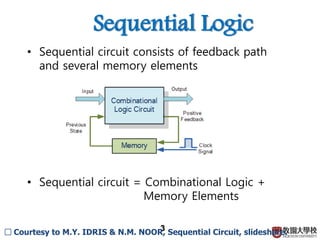
Sequential Logic
• Sequential circuit consists of feedback path
and several memory elements
• Sequential circuit = Combinational Logic +
Memory Elements
3
□ Courtesy to M.Y. IDRIS & N.M. NOOR, Sequential Circuit, slideshare.
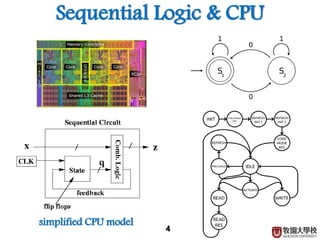
Sequential Logic & CPU
4
simplified CPU model
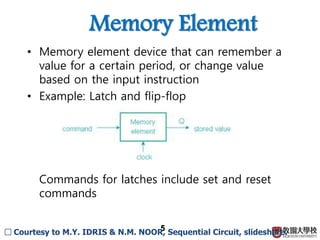
Memory Element
• Memory element device that can remember a
value for a certain period, or change value
based on the input instruction
• Example: Latch and flip-flop
Commands for latches include set and reset
commands
5
□ Courtesy to M.Y. IDRIS & N.M. NOOR, Sequential Circuit, slideshare.
Latch & Flip-flop
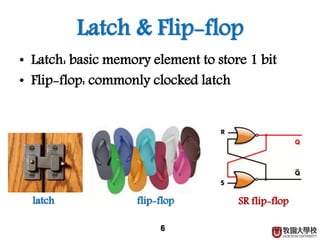
• Latch: basic memory element to store 1 bit
• Flip-flop: commonly clocked latch
latch flip-flop SR flip-flop
6
Flip-flop
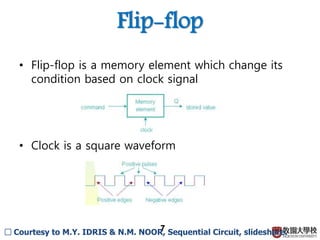
• Flip-flop is a memory element which change its
condition based on clock signal
• Clock is a square waveform
7
□ Courtesy to M.Y. IDRIS & N.M. NOOR, Sequential Circuit, slideshare.
SR Latch
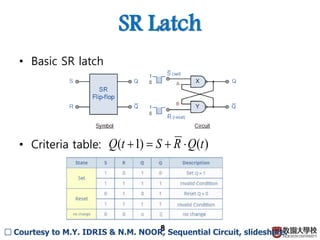
• Basic SR latch
• Criteria table:
8
)()1( tQRStQ 
□ Courtesy to M.Y. IDRIS & N.M. NOOR, Sequential Circuit, slideshare.
SR Latch Circuit
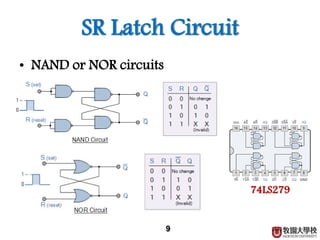
• NAND or NOR circuits
9
74LS279
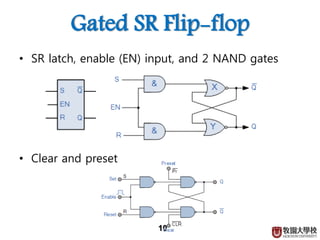
Gated SR Flip-flop
• SR latch, enable (EN) input, and 2 NAND gates
• Clear and preset
10
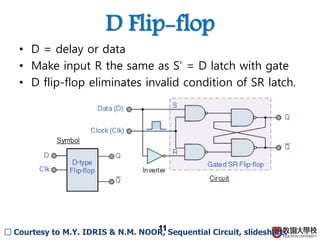
D Flip-flop
• D = delay or data
• Make input R the same as S’ = D latch with gate
• D flip-flop eliminates invalid condition of SR latch.
11
□ Courtesy to M.Y. IDRIS & N.M. NOOR, Sequential Circuit, slideshare.
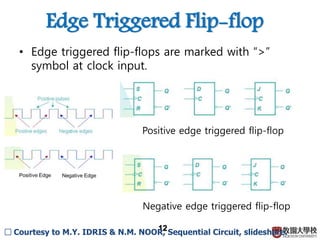
Edge Triggered Flip-flop
• Edge triggered flip-flops are marked with “>”
symbol at clock input.
Positive edge triggered flip-flop
Negative edge triggered flip-flop
12
□ Courtesy to M.Y. IDRIS & N.M. NOOR, Sequential Circuit, slideshare.
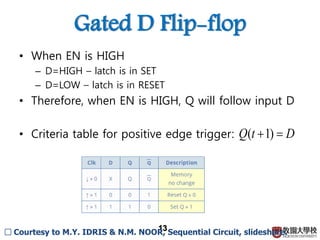
Gated D Flip-flop
• When EN is HIGH
– D=HIGH – latch is in SET
– D=LOW – latch is in RESET
• Therefore, when EN is HIGH, Q will follow input D
• Criteria table for positive edge trigger:
13
DtQ  )1(
□ Courtesy to M.Y. IDRIS & N.M. NOOR, Sequential Circuit, slideshare.
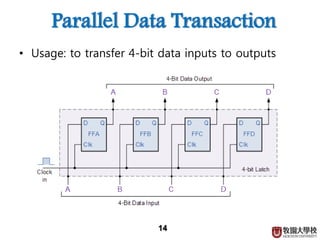
Parallel Data Transaction
• Usage: to transfer 4-bit data inputs to outputs
14
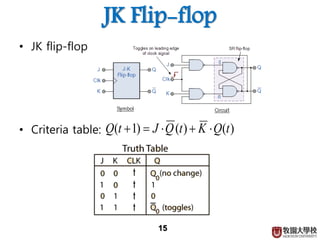
JK Flip-flop
• JK flip-flop
• Criteria table:
15
)()()1( tQKtQJtQ 
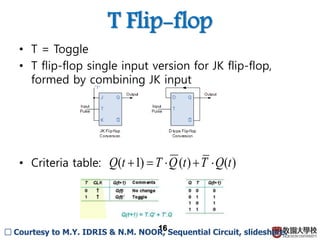
T Flip-flop
• T = Toggle
• T flip-flop single input version for JK flip-flop,
formed by combining JK input
• Criteria table:
16
)()()1( tQTtQTtQ 
□ Courtesy to M.Y. IDRIS & N.M. NOOR, Sequential Circuit, slideshare.
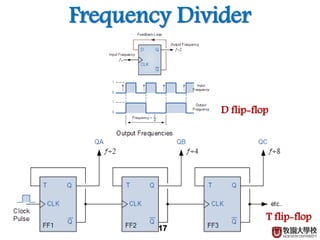
Frequency Divider
17
D flip-flop
T flip-flop
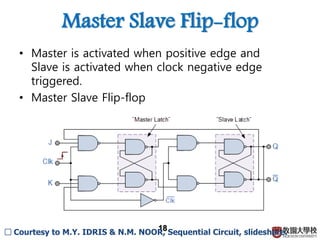
Master Slave Flip-flop
• Master is activated when positive edge and
Slave is activated when clock negative edge
triggered.
• Master Slave Flip-flop
18
□ Courtesy to M.Y. IDRIS & N.M. NOOR, Sequential Circuit, slideshare.

Sequential Logic Circuit

  • 1.
    Sequential Logic Circuit Yong HeuiCho @ Mokwon University Most of slides are referred to and all credits should go to: [1] M.Y. Idris & N.M. Noor, Sequential Circuit, slideshare.
  • 2.
    Basic Computer Design 3.Basic Computer Architecture 4. Combinational Logic Circuit 5. Sequential Logic Circuit 6. CPU Architecture - Basic
  • 3.
    Sequential Logic • Sequentialcircuit consists of feedback path and several memory elements • Sequential circuit = Combinational Logic + Memory Elements 3 □ Courtesy to M.Y. IDRIS & N.M. NOOR, Sequential Circuit, slideshare.
  • 4.
    Sequential Logic &CPU 4 simplified CPU model
  • 5.
    Memory Element • Memoryelement device that can remember a value for a certain period, or change value based on the input instruction • Example: Latch and flip-flop Commands for latches include set and reset commands 5 □ Courtesy to M.Y. IDRIS & N.M. NOOR, Sequential Circuit, slideshare.
  • 6.
    Latch & Flip-flop •Latch: basic memory element to store 1 bit • Flip-flop: commonly clocked latch latch flip-flop SR flip-flop 6
  • 7.
    Flip-flop • Flip-flop isa memory element which change its condition based on clock signal • Clock is a square waveform 7 □ Courtesy to M.Y. IDRIS & N.M. NOOR, Sequential Circuit, slideshare.
  • 8.
    SR Latch • BasicSR latch • Criteria table: 8 )()1( tQRStQ  □ Courtesy to M.Y. IDRIS & N.M. NOOR, Sequential Circuit, slideshare.
  • 9.
    SR Latch Circuit •NAND or NOR circuits 9 74LS279
  • 10.
    Gated SR Flip-flop •SR latch, enable (EN) input, and 2 NAND gates • Clear and preset 10
  • 11.
    D Flip-flop • D= delay or data • Make input R the same as S’ = D latch with gate • D flip-flop eliminates invalid condition of SR latch. 11 □ Courtesy to M.Y. IDRIS & N.M. NOOR, Sequential Circuit, slideshare.
  • 12.
    Edge Triggered Flip-flop •Edge triggered flip-flops are marked with “>” symbol at clock input. Positive edge triggered flip-flop Negative edge triggered flip-flop 12 □ Courtesy to M.Y. IDRIS & N.M. NOOR, Sequential Circuit, slideshare.
  • 13.
    Gated D Flip-flop •When EN is HIGH – D=HIGH – latch is in SET – D=LOW – latch is in RESET • Therefore, when EN is HIGH, Q will follow input D • Criteria table for positive edge trigger: 13 DtQ  )1( □ Courtesy to M.Y. IDRIS & N.M. NOOR, Sequential Circuit, slideshare.
  • 14.
    Parallel Data Transaction •Usage: to transfer 4-bit data inputs to outputs 14
  • 15.
    JK Flip-flop • JKflip-flop • Criteria table: 15 )()()1( tQKtQJtQ 
  • 16.
    T Flip-flop • T= Toggle • T flip-flop single input version for JK flip-flop, formed by combining JK input • Criteria table: 16 )()()1( tQTtQTtQ  □ Courtesy to M.Y. IDRIS & N.M. NOOR, Sequential Circuit, slideshare.
  • 17.
  • 18.
    Master Slave Flip-flop •Master is activated when positive edge and Slave is activated when clock negative edge triggered. • Master Slave Flip-flop 18 □ Courtesy to M.Y. IDRIS & N.M. NOOR, Sequential Circuit, slideshare.