• Sequential Ckt
Lecture 11: Sequential Logic
Latches & Flip-flops
Introduction
Memory Elements
Pulse-Triggered Latch
S-R Latch
Gated S-R Latch
Gated D Latch
Edge-Triggered Flip-flops
S-R Flip-flop
D Flip-flop
J-K Flip-flop
T Flip-flop
Asynchronous Inputs
Introduction
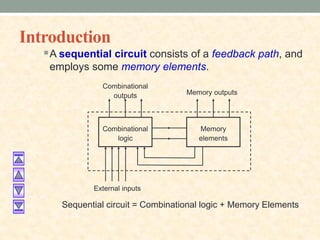
A sequential circuit consists of a feedback path, and
employs some memory elements.
Combinational
logic
Memory
elements
Combinational
outputs Memory outputs
External inputs
Sequential circuit = Combinational logic + Memory Elements
Introduction
There are two types of sequential circuits:
synchronous: outputs change only at specific time
asynchronous: outputs change at any time
Multivibrator: a class of sequential circuits. They can
be:
bistable (2 stable states)
monostable or one-shot (1 stable state)
astable (no stable state)
Bistable logic devices: latches and flip-flops.
Latches and flip-flops differ in the method used for
changing their state.
Memory Elements
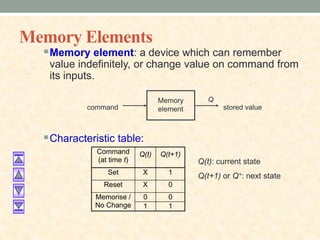
Memory element: a device which can remember
value indefinitely, or change value on command from
its inputs.
Characteristic table:
Command
(at time t)
Q(t) Q(t+1)
Set X 1
Reset X 0
0 0
Memorise /
No Change 1 1
command
Memory
element stored value
Q
Q(t): current state
Q(t+1) or Q+: next state
Memory Elements
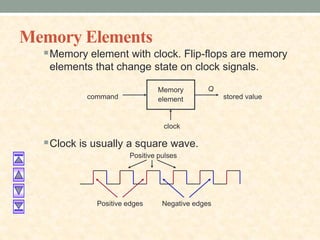
Memory element with clock. Flip-flops are memory
elements that change state on clock signals.
Clock is usually a square wave.
command
Memory
element stored value
Q
clock
Positive edges Negative edges
Positive pulses
Memory Elements
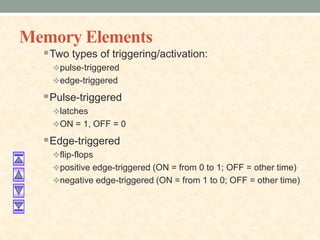
Two types of triggering/activation:
pulse-triggered
edge-triggered
Pulse-triggered
latches
ON = 1, OFF = 0
Edge-triggered
flip-flops
positive edge-triggered (ON = from 0 to 1; OFF = other time)
negative edge-triggered (ON = from 1 to 0; OFF = other time)
S-R Latch
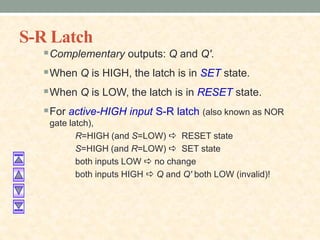
Complementary outputs: Q and Q'.
When Q is HIGH, the latch is in SET state.
When Q is LOW, the latch is in RESET state.
For active-HIGH input S-R latch (also known as NOR
gate latch),
R=HIGH (and S=LOW) a RESET state
S=HIGH (and R=LOW) a SET state
both inputs LOW a no change
both inputs HIGH a Q and Q' both LOW (invalid)!
S-R Latch
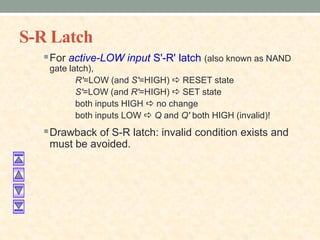
For active-LOW input S'-R' latch (also known as NAND
gate latch),
R'=LOW (and S'=HIGH) a RESET state
S'=LOW (and R'=HIGH) a SET state
both inputs HIGH a no change
both inputs LOW a Q and Q' both HIGH (invalid)!
Drawback of S-R latch: invalid condition exists and
must be avoided.
S-R Latch
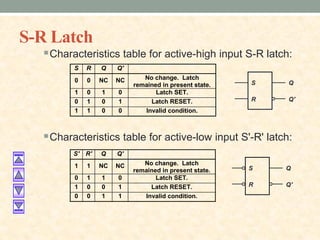
Characteristics table for active-high input S-R latch:
Characteristics table for active-low input S'-R' latch:
S R Q Q'
0 0 NC NC No change. Latch
remained in present state.
1 0 1 0 Latch SET.
0 1 0 1 Latch RESET.
1 1 0 0 Invalid condition.
S' R' Q Q'
1 1 NC NC No change. Latch
remained in present state.
0 1 1 0 Latch SET.
1 0 0 1 Latch RESET.
0 0 1 1 Invalid condition.
S
R
Q
Q'
S
R
Q
Q'
S-R Latch
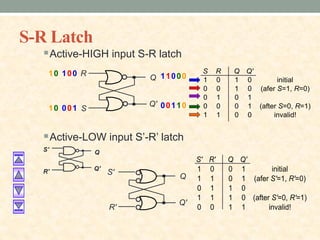
Active-HIGH input S-R latch
Active-LOW input S’-R’ latch
R
S
Q
Q'
S R Q Q'
1 0 1 0 initial
0 0 1 0 (afer S=1, R=0)
0 1 0 1
0 0 0 1 (after S=0, R=1)
1 1 0 0 invalid!
S' R' Q Q'
1 0 0 1 initial
1 1 0 1 (afer S'=1, R'=0)
0 1 1 0
1 1 1 0 (after S'=0, R'=1)
0 0 1 1 invalid!
S'
R'
Q
Q'
S'
R'
Q
Q'
0
1
1
0
0
0
1
0
1
0
0
1
0
0
0
1
1
1
0
0
Gated S-R Latch
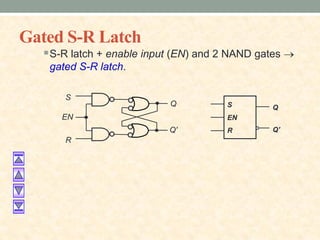
S-R latch + enable input (EN) and 2 NAND gates 
gated S-R latch.
S
R
Q
Q'
EN
S
EN
R
Q
Q'
Gated S-R Latch
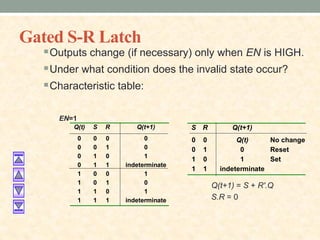
Outputs change (if necessary) only when EN is HIGH.
Under what condition does the invalid state occur?
Characteristic table:
Q(t) S R Q(t+1)
0 0 0 0
0 0 1 0
0 1 0 1
0 1 1 indeterminate
1 0 0 1
1 0 1 0
1 1 0 1
1 1 1 indeterminate
EN=1
S R Q(t+1)
0 0 Q(t) No change
0 1 0 Reset
1 0 1 Set
1 1 indeterminate
Q(t+1) = S + R'.Q
S.R = 0
Gated D Latch
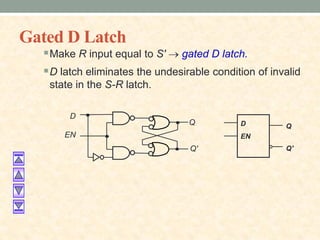
Make R input equal to S'  gated D latch.
D latch eliminates the undesirable condition of invalid
state in the S-R latch.
D
EN
Q
Q'
D
Q
Q'
EN
Gated D Latch
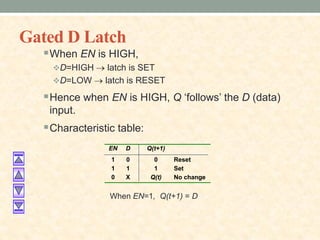
When EN is HIGH,
D=HIGH  latch is SET
D=LOW  latch is RESET
Hence when EN is HIGH, Q ‘follows’ the D (data)
input.
Characteristic table:
When EN=1, Q(t+1) = D
EN D Q(t+1)
1 0 0 Reset
1 1 1 Set
0 X Q(t) No change
Latch Circuits: Not Suitable
Latch circuits are not suitable in synchronous logic
circuits.
When the enable signal is active, the excitation inputs
are gated directly to the output Q. Thus, any change
in the excitation input immediately causes a change in
the latch output.
The problem is solved by using a special timing
control signal called a clock to restrict the times at
which the states of the memory elements may
change.
This leads us to the edge-triggered memory elements
called flip-flops.
Edge-Triggered Flip-flops
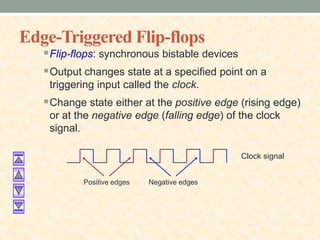
Flip-flops: synchronous bistable devices
Output changes state at a specified point on a
triggering input called the clock.
Change state either at the positive edge (rising edge)
or at the negative edge (falling edge) of the clock
signal.
Positive edges Negative edges
Clock signal
Edge-Triggered Flip-flops
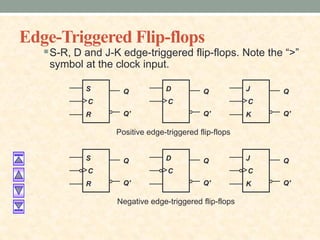
S-R, D and J-K edge-triggered flip-flops. Note the “>”
symbol at the clock input.
S
C
R
Q
Q'
S
C
R
Q
Q'
D
C
Q
Q'
D
C
Q
Q'
J
C
K
Q
Q'
J
C
K
Q
Q'
Positive edge-triggered flip-flops
Negative edge-triggered flip-flops
S-R Flip-flop
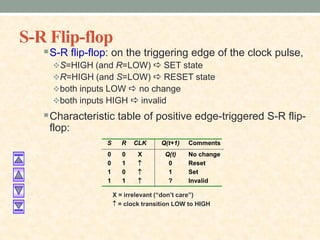
S-R flip-flop: on the triggering edge of the clock pulse,
S=HIGH (and R=LOW) a SET state
R=HIGH (and S=LOW) a RESET state
both inputs LOW a no change
both inputs HIGH a invalid
Characteristic table of positive edge-triggered S-R flip-
flop:
X = irrelevant (“don’t care”)
 = clock transition LOW to HIGH
S R CLK Q(t+1) Comments
0 0 X Q(t) No change
0 1  0 Reset
1 0  1 Set
1 1  ? Invalid
S-R Flip-flop
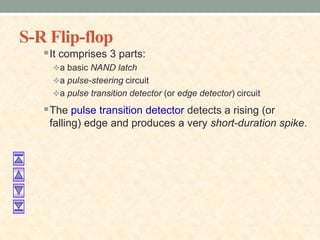
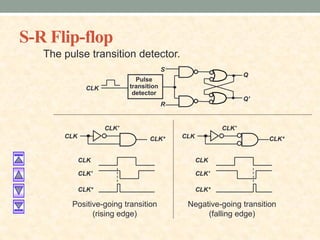
It comprises 3 parts:
a basic NAND latch
a pulse-steering circuit
a pulse transition detector (or edge detector) circuit
The pulse transition detector detects a rising (or
falling) edge and produces a very short-duration spike.
S-R Flip-flop
The pulse transition detector.
S
Q
Q'
CLK
Pulse
transition
detector
R
Positive-going transition
(rising edge)
CLK
CLK'
CLK*
CLK'
CLK
CLK*
Negative-going transition
(falling edge)
CLK'
CLK
CLK*
CLK
CLK'
CLK*
D Flip-flop
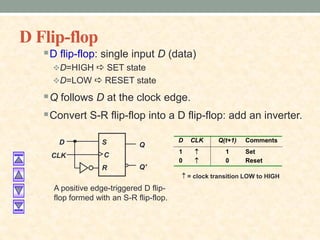
D flip-flop: single input D (data)
D=HIGH a SET state
D=LOW a RESET state
Q follows D at the clock edge.
Convert S-R flip-flop into a D flip-flop: add an inverter.
A positive edge-triggered D flip-
flop formed with an S-R flip-flop.
S
C
R
Q
Q'
CLK
D D CLK Q(t+1) Comments
1  1 Set
0  0 Reset
 = clock transition LOW to HIGH
D Flip-flop
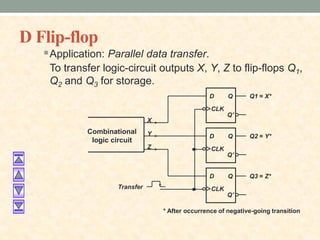
Application: Parallel data transfer.
To transfer logic-circuit outputs X, Y, Z to flip-flops Q1,
Q2 and Q3 for storage.
* After occurrence of negative-going transition
Q1 = X*
D
CLK
Q
Q'
Q2 = Y*
D
CLK
Q
Q'
Q3 = Z*
D
CLK
Q
Q'
Combinational
logic circuit
Transfer
X
Y
Z
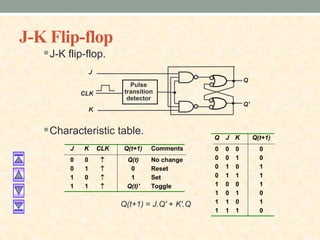
J-K Flip-flop
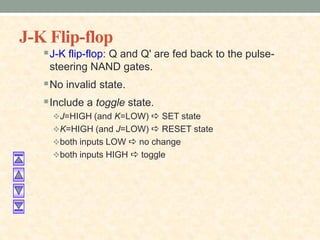
J-K flip-flop: Q and Q' are fed back to the pulse-
steering NAND gates.
No invalid state.
Include a toggle state.
J=HIGH (and K=LOW) a SET state
K=HIGH (and J=LOW) a RESET state
both inputs LOW a no change
both inputs HIGH a toggle
J-K Flip-flop
J-K flip-flop.
Characteristic table.
J
Q
Q'
CLK
Pulse
transition
detector
K
J K CLK Q(t+1) Comments
0 0  Q(t) No change
0 1  0 Reset
1 0  1 Set
1 1  Q(t)' Toggle
Q J K Q(t+1)
0 0 0 0
0 0 1 0
0 1 0 1
0 1 1 1
1 0 0 1
1 0 1 0
1 1 0 1
1 1 1 0
Q(t+1) = J.Q' + K'.Q
T Flip-flop
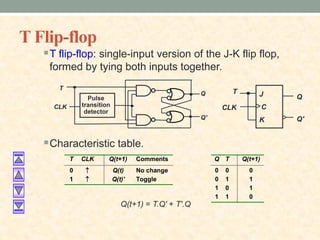
T flip-flop: single-input version of the J-K flip flop,
formed by tying both inputs together.
Characteristic table.
T CLK Q(t+1) Comments
0  Q(t) No change
1  Q(t)' Toggle
Q T Q(t+1)
0 0 0
0 1 1
1 0 1
1 1 0
Q(t+1) = T.Q' + T'.Q
T
Q
Q'
CLK
Pulse
transition
detector
J
C
K
Q
Q'
CLK
T
T Flip-flop
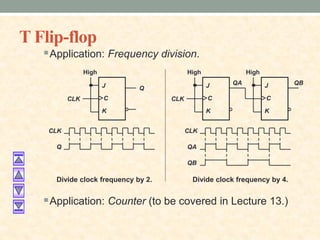
Application: Frequency division.
Application: Counter (to be covered in Lecture 13.)
J
C
K
Q
CLK
High
CLK
Q
Divide clock frequency by 2.
J
C
K
QA
CLK
High
J
C
K
QB
High
CLK
QA
QB
Divide clock frequency by 4.
Asynchronous Inputs
S-R, D and J-K inputs are synchronous inputs, as data
on these inputs are transferred to the flip-flop’s output
only on the triggered edge of the clock pulse.
Asynchronous inputs affect the state of the flip-flop
independent of the clock; example: preset (PRE) and
clear (CLR) [or direct set (SD) and direct reset (RD)]
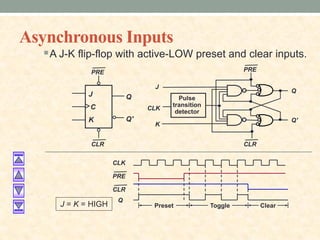
When PRE=HIGH, Q is immediately set to HIGH.
When CLR=HIGH, Q is immediately cleared to LOW.
Flip-flop in normal operation mode when both PRE
and CLR are LOW.
Asynchronous Inputs
A J-K flip-flop with active-LOW preset and clear inputs.
J
Q
Q'
CLK
Pulse
transition
detector
K
PRE
CLR
J
C
K
Q
Q'
PRE
CLR
PRE
CLR
CLK
Q
Preset Toggle Clear
J = K = HIGH
Assignment
1. Explain Flip Flops and its types.
2. Explain truth table of J-K flip flop.
3. Explain S-R flip flop with the help of circuit.
4. Differentiate between D and T flip flop.

best slides latches.pdf

  • 1.
  • 2.
    Lecture 11: SequentialLogic Latches & Flip-flops Introduction Memory Elements Pulse-Triggered Latch S-R Latch Gated S-R Latch Gated D Latch Edge-Triggered Flip-flops S-R Flip-flop D Flip-flop J-K Flip-flop T Flip-flop Asynchronous Inputs
  • 3.
    Introduction A sequential circuitconsists of a feedback path, and employs some memory elements. Combinational logic Memory elements Combinational outputs Memory outputs External inputs Sequential circuit = Combinational logic + Memory Elements
  • 4.
    Introduction There are twotypes of sequential circuits: synchronous: outputs change only at specific time asynchronous: outputs change at any time Multivibrator: a class of sequential circuits. They can be: bistable (2 stable states) monostable or one-shot (1 stable state) astable (no stable state) Bistable logic devices: latches and flip-flops. Latches and flip-flops differ in the method used for changing their state.
  • 5.
    Memory Elements Memory element:a device which can remember value indefinitely, or change value on command from its inputs. Characteristic table: Command (at time t) Q(t) Q(t+1) Set X 1 Reset X 0 0 0 Memorise / No Change 1 1 command Memory element stored value Q Q(t): current state Q(t+1) or Q+: next state
  • 6.
    Memory Elements Memory elementwith clock. Flip-flops are memory elements that change state on clock signals. Clock is usually a square wave. command Memory element stored value Q clock Positive edges Negative edges Positive pulses
  • 7.
    Memory Elements Two typesof triggering/activation: pulse-triggered edge-triggered Pulse-triggered latches ON = 1, OFF = 0 Edge-triggered flip-flops positive edge-triggered (ON = from 0 to 1; OFF = other time) negative edge-triggered (ON = from 1 to 0; OFF = other time)
  • 8.
    S-R Latch Complementary outputs:Q and Q'. When Q is HIGH, the latch is in SET state. When Q is LOW, the latch is in RESET state. For active-HIGH input S-R latch (also known as NOR gate latch), R=HIGH (and S=LOW) a RESET state S=HIGH (and R=LOW) a SET state both inputs LOW a no change both inputs HIGH a Q and Q' both LOW (invalid)!
  • 9.
    S-R Latch For active-LOWinput S'-R' latch (also known as NAND gate latch), R'=LOW (and S'=HIGH) a RESET state S'=LOW (and R'=HIGH) a SET state both inputs HIGH a no change both inputs LOW a Q and Q' both HIGH (invalid)! Drawback of S-R latch: invalid condition exists and must be avoided.
  • 10.
    S-R Latch Characteristics tablefor active-high input S-R latch: Characteristics table for active-low input S'-R' latch: S R Q Q' 0 0 NC NC No change. Latch remained in present state. 1 0 1 0 Latch SET. 0 1 0 1 Latch RESET. 1 1 0 0 Invalid condition. S' R' Q Q' 1 1 NC NC No change. Latch remained in present state. 0 1 1 0 Latch SET. 1 0 0 1 Latch RESET. 0 0 1 1 Invalid condition. S R Q Q' S R Q Q'
  • 11.
    S-R Latch Active-HIGH inputS-R latch Active-LOW input S’-R’ latch R S Q Q' S R Q Q' 1 0 1 0 initial 0 0 1 0 (afer S=1, R=0) 0 1 0 1 0 0 0 1 (after S=0, R=1) 1 1 0 0 invalid! S' R' Q Q' 1 0 0 1 initial 1 1 0 1 (afer S'=1, R'=0) 0 1 1 0 1 1 1 0 (after S'=0, R'=1) 0 0 1 1 invalid! S' R' Q Q' S' R' Q Q' 0 1 1 0 0 0 1 0 1 0 0 1 0 0 0 1 1 1 0 0
  • 12.
    Gated S-R Latch S-Rlatch + enable input (EN) and 2 NAND gates  gated S-R latch. S R Q Q' EN S EN R Q Q'
  • 13.
    Gated S-R Latch Outputschange (if necessary) only when EN is HIGH. Under what condition does the invalid state occur? Characteristic table: Q(t) S R Q(t+1) 0 0 0 0 0 0 1 0 0 1 0 1 0 1 1 indeterminate 1 0 0 1 1 0 1 0 1 1 0 1 1 1 1 indeterminate EN=1 S R Q(t+1) 0 0 Q(t) No change 0 1 0 Reset 1 0 1 Set 1 1 indeterminate Q(t+1) = S + R'.Q S.R = 0
  • 14.
    Gated D Latch MakeR input equal to S'  gated D latch. D latch eliminates the undesirable condition of invalid state in the S-R latch. D EN Q Q' D Q Q' EN
  • 15.
    Gated D Latch WhenEN is HIGH, D=HIGH  latch is SET D=LOW  latch is RESET Hence when EN is HIGH, Q ‘follows’ the D (data) input. Characteristic table: When EN=1, Q(t+1) = D EN D Q(t+1) 1 0 0 Reset 1 1 1 Set 0 X Q(t) No change
  • 16.
    Latch Circuits: NotSuitable Latch circuits are not suitable in synchronous logic circuits. When the enable signal is active, the excitation inputs are gated directly to the output Q. Thus, any change in the excitation input immediately causes a change in the latch output. The problem is solved by using a special timing control signal called a clock to restrict the times at which the states of the memory elements may change. This leads us to the edge-triggered memory elements called flip-flops.
  • 17.
    Edge-Triggered Flip-flops Flip-flops: synchronousbistable devices Output changes state at a specified point on a triggering input called the clock. Change state either at the positive edge (rising edge) or at the negative edge (falling edge) of the clock signal. Positive edges Negative edges Clock signal
  • 18.
    Edge-Triggered Flip-flops S-R, Dand J-K edge-triggered flip-flops. Note the “>” symbol at the clock input. S C R Q Q' S C R Q Q' D C Q Q' D C Q Q' J C K Q Q' J C K Q Q' Positive edge-triggered flip-flops Negative edge-triggered flip-flops
  • 19.
    S-R Flip-flop S-R flip-flop:on the triggering edge of the clock pulse, S=HIGH (and R=LOW) a SET state R=HIGH (and S=LOW) a RESET state both inputs LOW a no change both inputs HIGH a invalid Characteristic table of positive edge-triggered S-R flip- flop: X = irrelevant (“don’t care”)  = clock transition LOW to HIGH S R CLK Q(t+1) Comments 0 0 X Q(t) No change 0 1  0 Reset 1 0  1 Set 1 1  ? Invalid
  • 20.
    S-R Flip-flop It comprises3 parts: a basic NAND latch a pulse-steering circuit a pulse transition detector (or edge detector) circuit The pulse transition detector detects a rising (or falling) edge and produces a very short-duration spike.
  • 21.
    S-R Flip-flop The pulsetransition detector. S Q Q' CLK Pulse transition detector R Positive-going transition (rising edge) CLK CLK' CLK* CLK' CLK CLK* Negative-going transition (falling edge) CLK' CLK CLK* CLK CLK' CLK*
  • 22.
    D Flip-flop D flip-flop:single input D (data) D=HIGH a SET state D=LOW a RESET state Q follows D at the clock edge. Convert S-R flip-flop into a D flip-flop: add an inverter. A positive edge-triggered D flip- flop formed with an S-R flip-flop. S C R Q Q' CLK D D CLK Q(t+1) Comments 1  1 Set 0  0 Reset  = clock transition LOW to HIGH
  • 23.
    D Flip-flop Application: Paralleldata transfer. To transfer logic-circuit outputs X, Y, Z to flip-flops Q1, Q2 and Q3 for storage. * After occurrence of negative-going transition Q1 = X* D CLK Q Q' Q2 = Y* D CLK Q Q' Q3 = Z* D CLK Q Q' Combinational logic circuit Transfer X Y Z
  • 24.
    J-K Flip-flop J-K flip-flop:Q and Q' are fed back to the pulse- steering NAND gates. No invalid state. Include a toggle state. J=HIGH (and K=LOW) a SET state K=HIGH (and J=LOW) a RESET state both inputs LOW a no change both inputs HIGH a toggle
  • 25.
    J-K Flip-flop J-K flip-flop. Characteristictable. J Q Q' CLK Pulse transition detector K J K CLK Q(t+1) Comments 0 0  Q(t) No change 0 1  0 Reset 1 0  1 Set 1 1  Q(t)' Toggle Q J K Q(t+1) 0 0 0 0 0 0 1 0 0 1 0 1 0 1 1 1 1 0 0 1 1 0 1 0 1 1 0 1 1 1 1 0 Q(t+1) = J.Q' + K'.Q
  • 26.
    T Flip-flop T flip-flop:single-input version of the J-K flip flop, formed by tying both inputs together. Characteristic table. T CLK Q(t+1) Comments 0  Q(t) No change 1  Q(t)' Toggle Q T Q(t+1) 0 0 0 0 1 1 1 0 1 1 1 0 Q(t+1) = T.Q' + T'.Q T Q Q' CLK Pulse transition detector J C K Q Q' CLK T
  • 27.
    T Flip-flop Application: Frequencydivision. Application: Counter (to be covered in Lecture 13.) J C K Q CLK High CLK Q Divide clock frequency by 2. J C K QA CLK High J C K QB High CLK QA QB Divide clock frequency by 4.
  • 28.
    Asynchronous Inputs S-R, Dand J-K inputs are synchronous inputs, as data on these inputs are transferred to the flip-flop’s output only on the triggered edge of the clock pulse. Asynchronous inputs affect the state of the flip-flop independent of the clock; example: preset (PRE) and clear (CLR) [or direct set (SD) and direct reset (RD)] When PRE=HIGH, Q is immediately set to HIGH. When CLR=HIGH, Q is immediately cleared to LOW. Flip-flop in normal operation mode when both PRE and CLR are LOW.
  • 29.
    Asynchronous Inputs A J-Kflip-flop with active-LOW preset and clear inputs. J Q Q' CLK Pulse transition detector K PRE CLR J C K Q Q' PRE CLR PRE CLR CLK Q Preset Toggle Clear J = K = HIGH
  • 30.
    Assignment 1. Explain FlipFlops and its types. 2. Explain truth table of J-K flip flop. 3. Explain S-R flip flop with the help of circuit. 4. Differentiate between D and T flip flop.