SEQUENTIAL 
CIRCUITS 
12/11/2014 
1
COMBINATIONAL CIRCUITS 
 Combinational Circuits are made of logic gates. 
 Doesn’t contain memory element , that’s why they cant 
store any information. 
 Value of present output is determined by latest input. 
 Examples of combinational circuits are half adders, full 
adders, sub tractors etc. 
12/11/2014 
2
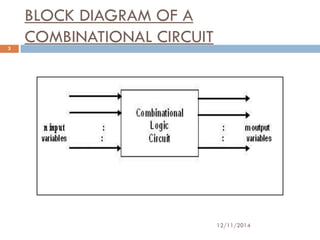
BLOCK DIAGRAM OF A 
COMBINATIONAL CIRCUIT 
12/11/2014 
3
SEQUENTIAL LOGIC CIRCUITS 
 Made up of combinational circuits and memory 
elements. 
 These memory elements are devices capable of 
storing ONE-BIT information. 
 Output depend on latest input and previous state. 
 Examples of sequential circuits are flip flops, 
counters, shift registers 
12/11/2014 
4
BLOCK DIAGRAM OF A SEQUENTIAL 
CIRCUIT 
12/11/2014 
5
TYPES OF SEQUENTIAL CIRCUITS 
Sequential circuits are of two types: 
1.SYNCHRONOUS CIRCUITS: 
 In synchronous sequential circuits, the state of the 
device changes only at discrete times in response to 
a clock Pulse. 
2.ASYNCHRONOUS CIRCUITS: 
 Asynchronous circuit is not synchronized by a 
clock signal; the outputs of the circuit change 
directly in response to changes in Inputs. 
12/11/2014 
6
inputs X outputs Z 
present state next state 
12/11/2014 
7 
Synchronous Sequential Circuits 
Combinational 
Circuits 
Flip-Flops 
clock 
Memory 
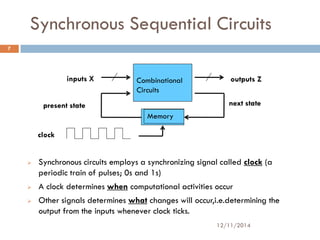
 Synchronous circuits employs a synchronizing signal called clock (a 
periodic train of pulses; 0s and 1s) 
 A clock determines when computational activities occur 
 Other signals determines what changes will occur,i.e.determining the 
output from the inputs whenever clock ticks.
SYNCHORONOUS CIRCUITS:- 
inputs X outputs Z 
present state next state 
12/11/2014 
8 
Combinational 
Circuits 
Flip-Flops 
clock 
 The storage elements (memory) used in clocked sequential circuits are 
called flip-flops 
 Each flip-flop can store one bit of information 0,1 
 A circuit may use many flip-flops; together they define the circuit state 
 Flip-Flops (memory/state) update only with the clock
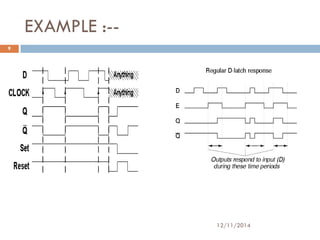
EXAMPLE :-- 
12/11/2014 
9
inputs X outputs Z 
Example 
D Q 
12/11/2014 
10 
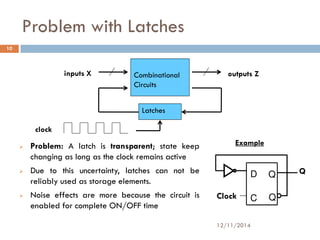
Problem with Latches 
 Problem: A latch is transparent; state keep 
changing as long as the clock remains active 
 Due to this uncertainty, latches can not be 
reliably used as storage elements. 
 Noise effects are more because the circuit is 
enabled for complete ON/OFF time 
C 
Q 
Q 
Clock 
Combinational 
Circuits 
Latches 
clock
SEQUENTIAL CIRCUITS… 
12/11/2014 
11 
bistable (2 stable states are stable)..... 
Bistable logic devices: latches (level) and flip-flops (edge). 
Latches and flip-flops differ in the method used for changing 
their state. 
Latches are useful in asynchronous sequential circuits 
Flip-Flips are built with latches
Difference between flip flop and latch 
 Flip flop and latch are two basic building blocks of 
sequentional circuit but there is suitable difference 
between the two is; 
 A flip flop continuously checks its inputs and 
corresponding changes its output only at times 
determined by clocking the signal. 
 Where as latch is a device which continuously checks 
all its inputs and correspondingly changes its output, 
independent of time determined by clocking signal. 
12/11/2014 
12
Difference between flip flop and latch 
12/11/2014 
13 
A unique signal called “enable” is provided 
with latch. 
The output changes only when enable signal is 
active. 
No change in output take place when the 
enable signal is inactive. 
Flip flop are edge trigger, while latches are 
level trigger.
FLIPFLOPS :-- 
12/11/2014 
14 
 What is Flip flop? 
Answer: 
 In digital circuits, the flip-flop, is a kind 
of bistable multivibrator. 
 It is a Sequential Circuits / an electronic circuit which 
has two stable states and thereby is capable of 
serving as one bit of memory , bit 1 or bit 0.
CHARECTERSTICS OF FLIPFLOP… 
12/11/2014 
15 
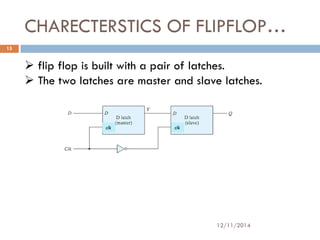
 flip flop is built with a pair of latches. 
 The two latches are master and slave latches. 
clk clk
CHARECTERSTICS ….(CONT’D) 
12/11/2014 
16 
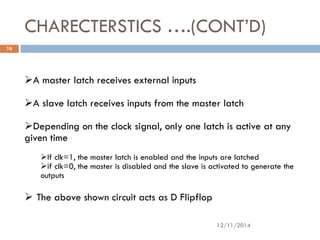
A master latch receives external inputs 
A slave latch receives inputs from the master latch 
Depending on the clock signal, only one latch is active at any 
given time 
If clk=1, the master latch is enabled and the inputs are latched 
if clk=0, the master is disabled and the slave is activated to generate the 
outputs 
 The above shown circuit acts as D Flipflop
CHARECTERSTICS….(CONTD) 
level 
positive (rising) edge negative (falling) edge 
12/11/2014 
17 
Active only at transitions; i.e. either from 0  1 or 1  0 
flip flop is one bit storage element. 
 flip flops are edge sensitive.
GRAPHIC SYMBOL OF FLIPFLOP 
12/11/2014 
18 
 A Flip Flop is designated by a rectangular block with inputs on 
the left and outputs on the right (similar to latches) 
 The clock is designated with an arrowhead 
 A bubble designates a negative-edge triggered flip flops
CHARECTERSTICS …(CONT’D) 
12/11/2014 
19 
ASYNCHRONOUS INPUTS:-- 
Some flip-flops have asynchronous inputs to set/reset 
their states independently of the clock. 
Preset or direct set, sets the flip-flop to 1 
Clear or direct reset, set the flip-flop to 0 
When power is turned on, a flip-flop state is unknown; 
Direct inputs are useful to put in a known state
METASTABILITY:-- 
12/11/2014 
20 
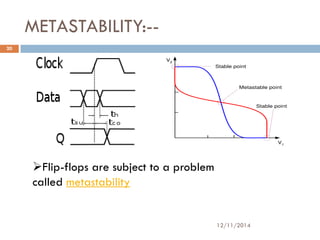
Flip-flops are subject to a problem 
called metastability 
V1 
V2 
Stable point 
Metastable point 
Stable point
METASTABILITY:- 
12/11/2014 
21 
metastability condition is occurred because by violating 
setup and hold time violation. 
Due to metastability state corruption of data will be 
occur. 
Setup time is the minimum amount of time the data signal should 
be held steady before the clock event so that the data are 
reliably sampled by the clock. This applies to synchronous input 
signals to the flip-flop. 
Hold time is the minimum amount of time the data signal should 
be held steady after the clock event so that the data are reliably 
sampled. This applies to synchronous input signals to the 
flip-flop.
CHARECTERSTIC TABLE OF FLIPFLOP :-- 
12/11/2014 
22
12/11/2014 
23

Sequential circuits in digital logic design

  • 1.
  • 2.
    COMBINATIONAL CIRCUITS Combinational Circuits are made of logic gates.  Doesn’t contain memory element , that’s why they cant store any information.  Value of present output is determined by latest input.  Examples of combinational circuits are half adders, full adders, sub tractors etc. 12/11/2014 2
  • 3.
    BLOCK DIAGRAM OFA COMBINATIONAL CIRCUIT 12/11/2014 3
  • 4.
    SEQUENTIAL LOGIC CIRCUITS  Made up of combinational circuits and memory elements.  These memory elements are devices capable of storing ONE-BIT information.  Output depend on latest input and previous state.  Examples of sequential circuits are flip flops, counters, shift registers 12/11/2014 4
  • 5.
    BLOCK DIAGRAM OFA SEQUENTIAL CIRCUIT 12/11/2014 5
  • 6.
    TYPES OF SEQUENTIALCIRCUITS Sequential circuits are of two types: 1.SYNCHRONOUS CIRCUITS:  In synchronous sequential circuits, the state of the device changes only at discrete times in response to a clock Pulse. 2.ASYNCHRONOUS CIRCUITS:  Asynchronous circuit is not synchronized by a clock signal; the outputs of the circuit change directly in response to changes in Inputs. 12/11/2014 6
  • 7.
    inputs X outputsZ present state next state 12/11/2014 7 Synchronous Sequential Circuits Combinational Circuits Flip-Flops clock Memory  Synchronous circuits employs a synchronizing signal called clock (a periodic train of pulses; 0s and 1s)  A clock determines when computational activities occur  Other signals determines what changes will occur,i.e.determining the output from the inputs whenever clock ticks.
  • 8.
    SYNCHORONOUS CIRCUITS:- inputsX outputs Z present state next state 12/11/2014 8 Combinational Circuits Flip-Flops clock  The storage elements (memory) used in clocked sequential circuits are called flip-flops  Each flip-flop can store one bit of information 0,1  A circuit may use many flip-flops; together they define the circuit state  Flip-Flops (memory/state) update only with the clock
  • 9.
  • 10.
    inputs X outputsZ Example D Q 12/11/2014 10 Problem with Latches  Problem: A latch is transparent; state keep changing as long as the clock remains active  Due to this uncertainty, latches can not be reliably used as storage elements.  Noise effects are more because the circuit is enabled for complete ON/OFF time C Q Q Clock Combinational Circuits Latches clock
  • 11.
    SEQUENTIAL CIRCUITS… 12/11/2014 11 bistable (2 stable states are stable)..... Bistable logic devices: latches (level) and flip-flops (edge). Latches and flip-flops differ in the method used for changing their state. Latches are useful in asynchronous sequential circuits Flip-Flips are built with latches
  • 12.
    Difference between flipflop and latch  Flip flop and latch are two basic building blocks of sequentional circuit but there is suitable difference between the two is;  A flip flop continuously checks its inputs and corresponding changes its output only at times determined by clocking the signal.  Where as latch is a device which continuously checks all its inputs and correspondingly changes its output, independent of time determined by clocking signal. 12/11/2014 12
  • 13.
    Difference between flipflop and latch 12/11/2014 13 A unique signal called “enable” is provided with latch. The output changes only when enable signal is active. No change in output take place when the enable signal is inactive. Flip flop are edge trigger, while latches are level trigger.
  • 14.
    FLIPFLOPS :-- 12/11/2014 14  What is Flip flop? Answer:  In digital circuits, the flip-flop, is a kind of bistable multivibrator.  It is a Sequential Circuits / an electronic circuit which has two stable states and thereby is capable of serving as one bit of memory , bit 1 or bit 0.
  • 15.
    CHARECTERSTICS OF FLIPFLOP… 12/11/2014 15  flip flop is built with a pair of latches.  The two latches are master and slave latches. clk clk
  • 16.
    CHARECTERSTICS ….(CONT’D) 12/11/2014 16 A master latch receives external inputs A slave latch receives inputs from the master latch Depending on the clock signal, only one latch is active at any given time If clk=1, the master latch is enabled and the inputs are latched if clk=0, the master is disabled and the slave is activated to generate the outputs  The above shown circuit acts as D Flipflop
  • 17.
    CHARECTERSTICS….(CONTD) level positive(rising) edge negative (falling) edge 12/11/2014 17 Active only at transitions; i.e. either from 0  1 or 1  0 flip flop is one bit storage element.  flip flops are edge sensitive.
  • 18.
    GRAPHIC SYMBOL OFFLIPFLOP 12/11/2014 18  A Flip Flop is designated by a rectangular block with inputs on the left and outputs on the right (similar to latches)  The clock is designated with an arrowhead  A bubble designates a negative-edge triggered flip flops
  • 19.
    CHARECTERSTICS …(CONT’D) 12/11/2014 19 ASYNCHRONOUS INPUTS:-- Some flip-flops have asynchronous inputs to set/reset their states independently of the clock. Preset or direct set, sets the flip-flop to 1 Clear or direct reset, set the flip-flop to 0 When power is turned on, a flip-flop state is unknown; Direct inputs are useful to put in a known state
  • 20.
    METASTABILITY:-- 12/11/2014 20 Flip-flops are subject to a problem called metastability V1 V2 Stable point Metastable point Stable point
  • 21.
    METASTABILITY:- 12/11/2014 21 metastability condition is occurred because by violating setup and hold time violation. Due to metastability state corruption of data will be occur. Setup time is the minimum amount of time the data signal should be held steady before the clock event so that the data are reliably sampled by the clock. This applies to synchronous input signals to the flip-flop. Hold time is the minimum amount of time the data signal should be held steady after the clock event so that the data are reliably sampled. This applies to synchronous input signals to the flip-flop.
  • 22.
    CHARECTERSTIC TABLE OFFLIPFLOP :-- 12/11/2014 22
  • 23.