MOHD. YAMANI IDRIS/ NOORZAILY MOHAMED NOOR 1
Sequential Circuit
Latch & Flip-flop
MOHD. YAMANI IDRIS/ NOORZAILY MOHAMED NOOR 2
Contents
 Introduction
 Memory Element
 Latch
 SR latch
 D latch
 Flip-flop
 SR flip-flop
 D flip-flop
 JK flip-flop
 T flip-flop
MOHD. YAMANI IDRIS/ NOORZAILY MOHAMED NOOR 3
Introduction
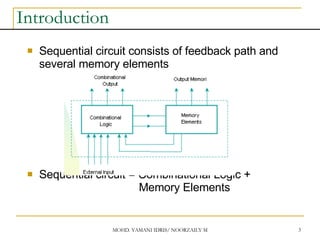
 Sequential circuit consists of feedback path and
several memory elements
 Sequential circuit = Combinational Logic +
Memory Elements
MOHD. YAMANI IDRIS/ NOORZAILY MOHAMED NOOR 4
Introduction
 There are two types of sequential circuit
 Synchronous – output change at certain time
 Asynchronous – output change any time
 Multivibrator – sequential circuit category – can
be
 Bistable – consist of two stable condition
 Monostable – consist of one stable condition
 Astable - no stable condition
 Bistable logic device is latch and flip-flop
 Latch and flip-flop differ by the method used to
change stable condition
MOHD. YAMANI IDRIS/ NOORZAILY MOHAMED NOOR 5
Memory Element
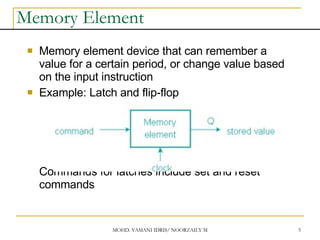
 Memory element device that can remember a
value for a certain period, or change value based
on the input instruction
 Example: Latch and flip-flop
Commands for latches include set and reset
commands
MOHD. YAMANI IDRIS/ NOORZAILY MOHAMED NOOR 6
Memory Element
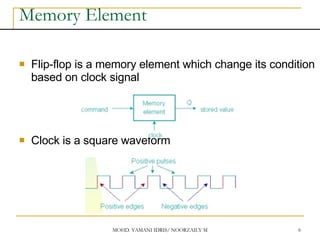
 Flip-flop is a memory element which change its condition
based on clock signal
 Clock is a square waveform
MOHD. YAMANI IDRIS/ NOORZAILY MOHAMED NOOR 7
Memory Element
 There are two types of trigger/activator
 Pulse triggered
 Edge triggered
 Pulse triggered
 Latch
 ON=1, OFF=0
 Edge triggered
 Flip-flop
 Positive edge triggered (ON=when 0 to 1, OFF=other time)
 Negative edge triggered (ON=when 1 to 0, OFF=other time)
MOHD. YAMANI IDRIS/ NOORZAILY MOHAMED NOOR 8
SR Latch
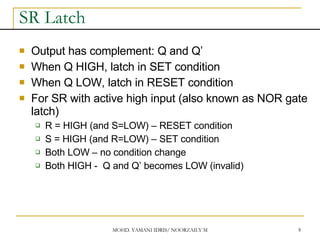
 Output has complement: Q and Q’
 When Q HIGH, latch in SET condition
 When Q LOW, latch in RESET condition
 For SR with active high input (also known as NOR gate
latch)
 R = HIGH (and S=LOW) – RESET condition
 S = HIGH (and R=LOW) – SET condition
 Both LOW – no condition change
 Both HIGH - Q and Q’ becomes LOW (invalid)
MOHD. YAMANI IDRIS/ NOORZAILY MOHAMED NOOR 9
SR Latch
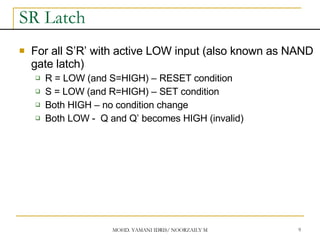
 For all S’R’ with active LOW input (also known as NAND
gate latch)
 R = LOW (and S=HIGH) – RESET condition
 S = LOW (and R=HIGH) – SET condition
 Both HIGH – no condition change
 Both LOW - Q and Q’ becomes HIGH (invalid)
MOHD. YAMANI IDRIS/ NOORZAILY MOHAMED NOOR 10
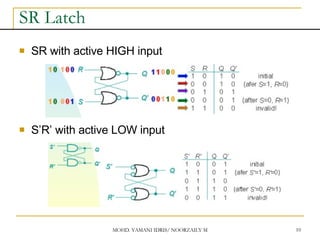
SR Latch
 SR with active HIGH input
 S’R’ with active LOW input
MOHD. YAMANI IDRIS/ NOORZAILY MOHAMED NOOR 11
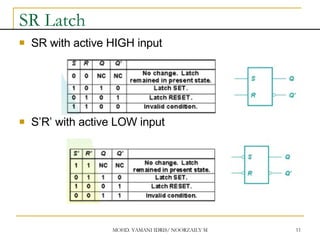
SR Latch
 SR with active HIGH input
 S’R’ with active LOW input
MOHD. YAMANI IDRIS/ NOORZAILY MOHAMED NOOR 12
SR Latch with Gate
 SR latch + enable (EN) input amd 2 NAND gate -
SR Latch with Gate
MOHD. YAMANI IDRIS/ NOORZAILY MOHAMED NOOR 13
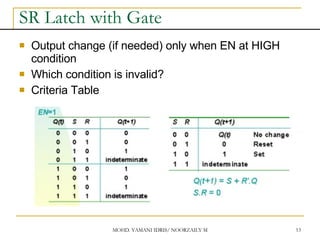
SR Latch with Gate
 Output change (if needed) only when EN at HIGH
condition
 Which condition is invalid?
 Criteria Table
MOHD. YAMANI IDRIS/ NOORZAILY MOHAMED NOOR 14
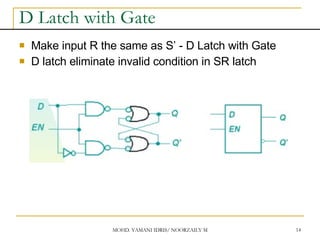
D Latch with Gate
 Make input R the same as S’ - D Latch with Gate
 D latch eliminate invalid condition in SR latch
MOHD. YAMANI IDRIS/ NOORZAILY MOHAMED NOOR 15
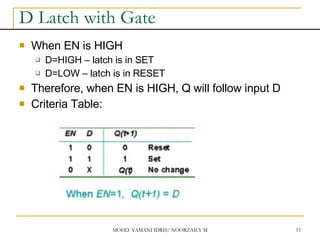
D Latch with Gate
 When EN is HIGH
 D=HIGH – latch is in SET
 D=LOW – latch is in RESET
 Therefore, when EN is HIGH, Q will follow input D
 Criteria Table:
MOHD. YAMANI IDRIS/ NOORZAILY MOHAMED NOOR 16
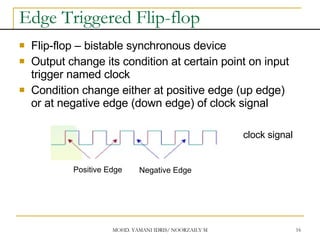
Edge Triggered Flip-flop
 Flip-flop – bistable synchronous device
 Output change its condition at certain point on input
trigger named clock
 Condition change either at positive edge (up edge)
or at negative edge (down edge) of clock signal
clock signal
Positive Edge Negative Edge
MOHD. YAMANI IDRIS/ NOORZAILY MOHAMED NOOR 17
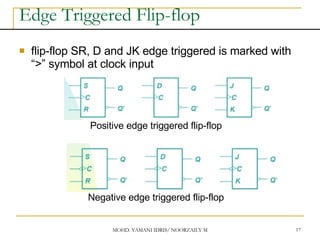
Edge Triggered Flip-flop
 flip-flop SR, D and JK edge triggered is marked with
“>” symbol at clock input
Positive edge triggered flip-flop
Negative edge triggered flip-flop
MOHD. YAMANI IDRIS/ NOORZAILY MOHAMED NOOR 18
SR Flip-flop
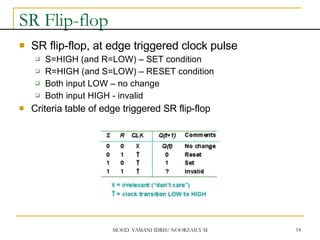
 SR flip-flop, at edge triggered clock pulse
 S=HIGH (and R=LOW) – SET condition
 R=HIGH (and S=LOW) – RESET condition
 Both input LOW – no change
 Both input HIGH - invalid
 Criteria table of edge triggered SR flip-flop
MOHD. YAMANI IDRIS/ NOORZAILY MOHAMED NOOR 19
SR Flip-flop
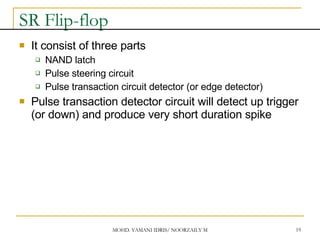
 It consist of three parts
 NAND latch
 Pulse steering circuit
 Pulse transaction circuit detector (or edge detector)
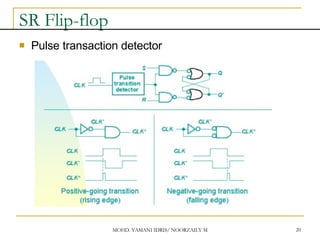
 Pulse transaction detector circuit will detect up trigger
(or down) and produce very short duration spike
MOHD. YAMANI IDRIS/ NOORZAILY MOHAMED NOOR 20
SR Flip-flop
 Pulse transaction detector
MOHD. YAMANI IDRIS/ NOORZAILY MOHAMED NOOR 21
D Flip-flop
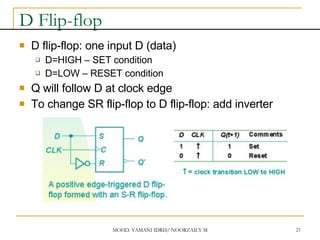
 D flip-flop: one input D (data)
 D=HIGH – SET condition
 D=LOW – RESET condition
 Q will follow D at clock edge
 To change SR flip-flop to D flip-flop: add inverter
MOHD. YAMANI IDRIS/ NOORZAILY MOHAMED NOOR 22
D Flip-flop
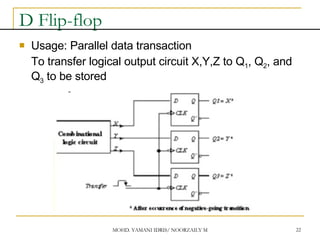
 Usage: Parallel data transaction
To transfer logical output circuit X,Y,Z to Q1, Q2, and
Q3 to be stored
MOHD. YAMANI IDRIS/ NOORZAILY MOHAMED NOOR 23
JK Flip-flop
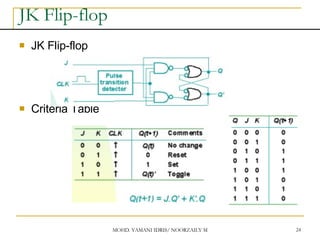
 There is no invalid condition
 There is toggle condition
 J=HIGH (and K=LOW) – SET condition
 K=HIGH (and J=LOW) – RESET condition
 Both input LOW – no change
 Both input HIGH – “toggle”
MOHD. YAMANI IDRIS/ NOORZAILY MOHAMED NOOR 24
JK Flip-flop
 JK Flip-flop
 Criteria Table
MOHD. YAMANI IDRIS/ NOORZAILY MOHAMED NOOR 25
T Flip-flop
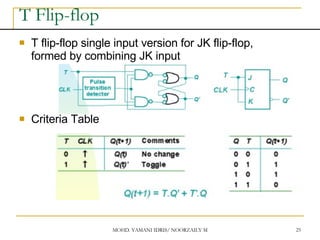
 T flip-flop single input version for JK flip-flop,
formed by combining JK input
 Criteria Table
MOHD. YAMANI IDRIS/ NOORZAILY MOHAMED NOOR 26
T Flip-flop
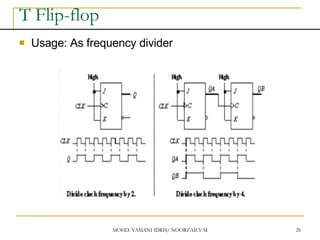
 Usage: As frequency divider
MOHD. YAMANI IDRIS/ NOORZAILY MOHAMED NOOR 27
Asynchronous Input
 SR input, D and JK is synchronous input. Where
data from input will be transferred to flip-flop
output only when edge triggered of clock pulse
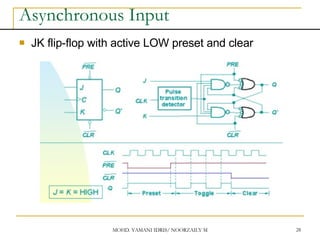
 Asynchronous Input free change condition from
pulse clock. Example: preset (PRE) and clear
(CLR) [or direct set (SD) and direct reset (RD)]
 When PRE=HIGH, Q immediately HIGH
 When CLR=HIGH, Q immediately LOW
 Flip flop function as normal when both PRE and
CLR is LOW
MOHD. YAMANI IDRIS/ NOORZAILY MOHAMED NOOR 28
Asynchronous Input
 JK flip-flop with active LOW preset and clear
MOHD. YAMANI IDRIS/ NOORZAILY MOHAMED NOOR 29
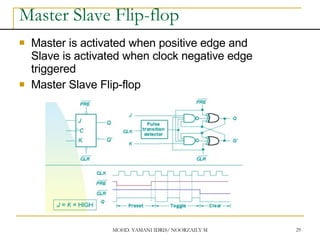
Master Slave Flip-flop
 Master is activated when positive edge and
Slave is activated when clock negative edge
triggered
 Master Slave Flip-flop

sequential circuits PPT.pdf

  • 1.
    MOHD. YAMANI IDRIS/NOORZAILY MOHAMED NOOR 1 Sequential Circuit Latch & Flip-flop
  • 2.
    MOHD. YAMANI IDRIS/NOORZAILY MOHAMED NOOR 2 Contents  Introduction  Memory Element  Latch  SR latch  D latch  Flip-flop  SR flip-flop  D flip-flop  JK flip-flop  T flip-flop
  • 3.
    MOHD. YAMANI IDRIS/NOORZAILY MOHAMED NOOR 3 Introduction  Sequential circuit consists of feedback path and several memory elements  Sequential circuit = Combinational Logic + Memory Elements
  • 4.
    MOHD. YAMANI IDRIS/NOORZAILY MOHAMED NOOR 4 Introduction  There are two types of sequential circuit  Synchronous – output change at certain time  Asynchronous – output change any time  Multivibrator – sequential circuit category – can be  Bistable – consist of two stable condition  Monostable – consist of one stable condition  Astable - no stable condition  Bistable logic device is latch and flip-flop  Latch and flip-flop differ by the method used to change stable condition
  • 5.
    MOHD. YAMANI IDRIS/NOORZAILY MOHAMED NOOR 5 Memory Element  Memory element device that can remember a value for a certain period, or change value based on the input instruction  Example: Latch and flip-flop Commands for latches include set and reset commands
  • 6.
    MOHD. YAMANI IDRIS/NOORZAILY MOHAMED NOOR 6 Memory Element  Flip-flop is a memory element which change its condition based on clock signal  Clock is a square waveform
  • 7.
    MOHD. YAMANI IDRIS/NOORZAILY MOHAMED NOOR 7 Memory Element  There are two types of trigger/activator  Pulse triggered  Edge triggered  Pulse triggered  Latch  ON=1, OFF=0  Edge triggered  Flip-flop  Positive edge triggered (ON=when 0 to 1, OFF=other time)  Negative edge triggered (ON=when 1 to 0, OFF=other time)
  • 8.
    MOHD. YAMANI IDRIS/NOORZAILY MOHAMED NOOR 8 SR Latch  Output has complement: Q and Q’  When Q HIGH, latch in SET condition  When Q LOW, latch in RESET condition  For SR with active high input (also known as NOR gate latch)  R = HIGH (and S=LOW) – RESET condition  S = HIGH (and R=LOW) – SET condition  Both LOW – no condition change  Both HIGH - Q and Q’ becomes LOW (invalid)
  • 9.
    MOHD. YAMANI IDRIS/NOORZAILY MOHAMED NOOR 9 SR Latch  For all S’R’ with active LOW input (also known as NAND gate latch)  R = LOW (and S=HIGH) – RESET condition  S = LOW (and R=HIGH) – SET condition  Both HIGH – no condition change  Both LOW - Q and Q’ becomes HIGH (invalid)
  • 10.
    MOHD. YAMANI IDRIS/NOORZAILY MOHAMED NOOR 10 SR Latch  SR with active HIGH input  S’R’ with active LOW input
  • 11.
    MOHD. YAMANI IDRIS/NOORZAILY MOHAMED NOOR 11 SR Latch  SR with active HIGH input  S’R’ with active LOW input
  • 12.
    MOHD. YAMANI IDRIS/NOORZAILY MOHAMED NOOR 12 SR Latch with Gate  SR latch + enable (EN) input amd 2 NAND gate - SR Latch with Gate
  • 13.
    MOHD. YAMANI IDRIS/NOORZAILY MOHAMED NOOR 13 SR Latch with Gate  Output change (if needed) only when EN at HIGH condition  Which condition is invalid?  Criteria Table
  • 14.
    MOHD. YAMANI IDRIS/NOORZAILY MOHAMED NOOR 14 D Latch with Gate  Make input R the same as S’ - D Latch with Gate  D latch eliminate invalid condition in SR latch
  • 15.
    MOHD. YAMANI IDRIS/NOORZAILY MOHAMED NOOR 15 D Latch with Gate  When EN is HIGH  D=HIGH – latch is in SET  D=LOW – latch is in RESET  Therefore, when EN is HIGH, Q will follow input D  Criteria Table:
  • 16.
    MOHD. YAMANI IDRIS/NOORZAILY MOHAMED NOOR 16 Edge Triggered Flip-flop  Flip-flop – bistable synchronous device  Output change its condition at certain point on input trigger named clock  Condition change either at positive edge (up edge) or at negative edge (down edge) of clock signal clock signal Positive Edge Negative Edge
  • 17.
    MOHD. YAMANI IDRIS/NOORZAILY MOHAMED NOOR 17 Edge Triggered Flip-flop  flip-flop SR, D and JK edge triggered is marked with “>” symbol at clock input Positive edge triggered flip-flop Negative edge triggered flip-flop
  • 18.
    MOHD. YAMANI IDRIS/NOORZAILY MOHAMED NOOR 18 SR Flip-flop  SR flip-flop, at edge triggered clock pulse  S=HIGH (and R=LOW) – SET condition  R=HIGH (and S=LOW) – RESET condition  Both input LOW – no change  Both input HIGH - invalid  Criteria table of edge triggered SR flip-flop
  • 19.
    MOHD. YAMANI IDRIS/NOORZAILY MOHAMED NOOR 19 SR Flip-flop  It consist of three parts  NAND latch  Pulse steering circuit  Pulse transaction circuit detector (or edge detector)  Pulse transaction detector circuit will detect up trigger (or down) and produce very short duration spike
  • 20.
    MOHD. YAMANI IDRIS/NOORZAILY MOHAMED NOOR 20 SR Flip-flop  Pulse transaction detector
  • 21.
    MOHD. YAMANI IDRIS/NOORZAILY MOHAMED NOOR 21 D Flip-flop  D flip-flop: one input D (data)  D=HIGH – SET condition  D=LOW – RESET condition  Q will follow D at clock edge  To change SR flip-flop to D flip-flop: add inverter
  • 22.
    MOHD. YAMANI IDRIS/NOORZAILY MOHAMED NOOR 22 D Flip-flop  Usage: Parallel data transaction To transfer logical output circuit X,Y,Z to Q1, Q2, and Q3 to be stored
  • 23.
    MOHD. YAMANI IDRIS/NOORZAILY MOHAMED NOOR 23 JK Flip-flop  There is no invalid condition  There is toggle condition  J=HIGH (and K=LOW) – SET condition  K=HIGH (and J=LOW) – RESET condition  Both input LOW – no change  Both input HIGH – “toggle”
  • 24.
    MOHD. YAMANI IDRIS/NOORZAILY MOHAMED NOOR 24 JK Flip-flop  JK Flip-flop  Criteria Table
  • 25.
    MOHD. YAMANI IDRIS/NOORZAILY MOHAMED NOOR 25 T Flip-flop  T flip-flop single input version for JK flip-flop, formed by combining JK input  Criteria Table
  • 26.
    MOHD. YAMANI IDRIS/NOORZAILY MOHAMED NOOR 26 T Flip-flop  Usage: As frequency divider
  • 27.
    MOHD. YAMANI IDRIS/NOORZAILY MOHAMED NOOR 27 Asynchronous Input  SR input, D and JK is synchronous input. Where data from input will be transferred to flip-flop output only when edge triggered of clock pulse  Asynchronous Input free change condition from pulse clock. Example: preset (PRE) and clear (CLR) [or direct set (SD) and direct reset (RD)]  When PRE=HIGH, Q immediately HIGH  When CLR=HIGH, Q immediately LOW  Flip flop function as normal when both PRE and CLR is LOW
  • 28.
    MOHD. YAMANI IDRIS/NOORZAILY MOHAMED NOOR 28 Asynchronous Input  JK flip-flop with active LOW preset and clear
  • 29.
    MOHD. YAMANI IDRIS/NOORZAILY MOHAMED NOOR 29 Master Slave Flip-flop  Master is activated when positive edge and Slave is activated when clock negative edge triggered  Master Slave Flip-flop