ASIC DESIGN FLOW
Submitted To:- Submitted By:-
Manju K. Chattopadhyay Purvi Medawala
14MTES11
TABLE OF CONTENTS
 Introduction
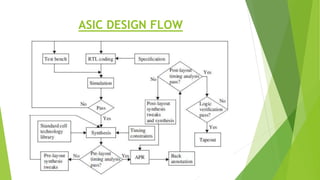
 ASIC Design Flow
 Specification
 RTL Coding
 Test Bench & Simulation
 Synthesis
 Pre-layout Timing Analysis
 APR
 Back Annotation
 Post-layout Timing Analysis
 Logic Verification
 Tapeout
What is ASIC ?
 Application Specific
Integrated Circuit
 Build by connecting
existing circuit blocks in
new ways
 High speed, Lesser area &
power consumption, more
time to market
ASIC DESIGN FLOW
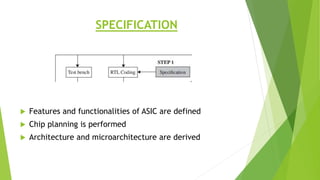
SPECIFICATION
 Features and functionalities of ASIC are defined
 Chip planning is performed
 Architecture and microarchitecture are derived
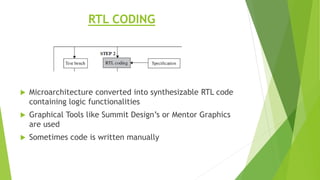
RTL CODING
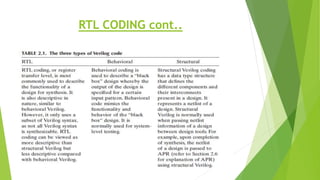
 Microarchitecture converted into synthesizable RTL code
containing logic functionalities
 Graphical Tools like Summit Design’s or Mentor Graphics
are used
 Sometimes code is written manually
RTL CODING cont..
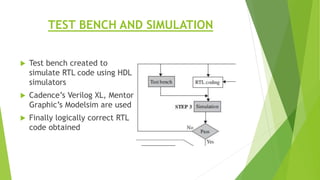
TEST BENCH AND SIMULATION
 Test bench created to
simulate RTL code using HDL
simulators
 Cadence’s Verilog XL, Mentor
Graphic’s Modelsim are used
 Finally logically correct RTL
code obtained
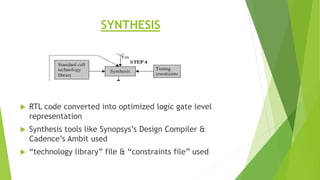
SYNTHESIS
 RTL code converted into optimized logic gate level
representation
 Synthesis tools like Synopsys’s Design Compiler &
Cadence’s Ambit used
 “technology library” file & “constraints file” used
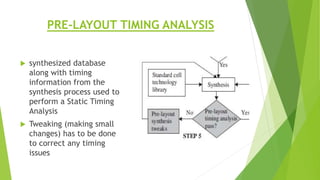
PRE-LAYOUT TIMING ANALYSIS
 synthesized database
along with timing
information from the
synthesis process used to
perform a Static Timing
Analysis
 Tweaking (making small
changes) has to be done
to correct any timing
issues
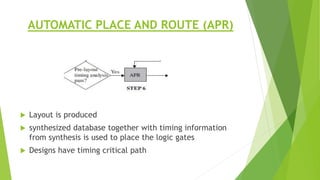
AUTOMATIC PLACE AND ROUTE (APR)
 Layout is produced
 synthesized database together with timing information
from synthesis is used to place the logic gates
 Designs have timing critical path
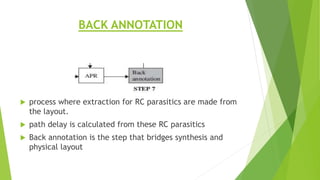
BACK ANNOTATION
 process where extraction for RC parasitics are made from
the layout.
 path delay is calculated from these RC parasitics
 Back annotation is the step that bridges synthesis and
physical layout
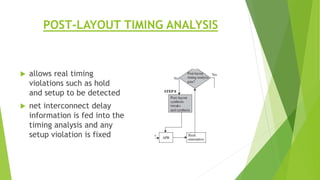
POST-LAYOUT TIMING ANALYSIS
 allows real timing
violations such as hold
and setup to be detected
 net interconnect delay
information is fed into the
timing analysis and any
setup violation is fixed
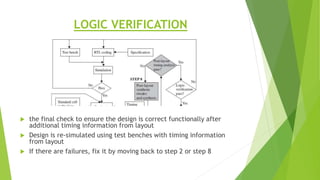
LOGIC VERIFICATION
 the final check to ensure the design is correct functionally after
additional timing information from layout
 Design is re-simulated using test benches with timing information
from layout
 If there are failures, fix it by moving back to step 2 or step 8
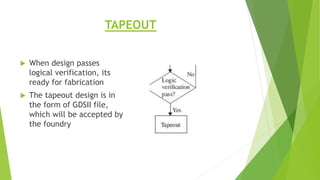
TAPEOUT
 When design passes
logical verification, its
ready for fabrication
 The tapeout design is in
the form of GDSII file,
which will be accepted by
the foundry
REFRENCES
 Verilog Coding for Logic Synthesis, edited by Weng
Fook Lee, John Wiley and Sons, Inc.
 CMOS Digital Integrated Circuits , Analysis and
Design by Sung-Mo Kang & Yusuf Leblebici, TMH
ANY QUESTIONS ????
THANK YOU !
 

ASIC DESIGN FLOW

  • 1.
    ASIC DESIGN FLOW SubmittedTo:- Submitted By:- Manju K. Chattopadhyay Purvi Medawala 14MTES11
  • 2.
    TABLE OF CONTENTS Introduction  ASIC Design Flow  Specification  RTL Coding  Test Bench & Simulation  Synthesis  Pre-layout Timing Analysis  APR  Back Annotation  Post-layout Timing Analysis  Logic Verification  Tapeout
  • 3.
    What is ASIC?  Application Specific Integrated Circuit  Build by connecting existing circuit blocks in new ways  High speed, Lesser area & power consumption, more time to market
  • 4.
  • 5.
    SPECIFICATION  Features andfunctionalities of ASIC are defined  Chip planning is performed  Architecture and microarchitecture are derived
  • 6.
    RTL CODING  Microarchitectureconverted into synthesizable RTL code containing logic functionalities  Graphical Tools like Summit Design’s or Mentor Graphics are used  Sometimes code is written manually
  • 7.
  • 8.
    TEST BENCH ANDSIMULATION  Test bench created to simulate RTL code using HDL simulators  Cadence’s Verilog XL, Mentor Graphic’s Modelsim are used  Finally logically correct RTL code obtained
  • 9.
    SYNTHESIS  RTL codeconverted into optimized logic gate level representation  Synthesis tools like Synopsys’s Design Compiler & Cadence’s Ambit used  “technology library” file & “constraints file” used
  • 10.
    PRE-LAYOUT TIMING ANALYSIS synthesized database along with timing information from the synthesis process used to perform a Static Timing Analysis  Tweaking (making small changes) has to be done to correct any timing issues
  • 11.
    AUTOMATIC PLACE ANDROUTE (APR)  Layout is produced  synthesized database together with timing information from synthesis is used to place the logic gates  Designs have timing critical path
  • 12.
    BACK ANNOTATION  processwhere extraction for RC parasitics are made from the layout.  path delay is calculated from these RC parasitics  Back annotation is the step that bridges synthesis and physical layout
  • 13.
    POST-LAYOUT TIMING ANALYSIS allows real timing violations such as hold and setup to be detected  net interconnect delay information is fed into the timing analysis and any setup violation is fixed
  • 14.
    LOGIC VERIFICATION  thefinal check to ensure the design is correct functionally after additional timing information from layout  Design is re-simulated using test benches with timing information from layout  If there are failures, fix it by moving back to step 2 or step 8
  • 15.
    TAPEOUT  When designpasses logical verification, its ready for fabrication  The tapeout design is in the form of GDSII file, which will be accepted by the foundry
  • 16.
    REFRENCES  Verilog Codingfor Logic Synthesis, edited by Weng Fook Lee, John Wiley and Sons, Inc.  CMOS Digital Integrated Circuits , Analysis and Design by Sung-Mo Kang & Yusuf Leblebici, TMH
  • 17.
  • 18.