DIGITAL ELEVATION MODEL
(DEM)
UNIT – III
Dr. Rambabu Palaka, Professor, BVRITAugust 2018
Topics
1. What is DEM?
2. Use of DEM
3. Types of DEM
a) Raster DEM
b) Vector DEM – Triangular Irregular networks (TIN)
4. Data Capture Methods
a) Remote Sensing
b) Aerial Photogrammetry
c) Land Surveying and Contour Maps
5. Generation of DEM/ Source of DEM
a) SRTM
b) ASTER
c) JAXA’s Global ALOS 3D World
d) NRSA Bhuvan’s CartoDEM
6. Application of DEM
What is DEM?
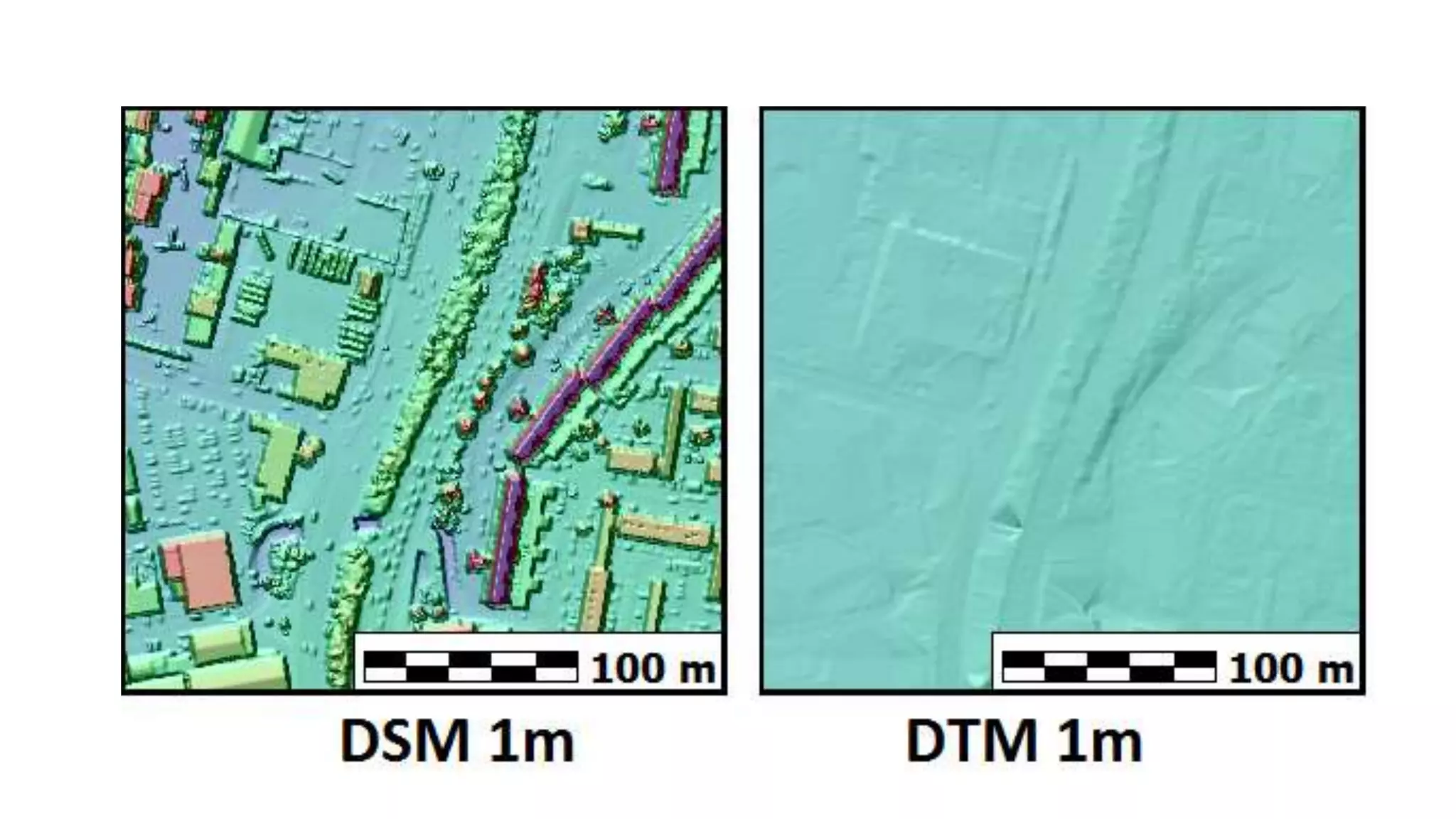
A Digital Elevation Model (DEM), also referred to as the Digital Terrain
Model (DTM) is a digital model or three dimensional (3D)
representation of the land surface elevation with respect to any
reference datum.
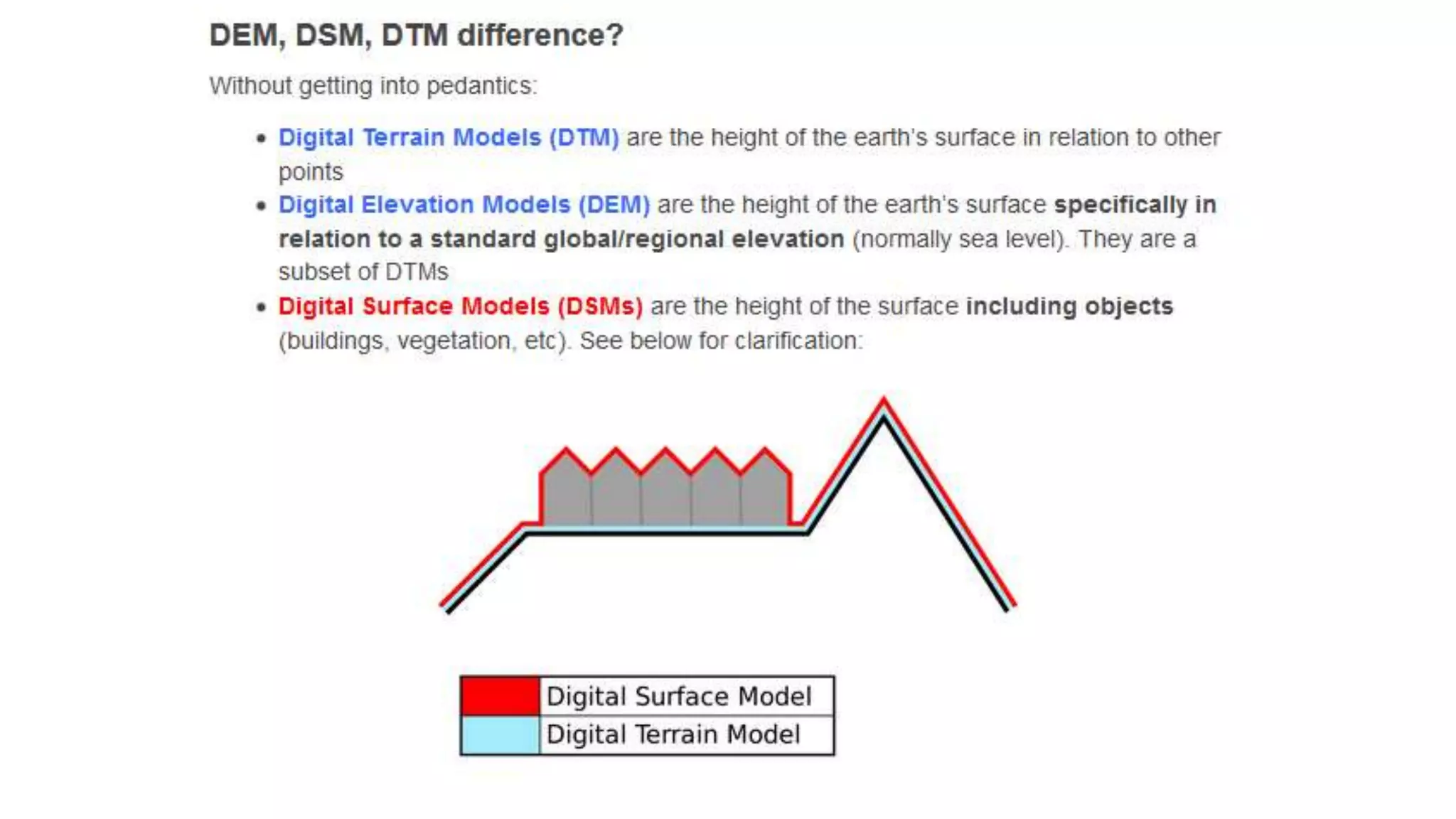
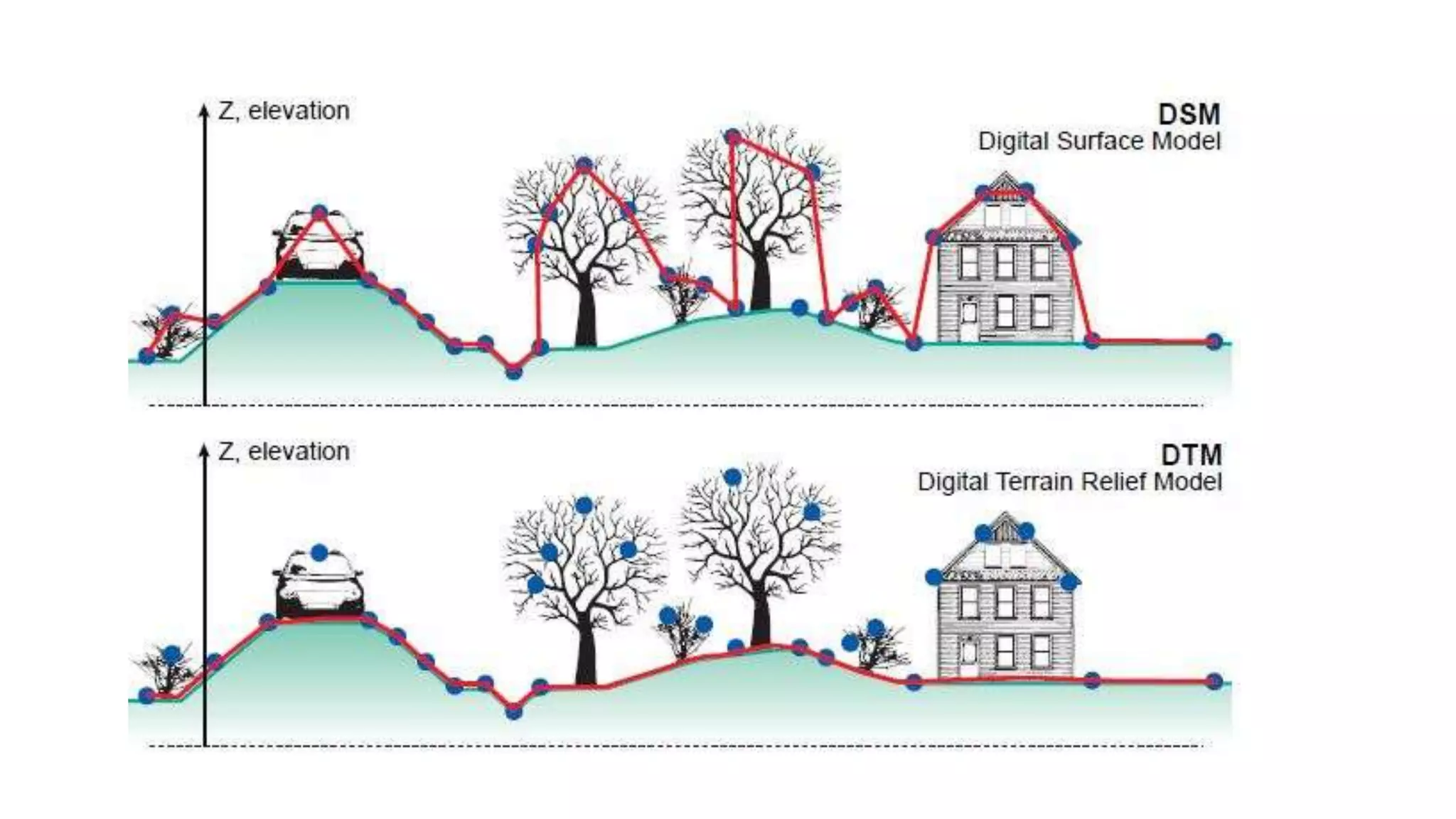
Technically a DEM contains only the elevation information of the
surface, free of vegetation, buildings and other non ground objects
with reference to a datum such as Mean Sea Level (MSL).
Reference: http://charim.net/datamanagement/32
Uses of DEM?
The following are most useful Parameters in depicting geological information using DEM:
1. Slope: Displays the grade of steepness expressed in degrees or as percent slope. This image can
reveal structural lineaments, fault scarps, fluvial terrace scarps, etc.
2. Aspect: Identifies the down-slope direction. Aspect images may enhance landforms such as
fluvial networks, alluvial fans, faceted fault related scarps, etc.
3. Shaded topographic relief or hill-shading: This image depicts relief by simulating the effect of
the sun's illumination on the terrain. The direction and the altitude of the illumination can be changed
in order to emphasize faults, lineaments, etc.
4. Flow direction: Shows the direction of flow by finding the direction of the steepest descent or
maximum drop. This DEM derived surface depicts the drainage.
5. Basin/ Watershed: Function that uses a grid of flow direction (output of flow direction) to
determine the contributing area.
Types of DEM
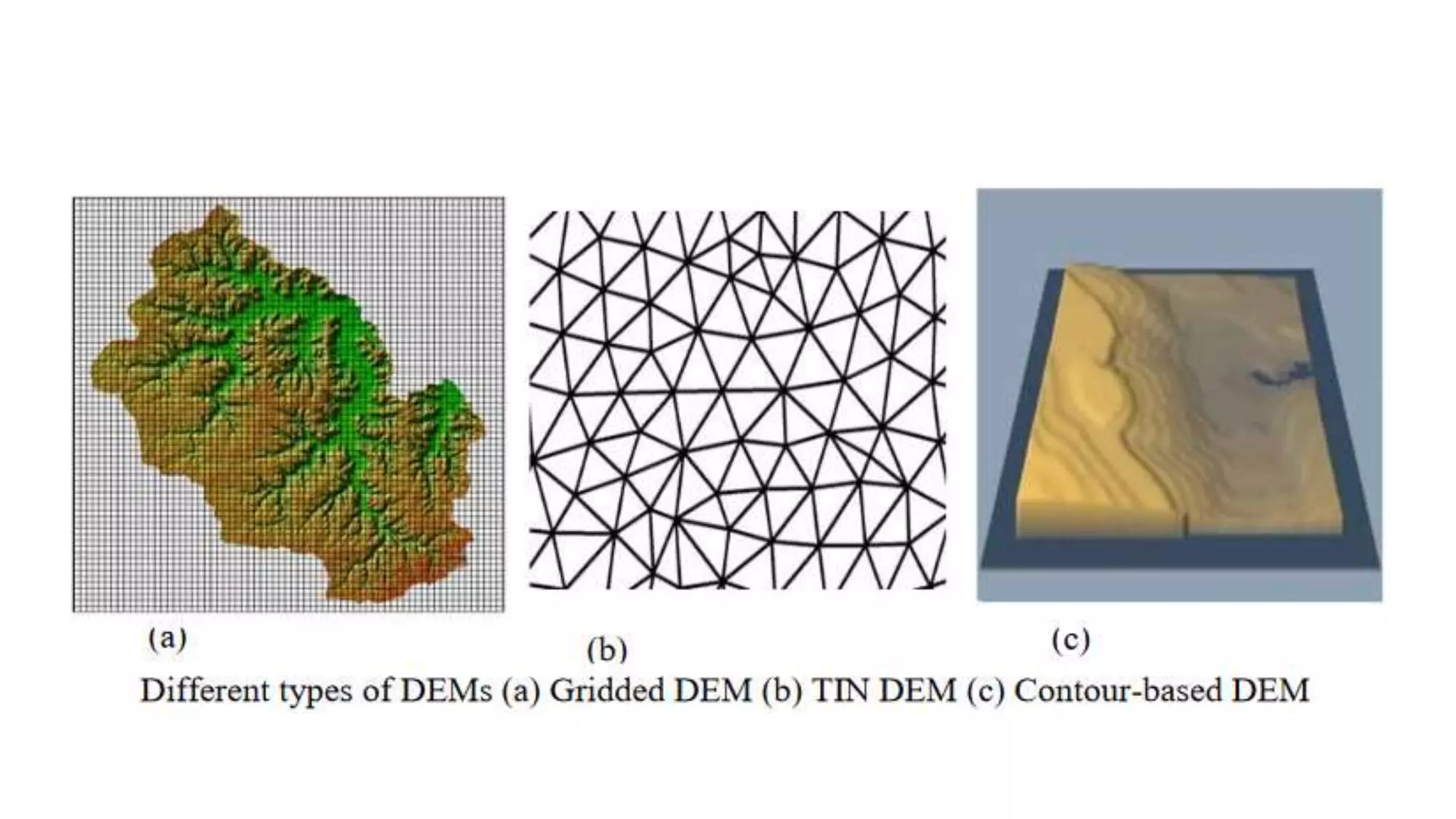
DEMs are generated by using the elevation information from several points
spaced at regular or irregular intervals.
The DEM could be acquired through techniques such as photogrammetry,
LiDAR, land surveying, etc. DEMs are commonly built using data collected
using remote sensing techniques, but they may also be built from land
surveying.
DEMs use different structures to acquire or store the elevation
information from various sources. Three main type of structures used are
the following:
1. Raster DEM - Regular square grids
2. Vector DEM - Triangular irregular networks (TIN)
Triangular Irregular Network (TIN)
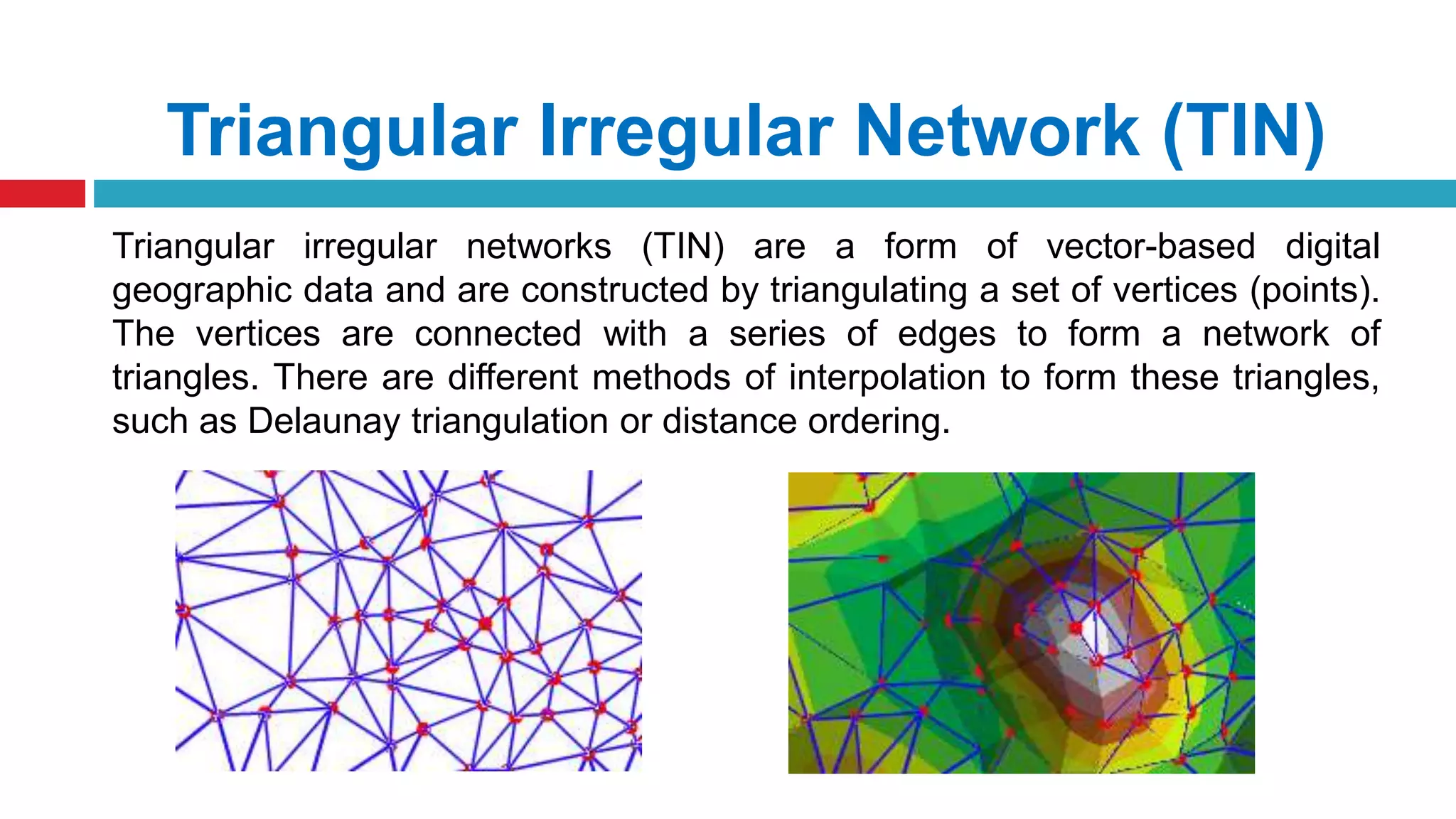
Triangular irregular networks (TIN) are a form of vector-based digital
geographic data and are constructed by triangulating a set of vertices (points).
The vertices are connected with a series of edges to form a network of
triangles. There are different methods of interpolation to form these triangles,
such as Delaunay triangulation or distance ordering.
Data Capture
1. Data Capture through Remote Sensing:
One powerful technique for generating DEM is interferometric synthetic
aperture radar where two passes of a radar satellite (such as RADARSAT-1 or
TerraSAR-X or Cosmo SkyMed), or a single pass if the satellite is equipped
with two antennas (like the SRTM instrumentation), collect sufficient data to
generate a digital elevation map.
2. Data Capture through Phogrammetry:
Other kinds of stereoscopic pairs can be employed using the digital image
correlation method, where two optical images are acquired with different
angles taken from the same pass of an airplane or an Earth Observation
Satellite (such as the HRS instrument of SPOT5 or the VNIR band of ASTER).
Data Capture
3. Data Capture through Land Surveying:
Older methods of generating DEMs often involve interpolating digital contour
maps that may have been produced by direct survey of the land surface. This
method is still used in mountain areas, where inter-ferometry is not always
satisfactory.
Note that contour line data or any other sampled elevation datasets (by GPS
or ground survey) are not DEMs, but may be considered digital terrain models
(DSM). A DEM implies that elevation is available continuously at each location
in the study area.
Data Collection Methods
Methods for obtaining elevation data used to create DEMs
 Lidar
 Stereo photogrammetry from aerial surveys
 Structure from motion/ Multi-view stereo applied to aerial photography
 Block adjustment from optical satellite imagery
 Interferometry from radar data
 Real Time Kinematic GPS
 Topographic maps
 Theodolite or total station
 Doppler radar
 Surveying and mapping drones
Quality of DEM
The quality of a DEM is a measure of how accurate elevation is at each pixel
(absolute accuracy) and how accurately is the morphology presented (relative
accuracy). Several factors play an important role for quality of DEM-derived
products:
• terrain roughness;
• sampling density (elevation data collection method);
• grid resolution or pixel size;
• Interpolation algorithm;
• vertical resolution;
• terrain analysis algorithm;
• Reference 3D products include quality masks that give information on the
coastline, lake, snow, clouds, correlation etc.
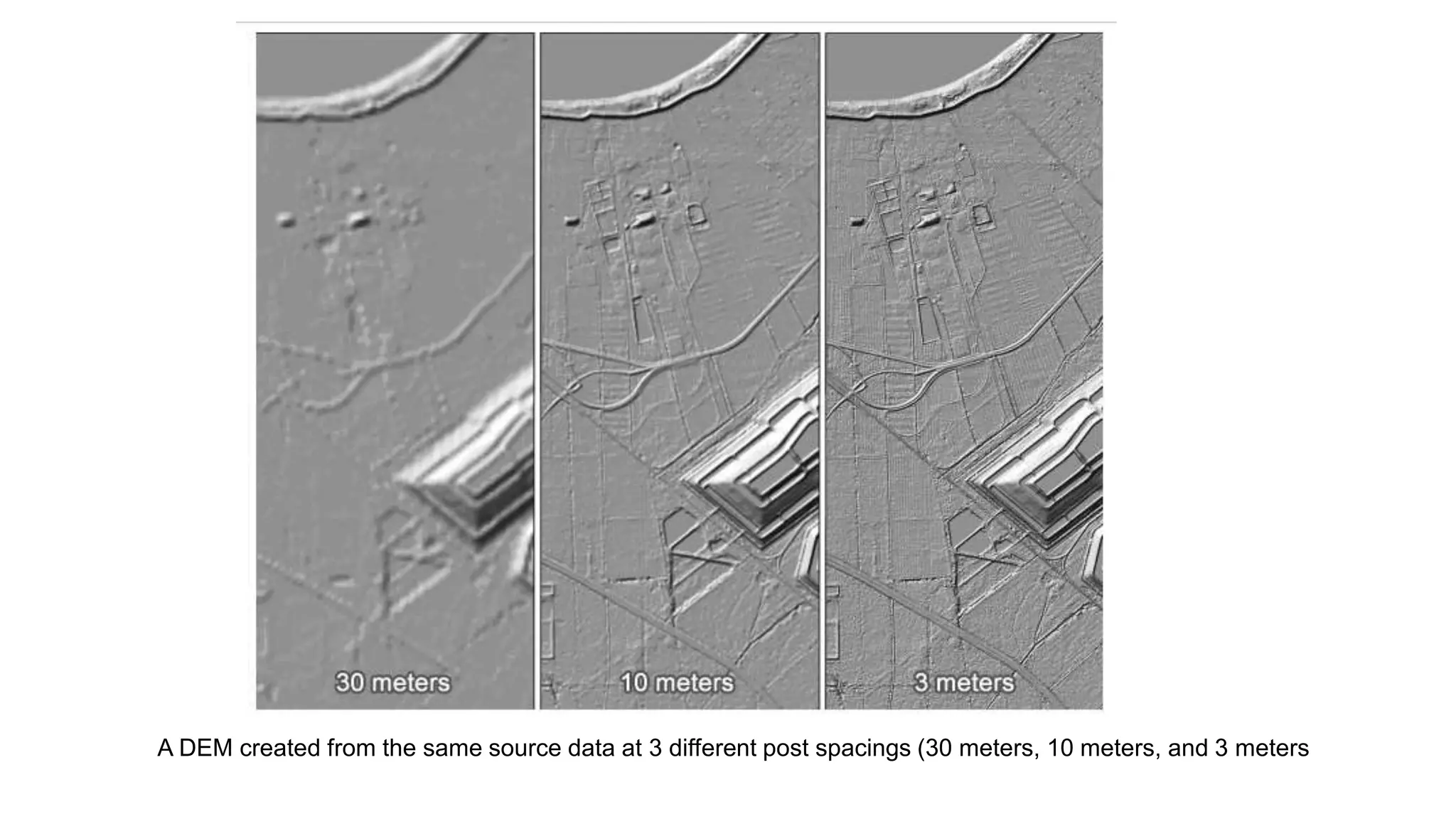
A DEM created from the same source data at 3 different post spacings (30 meters, 10 meters, and 3 meters
Free Data Sources
1. Space Shuttle Radar Topography Mission (SRTM)
This 1-arc second global digital elevation model has a spatial resolution of about 30 meters covering most of the world
with absolute vertical height accuracy of less than 16m. SRTM DEM data is being housed on the USGS Earth
Explorer server.
2. ASTER Global Digital Elevation Model
A joint operation between NASA and Japan was the birth of Advanced Spaceborne Thermal Emission and Reflection
Radiometer (ASTER). ASTER GDEM boasted a global resolution of 90 meters with a resolution of 30 meters in the
United States. You can download the ASTER DEM data for free from the “USGS Earth Explorer”.
3. JAXA’s Global ALOS 3D World
The ALOS World 3d is a 30-meter spatial resolution digital surface model (DSM) constructed by the Japan Aerospace
Exploration Agency’s (JAXA). It is the most precise global-scale elevation data at this time using the Advanced Land
Observing Satellite “DAICHI” (ALOS). The DSM was generated using stereo mapping (PRISM) for worldwide
topographic data with its optical stereoscopic observation. In order to obtain this highly accurate DSM, you’ll have to
register online through the “JAXA Global ALOS portal” to download it.
4. Indian Portal Bhuvan
CARTOSAT 1 and 2 derived stereo DEM, available for entire India freely. For specification and other details go
through Bhuvan website at http://bhuvan.nrsc.gov.in/data/download/index.php
Application of DEM
Common uses of DEMs include:
 Extracting terrain parameters for geomorphology
 Modeling water flow for hydrology or mass movement (for example
avalanches and landslides)
 Modeling soils wetness with Cartographic Depth to Water Indexes (DTW-
index)
 Creation of relief maps
 Rendering of 3D visualizations.
 3D flight planning and TERCOM
 Creation of physical models (including raised relief maps)
 Rectification of aerial photography or satellite imagery
 Reduction (terrain correction) of gravity measurements (gravimetry,
physical geodesy)
Application of DEM
Common uses of DEMs include:
 Terrain analysis in geomorphology and physical geography
 Geographic Information Systems(GIS)
 Engineering and infrastructure design
 Satellite navigation(for example GPS and GLONASS)
 Line-of-sight analysis
 Base mapping
 Flight simulation
 Precision farming and forestry
 Surface analysis
 Intelligent transportation systems(ITS)
 Auto safety / Advanced Driver Assistance Systems(ADAS)
 Archaeology
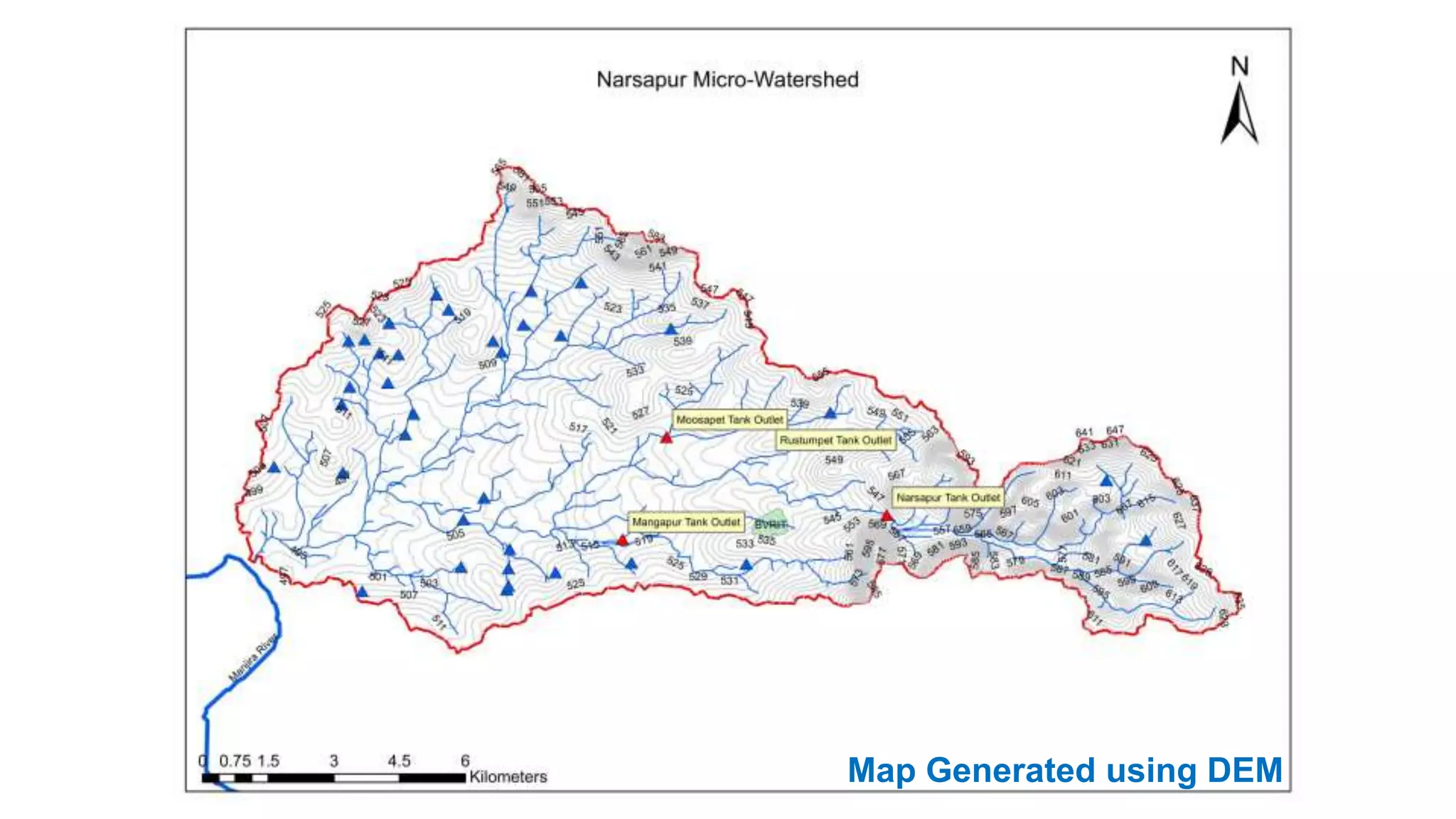
Map Generated using DEM
• WorldDEM: Source of DEM
Video References:
• Digital Globe: Source of DEM (Must Watch!)
• Terrain Modelling using DEM & DTM
• Triangular Irregular Network (TIN)

Digital Elevation Model (DEM)

  • 1.
    DIGITAL ELEVATION MODEL (DEM) UNIT– III Dr. Rambabu Palaka, Professor, BVRITAugust 2018
  • 2.
    Topics 1. What isDEM? 2. Use of DEM 3. Types of DEM a) Raster DEM b) Vector DEM – Triangular Irregular networks (TIN) 4. Data Capture Methods a) Remote Sensing b) Aerial Photogrammetry c) Land Surveying and Contour Maps 5. Generation of DEM/ Source of DEM a) SRTM b) ASTER c) JAXA’s Global ALOS 3D World d) NRSA Bhuvan’s CartoDEM 6. Application of DEM
  • 3.
    What is DEM? ADigital Elevation Model (DEM), also referred to as the Digital Terrain Model (DTM) is a digital model or three dimensional (3D) representation of the land surface elevation with respect to any reference datum. Technically a DEM contains only the elevation information of the surface, free of vegetation, buildings and other non ground objects with reference to a datum such as Mean Sea Level (MSL). Reference: http://charim.net/datamanagement/32
  • 4.
    Uses of DEM? Thefollowing are most useful Parameters in depicting geological information using DEM: 1. Slope: Displays the grade of steepness expressed in degrees or as percent slope. This image can reveal structural lineaments, fault scarps, fluvial terrace scarps, etc. 2. Aspect: Identifies the down-slope direction. Aspect images may enhance landforms such as fluvial networks, alluvial fans, faceted fault related scarps, etc. 3. Shaded topographic relief or hill-shading: This image depicts relief by simulating the effect of the sun's illumination on the terrain. The direction and the altitude of the illumination can be changed in order to emphasize faults, lineaments, etc. 4. Flow direction: Shows the direction of flow by finding the direction of the steepest descent or maximum drop. This DEM derived surface depicts the drainage. 5. Basin/ Watershed: Function that uses a grid of flow direction (output of flow direction) to determine the contributing area.
  • 8.
    Types of DEM DEMsare generated by using the elevation information from several points spaced at regular or irregular intervals. The DEM could be acquired through techniques such as photogrammetry, LiDAR, land surveying, etc. DEMs are commonly built using data collected using remote sensing techniques, but they may also be built from land surveying. DEMs use different structures to acquire or store the elevation information from various sources. Three main type of structures used are the following: 1. Raster DEM - Regular square grids 2. Vector DEM - Triangular irregular networks (TIN)
  • 10.
    Triangular Irregular Network(TIN) Triangular irregular networks (TIN) are a form of vector-based digital geographic data and are constructed by triangulating a set of vertices (points). The vertices are connected with a series of edges to form a network of triangles. There are different methods of interpolation to form these triangles, such as Delaunay triangulation or distance ordering.
  • 11.
    Data Capture 1. DataCapture through Remote Sensing: One powerful technique for generating DEM is interferometric synthetic aperture radar where two passes of a radar satellite (such as RADARSAT-1 or TerraSAR-X or Cosmo SkyMed), or a single pass if the satellite is equipped with two antennas (like the SRTM instrumentation), collect sufficient data to generate a digital elevation map. 2. Data Capture through Phogrammetry: Other kinds of stereoscopic pairs can be employed using the digital image correlation method, where two optical images are acquired with different angles taken from the same pass of an airplane or an Earth Observation Satellite (such as the HRS instrument of SPOT5 or the VNIR band of ASTER).
  • 12.
    Data Capture 3. DataCapture through Land Surveying: Older methods of generating DEMs often involve interpolating digital contour maps that may have been produced by direct survey of the land surface. This method is still used in mountain areas, where inter-ferometry is not always satisfactory. Note that contour line data or any other sampled elevation datasets (by GPS or ground survey) are not DEMs, but may be considered digital terrain models (DSM). A DEM implies that elevation is available continuously at each location in the study area.
  • 13.
    Data Collection Methods Methodsfor obtaining elevation data used to create DEMs  Lidar  Stereo photogrammetry from aerial surveys  Structure from motion/ Multi-view stereo applied to aerial photography  Block adjustment from optical satellite imagery  Interferometry from radar data  Real Time Kinematic GPS  Topographic maps  Theodolite or total station  Doppler radar  Surveying and mapping drones
  • 14.
    Quality of DEM Thequality of a DEM is a measure of how accurate elevation is at each pixel (absolute accuracy) and how accurately is the morphology presented (relative accuracy). Several factors play an important role for quality of DEM-derived products: • terrain roughness; • sampling density (elevation data collection method); • grid resolution or pixel size; • Interpolation algorithm; • vertical resolution; • terrain analysis algorithm; • Reference 3D products include quality masks that give information on the coastline, lake, snow, clouds, correlation etc.
  • 15.
    A DEM createdfrom the same source data at 3 different post spacings (30 meters, 10 meters, and 3 meters
  • 16.
    Free Data Sources 1.Space Shuttle Radar Topography Mission (SRTM) This 1-arc second global digital elevation model has a spatial resolution of about 30 meters covering most of the world with absolute vertical height accuracy of less than 16m. SRTM DEM data is being housed on the USGS Earth Explorer server. 2. ASTER Global Digital Elevation Model A joint operation between NASA and Japan was the birth of Advanced Spaceborne Thermal Emission and Reflection Radiometer (ASTER). ASTER GDEM boasted a global resolution of 90 meters with a resolution of 30 meters in the United States. You can download the ASTER DEM data for free from the “USGS Earth Explorer”. 3. JAXA’s Global ALOS 3D World The ALOS World 3d is a 30-meter spatial resolution digital surface model (DSM) constructed by the Japan Aerospace Exploration Agency’s (JAXA). It is the most precise global-scale elevation data at this time using the Advanced Land Observing Satellite “DAICHI” (ALOS). The DSM was generated using stereo mapping (PRISM) for worldwide topographic data with its optical stereoscopic observation. In order to obtain this highly accurate DSM, you’ll have to register online through the “JAXA Global ALOS portal” to download it. 4. Indian Portal Bhuvan CARTOSAT 1 and 2 derived stereo DEM, available for entire India freely. For specification and other details go through Bhuvan website at http://bhuvan.nrsc.gov.in/data/download/index.php
  • 17.
    Application of DEM Commonuses of DEMs include:  Extracting terrain parameters for geomorphology  Modeling water flow for hydrology or mass movement (for example avalanches and landslides)  Modeling soils wetness with Cartographic Depth to Water Indexes (DTW- index)  Creation of relief maps  Rendering of 3D visualizations.  3D flight planning and TERCOM  Creation of physical models (including raised relief maps)  Rectification of aerial photography or satellite imagery  Reduction (terrain correction) of gravity measurements (gravimetry, physical geodesy)
  • 18.
    Application of DEM Commonuses of DEMs include:  Terrain analysis in geomorphology and physical geography  Geographic Information Systems(GIS)  Engineering and infrastructure design  Satellite navigation(for example GPS and GLONASS)  Line-of-sight analysis  Base mapping  Flight simulation  Precision farming and forestry  Surface analysis  Intelligent transportation systems(ITS)  Auto safety / Advanced Driver Assistance Systems(ADAS)  Archaeology
  • 19.
  • 20.
    • WorldDEM: Sourceof DEM Video References: • Digital Globe: Source of DEM (Must Watch!) • Terrain Modelling using DEM & DTM • Triangular Irregular Network (TIN)