1
Spectral Signature
The Physics behind EMR absorption and
emission by water
2
Contents
• Background on Spectral signatures
• Beer-Lambert Law for atmosphere
• Dependence of absorption on Physical State of
water
• Summary
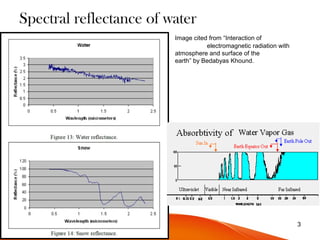
Spectral reflectance of water
3
Image cited from “Interaction of
electromagnetic radiation with
atmosphere and surface of the
earth” by Bedabyas Khound.
Background on spectral signatures
• For any given material, the amount of solar radiation that is reflected
(absorbed, transmitted) will vary with wavelength. This important property of
matter allows us to separate distinct cover types based on their response
values for a given wavelength. When we plot the response characteristics of
a certain cover type against wavelength, we define what is termed the
spectral signature of that cover. The diagram below illustrates the spectral
signatures for some common cover types. [2]
4
Figure: Remote Sensing #2: Spectral Signatures by Ryan Swearingen
Qualitative Explaination (for water)
• Longer wavelength visible and near infrared radiation is absorbed more by water than
shorter visible wavelengths.
• Thus water typically looks blue or blue-green due to stronger reflectance at these
shorter wavelengths, and darker if viewed at red or near infrared wavelengths.
• If there is suspended sediment present in the upper layers of the water body, then
this will allow better reflectivity and a brighter appearance of the water. The apparent
colour of the water will show a slight shift to longer wavelengths.
• Chlorophyll in algae absorbs more of the blue wavelengths and reflects the green,
making the water appear more green in colour when algae is present.
Quantifying the problem
• The absorbance of an object
quantifies how much of the
incident light is absorbed by it
(instead of being reflected or
refracted).
• Beer-Lambert Law[3]
– It relates the attenuation of light to
the properties of the material
through which the light is traveling.
• "The absorption is directly proportional
to the thickness of the object or in other
words the transmittance is inversely
proportional to the path length travelled
by the radiation into the bulk"
Physical Quantities in
Formula:
T Transmissivity
Σ attenuation coefficient
ℓ distance of light
travelled through material
ε absorptivity
c concentration of
material
Io & I Intensity of incident &
transmitted radiation
Beer–Lambert law in the atmosphere[3]
'Tx refers to the optical depth travelled by radiation in x matter (absorption or
scattering'
Ta refers to aerosols (that absorb and scatter)
Tg are uniformly mixed gases (mainly carbon dioxide (CO2) and molecular
oxygen (O2) which only absorb)
TRS are effects due to Raman scattering in the atmosphere
TNO2 is nitrogen dioxide, mainly due to urban pollution (absorption only)
Tw is water vapour absorption
TO3 is ozone (absorption only)
Tr is Rayleigh scattering from molecular oxygen (O2) and nitrogen (N2)
(responsible for the blue color of the sky).
Did above formula reminded you this ... ?
gb = gobs - gr + ( gL + gFA + gB + gT)
"Bouguer Gravity Anomaly"
Dependence of absorption on the physical state
• In some fluids the absorption depends on their physical state too.
The absorption of electromagnetic radiation by water depends on
it’s state. [1]
8
Figure:
Absorption spectrum
(attenuation coefficient(Yaxis)
vs. wavelength-Xaxis) of
liquid water (red), water vapor
(green) and ice (blue line)
between 667 nm and 200μm.
The plot for vapor is a
transformation of data Syn
-thetic spectrum for gas
mixture 'Pure H2O' (296K,
1 atm)
Fig. EMR Spectral regions [1]
• The absorption in the gas phase occurs in three regions of the spectrum.
Rotational transitions are responsible for absorption in the microwave
and far-infrared, Vibrational transitions in the mid-infrared and near-
infrared. Vibrational bands have rotational fine structure. Electronic
transitions occur in the vacuum ultraviolet regions.
• Liquid water has no rotational spectrum but does absorb in the microwave
region.
• Ice has a spectrum similar to liquid water
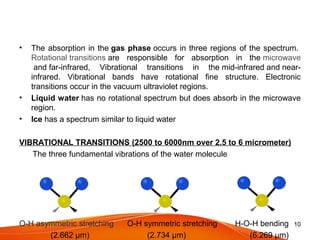
VIBRATIONAL TRANSITIONS (2500 to 6000nm over 2.5 to 6 micrometer)
The three fundamental vibrations of the water molecule
O-H asymmetric stretching O-H symmetric stretching H-O-H bending
(2.662 μm) (2.734 μm) (6.269 μm)
10
• Electronic Transitions (135nm to 180nm OR 0.135 to 0.180micrometer)
The electronic transitions of the water molecule lie in the vacuum ultraviolet
region.
i.e. 135 nm to 180 nm
"photodissociation of water into H+ OH- at 166.5 nm“
• Rotational spectrum (over 10000nm OR 10micrometer)
The water molecule is an asymmetric top, that is, it has three independent
moments of inertia. Consequently the rotational spectrum has no obvious
structure.
11
Short Summary
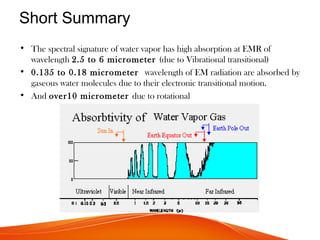
• The spectral signature of water vapor has high absorption at EMR of
wavelength 2.5 to 6 micrometer (due to Vibrational transitional)
• 0.135 to 0.18 micrometer wavelength of EM radiation are absorbed by
gaseous water molecules due to their electronic transitional motion.
• And over10 micrometer due to rotational
Reference
[1] Wikipedia article: Electromagnetic Absorption by water, Link:
http://en.wikipedia.org/wiki/Electromagnetic_absorption_by_water
[2] Swearingen R., “Remote Sensing #2: Spectral Signature” Link:
www.iupui.edu/~ghw/lessons/materials/SpectralSig.doc.
[3] Wikipedia article: Beer-Lambert Law Link: "http://en.wikipedia.org/wiki/Beer
%E2%80%93Lambert_law"
13
KUNAL RATHOD
B.TECH IN PETROLEUM ENGINEERING
M.TECH IN EXPLORATION GEOPHYSICS
By

Spectral signatures

  • 1.
    1 Spectral Signature The Physicsbehind EMR absorption and emission by water
  • 2.
    2 Contents • Background onSpectral signatures • Beer-Lambert Law for atmosphere • Dependence of absorption on Physical State of water • Summary
  • 3.
    Spectral reflectance ofwater 3 Image cited from “Interaction of electromagnetic radiation with atmosphere and surface of the earth” by Bedabyas Khound.
  • 4.
    Background on spectralsignatures • For any given material, the amount of solar radiation that is reflected (absorbed, transmitted) will vary with wavelength. This important property of matter allows us to separate distinct cover types based on their response values for a given wavelength. When we plot the response characteristics of a certain cover type against wavelength, we define what is termed the spectral signature of that cover. The diagram below illustrates the spectral signatures for some common cover types. [2] 4 Figure: Remote Sensing #2: Spectral Signatures by Ryan Swearingen
  • 5.
    Qualitative Explaination (forwater) • Longer wavelength visible and near infrared radiation is absorbed more by water than shorter visible wavelengths. • Thus water typically looks blue or blue-green due to stronger reflectance at these shorter wavelengths, and darker if viewed at red or near infrared wavelengths. • If there is suspended sediment present in the upper layers of the water body, then this will allow better reflectivity and a brighter appearance of the water. The apparent colour of the water will show a slight shift to longer wavelengths. • Chlorophyll in algae absorbs more of the blue wavelengths and reflects the green, making the water appear more green in colour when algae is present.
  • 6.
    Quantifying the problem •The absorbance of an object quantifies how much of the incident light is absorbed by it (instead of being reflected or refracted). • Beer-Lambert Law[3] – It relates the attenuation of light to the properties of the material through which the light is traveling. • "The absorption is directly proportional to the thickness of the object or in other words the transmittance is inversely proportional to the path length travelled by the radiation into the bulk" Physical Quantities in Formula: T Transmissivity Σ attenuation coefficient ℓ distance of light travelled through material ε absorptivity c concentration of material Io & I Intensity of incident & transmitted radiation
  • 7.
    Beer–Lambert law inthe atmosphere[3] 'Tx refers to the optical depth travelled by radiation in x matter (absorption or scattering' Ta refers to aerosols (that absorb and scatter) Tg are uniformly mixed gases (mainly carbon dioxide (CO2) and molecular oxygen (O2) which only absorb) TRS are effects due to Raman scattering in the atmosphere TNO2 is nitrogen dioxide, mainly due to urban pollution (absorption only) Tw is water vapour absorption TO3 is ozone (absorption only) Tr is Rayleigh scattering from molecular oxygen (O2) and nitrogen (N2) (responsible for the blue color of the sky). Did above formula reminded you this ... ? gb = gobs - gr + ( gL + gFA + gB + gT) "Bouguer Gravity Anomaly"
  • 8.
    Dependence of absorptionon the physical state • In some fluids the absorption depends on their physical state too. The absorption of electromagnetic radiation by water depends on it’s state. [1] 8 Figure: Absorption spectrum (attenuation coefficient(Yaxis) vs. wavelength-Xaxis) of liquid water (red), water vapor (green) and ice (blue line) between 667 nm and 200μm. The plot for vapor is a transformation of data Syn -thetic spectrum for gas mixture 'Pure H2O' (296K, 1 atm)
  • 9.
    Fig. EMR Spectralregions [1]
  • 10.
    • The absorptionin the gas phase occurs in three regions of the spectrum. Rotational transitions are responsible for absorption in the microwave and far-infrared, Vibrational transitions in the mid-infrared and near- infrared. Vibrational bands have rotational fine structure. Electronic transitions occur in the vacuum ultraviolet regions. • Liquid water has no rotational spectrum but does absorb in the microwave region. • Ice has a spectrum similar to liquid water VIBRATIONAL TRANSITIONS (2500 to 6000nm over 2.5 to 6 micrometer) The three fundamental vibrations of the water molecule O-H asymmetric stretching O-H symmetric stretching H-O-H bending (2.662 μm) (2.734 μm) (6.269 μm) 10
  • 11.
    • Electronic Transitions(135nm to 180nm OR 0.135 to 0.180micrometer) The electronic transitions of the water molecule lie in the vacuum ultraviolet region. i.e. 135 nm to 180 nm "photodissociation of water into H+ OH- at 166.5 nm“ • Rotational spectrum (over 10000nm OR 10micrometer) The water molecule is an asymmetric top, that is, it has three independent moments of inertia. Consequently the rotational spectrum has no obvious structure. 11
  • 12.
    Short Summary • Thespectral signature of water vapor has high absorption at EMR of wavelength 2.5 to 6 micrometer (due to Vibrational transitional) • 0.135 to 0.18 micrometer wavelength of EM radiation are absorbed by gaseous water molecules due to their electronic transitional motion. • And over10 micrometer due to rotational
  • 13.
    Reference [1] Wikipedia article:Electromagnetic Absorption by water, Link: http://en.wikipedia.org/wiki/Electromagnetic_absorption_by_water [2] Swearingen R., “Remote Sensing #2: Spectral Signature” Link: www.iupui.edu/~ghw/lessons/materials/SpectralSig.doc. [3] Wikipedia article: Beer-Lambert Law Link: "http://en.wikipedia.org/wiki/Beer %E2%80%93Lambert_law" 13
  • 14.
    KUNAL RATHOD B.TECH INPETROLEUM ENGINEERING M.TECH IN EXPLORATION GEOPHYSICS By

Editor's Notes

  • #4 0.5 to 2 micrometer = 500 to 2000 nm; low reflectance of solid water at 1500nm, 2000nm and 2500nm wavelength
  • #8 The law was discovered by Pierre Bouguer before 1729. It is often attributed to Lambert, who cited Bouguer's Essai d'Optique sur la Gradation de la Lumiere (Claude Jombert, Paris, 1729) — and even quoted from it — in his Photometria in 1760. Much later August Beer extended the exponential attenuation law in 1852 to include the concentration of solutions in the attenuation coefficient.