
A PRESENTATION ON NON
CONVENTIONAL RESOURCES OF
ENERGY


       Created By:-
               Nikhil Pakwanne
OBJECTIVE
   To create awareness on the advantages of
    utilizing Renewable energy sources among
    the rural population.
   To propagate on the use of Non
    conventional energy applications such as
    Solar Lanterns, Solar Water Heaters, Solar
    Lighting, Solar Cookers etc.

   To motivate students in propagating the
    use of Renewable energy in society
    (Especially in Rural region )
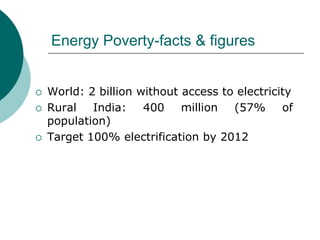
Energy Poverty-facts & figures


   World: 2 billion without access to electricity
   Rural   India: 400       million  (57%      of
    population)
   Target 100% electrification by 2012
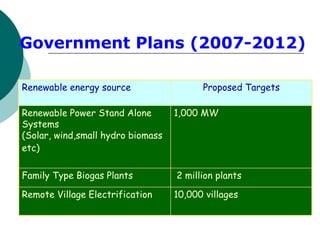
Government Plans (2007-2012)

Renewable energy source                  Proposed Targets

Renewable Power Stand Alone        1,000 MW
Systems
(Solar, wind,small hydro biomass
etc)

Family Type Biogas Plants          2 million plants

Remote Village Electrification     10,000 villages
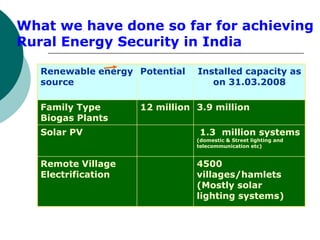
What we have done so far for achieving
Rural Energy Security in India

   Renewable energy Potential   Installed capacity as
   source                          on 31.03.2008

   Family Type       12 million 3.9 million
   Biogas Plants
   Solar PV                      1.3 million systems
                                (domestic & Street lighting and
                                telecommunication etc)


   Remote Village               4500
   Electrification              villages/hamlets
                                (Mostly solar
                                lighting systems)
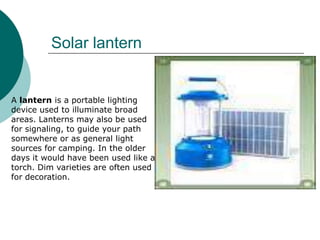
Solar lantern


A lantern is a portable lighting
device used to illuminate broad
areas. Lanterns may also be used
for signaling, to guide your path
somewhere or as general light
sources for camping. In the older
days it would have been used like a
torch. Dim varieties are often used
for decoration.
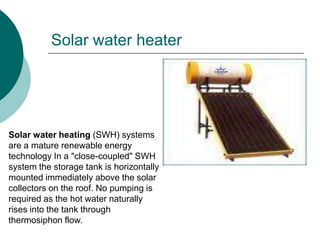
Solar water heater


Solar water heating (SWH) systems
are a mature renewable energy
technology In a "close-coupled" SWH
system the storage tank is horizontally
mounted immediately above the solar
collectors on the roof. No pumping is
required as the hot water naturally
rises into the tank through
thermosiphon flow.
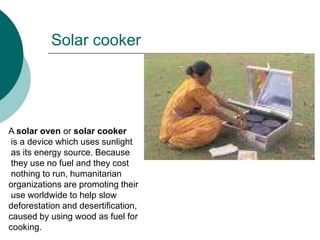
Solar cooker


A solar oven or solar cooker
 is a device which uses sunlight
 as its energy source. Because
 they use no fuel and they cost
 nothing to run, humanitarian
organizations are promoting their
 use worldwide to help slow
deforestation and desertification,
caused by using wood as fuel for
cooking.
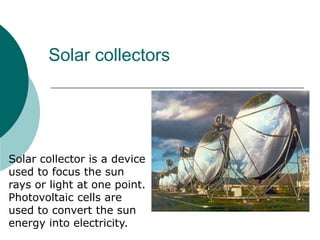
Solar collectors


Solar collector is a device
used to focus the sun
rays or light at one point.
Photovoltaic cells are
used to convert the sun
energy into electricity.
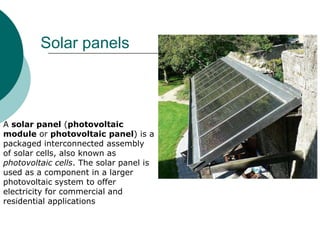
Solar panels


A solar panel (photovoltaic
module or photovoltaic panel) is a
packaged interconnected assembly
of solar cells, also known as
photovoltaic cells. The solar panel is
used as a component in a larger
photovoltaic system to offer
electricity for commercial and
residential applications
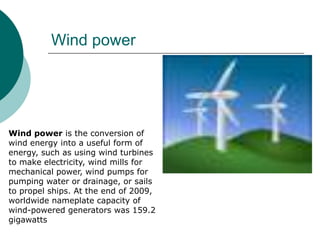
Wind power


Wind power is the conversion of
wind energy into a useful form of
energy, such as using wind turbines
to make electricity, wind mills for
mechanical power, wind pumps for
pumping water or drainage, or sails
to propel ships. At the end of 2009,
worldwide nameplate capacity of
wind-powered generators was 159.2
gigawatts
REFERENCES


•www.wikipedia.com
•www.google.com
•http://www.terra.o
rg/html/s/sol/coci
na/directorioen.ph
p
THANK YOU

Renewable energy

  • 1.
    A PRESENTATION ONNON CONVENTIONAL RESOURCES OF ENERGY Created By:- Nikhil Pakwanne
  • 2.
    OBJECTIVE  To create awareness on the advantages of utilizing Renewable energy sources among the rural population.  To propagate on the use of Non conventional energy applications such as Solar Lanterns, Solar Water Heaters, Solar Lighting, Solar Cookers etc.  To motivate students in propagating the use of Renewable energy in society (Especially in Rural region )
  • 3.
    Energy Poverty-facts &figures  World: 2 billion without access to electricity  Rural India: 400 million (57% of population)  Target 100% electrification by 2012
  • 4.
    Government Plans (2007-2012) Renewableenergy source Proposed Targets Renewable Power Stand Alone 1,000 MW Systems (Solar, wind,small hydro biomass etc) Family Type Biogas Plants 2 million plants Remote Village Electrification 10,000 villages
  • 5.
    What we havedone so far for achieving Rural Energy Security in India Renewable energy Potential Installed capacity as source on 31.03.2008 Family Type 12 million 3.9 million Biogas Plants Solar PV 1.3 million systems (domestic & Street lighting and telecommunication etc) Remote Village 4500 Electrification villages/hamlets (Mostly solar lighting systems)
  • 7.
    Solar lantern A lanternis a portable lighting device used to illuminate broad areas. Lanterns may also be used for signaling, to guide your path somewhere or as general light sources for camping. In the older days it would have been used like a torch. Dim varieties are often used for decoration.
  • 8.
    Solar water heater Solarwater heating (SWH) systems are a mature renewable energy technology In a "close-coupled" SWH system the storage tank is horizontally mounted immediately above the solar collectors on the roof. No pumping is required as the hot water naturally rises into the tank through thermosiphon flow.
  • 9.
    Solar cooker A solaroven or solar cooker is a device which uses sunlight as its energy source. Because they use no fuel and they cost nothing to run, humanitarian organizations are promoting their use worldwide to help slow deforestation and desertification, caused by using wood as fuel for cooking.
  • 10.
    Solar collectors Solar collectoris a device used to focus the sun rays or light at one point. Photovoltaic cells are used to convert the sun energy into electricity.
  • 11.
    Solar panels A solarpanel (photovoltaic module or photovoltaic panel) is a packaged interconnected assembly of solar cells, also known as photovoltaic cells. The solar panel is used as a component in a larger photovoltaic system to offer electricity for commercial and residential applications
  • 12.
    Wind power Wind poweris the conversion of wind energy into a useful form of energy, such as using wind turbines to make electricity, wind mills for mechanical power, wind pumps for pumping water or drainage, or sails to propel ships. At the end of 2009, worldwide nameplate capacity of wind-powered generators was 159.2 gigawatts
  • 13.
  • 14.