By:
Muhammad Sajjad
  PH# 03346544625
Contents
 Remote Sensing?
     History
 Remote Sensing Sensors
     Active Remote Sensing Sensors
     Passive Remote Sensing Sensors
 Platforms used for Remote Sensing
     Ground Based
     Airborne
     Space borne
 Applications of Remote sensing
 Software used for analyses
 Remote Sensing in Pakistan
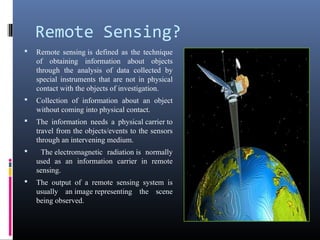
Remote Sensing?
   Remote sensing is defined as the technique
    of obtaining information about objects
    through the analysis of data collected by
    special instruments that are not in physical
    contact with the objects of investigation.
   Collection of information about an object
    without coming into physical contact.
   The information needs a physical carrier to
    travel from the objects/events to the sensors
    through an intervening medium.
    The electromagnetic radiation is normally
    used as an information carrier in remote
    sensing.
   The output of a remote sensing system is
    usually an image representing the scene
    being observed.
History
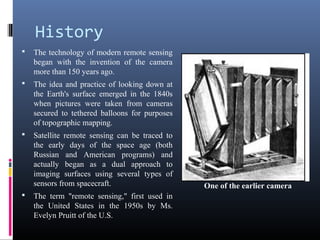
   The technology of modern remote sensing
    began with the invention of the camera
    more than 150 years ago.
   The idea and practice of looking down at
    the Earth's surface emerged in the 1840s
    when pictures were taken from cameras
    secured to tethered balloons for purposes
    of topographic mapping.
   Satellite remote sensing can be traced to
    the early days of the space age (both
    Russian and American programs) and
    actually began as a dual approach to
    imaging surfaces using several types of
    sensors from spacecraft.                    One of the earlier camera
   The term "remote sensing," first used in
    the United States in the 1950s by Ms.
    Evelyn Pruitt of the U.S.
Remote Sensing Sensors
 Active Remote Sensors
       These provide their own energy source for illumination. The sensor
  emits radiation which is directed toward the target to be investigated. The
  radiation reflected from that target is detected and measured by the
  sensor.

  Examples:
        LIDAR (Light Detection And Ranging)
        RADAR (Radio Detection And Ranging)

 Passive Remote Sensors
       Remote sensing systems which measure energy that is naturally
  available are called passive sensors.

  Examples :
        Passive microwave radiometer that detects naturally emitted microwave energy.
        Radiometers that measure reflected (or backscattered) sun light from the atmosphere and ocean.
Platforms used for Remote
Sensing
 Ground-based platforms: ground, vehicles and/or towers
    => up to 50 m

 Airborne platforms: airplanes, helicopters, high-altitude
    aircrafts, balloons => up to 50 km

 Space borne: rockets, satellites, shuttle => from about 100
    km to 36000 km
               Space shuttle: 250-300 km
               Space station: 300-400 km
               Low-level satellites: 700-1500 km
               High-level satellites: about 36000 km
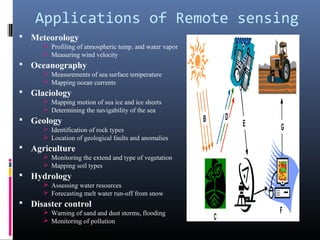
Applications of Remote sensing
 Meteorology
       Profiling of atmospheric temp. and water vapor
       Measuring wind velocity
 Oceanography
       Measurements of sea surface temperature
       Mapping ocean currents
 Glaciology
       Mapping motion of sea ice and ice sheets
       Determining the navigability of the sea
 Geology
       Identification of rock types
       Location of geological faults and anomalies
 Agriculture
       Monitoring the extend and type of vegetation
       Mapping soil types
 Hydrology
       Assessing water resources
       Forecasting melt water run-off from snow
 Disaster control
       Warning of sand and dust storms, flooding
       Monitoring of pollution
Software used for analyses
   Remote Sensing data is processed and analyzed with computer software,
    known as a remote sensing application.

   According to an NOAA Sponsored Research by Global Marketing
    Insights, Including the most used applications among Asian academic
    groups involved in remote sensing are as follows:
     ERDAS 36%
     ESRI 30%
     ITT Visual Information Solutions ENVI 17%
     MapInfo 17%
   Among Western Academic respondents as follows
       ESRI 39%
       ERDAS IMAGINE 27%
       MapInfo 9%
       Autodesk 7%
       I TT Visual Information Solutions ENVI 17%.
Remote Sensing in Pakistan
 The Pakistan Remote Sensing Satellite (PRSS) or RSSS is being
  developed as a dual purpose Earth observational and optical satellite
  which was scheduled to launch by the end year of 2011 for the
  replacement of BADR-II satellite. The satellite is manufactured
  indigenously in Lahore SUPARCO center. The satellite is equipped
  with very high resolution radio meter and a SAR.(Synthetic Aperture
  RADAR)
 Remote-sensing-based climate and flood warning technology is to
  upgrade flood management of Pakistan. The project will help build
  the capacity of Pakistan Meteorological Department and other
  agencies responsible for flood forecasting, early warning and
  management at the national, provincial and district levels. UNESCO,
  with the financial assistance of Japan, is introducing the system at a
  cost of 3.5 million dollar. The system is expected to be completed by
  2013.
Pakistan Remote Sensing
Satellite (PRSS)
Operator
Space and Upper Atmosphere Research Commission

Major contractors
SUPARCO, Pakistan

Mission type
Oceanography
Weather satellite
Earth observation satellite
Geographic information system
constellation of Optical
Global navigation satellite system
Optical satellite system
References
 http://earthobservatory.nasa.gov/Features/RemoteSensing
 http://www.suparco.gov.pk/pages/rsss.asp

 http://jan.ucc.nau.edu/~geog-p/geog/RemoteSensing/

 http://www.crisp.nus.edu.sg/~research/tutorial/intro.htm

 http://www.nrcan.gc.ca/earth-sciences/geography-
  boundary/remote-sensing/fundamentals/1212

 http://www.hydrology.nl/ihpnews/300-pakistan-remote-
  sensing-to-forecast-floods.html

Remote sensing and its applications in environment

  • 1.
    By: Muhammad Sajjad PH# 03346544625
  • 2.
    Contents  Remote Sensing?  History  Remote Sensing Sensors  Active Remote Sensing Sensors  Passive Remote Sensing Sensors  Platforms used for Remote Sensing  Ground Based  Airborne  Space borne  Applications of Remote sensing  Software used for analyses  Remote Sensing in Pakistan
  • 3.
    Remote Sensing?  Remote sensing is defined as the technique of obtaining information about objects through the analysis of data collected by special instruments that are not in physical contact with the objects of investigation.  Collection of information about an object without coming into physical contact.  The information needs a physical carrier to travel from the objects/events to the sensors through an intervening medium.  The electromagnetic radiation is normally used as an information carrier in remote sensing.  The output of a remote sensing system is usually an image representing the scene being observed.
  • 4.
    History  The technology of modern remote sensing began with the invention of the camera more than 150 years ago.  The idea and practice of looking down at the Earth's surface emerged in the 1840s when pictures were taken from cameras secured to tethered balloons for purposes of topographic mapping.  Satellite remote sensing can be traced to the early days of the space age (both Russian and American programs) and actually began as a dual approach to imaging surfaces using several types of sensors from spacecraft. One of the earlier camera  The term "remote sensing," first used in the United States in the 1950s by Ms. Evelyn Pruitt of the U.S.
  • 5.
    Remote Sensing Sensors Active Remote Sensors These provide their own energy source for illumination. The sensor emits radiation which is directed toward the target to be investigated. The radiation reflected from that target is detected and measured by the sensor. Examples:  LIDAR (Light Detection And Ranging)  RADAR (Radio Detection And Ranging)  Passive Remote Sensors Remote sensing systems which measure energy that is naturally available are called passive sensors. Examples :  Passive microwave radiometer that detects naturally emitted microwave energy.  Radiometers that measure reflected (or backscattered) sun light from the atmosphere and ocean.
  • 6.
    Platforms used forRemote Sensing  Ground-based platforms: ground, vehicles and/or towers => up to 50 m  Airborne platforms: airplanes, helicopters, high-altitude aircrafts, balloons => up to 50 km  Space borne: rockets, satellites, shuttle => from about 100 km to 36000 km  Space shuttle: 250-300 km  Space station: 300-400 km  Low-level satellites: 700-1500 km  High-level satellites: about 36000 km
  • 7.
    Applications of Remotesensing  Meteorology  Profiling of atmospheric temp. and water vapor  Measuring wind velocity  Oceanography  Measurements of sea surface temperature  Mapping ocean currents  Glaciology  Mapping motion of sea ice and ice sheets  Determining the navigability of the sea  Geology  Identification of rock types  Location of geological faults and anomalies  Agriculture  Monitoring the extend and type of vegetation  Mapping soil types  Hydrology  Assessing water resources  Forecasting melt water run-off from snow  Disaster control  Warning of sand and dust storms, flooding  Monitoring of pollution
  • 8.
    Software used foranalyses  Remote Sensing data is processed and analyzed with computer software, known as a remote sensing application.  According to an NOAA Sponsored Research by Global Marketing Insights, Including the most used applications among Asian academic groups involved in remote sensing are as follows:  ERDAS 36%  ESRI 30%  ITT Visual Information Solutions ENVI 17%  MapInfo 17%  Among Western Academic respondents as follows  ESRI 39%  ERDAS IMAGINE 27%  MapInfo 9%  Autodesk 7%  I TT Visual Information Solutions ENVI 17%.
  • 9.
    Remote Sensing inPakistan  The Pakistan Remote Sensing Satellite (PRSS) or RSSS is being developed as a dual purpose Earth observational and optical satellite which was scheduled to launch by the end year of 2011 for the replacement of BADR-II satellite. The satellite is manufactured indigenously in Lahore SUPARCO center. The satellite is equipped with very high resolution radio meter and a SAR.(Synthetic Aperture RADAR)  Remote-sensing-based climate and flood warning technology is to upgrade flood management of Pakistan. The project will help build the capacity of Pakistan Meteorological Department and other agencies responsible for flood forecasting, early warning and management at the national, provincial and district levels. UNESCO, with the financial assistance of Japan, is introducing the system at a cost of 3.5 million dollar. The system is expected to be completed by 2013.
  • 10.
    Pakistan Remote Sensing Satellite(PRSS) Operator Space and Upper Atmosphere Research Commission Major contractors SUPARCO, Pakistan Mission type Oceanography Weather satellite Earth observation satellite Geographic information system constellation of Optical Global navigation satellite system Optical satellite system
  • 11.
    References  http://earthobservatory.nasa.gov/Features/RemoteSensing  http://www.suparco.gov.pk/pages/rsss.asp http://jan.ucc.nau.edu/~geog-p/geog/RemoteSensing/  http://www.crisp.nus.edu.sg/~research/tutorial/intro.htm  http://www.nrcan.gc.ca/earth-sciences/geography- boundary/remote-sensing/fundamentals/1212  http://www.hydrology.nl/ihpnews/300-pakistan-remote- sensing-to-forecast-floods.html