Government College Of Engineering,
         Aurangabad.


              Created By-
                       Nikhil Pakwannne

                                          1
Approximate Methods for
 calculation of stresses
1) Equivalent Point-Load Method

2) Two-to-one Load Distribution Method

3) Sixty Degree Distribution Method
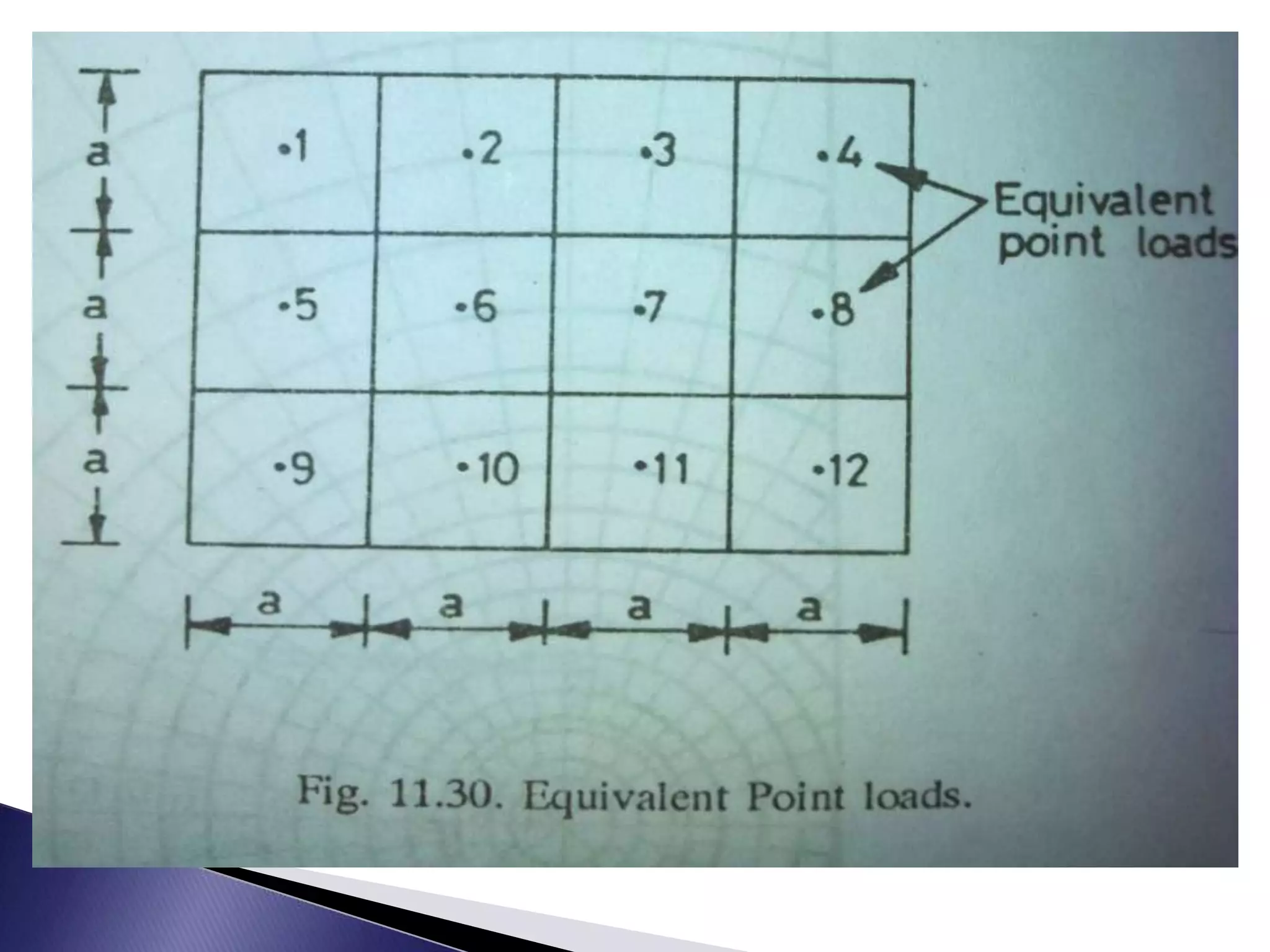
   The vertical stress at a point under a
    loaded area of any shape can be
    determined by dividing the loaded
    area into small area & replacing the
    distributed load on each small area by
    an equivalent load acting at the
    centroid of the area shown in fig.
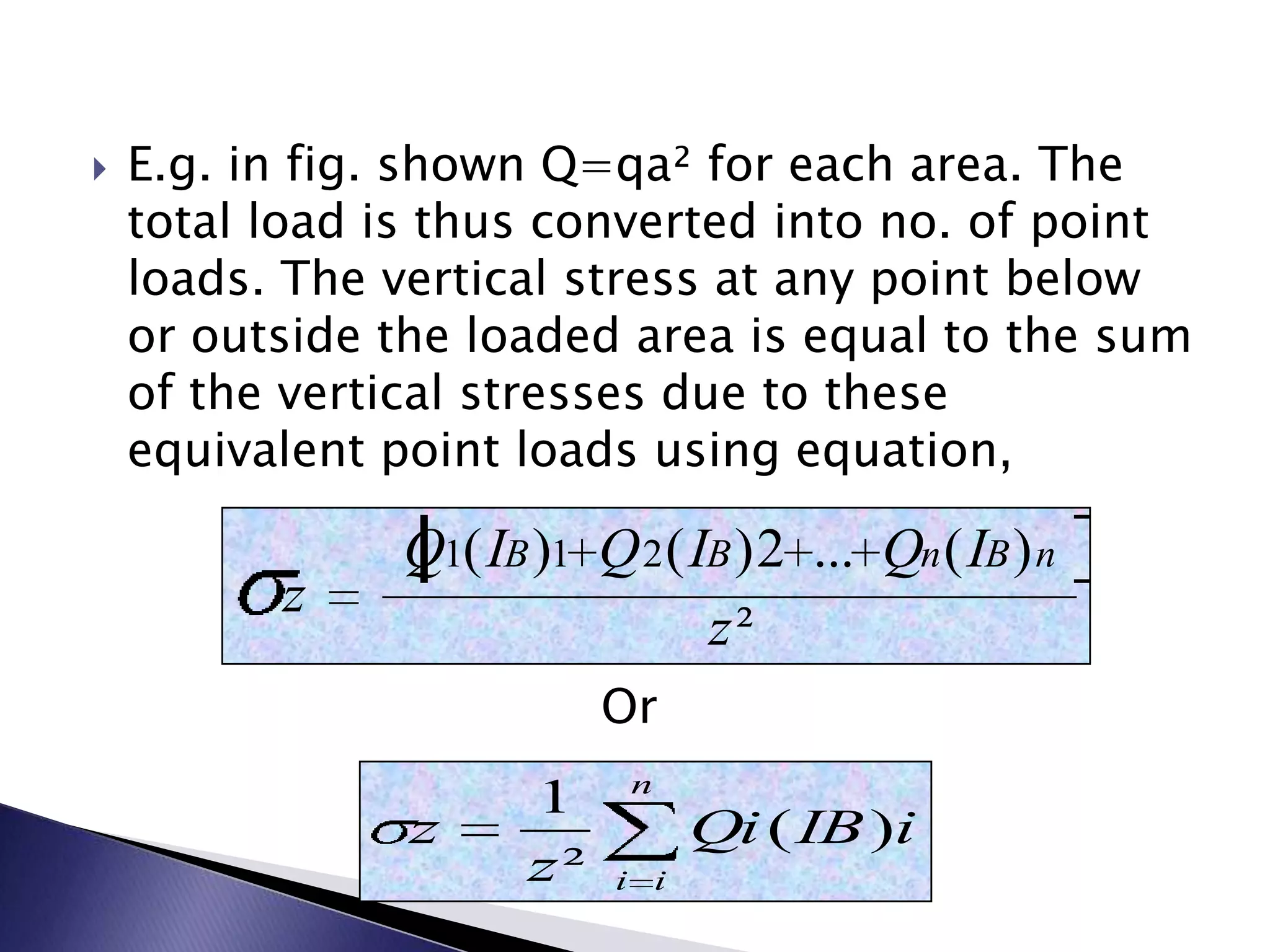
   E.g. in fig. shown Q=qa² for each area. The
    total load is thus converted into no. of point
    loads. The vertical stress at any point below
    or outside the loaded area is equal to the sum
    of the vertical stresses due to these
    equivalent point loads using equation,

               Q1( IB )1 Q 2 ( IB ) 2 ... Qn ( IB ) n
          z
                                z²
                           Or
                            n
                      1
                z                Qi ( IB )i
                      z²   i i
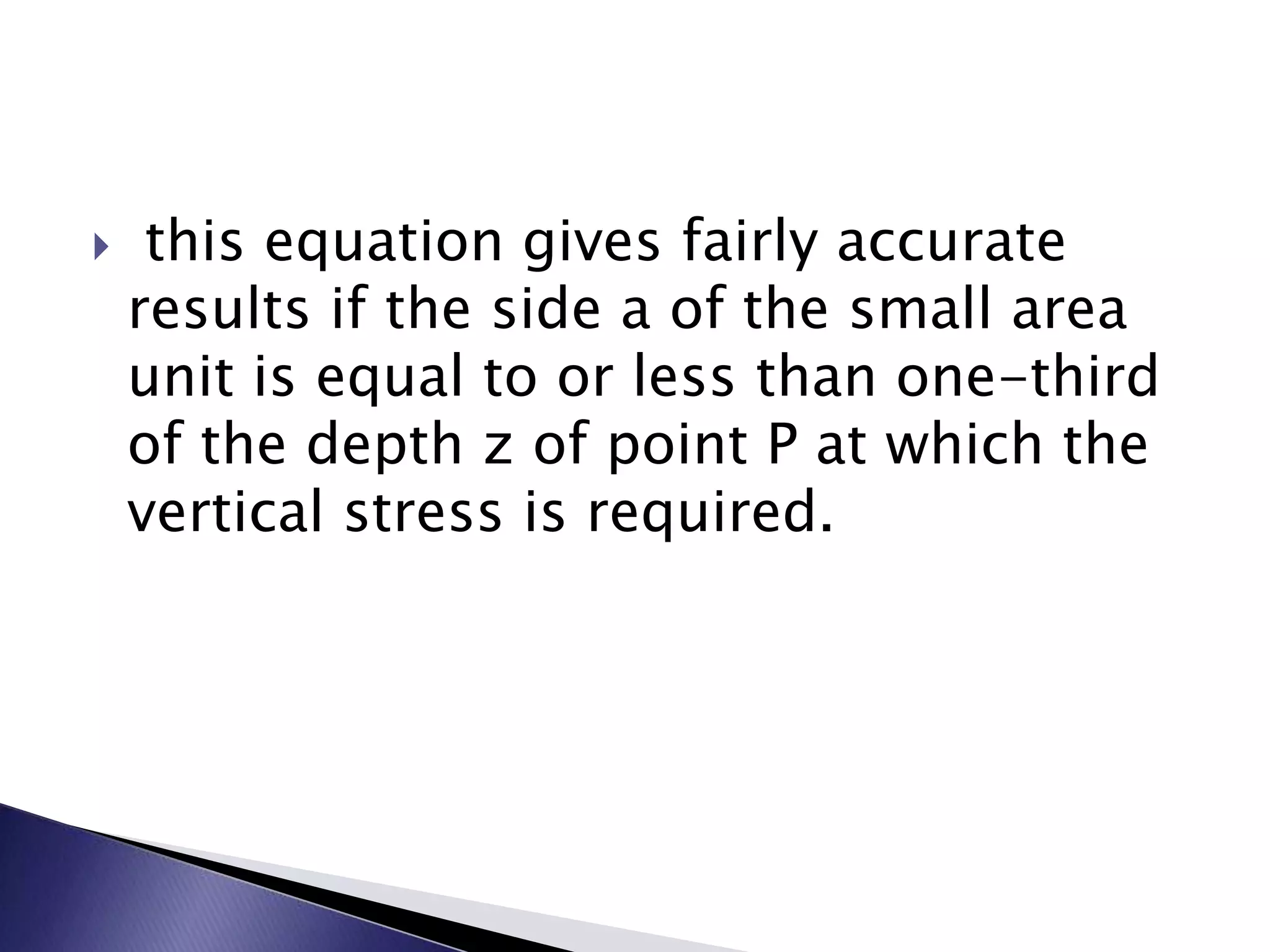
    this equation gives fairly accurate
    results if the side a of the small area
    unit is equal to or less than one-third
    of the depth z of point P at which the
    vertical stress is required.
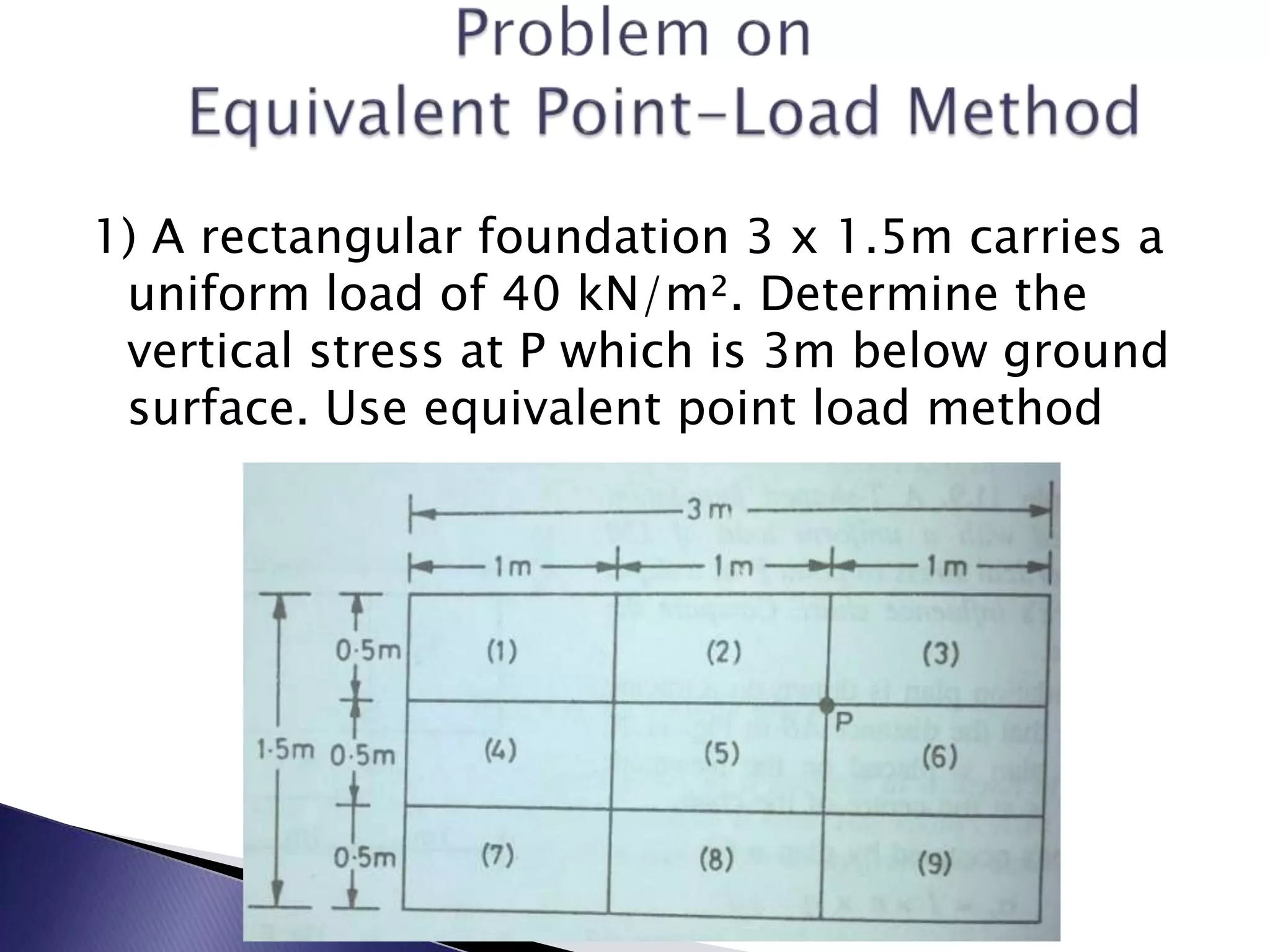
1) A rectangular foundation 3 x 1.5m carries a
 uniform load of 40 kN/m². Determine the
 vertical stress at P which is 3m below ground
 surface. Use equivalent point load method
   Solution:-
     Let us divide the loaded area into 9 small
    areas of size 0.5 x 1m.
    Load on each area = 40 x (1x0.5) = 20kN
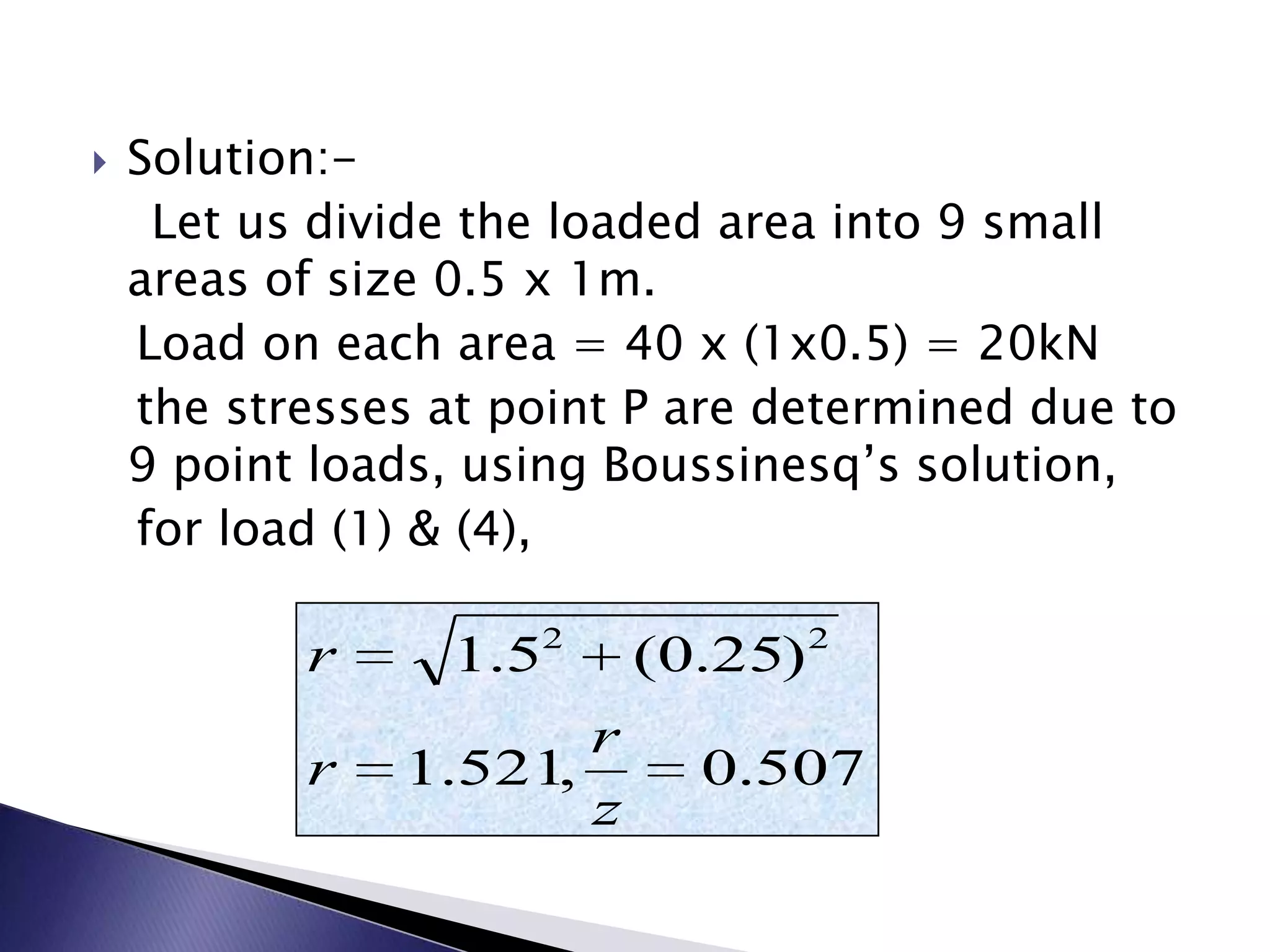
    the stresses at point P are determined due to
    9 point loads, using Boussinesq’s solution,
    for load (1) & (4),

                     2             2
           r     1.5      (0.25)
                      r
           r   1.521,       0.507
                      z
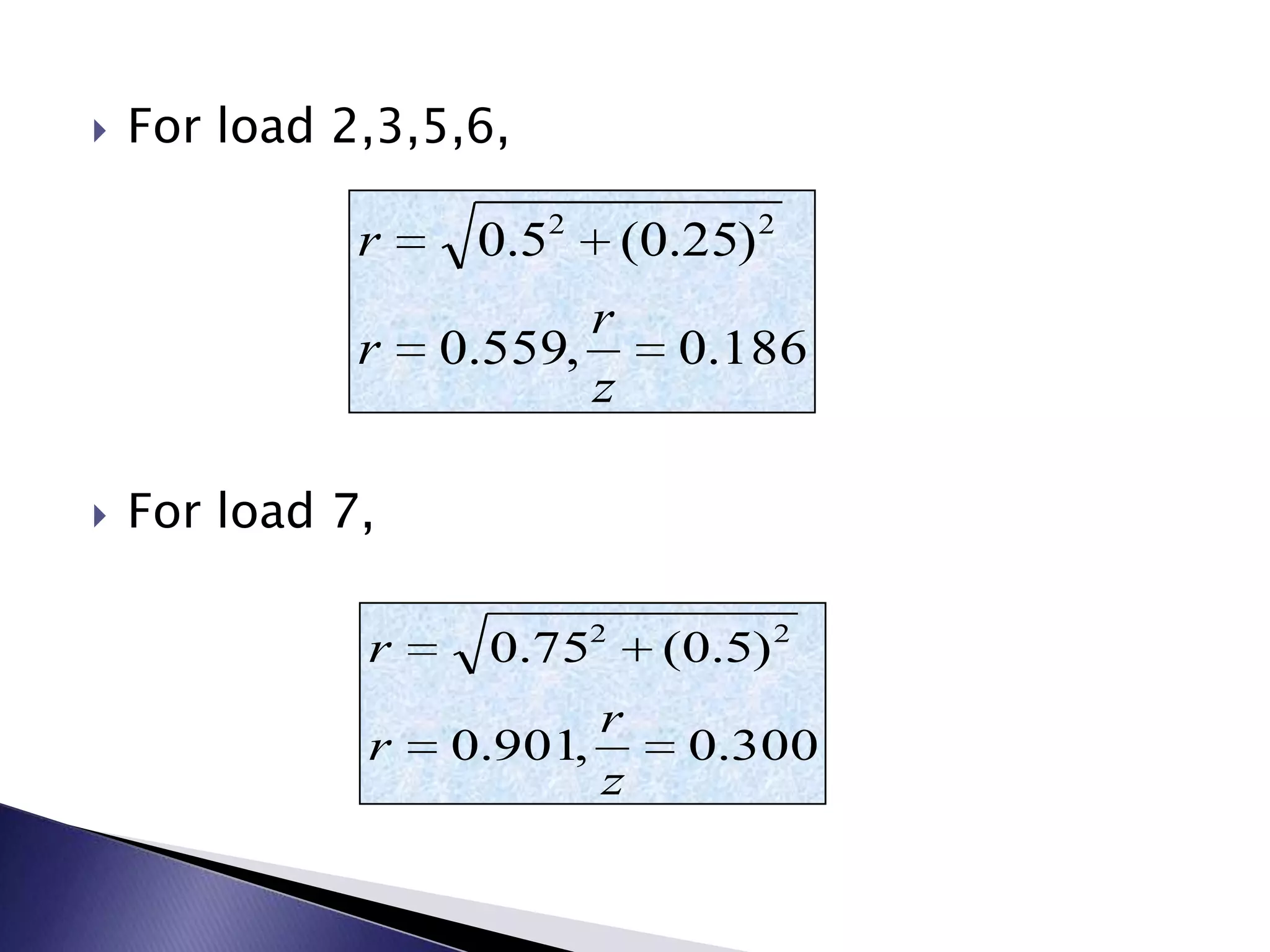
   For load 2,3,5,6,

              r    0.52      (0.25) 2
                         r
              r   0.559,        0.186
                         z

   For load 7,

              r     0.752      (0.5) 2
                         r
              r   0.901,        0.300
                         z
   In this case,

            3  20                  2                        4
    z
            2 (3) 2    [(1   (0.507) 2 ]2.5        [(1   (0.186) 2 ]2.5

                2                         1
    [(1      (0.30) 2 ]2.5   [(1       (0.559) 2 ]2.5

        z   1.061 (1.129     3.674         1.612     0.507 )
        z   7.34 kN / m 2
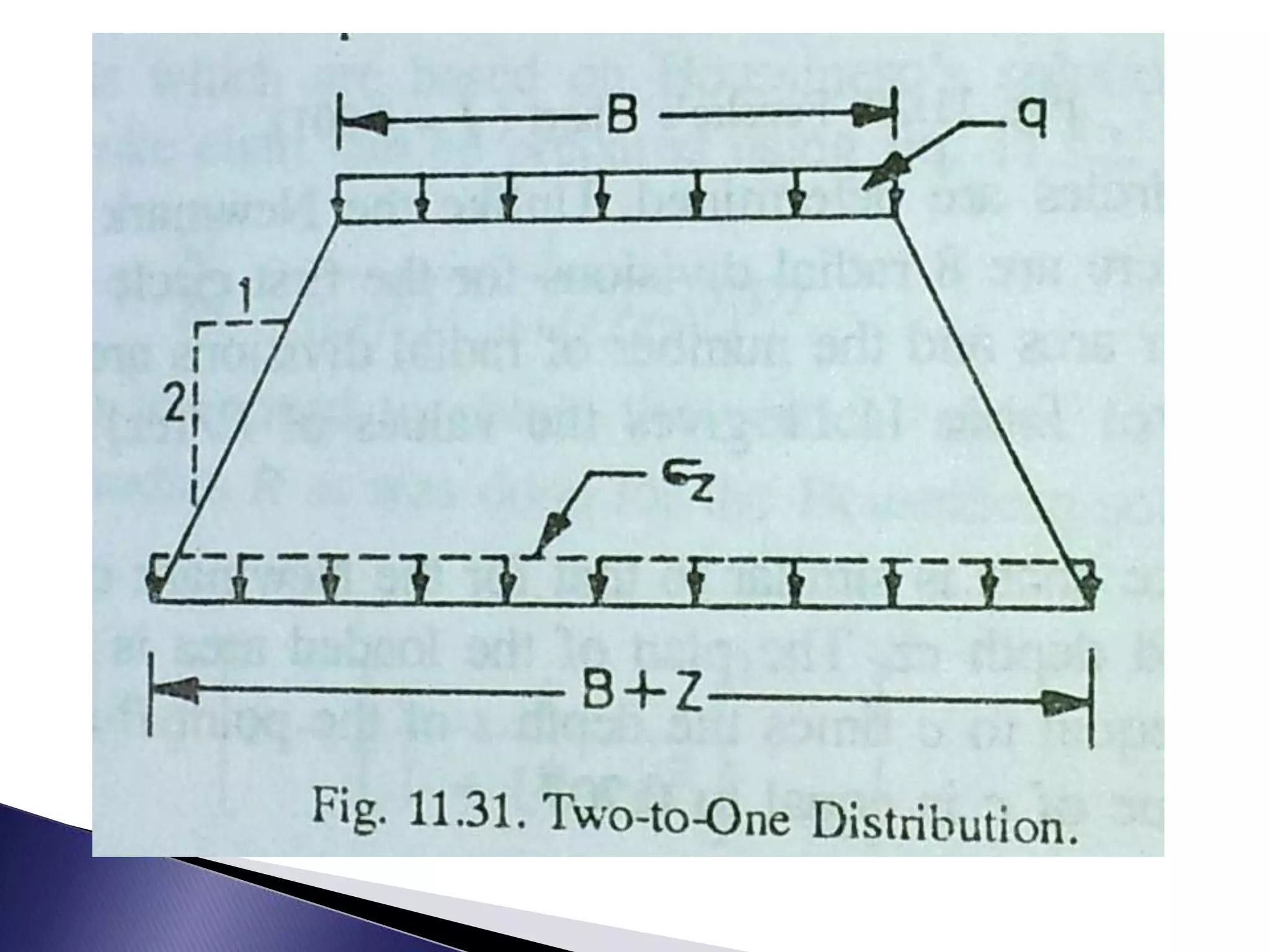
   The actual distribution of load with the depth
    is complex. However, it can be assumed to
    spread approximately at a slope of two
    vertical & one horizontal.

   Thus the vertical pressure at any depth z
    below the soil surface can be determined
    approximately by constructing a frustum of
    pyramid of depth z & side slope 2:1.The
    pressure distribution is assumed to be
    uniform on horizontal plane at that depth.
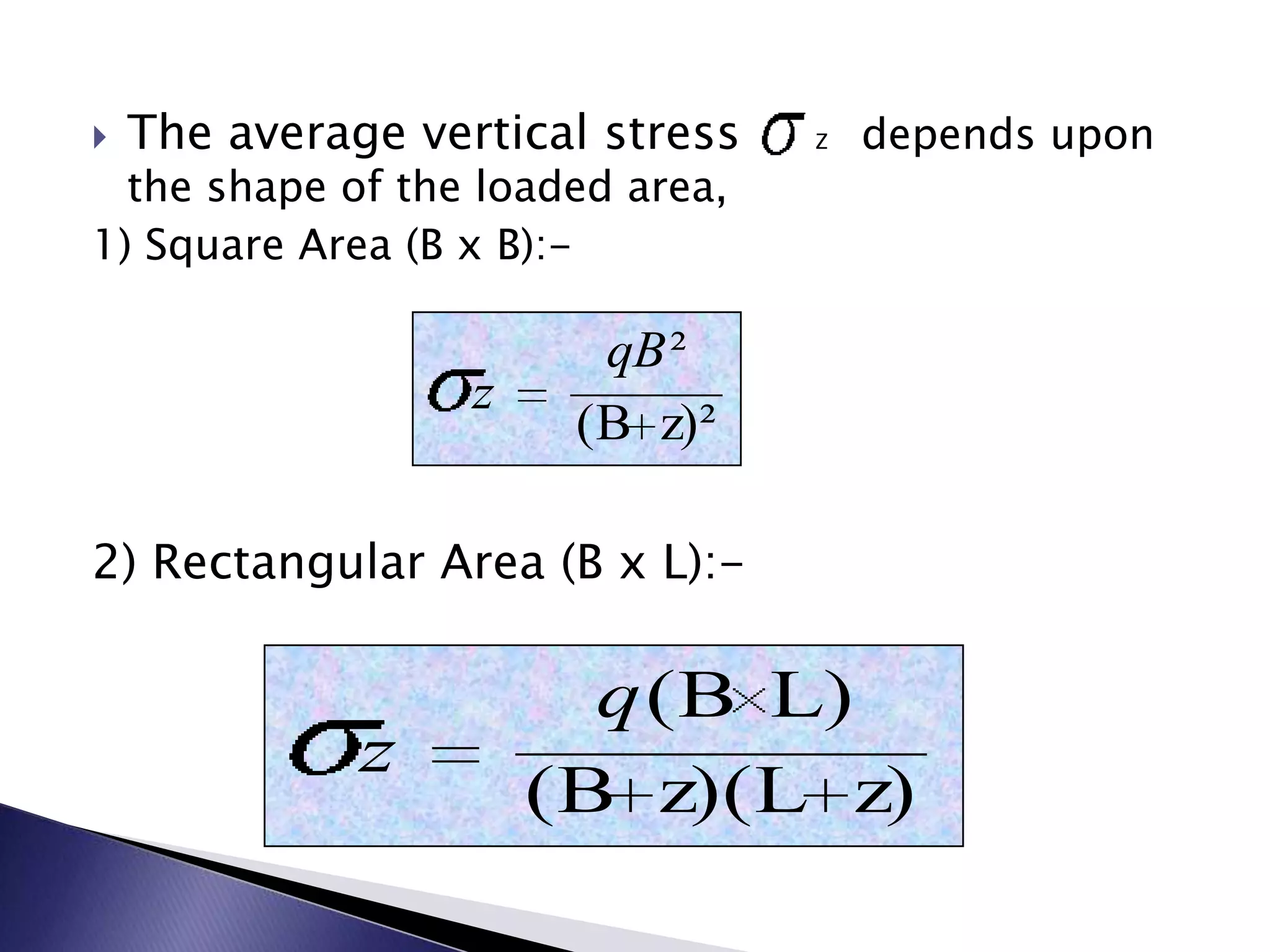
   The average vertical stress   Z   depends upon
  the shape of the loaded area,
1) Square Area (B x B):-

                         qB ²
                   z
                        (B z)²

2) Rectangular Area (B x L):-

                         q (B L)
              z
                       (B z)(L z)
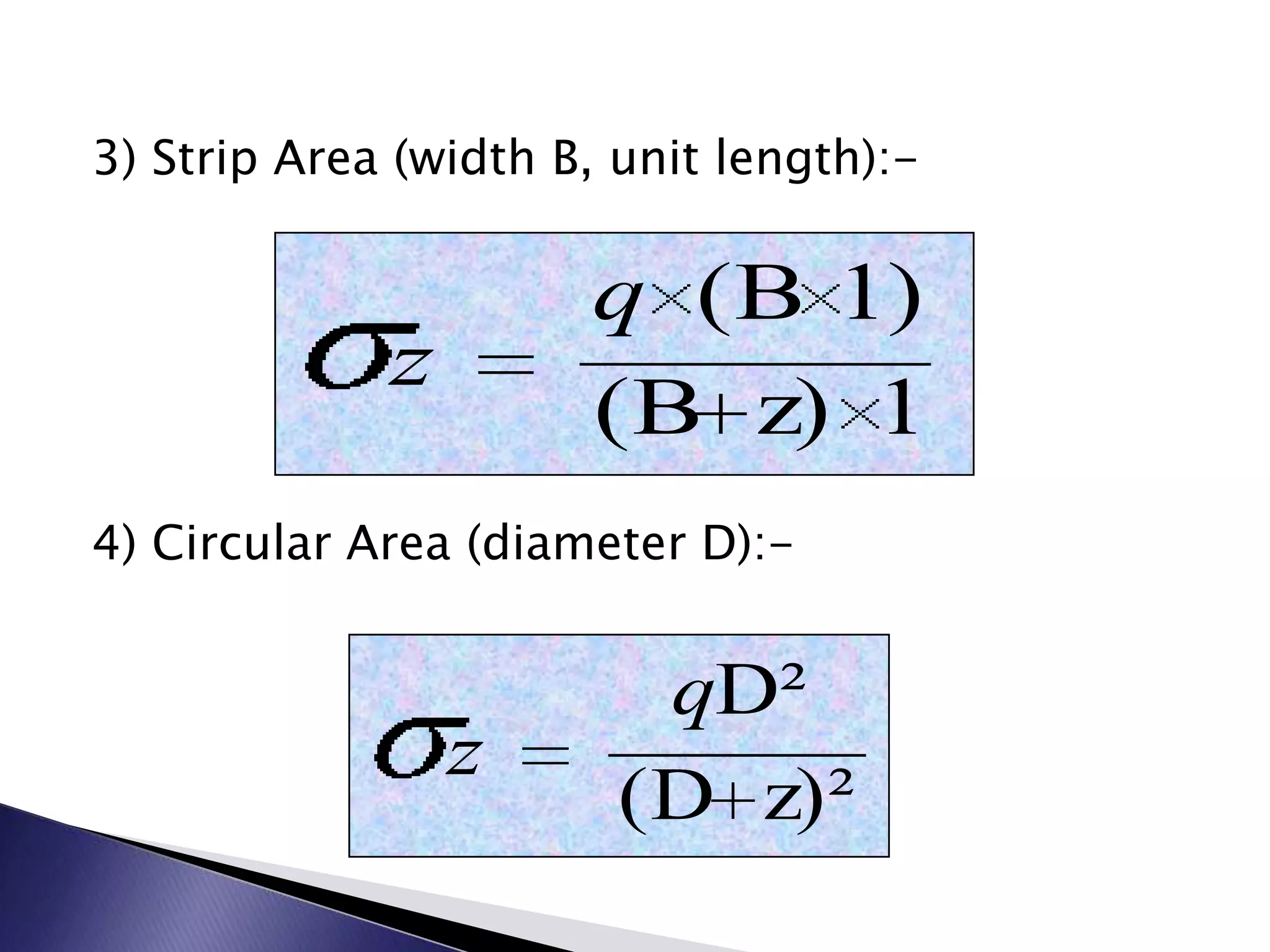
3) Strip Area (width B, unit length):-


                       q (B 1)
             z
                       (B z) 1
4) Circular Area (diameter D):-


                         qD²
                 z
                        (D z)²
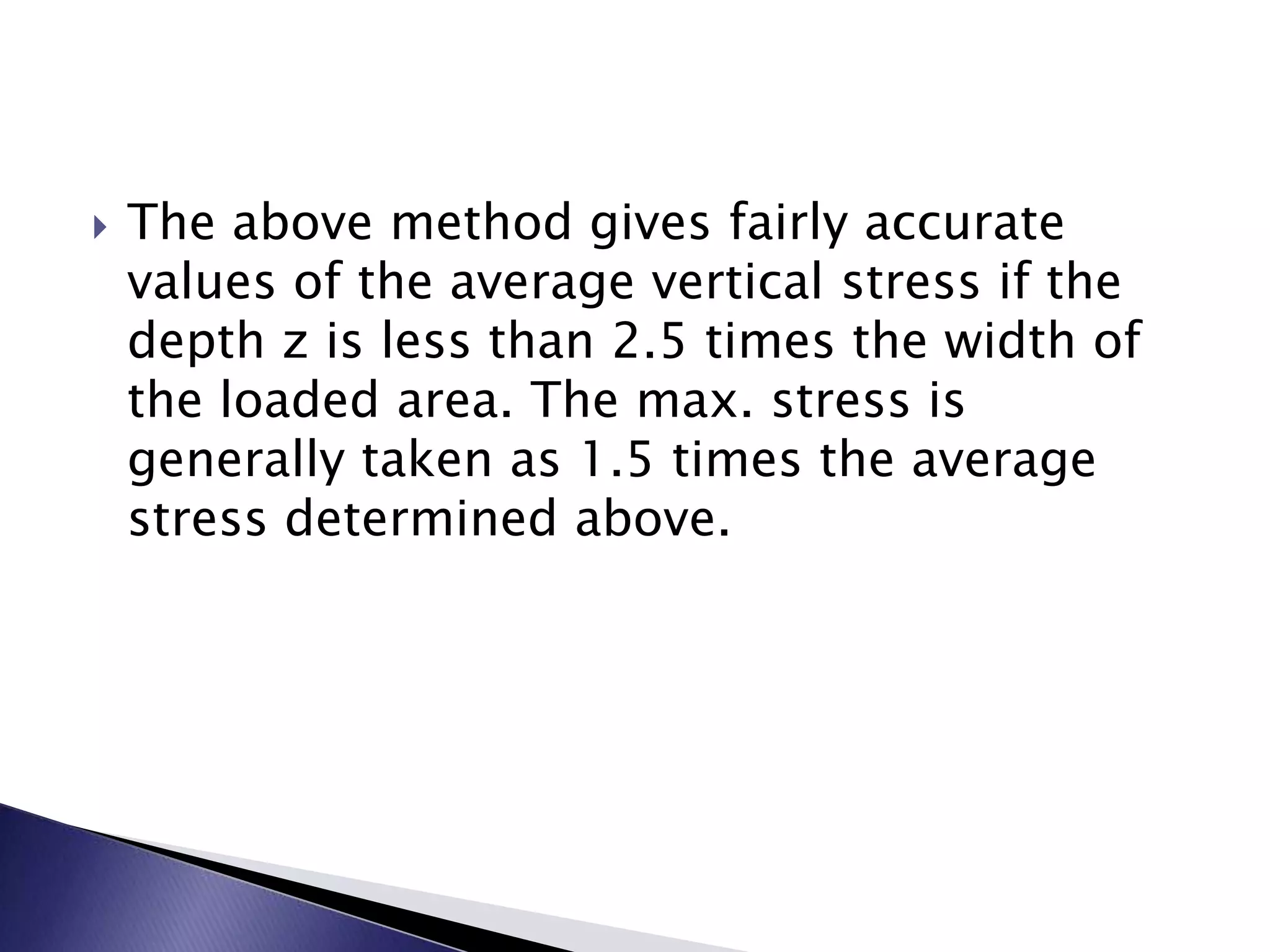
   The above method gives fairly accurate
    values of the average vertical stress if the
    depth z is less than 2.5 times the width of
    the loaded area. The max. stress is
    generally taken as 1.5 times the average
    stress determined above.
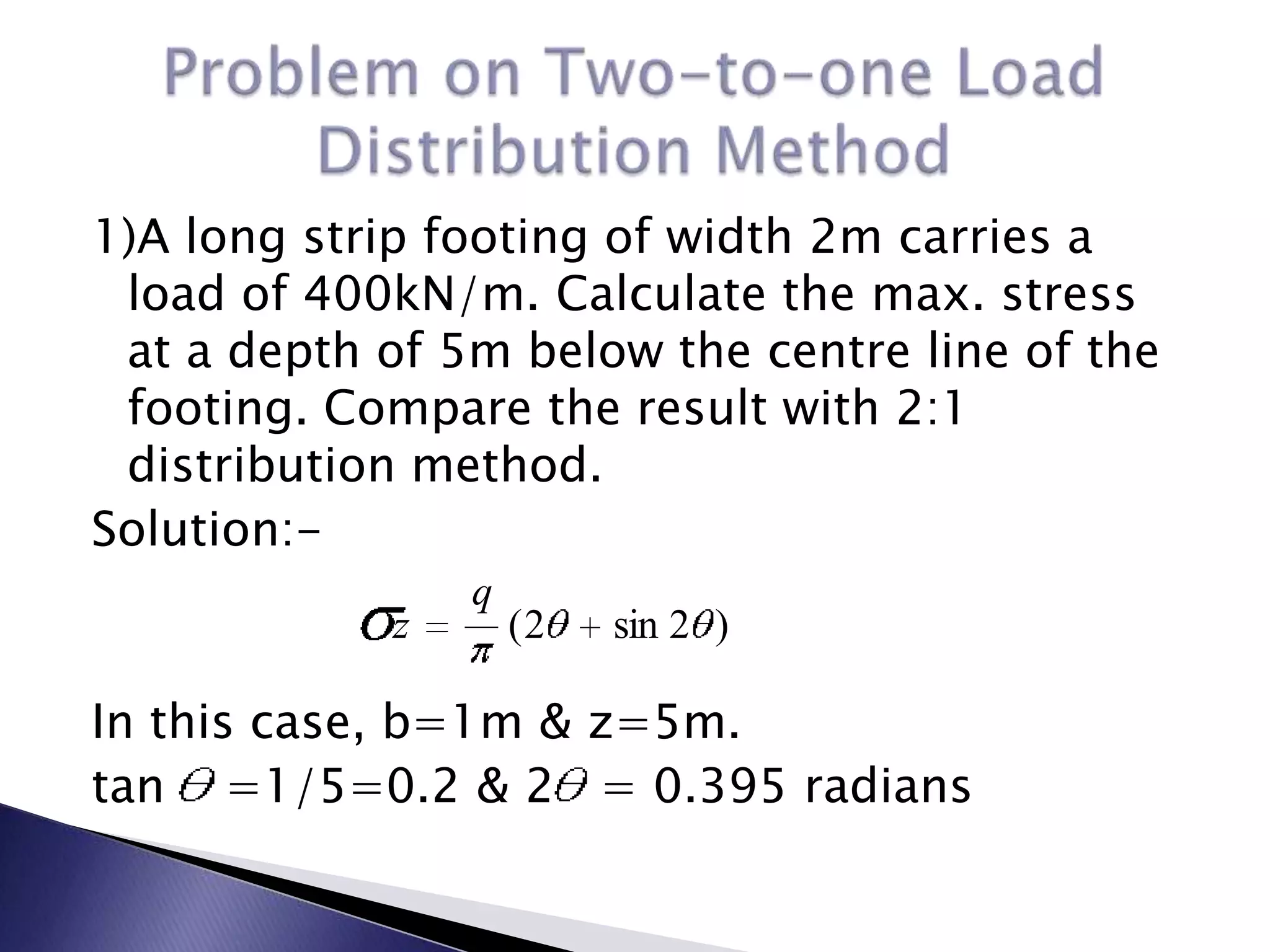
1)A long strip footing of width 2m carries a
 load of 400kN/m. Calculate the max. stress
 at a depth of 5m below the centre line of the
 footing. Compare the result with 2:1
 distribution method.
Solution:-
                q
            z       (2   sin 2 )

In this case, b=1m & z=5m.
tan =1/5=0.2 & 2 = 0.395 radians
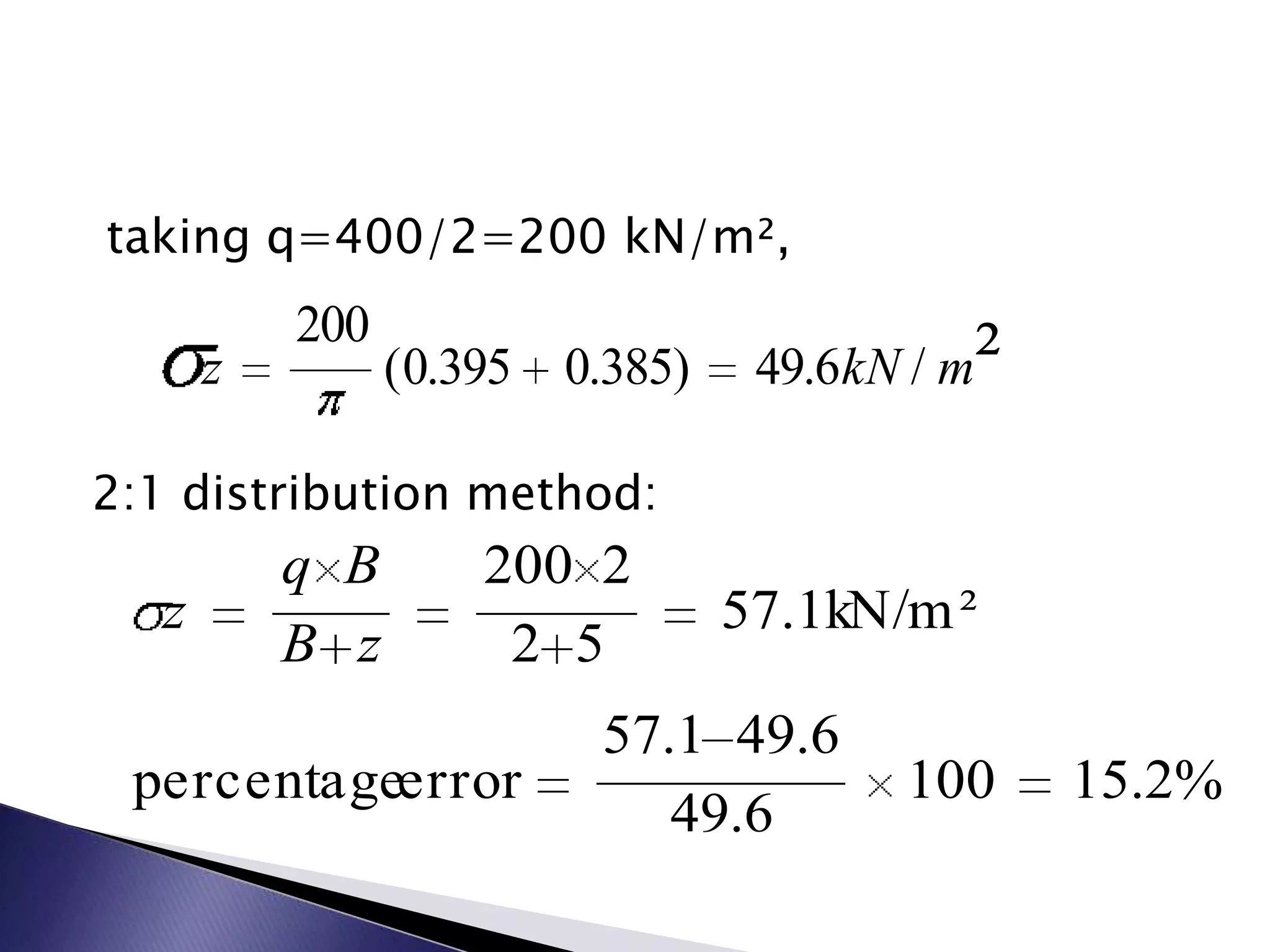
taking q=400/2=200 kN/m²,
           200
       z         ( 0.395 0.385)    49.6kN / m   ²
2:1 distribution method:
           q B       200 2
   z                              57.1kN/m ²
           B z        2 5
                          57.1 49.6
 percentageerror                         100        15.2%
                             49.6
   This method is similar to the preceding
    method. In this case, the pressure
    distribution is assumed along line making an
    angle of 60º with the horizontal instead of
    63.5º(2:1) method gives approximately the
    same results.
 Soil
     mechanics and
 foundation engg by
 K.R.ARORA

 http://en.wikipedia.org
Appreciate
      your time and attention!

Approximate methods by Nikhil Pakwanne

  • 1.
    Government College OfEngineering, Aurangabad. Created By- Nikhil Pakwannne 1
  • 2.
    Approximate Methods for calculation of stresses
  • 3.
    1) Equivalent Point-LoadMethod 2) Two-to-one Load Distribution Method 3) Sixty Degree Distribution Method
  • 4.
    The vertical stress at a point under a loaded area of any shape can be determined by dividing the loaded area into small area & replacing the distributed load on each small area by an equivalent load acting at the centroid of the area shown in fig.
  • 6.
    E.g. in fig. shown Q=qa² for each area. The total load is thus converted into no. of point loads. The vertical stress at any point below or outside the loaded area is equal to the sum of the vertical stresses due to these equivalent point loads using equation, Q1( IB )1 Q 2 ( IB ) 2 ... Qn ( IB ) n z z² Or n 1 z Qi ( IB )i z² i i
  • 7.
    this equation gives fairly accurate results if the side a of the small area unit is equal to or less than one-third of the depth z of point P at which the vertical stress is required.
  • 8.
    1) A rectangularfoundation 3 x 1.5m carries a uniform load of 40 kN/m². Determine the vertical stress at P which is 3m below ground surface. Use equivalent point load method
  • 9.
    Solution:- Let us divide the loaded area into 9 small areas of size 0.5 x 1m. Load on each area = 40 x (1x0.5) = 20kN the stresses at point P are determined due to 9 point loads, using Boussinesq’s solution, for load (1) & (4), 2 2 r 1.5 (0.25) r r 1.521, 0.507 z
  • 10.
    For load 2,3,5,6, r 0.52 (0.25) 2 r r 0.559, 0.186 z  For load 7, r 0.752 (0.5) 2 r r 0.901, 0.300 z
  • 11.
    In this case, 3 20 2 4 z 2 (3) 2 [(1 (0.507) 2 ]2.5 [(1 (0.186) 2 ]2.5 2 1 [(1 (0.30) 2 ]2.5 [(1 (0.559) 2 ]2.5 z 1.061 (1.129 3.674 1.612 0.507 ) z 7.34 kN / m 2
  • 12.
    The actual distribution of load with the depth is complex. However, it can be assumed to spread approximately at a slope of two vertical & one horizontal.  Thus the vertical pressure at any depth z below the soil surface can be determined approximately by constructing a frustum of pyramid of depth z & side slope 2:1.The pressure distribution is assumed to be uniform on horizontal plane at that depth.
  • 14.
    The average vertical stress Z depends upon the shape of the loaded area, 1) Square Area (B x B):- qB ² z (B z)² 2) Rectangular Area (B x L):- q (B L) z (B z)(L z)
  • 15.
    3) Strip Area(width B, unit length):- q (B 1) z (B z) 1 4) Circular Area (diameter D):- qD² z (D z)²
  • 16.
    The above method gives fairly accurate values of the average vertical stress if the depth z is less than 2.5 times the width of the loaded area. The max. stress is generally taken as 1.5 times the average stress determined above.
  • 17.
    1)A long stripfooting of width 2m carries a load of 400kN/m. Calculate the max. stress at a depth of 5m below the centre line of the footing. Compare the result with 2:1 distribution method. Solution:- q z (2 sin 2 ) In this case, b=1m & z=5m. tan =1/5=0.2 & 2 = 0.395 radians
  • 18.
    taking q=400/2=200 kN/m², 200 z ( 0.395 0.385) 49.6kN / m ² 2:1 distribution method: q B 200 2 z 57.1kN/m ² B z 2 5 57.1 49.6 percentageerror 100 15.2% 49.6
  • 19.
    This method is similar to the preceding method. In this case, the pressure distribution is assumed along line making an angle of 60º with the horizontal instead of 63.5º(2:1) method gives approximately the same results.
  • 20.
     Soil mechanics and foundation engg by K.R.ARORA  http://en.wikipedia.org
  • 21.
    Appreciate your time and attention!