A L I R E Z A R A H I Z A D E G A N A S L
Remote Sensing Satellites
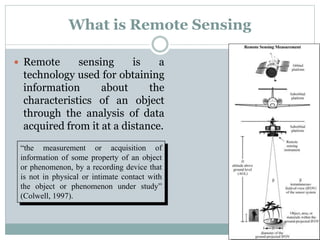
What is Remote Sensing
 Remote sensing is a
technology used for obtaining
information about the
characteristics of an object
through the analysis of data
acquired from it at a distance.
“the measurement or acquisition of
information of some property of an object
or phenomenon, by a recording device that
is not in physical or intimate contact with
the object or phenomenon under study”
(Colwell, 1997).
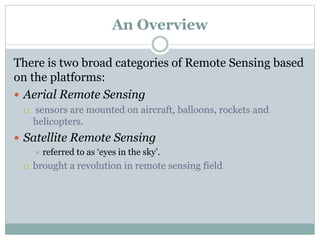
An Overview
There is two broad categories of Remote Sensing based
on the platforms:
 Aerial Remote Sensing
 sensors are mounted on aircraft, balloons, rockets and
helicopters.
 Satellite Remote Sensing
 referred to as ‘eyes in the sky’.
 brought a revolution in remote sensing field
Advantage of Satellite Remote Sensing to
Arial One
1. Continuous acquisition of data
2. Frequent and regular re-visit capabilities resulting in
up-to-date information
3. Broad coverage area
4. Good spectral resolution
5. Semi-automated/computerized processing and analysis
6. Ability to manipulate/enhance data for better image
interpretation
7. Accurate data mapping
 hereafter, whenever remote sensing is mentioned, it will
refer to satellite remote sensing unless otherwise stated.
Classification of Satellite Remote Sensing
Systems
Remote sensing systems can be classified on the two
basis:
a. The source of radiation
1. Passive remote sensing systems
2. Active remote sensing systems
b. The spectral regions used for data acquisition
1. Optical remote sensing systems (including visible, near IR
and shortwave IR systems)
2. Thermal infrared remote sensing systems
3. Microwave remote sensing systems
 Passive remote sensing systems:
 Passive remote sensing systems either detect the solar radiation reflected
by the objects on the surface of the Earth or detect the thermal or
microwave radiation emitted by them.
 A passive system generally consists of an array of sensors or
detectors that record the amount of electromagnetic radiation
reflected and/or emitted from the Earth’s surface.
 Active remote sensing systems
 Active remote sensing systems make use of active artificial
sources of radiation generally mounted on the remote sensing
platform.
 An active system, on the other hand, emits electromagnetic
radiation and measures the intensity of the return signal.
Classification of Satellite Remote Sensing
Systems
Both passive and active sensors can be further
classified as:
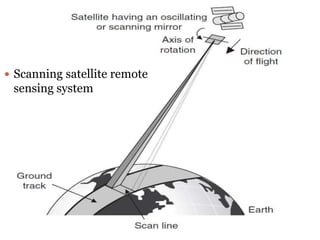
1. Scanning sensors
 The field of interest scanned sequentially
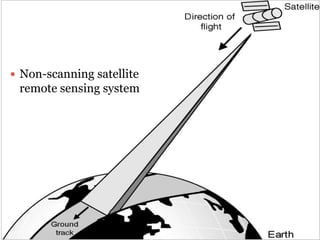
2. Non-scanning sensors
 The entire field of interest is explored in one take.
Classification of Satellite Remote Sensing
Systems
 Scanning satellite remote
sensing system
 Non-scanning satellite
remote sensing system
Classification of Satellite Remote Sensing
Systems based on spectral regions
Optical Remote Sensing
Systems
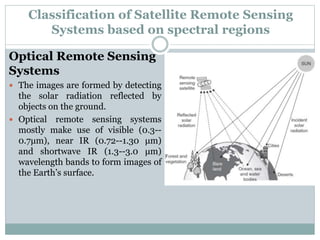
 The images are formed by detecting
the solar radiation reflected by
objects on the ground.
 Optical remote sensing systems
mostly make use of visible (0.3--
0.7μm), near IR (0.72--1.30 μm)
and shortwave IR (1.3--3.0 μm)
wavelength bands to form images of
the Earth’s surface.
Thermal Infrared Remote
Sensing Systems
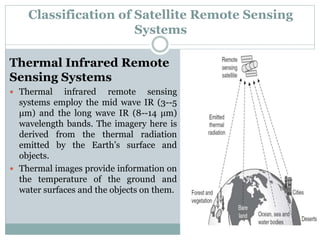
 Thermal infrared remote sensing
systems employ the mid wave IR (3--5
μm) and the long wave IR (8--14 μm)
wavelength bands. The imagery here is
derived from the thermal radiation
emitted by the Earth’s surface and
objects.
 Thermal images provide information on
the temperature of the ground and
water surfaces and the objects on them.
Classification of Satellite Remote Sensing
Systems
Microwave Remote
Sensing Systems
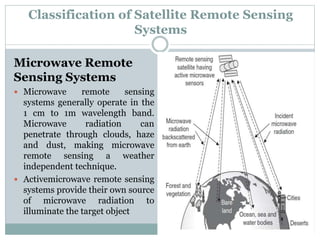
 Microwave remote sensing
systems generally operate in the
1 cm to 1m wavelength band.
Microwave radiation can
penetrate through clouds, haze
and dust, making microwave
remote sensing a weather
independent technique.
 Activemicrowave remote sensing
systems provide their own source
of microwave radiation to
illuminate the target object
Classification of Satellite Remote Sensing
Systems
Remote Sensing Satellite Orbits
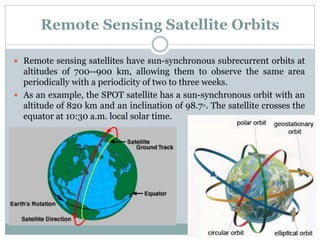
 Remote sensing satellites have sun-synchronous subrecurrent orbits at
altitudes of 700--900 km, allowing them to observe the same area
periodically with a periodicity of two to three weeks.
 As an example, the SPOT satellite has a sun-synchronous orbit with an
altitude of 820 km and an inclination of 98.7◦. The satellite crosses the
equator at 10:30 a.m. local solar time.
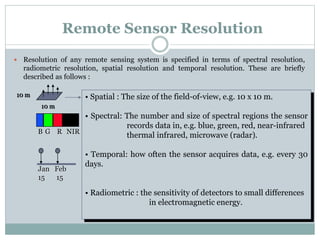
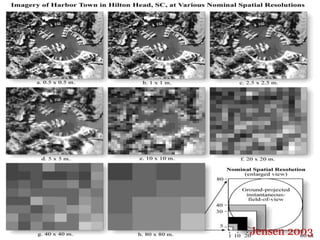
• Spatial : The size of the field-of-view, e.g. 10 x 10 m.
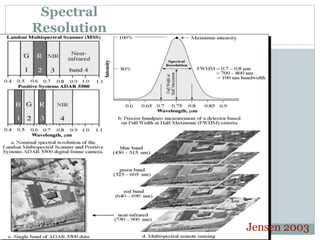
• Spectral: The number and size of spectral regions the sensor
records data in, e.g. blue, green, red, near-infrared
thermal infrared, microwave (radar).
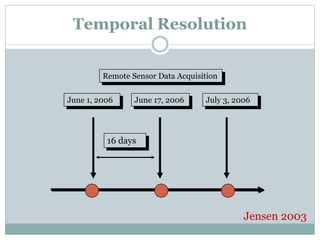
• Temporal: how often the sensor acquires data, e.g. every 30
days.
• Radiometric : the sensitivity of detectors to small differences
in electromagnetic energy.
10 m
B G R NIR
Jan
15
Feb
15
10 m
Remote Sensor Resolution
 Resolution of any remote sensing system is specified in terms of spectral resolution,
radiometric resolution, spatial resolution and temporal resolution. These are briefly
described as follows :
Spatial Resolution
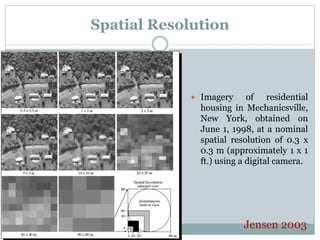
 Imagery of residential
housing in Mechanicsville,
New York, obtained on
June 1, 1998, at a nominal
spatial resolution of 0.3 x
0.3 m (approximately 1 x 1
ft.) using a digital camera.
Jensen 2003
Jensen 2003
Spectral
Resolution
Jensen 2003
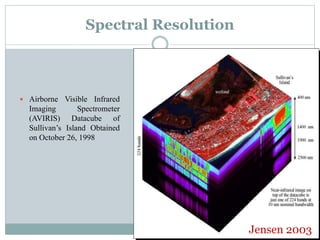
Spectral Resolution
 Airborne Visible Infrared
Imaging Spectrometer
(AVIRIS) Datacube of
Sullivan’s Island Obtained
on October 26, 1998
Jensen 2003
Temporal Resolution
June 1, 2006 June 17, 2006 July 3, 2006
Remote Sensor Data Acquisition
16 days
Jensen 2003
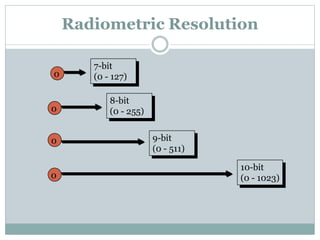
Radiometric Resolution
8-bit
(0 - 255)
9-bit
(0 - 511)
10-bit
(0 - 1023)
0
0
0
7-bit
(0 - 127)0
Passive Sensors
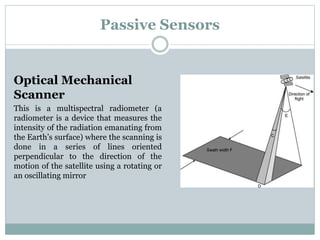
Optical Mechanical
Scanner
This is a multispectral radiometer (a
radiometer is a device that measures the
intensity of the radiation emanating from
the Earth’s surface) where the scanning is
done in a series of lines oriented
perpendicular to the direction of the
motion of the satellite using a rotating or
an oscillating mirror
Passive Sensors
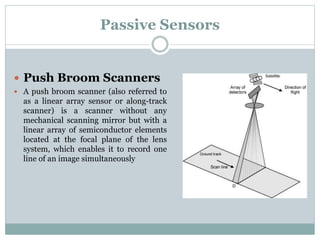
 Push Broom Scanners
 A push broom scanner (also referred to
as a linear array sensor or along-track
scanner) is a scanner without any
mechanical scanning mirror but with a
linear array of semiconductor elements
located at the focal plane of the lens
system, which enables it to record one
line of an image simultaneously
Active Sensors
 Active Non-scanning Sensors
 Active non-scanning sensor systems include microwave altimeters,
microwave scatterometers, laser distance meters and laserwater
depthmeters.
 Active Scanning Sensors
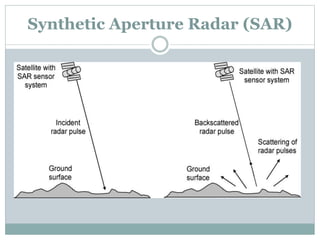
 The most common active scanning sensor used is the synthetic aperture
radar (SAR). In synthetic aperture radar imaging, microwave pulses are
transmitted by an antenna towards the Earth’s surface and the energy
scattered back to the sensor is measured.
Synthetic Aperture Radar (SAR)
Applications of Remote Sensing Satellites
 Land Cover Classification
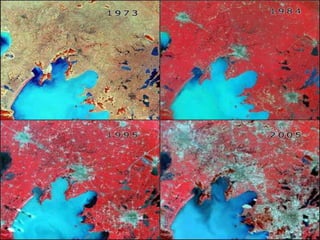
 Land Cover Change Detection
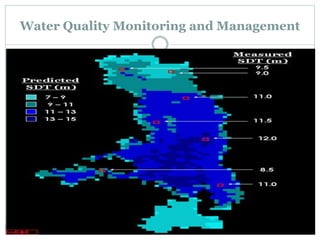
 Water Quality Monitoring and Management
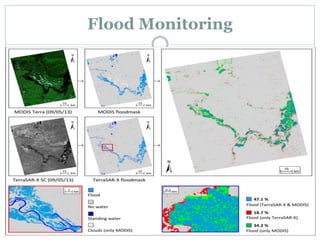
 Flood Monitoring
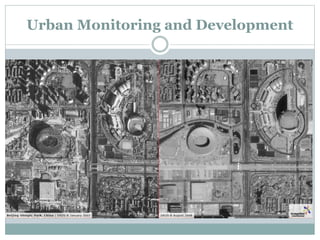
 Urban Monitoring and Development
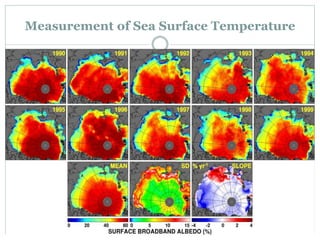
 Measurement of Sea Surface Temperature
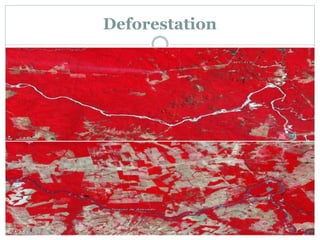
 Deforestation
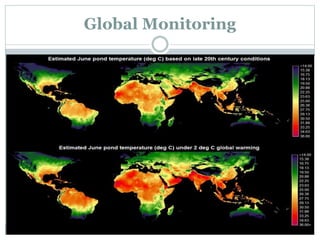
 Global Monitoring
 Predicting Disasters
 Predicting Earthquakes
 Volcanic Eruptions
 Other Applications
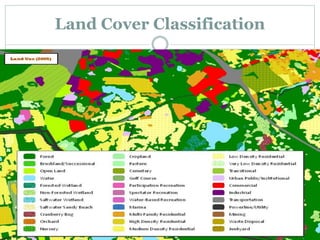
Land Cover Classification
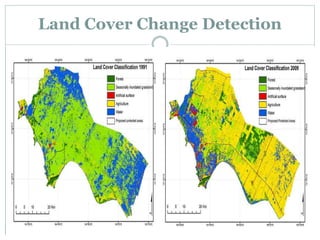
Land Cover Change Detection
Water Quality Monitoring and Management
Flood Monitoring
Urban Monitoring and Development
Measurement of Sea Surface Temperature
Deforestation
Global Monitoring
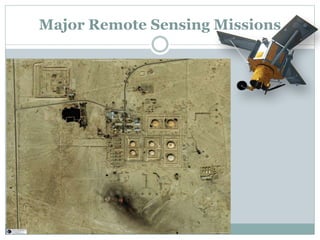
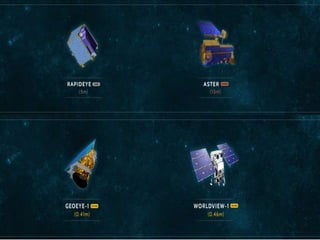
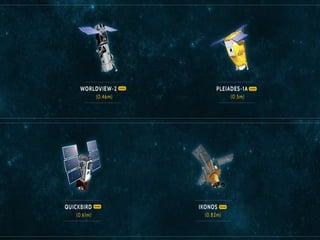
Major Remote Sensing Missions
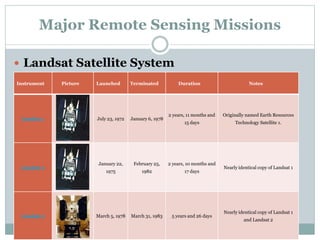
 Landsat Satellite System
Instrument Picture Launched Terminated Duration Notes
Landsat 1 July 23, 1972 January 6, 1978
2 years, 11 months and
15 days
Originally named Earth Resources
Technology Satellite 1.
Landsat 2
January 22,
1975
February 25,
1982
2 years, 10 months and
17 days
Nearly identical copy of Landsat 1
Landsat 3 March 5, 1978 March 31, 1983 5 years and 26 days
Nearly identical copy of Landsat 1
and Landsat 2
Major Remote Sensing Missions(Landsat)
Instrument Picture Launched Terminated Duration Notes
Landsat 4 July 16, 1982
December 14,
1993
11 years, 4 months and
28 days
Landsat 5 March 1, 1984 June 5, 2013[7]
29 years, 3 months and
4 days
Nearly identical copy of Landsat 4.
Longest Earth-observing satellite
mission in history.
Landsat 6
October 5,
1993
October 5, 1993 0 days Failed to reach orbit.
Major Remote Sensing Missions(Landsat)
Instrument Picture Launched Terminated Duration Notes
Landsat 7 April 15, 1999 Still active
16 years, 11 months and
15 days
Operating with scan line corrector
disabled since May 2003.[8]
Landsat 8
February 11,
2013
Still active
3 years, 1 month and
19 days
Originally named Landsat Data
Continuity Mission from launch until
May 30, 2013, when NASA operations
were turned over to USGS.[9]
Major Remote Sensing Missions(Landsat)
Major Remote Sensing Missions
SPOT Satellite System
(satellite pour l’observation de la terre)
 SPOT 1 launched February 22, 1986 with 10 meter panchromatic and 20
meter multispectral picture resolution capability. Withdrawn December 31,
1990.
 SPOT 2 launched January 22, 1990 and deorbited in July 2009.
 SPOT 3 launched September 26, 1993. Stopped functioning November 14,
1997.
 SPOT 4 launched March 24, 1998. Stopped functioning July, 2013.
 SPOT 5 launched May 4, 2002 with 2.5 m, 5 m and 10 m capability.
 SPOT 6 launched September 9, 2012.
 SPOT 7 launched on June 30, 2014
Major Remote Sensing Missions
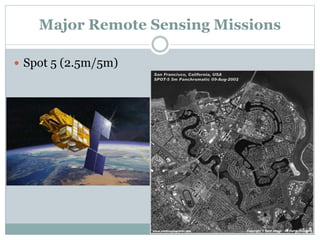
 Spot 5 (2.5m/5m)
Major Remote Sensing Missions
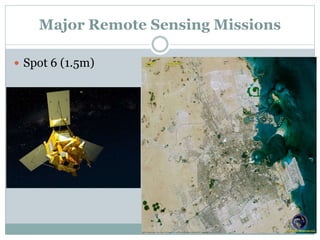
 Spot 6 (1.5m)
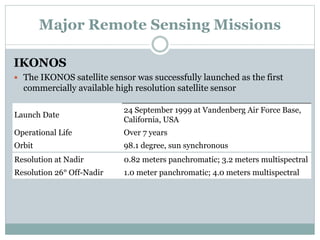
Resolution at Nadir 0.82 meters panchromatic; 3.2 meters multispectral
Resolution 26° Off-Nadir 1.0 meter panchromatic; 4.0 meters multispectral
Major Remote Sensing Missions
IKONOS
 The IKONOS satellite sensor was successfully launched as the first
commercially available high resolution satellite sensor
Launch Date
24 September 1999 at Vandenberg Air Force Base,
California, USA
Operational Life Over 7 years
Orbit 98.1 degree, sun synchronous
Major Remote Sensing Missions
Any Question?
Thank You
for Your
Attention

A Brief Introduction to Remote Sensing Satellites

  • 1.
    A L IR E Z A R A H I Z A D E G A N A S L Remote Sensing Satellites
  • 2.
    What is RemoteSensing  Remote sensing is a technology used for obtaining information about the characteristics of an object through the analysis of data acquired from it at a distance. “the measurement or acquisition of information of some property of an object or phenomenon, by a recording device that is not in physical or intimate contact with the object or phenomenon under study” (Colwell, 1997).
  • 3.
    An Overview There istwo broad categories of Remote Sensing based on the platforms:  Aerial Remote Sensing  sensors are mounted on aircraft, balloons, rockets and helicopters.  Satellite Remote Sensing  referred to as ‘eyes in the sky’.  brought a revolution in remote sensing field
  • 4.
    Advantage of SatelliteRemote Sensing to Arial One 1. Continuous acquisition of data 2. Frequent and regular re-visit capabilities resulting in up-to-date information 3. Broad coverage area 4. Good spectral resolution 5. Semi-automated/computerized processing and analysis 6. Ability to manipulate/enhance data for better image interpretation 7. Accurate data mapping  hereafter, whenever remote sensing is mentioned, it will refer to satellite remote sensing unless otherwise stated.
  • 5.
    Classification of SatelliteRemote Sensing Systems Remote sensing systems can be classified on the two basis: a. The source of radiation 1. Passive remote sensing systems 2. Active remote sensing systems b. The spectral regions used for data acquisition 1. Optical remote sensing systems (including visible, near IR and shortwave IR systems) 2. Thermal infrared remote sensing systems 3. Microwave remote sensing systems
  • 6.
     Passive remotesensing systems:  Passive remote sensing systems either detect the solar radiation reflected by the objects on the surface of the Earth or detect the thermal or microwave radiation emitted by them.  A passive system generally consists of an array of sensors or detectors that record the amount of electromagnetic radiation reflected and/or emitted from the Earth’s surface.  Active remote sensing systems  Active remote sensing systems make use of active artificial sources of radiation generally mounted on the remote sensing platform.  An active system, on the other hand, emits electromagnetic radiation and measures the intensity of the return signal. Classification of Satellite Remote Sensing Systems
  • 7.
    Both passive andactive sensors can be further classified as: 1. Scanning sensors  The field of interest scanned sequentially 2. Non-scanning sensors  The entire field of interest is explored in one take. Classification of Satellite Remote Sensing Systems
  • 8.
     Scanning satelliteremote sensing system
  • 9.
  • 10.
    Classification of SatelliteRemote Sensing Systems based on spectral regions Optical Remote Sensing Systems  The images are formed by detecting the solar radiation reflected by objects on the ground.  Optical remote sensing systems mostly make use of visible (0.3-- 0.7μm), near IR (0.72--1.30 μm) and shortwave IR (1.3--3.0 μm) wavelength bands to form images of the Earth’s surface.
  • 11.
    Thermal Infrared Remote SensingSystems  Thermal infrared remote sensing systems employ the mid wave IR (3--5 μm) and the long wave IR (8--14 μm) wavelength bands. The imagery here is derived from the thermal radiation emitted by the Earth’s surface and objects.  Thermal images provide information on the temperature of the ground and water surfaces and the objects on them. Classification of Satellite Remote Sensing Systems
  • 12.
    Microwave Remote Sensing Systems Microwave remote sensing systems generally operate in the 1 cm to 1m wavelength band. Microwave radiation can penetrate through clouds, haze and dust, making microwave remote sensing a weather independent technique.  Activemicrowave remote sensing systems provide their own source of microwave radiation to illuminate the target object Classification of Satellite Remote Sensing Systems
  • 13.
    Remote Sensing SatelliteOrbits  Remote sensing satellites have sun-synchronous subrecurrent orbits at altitudes of 700--900 km, allowing them to observe the same area periodically with a periodicity of two to three weeks.  As an example, the SPOT satellite has a sun-synchronous orbit with an altitude of 820 km and an inclination of 98.7◦. The satellite crosses the equator at 10:30 a.m. local solar time.
  • 14.
    • Spatial :The size of the field-of-view, e.g. 10 x 10 m. • Spectral: The number and size of spectral regions the sensor records data in, e.g. blue, green, red, near-infrared thermal infrared, microwave (radar). • Temporal: how often the sensor acquires data, e.g. every 30 days. • Radiometric : the sensitivity of detectors to small differences in electromagnetic energy. 10 m B G R NIR Jan 15 Feb 15 10 m Remote Sensor Resolution  Resolution of any remote sensing system is specified in terms of spectral resolution, radiometric resolution, spatial resolution and temporal resolution. These are briefly described as follows :
  • 15.
    Spatial Resolution  Imageryof residential housing in Mechanicsville, New York, obtained on June 1, 1998, at a nominal spatial resolution of 0.3 x 0.3 m (approximately 1 x 1 ft.) using a digital camera. Jensen 2003
  • 16.
  • 17.
  • 18.
    Spectral Resolution  AirborneVisible Infrared Imaging Spectrometer (AVIRIS) Datacube of Sullivan’s Island Obtained on October 26, 1998 Jensen 2003
  • 19.
    Temporal Resolution June 1,2006 June 17, 2006 July 3, 2006 Remote Sensor Data Acquisition 16 days Jensen 2003
  • 20.
    Radiometric Resolution 8-bit (0 -255) 9-bit (0 - 511) 10-bit (0 - 1023) 0 0 0 7-bit (0 - 127)0
  • 21.
    Passive Sensors Optical Mechanical Scanner Thisis a multispectral radiometer (a radiometer is a device that measures the intensity of the radiation emanating from the Earth’s surface) where the scanning is done in a series of lines oriented perpendicular to the direction of the motion of the satellite using a rotating or an oscillating mirror
  • 22.
    Passive Sensors  PushBroom Scanners  A push broom scanner (also referred to as a linear array sensor or along-track scanner) is a scanner without any mechanical scanning mirror but with a linear array of semiconductor elements located at the focal plane of the lens system, which enables it to record one line of an image simultaneously
  • 23.
    Active Sensors  ActiveNon-scanning Sensors  Active non-scanning sensor systems include microwave altimeters, microwave scatterometers, laser distance meters and laserwater depthmeters.  Active Scanning Sensors  The most common active scanning sensor used is the synthetic aperture radar (SAR). In synthetic aperture radar imaging, microwave pulses are transmitted by an antenna towards the Earth’s surface and the energy scattered back to the sensor is measured.
  • 24.
  • 25.
    Applications of RemoteSensing Satellites  Land Cover Classification  Land Cover Change Detection  Water Quality Monitoring and Management  Flood Monitoring  Urban Monitoring and Development  Measurement of Sea Surface Temperature  Deforestation  Global Monitoring  Predicting Disasters  Predicting Earthquakes  Volcanic Eruptions  Other Applications
  • 26.
  • 27.
  • 28.
  • 29.
  • 30.
  • 31.
    Measurement of SeaSurface Temperature
  • 32.
  • 33.
  • 34.
    Major Remote SensingMissions  Landsat Satellite System Instrument Picture Launched Terminated Duration Notes Landsat 1 July 23, 1972 January 6, 1978 2 years, 11 months and 15 days Originally named Earth Resources Technology Satellite 1. Landsat 2 January 22, 1975 February 25, 1982 2 years, 10 months and 17 days Nearly identical copy of Landsat 1 Landsat 3 March 5, 1978 March 31, 1983 5 years and 26 days Nearly identical copy of Landsat 1 and Landsat 2
  • 35.
    Major Remote SensingMissions(Landsat) Instrument Picture Launched Terminated Duration Notes Landsat 4 July 16, 1982 December 14, 1993 11 years, 4 months and 28 days Landsat 5 March 1, 1984 June 5, 2013[7] 29 years, 3 months and 4 days Nearly identical copy of Landsat 4. Longest Earth-observing satellite mission in history. Landsat 6 October 5, 1993 October 5, 1993 0 days Failed to reach orbit.
  • 36.
    Major Remote SensingMissions(Landsat) Instrument Picture Launched Terminated Duration Notes Landsat 7 April 15, 1999 Still active 16 years, 11 months and 15 days Operating with scan line corrector disabled since May 2003.[8] Landsat 8 February 11, 2013 Still active 3 years, 1 month and 19 days Originally named Landsat Data Continuity Mission from launch until May 30, 2013, when NASA operations were turned over to USGS.[9]
  • 37.
    Major Remote SensingMissions(Landsat)
  • 38.
    Major Remote SensingMissions SPOT Satellite System (satellite pour l’observation de la terre)  SPOT 1 launched February 22, 1986 with 10 meter panchromatic and 20 meter multispectral picture resolution capability. Withdrawn December 31, 1990.  SPOT 2 launched January 22, 1990 and deorbited in July 2009.  SPOT 3 launched September 26, 1993. Stopped functioning November 14, 1997.  SPOT 4 launched March 24, 1998. Stopped functioning July, 2013.  SPOT 5 launched May 4, 2002 with 2.5 m, 5 m and 10 m capability.  SPOT 6 launched September 9, 2012.  SPOT 7 launched on June 30, 2014
  • 39.
    Major Remote SensingMissions  Spot 5 (2.5m/5m)
  • 40.
    Major Remote SensingMissions  Spot 6 (1.5m)
  • 41.
    Resolution at Nadir0.82 meters panchromatic; 3.2 meters multispectral Resolution 26° Off-Nadir 1.0 meter panchromatic; 4.0 meters multispectral Major Remote Sensing Missions IKONOS  The IKONOS satellite sensor was successfully launched as the first commercially available high resolution satellite sensor Launch Date 24 September 1999 at Vandenberg Air Force Base, California, USA Operational Life Over 7 years Orbit 98.1 degree, sun synchronous
  • 42.
  • 43.
  • 45.
  • 46.