IN PURSUIT OF GLOBAL COMPETITIVENESS


AN AUTONOMUS INSTITUTE OF GOVT. OF
         MAHARASHTRA
CEMENT


     Created BY:-
         Nikhil Pakwanne
CEMENT
   Cement   is a Building material obtained by
burning and crushing of powder form ,
  homogeneous and well proportioned mixture of
lime (calcareous) and clay (argillaceous material).
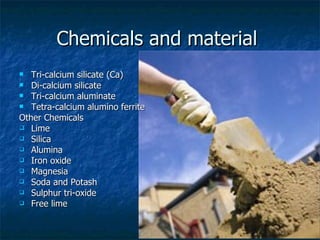
Chemicals and material
  Tri-calcium silicate (Ca)
 Di-calcium silicate
 Tri-calcium aluminate
 Tetra-calcium alumino ferrite

Other Chemicals
 Lime
 Silica
 Alumina
 Iron oxide
 Magnesia
 Soda and Potash
 Sulphur tri-oxide
 Free lime
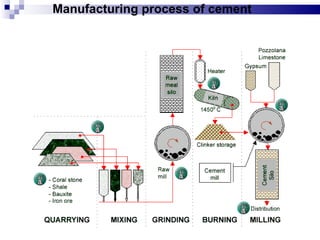
Manufacturing process of cement
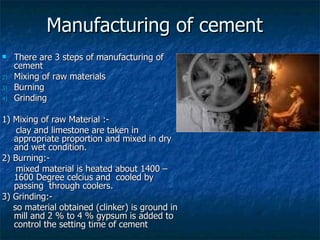
Manufacturing of cement
    There are 3 steps of manufacturing of
     cement
2)   Mixing of raw materials
3)   Burning
4)   Grinding

1) Mixing of raw Material :-
    clay and limestone are taken in
   appropriate proportion and mixed in dry
   and wet condition.
2) Burning:-
    mixed material is heated about 1400 –
   1600 Degree celcius and cooled by
   passing through coolers.
3) Grinding:-
   so material obtained (clinker) is ground in
   mill and 2 % to 4 % gypsum is added to
   control the setting time of cement
T ype o C e nt
                    sf    me
1)Ordinary Portland cement
2)Portland Pozzolana Cement
3)Sulphate Resisting Cement
4)Coloured Cement
5)Rediset Cement
6)Very high strength cement
7)Rapid Hardening Cement
8) Portland Slag Cement
9)Masonry Cement
10)Oil Well Cement
Ordinary Portland Cement
                                          (is 269:1989)
   Although there are many types of Cement , about 80 -90% of total
    production is of Ordinary Portland Cement (OPC) only.
   OPC is classified in three types of grades depending upon strength
    of cement as
          1)33 Grade
          2)43 Grade
          3)53 Grade

   Faster rate of development of strength
   Offers 10-20 % savings in cement consumption
   33 grade cement is almost out of the market
   The manufacture of OPC is decreasing in view of popularity of
    blended cement on account of lower energy consumption,
    environmental pollution.
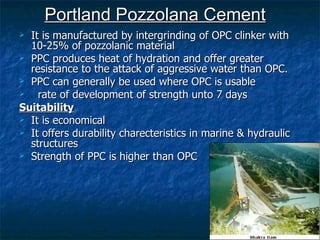
Portland Pozzolana Cement
 It is manufactured by intergrinding of OPC clinker with
  10-25% of pozzolanic material
 PPC produces heat of hydration and offer greater
  resistance to the attack of aggressive water than OPC.
 PPC can generally be used where OPC is usable
   rate of development of strength unto 7 days
Suitability
 It is economical
 It offers durability charecteristics in marine & hydraulic
  structures
 Strength of PPC is higher than OPC
Coloured cement
                           (is 8042-1989)
   For manufacturing of this cement ,white or grey
    portland cement is used as base
   Use of white cement is costly while using grey
    portland cement only red & brown cement can
    be produced
   Consists of PPC with 5-10% of pigment
   For manufacture of white portland cement
    required limestone is only available around
    Jodhpur(Rajasthan)
   White cement is ground finer than grey cement
Rapid Hardening Cement
             (is 8041-1990)
   This cement develops higher rate of
    development of strength
   Suitability
          -Road repair works
          -In pre-fabricated concrete
    construction
          -In cold weather concrete
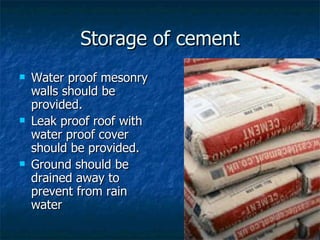
Storage of cement
   Water proof mesonry
    walls should be
    provided.
   Leak proof roof with
    water proof cover
    should be provided.
   Ground should be
    drained away to
    prevent from rain
    water
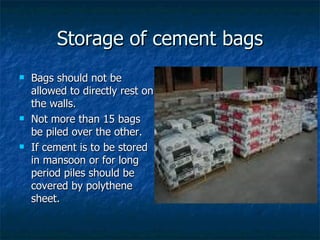
Storage of cement bags
   Bags should not be
    allowed to directly rest on
    the walls.
   Not more than 15 bags
    be piled over the other.
   If cement is to be stored
    in mansoon or for long
    period piles should be
    covered by polythene
    sheet.
Field Tests for cement
   Cement should be of uniform color.
   When small sample of cement is rubbed
    between fingers ,it should feel smooth and
    cool.
   There should no lumps in the cement.
Laboratory tests of cement
1)Fineness :-
  This test is varified by using I.S. sieve No.9.
  -now gentle sieving is done for fifteen minutes.
  -The residue left is measured this should not be exceed
   10 % by weight of the sample of the cement.
2)Consistency:-
  This is a test sonducted to estimate quantity
  of water to be mixed with cement.
3) Soundness of cement ;-
 Due to excess of lime in the cement expansion of cement
   occurs, that should be minimized.
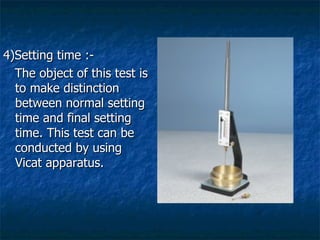
4)Setting time :-
  The object of this test is
  to make distinction
  between normal setting
  time and final setting
  time. This test can be
  conducted by using
  Vicat apparatus.
References
   S.Ramamrutham ,Basics of civil
    Engineering,Dhanpat rai publishing
    company,New Delhi.
   www.cemex.com
Cement by Nikhil Pakwanne

Cement by Nikhil Pakwanne

  • 1.
    IN PURSUIT OFGLOBAL COMPETITIVENESS AN AUTONOMUS INSTITUTE OF GOVT. OF MAHARASHTRA
  • 2.
    CEMENT Created BY:- Nikhil Pakwanne
  • 3.
    CEMENT Cement is a Building material obtained by burning and crushing of powder form , homogeneous and well proportioned mixture of lime (calcareous) and clay (argillaceous material).
  • 4.
    Chemicals and material  Tri-calcium silicate (Ca)  Di-calcium silicate  Tri-calcium aluminate  Tetra-calcium alumino ferrite Other Chemicals  Lime  Silica  Alumina  Iron oxide  Magnesia  Soda and Potash  Sulphur tri-oxide  Free lime
  • 5.
  • 6.
    Manufacturing of cement  There are 3 steps of manufacturing of cement 2) Mixing of raw materials 3) Burning 4) Grinding 1) Mixing of raw Material :- clay and limestone are taken in appropriate proportion and mixed in dry and wet condition. 2) Burning:- mixed material is heated about 1400 – 1600 Degree celcius and cooled by passing through coolers. 3) Grinding:- so material obtained (clinker) is ground in mill and 2 % to 4 % gypsum is added to control the setting time of cement
  • 7.
    T ype oC e nt sf me 1)Ordinary Portland cement 2)Portland Pozzolana Cement 3)Sulphate Resisting Cement 4)Coloured Cement 5)Rediset Cement 6)Very high strength cement 7)Rapid Hardening Cement 8) Portland Slag Cement 9)Masonry Cement 10)Oil Well Cement
  • 8.
    Ordinary Portland Cement (is 269:1989)  Although there are many types of Cement , about 80 -90% of total production is of Ordinary Portland Cement (OPC) only.  OPC is classified in three types of grades depending upon strength of cement as 1)33 Grade 2)43 Grade 3)53 Grade  Faster rate of development of strength  Offers 10-20 % savings in cement consumption  33 grade cement is almost out of the market  The manufacture of OPC is decreasing in view of popularity of blended cement on account of lower energy consumption, environmental pollution.
  • 9.
    Portland Pozzolana Cement It is manufactured by intergrinding of OPC clinker with 10-25% of pozzolanic material  PPC produces heat of hydration and offer greater resistance to the attack of aggressive water than OPC.  PPC can generally be used where OPC is usable  rate of development of strength unto 7 days Suitability  It is economical  It offers durability charecteristics in marine & hydraulic structures  Strength of PPC is higher than OPC
  • 10.
    Coloured cement (is 8042-1989)  For manufacturing of this cement ,white or grey portland cement is used as base  Use of white cement is costly while using grey portland cement only red & brown cement can be produced  Consists of PPC with 5-10% of pigment  For manufacture of white portland cement required limestone is only available around Jodhpur(Rajasthan)  White cement is ground finer than grey cement
  • 11.
    Rapid Hardening Cement (is 8041-1990)  This cement develops higher rate of development of strength  Suitability -Road repair works -In pre-fabricated concrete construction -In cold weather concrete
  • 12.
    Storage of cement  Water proof mesonry walls should be provided.  Leak proof roof with water proof cover should be provided.  Ground should be drained away to prevent from rain water
  • 13.
    Storage of cementbags  Bags should not be allowed to directly rest on the walls.  Not more than 15 bags be piled over the other.  If cement is to be stored in mansoon or for long period piles should be covered by polythene sheet.
  • 14.
    Field Tests forcement  Cement should be of uniform color.  When small sample of cement is rubbed between fingers ,it should feel smooth and cool.  There should no lumps in the cement.
  • 15.
    Laboratory tests ofcement 1)Fineness :- This test is varified by using I.S. sieve No.9. -now gentle sieving is done for fifteen minutes. -The residue left is measured this should not be exceed 10 % by weight of the sample of the cement. 2)Consistency:- This is a test sonducted to estimate quantity of water to be mixed with cement. 3) Soundness of cement ;- Due to excess of lime in the cement expansion of cement occurs, that should be minimized.
  • 16.
    4)Setting time :- The object of this test is to make distinction between normal setting time and final setting time. This test can be conducted by using Vicat apparatus.
  • 17.
    References  S.Ramamrutham ,Basics of civil Engineering,Dhanpat rai publishing company,New Delhi.  www.cemex.com