Welcome
P.TEJASREE
BAM-20-27
Dept Of GPBR
Learning Objectives
– what is population
– What is population genetics
– What is Mendelian population
– What is gene pool
– What is gene frequency
– What is genotypic frequency
– What is Hardy-Weinberg Equilibrium
– What are evolutionary forces in a population
– What are the significance of Hardy-Wienberg equilibrium
– Factors affecting H-W principle
What is a Population
– Definition: A group of individuals of a particular species occupying a
definite space, in which the individuals interact, interbreed and
exchange genetic materials.
– Species is a group of living organism comprising of similar individuals
capable of exchanging genes through interbreeding
– Individuals of same species of a particular region is called population
– A part from its ecological significance, population has a important role in
the process of evolution
What is Population genetics
 Study of distributions and changes of allele frequency and interaction of
allele in a population
 Population is prone to the four main evolutionary forces:
1. Natural selection
2. Genetic drift
3. Mutation
4. Migration
 Study of population genetics is essential for species adaptation and
evolution
– For better understanding of population genetics we must study
1.Mendalian population
2.Gene pool
3.Gene frequency
4.Genotypic frequency
5.Hardy Weinberg Law
6.Evolutionary forces in population
Mendelian Population
 A group of sexually interbreeding organism also called as genetic
population or random mating population
 Definition: A community of similar individuals living within a
circumscribed area at a given time and capable of interbreeding
to produce fertile offspring's.
 Mendelian population is characterized by individuals having
somewhat similar genetic constitution
Gene pool
– Sum total of genes present in the Reproductive individuals of a
population called Gene pool
– A gene pool of population describes:
1. Gene present in the population
2. Properties different kinds of gene
3. Pattern of distribution of gene in the individuals of population
Allelic frequency
 Suppose there are 100 individuals in a population, in which
 40 are homozygous dominant (AA)
 40 are heterozygous dominant(Aa)
 20 are homozygous recessive(aa)
 The frequency of ‘A’ allele will be (p)
(119+1/2 *76)/208=0.75
 The frequency of ‘a’ allele will be (q)
(13+1/2*76)/208=0.25
 Gene frequency calculated by dividing the no.of a particular allele
with total no.of allele present on that locus in the population
GENOTYPE FREQUENCY
– Definition: The Proportions of different genotypes for a gene in a
population are known as genotypic frequency
– Genotype frequency is the proportion of a genotype in a sample
will be the ratio of the number of individuals having that genotype
to the total number of individuals in the sample.
– Genotypic frequencies for MN blood group
– L^M L^M = 0.57 (119/208) p2=0.56
– L^M L^N = 0.36 (76/208) 2pq = 0.38
– L^N L^N = 0.06 (13/208) q2=0.06
Gene frequency
– Definition : Proportion of different alleles of a gene present in a Mendelian Population
are known as Gene frequency
– If a gene has two alleles for eg; L^M And L^N, their frequencies may be represented by p
and q
– p = 0.75 , q = 0.25
– p+q = (0.75+0.25) p+q = 1
– p = 1-q ,q = 1-p
– For gene with multiple alleles
– The A-B-O blood types are determined by three alleles IA,IB,and i
– Frequencies of these are p,q and r respectively
– The frequencies of 6 different genotypes in the A-B-O blood typing system are
obtained by expanding the trinomial (p+q+r)2=p2+q2+r2+2pq+2qr+2pr
– N :- Total no.of individuals in the population
– D :- Total no.of homozygous dominant
– H :- Total no.of heterozygous dominant
– R :- Total no.of homozygous recessive
– Genotypic frequency of AA individuals D/N
– G.f of Aa individuals H/N
– G.f of aa individuals R/N
HARDY WIENBERG’S EQUILIBRIUM
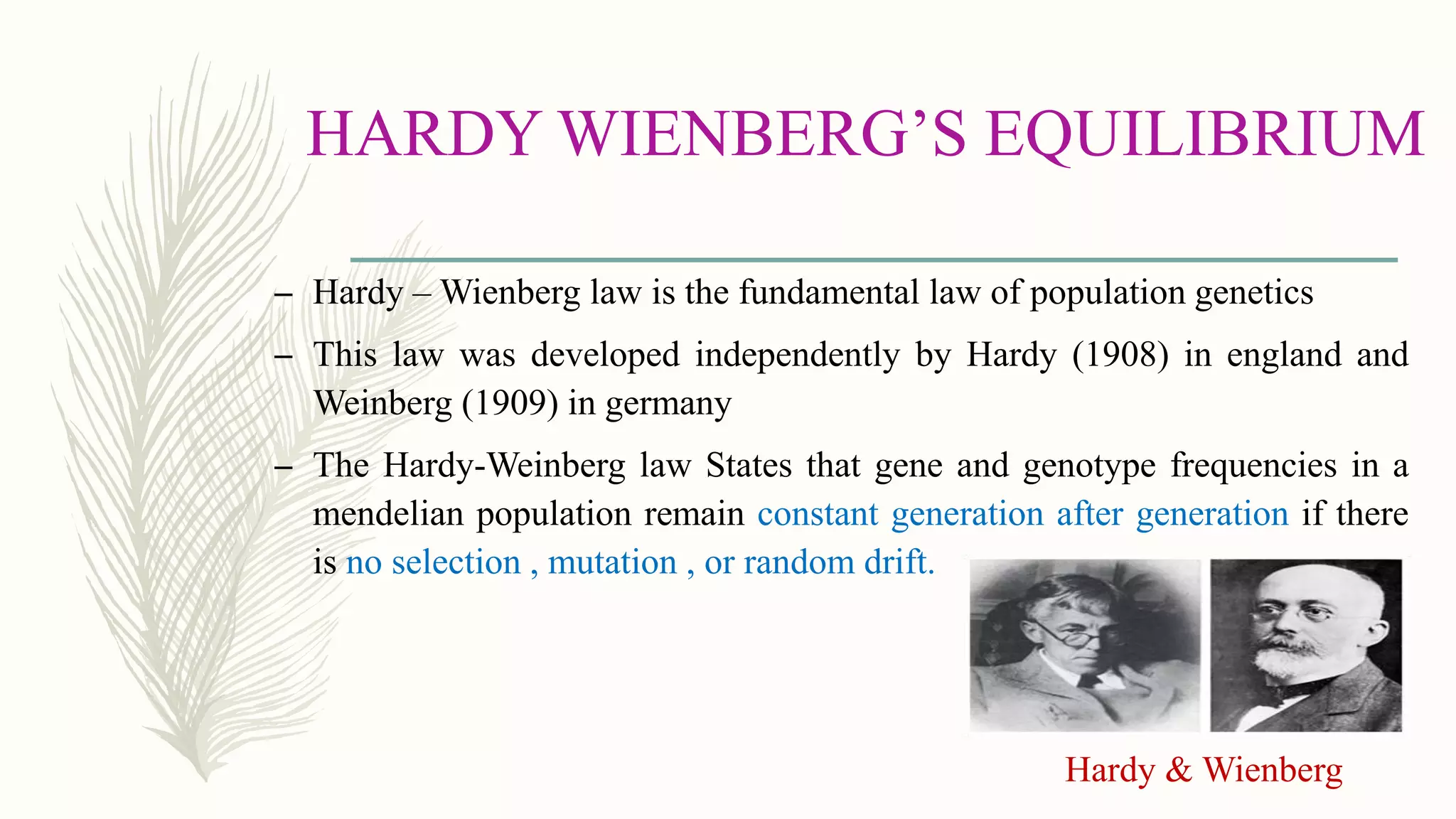
– Hardy – Wienberg law is the fundamental law of population genetics
– This law was developed independently by Hardy (1908) in england and
Weinberg (1909) in germany
– The Hardy-Weinberg law States that gene and genotype frequencies in a
mendelian population remain constant generation after generation if there
is no selection , mutation , or random drift.
Hardy & Wienberg
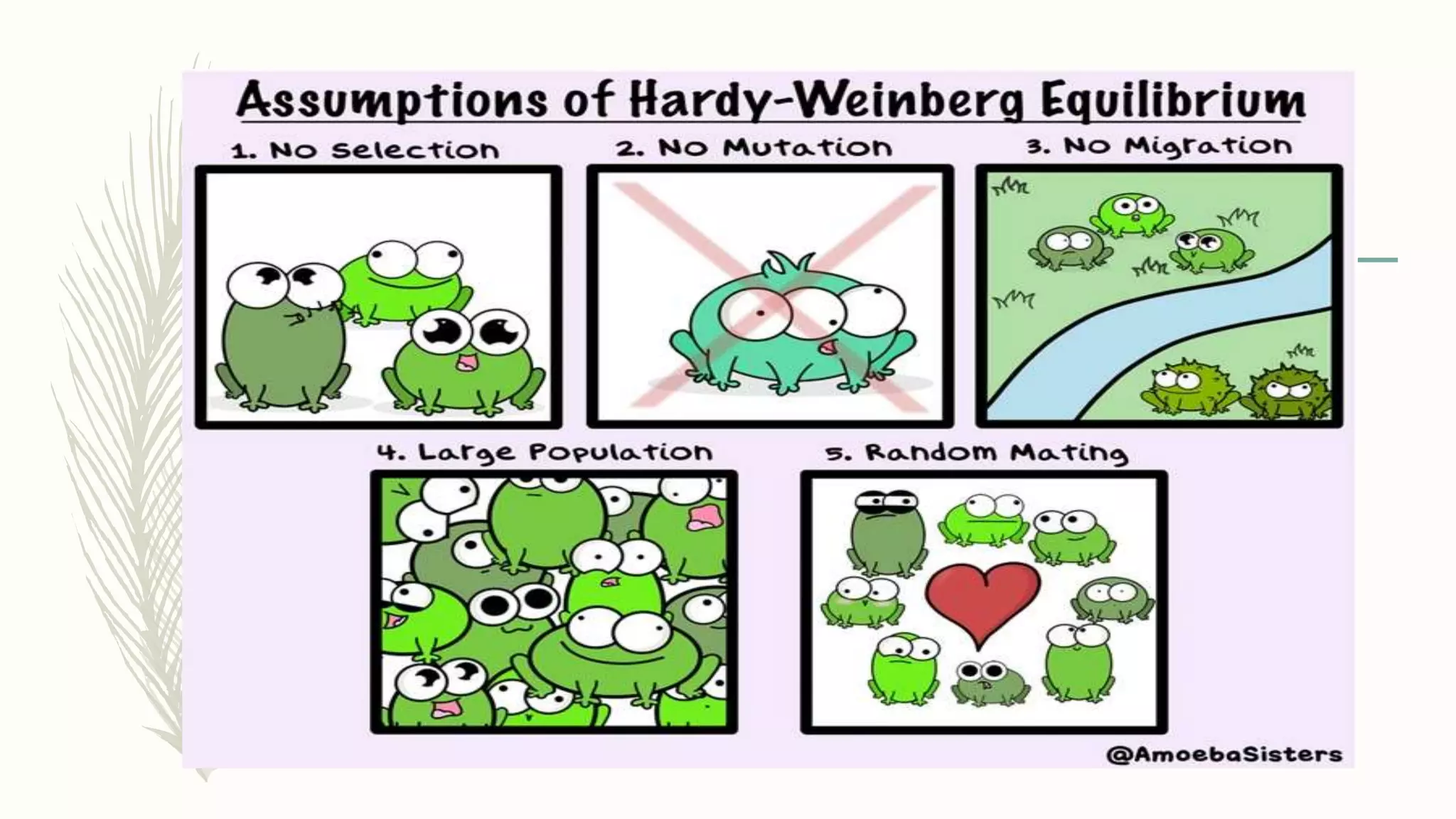
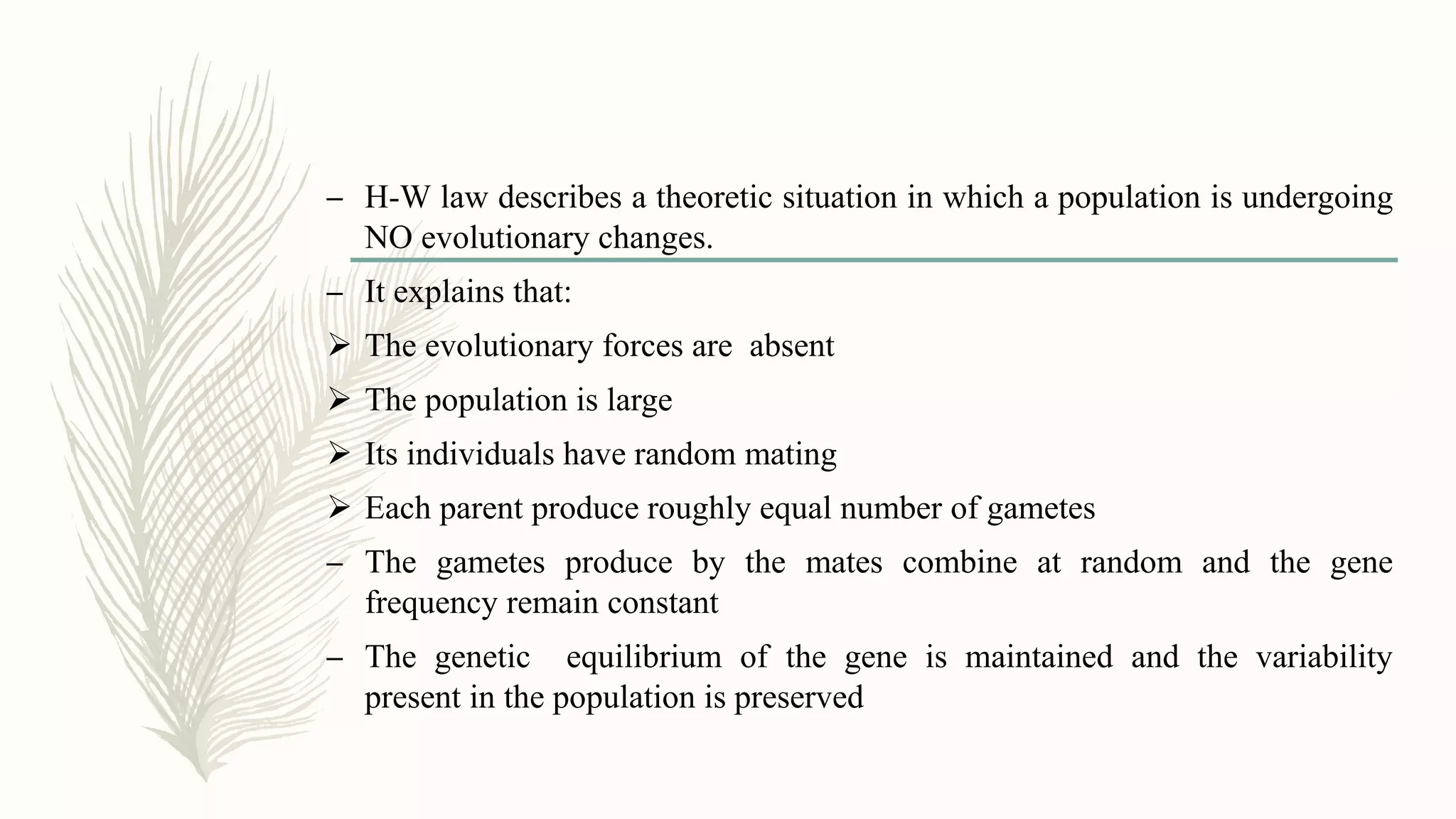
– H-W law describes a theoretic situation in which a population is undergoing
NO evolutionary changes.
– It explains that:
 The evolutionary forces are absent
 The population is large
 Its individuals have random mating
 Each parent produce roughly equal number of gametes
– The gametes produce by the mates combine at random and the gene
frequency remain constant
– The genetic equilibrium of the gene is maintained and the variability
present in the population is preserved
Significance
– Gene and genotype frequencies of different allele of a gene in a population remain
equilibrium
– Mating is completely random phenomenon in a population
– Only large population follow H-W law of equilibrium
– Gene frequencies will be unpredictable in small population
– All the genotypes in a population reproduce equally successfully
– The variation in H-W equilibrium is produced by mutation , selection , and
genetic drift these are the evolutionary forces in a population
– If these evolutionary forces not there in the population, it follows H-W
equilibrium
– A population in H-W equilibrium do not show evolution
Evolutionary Factors Affecting
MUTATIONS: - p = v / u+v , q = u / u+v
* Mutation in only one direction can cause one allele slowly to replace another.
* Mutation in both directions results in an equilibrium with frequencies determined
by the mutation rates.
* Mutation may produce new allele or may change the frequency of existing allele
which is not in that population.
MIGRATION: Ne=4N*Nm / (Nf+Nm) , m = M / N+M
* Migration between population always causes the gene frequencies of the
receiving population to shift towards those of the immigrants
* This addition or removal of alleles when individuals enter or leave a population
from another locality is called gene flow
* Wright estimated small amount of migration m=0.0001
NON RANDOM MATING
INBREEDING : results in more homozygotes
ASSORTATIVE MATING : mating according to phenotype , mating between
phenotypically similar individuals being either more frequent or less frequent
NATURAL SELECTION: Fitness (W)=Ri / Rh
• If selection occurs in such a way that out of the 2 alleles only 1 allele is
preferred by nature . It leads to change in the equilibrium .
• The genotype having fitness of 1 are favoured by selection , the magnitude of
selection aganist a genotype is called selection coefficient or selection
differential .
RANDOM GENETIC DRIFT : Random change in gene frequency or allele
frequency due to sampling error . It occurs in small populations becoz of
greater sampling error .
• Sampling errors lead to – Fixation of certain alleles
Elimination of some other alleles
Gametic selection : when selection acts on gametes or on the haploid phase of life cycle
is called gametic selection . Ex :- fungi
• Thus in each generation , the frequency of a allele will decline by the proportion s till
it reaches zero , and A becomes fixed in the population .
Zygotic selection :- selection operates on the zygotes or the diploid phase is called
zygotic selection .
• Zygotic selection may be :-
• aganist the recessive phenotype
• Aganist the dominant phenotype
• In the favour of heterozygote
FOUNDER PRINCIPLE :- the genetic divergence created by the limited no.of founders
of new populations is called the founder principle .
Ex :- Evolution of Darwin finches on Galapagos Islands which were probably derived
from a few initial founders
• A new population of a species is often initiated by a relatively small no.of individuals
of a population ; these individuals are called founders of the new population .
Reference
– GENETICS – P.S VERMA
– GENETICS –B.D.SINGH
Thank You
Submitted to :-
Dr Lal Ahamad
Associate Professor
Dept of GPBR

Hardy weinberg equilibrium

  • 1.
  • 3.
    Learning Objectives – whatis population – What is population genetics – What is Mendelian population – What is gene pool – What is gene frequency – What is genotypic frequency – What is Hardy-Weinberg Equilibrium – What are evolutionary forces in a population – What are the significance of Hardy-Wienberg equilibrium – Factors affecting H-W principle
  • 4.
    What is aPopulation – Definition: A group of individuals of a particular species occupying a definite space, in which the individuals interact, interbreed and exchange genetic materials. – Species is a group of living organism comprising of similar individuals capable of exchanging genes through interbreeding – Individuals of same species of a particular region is called population – A part from its ecological significance, population has a important role in the process of evolution
  • 5.
    What is Populationgenetics  Study of distributions and changes of allele frequency and interaction of allele in a population  Population is prone to the four main evolutionary forces: 1. Natural selection 2. Genetic drift 3. Mutation 4. Migration  Study of population genetics is essential for species adaptation and evolution
  • 6.
    – For betterunderstanding of population genetics we must study 1.Mendalian population 2.Gene pool 3.Gene frequency 4.Genotypic frequency 5.Hardy Weinberg Law 6.Evolutionary forces in population
  • 7.
    Mendelian Population  Agroup of sexually interbreeding organism also called as genetic population or random mating population  Definition: A community of similar individuals living within a circumscribed area at a given time and capable of interbreeding to produce fertile offspring's.  Mendelian population is characterized by individuals having somewhat similar genetic constitution
  • 8.
    Gene pool – Sumtotal of genes present in the Reproductive individuals of a population called Gene pool – A gene pool of population describes: 1. Gene present in the population 2. Properties different kinds of gene 3. Pattern of distribution of gene in the individuals of population
  • 9.
    Allelic frequency  Supposethere are 100 individuals in a population, in which  40 are homozygous dominant (AA)  40 are heterozygous dominant(Aa)  20 are homozygous recessive(aa)  The frequency of ‘A’ allele will be (p) (119+1/2 *76)/208=0.75  The frequency of ‘a’ allele will be (q) (13+1/2*76)/208=0.25  Gene frequency calculated by dividing the no.of a particular allele with total no.of allele present on that locus in the population
  • 10.
    GENOTYPE FREQUENCY – Definition:The Proportions of different genotypes for a gene in a population are known as genotypic frequency – Genotype frequency is the proportion of a genotype in a sample will be the ratio of the number of individuals having that genotype to the total number of individuals in the sample. – Genotypic frequencies for MN blood group – L^M L^M = 0.57 (119/208) p2=0.56 – L^M L^N = 0.36 (76/208) 2pq = 0.38 – L^N L^N = 0.06 (13/208) q2=0.06
  • 11.
    Gene frequency – Definition: Proportion of different alleles of a gene present in a Mendelian Population are known as Gene frequency – If a gene has two alleles for eg; L^M And L^N, their frequencies may be represented by p and q – p = 0.75 , q = 0.25 – p+q = (0.75+0.25) p+q = 1 – p = 1-q ,q = 1-p – For gene with multiple alleles – The A-B-O blood types are determined by three alleles IA,IB,and i – Frequencies of these are p,q and r respectively – The frequencies of 6 different genotypes in the A-B-O blood typing system are obtained by expanding the trinomial (p+q+r)2=p2+q2+r2+2pq+2qr+2pr
  • 12.
    – N :-Total no.of individuals in the population – D :- Total no.of homozygous dominant – H :- Total no.of heterozygous dominant – R :- Total no.of homozygous recessive – Genotypic frequency of AA individuals D/N – G.f of Aa individuals H/N – G.f of aa individuals R/N
  • 13.
    HARDY WIENBERG’S EQUILIBRIUM –Hardy – Wienberg law is the fundamental law of population genetics – This law was developed independently by Hardy (1908) in england and Weinberg (1909) in germany – The Hardy-Weinberg law States that gene and genotype frequencies in a mendelian population remain constant generation after generation if there is no selection , mutation , or random drift. Hardy & Wienberg
  • 15.
    – H-W lawdescribes a theoretic situation in which a population is undergoing NO evolutionary changes. – It explains that:  The evolutionary forces are absent  The population is large  Its individuals have random mating  Each parent produce roughly equal number of gametes – The gametes produce by the mates combine at random and the gene frequency remain constant – The genetic equilibrium of the gene is maintained and the variability present in the population is preserved
  • 16.
    Significance – Gene andgenotype frequencies of different allele of a gene in a population remain equilibrium – Mating is completely random phenomenon in a population – Only large population follow H-W law of equilibrium – Gene frequencies will be unpredictable in small population – All the genotypes in a population reproduce equally successfully – The variation in H-W equilibrium is produced by mutation , selection , and genetic drift these are the evolutionary forces in a population – If these evolutionary forces not there in the population, it follows H-W equilibrium – A population in H-W equilibrium do not show evolution
  • 21.
    Evolutionary Factors Affecting MUTATIONS:- p = v / u+v , q = u / u+v * Mutation in only one direction can cause one allele slowly to replace another. * Mutation in both directions results in an equilibrium with frequencies determined by the mutation rates. * Mutation may produce new allele or may change the frequency of existing allele which is not in that population. MIGRATION: Ne=4N*Nm / (Nf+Nm) , m = M / N+M * Migration between population always causes the gene frequencies of the receiving population to shift towards those of the immigrants * This addition or removal of alleles when individuals enter or leave a population from another locality is called gene flow * Wright estimated small amount of migration m=0.0001
  • 23.
    NON RANDOM MATING INBREEDING: results in more homozygotes ASSORTATIVE MATING : mating according to phenotype , mating between phenotypically similar individuals being either more frequent or less frequent NATURAL SELECTION: Fitness (W)=Ri / Rh • If selection occurs in such a way that out of the 2 alleles only 1 allele is preferred by nature . It leads to change in the equilibrium . • The genotype having fitness of 1 are favoured by selection , the magnitude of selection aganist a genotype is called selection coefficient or selection differential . RANDOM GENETIC DRIFT : Random change in gene frequency or allele frequency due to sampling error . It occurs in small populations becoz of greater sampling error . • Sampling errors lead to – Fixation of certain alleles Elimination of some other alleles
  • 26.
    Gametic selection :when selection acts on gametes or on the haploid phase of life cycle is called gametic selection . Ex :- fungi • Thus in each generation , the frequency of a allele will decline by the proportion s till it reaches zero , and A becomes fixed in the population . Zygotic selection :- selection operates on the zygotes or the diploid phase is called zygotic selection . • Zygotic selection may be :- • aganist the recessive phenotype • Aganist the dominant phenotype • In the favour of heterozygote FOUNDER PRINCIPLE :- the genetic divergence created by the limited no.of founders of new populations is called the founder principle . Ex :- Evolution of Darwin finches on Galapagos Islands which were probably derived from a few initial founders • A new population of a species is often initiated by a relatively small no.of individuals of a population ; these individuals are called founders of the new population .
  • 34.
    Reference – GENETICS –P.S VERMA – GENETICS –B.D.SINGH
  • 35.
    Thank You Submitted to:- Dr Lal Ahamad Associate Professor Dept of GPBR