1
Subject: Principles of
Genetics
Topic :Population
genetics
1
2
POPULATION GENETICS:
The study of the rules governing the
maintenance and transmission of
genetic variation in natural
populations.
3
DARWINIAN EVOLUTION BY NATURAL SELECTION
 Many more individuals are born than survive (COMPETITION).
 Individuals within species are variable (VARIATION).
 Some of these variations are passed on to offspring (HERITABILITY).
 Survival and reproduction are not random. There must be a correlation
between fitness and phenotype.
4
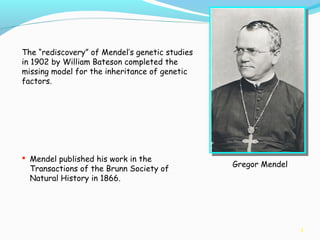
Gregor Mendel
The “rediscovery” of Mendel’s genetic studies
in 1902 by William Bateson completed the
missing model for the inheritance of genetic
factors.
 Mendel published his work in the
Transactions of the Brunn Society of
Natural History in 1866.
55
1
6
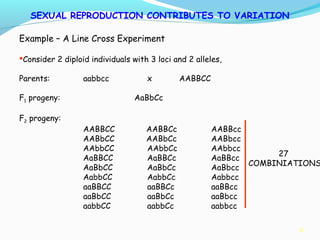
SEXUAL REPRODUCTION CONTRIBUTES TO VARIATION
Example – A Line Cross Experiment
Consider 2 diploid individuals with 3 loci and 2 alleles,
Parents: aabbcc x AABBCC
F1 progeny: AaBbCc
F2 progeny:
AABBCC AABBCc AABBcc
AABbCC AABbCc AABbcc
AAbbCC AAbbCc AAbbcc
AaBBCC AaBBCc AaBBcc
AaBbCC AaBbCc AaBbcc
AabbCC AabbCc Aabbcc
aaBBCC aaBBCc aaBBcc
aaBbCC aaBbCc aaBbcc
aabbCC aabbCc aabbcc
27
COMBINIATIONS
7
Mechanisms of Evolution: Mendelian Genetics
in Populations
 Genetic variation is the raw material of evolutionary change: how do we
measure it?
 What are the forces that cause genetic changes within populations? That
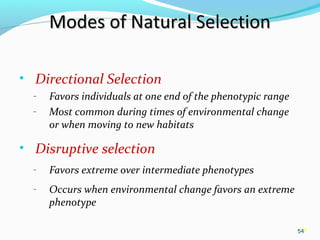
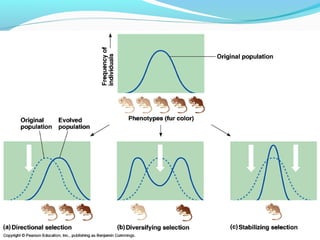
is, what mechanisms cause evolutionary change?
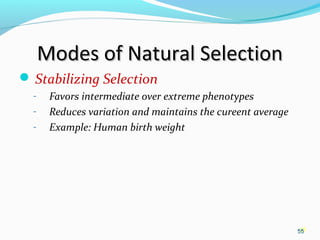
8
Population Genetics
 Evolution can be defined as a change in gene frequencies through time.
 Population genetics tracks the fate, across generations, of Mendelian
genes in populations.
 Population genetics is concerned with whether a particular allele or
genotype will become more or less common over time, and WHY.
9
A few things to keep in mind as we take
an excursion into population genetic
theory:
“Make things as simple as possible, but no simpler.”
---Einstein
“All models are wrong, some are useful.”
---Box
“No theory should fit all the facts because some of the facts are
wrong.”
---Bohr
10
Some Definitions:
 Population: A freely interbreeding group of individuals.
 Gene Pool: The sum total of genetic information present in a
population at any given point in time.
 Phenotype: A morphological, physiological, biochemical, or
behavioral characteristic of an individual organism.
 Genotype: The genetic constitution of an individual organism.
 Locus: A site on a chromosome, or the gene that occupies the
site.
 Gene: A nucleic acid sequence that encodes a product with a
distinct function in the organism.
 Allele: A particular form of a gene.
 Gene (Allele) Frequency: The relative proportion of a particular
allele at a single locus in a population (a number between 0 and 1).
 Genotype Frequency: The relative proportion of a particular
genotype in a population (a number between 0 and 1).
11
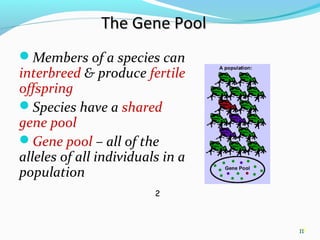
The Gene PoolThe Gene Pool
Members of a species can
interbreed & produce fertile
offspring
Species have a shared
gene pool
Gene pool – all of the
alleles of all individuals in a
population
11
2
12
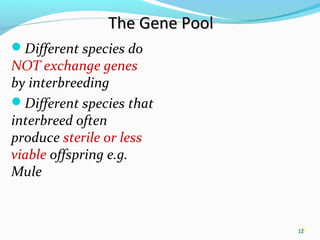
The Gene PoolThe Gene Pool
Different species do
NOT exchange genes
by interbreeding
Different species that
interbreed often
produce sterile or less
viable offspring e.g.
Mule
12
13
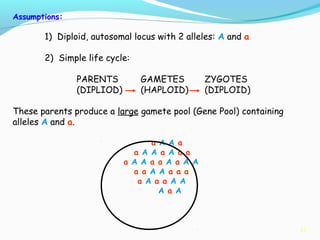
Assumptions:
1) Diploid, autosomal locus with 2 alleles: A and a
2) Simple life cycle:
PARENTS GAMETES ZYGOTES
(DIPLIOD) (HAPLOID) (DIPLOID)
These parents produce a large gamete pool (Gene Pool) containing
alleles A and a.
a A A a
a A A a A a a
a A A a a A a A A
a a A A a a a
a A a a A A
A a A
14
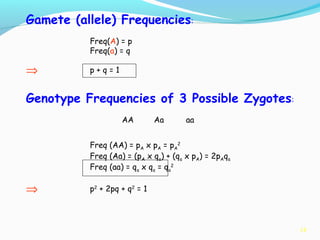
Gamete (allele) Frequencies:
Freq(A) = p
Freq(a) = q
⇒ p + q = 1
Genotype Frequencies of 3 Possible Zygotes:
AA Aa aa
Freq (AA) = pA x pA = pA
2
Freq (Aa) = (pA x qa) + (qa x pA) = 2pAqa
Freq (aa) = qa x qa = qa
2
⇒ p2
+ 2pq + q2
= 1
15
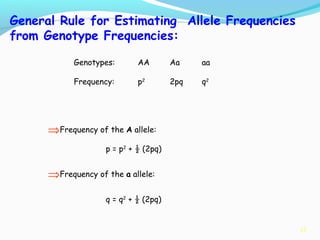
General Rule for Estimating Allele Frequencies
from Genotype Frequencies:
Genotypes: AA Aa aa
Frequency: p2
2pq q2
⇒Frequency of the A allele:
p = p2
+ ½ (2pq)
⇒Frequency of the a allele:
q = q2
+ ½ (2pq)
16
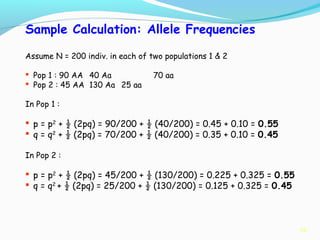
Sample Calculation: Allele Frequencies
Assume N = 200 indiv. in each of two populations 1 & 2
 Pop 1 : 90 AA 40 Aa 70 aa
 Pop 2 : 45 AA 130 Aa 25 aa
In Pop 1 :
 p = p2
+ ½ (2pq) = 90/200 + ½ (40/200) = 0.45 + 0.10 = 0.55
 q = q2
+ ½ (2pq) = 70/200 + ½ (40/200) = 0.35 + 0.10 = 0.45
In Pop 2 :
 p = p2
+ ½ (2pq) = 45/200 + ½ (130/200) = 0.225 + 0.325 = 0.55
 q = q2
+ ½ (2pq) = 25/200 + ½ (130/200) = 0.125 + 0.325 = 0.45
17
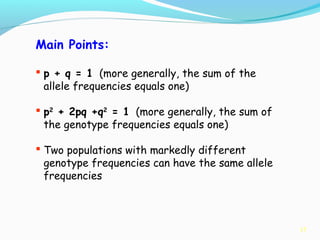
Main Points:
 p + q = 1 (more generally, the sum of the
allele frequencies equals one)
 p2
+ 2pq +q2
= 1 (more generally, the sum of
the genotype frequencies equals one)
 Two populations with markedly different
genotype frequencies can have the same allele
frequencies
18
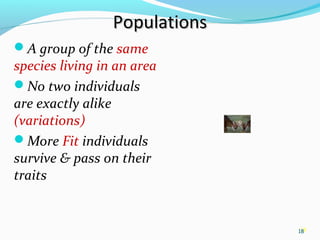
PopulationsPopulations
A group of the same
species living in an area
No two individuals
are exactly alike
(variations)
More Fit individuals
survive & pass on their
traits
18
19
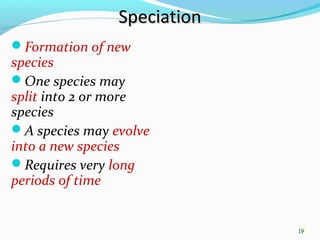
SpeciationSpeciation
Formation of new
species
One species may
split into 2 or more
species
A species may evolve
into a new species
Requires very long
periods of time
19
2020
21
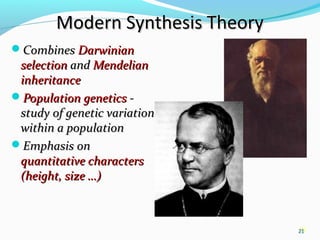
Modern Synthesis TheoryModern Synthesis Theory
CombinesCombines DarwinianDarwinian
selectionselection andand MendelianMendelian
inheritanceinheritance
Population geneticsPopulation genetics --
study of genetic variationstudy of genetic variation
within a populationwithin a population
Emphasis onEmphasis on
quantitative charactersquantitative characters
(height, size …)(height, size …)
21
22
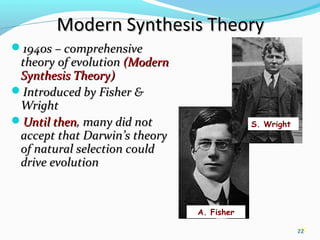
Modern Synthesis TheoryModern Synthesis Theory
1940s – comprehensive1940s – comprehensive
theory of evolutiontheory of evolution (Modern(Modern
Synthesis Theory)Synthesis Theory)
Introduced by Fisher &Introduced by Fisher &
WrightWright
Until thenUntil then, many did not, many did not
accept that Darwin’s theoryaccept that Darwin’s theory
of natural selection couldof natural selection could
drive evolutiondrive evolution
22
S. Wright
A. Fisher
23
Modern Synthesis Theory
• TODAY’S theory on evolution
 Recognizes that GENES are responsible for the
inheritance of characteristics
 Recognizes that POPULATIONS, not individuals,
evolve due to natural selection & genetic drift
 Recognizes that SPECIATION usually is due to the
gradual accumulation of small genetic changes
23
24
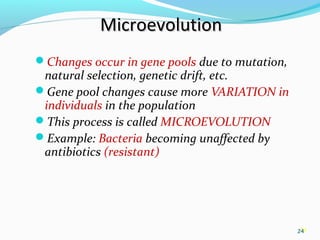
MicroevolutionMicroevolution
Changes occur in gene pools due to mutation,
natural selection, genetic drift, etc.
Gene pool changes cause more VARIATION in
individuals in the population
This process is called MICROEVOLUTION
Example: Bacteria becoming unaffected by
antibiotics (resistant)
24
2525
Hardy-Hardy-
WeinbergWeinberg
PrinciplePrinciple
26
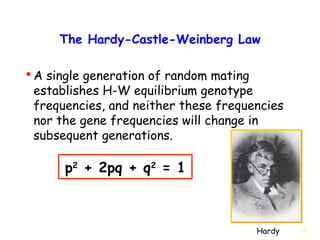
The Hardy-Castle-Weinberg Law
 A single generation of random mating
establishes H-W equilibrium genotype
frequencies, and neither these frequencies
nor the gene frequencies will change in
subsequent generations.
Hardy
p2
+ 2pq + q2
= 1
27
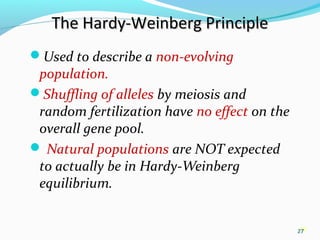
The Hardy-Weinberg PrincipleThe Hardy-Weinberg Principle
Used to describe a non-evolving
population.
Shuffling of alleles by meiosis and
random fertilization have no effect on the
overall gene pool.
 Natural populations are NOT expected
to actually be in Hardy-Weinberg
equilibrium.
27
28
The Hardy-Weinberg PrincipleThe Hardy-Weinberg Principle
Deviation from Hardy-Weinberg
equilibrium usually results in evolution
Understanding a non-evolving
population, helps us to understand how
evolution occurs
28                       
29
5 Assumptions of the H-W Principle5 Assumptions of the H-W Principle
1. Large population size
- small populations have fluctuations in allele
frequencies (e.g., fire, storm).
2. No migration
- immigrants can change the frequency of an allele by
bringing in new alleles to a population.
3. No net mutations
- if alleles change from one to another, this will
change the frequency of those alleles
29
30
5 Assumptions of the H-W Principle5 Assumptions of the H-W Principle
4. Random mating
- if certain traits are more desirable, then
individuals with those traits will be selected and
this will not allow for random mixing of alleles.
5. No natural selection
- if some individuals survive and reproduce at a
higher rate than others, then their offspring will
carry those genes and the frequency will change for
the next generation.
30
31
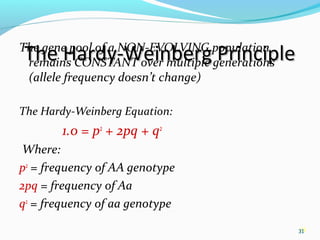
The Hardy-Weinberg PrincipleThe Hardy-Weinberg PrincipleThe gene pool of a NON-EVOLVING population
remains CONSTANT over multiple generations
(allele frequency doesn’t change)
The Hardy-Weinberg Equation:
               1.0 = p2
+ 2pq + q2
 Where:
p2
= frequency of AA genotype
2pq = frequency of Aa
q2
= frequency of aa genotype
31
32
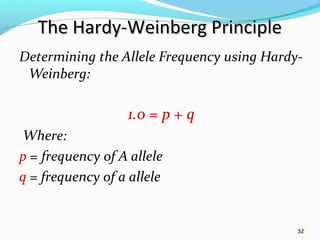
The Hardy-Weinberg PrincipleThe Hardy-Weinberg Principle
Determining the Allele Frequency using Hardy-
Weinberg:
              
1.0 = p + q
 Where:
p = frequency of A allele
q = frequency of a allele
32
3333
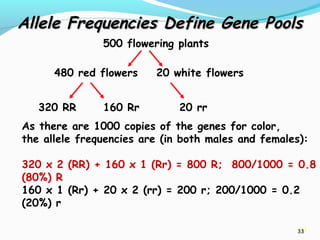
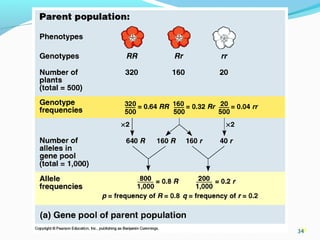
Allele Frequencies Define Gene PoolsAllele Frequencies Define Gene Pools
As there are 1000 copies of the genes for color,
the allele frequencies are (in both males and females):
320 x 2 (RR) + 160 x 1 (Rr) = 800 R; 800/1000 = 0.8
(80%) R
160 x 1 (Rr) + 20 x 2 (rr) = 200 r; 200/1000 = 0.2
(20%) r
500 flowering plants
480 red flowers 20 white flowers
320 RR 160 Rr 20 rr
3434
35
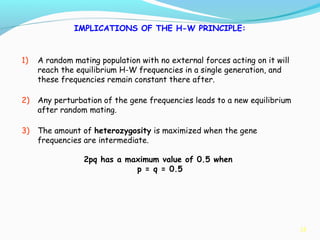
IMPLICATIONS OF THE H-W PRINCIPLE:
1) A random mating population with no external forces acting on it will
reach the equilibrium H-W frequencies in a single generation, and
these frequencies remain constant there after.
2) Any perturbation of the gene frequencies leads to a new equilibrium
after random mating.
3) The amount of heterozygosity is maximized when the gene
frequencies are intermediate.
2pq has a maximum value of 0.5 when
p = q = 0.5
36
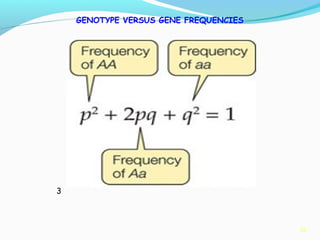
GENOTYPE VERSUS GENE FREQUENCIES
3
37
FOUR PRIMARY USES OF THE H-W PRINCIPLE:
1) Enables us to compute genotype frequencies from generation to
generation, even with selection.
2) Serves as a null model in tests for natural selection, nonrandom
mating, etc., by comparing observed to expected genotype
frequencies.
3) Forensic analysis.
4) Expected heterozygosity provides a useful means of summarizing the
molecular genetic diversity in natural populations.
38
DETECTING DEPARTURES FROM HWE
A χ2
-test (a standard goodness-of-fit test) can be used to detect
statistically significant departures from Hardy-Weinberg Equilibrium.
Step 1: Determine allele frequencies. (N = 100).
AA Aa aa
Observed: 30 60 10
p = 0.30 + 0.30 = 0.60 and q = 0.10 + 0.30 = 0.40
Step 2: Based on allele frequencies, calculate the expected
number of each genotype.
AA Aa aa
p2
N 2pqN q2
N
Expected: 36 48 16
39
AA Aa aa
Observed: 30 60 10
Expected: 36 48 16
Step 3: Calculate χ2
test statistic.
χ2
= Σ [(O-E)2
/E]
= (30-36)2
/36 + (60-48)2
/48 + (10-16)2
/16 = 6.25
Step 4: Compare this result to critical value from the χ2
statistical
table. This test has 1 degree of freedom, so the critical value for α =
0.05 is 3.84.
6.25 > 3.84, so this is a significant departure from HWE!
DETECTING DEPARTURES FROM HWE
40
IMPLICATIONS OF A STATISTICAL DEPARTURE FROM HWE
 If the null hypothesis is true (i.e., we are in H-W equilibrium), we
would expect a sample of this size to show this much (or more) of a
departure from expectations (purely by chance sampling) less than
5 percent of the time.
 One or more of the assumptions of the H-W principle are not
satisfied in this population.
 Further research will be necessary to establish which assumption is
violated. [Excess of heterozygotes could be due to overdominant
selection, for example].
 NOTE: A failure to detect a departure from H-W equilibrium does
not guarantee that the population satisfies all of the assumptions
of the model. The departure may simply not be statistically
detectable.
See Box 6.5 in F&H for more on X2
tests.
41
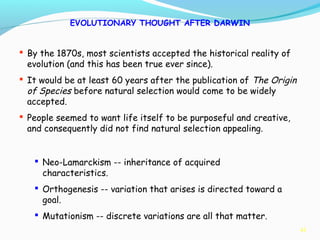
EVOLUTIONARY THOUGHT AFTER DARWIN
 By the 1870s, most scientists accepted the historical reality of
evolution (and this has been true ever since).
 It would be at least 60 years after the publication of The Origin
of Species before natural selection would come to be widely
accepted.
 People seemed to want life itself to be purposeful and creative,
and consequently did not find natural selection appealing.
 Neo-Lamarckism -- inheritance of acquired
characteristics.
 Orthogenesis -- variation that arises is directed toward a
goal.
 Mutationism -- discrete variations are all that matter.
42
Outcomes of the “MODERN
SYNTHESIS”
 Populations contain genetic variation that arises by random
mutation.
 Populations evolve by changes in gene frequency.
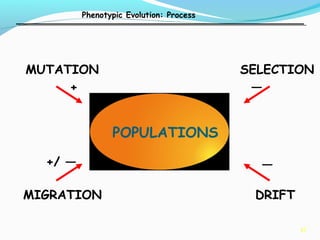
 Gene frequencies change through random genetic drift, gene
flow, and natural selection.
 Most adaptive variants have small effects on the phenotype so
changes are typically gradual.
 Diversification comes about through speciation.
43
MUTATION SELECTION
DRIFTMIGRATION
POPULATIONS
Phenotypic Evolution: Process
+
+/ —
—
—
44
MEASURING GENETIC VARIATION
IN NATURAL POPULATIONS
TWO COMMONLY USED MEASURES TO QUANTIFY GENETIC
VARIATION ARE:
P – the proportion of polymorphic loci (those that have 2
or more alleles)
H – the average heterozygosity = proportion of loci at
which a randomly chosen individual is heterozygous.
4545
46
Causes of MicroevolutionCauses of Microevolution
 Genetic Drift
- the change in the gene pool of a small population due
to chance
 Natural Selection
- success in reproduction based on heritable traits
results in selected alleles being passed to relatively more
offspring (Darwinian inheritance)
- Cause ADAPTATION of Populations
 Gene Flow
-is genetic exchange due to the migration of fertile
individuals or gametes between populations
46
47
Causes of MicroevolutionCauses of Microevolution
• Mutation
- a change in an organism’s DNA
- Mutations can be transmitted in gametes to offspring
• Non-random mating
- Mates are chosen on the basis of the best traits
47
4848
Genetic DriftGenetic Drift
49
Factors that Cause Genetic DriftFactors that Cause Genetic Drift
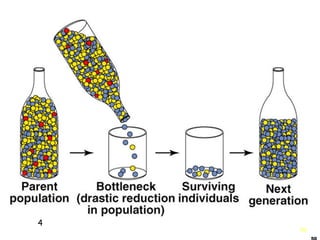
•Bottleneck Effect
-a drastic reduction in population (volcanoes,
earthquakes, landslides …)
-Reduced genetic variation
-Smaller population may not be able to adapt to new
selection pressures
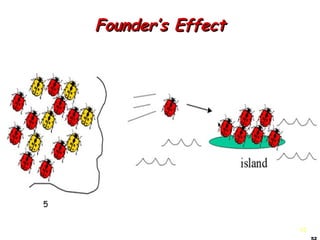
•Founder Effect
-occurs when a new colony is started by a few
members of the original population
-Reduced genetic variation
-May lead to speciation
50
4
51
Loss of Genetic VariationLoss of Genetic Variation
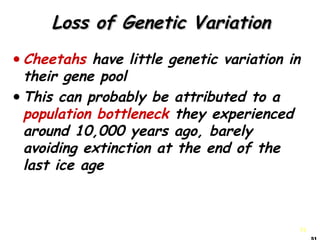
•Cheetahs have little genetic variation in
their gene pool
•This can probably be attributed to a
population bottleneck they experienced
around 10,000 years ago, barely
avoiding extinction at the end of the
last ice age
52
Founder’s EffectFounder’s Effect
5
5353
54
Modes of Natural SelectionModes of Natural Selection
• Directional Selection
- Favors individuals at one end of the phenotypic range
- Most common during times of environmental change
or when moving to new habitats
• Disruptive selection
- Favors extreme over intermediate phenotypes
- Occurs when environmental change favors an extreme
phenotype
54
55
Modes of Natural SelectionModes of Natural Selection
 Stabilizing Selection
- Favors intermediate over extreme phenotypes
- Reduces variation and maintains the cureent average
- Example: Human birth weight
55
5656
5757
Variations inVariations in
PopulationsPopulations
58
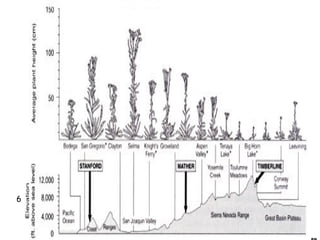
Geographic VariationsGeographic Variations
•Variation in a species
due to climate or
another geographical
condition
•Populations live in
different locations
•Example: Finches of
Galapagos Islands &
South America
59
6
60
Heterozygote AdvantageHeterozygote Advantage
• Favors heterozygotes (Aa)
• Maintains both alleles (A,a) instead of removing less
successful alleles from a population
• Sickle cell anemia
> Homozygotes exhibit severe anemia, have
abnormal blood cell shape, and usually die before
reproductive age.
> Heterozygotes are less susceptible to malaria
60
61
Other Sources of VariationOther Sources of Variation
• Mutations
- In stable environments, mutations often result in little or no
benefit to an organism, or are often harmful
- Mutations are more beneficial (rare) in changing environments
(Example: HIV resistance to antiviral drugs)
• Genetic Recombination
- source of most genetic differences between individuals in a
population
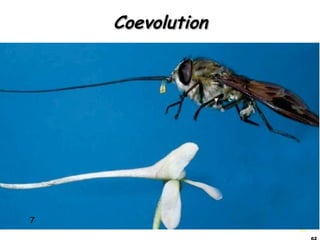
• Co-evolution
-Often occurs between parasite & host and flowers & their
pollinators
61
62
CoevolutionCoevolution
7
63
• References
• Fig 1
http://www.docstoc.com/docs/121720670/Figure-151-The-chromos
• Fig 2
http://www.windows2universe.org/earth/Life/genetics_microevolution
• Fig 3 http://sites.sinauer.com/ecology2e/webext06.1.html
• Fig 4
http://science.nayland.school.nz/graemeb/yr13%20work/evolution/ge
• Fig 5 http://theflamboyantcuttlefish.weebly.com/evolution.html
6 http://www.slideshare.net/marmayy/chapter23-6769543
• Fig 6 http://scienceblogs.com/pharyngula/2006/06/10/clausen-
keck-hiesey/
• Fig 7 https://biologyeoc.wikispaces.com/CoEvolution
• Principles of inheritance Mendal’s laws and and genetic models by
Springer
6464

B.sc. agri i pog unit 4 population genetics

  • 1.
  • 2.
    2 POPULATION GENETICS: The studyof the rules governing the maintenance and transmission of genetic variation in natural populations.
  • 3.
    3 DARWINIAN EVOLUTION BYNATURAL SELECTION  Many more individuals are born than survive (COMPETITION).  Individuals within species are variable (VARIATION).  Some of these variations are passed on to offspring (HERITABILITY).  Survival and reproduction are not random. There must be a correlation between fitness and phenotype.
  • 4.
    4 Gregor Mendel The “rediscovery”of Mendel’s genetic studies in 1902 by William Bateson completed the missing model for the inheritance of genetic factors.  Mendel published his work in the Transactions of the Brunn Society of Natural History in 1866.
  • 5.
  • 6.
    6 SEXUAL REPRODUCTION CONTRIBUTESTO VARIATION Example – A Line Cross Experiment Consider 2 diploid individuals with 3 loci and 2 alleles, Parents: aabbcc x AABBCC F1 progeny: AaBbCc F2 progeny: AABBCC AABBCc AABBcc AABbCC AABbCc AABbcc AAbbCC AAbbCc AAbbcc AaBBCC AaBBCc AaBBcc AaBbCC AaBbCc AaBbcc AabbCC AabbCc Aabbcc aaBBCC aaBBCc aaBBcc aaBbCC aaBbCc aaBbcc aabbCC aabbCc aabbcc 27 COMBINIATIONS
  • 7.
    7 Mechanisms of Evolution:Mendelian Genetics in Populations  Genetic variation is the raw material of evolutionary change: how do we measure it?  What are the forces that cause genetic changes within populations? That is, what mechanisms cause evolutionary change?
  • 8.
    8 Population Genetics  Evolutioncan be defined as a change in gene frequencies through time.  Population genetics tracks the fate, across generations, of Mendelian genes in populations.  Population genetics is concerned with whether a particular allele or genotype will become more or less common over time, and WHY.
  • 9.
    9 A few thingsto keep in mind as we take an excursion into population genetic theory: “Make things as simple as possible, but no simpler.” ---Einstein “All models are wrong, some are useful.” ---Box “No theory should fit all the facts because some of the facts are wrong.” ---Bohr
  • 10.
    10 Some Definitions:  Population:A freely interbreeding group of individuals.  Gene Pool: The sum total of genetic information present in a population at any given point in time.  Phenotype: A morphological, physiological, biochemical, or behavioral characteristic of an individual organism.  Genotype: The genetic constitution of an individual organism.  Locus: A site on a chromosome, or the gene that occupies the site.  Gene: A nucleic acid sequence that encodes a product with a distinct function in the organism.  Allele: A particular form of a gene.  Gene (Allele) Frequency: The relative proportion of a particular allele at a single locus in a population (a number between 0 and 1).  Genotype Frequency: The relative proportion of a particular genotype in a population (a number between 0 and 1).
  • 11.
    11 The Gene PoolTheGene Pool Members of a species can interbreed & produce fertile offspring Species have a shared gene pool Gene pool – all of the alleles of all individuals in a population 11 2
  • 12.
    12 The Gene PoolTheGene Pool Different species do NOT exchange genes by interbreeding Different species that interbreed often produce sterile or less viable offspring e.g. Mule 12
  • 13.
    13 Assumptions: 1) Diploid, autosomallocus with 2 alleles: A and a 2) Simple life cycle: PARENTS GAMETES ZYGOTES (DIPLIOD) (HAPLOID) (DIPLOID) These parents produce a large gamete pool (Gene Pool) containing alleles A and a. a A A a a A A a A a a a A A a a A a A A a a A A a a a a A a a A A A a A
  • 14.
    14 Gamete (allele) Frequencies: Freq(A)= p Freq(a) = q ⇒ p + q = 1 Genotype Frequencies of 3 Possible Zygotes: AA Aa aa Freq (AA) = pA x pA = pA 2 Freq (Aa) = (pA x qa) + (qa x pA) = 2pAqa Freq (aa) = qa x qa = qa 2 ⇒ p2 + 2pq + q2 = 1
  • 15.
    15 General Rule forEstimating Allele Frequencies from Genotype Frequencies: Genotypes: AA Aa aa Frequency: p2 2pq q2 ⇒Frequency of the A allele: p = p2 + ½ (2pq) ⇒Frequency of the a allele: q = q2 + ½ (2pq)
  • 16.
    16 Sample Calculation: AlleleFrequencies Assume N = 200 indiv. in each of two populations 1 & 2  Pop 1 : 90 AA 40 Aa 70 aa  Pop 2 : 45 AA 130 Aa 25 aa In Pop 1 :  p = p2 + ½ (2pq) = 90/200 + ½ (40/200) = 0.45 + 0.10 = 0.55  q = q2 + ½ (2pq) = 70/200 + ½ (40/200) = 0.35 + 0.10 = 0.45 In Pop 2 :  p = p2 + ½ (2pq) = 45/200 + ½ (130/200) = 0.225 + 0.325 = 0.55  q = q2 + ½ (2pq) = 25/200 + ½ (130/200) = 0.125 + 0.325 = 0.45
  • 17.
    17 Main Points:  p+ q = 1 (more generally, the sum of the allele frequencies equals one)  p2 + 2pq +q2 = 1 (more generally, the sum of the genotype frequencies equals one)  Two populations with markedly different genotype frequencies can have the same allele frequencies
  • 18.
    18 PopulationsPopulations A group ofthe same species living in an area No two individuals are exactly alike (variations) More Fit individuals survive & pass on their traits 18
  • 19.
    19 SpeciationSpeciation Formation of new species Onespecies may split into 2 or more species A species may evolve into a new species Requires very long periods of time 19
  • 20.
  • 21.
    21 Modern Synthesis TheoryModernSynthesis Theory CombinesCombines DarwinianDarwinian selectionselection andand MendelianMendelian inheritanceinheritance Population geneticsPopulation genetics -- study of genetic variationstudy of genetic variation within a populationwithin a population Emphasis onEmphasis on quantitative charactersquantitative characters (height, size …)(height, size …) 21
  • 22.
    22 Modern Synthesis TheoryModernSynthesis Theory 1940s – comprehensive1940s – comprehensive theory of evolutiontheory of evolution (Modern(Modern Synthesis Theory)Synthesis Theory) Introduced by Fisher &Introduced by Fisher & WrightWright Until thenUntil then, many did not, many did not accept that Darwin’s theoryaccept that Darwin’s theory of natural selection couldof natural selection could drive evolutiondrive evolution 22 S. Wright A. Fisher
  • 23.
    23 Modern Synthesis Theory •TODAY’S theory on evolution  Recognizes that GENES are responsible for the inheritance of characteristics  Recognizes that POPULATIONS, not individuals, evolve due to natural selection & genetic drift  Recognizes that SPECIATION usually is due to the gradual accumulation of small genetic changes 23
  • 24.
    24 MicroevolutionMicroevolution Changes occur ingene pools due to mutation, natural selection, genetic drift, etc. Gene pool changes cause more VARIATION in individuals in the population This process is called MICROEVOLUTION Example: Bacteria becoming unaffected by antibiotics (resistant) 24
  • 25.
  • 26.
    26 The Hardy-Castle-Weinberg Law A single generation of random mating establishes H-W equilibrium genotype frequencies, and neither these frequencies nor the gene frequencies will change in subsequent generations. Hardy p2 + 2pq + q2 = 1
  • 27.
    27 The Hardy-Weinberg PrincipleTheHardy-Weinberg Principle Used to describe a non-evolving population. Shuffling of alleles by meiosis and random fertilization have no effect on the overall gene pool.  Natural populations are NOT expected to actually be in Hardy-Weinberg equilibrium. 27
  • 28.
    28 The Hardy-Weinberg PrincipleTheHardy-Weinberg Principle Deviation from Hardy-Weinberg equilibrium usually results in evolution Understanding a non-evolving population, helps us to understand how evolution occurs 28                       
  • 29.
    29 5 Assumptions ofthe H-W Principle5 Assumptions of the H-W Principle 1. Large population size - small populations have fluctuations in allele frequencies (e.g., fire, storm). 2. No migration - immigrants can change the frequency of an allele by bringing in new alleles to a population. 3. No net mutations - if alleles change from one to another, this will change the frequency of those alleles 29
  • 30.
    30 5 Assumptions ofthe H-W Principle5 Assumptions of the H-W Principle 4. Random mating - if certain traits are more desirable, then individuals with those traits will be selected and this will not allow for random mixing of alleles. 5. No natural selection - if some individuals survive and reproduce at a higher rate than others, then their offspring will carry those genes and the frequency will change for the next generation. 30
  • 31.
    31 The Hardy-Weinberg PrincipleTheHardy-Weinberg PrincipleThe gene pool of a NON-EVOLVING population remains CONSTANT over multiple generations (allele frequency doesn’t change) The Hardy-Weinberg Equation:                1.0 = p2 + 2pq + q2  Where: p2 = frequency of AA genotype 2pq = frequency of Aa q2 = frequency of aa genotype 31
  • 32.
    32 The Hardy-Weinberg PrincipleTheHardy-Weinberg Principle Determining the Allele Frequency using Hardy- Weinberg:                1.0 = p + q  Where: p = frequency of A allele q = frequency of a allele 32
  • 33.
    3333 Allele Frequencies DefineGene PoolsAllele Frequencies Define Gene Pools As there are 1000 copies of the genes for color, the allele frequencies are (in both males and females): 320 x 2 (RR) + 160 x 1 (Rr) = 800 R; 800/1000 = 0.8 (80%) R 160 x 1 (Rr) + 20 x 2 (rr) = 200 r; 200/1000 = 0.2 (20%) r 500 flowering plants 480 red flowers 20 white flowers 320 RR 160 Rr 20 rr
  • 34.
  • 35.
    35 IMPLICATIONS OF THEH-W PRINCIPLE: 1) A random mating population with no external forces acting on it will reach the equilibrium H-W frequencies in a single generation, and these frequencies remain constant there after. 2) Any perturbation of the gene frequencies leads to a new equilibrium after random mating. 3) The amount of heterozygosity is maximized when the gene frequencies are intermediate. 2pq has a maximum value of 0.5 when p = q = 0.5
  • 36.
  • 37.
    37 FOUR PRIMARY USESOF THE H-W PRINCIPLE: 1) Enables us to compute genotype frequencies from generation to generation, even with selection. 2) Serves as a null model in tests for natural selection, nonrandom mating, etc., by comparing observed to expected genotype frequencies. 3) Forensic analysis. 4) Expected heterozygosity provides a useful means of summarizing the molecular genetic diversity in natural populations.
  • 38.
    38 DETECTING DEPARTURES FROMHWE A χ2 -test (a standard goodness-of-fit test) can be used to detect statistically significant departures from Hardy-Weinberg Equilibrium. Step 1: Determine allele frequencies. (N = 100). AA Aa aa Observed: 30 60 10 p = 0.30 + 0.30 = 0.60 and q = 0.10 + 0.30 = 0.40 Step 2: Based on allele frequencies, calculate the expected number of each genotype. AA Aa aa p2 N 2pqN q2 N Expected: 36 48 16
  • 39.
    39 AA Aa aa Observed:30 60 10 Expected: 36 48 16 Step 3: Calculate χ2 test statistic. χ2 = Σ [(O-E)2 /E] = (30-36)2 /36 + (60-48)2 /48 + (10-16)2 /16 = 6.25 Step 4: Compare this result to critical value from the χ2 statistical table. This test has 1 degree of freedom, so the critical value for α = 0.05 is 3.84. 6.25 > 3.84, so this is a significant departure from HWE! DETECTING DEPARTURES FROM HWE
  • 40.
    40 IMPLICATIONS OF ASTATISTICAL DEPARTURE FROM HWE  If the null hypothesis is true (i.e., we are in H-W equilibrium), we would expect a sample of this size to show this much (or more) of a departure from expectations (purely by chance sampling) less than 5 percent of the time.  One or more of the assumptions of the H-W principle are not satisfied in this population.  Further research will be necessary to establish which assumption is violated. [Excess of heterozygotes could be due to overdominant selection, for example].  NOTE: A failure to detect a departure from H-W equilibrium does not guarantee that the population satisfies all of the assumptions of the model. The departure may simply not be statistically detectable. See Box 6.5 in F&H for more on X2 tests.
  • 41.
    41 EVOLUTIONARY THOUGHT AFTERDARWIN  By the 1870s, most scientists accepted the historical reality of evolution (and this has been true ever since).  It would be at least 60 years after the publication of The Origin of Species before natural selection would come to be widely accepted.  People seemed to want life itself to be purposeful and creative, and consequently did not find natural selection appealing.  Neo-Lamarckism -- inheritance of acquired characteristics.  Orthogenesis -- variation that arises is directed toward a goal.  Mutationism -- discrete variations are all that matter.
  • 42.
    42 Outcomes of the“MODERN SYNTHESIS”  Populations contain genetic variation that arises by random mutation.  Populations evolve by changes in gene frequency.  Gene frequencies change through random genetic drift, gene flow, and natural selection.  Most adaptive variants have small effects on the phenotype so changes are typically gradual.  Diversification comes about through speciation.
  • 43.
  • 44.
    44 MEASURING GENETIC VARIATION INNATURAL POPULATIONS TWO COMMONLY USED MEASURES TO QUANTIFY GENETIC VARIATION ARE: P – the proportion of polymorphic loci (those that have 2 or more alleles) H – the average heterozygosity = proportion of loci at which a randomly chosen individual is heterozygous.
  • 45.
  • 46.
    46 Causes of MicroevolutionCausesof Microevolution  Genetic Drift - the change in the gene pool of a small population due to chance  Natural Selection - success in reproduction based on heritable traits results in selected alleles being passed to relatively more offspring (Darwinian inheritance) - Cause ADAPTATION of Populations  Gene Flow -is genetic exchange due to the migration of fertile individuals or gametes between populations 46
  • 47.
    47 Causes of MicroevolutionCausesof Microevolution • Mutation - a change in an organism’s DNA - Mutations can be transmitted in gametes to offspring • Non-random mating - Mates are chosen on the basis of the best traits 47
  • 48.
  • 49.
    49 Factors that CauseGenetic DriftFactors that Cause Genetic Drift •Bottleneck Effect -a drastic reduction in population (volcanoes, earthquakes, landslides …) -Reduced genetic variation -Smaller population may not be able to adapt to new selection pressures •Founder Effect -occurs when a new colony is started by a few members of the original population -Reduced genetic variation -May lead to speciation
  • 50.
  • 51.
    51 Loss of GeneticVariationLoss of Genetic Variation •Cheetahs have little genetic variation in their gene pool •This can probably be attributed to a population bottleneck they experienced around 10,000 years ago, barely avoiding extinction at the end of the last ice age
  • 52.
  • 53.
  • 54.
    54 Modes of NaturalSelectionModes of Natural Selection • Directional Selection - Favors individuals at one end of the phenotypic range - Most common during times of environmental change or when moving to new habitats • Disruptive selection - Favors extreme over intermediate phenotypes - Occurs when environmental change favors an extreme phenotype 54
  • 55.
    55 Modes of NaturalSelectionModes of Natural Selection  Stabilizing Selection - Favors intermediate over extreme phenotypes - Reduces variation and maintains the cureent average - Example: Human birth weight 55
  • 56.
  • 57.
  • 58.
    58 Geographic VariationsGeographic Variations •Variationin a species due to climate or another geographical condition •Populations live in different locations •Example: Finches of Galapagos Islands & South America
  • 59.
  • 60.
    60 Heterozygote AdvantageHeterozygote Advantage •Favors heterozygotes (Aa) • Maintains both alleles (A,a) instead of removing less successful alleles from a population • Sickle cell anemia > Homozygotes exhibit severe anemia, have abnormal blood cell shape, and usually die before reproductive age. > Heterozygotes are less susceptible to malaria 60
  • 61.
    61 Other Sources ofVariationOther Sources of Variation • Mutations - In stable environments, mutations often result in little or no benefit to an organism, or are often harmful - Mutations are more beneficial (rare) in changing environments (Example: HIV resistance to antiviral drugs) • Genetic Recombination - source of most genetic differences between individuals in a population • Co-evolution -Often occurs between parasite & host and flowers & their pollinators 61
  • 62.
  • 63.
    63 • References • Fig1 http://www.docstoc.com/docs/121720670/Figure-151-The-chromos • Fig 2 http://www.windows2universe.org/earth/Life/genetics_microevolution • Fig 3 http://sites.sinauer.com/ecology2e/webext06.1.html • Fig 4 http://science.nayland.school.nz/graemeb/yr13%20work/evolution/ge • Fig 5 http://theflamboyantcuttlefish.weebly.com/evolution.html 6 http://www.slideshare.net/marmayy/chapter23-6769543 • Fig 6 http://scienceblogs.com/pharyngula/2006/06/10/clausen- keck-hiesey/ • Fig 7 https://biologyeoc.wikispaces.com/CoEvolution • Principles of inheritance Mendal’s laws and and genetic models by Springer
  • 64.

Editor's Notes

  • #44 Main Points: Since the Modern Synthesis we have a good understanding of the forces that act on populations to cause evolutionary change. These forces are: MUTATION, SELECTION, MIGRATION, and RANDOM GENETIC DRIFT. It is the interaction of these forces with the GENETIC ARCHITECTURE in natural populations that determines the rate and trajectory of populations evolving in an adaptive landscape. One pressing challenge for evolutionary biologists is to connect the processes that act on populations and within lineages with patterns of diversity between lineages. Today I’m going to focus on the GENETIC ARCHITECTURE of natural populations. In order to make the connection between evolution within lineages and diversity between we need to examine genetic variation at multiple levels……