Mechanisms of Evolution II
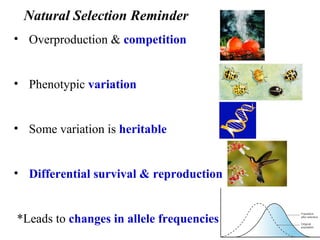
• Overproduction & competition
• Phenotypic variation
• Some variation is heritable
• Differential survival & reproduction
*Leads to changes in allele frequencies over time
Natural Selection Reminder
The Equilibrium Population:
Assumptions of Hardy-Weinberg
• No mutation (no new genetic variation)
• No genetic drift (infinitely large population)
• No migration (no individuals entering or leaving the pop)
• No selection (genotypes have equal fitness)
• Random mating (dealing with a single population)
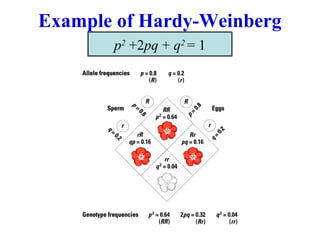
Example of Hardy-Weinberg
p2
+2pq + q2
= 1
The Equilibrium Population:
Assumptions of Hardy-Weinberg
• No mutation (no new genetic variation)
• No genetic drift (infinitely large population)
• No migration (no individuals entering or leaving the pop)
• No selection (genotypes have equal fitness)
• Random mating (dealing with a single population)
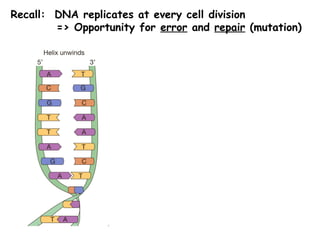
Recall: DNA replicates at every cell division
=> Opportunity for error and repair (mutation)
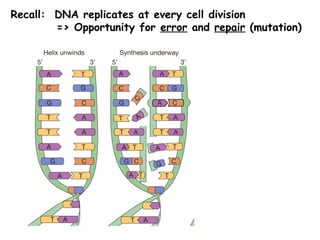
Recall: DNA replicates at every cell division
=> Opportunity for error and repair (mutation)
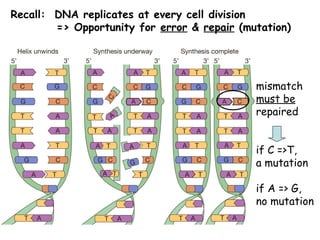
Recall: DNA replicates at every cell division
=> Opportunity for error & repair (mutation)
mismatch
must be
repaired
if C =>T,
a mutation
if A => G,
no mutation
Mutation
• alterations of the base DNA sequence
• ultimate source of all genetic variation
• many types of mutation (e.g. point, chromosomal)
• often reduce fitness (deleterious), but can be
beneficial or neutral too
• weak force in changing allele frequencies over time
(evolution)
• many genes per genome (~30,000 in humans), so odds
of hitting any particular one is very low per
generation
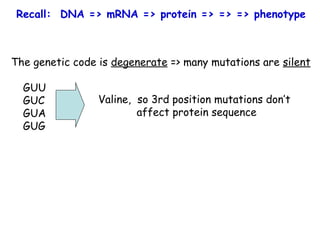
The genetic code is degenerate => many mutations are silent
GUU
GUC
GUA
GUG
Valine, so 3rd position mutations don’t
affect protein sequence
Recall: DNA => mRNA => protein => => => phenotype
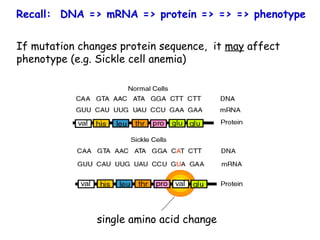
If mutation changes protein sequence, it may affect
phenotype (e.g. Sickle cell anemia)
Recall: DNA => mRNA => protein => => => phenotype
single amino acid change
The Equilibrium Population:
Assumptions of Hardy-Weinberg
• No mutation (no new genetic variation)
• No genetic drift (infinitely large population)
• No migration (no individuals entering or leaving the pop)
• No selection (genotypes have equal fitness)
• Random mating (dealing with a single population)
Genetic drift: an extreme example
• Imagine a population of only 1 M and 1 F per generation (N = 2)
• Start with 2 heterozygotes (Aa), p & q = 0.5
• Simulate allele formation & random mating with coin flip
1.0
.50
.75
.25
allelefreq.
0 1 2 3 4 5 6 7 8 9 10
Genetic drift
• change in allele frequency between generations due to the
random sampling of alleles
• large population, allele and genotype frequencies predictable
• smaller populations, random chance (drift) becomes important
Genetic drift...
1. Changes allele frequencies of populations
2. Reduces genetic variation of populations
3. Is random: same starting point => different outcomes
4. Depends on population size (small pops have strong drift)
N = 4 N = 40 N = 400
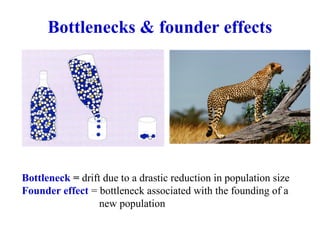
Bottlenecks & founder effects
Bottleneck = drift due to a drastic reduction in population size
Founder effect = bottleneck associated with the founding of a
new population
The Equilibrium Population:
Assumptions of Hardy-Weinberg
• No mutation (no new genetic variation)
• No genetic drift (infinitely large population)
• No migration (no individuals entering or leaving the pop)
• No selection (genotypes have equal fitness)
• Random mating (dealing with a single population)
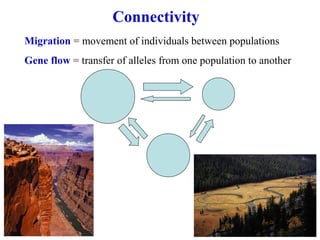
Migration = movement of individuals between populations
Gene flow = transfer of alleles from one population to another
Connectivity
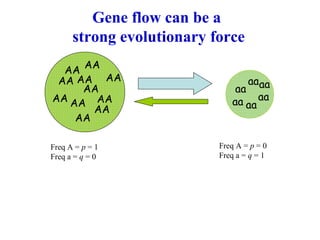
AA
aa
AAAA AA
AAAA aaAA
AA
AA
aaaa
AA
aa
AA
aa
Freq A = p = 1
Freq a = q = 0
Freq A = p = 0
Freq a = q = 1
Gene flow can be a
strong evolutionary force
Gene flow can be a
strong evolutionary force
One migration event => deviation from H-W expectations
AAaa
AAAA AA
AAAA
aa
AA
AA
AA
aaaaAA
aaAA
aa
Freq A = p = 0.82
Freq a = q = 0.18
Would predict 2pq = 0.30
Actual frequ of Aa = 0
Freq A = p = 0.33
Freq a = q = 0.67
Would predict 2pq = 0.44
Actual frequ of Aa = 0
AAAa
AAAA Aa
AA
AAAA
Aa
Aa
aa
aa
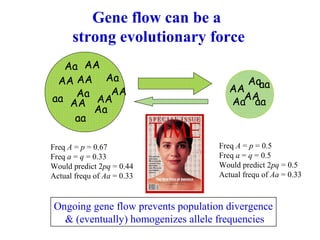
Ongoing gene flow prevents population divergence
& (eventually) homogenizes allele frequencies
AaaaAA
aa
AA
Aa
Gene flow can be a
strong evolutionary force
Freq A = p = 0.67
Freq a = q = 0.33
Would predict 2pq = 0.44
Actual frequ of Aa = 0.33
Freq A = p = 0.5
Freq a = q = 0.5
Would predict 2pq = 0.5
Actual frequ of Aa = 0.33
The Equilibrium Population:
Assumptions of Hardy-Weinberg
• No mutation (no new genetic variation)
• No genetic drift (infinitely large population)
• No migration (no individuals entering or leaving the pop)
• No selection (genotypes have equal fitness)
• Random mating (dealing with a single population)
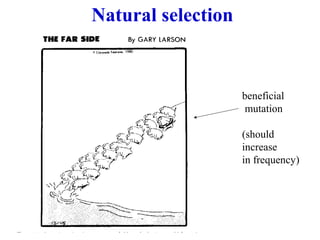
Natural selection
beneficial
mutation
(should
increase
in frequency)
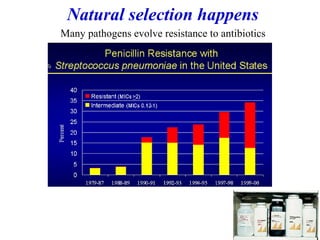
Natural selection happens
Many pathogens evolve resistance to antibiotics
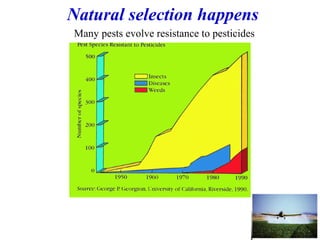
Many pests evolve resistance to pesticides
Natural selection happens
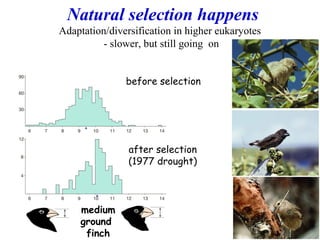
Adaptation/diversification in higher eukaryotes
- slower, but still going on
before selection
after selection
(1977 drought)
medium
ground
finch
Natural selection happens
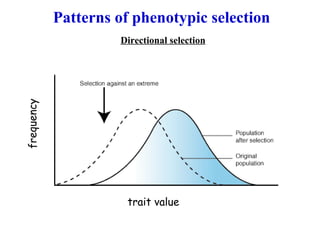
Patterns of phenotypic selection
Directional selection
trait value
frequency
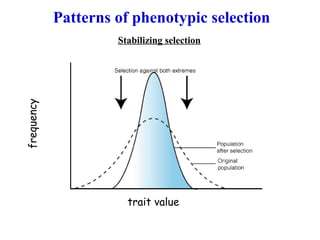
Stabilizing selection
trait value
frequency
Patterns of phenotypic selection
Diversifying selection
trait value
frequency
Patterns of phenotypic selection
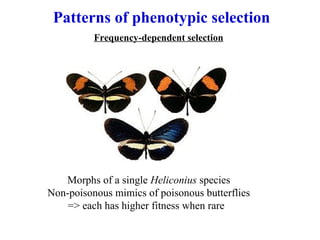
Frequency-dependent selection
Morphs of a single Heliconius species
Non-poisonous mimics of poisonous butterflies
=> each has higher fitness when rare
Patterns of phenotypic selection
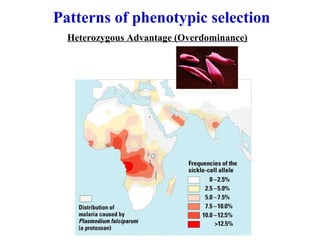
Heterozygous Advantage (Overdominance)

Mechanisms of evolution-II

  • 1.
  • 2.
    • Overproduction &competition • Phenotypic variation • Some variation is heritable • Differential survival & reproduction *Leads to changes in allele frequencies over time Natural Selection Reminder
  • 3.
    The Equilibrium Population: Assumptionsof Hardy-Weinberg • No mutation (no new genetic variation) • No genetic drift (infinitely large population) • No migration (no individuals entering or leaving the pop) • No selection (genotypes have equal fitness) • Random mating (dealing with a single population)
  • 4.
  • 5.
    The Equilibrium Population: Assumptionsof Hardy-Weinberg • No mutation (no new genetic variation) • No genetic drift (infinitely large population) • No migration (no individuals entering or leaving the pop) • No selection (genotypes have equal fitness) • Random mating (dealing with a single population)
  • 6.
    Recall: DNA replicatesat every cell division => Opportunity for error and repair (mutation)
  • 7.
    Recall: DNA replicatesat every cell division => Opportunity for error and repair (mutation)
  • 8.
    Recall: DNA replicatesat every cell division => Opportunity for error & repair (mutation) mismatch must be repaired if C =>T, a mutation if A => G, no mutation
  • 9.
    Mutation • alterations ofthe base DNA sequence • ultimate source of all genetic variation • many types of mutation (e.g. point, chromosomal) • often reduce fitness (deleterious), but can be beneficial or neutral too • weak force in changing allele frequencies over time (evolution) • many genes per genome (~30,000 in humans), so odds of hitting any particular one is very low per generation
  • 10.
    The genetic codeis degenerate => many mutations are silent GUU GUC GUA GUG Valine, so 3rd position mutations don’t affect protein sequence Recall: DNA => mRNA => protein => => => phenotype
  • 11.
    If mutation changesprotein sequence, it may affect phenotype (e.g. Sickle cell anemia) Recall: DNA => mRNA => protein => => => phenotype single amino acid change
  • 12.
    The Equilibrium Population: Assumptionsof Hardy-Weinberg • No mutation (no new genetic variation) • No genetic drift (infinitely large population) • No migration (no individuals entering or leaving the pop) • No selection (genotypes have equal fitness) • Random mating (dealing with a single population)
  • 13.
    Genetic drift: anextreme example • Imagine a population of only 1 M and 1 F per generation (N = 2) • Start with 2 heterozygotes (Aa), p & q = 0.5 • Simulate allele formation & random mating with coin flip 1.0 .50 .75 .25 allelefreq. 0 1 2 3 4 5 6 7 8 9 10
  • 14.
    Genetic drift • changein allele frequency between generations due to the random sampling of alleles • large population, allele and genotype frequencies predictable • smaller populations, random chance (drift) becomes important
  • 15.
    Genetic drift... 1. Changesallele frequencies of populations 2. Reduces genetic variation of populations 3. Is random: same starting point => different outcomes 4. Depends on population size (small pops have strong drift) N = 4 N = 40 N = 400
  • 16.
    Bottlenecks & foundereffects Bottleneck = drift due to a drastic reduction in population size Founder effect = bottleneck associated with the founding of a new population
  • 17.
    The Equilibrium Population: Assumptionsof Hardy-Weinberg • No mutation (no new genetic variation) • No genetic drift (infinitely large population) • No migration (no individuals entering or leaving the pop) • No selection (genotypes have equal fitness) • Random mating (dealing with a single population)
  • 18.
    Migration = movementof individuals between populations Gene flow = transfer of alleles from one population to another Connectivity
  • 19.
    AA aa AAAA AA AAAA aaAA AA AA aaaa AA aa AA aa FreqA = p = 1 Freq a = q = 0 Freq A = p = 0 Freq a = q = 1 Gene flow can be a strong evolutionary force
  • 20.
    Gene flow canbe a strong evolutionary force One migration event => deviation from H-W expectations AAaa AAAA AA AAAA aa AA AA AA aaaaAA aaAA aa Freq A = p = 0.82 Freq a = q = 0.18 Would predict 2pq = 0.30 Actual frequ of Aa = 0 Freq A = p = 0.33 Freq a = q = 0.67 Would predict 2pq = 0.44 Actual frequ of Aa = 0
  • 21.
    AAAa AAAA Aa AA AAAA Aa Aa aa aa Ongoing geneflow prevents population divergence & (eventually) homogenizes allele frequencies AaaaAA aa AA Aa Gene flow can be a strong evolutionary force Freq A = p = 0.67 Freq a = q = 0.33 Would predict 2pq = 0.44 Actual frequ of Aa = 0.33 Freq A = p = 0.5 Freq a = q = 0.5 Would predict 2pq = 0.5 Actual frequ of Aa = 0.33
  • 22.
    The Equilibrium Population: Assumptionsof Hardy-Weinberg • No mutation (no new genetic variation) • No genetic drift (infinitely large population) • No migration (no individuals entering or leaving the pop) • No selection (genotypes have equal fitness) • Random mating (dealing with a single population)
  • 23.
  • 24.
    Natural selection happens Manypathogens evolve resistance to antibiotics
  • 25.
    Many pests evolveresistance to pesticides Natural selection happens
  • 26.
    Adaptation/diversification in highereukaryotes - slower, but still going on before selection after selection (1977 drought) medium ground finch Natural selection happens
  • 27.
    Patterns of phenotypicselection Directional selection trait value frequency
  • 28.
  • 29.
  • 30.
    Frequency-dependent selection Morphs ofa single Heliconius species Non-poisonous mimics of poisonous butterflies => each has higher fitness when rare Patterns of phenotypic selection
  • 31.
    Patterns of phenotypicselection Heterozygous Advantage (Overdominance)

Editor's Notes

  • #2 TL- marine iguana of the Galapagos Bottom-examples of camouflage as evolutionary adaptation, related mantid species L = leaf mantid in Costa Rica, C = flower mantid in Malaysia, R = trinidad tree mantid mimics dead leaves
  • #3 Natural selection does not create variation! It just works with what is there already NS favors characteristics for a certain time/place – what it favors changes as conditions change!
  • #4 To explore the forces that changes allele frequencies over time, we’re going to start with an idealized population at equilibrium.... This means that the population is not experiencing any changes in allele frequ over time – which alleles the pop has and how rare/frequent they are is the same in every generation (no evolution) A population in this condition is said to be in Hardy-Weinberg equilibrium (named after two guys developed it in 1908) A population that is in H-W Equ (experiencing no evolution) meets these 5 assumptions
  • #5 If we know the frequency of one allele, can use H-W to figure the frequency of the other allele and the genotypes too For example, consider a single locus for flower color R = red, r = white In our hypothetical population, 80% of all the alleles for flower color in the gene pool are R, Thus p=0.8 Because there are only two alleles at this locus, all the other alleles (20%) must be r and q=0.2 (sum to one) Go thru square to show expected genotypic frequencies In practice, you then compare these expected values to the frequencies you observed... if they do not match, your pop is out of H-W equilibrium, one of your assumptions is violated – which one????
  • #6 Revisiting our assumptions – why are the genotypic frequencies we observe different from those expected? One reason is mutation...
  • #7 DNA is replicated with every cell division = a chance for error & repair
  • #8 Here DNA polymerases are building complimentary DNA strands, on right errs in attaching an A where a G should be
  • #9 This mismatch must be repaired – if original error is fixed, then no mutation, If instead the correct other side is “fixed” to match the side in error, there is a point mutation Here single transition (C to T)
  • #11 Often mutations don’t matter....here doesn’t change the protein codon produces
  • #13 Genetic drift can cause pop to be out of H-W due to low population size!
  • #14 Heads = A, tails =a Flip coin 4x to determine genotypes of two offspring, calculate frequency of A, map, repeat Example: Gen 1 – Aa, AA, frequ A (p) = 0.75 (would predict 0.38 frequ of Aa but of course, here it is 0.5) Gen 2 – AA, AA, frequ A = 1.0 = gone to fixation in two generations! GAME OVER
  • #15 Example here is a lethal and recessive allele in a beetle. At large pop sizes, this allele is rare, but as pop size decreases, the frequency of the allele went up due to random chance
  • #16 Bottom graphs represent changes in frequency of an allele in a population (each line) Notice all four effects listed above are evident in the graphs
  • #17 Cheetahs once widespread in Africa and Asia, numbers fell drastically during last ice age (~10,000 years ago), Also hunted to near extinction in 1800’s Today, only 3 small pops left in the wild Have very low genetic variation! Similar to that found among inbred lab mice strains.
  • #19 Populations experience different levels of connectivity.... The circles represent populations, the arrows movement of genes between them Left = grand canyon with Colorado River – fish in river are connected and gene flow possible, rodents on either side world’s apart Right = Doug Fir tree pops separated by valley w/o trees, two pops not totally isolated though b/c wind can blow pollen across, otherwise are isolated from each other (again, critters in the river are connected)
  • #22 In fact, migration of people around the world and intermarriage between locations, cultures = gene flow Transfer of alleles between pops that were once isolated, This is a computer generated image blending facial features from several races
  • #23 To explore the forces that cause changes in allele frequencies over time, we’re going to start with an idealized population – one that is at equilibrium.... This means that the population is not experiencing any changes in allele frequ over time – which alleles the pop has and how rare/frequent they are is the same in every generation (no evolution)
  • #24 Selection happens to individuals! Evolution happens to populations!!! selection is a strong force in changing allele frequencies over time
  • #25 Our use of antibiotics has produced super strains of bacteria that are resistant to our medicines!
  • #26 Our use of insecticides has promoted selection for insects, diseases and weeds that are resistant to pesticides!
  • #27 One classic example is Darwin’s finches – huge variety of forms – Adaptive Radiation!!!! On left = frequency of bill depths in medium ground finch before and after drought Looks like drought favored deep and shallow billed birds but not intermediates = selection On right – some more species (closely related galapagos finches) Top = small tree finch, uses beak to grasp insects Center = large ground finch, uses beak to crack seed trees that fall to ground Bottom – woodpecker finch, uses beak to manipulate tools (e.g. cactus spines) to probe for termites, other wood boring beetles
  • #28 Consider a butterfly species with color that ranges from white to blue Here selection against white indiv moves mean pop color more toward blue
  • #29 Here selection against whitest and bluest butterflies (extremes), Stabilizes mean pop color at mean (less variation)
  • #30 Here selection favors the extremes and makes pop color bimodal
  • #31 Selection can actually help maintain variation in nature too!!!!
  • #32 Going back to the sickle cell anemia ex., why would the allele for this recessive disorder persist? Wouldn’t it be selected against? Turns out that the sickle cell heterozygote is resistant to malaria So populations with the highest frequency of the sickle cell allele are found in areas with high incidence of malaria (e.g. Africa) In these environments, hets at the sickle cell locus have the highest fitness