Bio 106
Lecture 11
Genes in Populations
A. Population Genetics
B. Gene Frequencies and Equilibrium
1. Gene Frequencies
2. Gene Pool
3. Model System for Population
Stability (Hardy – Weinberg Law)
2cces2015
C. Changes in Gene Frequencies
1. Mutation
2. Selection
2.1 Relative Fitness
2.2 Selections and Variability
2.3 Selection and Mating
3. Systems
4. Migration
5. Genetic Drift
3cces2015
D. Race and Species Formation
1. The Concept of Races
2. The Concept of Species
2.1 Reproductive Isolating Mechanisms
2.2 Rapid Speciation
4cces2015
Population: a group of individuals of the
same species that live in the same
area and interbreed (interbreeding
causes production of fertile offspring)
5cces2015
POPULATION GENETICS
the study of genetic variation within
populations
involves the examination and modelling
of changes in the frequencies of genes
and alleles in populations over space
and time.
FOCUS: species or population
6cces2015
Gene frequencies & equilibrium
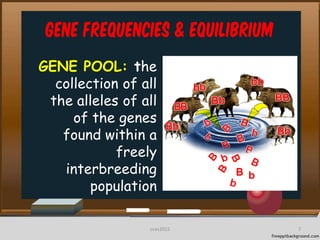
GENE POOL: the
collection of all
the alleles of all
of the genes
found within a
freely
interbreeding
population
7cces2015
Gene frequencies & equilibrium
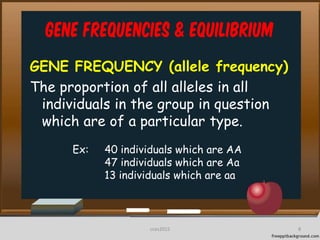
GENE FREQUENCY (allele frequency)
The proportion of all alleles in all
individuals in the group in question
which are of a particular type.
Ex: 40 individuals which are AA
47 individuals which are Aa
13 individuals which are aa
8cces2015
Gene frequencies & equilibrium
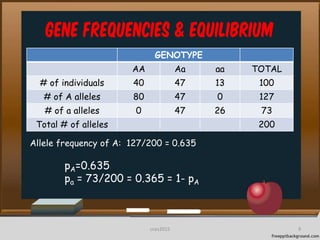
GENOTYPE
AA Aa aa TOTAL
# of individuals 40 47 13 100
# of A alleles 80 47 0 127
# of a alleles 0 47 26 73
Total # of alleles 200
Allele frequency of A: 127/200 = 0.635
pA=0.635
pa = 73/200 = 0.365 = 1- pA
9cces2015
Gene frequencies & equilibrium
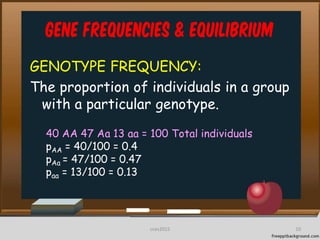
GENOTYPE FREQUENCY:
The proportion of individuals in a group
with a particular genotype.
40 AA 47 Aa 13 aa = 100 Total individuals
pAA = 40/100 = 0.4
pAa = 47/100 = 0.47
paa = 13/100 = 0.13
10cces2015
Gene frequencies & equilibrium
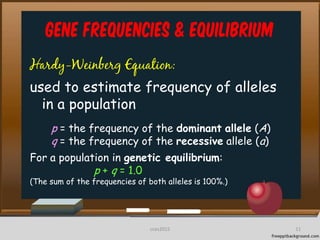
Hardy-Weinberg Equation:
used to estimate frequency of alleles
in a population
p = the frequency of the dominant allele (A)
q = the frequency of the recessive allele (a)
For a population in genetic equilibrium:
p + q = 1.0
(The sum of the frequencies of both alleles is 100%.)
11cces2015
Gene frequencies & equilibrium
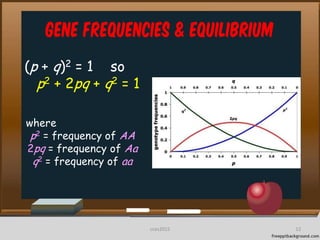
(p + q)2 = 1 so
p2 + 2pq + q2 = 1
where
p2 = frequency of AA
2pq = frequency of Aa
q2 = frequency of aa
12cces2015
Gene frequencies & equilibrium
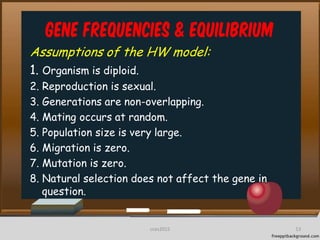
Assumptions of the HW model:
1. Organism is diploid.
2. Reproduction is sexual.
3. Generations are non-overlapping.
4. Mating occurs at random.
5. Population size is very large.
6. Migration is zero.
7. Mutation is zero.
8. Natural selection does not affect the gene in
question.
13cces2015
Changes in Gene frequencies
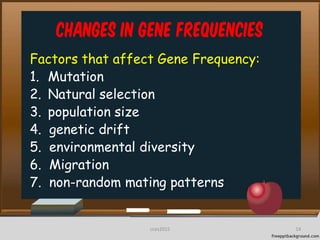
Factors that affect Gene Frequency:
1. Mutation
2. Natural selection
3. population size
4. genetic drift
5. environmental diversity
6. Migration
7. non-random mating patterns
14cces2015
Changes in Gene frequencies
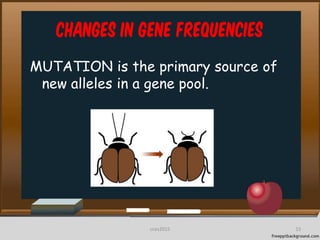
MUTATION is the primary source of
new alleles in a gene pool.
15cces2015
Changes in Gene
frequencies
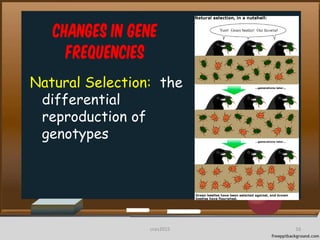
Natural Selection: the
differential
reproduction of
genotypes
16cces2015
Changes in Gene frequencies
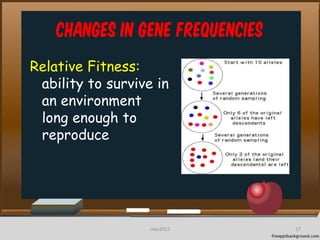
Relative Fitness:
ability to survive in
an environment
long enough to
reproduce
17cces2015
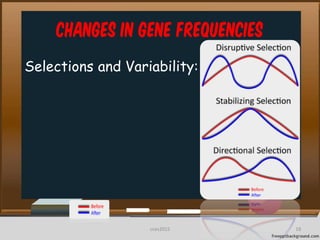
Changes in Gene frequencies
Selections and Variability:
18cces2015
Changes in Gene frequencies
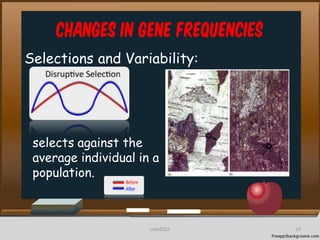
Selections and Variability:
selects against the
average individual in a
population.
19cces2015
Changes in Gene frequencies
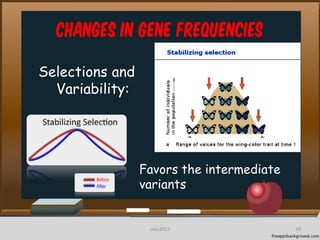
Selections and
Variability:
Favors the intermediate
variants
20cces2015
Changes in Gene frequencies
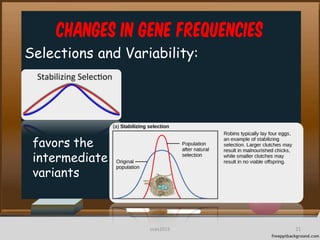
Selections and Variability:
favors the
intermediate
variants
21cces2015
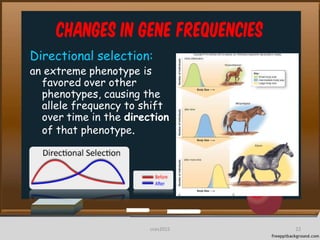
Changes in Gene frequencies
Directional selection:
an extreme phenotype is
favored over other
phenotypes, causing the
allele frequency to shift
over time in the direction
of that phenotype.
22cces2015
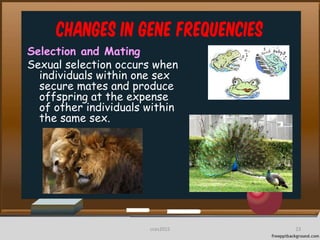
Changes in Gene frequencies
Selection and Mating
Sexual selection occurs when
individuals within one sex
secure mates and produce
offspring at the expense
of other individuals within
the same sex.
23cces2015
Changes in Gene frequencies
Mating systems:
RANDOM: mate choice is independent of
phenotype and genotype
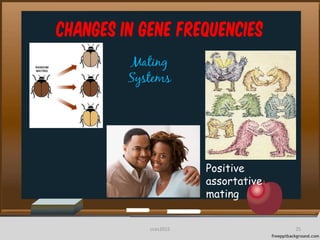
POSITIVE ASSORTMENT: mate choice is
dependent on similarity of phenotype
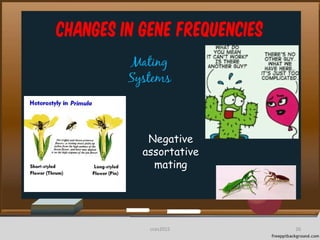
NEGATIVE ASSORTMENT: …..on dissimilarity
of phenotype
INBREEDING: mating with relatives at a rate
greater than expected by chance
24cces2015
Changes in Gene frequencies
Mating
Systems
Positive
assortative
mating
25cces2015
Changes in Gene frequencies
Mating
Systems
Negative
assortative
mating
26cces2015
Changes in Gene frequencies
Positive assortment:
- increases homozygosity (prevents HW
equilibrium)
- does not affect allele frequency
- dominance dilutes its effect
- affects only those genes related to
the phenotype by which mates are
chosen
27cces2015
Changes in Gene frequencies
Negative Assortment/disassortative
mating:
- yields an excess of heterozygotes
(compared to HW)
- does not affect allele frequencies *
- dominance dilutes its effect
- Increases the rate to equilibrium of
alleles among loci (because linkage phases are
disrupted by recombination in double homozygotes).
28cces2015
Changes in Gene frequencies
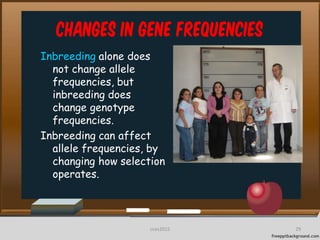
Inbreeding alone does
not change allele
frequencies, but
inbreeding does
change genotype
frequencies.
Inbreeding can affect
allele frequencies, by
changing how selection
operates.
29cces2015
Changes in Gene frequencies
Inbreeding
- Can result to excess homozygotes
- Inbred individuals usually have lower fitness
than outbred individuals. (inbreeding
depression)
- 2 possible reasons for inbreeding depression:
(1) deleterious recessive alleles
(2) overdominance
30cces2015
Changes in Gene frequencies
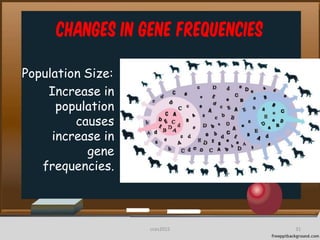
Population Size:
Increase in
population
causes
increase in
gene
frequencies.
31cces2015
Changes in Gene frequencies
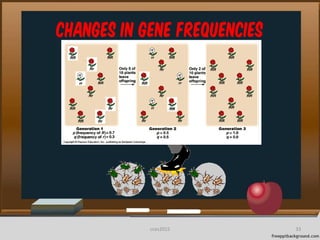
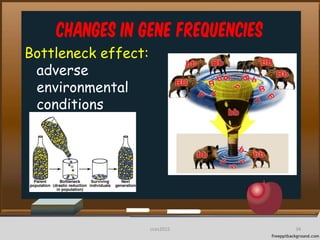
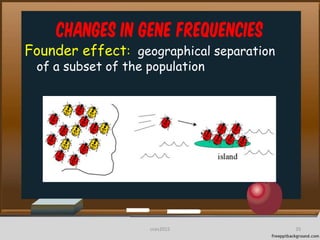
GENETIC DRIFT occurs as the result
of random fluctuations in the
transfer of alleles from one
generation to the next, especially in
small populations formed, as a result
of bottleneck effect and founder
effect
32cces2015
Changes in Gene frequencies
33cces2015
Changes in Gene frequencies
Bottleneck effect:
adverse
environmental
conditions
34cces2015
Changes in Gene frequencies
Founder effect: geographical separation
of a subset of the population
35cces2015
Changes in Gene frequencies
Random genetic drift can continue until
one allele is fixed or lost
As genetic drift progresses,
- heterozygosity decreases.
- genetic variance within populations
decreases.
- genetic variance among populations
increases.
36cces2015
Changes in Gene frequencies
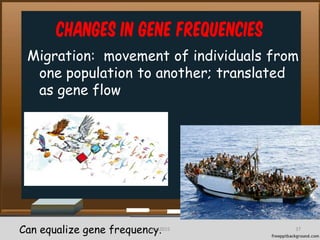
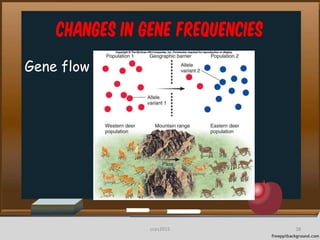
Migration: movement of individuals from
one population to another; translated
as gene flow
Can equalize gene frequency. 37cces2015
Changes in Gene frequencies
Gene flow
38cces2015
Race and Species Formation
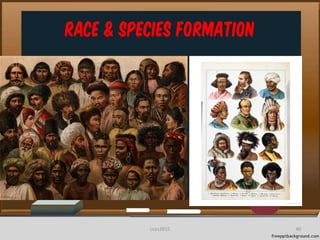
Race: geographically isolated breeding
population that shares certain
characteristics in higher frequencies
than other populations of that species,
but has not become reproductively
isolated from other populations of the
same species.
39cces2015
Race & Species Formation
40cces2015
Race & Species Formation
Species: members of populations that
actually or potentially interbreed in
nature, not according to similarity of
appearance
41cces2015
Race & Species Formation
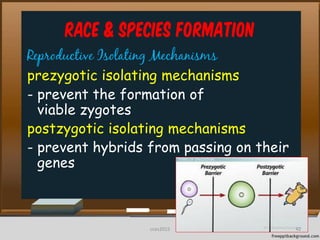
Reproductive Isolating Mechanisms
prezygotic isolating mechanisms
- prevent the formation of
viable zygotes
postzygotic isolating mechanisms
- prevent hybrids from passing on their
genes
42cces2015
Race & Species Formation
Reproductive Isolating
Mechanisms
Prezygotic Isolating
Mechanisms
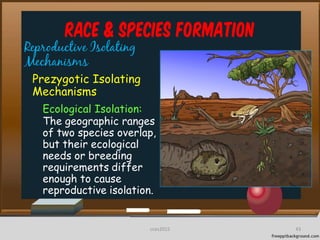
Ecological Isolation:
The geographic ranges
of two species overlap,
but their ecological
needs or breeding
requirements differ
enough to cause
reproductive isolation.
43cces2015
Race&SpeciesFormation Reproductive Isolating
Mechanisms
Prezygotic Isolating
Mechanisms
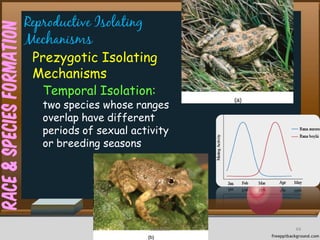
Temporal Isolation:
two species whose ranges
overlap have different
periods of sexual activity
or breeding seasons
44cces2015
45cces2015
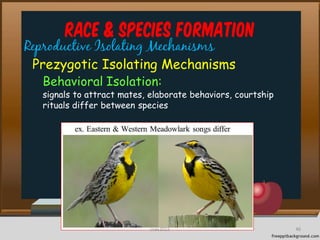
Race & Species Formation
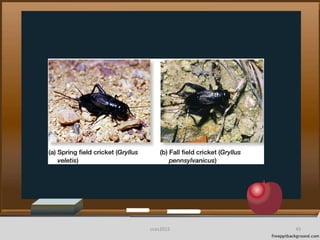
Reproductive Isolating Mechanisms
Prezygotic Isolating Mechanisms
Behavioral Isolation:
signals to attract mates, elaborate behaviors, courtship
rituals differ between species
46cces2015
Race & Species Formation
Reproductive Isolating Mechanisms
Prezygotic Isolating Mechanisms
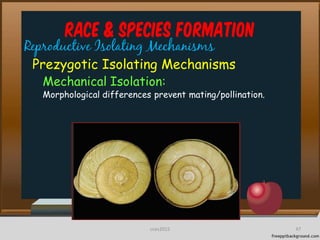
Mechanical Isolation:
Morphological differences prevent mating/pollination.
47cces2015
Race & Species Formation
Reproductive Isolating Mechanisms
Prezygotic Isolating Mechanisms
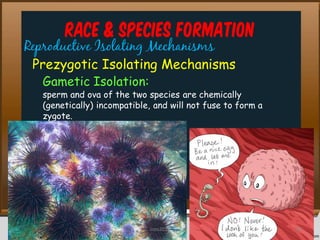
Gametic Isolation:
sperm and ova of the two species are chemically
(genetically) incompatible, and will not fuse to form a
zygote.
48cces2015
Race & Species Formation
Reproductive Isolating
Mechanisms
Postzygotic
Isolating
Mechanisms
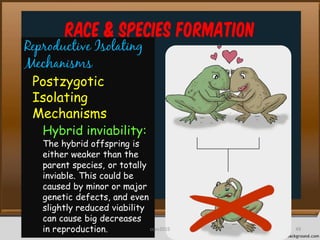
Hybrid inviability:
The hybrid offspring is
either weaker than the
parent species, or totally
inviable. This could be
caused by minor or major
genetic defects, and even
slightly reduced viability
can cause big decreases
in reproduction. 49cces2015
Race & Species Formation
Reproductive Isolating
Mechanisms
Postzygotic Isolating
Mechanisms
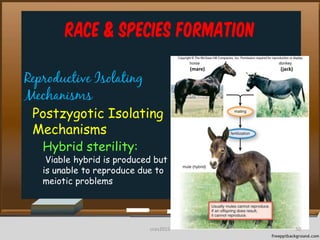
Hybrid sterility:
Viable hybrid is produced but
is unable to reproduce due to
meiotic problems
(mare) (jack)
50cces2015
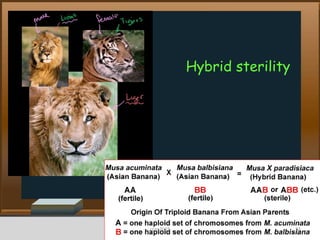
Hybrid sterility
51cces2015
Race & Species Formation
Reproductive Isolating
Mechanisms
Postzygotic Isolating
Mechanisms
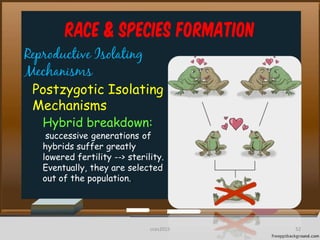
Hybrid breakdown:
successive generations of
hybrids suffer greatly
lowered fertility --> sterility.
Eventually, they are selected
out of the population..
52cces2015
Race and Species Formation
Speciation:
Hybrids may actually be reproductively superior to
parent populations, and if they tend to breed with
each other, this can result in what could be
termed hybrid speciation.
Speciation can occur as a result of hybridization
between two related species, if the hybrid
• receives a genome that enables it to breed with other
such hybrids but not breed with either parental species;
• can escape to a habitat where it does not have to compete
with either parent;
• is adapted to live under those new conditions.
53cces2015

Genetics: Genes in Populations

  • 1.
  • 2.
    A. Population Genetics B.Gene Frequencies and Equilibrium 1. Gene Frequencies 2. Gene Pool 3. Model System for Population Stability (Hardy – Weinberg Law) 2cces2015
  • 3.
    C. Changes inGene Frequencies 1. Mutation 2. Selection 2.1 Relative Fitness 2.2 Selections and Variability 2.3 Selection and Mating 3. Systems 4. Migration 5. Genetic Drift 3cces2015
  • 4.
    D. Race andSpecies Formation 1. The Concept of Races 2. The Concept of Species 2.1 Reproductive Isolating Mechanisms 2.2 Rapid Speciation 4cces2015
  • 5.
    Population: a groupof individuals of the same species that live in the same area and interbreed (interbreeding causes production of fertile offspring) 5cces2015
  • 6.
    POPULATION GENETICS the studyof genetic variation within populations involves the examination and modelling of changes in the frequencies of genes and alleles in populations over space and time. FOCUS: species or population 6cces2015
  • 7.
    Gene frequencies &equilibrium GENE POOL: the collection of all the alleles of all of the genes found within a freely interbreeding population 7cces2015
  • 8.
    Gene frequencies &equilibrium GENE FREQUENCY (allele frequency) The proportion of all alleles in all individuals in the group in question which are of a particular type. Ex: 40 individuals which are AA 47 individuals which are Aa 13 individuals which are aa 8cces2015
  • 9.
    Gene frequencies &equilibrium GENOTYPE AA Aa aa TOTAL # of individuals 40 47 13 100 # of A alleles 80 47 0 127 # of a alleles 0 47 26 73 Total # of alleles 200 Allele frequency of A: 127/200 = 0.635 pA=0.635 pa = 73/200 = 0.365 = 1- pA 9cces2015
  • 10.
    Gene frequencies &equilibrium GENOTYPE FREQUENCY: The proportion of individuals in a group with a particular genotype. 40 AA 47 Aa 13 aa = 100 Total individuals pAA = 40/100 = 0.4 pAa = 47/100 = 0.47 paa = 13/100 = 0.13 10cces2015
  • 11.
    Gene frequencies &equilibrium Hardy-Weinberg Equation: used to estimate frequency of alleles in a population p = the frequency of the dominant allele (A) q = the frequency of the recessive allele (a) For a population in genetic equilibrium: p + q = 1.0 (The sum of the frequencies of both alleles is 100%.) 11cces2015
  • 12.
    Gene frequencies &equilibrium (p + q)2 = 1 so p2 + 2pq + q2 = 1 where p2 = frequency of AA 2pq = frequency of Aa q2 = frequency of aa 12cces2015
  • 13.
    Gene frequencies &equilibrium Assumptions of the HW model: 1. Organism is diploid. 2. Reproduction is sexual. 3. Generations are non-overlapping. 4. Mating occurs at random. 5. Population size is very large. 6. Migration is zero. 7. Mutation is zero. 8. Natural selection does not affect the gene in question. 13cces2015
  • 14.
    Changes in Genefrequencies Factors that affect Gene Frequency: 1. Mutation 2. Natural selection 3. population size 4. genetic drift 5. environmental diversity 6. Migration 7. non-random mating patterns 14cces2015
  • 15.
    Changes in Genefrequencies MUTATION is the primary source of new alleles in a gene pool. 15cces2015
  • 16.
    Changes in Gene frequencies NaturalSelection: the differential reproduction of genotypes 16cces2015
  • 17.
    Changes in Genefrequencies Relative Fitness: ability to survive in an environment long enough to reproduce 17cces2015
  • 18.
    Changes in Genefrequencies Selections and Variability: 18cces2015
  • 19.
    Changes in Genefrequencies Selections and Variability: selects against the average individual in a population. 19cces2015
  • 20.
    Changes in Genefrequencies Selections and Variability: Favors the intermediate variants 20cces2015
  • 21.
    Changes in Genefrequencies Selections and Variability: favors the intermediate variants 21cces2015
  • 22.
    Changes in Genefrequencies Directional selection: an extreme phenotype is favored over other phenotypes, causing the allele frequency to shift over time in the direction of that phenotype. 22cces2015
  • 23.
    Changes in Genefrequencies Selection and Mating Sexual selection occurs when individuals within one sex secure mates and produce offspring at the expense of other individuals within the same sex. 23cces2015
  • 24.
    Changes in Genefrequencies Mating systems: RANDOM: mate choice is independent of phenotype and genotype POSITIVE ASSORTMENT: mate choice is dependent on similarity of phenotype NEGATIVE ASSORTMENT: …..on dissimilarity of phenotype INBREEDING: mating with relatives at a rate greater than expected by chance 24cces2015
  • 25.
    Changes in Genefrequencies Mating Systems Positive assortative mating 25cces2015
  • 26.
    Changes in Genefrequencies Mating Systems Negative assortative mating 26cces2015
  • 27.
    Changes in Genefrequencies Positive assortment: - increases homozygosity (prevents HW equilibrium) - does not affect allele frequency - dominance dilutes its effect - affects only those genes related to the phenotype by which mates are chosen 27cces2015
  • 28.
    Changes in Genefrequencies Negative Assortment/disassortative mating: - yields an excess of heterozygotes (compared to HW) - does not affect allele frequencies * - dominance dilutes its effect - Increases the rate to equilibrium of alleles among loci (because linkage phases are disrupted by recombination in double homozygotes). 28cces2015
  • 29.
    Changes in Genefrequencies Inbreeding alone does not change allele frequencies, but inbreeding does change genotype frequencies. Inbreeding can affect allele frequencies, by changing how selection operates. 29cces2015
  • 30.
    Changes in Genefrequencies Inbreeding - Can result to excess homozygotes - Inbred individuals usually have lower fitness than outbred individuals. (inbreeding depression) - 2 possible reasons for inbreeding depression: (1) deleterious recessive alleles (2) overdominance 30cces2015
  • 31.
    Changes in Genefrequencies Population Size: Increase in population causes increase in gene frequencies. 31cces2015
  • 32.
    Changes in Genefrequencies GENETIC DRIFT occurs as the result of random fluctuations in the transfer of alleles from one generation to the next, especially in small populations formed, as a result of bottleneck effect and founder effect 32cces2015
  • 33.
    Changes in Genefrequencies 33cces2015
  • 34.
    Changes in Genefrequencies Bottleneck effect: adverse environmental conditions 34cces2015
  • 35.
    Changes in Genefrequencies Founder effect: geographical separation of a subset of the population 35cces2015
  • 36.
    Changes in Genefrequencies Random genetic drift can continue until one allele is fixed or lost As genetic drift progresses, - heterozygosity decreases. - genetic variance within populations decreases. - genetic variance among populations increases. 36cces2015
  • 37.
    Changes in Genefrequencies Migration: movement of individuals from one population to another; translated as gene flow Can equalize gene frequency. 37cces2015
  • 38.
    Changes in Genefrequencies Gene flow 38cces2015
  • 39.
    Race and SpeciesFormation Race: geographically isolated breeding population that shares certain characteristics in higher frequencies than other populations of that species, but has not become reproductively isolated from other populations of the same species. 39cces2015
  • 40.
    Race & SpeciesFormation 40cces2015
  • 41.
    Race & SpeciesFormation Species: members of populations that actually or potentially interbreed in nature, not according to similarity of appearance 41cces2015
  • 42.
    Race & SpeciesFormation Reproductive Isolating Mechanisms prezygotic isolating mechanisms - prevent the formation of viable zygotes postzygotic isolating mechanisms - prevent hybrids from passing on their genes 42cces2015
  • 43.
    Race & SpeciesFormation Reproductive Isolating Mechanisms Prezygotic Isolating Mechanisms Ecological Isolation: The geographic ranges of two species overlap, but their ecological needs or breeding requirements differ enough to cause reproductive isolation. 43cces2015
  • 44.
    Race&SpeciesFormation Reproductive Isolating Mechanisms PrezygoticIsolating Mechanisms Temporal Isolation: two species whose ranges overlap have different periods of sexual activity or breeding seasons 44cces2015
  • 45.
  • 46.
    Race & SpeciesFormation Reproductive Isolating Mechanisms Prezygotic Isolating Mechanisms Behavioral Isolation: signals to attract mates, elaborate behaviors, courtship rituals differ between species 46cces2015
  • 47.
    Race & SpeciesFormation Reproductive Isolating Mechanisms Prezygotic Isolating Mechanisms Mechanical Isolation: Morphological differences prevent mating/pollination. 47cces2015
  • 48.
    Race & SpeciesFormation Reproductive Isolating Mechanisms Prezygotic Isolating Mechanisms Gametic Isolation: sperm and ova of the two species are chemically (genetically) incompatible, and will not fuse to form a zygote. 48cces2015
  • 49.
    Race & SpeciesFormation Reproductive Isolating Mechanisms Postzygotic Isolating Mechanisms Hybrid inviability: The hybrid offspring is either weaker than the parent species, or totally inviable. This could be caused by minor or major genetic defects, and even slightly reduced viability can cause big decreases in reproduction. 49cces2015
  • 50.
    Race & SpeciesFormation Reproductive Isolating Mechanisms Postzygotic Isolating Mechanisms Hybrid sterility: Viable hybrid is produced but is unable to reproduce due to meiotic problems (mare) (jack) 50cces2015
  • 51.
  • 52.
    Race & SpeciesFormation Reproductive Isolating Mechanisms Postzygotic Isolating Mechanisms Hybrid breakdown: successive generations of hybrids suffer greatly lowered fertility --> sterility. Eventually, they are selected out of the population.. 52cces2015
  • 53.
    Race and SpeciesFormation Speciation: Hybrids may actually be reproductively superior to parent populations, and if they tend to breed with each other, this can result in what could be termed hybrid speciation. Speciation can occur as a result of hybridization between two related species, if the hybrid • receives a genome that enables it to breed with other such hybrids but not breed with either parental species; • can escape to a habitat where it does not have to compete with either parent; • is adapted to live under those new conditions. 53cces2015