1
1
2
2
The Gene Pool
•Members of a species
can interbreed &
produce fertile
offspring
•Species have a shared
gene pool
•Gene pool – all of the
alleles of all individuals
in a population
3
3
The Gene Pool
•Different species
do NOT exchange
genes by
interbreeding
•Different species
that interbreed
often produce
sterile or less viable
offspring e.g. Mule
4
4
Populations
•A group of the
same species living
in an area
•No two individuals
are exactly alike
(variations)
•More Fit
individuals survive &
pass on their traits
5
5
Speciation
•Formation of new
species
•One species may
split into 2 or more
species
•A species may
evolve into a new
species
•Requires very long
periods of time
6
6
Modern
Evolutionary
Thought
7
7
Modern Synthesis Theory
•Combines Darwinian
selection and
Mendelian inheritance
•Population genetics -
study of genetic
variation within a
population
•Emphasis on
quantitative
characters (height,
size …)
8
8
Modern Synthesis Theory
•1940s – comprehensive
theory of evolution
(Modern Synthesis
Theory)
•Introduced by Fisher &
Wright
•Until then, many did not
accept that Darwin’s
theory of natural
selection could drive
evolution
S. Wright
A. Fisher
9
9
Modern Synthesis Theory
• TODAY’S theory on evolution
•Recognizes that GENES are responsible for
the inheritance of characteristics
•Recognizes that POPULATIONS, not
individuals, evolve due to natural selection
& genetic drift
•Recognizes that SPECIATION usually is due
to the gradual accumulation of small genetic
changes
10
10
Microevolution
•Changes occur in gene pools due to
mutation, natural selection, genetic
drift, etc.
•Gene pool changes cause more
VARIATION in individuals in the
population
•This process is called
MICROEVOLUTION
•Example: Bacteria becoming unaffected
by antibiotics (resistant)
11
11
Hardy-
Weinberg
Principle
12
12
The Hardy-Weinberg Principle
•Used to describe a non-evolving
population.
•Shuffling of alleles by meiosis and
random fertilization have no effect
on the overall gene pool.
• Natural populations are NOT
expected to actually be in Hardy-
Weinberg equilibrium.
13
13
The Hardy-Weinberg Principle
•Deviation from Hardy-Weinberg
equilibrium usually results in
evolution
•Understanding a non-evolving
population, helps us to understand
how evolution occurs
14
14
5 Assumptions of the H-W Principle
1.Large population size
- small populations have fluctuations in allele
frequencies (e.g., fire, storm).
2.No migration
- immigrants can change the frequency of an
allele by bringing in new alleles to a
population.
3.No net mutations
- if alleles change from one to another, this
will change the frequency of those alleles
15
15
5 Assumptions of the H-W Principle
3.Random mating
- if certain traits are more desirable,
then individuals with those traits will be
selected and this will not allow for random
mixing of alleles.
4.No natural selection
- if some individuals survive and reproduce
at a higher rate than others, then their
offspring will carry those genes and the
frequency will change for the next
generation.
16
Traits Selected for Random Mating
16
17
The Hardy-Weinberg Principle
The gene pool of a NON-EVOLVING
population remains CONSTANT over multiple
generations (allele frequency doesn’t change)
The Hardy-Weinberg Equation:
1.0 = p2 + 2pq + q2
Where:
p2 = frequency of AA genotype
2pq = frequency of Aa
q2 = frequency of aa genotype
17
18
The Hardy-Weinberg Principle
Determining the Allele Frequency using
Hardy-Weinberg:
1.0 = p + q
Where:
p = frequency of A allele
q = frequency of a allele
18
19
19
Allele Frequencies Define Gene Pools
As there are 1000 copies of the genes for color,
the allele frequencies are (in both males and females):
320 x 2 (RR) + 160 x 1 (Rr) = 800 R; 800/1000 = 0.8
(80%) R
160 x 1 (Rr) + 20 x 2 (rr) = 200 r; 200/1000 = 0.2
(20%) r
500 flowering plants
480 red flowers 20 white flowers
320 RR 160 Rr 20 rr
20
20
21
21
22
22
Microevolution
of Species
23
Causes of Microevolution
• Genetic Drift
- the change in the gene pool of a small
population due to chance
• Natural Selection
- success in reproduction based on heritable
traits results in selected alleles being passed to
relatively more offspring (Darwinian inheritance)
- Cause ADAPTATION of Populations
• Gene Flow
-is genetic exchange due to the migration of
fertile individuals or gametes between
populations
23
24
Causes of Microevolution
• Mutation
-a change in an organism’s DNA
-Mutations can be transmitted in gametes to
offspring
• Non-random mating
- Mates are chosen on the basis of the best
traits
24
25
25
Genetic Drift
26
Factors that Cause Genetic Drift
•Bottleneck Effect
-a drastic reduction in population (volcanoes,
earthquakes, landslides …)
-Reduced genetic variation
-Smaller population may not be able to adapt to new
selection pressures
• Founder Effect
-occurs when a new colony is started by a few
members of the original population
-Reduced genetic variation
-May lead to speciation
26
27
27
28
Loss of Genetic Variation
•Cheetahs have little genetic variation in
their gene pool
•This can probably be attributed to a
population bottleneck they experienced
around 10,000 years ago, barely
avoiding extinction at the end of the
last ice age
28
29
30
Founder’s Effect
30
31
31
Modes of Natural
Selection
32
Modes of Natural Selection
• Directional Selection
- Favors individuals at one end of the phenotypic
range
- Most common during times of environmental change
or when moving to new habitats
• Disruptive selection
-Favors extreme over intermediate phenotypes
-Occurs when environmental change favors an
extreme phenotype
32
33
33
Directional
Selection
34
34
Disruptive Selection
35
Modes of Natural Selection
• Stabilizing Selection
- Favors intermediate over extreme phenotypes
- Reduces variation and maintains the cureent
average
- Example: Human birth weight
35
36
36
37
37
Variations in
Populations
38
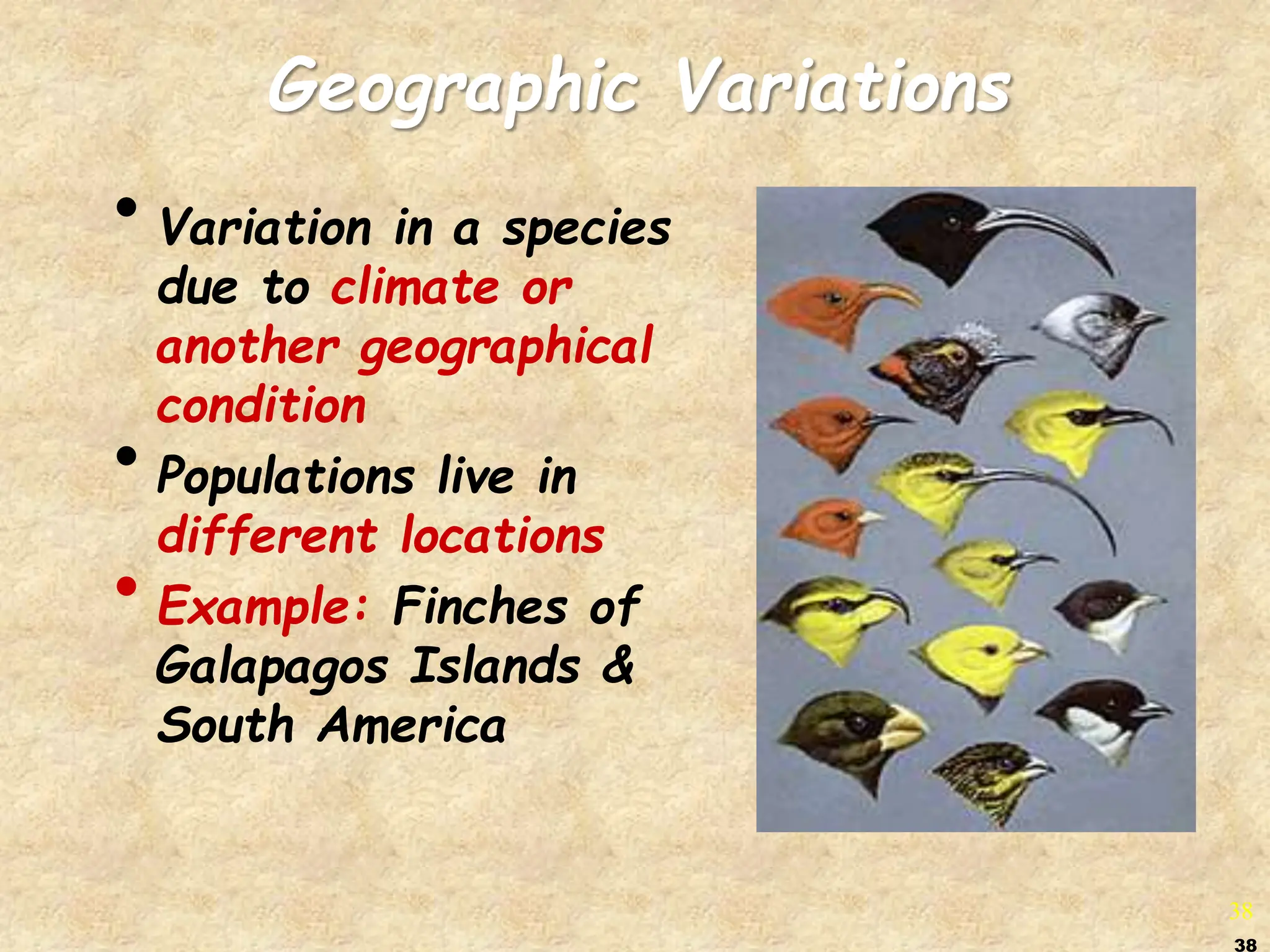
Geographic Variations
•Variation in a species
due to climate or
another geographical
condition
•Populations live in
different locations
•Example: Finches of
Galapagos Islands &
South America
38
39
39
40
40
Heterozygote Advantage
• Favors heterozygotes (Aa)
• Maintains both alleles (A,a) instead of
removing less successful alleles from a
population
• Sickle cell anemia
> Homozygotes exhibit severe anemia, have
abnormal blood cell shape, and usually die
before reproductive age.
> Heterozygotes are less susceptible to
malaria
41
41
Sickle Cell and Malaria
42
42
43
Other Sources of Variation
• Mutations
-In stable environments, mutations often result in
little or no benefit to an organism, or are often
harmful
-Mutations are more beneficial (rare) in changing
environments (Example: HIV resistance to
antiviral drugs)
• Genetic Recombination
-source of most genetic differences between
individuals in a population
• Co-evolution
-Often occurs between parasite & host and
flowers & their pollinators
43
44
Coevolution
44
45
45

biology population genetics chapter 17.ppt

  • 1.
  • 2.
    2 2 The Gene Pool •Membersof a species can interbreed & produce fertile offspring •Species have a shared gene pool •Gene pool – all of the alleles of all individuals in a population
  • 3.
    3 3 The Gene Pool •Differentspecies do NOT exchange genes by interbreeding •Different species that interbreed often produce sterile or less viable offspring e.g. Mule
  • 4.
    4 4 Populations •A group ofthe same species living in an area •No two individuals are exactly alike (variations) •More Fit individuals survive & pass on their traits
  • 5.
    5 5 Speciation •Formation of new species •Onespecies may split into 2 or more species •A species may evolve into a new species •Requires very long periods of time
  • 6.
  • 7.
    7 7 Modern Synthesis Theory •CombinesDarwinian selection and Mendelian inheritance •Population genetics - study of genetic variation within a population •Emphasis on quantitative characters (height, size …)
  • 8.
    8 8 Modern Synthesis Theory •1940s– comprehensive theory of evolution (Modern Synthesis Theory) •Introduced by Fisher & Wright •Until then, many did not accept that Darwin’s theory of natural selection could drive evolution S. Wright A. Fisher
  • 9.
    9 9 Modern Synthesis Theory •TODAY’S theory on evolution •Recognizes that GENES are responsible for the inheritance of characteristics •Recognizes that POPULATIONS, not individuals, evolve due to natural selection & genetic drift •Recognizes that SPECIATION usually is due to the gradual accumulation of small genetic changes
  • 10.
    10 10 Microevolution •Changes occur ingene pools due to mutation, natural selection, genetic drift, etc. •Gene pool changes cause more VARIATION in individuals in the population •This process is called MICROEVOLUTION •Example: Bacteria becoming unaffected by antibiotics (resistant)
  • 11.
  • 12.
    12 12 The Hardy-Weinberg Principle •Usedto describe a non-evolving population. •Shuffling of alleles by meiosis and random fertilization have no effect on the overall gene pool. • Natural populations are NOT expected to actually be in Hardy- Weinberg equilibrium.
  • 13.
    13 13 The Hardy-Weinberg Principle •Deviationfrom Hardy-Weinberg equilibrium usually results in evolution •Understanding a non-evolving population, helps us to understand how evolution occurs
  • 14.
    14 14 5 Assumptions ofthe H-W Principle 1.Large population size - small populations have fluctuations in allele frequencies (e.g., fire, storm). 2.No migration - immigrants can change the frequency of an allele by bringing in new alleles to a population. 3.No net mutations - if alleles change from one to another, this will change the frequency of those alleles
  • 15.
    15 15 5 Assumptions ofthe H-W Principle 3.Random mating - if certain traits are more desirable, then individuals with those traits will be selected and this will not allow for random mixing of alleles. 4.No natural selection - if some individuals survive and reproduce at a higher rate than others, then their offspring will carry those genes and the frequency will change for the next generation.
  • 16.
    16 Traits Selected forRandom Mating 16
  • 17.
    17 The Hardy-Weinberg Principle Thegene pool of a NON-EVOLVING population remains CONSTANT over multiple generations (allele frequency doesn’t change) The Hardy-Weinberg Equation: 1.0 = p2 + 2pq + q2 Where: p2 = frequency of AA genotype 2pq = frequency of Aa q2 = frequency of aa genotype 17
  • 18.
    18 The Hardy-Weinberg Principle Determiningthe Allele Frequency using Hardy-Weinberg: 1.0 = p + q Where: p = frequency of A allele q = frequency of a allele 18
  • 19.
    19 19 Allele Frequencies DefineGene Pools As there are 1000 copies of the genes for color, the allele frequencies are (in both males and females): 320 x 2 (RR) + 160 x 1 (Rr) = 800 R; 800/1000 = 0.8 (80%) R 160 x 1 (Rr) + 20 x 2 (rr) = 200 r; 200/1000 = 0.2 (20%) r 500 flowering plants 480 red flowers 20 white flowers 320 RR 160 Rr 20 rr
  • 20.
  • 21.
  • 22.
  • 23.
    23 Causes of Microevolution •Genetic Drift - the change in the gene pool of a small population due to chance • Natural Selection - success in reproduction based on heritable traits results in selected alleles being passed to relatively more offspring (Darwinian inheritance) - Cause ADAPTATION of Populations • Gene Flow -is genetic exchange due to the migration of fertile individuals or gametes between populations 23
  • 24.
    24 Causes of Microevolution •Mutation -a change in an organism’s DNA -Mutations can be transmitted in gametes to offspring • Non-random mating - Mates are chosen on the basis of the best traits 24
  • 25.
  • 26.
    26 Factors that CauseGenetic Drift •Bottleneck Effect -a drastic reduction in population (volcanoes, earthquakes, landslides …) -Reduced genetic variation -Smaller population may not be able to adapt to new selection pressures • Founder Effect -occurs when a new colony is started by a few members of the original population -Reduced genetic variation -May lead to speciation 26
  • 27.
  • 28.
    28 Loss of GeneticVariation •Cheetahs have little genetic variation in their gene pool •This can probably be attributed to a population bottleneck they experienced around 10,000 years ago, barely avoiding extinction at the end of the last ice age 28
  • 29.
  • 30.
  • 31.
  • 32.
    32 Modes of NaturalSelection • Directional Selection - Favors individuals at one end of the phenotypic range - Most common during times of environmental change or when moving to new habitats • Disruptive selection -Favors extreme over intermediate phenotypes -Occurs when environmental change favors an extreme phenotype 32
  • 33.
  • 34.
  • 35.
    35 Modes of NaturalSelection • Stabilizing Selection - Favors intermediate over extreme phenotypes - Reduces variation and maintains the cureent average - Example: Human birth weight 35
  • 36.
  • 37.
  • 38.
    38 Geographic Variations •Variation ina species due to climate or another geographical condition •Populations live in different locations •Example: Finches of Galapagos Islands & South America 38
  • 39.
  • 40.
    40 40 Heterozygote Advantage • Favorsheterozygotes (Aa) • Maintains both alleles (A,a) instead of removing less successful alleles from a population • Sickle cell anemia > Homozygotes exhibit severe anemia, have abnormal blood cell shape, and usually die before reproductive age. > Heterozygotes are less susceptible to malaria
  • 41.
  • 42.
  • 43.
    43 Other Sources ofVariation • Mutations -In stable environments, mutations often result in little or no benefit to an organism, or are often harmful -Mutations are more beneficial (rare) in changing environments (Example: HIV resistance to antiviral drugs) • Genetic Recombination -source of most genetic differences between individuals in a population • Co-evolution -Often occurs between parasite & host and flowers & their pollinators 43
  • 44.
  • 45.