Population Genetics The Hardy-Weinberg principle Factors that can change allele frequencies
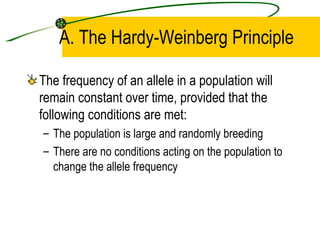
A. The Hardy-Weinberg Principle The frequency of an allele in a population will remain constant over time, provided that the following conditions are met: The population is large and randomly breeding There are no conditions acting on the population to change the allele frequency
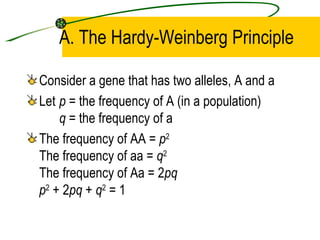
A. The Hardy-Weinberg Principle Consider a gene that has two alleles, A and a Let  p  = the frequency of A (in a population) q  = the frequency of a The frequency of AA =  p 2 The frequency of aa =  q 2 The frequency of Aa = 2 pq p 2  + 2 pq  +  q 2  = 1
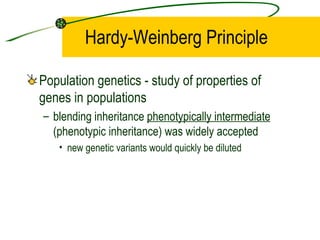
Hardy-Weinberg Principle Population genetics - study of properties of genes in populations blending inheritance  phenotypically intermediate  (phenotypic inheritance) was widely accepted new genetic variants would quickly be diluted
Hardy-Weinberg Principle Hardy-Weinberg - original proportions of  genotypes in a population will remain constant from generation to generation Sexual reproduction (meiosis and fertilization) alone will not change allelic (genotypic) proportions.
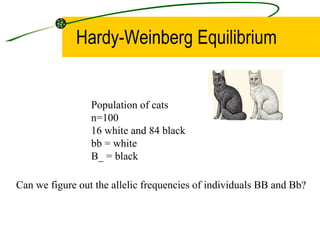
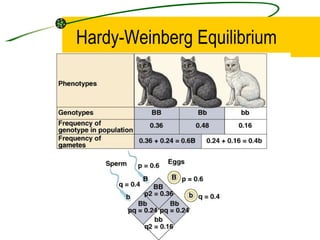
Hardy-Weinberg Equilibrium Population of cats  n=100 16 white and 84 black bb = white B_ = black Can we figure out the allelic frequencies of individuals BB and Bb?
Hardy-Weinberg Principle Necessary assumptions Allelic frequencies would remain constant if… population size is very large random mating no mutation no gene input from external sources no selection occurring
Hardy-Weinberg Principle Calculate genotype frequencies with a binomial expansion (p+q) 2  = p 2  + 2pq + q 2 p2 = individuals homozygous for first allele 2pq = individuals heterozygous for alleles q2 = individuals homozygous for second allele
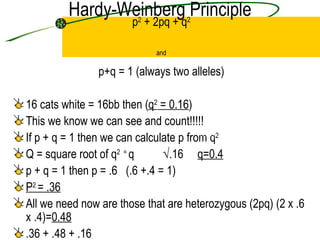
p 2  + 2pq + q 2 and p+q = 1 (always two alleles) 16 cats white = 16bb then ( q 2  = 0.16 ) This we know we can see and count!!!!! If p + q = 1 then we can calculate p from q 2 Q = square root of q 2  =  q  √.16  q=0.4 p + q = 1 then p = .6  (.6 +.4 = 1) P 2  = .36 All we need now are those that are heterozygous (2pq) (2 x .6 x .4)= 0.48   .36 + .48 + .16   Hardy-Weinberg Principle
Hardy-Weinberg Equilibrium
B. Factors That Change Allele Frequencies Mutation Migration Natural selection Random genetic drift

Hardy weinberg

  • 1.
    Population Genetics TheHardy-Weinberg principle Factors that can change allele frequencies
  • 2.
    A. The Hardy-WeinbergPrinciple The frequency of an allele in a population will remain constant over time, provided that the following conditions are met: The population is large and randomly breeding There are no conditions acting on the population to change the allele frequency
  • 3.
    A. The Hardy-WeinbergPrinciple Consider a gene that has two alleles, A and a Let p = the frequency of A (in a population) q = the frequency of a The frequency of AA = p 2 The frequency of aa = q 2 The frequency of Aa = 2 pq p 2 + 2 pq + q 2 = 1
  • 4.
    Hardy-Weinberg Principle Populationgenetics - study of properties of genes in populations blending inheritance phenotypically intermediate (phenotypic inheritance) was widely accepted new genetic variants would quickly be diluted
  • 5.
    Hardy-Weinberg Principle Hardy-Weinberg- original proportions of genotypes in a population will remain constant from generation to generation Sexual reproduction (meiosis and fertilization) alone will not change allelic (genotypic) proportions.
  • 6.
    Hardy-Weinberg Equilibrium Populationof cats n=100 16 white and 84 black bb = white B_ = black Can we figure out the allelic frequencies of individuals BB and Bb?
  • 7.
    Hardy-Weinberg Principle Necessaryassumptions Allelic frequencies would remain constant if… population size is very large random mating no mutation no gene input from external sources no selection occurring
  • 8.
    Hardy-Weinberg Principle Calculategenotype frequencies with a binomial expansion (p+q) 2 = p 2 + 2pq + q 2 p2 = individuals homozygous for first allele 2pq = individuals heterozygous for alleles q2 = individuals homozygous for second allele
  • 9.
    p 2 + 2pq + q 2 and p+q = 1 (always two alleles) 16 cats white = 16bb then ( q 2 = 0.16 ) This we know we can see and count!!!!! If p + q = 1 then we can calculate p from q 2 Q = square root of q 2 = q √.16 q=0.4 p + q = 1 then p = .6 (.6 +.4 = 1) P 2 = .36 All we need now are those that are heterozygous (2pq) (2 x .6 x .4)= 0.48 .36 + .48 + .16 Hardy-Weinberg Principle
  • 10.
  • 11.
    B. Factors ThatChange Allele Frequencies Mutation Migration Natural selection Random genetic drift