PRESENTATION ON
HARDY-WEINBERG LAW
PREPARED BY:
Santosh pathak
IAAS, lamjung campus
HARDY-WEINBERG LAW
 According to Hardy (England,1908) and Weinberg
(Germany,1909), gene and genotype frequency of a Mendelian
population remain constant generation after generation unless
there is selection,mutation,migration or random drift.
 Suppose in a population of plant species, a gene has two allele,
‘A’ n ‘a’ having frequency ‘p’ n ‘q’ resp.
 The frequencies of their genotypes AA,2Aa and aa are p,2pq
and q.
 Acc. to this law, the frequency of p and q in a population
remains constant generation after generation unless there’s any
factor’s influence.
 Validity of Hardy-Weinberg law:
a)Random union of game
Female
gamete
Male gamete
A(p) a(q)
A(p ) AA(p2 ) Aa(pq)
a(q) Aa(pq) aa(q2)
Genotype
frequency
AA:2Aa:aa
p2:2pq:q2
 Frequency of Aand a from AA,2Aa and aa individuals -
p2+2pq+q2 = (p+q)= 1 {since p+q=1}
 Frequency of ‘A’ gametes from AA and Aa individuals -
p2 +1/2 2pq = p(p+q) = p
 Frequency of ‘a’ gametes from Aa and aa individuals -
q2 +1/2 2pq = q(q+p) = q {since q+p is p+q and p+q=1}
Suppose Genotype
frequency
AA
(p2)
Aa
(2pq)
Aa
(q2)
b)Random mating of genotypes
Mating Probability Frequency Of Progeny
AA Aa Aa
AAxAA p4 p4 - -
AA x Aa 4p3q 2p3q 2p3q -
Aa x aa 2p2q2 - 2p2q2 -
Aa x Aa 4p2q2 p2q2 2p2q2 p2q2
Aa x aa 4pq3 -
2pq3
2pq3
Aa x aa q4 - - q4
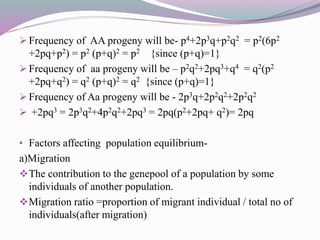
 Frequency of AA progeny will be- p4+2p3q+p2q2 = p2(6p2
+2pq+p2) = p2 (p+q)2 = p2 {since (p+q)=1}
 Frequency of aa progeny will be – p2q2+2pq3+q4 = q2(p2
+2pq+q2) = q2 (p+q)2 = q2 {since (p+q)=1}
 Frequency of Aa progeny will be - 2p3q+2p2q2+2p2q2
 +2pq3 = 2p3q2+4p2q2+2pq3 = 2pq(p2+2pq+ q2)= 2pq
• Factors affecting population equilibrium-
a)Migration
The contribution to the genepool of a population by some
individuals of another population.
Migration ratio =proportion of migrant individual / total no of
individuals(after migration)
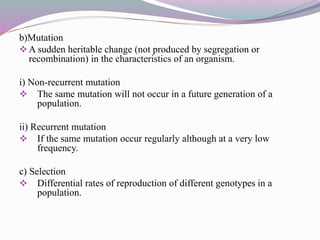
b)Mutation
A sudden heritable change (not produced by segregation or
recombination) in the characteristics of an organism.
i) Non-recurrent mutation
 The same mutation will not occur in a future generation of a
population.
ii) Recurrent mutation
 If the same mutation occur regularly although at a very low
frequency.
c) Selection
 Differential rates of reproduction of different genotypes in a
population.
Selection may operate on gametes or the haploids(n) phase
(gametic selection) or it may acts on zygotes or the diploids
(2n)phase (zygotic selection)
d)Random drift
Random fluctuation in gene frequency of a population due to
chance or sampling error
Change in gene frequency due to random drift does’nt occur in
same direction in all generation
Random drift is greater in smaller population than in larger
population
THANKYOU

Hardyweinberg law

  • 1.
    PRESENTATION ON HARDY-WEINBERG LAW PREPAREDBY: Santosh pathak IAAS, lamjung campus
  • 2.
    HARDY-WEINBERG LAW  Accordingto Hardy (England,1908) and Weinberg (Germany,1909), gene and genotype frequency of a Mendelian population remain constant generation after generation unless there is selection,mutation,migration or random drift.  Suppose in a population of plant species, a gene has two allele, ‘A’ n ‘a’ having frequency ‘p’ n ‘q’ resp.  The frequencies of their genotypes AA,2Aa and aa are p,2pq and q.  Acc. to this law, the frequency of p and q in a population remains constant generation after generation unless there’s any factor’s influence.
  • 3.
     Validity ofHardy-Weinberg law: a)Random union of game Female gamete Male gamete A(p) a(q) A(p ) AA(p2 ) Aa(pq) a(q) Aa(pq) aa(q2) Genotype frequency AA:2Aa:aa p2:2pq:q2
  • 4.
     Frequency ofAand a from AA,2Aa and aa individuals - p2+2pq+q2 = (p+q)= 1 {since p+q=1}  Frequency of ‘A’ gametes from AA and Aa individuals - p2 +1/2 2pq = p(p+q) = p  Frequency of ‘a’ gametes from Aa and aa individuals - q2 +1/2 2pq = q(q+p) = q {since q+p is p+q and p+q=1} Suppose Genotype frequency AA (p2) Aa (2pq) Aa (q2) b)Random mating of genotypes
  • 5.
    Mating Probability FrequencyOf Progeny AA Aa Aa AAxAA p4 p4 - - AA x Aa 4p3q 2p3q 2p3q - Aa x aa 2p2q2 - 2p2q2 - Aa x Aa 4p2q2 p2q2 2p2q2 p2q2 Aa x aa 4pq3 - 2pq3 2pq3 Aa x aa q4 - - q4
  • 6.
     Frequency ofAA progeny will be- p4+2p3q+p2q2 = p2(6p2 +2pq+p2) = p2 (p+q)2 = p2 {since (p+q)=1}  Frequency of aa progeny will be – p2q2+2pq3+q4 = q2(p2 +2pq+q2) = q2 (p+q)2 = q2 {since (p+q)=1}  Frequency of Aa progeny will be - 2p3q+2p2q2+2p2q2  +2pq3 = 2p3q2+4p2q2+2pq3 = 2pq(p2+2pq+ q2)= 2pq • Factors affecting population equilibrium- a)Migration The contribution to the genepool of a population by some individuals of another population. Migration ratio =proportion of migrant individual / total no of individuals(after migration)
  • 7.
    b)Mutation A sudden heritablechange (not produced by segregation or recombination) in the characteristics of an organism. i) Non-recurrent mutation  The same mutation will not occur in a future generation of a population. ii) Recurrent mutation  If the same mutation occur regularly although at a very low frequency. c) Selection  Differential rates of reproduction of different genotypes in a population.
  • 8.
    Selection may operateon gametes or the haploids(n) phase (gametic selection) or it may acts on zygotes or the diploids (2n)phase (zygotic selection) d)Random drift Random fluctuation in gene frequency of a population due to chance or sampling error Change in gene frequency due to random drift does’nt occur in same direction in all generation Random drift is greater in smaller population than in larger population
  • 9.