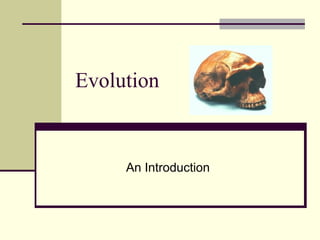
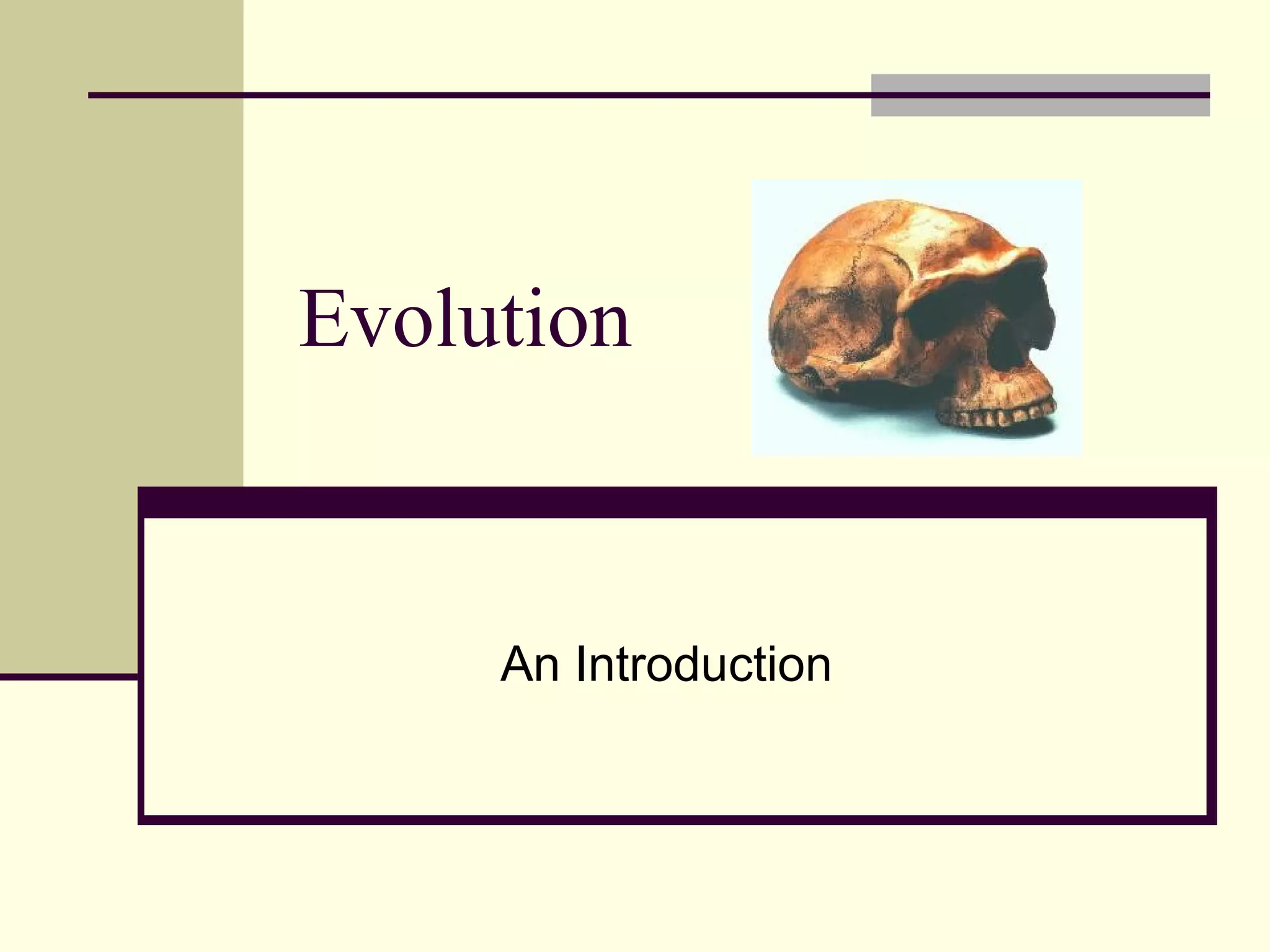
Evolution


     An Introduction
Evolution vs. Creationism
 Here are a few websites you can look at to
  inquire further into the arguments for both
  creationism and evolution.
     Creationism
          http://www.talkorigins.org/faqs/wic.html
          http://www.creationism.org/
     Evolution (and creationism)
          http://www.talkorigins.org/origins/faqs-mustread.html
          http://www.bcholmes.org/wicca/evolution.html
The Origin of Life


 What the heck happened?
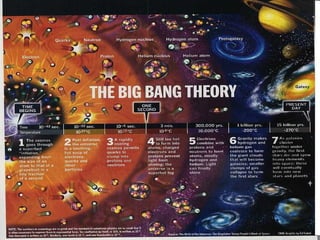
BANG!!!!!!!!!
The Universe
 Big Bang Theory
   15 bya
   Things cooled
   Atoms formed
   Planets, stars and solar systems formed


 More on the Big Bang Theory
     http://www.umich.edu/~gs265/bigbang.htm
The Earth
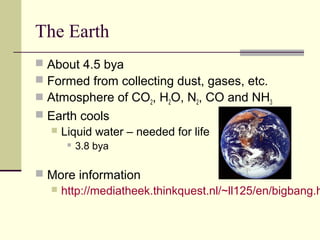
 About 4.5 bya
 Formed from collecting dust, gases, etc.
 Atmosphere of CO2, H2O, N2, CO and NH3
 Earth cools
   Liquid water – needed for life
         3.8 bya

 More information
   http://mediatheek.thinkquest.nl/~ll125/en/bigbang.h
First Organic Compounds
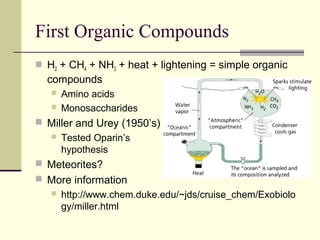
 H2 + CH4 + NH3 + heat + lightening = simple organic
  compounds
      Amino acids
      Monosaccharides
 Miller and Urey (1950’s)
   Tested Oparin’s
     hypothesis
 Meteorites?
 More information
   http://www.chem.duke.edu/~jds/cruise_chem/Exobiolo
    gy/miller.html
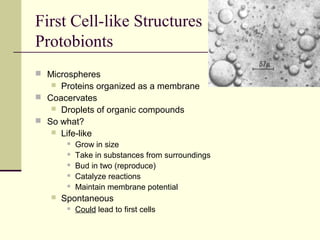
First Cell-like Structures
Protobionts
 Microspheres
    Proteins organized as a membrane
 Coacervates
    Droplets of organic compounds
 So what?
    Life-like
           Grow in size
           Take in substances from surroundings
           Bud in two (reproduce)
           Catalyze reactions
           Maintain membrane potential
      Spontaneous
           Could lead to first cells
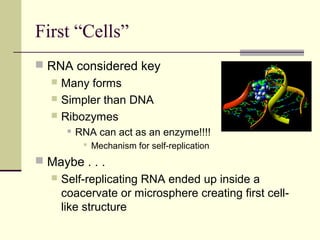
First “Cells”
 RNA considered key
   Many forms
   Simpler than DNA
   Ribozymes
          RNA can act as an enzyme!!!!
             Mechanism for self-replication
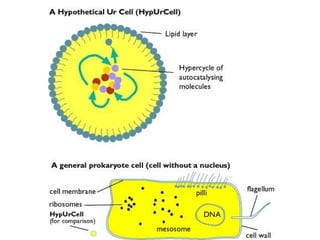
 Maybe . . .
     Self-replicating RNA ended up inside a
      coacervate or microsphere creating first cell-
      like structure
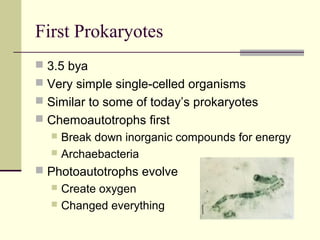
First Prokaryotes
 3.5 bya
 Very simple single-celled organisms
 Similar to some of today’s prokaryotes
 Chemoautotrophs first
   Break down inorganic compounds for energy
   Archaebacteria

 Photoautotrophs evolve
   Create oxygen
   Changed everything
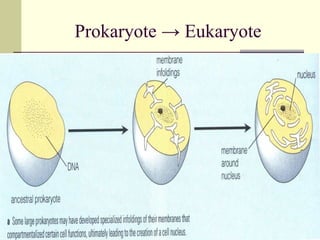
Prokaryote → Eukaryote
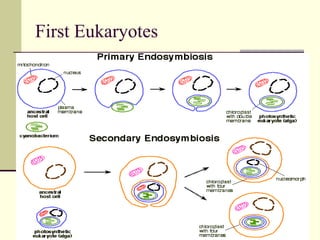
First Eukaryotes
Theories and Evidence
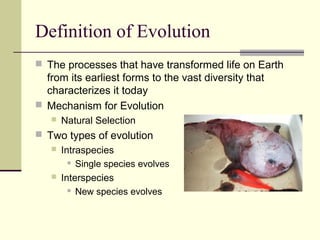
Definition of Evolution
 The processes that have transformed life on Earth
  from its earliest forms to the vast diversity that
  characterizes it today
 Mechanism for Evolution
      Natural Selection
 Two types of evolution
    Intraspecies
        Single species evolves

    Interspecies
        New species evolves
Historical Context
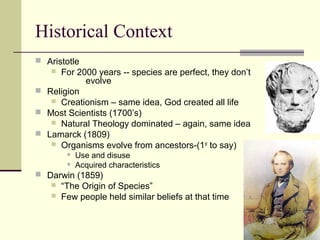
 Aristotle
    For 2000 years -- species are perfect, they don’t
           evolve
 Religion
    Creationism – same idea, God created all life
 Most Scientists (1700’s)
    Natural Theology dominated – again, same idea
 Lamarck (1809)
    Organisms evolve from ancestors-(1 st to say)
            Use and disuse
            Acquired characteristics
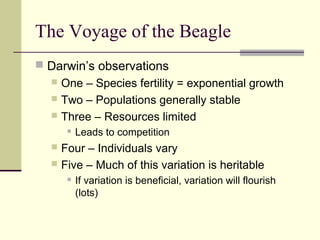
 Darwin (1859)
       “The Origin of Species”
       Few people held similar beliefs at that time
The Voyage of the Beagle
 Darwin’s observations
   One – Species fertility = exponential growth
   Two – Populations generally stable
   Three – Resources limited
         Leads to competition
   Four – Individuals vary
   Five – Much of this variation is heritable
         If variation is beneficial, variation will flourish
          (lots)
Darwin’s Conclusion
 Evolution through adaptation due to natural
  selection

 i.e. Some individuals (because of variation) in
  a population will have better success at
  surviving and reproducing; therefore, the
  heritable traits of those organisms will be
  passed on while the heritable characteristics
  of less successful individuals will not.
Darwin’s Overall View
 Unity in life – all organisms relate back to an
  unknown original ancestor
 New species arise through evolution
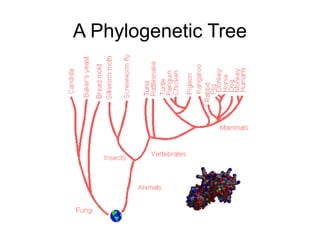
 Depicted by a phylogenetic tree
      Shows evolutionary history
A Phylogenetic Tree
“The Origin of Species"
 Two main points
   States the occurrence of evolution (descent
    with modification)
   Natural selection is the mechanism for
    evolution
Things to Note
 A population is the smallest unit that can
  evolve (a population is a group of
  interbreeding individuals belonging to a
  particular species in a given geographical
  area).
 Only heritable characteristics can be
  amplified or diminished through natural
  selection
 Generally, natural selection leads to evolution
  slowly over a long period of time.
EVIDENCE OF EVOLUTION
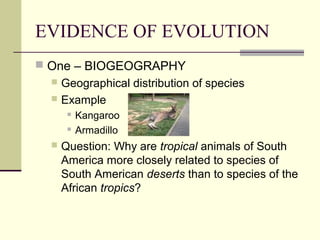
 One – BIOGEOGRAPHY
   Geographical distribution of species
   Example
          Kangaroo
          Armadillo
     Question: Why are tropical animals of South
      America more closely related to species of
      South American deserts than to species of the
      African tropics?
EVIDENCE OF EVOLUTION
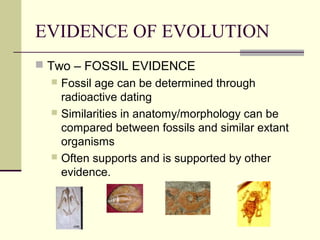
 Two – FOSSIL EVIDENCE
   Fossil age can be determined through
    radioactive dating
   Similarities in anatomy/morphology can be
    compared between fossils and similar extant
    organisms
   Often supports and is supported by other
    evidence.
EVIDENCE OF EVOLUTION
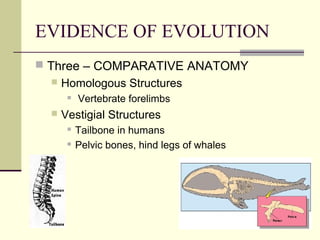
 Three – COMPARATIVE ANATOMY
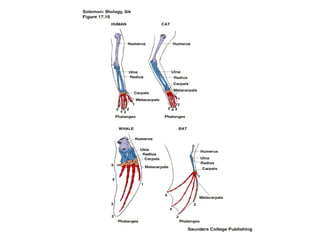
     Homologous Structures
          Vertebrate forelimbs
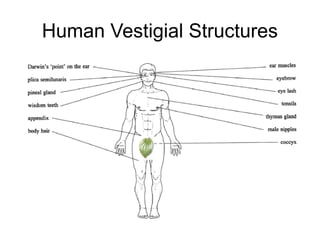
     Vestigial Structures
          Tailbone in humans
          Pelvic bones, hind legs of whales
Human Vestigial Structures
EVIDENCE OF EVOLUTION
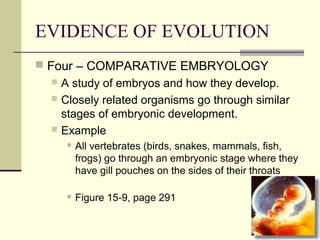
 Four – COMPARATIVE EMBRYOLOGY
   A study of embryos and how they develop.
   Closely related organisms go through similar
    stages of embryonic development.
   Example
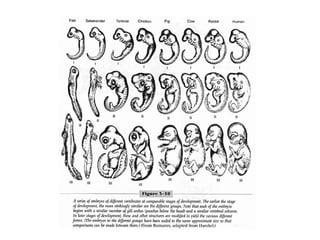
         All vertebrates (birds, snakes, mammals, fish,
          frogs) go through an embryonic stage where they
          have gill pouches on the sides of their throats

         Figure 15-9, page 291
EVIDENCE OF EVOLUTION
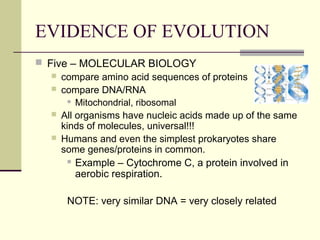
 Five – MOLECULAR BIOLOGY
    compare amino acid sequences of proteins
    compare DNA/RNA
        Mitochondrial, ribosomal

    All organisms have nucleic acids made up of the same
     kinds of molecules, universal!!!
    Humans and even the simplest prokaryotes share
     some genes/proteins in common.
         Example – Cytochrome C, a protein involved in
          aerobic respiration.

      NOTE: very similar DNA = very closely related
Direct Evidence of Intraspecies
Evolution
 Selective breeding in animals
 Selective breeding in plants, especially crops
 Guppies (Poecilia reticulata) of South
  America and Trinidad
     http://www.pbs.org/wgbh/evolution/sex/guppy/low_bandwidth.html
Patterns of Evolution
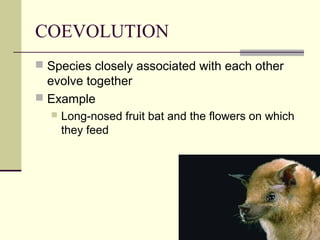
COEVOLUTION
 Species closely associated with each other
  evolve together
 Example
     Long-nosed fruit bat and the flowers on which
      they feed
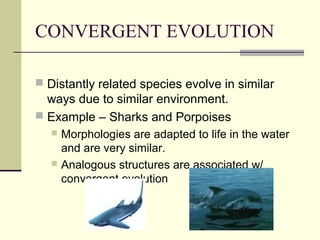
CONVERGENT EVOLUTION

 Distantly related species evolve in similar
  ways due to similar environment.
 Example – Sharks and Porpoises
    Morphologies are adapted to life in the water
     and are very similar.
    Analogous structures are associated w/
     convergent evolution
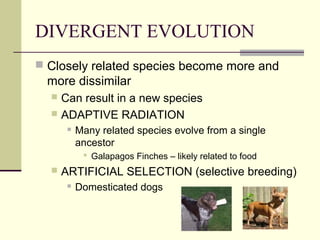
DIVERGENT EVOLUTION
 Closely related species become more and
  more dissimilar
   Can result in a new species
   ADAPTIVE RADIATION
          Many related species evolve from a single
           ancestor
             Galapagos Finches – likely related to food
     ARTIFICIAL SELECTION (selective breeding)
          Domesticated dogs
Genetic Equilibrium
 Population Genetics
   Study of evolution from a genetic point of view,
    i.e. traits
   POPULATION-smallest unit which may evolve
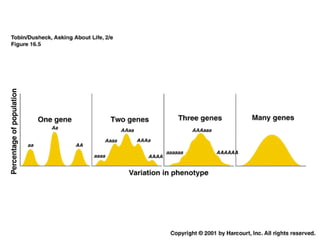
 Bell curves
      When graphed, many traits within a species
       take on the shape
      Indicates high # of individuals in the middle
       (average) with fewer #’s at either extreme
       (high or low) for a given trait.
      Many polygenic, quantitative traits show this
       type of distribution
Genetic Equilibrium
 Punnett’s square’s allow genotype and
  phenotype predictions for a new generation of
  offspring from a parent gene pool
 Recall that from one generation to the next
  genotype and phenotype (gene pool) vary
  greatly.
 In nature, gene pools tend to remain stable
  more than in the finite example we have
  looked at.
Genetic Equilibrium
 Hardy-Weinberg Genetic Equilibrium
   Allele frequencies in a population tend to
    remain the same from generation to
    generation unless acted on by outside
    influences
   Based on an “ideal” population (hypothetical)
Hardy-Weinberg Equilibrium
1. No net mutations occur (no change due to
     mutation)
2.   Individuals do not enter or leave population
3.   Large population (infinitely)
4.   Random mating required
5.   Selection does not occur

    More than anything, allows us to consider
     forces which may disrupt equilibrium and as
     a result, drive evolution
Disruption of Genetic Equilibrium
 Mutations
   Caused by outside factors
 Migration
     No immigration or emigration from population
 Genetic Drift
   Random chance affects allele frequency (more
    likely in small populations)
 Nonrandom Mating
   Humans violate with assortative mating
   Animals violate by mating by geographic
    proximity
Disruption of Genetic Equilibrium
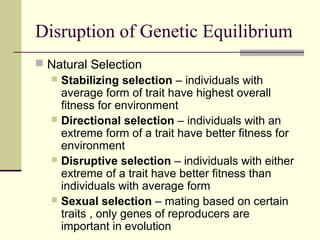
 Natural Selection
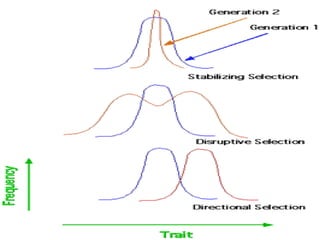
   Stabilizing selection – individuals with
    average form of trait have highest overall
    fitness for environment
   Directional selection – individuals with an
    extreme form of a trait have better fitness for
    environment
   Disruptive selection – individuals with either
    extreme of a trait have better fitness than
    individuals with average form
   Sexual selection – mating based on certain
    traits , only genes of reproducers are
    important in evolution
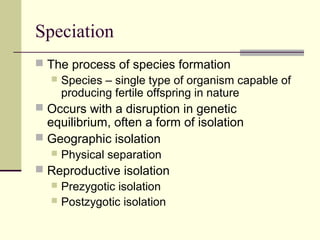
Speciation
 The process of species formation
    Species – single type of organism capable of
     producing fertile offspring in nature
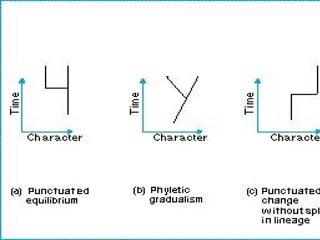
 Occurs with a disruption in genetic
  equilibrium, often a form of isolation
 Geographic isolation
      Physical separation
 Reproductive isolation
   Prezygotic isolation
   Postzygotic isolation
Evolution

Evolution

  • 1.
    Evolution An Introduction
  • 2.
    Evolution vs. Creationism Here are a few websites you can look at to inquire further into the arguments for both creationism and evolution.  Creationism  http://www.talkorigins.org/faqs/wic.html  http://www.creationism.org/  Evolution (and creationism)  http://www.talkorigins.org/origins/faqs-mustread.html  http://www.bcholmes.org/wicca/evolution.html
  • 3.
    The Origin ofLife What the heck happened?
  • 4.
  • 6.
    The Universe  BigBang Theory  15 bya  Things cooled  Atoms formed  Planets, stars and solar systems formed  More on the Big Bang Theory  http://www.umich.edu/~gs265/bigbang.htm
  • 7.
    The Earth  About4.5 bya  Formed from collecting dust, gases, etc.  Atmosphere of CO2, H2O, N2, CO and NH3  Earth cools  Liquid water – needed for life  3.8 bya  More information  http://mediatheek.thinkquest.nl/~ll125/en/bigbang.h
  • 8.
    First Organic Compounds H2 + CH4 + NH3 + heat + lightening = simple organic compounds  Amino acids  Monosaccharides  Miller and Urey (1950’s)  Tested Oparin’s hypothesis  Meteorites?  More information  http://www.chem.duke.edu/~jds/cruise_chem/Exobiolo gy/miller.html
  • 9.
    First Cell-like Structures Protobionts Microspheres  Proteins organized as a membrane  Coacervates  Droplets of organic compounds  So what?  Life-like  Grow in size  Take in substances from surroundings  Bud in two (reproduce)  Catalyze reactions  Maintain membrane potential  Spontaneous  Could lead to first cells
  • 10.
    First “Cells”  RNAconsidered key  Many forms  Simpler than DNA  Ribozymes  RNA can act as an enzyme!!!!  Mechanism for self-replication  Maybe . . .  Self-replicating RNA ended up inside a coacervate or microsphere creating first cell- like structure
  • 12.
    First Prokaryotes  3.5bya  Very simple single-celled organisms  Similar to some of today’s prokaryotes  Chemoautotrophs first  Break down inorganic compounds for energy  Archaebacteria  Photoautotrophs evolve  Create oxygen  Changed everything
  • 13.
  • 14.
  • 15.
  • 16.
    Definition of Evolution The processes that have transformed life on Earth from its earliest forms to the vast diversity that characterizes it today  Mechanism for Evolution  Natural Selection  Two types of evolution  Intraspecies  Single species evolves  Interspecies  New species evolves
  • 17.
    Historical Context  Aristotle For 2000 years -- species are perfect, they don’t evolve  Religion  Creationism – same idea, God created all life  Most Scientists (1700’s)  Natural Theology dominated – again, same idea  Lamarck (1809)  Organisms evolve from ancestors-(1 st to say)  Use and disuse  Acquired characteristics  Darwin (1859)  “The Origin of Species”  Few people held similar beliefs at that time
  • 18.
    The Voyage ofthe Beagle  Darwin’s observations  One – Species fertility = exponential growth  Two – Populations generally stable  Three – Resources limited  Leads to competition  Four – Individuals vary  Five – Much of this variation is heritable  If variation is beneficial, variation will flourish (lots)
  • 19.
    Darwin’s Conclusion  Evolutionthrough adaptation due to natural selection  i.e. Some individuals (because of variation) in a population will have better success at surviving and reproducing; therefore, the heritable traits of those organisms will be passed on while the heritable characteristics of less successful individuals will not.
  • 20.
    Darwin’s Overall View Unity in life – all organisms relate back to an unknown original ancestor  New species arise through evolution  Depicted by a phylogenetic tree  Shows evolutionary history
  • 21.
  • 22.
    “The Origin ofSpecies"  Two main points  States the occurrence of evolution (descent with modification)  Natural selection is the mechanism for evolution
  • 23.
    Things to Note A population is the smallest unit that can evolve (a population is a group of interbreeding individuals belonging to a particular species in a given geographical area).  Only heritable characteristics can be amplified or diminished through natural selection  Generally, natural selection leads to evolution slowly over a long period of time.
  • 24.
    EVIDENCE OF EVOLUTION One – BIOGEOGRAPHY  Geographical distribution of species  Example  Kangaroo  Armadillo  Question: Why are tropical animals of South America more closely related to species of South American deserts than to species of the African tropics?
  • 25.
    EVIDENCE OF EVOLUTION Two – FOSSIL EVIDENCE  Fossil age can be determined through radioactive dating  Similarities in anatomy/morphology can be compared between fossils and similar extant organisms  Often supports and is supported by other evidence.
  • 26.
    EVIDENCE OF EVOLUTION Three – COMPARATIVE ANATOMY  Homologous Structures  Vertebrate forelimbs  Vestigial Structures  Tailbone in humans  Pelvic bones, hind legs of whales
  • 28.
  • 29.
    EVIDENCE OF EVOLUTION Four – COMPARATIVE EMBRYOLOGY  A study of embryos and how they develop.  Closely related organisms go through similar stages of embryonic development.  Example  All vertebrates (birds, snakes, mammals, fish, frogs) go through an embryonic stage where they have gill pouches on the sides of their throats  Figure 15-9, page 291
  • 31.
    EVIDENCE OF EVOLUTION Five – MOLECULAR BIOLOGY  compare amino acid sequences of proteins  compare DNA/RNA  Mitochondrial, ribosomal  All organisms have nucleic acids made up of the same kinds of molecules, universal!!!  Humans and even the simplest prokaryotes share some genes/proteins in common.  Example – Cytochrome C, a protein involved in aerobic respiration. NOTE: very similar DNA = very closely related
  • 32.
    Direct Evidence ofIntraspecies Evolution  Selective breeding in animals  Selective breeding in plants, especially crops  Guppies (Poecilia reticulata) of South America and Trinidad  http://www.pbs.org/wgbh/evolution/sex/guppy/low_bandwidth.html
  • 33.
  • 34.
    COEVOLUTION  Species closelyassociated with each other evolve together  Example  Long-nosed fruit bat and the flowers on which they feed
  • 35.
    CONVERGENT EVOLUTION  Distantlyrelated species evolve in similar ways due to similar environment.  Example – Sharks and Porpoises  Morphologies are adapted to life in the water and are very similar.  Analogous structures are associated w/ convergent evolution
  • 36.
    DIVERGENT EVOLUTION  Closelyrelated species become more and more dissimilar  Can result in a new species  ADAPTIVE RADIATION  Many related species evolve from a single ancestor  Galapagos Finches – likely related to food  ARTIFICIAL SELECTION (selective breeding)  Domesticated dogs
  • 37.
    Genetic Equilibrium  PopulationGenetics  Study of evolution from a genetic point of view, i.e. traits  POPULATION-smallest unit which may evolve  Bell curves  When graphed, many traits within a species take on the shape  Indicates high # of individuals in the middle (average) with fewer #’s at either extreme (high or low) for a given trait.  Many polygenic, quantitative traits show this type of distribution
  • 39.
    Genetic Equilibrium  Punnett’ssquare’s allow genotype and phenotype predictions for a new generation of offspring from a parent gene pool  Recall that from one generation to the next genotype and phenotype (gene pool) vary greatly.  In nature, gene pools tend to remain stable more than in the finite example we have looked at.
  • 40.
    Genetic Equilibrium  Hardy-WeinbergGenetic Equilibrium  Allele frequencies in a population tend to remain the same from generation to generation unless acted on by outside influences  Based on an “ideal” population (hypothetical)
  • 41.
    Hardy-Weinberg Equilibrium 1. Nonet mutations occur (no change due to mutation) 2. Individuals do not enter or leave population 3. Large population (infinitely) 4. Random mating required 5. Selection does not occur  More than anything, allows us to consider forces which may disrupt equilibrium and as a result, drive evolution
  • 42.
    Disruption of GeneticEquilibrium  Mutations  Caused by outside factors  Migration  No immigration or emigration from population  Genetic Drift  Random chance affects allele frequency (more likely in small populations)  Nonrandom Mating  Humans violate with assortative mating  Animals violate by mating by geographic proximity
  • 43.
    Disruption of GeneticEquilibrium  Natural Selection  Stabilizing selection – individuals with average form of trait have highest overall fitness for environment  Directional selection – individuals with an extreme form of a trait have better fitness for environment  Disruptive selection – individuals with either extreme of a trait have better fitness than individuals with average form  Sexual selection – mating based on certain traits , only genes of reproducers are important in evolution
  • 45.
    Speciation  The processof species formation  Species – single type of organism capable of producing fertile offspring in nature  Occurs with a disruption in genetic equilibrium, often a form of isolation  Geographic isolation  Physical separation  Reproductive isolation  Prezygotic isolation  Postzygotic isolation