A Presentation by
Dr. N. Sannigrahi, Associate Professor,
Department of Botany,
Nistarini College, Purulia,
D,B. Road, Purulia ( W.B) India, 723101
Population Genetics : Allele frequencies, Genotype frequencies,
Hardy-Weinberg Law, Role of Natural Selection: Mutation,
Genetic drift.
POPULATION GENETICS
POPULATION GENETICS
 Microevolution, or evolution on a small scale, is defined as a change in the
frequency of gene variants, alleles, in a population over generations. The
field of biology that studies allele frequencies in populations and how they
change over time is called Population Genetics.
 Microevolution is sometimes contrasted with macroevolution, evolution that
involves large changes, such as formation of new groups or species, and
happens over long time periods. However, most biologists view
microevolution and macroevolution as the same process happening on
different timescales. Microevolution adds up gradually, over long periods of
time to produce macro-evolutionary changes.
 Let's look at three concepts that are core to the definition of microevolution:
populations, alleles, and allele frequency.
 Populations: Population is a group of organisms of the same species that are
found in the same area and can interbreed. A population is the smallest unit
that can evolve—in other words, an individual can’t evolve.
 Alleles: An allele is a version of a gene, a heritable unit that controls a
particular feature of an organism.
POPULATION GENETICS
Inheritance of acquired characters as explored by Mendel is mostly based on
controlled mating but the natural populations have the pleasure of random
mating. Here, male gamete produced by the population has equal
opportunity or the probability of mating with any female gamete of the
population and vice –versa-called random mating population or panmictic
population.
 Characteristic of Random Mating Population:
 No controlled mating,
 The pattern of the transmission of the individual genes can not be
determined,
 The genotypes of one or few individuals are not important,
 Gene pools and gene frequencies are the two main important attributes.
As a consequence, each species derived may be considered is the outcome
of several Mendelian Population occupying a separate territory but
fortunately bear the same gene pool. This so called derived population lays
the understanding of the dynamics of gene and genotype frequencies.
GENE FREQUENCY
 Frequency is the number of repeated occurrences of a score or case in a
sample. Allele is generally used to denote one pair of series, of alternative
forms of gene that occur at a given locus in a chromosome. The proportion
of one alleles relative to all alleles at a locus in a population is called allele
frequency. So, the proportions of different alleles of a gene present in a
Mendelian population are known as gene frequency. Thus, the proportions
of gametes produced by a population carrying the different allele of a gene
are the frequencies of these alleles in the population i.e gene frequency. This
can be exactly estimated by classifying the individuals of a random sample
from the population into different genotypic classes for a gene. The total
number of each of the alleles of the gene present in these individuals is then
computed, and their ratio to the total number for all the alleles of the gene is
estimated. These ratios are the gene frequencies for that locus.
 So, Gene frequency measures how the allele is relative to the other alleles
on the same locus.
 Frequency of allele A=Number of Copies of allele A in the population/Total
number of copies of genes in population.
GENE FREQUENCY
 Let us consider the flower color of Peas with following genotypic
combinations- WW (purple), WW (purple) ,WW (purple), WW (purple)
WW (purple), WW (purple), Ww (purple), ww (white, ww (white);
 Out of the two gene copies ( W, w), W appears 13 times and w appears 5
times,
 Total number of gene copies in the entire population: 13+5=18,
 There are two just alleles in the population where W=p, w=q
 P= Frequency of W=13/18=0.72 or 72% & q= Frequency of w= 5/18=0.28
or 28%; the frequency of all the alleles = (o.72+ 0.28)=1 0r 100%
 The genotype and phenotype frequency is different from the allele
frequency that can be calculated by the following methods:
 Genotype frequency:
 Frequency of WW= 6/9=0.67,
 Frequency of Ww= 1/9= 0.11
 Frequency of ww= 2/9=0.22
GENE FREQUENCY
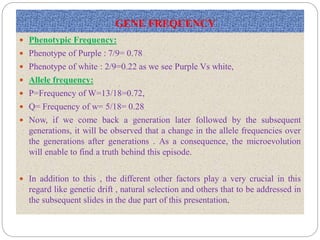
 Phenotypic Frequency:
 Phenotype of Purple : 7/9= 0.78
 Phenotype of white : 2/9=0.22 as we see Purple Vs white,
 Allele frequency:
 P=Frequency of W=13/18=0.72,
 Q= Frequency of w= 5/18= 0.28
 Now, if we come back a generation later followed by the subsequent
generations, it will be observed that a change in the allele frequencies over
the generations after generations . As a consequence, the microevolution
will enable to find a truth behind this episode.
 In addition to this , the different other factors play a very crucial in this
regard like genetic drift , natural selection and others that to be addressed in
the subsequent slides in the due part of this presentation.
GENE FREQUENCY
HARDY-WEINBERG LAW
 The Hardy-Weinberg equation is a mathematical equation that can be used
to calculate the genetic variation of a population at equilibrium. In 1908, G.
H. Hardy and Wilhelm Weinberg independently described a basic principle
of population genetics, which is now named the Hardy-Weinberg equation.
The equation is an expression of the principle known as Hardy-Weinberg
equilibrium, which states that the amount of genetic variation in a
population will remain constant from one generation to the next in the
absence of disturbing factors.
 The Hardy-Weinberg Law states that gene and genotype frequencies in a
Mendelian population remain constant generation after generation if there is
no selection , mutation, migration or random drift. Further, the frequencies
of the three genotypes for a focus with two alleles, say, A & a , will remain
constant at p2
 = AA, 2pq= Aa, and q2= aa where p & q are the frequencies of alleles A and
a respectively.
HARDY-WEINBERG LAW
HARDY-WEINBERG LAW
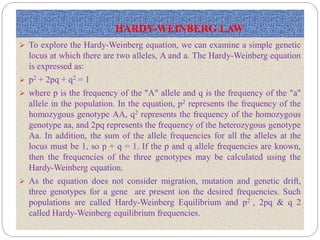
 To explore the Hardy-Weinberg equation, we can examine a simple genetic
locus at which there are two alleles, A and a. The Hardy-Weinberg equation
is expressed as:
 p2 + 2pq + q2 = 1
 where p is the frequency of the "A" allele and q is the frequency of the "a"
allele in the population. In the equation, p2 represents the frequency of the
homozygous genotype AA, q2 represents the frequency of the homozygous
genotype aa, and 2pq represents the frequency of the heterozygous genotype
Aa. In addition, the sum of the allele frequencies for all the alleles at the
locus must be 1, so p + q = 1. If the p and q allele frequencies are known,
then the frequencies of the three genotypes may be calculated using the
Hardy-Weinberg equation.
 As the equation does not consider migration, mutation and genetic drift,
three genotypes for a gene are present ion the desired frequencies. Such
populations are called Hardy-Weinberg Equilibrium and p2 , 2pq & q 2
called Hardy-Weinberg equilibrium frequencies.
NATURAL SELECTION
 English naturalist, Charles Darwin wrote the definitive book outlining his
idea of natural selection, On the Origin of Species. The book chronicled his
studies in South America and Pacific islands. Published in 1859, the book
became a best seller. Natural selection is the process through which
populations of living organisms adapt and change with the passage of the
time. Individuals in a population are naturally variable, meaning that they
are all different in some ways. This variation means that some individuals
have traits better suited to the environment than others. Individuals with
adaptive traits—traits that give them some advantage—are more likely to
survive and reproduce. These individuals then pass the adaptive traits on to
their offspring. Over time, these advantageous traits become more common
in the population. Through this process of natural selection, favorable traits
are transmitted through generations. Natural selection can lead to speciation,
where one species gives rise to a new and distinctly different species. It is
one of the processes that drives evolution and helps to explain the diversity
of life on Earth.
NATURAL SELECTION
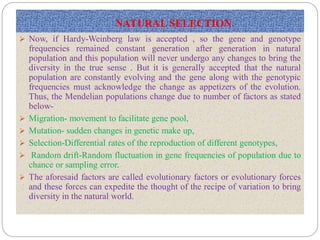
 Now, if Hardy-Weinberg law is accepted , so the gene and genotype
frequencies remained constant generation after generation in natural
population and this population will never undergo any changes to bring the
diversity in the true sense . But it is generally accepted that the natural
population are constantly evolving and the gene along with the genotypic
frequencies must acknowledge the change as appetizers of the evolution.
Thus, the Mendelian populations change due to number of factors as stated
below-
 Migration- movement to facilitate gene pool,
 Mutation- sudden changes in genetic make up,
 Selection-Differential rates of the reproduction of different genotypes,
 Random drift-Random fluctuation in gene frequencies of population due to
chance or sampling error.
 The aforesaid factors are called evolutionary factors or evolutionary forces
and these forces can expedite the thought of the recipe of variation to bring
diversity in the natural world.
NATURAL SELECTION
MIGRATION
 Intermating with the individuals generally enhanced by the migration and
this is the contribution to the gene pool of a population by some individuals
of another population. It may lead to change in gene frequency depending
upon the following factors-
 1. The proportion of the migrant individuals to the total number of
individuals in the population called migration ratio,
 2.The difference between the gene frequencies of the migrant individuals
and that of the population into which the migration has occurred
 The migration ratio (m)= M/(N+M)
 Where M= number of migrant individuals ,
 N= number of individuals in the population before migration.
 Thus . Migration is a mechanism to add new genotypes in the Mendelian
population. Individuals from surrounding population migrate to a certain
rate into the local population and therefore interbred with the local
population and brings gene frequency.
DNA-MUTATION
MUTATION
 The most important process to change gene frequency in the population is
mutation. It is the sudden, heritable change at the cost of the exposure of
mutagens in the sudden characteristic of an organism is called mutation; and
they are the ultimate source of all genetic variation. On the basis of the
types affecting the cell, it may be gene mutation or micro mutation or the
gross mutation called chromosomal mutation. The detailed mutation types
and the mechanisms is very elaborative but as far as the contribution of
mutation on the population is concerned, it may be two types-
 Non-recurrent mutation,
 Recurrent mutation.
 NON-RECURRENT MUTATION
 The same mutation will not occur in a future generation. Let taken an
example of AA homozygote having the mutation to turn heterozygote Aa.
Next the probability of the transmission of the mutant allele a to the next
generation will depend upon the number of the progeny produced by the
heterozygote, aA. If it does not produce any progeny, a will not be
transmitted to the next generation. But if it produces one progeny,
transmission of a will be ½, for 2 progeny, it will be ¾ etc. Simply, it
depends upon the number of progeny builds up by a in the subsequent
generation.
MUTATION
MUTATION
 The number of progeny produced by the different individuals of a
population is never equal even in the absence of selection; actually it
follows a Poisson distribution. Therefore, the probability of transmission of
a has to be corrected according to the Poisson distribution.After this
correction, if an average number of progeny produced by the mating in the
population is two, the probability of transmission of a by the Aa individual
to the next generation will be 0.6321 in the place of 0.75 ; it will be 0.4685
after three generations and only 0.05 after 30 generation. Thus, it is to be
stated that a non-recurrent mutation in a gene , the mutant allele will be lost
in one of the subsequent generation.
 RECURRENT MUTATION
 When any kind of mutation occurs at a regular intervals at a very low
frequency called recurrent mutation. If gene A mutating into a at the rate µ
proportion of A alleles will change into the a allele. Thus,
 The frequency of newly produced a alleles= p0 µ
MUTATION
The total frequency of a allele after mutation= q0+ P0 µ,
And the frequency of A after mutation= p0-p0 µ where, p0 and qo are the
frequencies of A & a alleles respectively , in the generation after mutation.
Thus in each generation, the frequency of A allele will decline by pu and that
of a will increase by the same value, where p is the frequency of A allele in
the generation before mutation. Thus, the value of q will increase by pu in
each generation i.e ∆q= pu. It should be noted that the value of p will go on
decreasing with every generation. Ultimately. All the A alleles will be
converted into a, I.e. a will become ‘fixed’ in the population. When the
allele has the frequency of 1, it is said to have been fixed , since its
frequency can no longer change except through migration and/or mutation.
In most of the cases, both forward ( A→a ) and reverse (a→A) mutations
take place; generally , the rates of forward mutations are much higher than
those of the reverse mutation.
But at the equilibrium, no changes are taken into account here.
MUTATION-HUMAN DNA
SELECTION
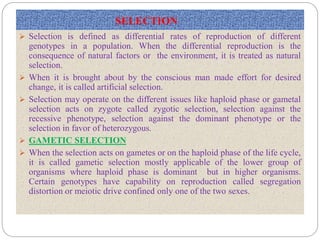
 Selection is defined as differential rates of reproduction of different
genotypes in a population. When the differential reproduction is the
consequence of natural factors or the environment, it is treated as natural
selection.
 When it is brought about by the conscious man made effort for desired
change, it is called artificial selection.
 Selection may operate on the different issues like haploid phase or gametal
selection acts on zygote called zygotic selection, selection against the
recessive phenotype, selection against the dominant phenotype or the
selection in favor of heterozygous.
 GAMETIC SELECTION
 When the selection acts on gametes or on the haploid phase of the life cycle,
it is called gametic selection mostly applicable of the lower group of
organisms where haploid phase is dominant but in higher organisms.
Certain genotypes have capability on reproduction called segregation
distortion or meiotic drive confined only one of the two sexes.
SELECTION
 The rate of the reproduction of the different genotypes are relative to that of
the genotype having highest rate; this relative value is called fitness or
selective value or adaptive value denoted by W= R i /Rh
R I = the rate of reproduction of the concerned genotypes while Rh is the rate
of the reproduction of that genotype which has the highest reproduction
rate. If the reproduction rate of the genotypes AA, Aa and aa are 16, 12 & 8
respectively, their fitness will be 1.0, (16/16), 0.75 (12/16) & 0.5 (8/16)
respectively. The fitness may have the value between 1 &0.. Now for a gene
with alleles , A & a with frequencies p& q respectively, and if the a gamete
have a selection coefficient of s, their fitness will be 1-s. There will be
gradual decline in the frequency of a in the next generation that will equal
sq. As it will lead to the reduction of the population size, the value of the q
in the next generation will be (q-sq) / (1-sq). Thus , in each generation. The
frequency of a allele will decline by the proportion s till it reaches zero and
A becomes fixed in the population.
SELECTION
 ZYGOTIC SELECTION
 The diploid organisms having short lived haploid phase , selection operates
on the zygotes and this is called zygotic selection. It may be against the
recessive phenotype, against the dominant phenotype or in favor of the
heterozygote.
 In addition to the above issues, selection against the recessive phenotypes
in case of the recessive alleles is also a matter of concern of the selection.
Mendelian populations retain many recessive alleles whose fitness is less
than 1, sometimes even zero, . These deleterious recessive reduce the fitness
of the population as a part of its lost due to selection. This proportion of the
population that is lost due to selection is called genetic load. Thus, the larger
the genetic load of a population, the lower will be its average fitness. Very
often , the selection for heterozygote will retain both the alleles A & a in the
population and these two alleles will be maintained in the equilibrium.
GENETIC DRIFT
 Genetic drift is one of the basic mechanisms of evolution. Random
fluctuation in gene frequencies of a population due to chance or sampling
error is the major concern of the change of the gene frequency in a
particular population. This is called genetic drift or random genetic drift or
random drift. In each generation, some individuals may, just by chance,
leave behind a few more descendants (and genes, of course!) than other
individuals. The genes and other genetic elements of the next generation
will be those of the “lucky” individuals, not necessarily the healthier or
“better” individuals. That, in a nutshell, is genetic drift. It happens to ALL
populations — there’s no avoiding the vagaries of chance. It does not occur
in the same direction in all the generations; its direction may change from
one generation to the next generation. Genetic drift may cause gene variants
to disappear completely and thereby reduce genetic variation. It could also
cause initially rare alleles to become much more frequent, and even fixed.
Consider a population of rabbits with brown fur and white fur, white fur
being the dominant allele. Due to genetic drift, only the brown population
might remain, with all the white ones eliminated. A couple with brown and
blue eyes has children with brown or blue eyes.
GENETIC DRIFT
GENETIC DRIFT
 Genetic drift is a mechanism of evolution in which allele frequencies of a
population change over generations due to chance (sampling error).
 Genetic drift occurs in all populations of non-infinite size, but its effects are
strongest in small populations.
 Genetic drift may result in the loss of some alleles (including beneficial
ones) and the fixation, or rise to 100%100%100, percent frequency, of other
alleles.
 Genetic drift can have major effects when a population is sharply reduced in
size by a natural disaster (bottleneck effect) or when a small group splits off
from the main population to found a colony (founder effect).
 Unlike natural selection, genetic drift does not depend on an allele’s
beneficial or harmful effects. Instead, drift changes allele frequencies purely
by chance, as random subsets of individuals (and the gametes of those
individuals) are sampled to produce the next generation.
GENETIC DRIFT
 Every population experiences genetic drift, but small populations feel its
effects more strongly. Genetic drift does not take into account an allele’s
adaptive value to a population, and it may result in loss of a beneficial allele
or fixation (rise to 100%100%100, percent frequency) of a harmful allele in
a population.
 The founder effect and the bottleneck effect are cases in which a small
population is formed from a larger population. These “sampled” populations
often do not represent the genetic diversity of the original population, and
their small size means they may experience strong drift for generations.
Genetic drift has also a fundamental role in the neutral theory of molecular
evolution proposed by the population geneticist Motoo Kimura. In this
theory, most of the genetic variation in DNA and protein sequences is
explained by a balance between mutation and genetic drift. Mutation slowly
creates new allelic variation in DNA and proteins, and genetic drift slowly
eliminates this variability, thereby achieving a steady state. A fundamental
prediction of genetic drift theory is that the substitution rate in genes is
constant, and equal to the mutation rate.
THE AWESOME ROAD OF THE MAGIC OF REALITY
THANK YOU VERY MUCH FOR YOUR JOURNEY
 References:
 Google for images,
 Different WebPages for content,
 Principles of Genetics- Basu & Hossain,
 A textbook of Botany (Vol III) Ghosh, Bhattacharya, Hait
 Fundamentals of Genetics- B.D. Singh,
 A Textbook of genetics- Ajoy Paul
 DISCLAIMER:
 This presentation has been made to enrich open source of information
without any financial interest. The presenter acknowledges Google for
images and other open sources of knowledge to develop this PPT.

Population Genetics

  • 1.
    A Presentation by Dr.N. Sannigrahi, Associate Professor, Department of Botany, Nistarini College, Purulia, D,B. Road, Purulia ( W.B) India, 723101 Population Genetics : Allele frequencies, Genotype frequencies, Hardy-Weinberg Law, Role of Natural Selection: Mutation, Genetic drift.
  • 2.
  • 3.
    POPULATION GENETICS  Microevolution,or evolution on a small scale, is defined as a change in the frequency of gene variants, alleles, in a population over generations. The field of biology that studies allele frequencies in populations and how they change over time is called Population Genetics.  Microevolution is sometimes contrasted with macroevolution, evolution that involves large changes, such as formation of new groups or species, and happens over long time periods. However, most biologists view microevolution and macroevolution as the same process happening on different timescales. Microevolution adds up gradually, over long periods of time to produce macro-evolutionary changes.  Let's look at three concepts that are core to the definition of microevolution: populations, alleles, and allele frequency.  Populations: Population is a group of organisms of the same species that are found in the same area and can interbreed. A population is the smallest unit that can evolve—in other words, an individual can’t evolve.  Alleles: An allele is a version of a gene, a heritable unit that controls a particular feature of an organism.
  • 4.
    POPULATION GENETICS Inheritance ofacquired characters as explored by Mendel is mostly based on controlled mating but the natural populations have the pleasure of random mating. Here, male gamete produced by the population has equal opportunity or the probability of mating with any female gamete of the population and vice –versa-called random mating population or panmictic population.  Characteristic of Random Mating Population:  No controlled mating,  The pattern of the transmission of the individual genes can not be determined,  The genotypes of one or few individuals are not important,  Gene pools and gene frequencies are the two main important attributes. As a consequence, each species derived may be considered is the outcome of several Mendelian Population occupying a separate territory but fortunately bear the same gene pool. This so called derived population lays the understanding of the dynamics of gene and genotype frequencies.
  • 5.
    GENE FREQUENCY  Frequencyis the number of repeated occurrences of a score or case in a sample. Allele is generally used to denote one pair of series, of alternative forms of gene that occur at a given locus in a chromosome. The proportion of one alleles relative to all alleles at a locus in a population is called allele frequency. So, the proportions of different alleles of a gene present in a Mendelian population are known as gene frequency. Thus, the proportions of gametes produced by a population carrying the different allele of a gene are the frequencies of these alleles in the population i.e gene frequency. This can be exactly estimated by classifying the individuals of a random sample from the population into different genotypic classes for a gene. The total number of each of the alleles of the gene present in these individuals is then computed, and their ratio to the total number for all the alleles of the gene is estimated. These ratios are the gene frequencies for that locus.  So, Gene frequency measures how the allele is relative to the other alleles on the same locus.  Frequency of allele A=Number of Copies of allele A in the population/Total number of copies of genes in population.
  • 6.
    GENE FREQUENCY  Letus consider the flower color of Peas with following genotypic combinations- WW (purple), WW (purple) ,WW (purple), WW (purple) WW (purple), WW (purple), Ww (purple), ww (white, ww (white);  Out of the two gene copies ( W, w), W appears 13 times and w appears 5 times,  Total number of gene copies in the entire population: 13+5=18,  There are two just alleles in the population where W=p, w=q  P= Frequency of W=13/18=0.72 or 72% & q= Frequency of w= 5/18=0.28 or 28%; the frequency of all the alleles = (o.72+ 0.28)=1 0r 100%  The genotype and phenotype frequency is different from the allele frequency that can be calculated by the following methods:  Genotype frequency:  Frequency of WW= 6/9=0.67,  Frequency of Ww= 1/9= 0.11  Frequency of ww= 2/9=0.22
  • 7.
    GENE FREQUENCY  PhenotypicFrequency:  Phenotype of Purple : 7/9= 0.78  Phenotype of white : 2/9=0.22 as we see Purple Vs white,  Allele frequency:  P=Frequency of W=13/18=0.72,  Q= Frequency of w= 5/18= 0.28  Now, if we come back a generation later followed by the subsequent generations, it will be observed that a change in the allele frequencies over the generations after generations . As a consequence, the microevolution will enable to find a truth behind this episode.  In addition to this , the different other factors play a very crucial in this regard like genetic drift , natural selection and others that to be addressed in the subsequent slides in the due part of this presentation.
  • 8.
  • 9.
    HARDY-WEINBERG LAW  TheHardy-Weinberg equation is a mathematical equation that can be used to calculate the genetic variation of a population at equilibrium. In 1908, G. H. Hardy and Wilhelm Weinberg independently described a basic principle of population genetics, which is now named the Hardy-Weinberg equation. The equation is an expression of the principle known as Hardy-Weinberg equilibrium, which states that the amount of genetic variation in a population will remain constant from one generation to the next in the absence of disturbing factors.  The Hardy-Weinberg Law states that gene and genotype frequencies in a Mendelian population remain constant generation after generation if there is no selection , mutation, migration or random drift. Further, the frequencies of the three genotypes for a focus with two alleles, say, A & a , will remain constant at p2  = AA, 2pq= Aa, and q2= aa where p & q are the frequencies of alleles A and a respectively.
  • 10.
  • 11.
    HARDY-WEINBERG LAW  Toexplore the Hardy-Weinberg equation, we can examine a simple genetic locus at which there are two alleles, A and a. The Hardy-Weinberg equation is expressed as:  p2 + 2pq + q2 = 1  where p is the frequency of the "A" allele and q is the frequency of the "a" allele in the population. In the equation, p2 represents the frequency of the homozygous genotype AA, q2 represents the frequency of the homozygous genotype aa, and 2pq represents the frequency of the heterozygous genotype Aa. In addition, the sum of the allele frequencies for all the alleles at the locus must be 1, so p + q = 1. If the p and q allele frequencies are known, then the frequencies of the three genotypes may be calculated using the Hardy-Weinberg equation.  As the equation does not consider migration, mutation and genetic drift, three genotypes for a gene are present ion the desired frequencies. Such populations are called Hardy-Weinberg Equilibrium and p2 , 2pq & q 2 called Hardy-Weinberg equilibrium frequencies.
  • 12.
    NATURAL SELECTION  Englishnaturalist, Charles Darwin wrote the definitive book outlining his idea of natural selection, On the Origin of Species. The book chronicled his studies in South America and Pacific islands. Published in 1859, the book became a best seller. Natural selection is the process through which populations of living organisms adapt and change with the passage of the time. Individuals in a population are naturally variable, meaning that they are all different in some ways. This variation means that some individuals have traits better suited to the environment than others. Individuals with adaptive traits—traits that give them some advantage—are more likely to survive and reproduce. These individuals then pass the adaptive traits on to their offspring. Over time, these advantageous traits become more common in the population. Through this process of natural selection, favorable traits are transmitted through generations. Natural selection can lead to speciation, where one species gives rise to a new and distinctly different species. It is one of the processes that drives evolution and helps to explain the diversity of life on Earth.
  • 13.
    NATURAL SELECTION  Now,if Hardy-Weinberg law is accepted , so the gene and genotype frequencies remained constant generation after generation in natural population and this population will never undergo any changes to bring the diversity in the true sense . But it is generally accepted that the natural population are constantly evolving and the gene along with the genotypic frequencies must acknowledge the change as appetizers of the evolution. Thus, the Mendelian populations change due to number of factors as stated below-  Migration- movement to facilitate gene pool,  Mutation- sudden changes in genetic make up,  Selection-Differential rates of the reproduction of different genotypes,  Random drift-Random fluctuation in gene frequencies of population due to chance or sampling error.  The aforesaid factors are called evolutionary factors or evolutionary forces and these forces can expedite the thought of the recipe of variation to bring diversity in the natural world.
  • 14.
  • 15.
    MIGRATION  Intermating withthe individuals generally enhanced by the migration and this is the contribution to the gene pool of a population by some individuals of another population. It may lead to change in gene frequency depending upon the following factors-  1. The proportion of the migrant individuals to the total number of individuals in the population called migration ratio,  2.The difference between the gene frequencies of the migrant individuals and that of the population into which the migration has occurred  The migration ratio (m)= M/(N+M)  Where M= number of migrant individuals ,  N= number of individuals in the population before migration.  Thus . Migration is a mechanism to add new genotypes in the Mendelian population. Individuals from surrounding population migrate to a certain rate into the local population and therefore interbred with the local population and brings gene frequency.
  • 16.
  • 17.
    MUTATION  The mostimportant process to change gene frequency in the population is mutation. It is the sudden, heritable change at the cost of the exposure of mutagens in the sudden characteristic of an organism is called mutation; and they are the ultimate source of all genetic variation. On the basis of the types affecting the cell, it may be gene mutation or micro mutation or the gross mutation called chromosomal mutation. The detailed mutation types and the mechanisms is very elaborative but as far as the contribution of mutation on the population is concerned, it may be two types-  Non-recurrent mutation,  Recurrent mutation.  NON-RECURRENT MUTATION  The same mutation will not occur in a future generation. Let taken an example of AA homozygote having the mutation to turn heterozygote Aa. Next the probability of the transmission of the mutant allele a to the next generation will depend upon the number of the progeny produced by the heterozygote, aA. If it does not produce any progeny, a will not be transmitted to the next generation. But if it produces one progeny, transmission of a will be ½, for 2 progeny, it will be ¾ etc. Simply, it depends upon the number of progeny builds up by a in the subsequent generation.
  • 18.
  • 19.
    MUTATION  The numberof progeny produced by the different individuals of a population is never equal even in the absence of selection; actually it follows a Poisson distribution. Therefore, the probability of transmission of a has to be corrected according to the Poisson distribution.After this correction, if an average number of progeny produced by the mating in the population is two, the probability of transmission of a by the Aa individual to the next generation will be 0.6321 in the place of 0.75 ; it will be 0.4685 after three generations and only 0.05 after 30 generation. Thus, it is to be stated that a non-recurrent mutation in a gene , the mutant allele will be lost in one of the subsequent generation.  RECURRENT MUTATION  When any kind of mutation occurs at a regular intervals at a very low frequency called recurrent mutation. If gene A mutating into a at the rate µ proportion of A alleles will change into the a allele. Thus,  The frequency of newly produced a alleles= p0 µ
  • 20.
    MUTATION The total frequencyof a allele after mutation= q0+ P0 µ, And the frequency of A after mutation= p0-p0 µ where, p0 and qo are the frequencies of A & a alleles respectively , in the generation after mutation. Thus in each generation, the frequency of A allele will decline by pu and that of a will increase by the same value, where p is the frequency of A allele in the generation before mutation. Thus, the value of q will increase by pu in each generation i.e ∆q= pu. It should be noted that the value of p will go on decreasing with every generation. Ultimately. All the A alleles will be converted into a, I.e. a will become ‘fixed’ in the population. When the allele has the frequency of 1, it is said to have been fixed , since its frequency can no longer change except through migration and/or mutation. In most of the cases, both forward ( A→a ) and reverse (a→A) mutations take place; generally , the rates of forward mutations are much higher than those of the reverse mutation. But at the equilibrium, no changes are taken into account here.
  • 21.
  • 22.
    SELECTION  Selection isdefined as differential rates of reproduction of different genotypes in a population. When the differential reproduction is the consequence of natural factors or the environment, it is treated as natural selection.  When it is brought about by the conscious man made effort for desired change, it is called artificial selection.  Selection may operate on the different issues like haploid phase or gametal selection acts on zygote called zygotic selection, selection against the recessive phenotype, selection against the dominant phenotype or the selection in favor of heterozygous.  GAMETIC SELECTION  When the selection acts on gametes or on the haploid phase of the life cycle, it is called gametic selection mostly applicable of the lower group of organisms where haploid phase is dominant but in higher organisms. Certain genotypes have capability on reproduction called segregation distortion or meiotic drive confined only one of the two sexes.
  • 23.
    SELECTION  The rateof the reproduction of the different genotypes are relative to that of the genotype having highest rate; this relative value is called fitness or selective value or adaptive value denoted by W= R i /Rh R I = the rate of reproduction of the concerned genotypes while Rh is the rate of the reproduction of that genotype which has the highest reproduction rate. If the reproduction rate of the genotypes AA, Aa and aa are 16, 12 & 8 respectively, their fitness will be 1.0, (16/16), 0.75 (12/16) & 0.5 (8/16) respectively. The fitness may have the value between 1 &0.. Now for a gene with alleles , A & a with frequencies p& q respectively, and if the a gamete have a selection coefficient of s, their fitness will be 1-s. There will be gradual decline in the frequency of a in the next generation that will equal sq. As it will lead to the reduction of the population size, the value of the q in the next generation will be (q-sq) / (1-sq). Thus , in each generation. The frequency of a allele will decline by the proportion s till it reaches zero and A becomes fixed in the population.
  • 24.
    SELECTION  ZYGOTIC SELECTION The diploid organisms having short lived haploid phase , selection operates on the zygotes and this is called zygotic selection. It may be against the recessive phenotype, against the dominant phenotype or in favor of the heterozygote.  In addition to the above issues, selection against the recessive phenotypes in case of the recessive alleles is also a matter of concern of the selection. Mendelian populations retain many recessive alleles whose fitness is less than 1, sometimes even zero, . These deleterious recessive reduce the fitness of the population as a part of its lost due to selection. This proportion of the population that is lost due to selection is called genetic load. Thus, the larger the genetic load of a population, the lower will be its average fitness. Very often , the selection for heterozygote will retain both the alleles A & a in the population and these two alleles will be maintained in the equilibrium.
  • 25.
    GENETIC DRIFT  Geneticdrift is one of the basic mechanisms of evolution. Random fluctuation in gene frequencies of a population due to chance or sampling error is the major concern of the change of the gene frequency in a particular population. This is called genetic drift or random genetic drift or random drift. In each generation, some individuals may, just by chance, leave behind a few more descendants (and genes, of course!) than other individuals. The genes and other genetic elements of the next generation will be those of the “lucky” individuals, not necessarily the healthier or “better” individuals. That, in a nutshell, is genetic drift. It happens to ALL populations — there’s no avoiding the vagaries of chance. It does not occur in the same direction in all the generations; its direction may change from one generation to the next generation. Genetic drift may cause gene variants to disappear completely and thereby reduce genetic variation. It could also cause initially rare alleles to become much more frequent, and even fixed. Consider a population of rabbits with brown fur and white fur, white fur being the dominant allele. Due to genetic drift, only the brown population might remain, with all the white ones eliminated. A couple with brown and blue eyes has children with brown or blue eyes.
  • 26.
  • 27.
    GENETIC DRIFT  Geneticdrift is a mechanism of evolution in which allele frequencies of a population change over generations due to chance (sampling error).  Genetic drift occurs in all populations of non-infinite size, but its effects are strongest in small populations.  Genetic drift may result in the loss of some alleles (including beneficial ones) and the fixation, or rise to 100%100%100, percent frequency, of other alleles.  Genetic drift can have major effects when a population is sharply reduced in size by a natural disaster (bottleneck effect) or when a small group splits off from the main population to found a colony (founder effect).  Unlike natural selection, genetic drift does not depend on an allele’s beneficial or harmful effects. Instead, drift changes allele frequencies purely by chance, as random subsets of individuals (and the gametes of those individuals) are sampled to produce the next generation.
  • 28.
    GENETIC DRIFT  Everypopulation experiences genetic drift, but small populations feel its effects more strongly. Genetic drift does not take into account an allele’s adaptive value to a population, and it may result in loss of a beneficial allele or fixation (rise to 100%100%100, percent frequency) of a harmful allele in a population.  The founder effect and the bottleneck effect are cases in which a small population is formed from a larger population. These “sampled” populations often do not represent the genetic diversity of the original population, and their small size means they may experience strong drift for generations. Genetic drift has also a fundamental role in the neutral theory of molecular evolution proposed by the population geneticist Motoo Kimura. In this theory, most of the genetic variation in DNA and protein sequences is explained by a balance between mutation and genetic drift. Mutation slowly creates new allelic variation in DNA and proteins, and genetic drift slowly eliminates this variability, thereby achieving a steady state. A fundamental prediction of genetic drift theory is that the substitution rate in genes is constant, and equal to the mutation rate.
  • 29.
    THE AWESOME ROADOF THE MAGIC OF REALITY
  • 30.
    THANK YOU VERYMUCH FOR YOUR JOURNEY  References:  Google for images,  Different WebPages for content,  Principles of Genetics- Basu & Hossain,  A textbook of Botany (Vol III) Ghosh, Bhattacharya, Hait  Fundamentals of Genetics- B.D. Singh,  A Textbook of genetics- Ajoy Paul  DISCLAIMER:  This presentation has been made to enrich open source of information without any financial interest. The presenter acknowledges Google for images and other open sources of knowledge to develop this PPT.