Dr S.Shanaz
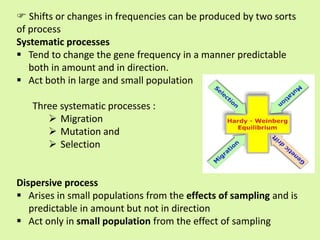
 Shifts or changes in frequencies can be produced by two sorts
of process
Systematic processes
 Tend to change the gene frequency in a manner predictable
both in amount and in direction.
 Act both in large and small population
Three systematic processes :
 Migration
 Mutation and
 Selection
Dispersive process
 Arises in small populations from the effects of sampling and is
predictable in amount but not in direction
 Act only in small population from the effect of sampling
MIGRATION
• Migration is the movement of individuals from one
breeding population to another
– Immigration: Inward migration of individuals into a
population from other populations
– Emigration : outward migration of individuals from a
population reduction in the size of gene pool
• Migration of breeding animals to or from a
population can cause changes in gene frequency.
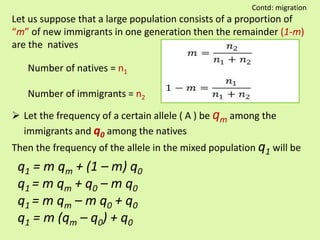
Let us suppose that a large population consists of a proportion of
“m” of new immigrants in one generation then the remainder (1-m)
are the natives
Number of natives = n1
Number of immigrants = n2
 Let the frequency of a certain allele ( A ) be qm among the
immigrants and q0 among the natives
Then the frequency of the allele in the mixed population q1 will be
q1 = m qm + (1 – m) q0
q1 = m qm + q0 – m q0
q1 = m qm – m q0 + q0
q1 = m (qm – q0) + q0
Contd: migration
• The gene frequency in mixed population will depend on the original
gene frequency of the population and the difference in gene
frequency between the immigrants and native s (qm – q0) and the
proportion of immigrants
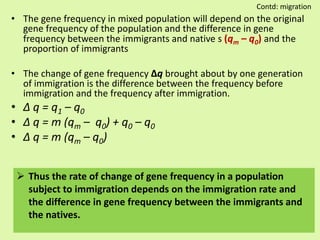
• The change of gene frequency Δq brought about by one generation
of immigration is the difference between the frequency before
immigration and the frequency after immigration.
• Δ q = q1 – q0
• Δ q = m (qm – q0) + q0 – q0
• Δ q = m (qm – q0)
Contd: migration
 Thus the rate of change of gene frequency in a population
subject to immigration depends on the immigration rate and
the difference in gene frequency between the immigrants and
the natives.
MUTATION
• Mutations may lead to new alleles and thereby changing the gene
pool of the population
• May be favourable or deleterious to the individual’s ability to survive
If changes are advantageous, then the new alleles will tend to prevail by
being selected in the population
If a wild allele A 1 mutates to A2 with a frequency of u per generation
u is the proportion of all A1 alleles that mutate to A2 between one
generation and the next
If the frequency of A1 in one generation is p0
Then,
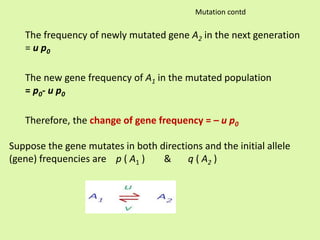
The frequency of newly mutated gene A2 in the next generation
= u p0
The new gene frequency of A1 in the mutated population
= p0- u p0
Therefore, the change of gene frequency = – u p0
Suppose the gene mutates in both directions and the initial allele
(gene) frequencies are p ( A1 ) & q ( A2 )
Mutation contd
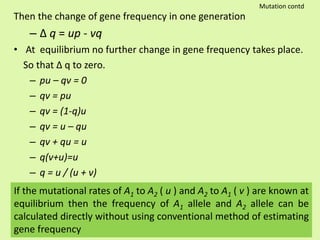
Then the change of gene frequency in one generation
– Δ q = up - vq
• At equilibrium no further change in gene frequency takes place.
So that Δ q to zero.
– pu – qv = 0
– qv = pu
– qv = (1-q)u
– qv = u – qu
– qv + qu = u
– q(v+u)=u
– q = u / (u + v)
– Similary p = v / (v + u)If the mutational rates of A1 to A2 ( u ) and A2 to A1 ( v ) are known at
equilibrium then the frequency of A1 allele and A2 allele can be
calculated directly without using conventional method of estimating
gene frequency
Mutation contd
SELECTION
 Selection is differential reproduction. It occurs whenever the
various kinds of individuals reproduce at different rates
 Individuals differ in viability and fertility and contribute different
number of progeny to the next generation
 The contribution of offspring to the next generation is called
fitness (W) of the individual or adaptive value or selective value
 Selection favoring certain genotypes should cause alleles to
increase in frequency and vice versa.
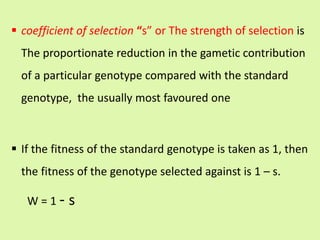
 coefficient of selection “s” or The strength of selection is
The proportionate reduction in the gametic contribution
of a particular genotype compared with the standard
genotype, the usually most favoured one
 If the fitness of the standard genotype is taken as 1, then
the fitness of the genotype selected against is 1 – s.
W = 1 - s
Complete selection against dominant gene
• Here, the coefficient of selection is 1 or fitness is 0
• One generation of selection is sufficient to eliminate
all the dominant genes provided there is complete
penetrance
• In the next generation, all the individuals will be of
recessive homozygotes and the frequency of
recessive allele (q) will be one
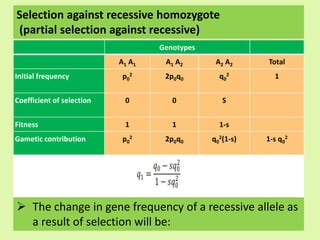
Genotypes
A1 A1 A1 A2 A2 A2 Total
Initial frequency p0
2 2p0q0 q0
2 1
Coefficient of selection 0 0 S
Fitness 1 1 1-s
Gametic contribution p0
2 2p0q0 q0
2(1-s) 1-s q0
2
Selection against recessive homozygote
(partial selection against recessive)
 The change in gene frequency of a recessive allele as
a result of selection will be:
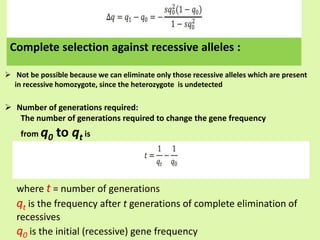
 Not be possible because we can eliminate only those recessive alleles which are present
in recessive homozygote, since the heterozygote is undetected
 Number of generations required:
The number of generations required to change the gene frequency
from q0 to qt is
where t = number of generations
qt is the frequency after t generations of complete elimination of
recessives
q0 is the initial (recessive) gene frequency
Complete selection against recessive alleles :
Genotypes
A1 A1 A1 A2 A2 A2 Total
Initial
frequency
p0
2 2p0q0 q0
2 1
Coefficient of
selection
s1 0 s2
Fitness 1-s1 1 1-s2
Gametic
contribution
p0
2(1-s1) 2p0q0 q0
2(1- s2) 1- s1 p0
2- s2 q0
2
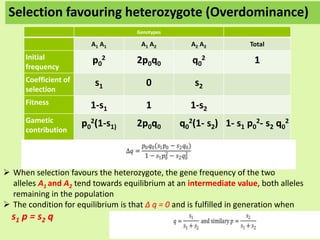
Selection favouring heterozygote (Overdominance)
 When selection favours the heterozygote, the gene frequency of the two
alleles A1 and A2 tend towards equilibrium at an intermediate value, both alleles
remaining in the population
 The condition for equilibrium is that Δ q = 0 and is fulfilled in generation when
s1 p = s2 q
Dispersive processes
• Dispersive process differs from systematic process in being
random in direction and predictable only in amount
• If systematic factors were present, (very large population)
gene frequencies would reach equilibrium and remain there
until external conditions change
• However, this property of stability does not hold in small
populations and the gene frequencies are subject to random
fluctuations arising from sampling of gametes
• The gametes that transmit genes to the next generation carry
a sample of the genes in the parent generation
• If the sample is not large, the gene frequencies are liable to
change from one generation to the next
Causes of dispersive processes
• Small population size
• Founder effects – occurs when a population is initially established
by small number of breeding individuals
• Bottleneck effect – occurs when a population is dramatically
reduced in size
• Random drift
• Differentiation between sub-populations
• Uniformity within sub-populations
• Increased homozygosity
Effects
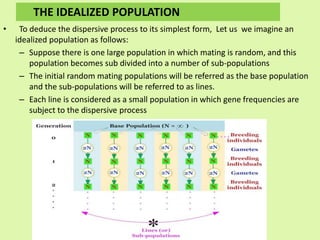
• To deduce the dispersive process to its simplest form, Let us we imagine an
idealized population as follows:
– Suppose there is one large population in which mating is random, and this
population becomes sub divided into a number of sub-populations
– The initial random mating populations will be referred as the base population
and the sub-populations will be referred to as lines.
– Each line is considered as a small population in which gene frequencies are
subject to the dispersive process
THE IDEALIZED POPULATION
• Conditions for the idealized population are as follows:
– The generations are distinct and do not overlap.
– Mating is restricted to members of the same line or in other
words migration is excluded.
– The number of breeding individuals is equal for all lines and in
all generations.
– Mating is random within each line.
– Selection is absent.
– Mutation is disregarded.
 The conditions specified for the idealized population may not hold in
real population.
Forces changing gene frequency

Forces changing gene frequency

  • 1.
  • 2.
     Shifts orchanges in frequencies can be produced by two sorts of process Systematic processes  Tend to change the gene frequency in a manner predictable both in amount and in direction.  Act both in large and small population Three systematic processes :  Migration  Mutation and  Selection Dispersive process  Arises in small populations from the effects of sampling and is predictable in amount but not in direction  Act only in small population from the effect of sampling
  • 3.
    MIGRATION • Migration isthe movement of individuals from one breeding population to another – Immigration: Inward migration of individuals into a population from other populations – Emigration : outward migration of individuals from a population reduction in the size of gene pool • Migration of breeding animals to or from a population can cause changes in gene frequency.
  • 4.
    Let us supposethat a large population consists of a proportion of “m” of new immigrants in one generation then the remainder (1-m) are the natives Number of natives = n1 Number of immigrants = n2  Let the frequency of a certain allele ( A ) be qm among the immigrants and q0 among the natives Then the frequency of the allele in the mixed population q1 will be q1 = m qm + (1 – m) q0 q1 = m qm + q0 – m q0 q1 = m qm – m q0 + q0 q1 = m (qm – q0) + q0 Contd: migration
  • 5.
    • The genefrequency in mixed population will depend on the original gene frequency of the population and the difference in gene frequency between the immigrants and native s (qm – q0) and the proportion of immigrants • The change of gene frequency Δq brought about by one generation of immigration is the difference between the frequency before immigration and the frequency after immigration. • Δ q = q1 – q0 • Δ q = m (qm – q0) + q0 – q0 • Δ q = m (qm – q0) Contd: migration  Thus the rate of change of gene frequency in a population subject to immigration depends on the immigration rate and the difference in gene frequency between the immigrants and the natives.
  • 6.
    MUTATION • Mutations maylead to new alleles and thereby changing the gene pool of the population • May be favourable or deleterious to the individual’s ability to survive If changes are advantageous, then the new alleles will tend to prevail by being selected in the population If a wild allele A 1 mutates to A2 with a frequency of u per generation u is the proportion of all A1 alleles that mutate to A2 between one generation and the next If the frequency of A1 in one generation is p0 Then,
  • 7.
    The frequency ofnewly mutated gene A2 in the next generation = u p0 The new gene frequency of A1 in the mutated population = p0- u p0 Therefore, the change of gene frequency = – u p0 Suppose the gene mutates in both directions and the initial allele (gene) frequencies are p ( A1 ) & q ( A2 ) Mutation contd
  • 8.
    Then the changeof gene frequency in one generation – Δ q = up - vq • At equilibrium no further change in gene frequency takes place. So that Δ q to zero. – pu – qv = 0 – qv = pu – qv = (1-q)u – qv = u – qu – qv + qu = u – q(v+u)=u – q = u / (u + v) – Similary p = v / (v + u)If the mutational rates of A1 to A2 ( u ) and A2 to A1 ( v ) are known at equilibrium then the frequency of A1 allele and A2 allele can be calculated directly without using conventional method of estimating gene frequency Mutation contd
  • 9.
    SELECTION  Selection isdifferential reproduction. It occurs whenever the various kinds of individuals reproduce at different rates  Individuals differ in viability and fertility and contribute different number of progeny to the next generation  The contribution of offspring to the next generation is called fitness (W) of the individual or adaptive value or selective value  Selection favoring certain genotypes should cause alleles to increase in frequency and vice versa.
  • 10.
     coefficient ofselection “s” or The strength of selection is The proportionate reduction in the gametic contribution of a particular genotype compared with the standard genotype, the usually most favoured one  If the fitness of the standard genotype is taken as 1, then the fitness of the genotype selected against is 1 – s. W = 1 - s
  • 11.
    Complete selection againstdominant gene • Here, the coefficient of selection is 1 or fitness is 0 • One generation of selection is sufficient to eliminate all the dominant genes provided there is complete penetrance • In the next generation, all the individuals will be of recessive homozygotes and the frequency of recessive allele (q) will be one
  • 12.
    Genotypes A1 A1 A1A2 A2 A2 Total Initial frequency p0 2 2p0q0 q0 2 1 Coefficient of selection 0 0 S Fitness 1 1 1-s Gametic contribution p0 2 2p0q0 q0 2(1-s) 1-s q0 2 Selection against recessive homozygote (partial selection against recessive)  The change in gene frequency of a recessive allele as a result of selection will be:
  • 13.
     Not bepossible because we can eliminate only those recessive alleles which are present in recessive homozygote, since the heterozygote is undetected  Number of generations required: The number of generations required to change the gene frequency from q0 to qt is where t = number of generations qt is the frequency after t generations of complete elimination of recessives q0 is the initial (recessive) gene frequency Complete selection against recessive alleles :
  • 14.
    Genotypes A1 A1 A1A2 A2 A2 Total Initial frequency p0 2 2p0q0 q0 2 1 Coefficient of selection s1 0 s2 Fitness 1-s1 1 1-s2 Gametic contribution p0 2(1-s1) 2p0q0 q0 2(1- s2) 1- s1 p0 2- s2 q0 2 Selection favouring heterozygote (Overdominance)  When selection favours the heterozygote, the gene frequency of the two alleles A1 and A2 tend towards equilibrium at an intermediate value, both alleles remaining in the population  The condition for equilibrium is that Δ q = 0 and is fulfilled in generation when s1 p = s2 q
  • 15.
    Dispersive processes • Dispersiveprocess differs from systematic process in being random in direction and predictable only in amount • If systematic factors were present, (very large population) gene frequencies would reach equilibrium and remain there until external conditions change • However, this property of stability does not hold in small populations and the gene frequencies are subject to random fluctuations arising from sampling of gametes • The gametes that transmit genes to the next generation carry a sample of the genes in the parent generation • If the sample is not large, the gene frequencies are liable to change from one generation to the next
  • 16.
    Causes of dispersiveprocesses • Small population size • Founder effects – occurs when a population is initially established by small number of breeding individuals • Bottleneck effect – occurs when a population is dramatically reduced in size • Random drift • Differentiation between sub-populations • Uniformity within sub-populations • Increased homozygosity Effects
  • 17.
    • To deducethe dispersive process to its simplest form, Let us we imagine an idealized population as follows: – Suppose there is one large population in which mating is random, and this population becomes sub divided into a number of sub-populations – The initial random mating populations will be referred as the base population and the sub-populations will be referred to as lines. – Each line is considered as a small population in which gene frequencies are subject to the dispersive process THE IDEALIZED POPULATION
  • 18.
    • Conditions forthe idealized population are as follows: – The generations are distinct and do not overlap. – Mating is restricted to members of the same line or in other words migration is excluded. – The number of breeding individuals is equal for all lines and in all generations. – Mating is random within each line. – Selection is absent. – Mutation is disregarded.  The conditions specified for the idealized population may not hold in real population.