Downloaded 996 times


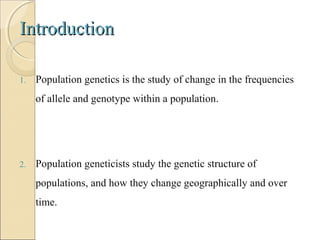

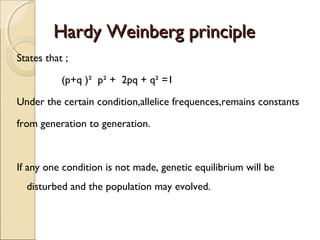
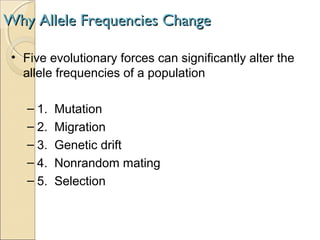


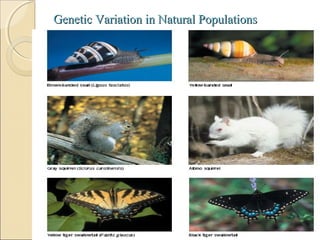


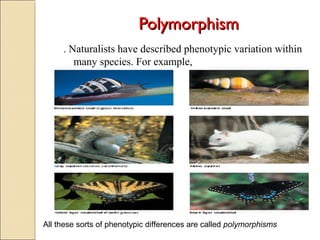




This document discusses key concepts in population genetics. It begins by defining population genetics as the study of allele frequency changes within a population over time. The Hardy-Weinberg principle states that allele frequencies remain constant between generations under certain conditions. Five evolutionary forces can change frequencies: mutation, migration, genetic drift, nonrandom mating, and natural selection. Natural selection acts to increase the frequency of traits that increase survival and reproduction. There are three types of natural selection: stabilizing selection eliminates extreme traits, disruptive selection eliminates intermediate traits, and directional selection eliminates a single trait. Polymorphisms within species, like shell color in grove snails, demonstrate genetic variation.


