POPULATION
 GENETICS
Vocab
Population- group of organisms of the
SAME species that occupies certain area

Species- organisms that can INTERBREED
and produce FERTILE offspring

Ex) Sauerman Woods Crown Point
       -whitetail rabbits -deer
       -sparrows          -squirrels
Can we capture all the whitetail
 rabbits in Sauerman Woods?

Population Sampling- technique uses
part of population to represent whole
population

Capture 100 random rabbits
– These rabbits are a representation of all the
  rabbits in the area.
– We can study many things within this group…
Genetics of the Population…
Gene Pool- all of the genes of every
individual in population sample

Frequency- how often something occurs

Population genetics involves studying the
frequency with which certain alleles
occur in a population’s gene pool.

Frequencies can be written as:
percentages, fractions, or decimals.
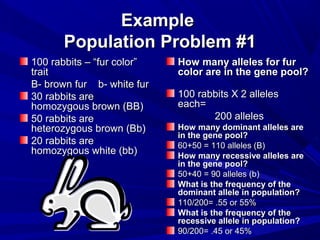
Example
      Population Problem #1
100 rabbits – “fur color”   How many alleles for fur
trait                       color are in the gene pool?
B- brown fur b- white fur
30 rabbits are              100 rabbits X 2 alleles
homozygous brown (BB)       each=
50 rabbits are                     200 alleles
heterozygous brown (Bb)     How many dominant alleles are
                            in the gene pool?
20 rabbits are              60+50 = 110 alleles (B)
homozygous white (bb)       How many recessive alleles are
                            in the gene pool?
                            50+40 = 90 alleles (b)
                            What is the frequency of the
                            dominant allele in population?
                            110/200= .55 or 55%
                            What is the frequency of the
                            recessive allele in population?
                            90/200= .45 or 45%
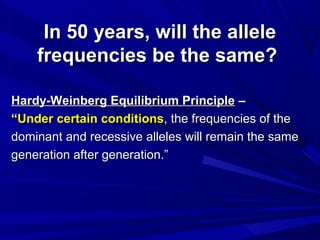
In 50 years, will the allele
    frequencies be the same?

Hardy-Weinberg Equilibrium Principle –
“Under certain conditions, the frequencies of the
dominant and recessive alleles will remain the same
generation after generation.”
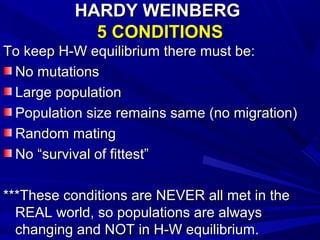
HARDY WEINBERG
            5 CONDITIONS
To keep H-W equilibrium there must be:
 No mutations
 Large population
 Population size remains same (no migration)
 Random mating
 No “survival of fittest”

***These conditions are NEVER all met in the
  REAL world, so populations are always
  changing and NOT in H-W equilibrium.

Population genetics pp

  • 1.
  • 2.
    Vocab Population- group oforganisms of the SAME species that occupies certain area Species- organisms that can INTERBREED and produce FERTILE offspring Ex) Sauerman Woods Crown Point -whitetail rabbits -deer -sparrows -squirrels
  • 3.
    Can we captureall the whitetail rabbits in Sauerman Woods? Population Sampling- technique uses part of population to represent whole population Capture 100 random rabbits – These rabbits are a representation of all the rabbits in the area. – We can study many things within this group…
  • 4.
    Genetics of thePopulation… Gene Pool- all of the genes of every individual in population sample Frequency- how often something occurs Population genetics involves studying the frequency with which certain alleles occur in a population’s gene pool. Frequencies can be written as: percentages, fractions, or decimals.
  • 5.
    Example Population Problem #1 100 rabbits – “fur color” How many alleles for fur trait color are in the gene pool? B- brown fur b- white fur 30 rabbits are 100 rabbits X 2 alleles homozygous brown (BB) each= 50 rabbits are 200 alleles heterozygous brown (Bb) How many dominant alleles are in the gene pool? 20 rabbits are 60+50 = 110 alleles (B) homozygous white (bb) How many recessive alleles are in the gene pool? 50+40 = 90 alleles (b) What is the frequency of the dominant allele in population? 110/200= .55 or 55% What is the frequency of the recessive allele in population? 90/200= .45 or 45%
  • 6.
    In 50 years,will the allele frequencies be the same? Hardy-Weinberg Equilibrium Principle – “Under certain conditions, the frequencies of the dominant and recessive alleles will remain the same generation after generation.”
  • 7.
    HARDY WEINBERG 5 CONDITIONS To keep H-W equilibrium there must be: No mutations Large population Population size remains same (no migration) Random mating No “survival of fittest” ***These conditions are NEVER all met in the REAL world, so populations are always changing and NOT in H-W equilibrium.