22/10/2012


GENETIC VARIATION AND
CHANGE


Biology 2.5 (external: 4 credits)
Factors affecting allele frequency
          in a gene pool

   1. Evolution
   2. Natural selection
   3. Mutations
   4. Migration
   5. Genetic drift
         a. Founder effect
         b. Bottleneck
            effect.
Genetic Change:
 Gene pool is the total number of alleles present in a
  population.
 Genetic change is the change in frequency of alleles
  in the gene pool of a population.
 The processes of mutation, natural
  selection, migration and genetic drift all affect
  the gene pool and change the frequency of the
  alleles in that gene pool.


 Frequency of an allele =    occurrence of allele   _
                              total number of alleles
1. Evolution:
 Is the process by which new species of
  organisms develop from earlier forms.
 Process normally occurs slowly.
 Most often in response to a change in a
  species’ environment.
 It is changes in the frequency of the alleles in
  a population (some alleles ‘do better’ than
  others).
 Evolution acts on populations (i.e. it is
  populations that evolve, not individuals).
2. Natural Selection
 The theory of natural selection was proposed by
  Charles Darwin over 150 years ago.


 Populations typically produce more offspring than
  environmental resources can maintain – there is a
  competition for survival.
 Individuals with the best adaptations survive and
  reproduce (this is what is meant by fitness) and
  pass their successful alleles onto their offspring.
 The frequency of these successful alleles will then
  increase in the gene pool.
 Environmental factors (both biotic and abiotic)
  act as selecting agents of phenotypes.


 When environmental factors change, different
  phenotypes will be selected for.


 As phenotype is largely determined by
  genotype, successful genotype alleles will
  increase in frequency in the gene pool.
 Favourable alleles increase in frequency in a
  gene pool, while unfavourable alleles decrease.
 If the frequency of alleles changes, evolution is
  occurring.


 After a certain number of generations, the
  frequency of alleles and phenotypes might
  change so markedly that the population becomes
  reproductively isolated from others of that
  species.


 It is now a new species.
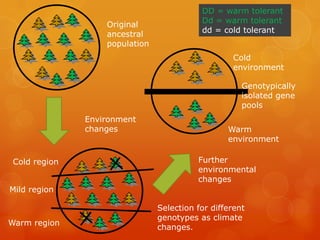
DD = warm tolerant
                                          Dd = warm tolerant
                  Original
                                          dd = cold tolerant
                  ancestral
                  population
                                                  Cold
                                                  environment

                                                     Genotypically
                                                     isolated gene
                                                     pools
              Environment
              changes                            Warm
                                                 environment

Cold region                              Further
                                         environmental
                                         changes
Mild region

                               Selection for different
                               genotypes as climate
Warm region
                               changes.
3. Mutations:
 Are the source of new alleles in the gene pool –
  mutations are essential for evolution.
 If a mutation occurs in the gamete-producing
  cells during DNA replication for meiosis and
  that gamete is fertilised, then the mutation will
  enter the gene pool.
 Any mutation that enters a gene pool is acted
  upon by natural selection.
 Alleles resulting from unfavourable mutations are
  selected against, and only remain in the gene
  pool if they are recessive (remain ‘hidden’ in
  heterozygotes).
 Neutral or ‘silent’ mutations (neither favourable
  nor unfavourable) are not acted upon by
  selection.
 The frequency of these mutated alleles in the
  gene pool will be due to chance.
 Eg. a change in a base code (GGG to GGC) that
  codes for the same amino acid. The same protein
  is made - no change results from this mutation.
4. Migration

 Migration is the movement of individuals from
  one population to another.


 Immigration = individuals migrate into a
  population.


 Emigration = individuals migrate out of a
  population.
 Both processes allow for gene flow between
  populations.


 Gene flow may change the frequency and/or the
  range of alleles in the populations.


 If populations are large, migration may have little
  or no effect on allele frequency.


 However, if populations are small, migration may
  have a big impact on allele frequency.
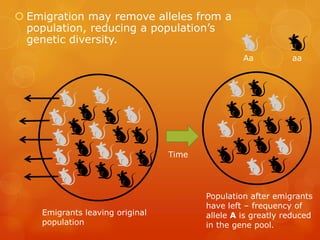
 Emigration may remove alleles from a
  population, reducing a population’s
  genetic diversity.
                                                 Aa          aa


                                 Time


                                        Population after emigrants
                                        have left – frequency of
    Emigrants leaving original          allele A is greatly reduced
    population                          in the gene pool.
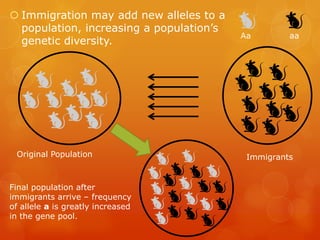
 Immigration may add new alleles to a
  population, increasing a population’s
                                          Aa        aa
  genetic diversity.


 Original Population                       Immigrants


Final population after
immigrants arrive – frequency
of allele a is greatly increased
in the gene pool.
5. Genetic Drift


 Is the change in allele frequency due to
  change (not selection), and may include
  the loss of alleles from the gene pool.


 Most likely to have an effect in small
  populations.
 When populations are large, mating is
  random and the environment is stable (i.e. no
  natural selection) – the frequency of alleles
  tends to remain stable from generation to
  generation.


 However, when populations become
  small, allele frequencies can
  increase, decrease or even be completely loss
  by change alone.


 This has nothing to do with natural selection.
a. Founder effect:

 Occurs when a small group of individuals
  (founder population) colonises a geographically
  isolated area such as an island.


 The range and frequency of alleles in this small
  group are unlikely to be representative of those
  of the original population – alleles may not be
  present or may be more or less frequent.
 Likely to be more pronounced in a founder
  population.


 Evolution is likely to occur at a faster rate
  than in the original or other populations.


 In extreme cases, a founder population
  may be a single individual (e.g. a
  windblown seed).
 Many species arrived in NZ in small numbers by
  chance (e.g. birds such as silvereye, white-faced
  heron, spur winged plover).


 Or through introduction by humans (e.g.
  chamois, tahr).


 They therefore have the potential to become quite
  different from the original populations and their
  evolution is likely to progress faster as natural
  selection by the different environment occurs.
b. Bottleneck effect:

 Populations may be suddenly reduced in
  numbers.
 Usually from a catastrophic environmental event
  (e.g. fire, flood, landslide, or drought).
 Or by sudden, severe selection pressure (often
  human activities, e.g. rapid habitat
  destruction, introduction of predators/
  competitors).
 After the event, the populations may recover to
  grow again to return to normal levels.
 As population numbers drop rapidly, it is likely
  that the range of alleles decreases and the
  frequency of alleles changes.


 When small, the population is more subject to
  genetic drift.


 When the population increases, it is likely that it
  will have reduced genetic diversity.

factors affecting allele frequencies

  • 1.
  • 2.
    Factors affecting allelefrequency in a gene pool 1. Evolution 2. Natural selection 3. Mutations 4. Migration 5. Genetic drift a. Founder effect b. Bottleneck effect.
  • 3.
    Genetic Change:  Genepool is the total number of alleles present in a population.  Genetic change is the change in frequency of alleles in the gene pool of a population.  The processes of mutation, natural selection, migration and genetic drift all affect the gene pool and change the frequency of the alleles in that gene pool.  Frequency of an allele = occurrence of allele _ total number of alleles
  • 4.
    1. Evolution:  Isthe process by which new species of organisms develop from earlier forms.  Process normally occurs slowly.  Most often in response to a change in a species’ environment.  It is changes in the frequency of the alleles in a population (some alleles ‘do better’ than others).  Evolution acts on populations (i.e. it is populations that evolve, not individuals).
  • 5.
    2. Natural Selection The theory of natural selection was proposed by Charles Darwin over 150 years ago.  Populations typically produce more offspring than environmental resources can maintain – there is a competition for survival.  Individuals with the best adaptations survive and reproduce (this is what is meant by fitness) and pass their successful alleles onto their offspring.  The frequency of these successful alleles will then increase in the gene pool.
  • 6.
     Environmental factors(both biotic and abiotic) act as selecting agents of phenotypes.  When environmental factors change, different phenotypes will be selected for.  As phenotype is largely determined by genotype, successful genotype alleles will increase in frequency in the gene pool.
  • 7.
     Favourable allelesincrease in frequency in a gene pool, while unfavourable alleles decrease.  If the frequency of alleles changes, evolution is occurring.  After a certain number of generations, the frequency of alleles and phenotypes might change so markedly that the population becomes reproductively isolated from others of that species.  It is now a new species.
  • 8.
    DD = warmtolerant Dd = warm tolerant Original dd = cold tolerant ancestral population Cold environment Genotypically isolated gene pools Environment changes Warm environment Cold region Further environmental changes Mild region Selection for different genotypes as climate Warm region changes.
  • 9.
    3. Mutations:  Arethe source of new alleles in the gene pool – mutations are essential for evolution.  If a mutation occurs in the gamete-producing cells during DNA replication for meiosis and that gamete is fertilised, then the mutation will enter the gene pool.  Any mutation that enters a gene pool is acted upon by natural selection.
  • 10.
     Alleles resultingfrom unfavourable mutations are selected against, and only remain in the gene pool if they are recessive (remain ‘hidden’ in heterozygotes).  Neutral or ‘silent’ mutations (neither favourable nor unfavourable) are not acted upon by selection.  The frequency of these mutated alleles in the gene pool will be due to chance.  Eg. a change in a base code (GGG to GGC) that codes for the same amino acid. The same protein is made - no change results from this mutation.
  • 11.
    4. Migration  Migrationis the movement of individuals from one population to another.  Immigration = individuals migrate into a population.  Emigration = individuals migrate out of a population.
  • 12.
     Both processesallow for gene flow between populations.  Gene flow may change the frequency and/or the range of alleles in the populations.  If populations are large, migration may have little or no effect on allele frequency.  However, if populations are small, migration may have a big impact on allele frequency.
  • 13.
     Emigration mayremove alleles from a population, reducing a population’s genetic diversity. Aa aa Time Population after emigrants have left – frequency of Emigrants leaving original allele A is greatly reduced population in the gene pool.
  • 14.
     Immigration mayadd new alleles to a population, increasing a population’s Aa aa genetic diversity. Original Population Immigrants Final population after immigrants arrive – frequency of allele a is greatly increased in the gene pool.
  • 15.
    5. Genetic Drift Is the change in allele frequency due to change (not selection), and may include the loss of alleles from the gene pool.  Most likely to have an effect in small populations.
  • 16.
     When populationsare large, mating is random and the environment is stable (i.e. no natural selection) – the frequency of alleles tends to remain stable from generation to generation.  However, when populations become small, allele frequencies can increase, decrease or even be completely loss by change alone.  This has nothing to do with natural selection.
  • 17.
    a. Founder effect: Occurs when a small group of individuals (founder population) colonises a geographically isolated area such as an island.  The range and frequency of alleles in this small group are unlikely to be representative of those of the original population – alleles may not be present or may be more or less frequent.
  • 18.
     Likely tobe more pronounced in a founder population.  Evolution is likely to occur at a faster rate than in the original or other populations.  In extreme cases, a founder population may be a single individual (e.g. a windblown seed).
  • 19.
     Many speciesarrived in NZ in small numbers by chance (e.g. birds such as silvereye, white-faced heron, spur winged plover).  Or through introduction by humans (e.g. chamois, tahr).  They therefore have the potential to become quite different from the original populations and their evolution is likely to progress faster as natural selection by the different environment occurs.
  • 20.
    b. Bottleneck effect: Populations may be suddenly reduced in numbers.  Usually from a catastrophic environmental event (e.g. fire, flood, landslide, or drought).  Or by sudden, severe selection pressure (often human activities, e.g. rapid habitat destruction, introduction of predators/ competitors).  After the event, the populations may recover to grow again to return to normal levels.
  • 21.
     As populationnumbers drop rapidly, it is likely that the range of alleles decreases and the frequency of alleles changes.  When small, the population is more subject to genetic drift.  When the population increases, it is likely that it will have reduced genetic diversity.