Hardy Weinberg Equilibrium
What is Hardy - Weinberg Equilibrium? It allows us to predict allele frequencies in living populations The allele frequency tends to remain the same from generation to generation unless acted on by outside influences. In other words, we can predict what phenotypes/traits will be in a given population
Hardy - Weinberg  assumes that: No net mutations occur Individuals never enter or leave a population The population is large Individuals mate randomly Selection does not occur
Misc. Info: “ gene pool” = total genetic information in a population Review: A = dominant allele Review: a = recessive allele Review: gametes = sperm, egg
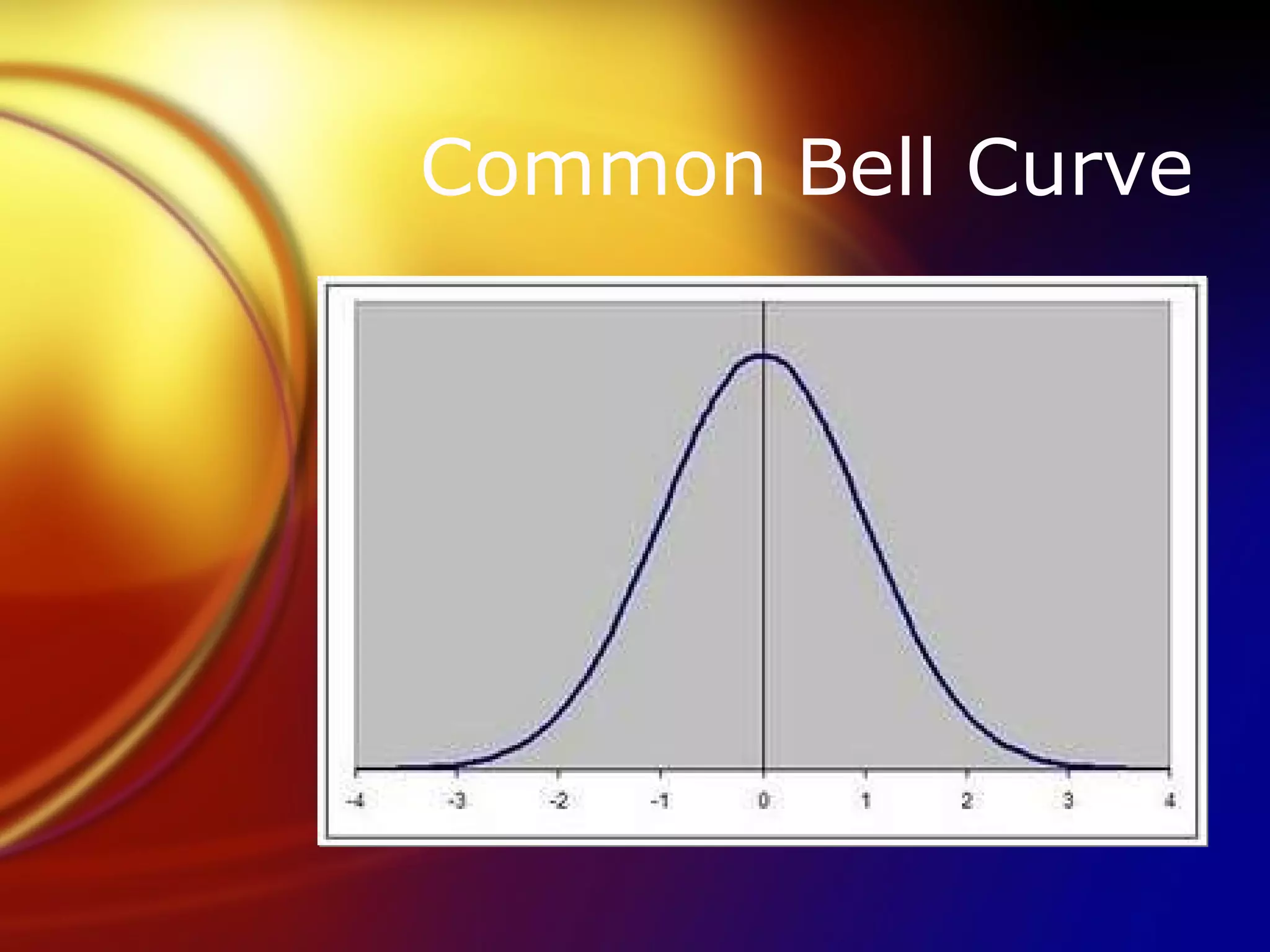
Common Patterns of Inheritance Many populations follow a bell-shaped curve pattern Consider fish length… Long fish = LL Average length fish = Ll Short fish = ll Most samples show a smaller amount of long & short fish, with more of them being average sized.
Common Bell Curve
Predicting Phenotype & Genetic Frequencies Assume 100 fish in a population This means with 100 fish, 200 total alleles are contributed. 4 are long (LL) So…there’s 8 “L” alleles 86 are average (Ll) So…there’s 86 more “L” alleles and 86 “l” alleles 10 are short (ll) So…there’s 20 “l” alleles Therefore … 8 L’s + 86 L’s + 86 l’s + 20 l’s = 200 total alleles
Determining frequencies of alleles There is a total of 94 “L”s out of 200 So … 94/200 = L There is a total of 106 “l”s out of 200. So … 106/200 = l
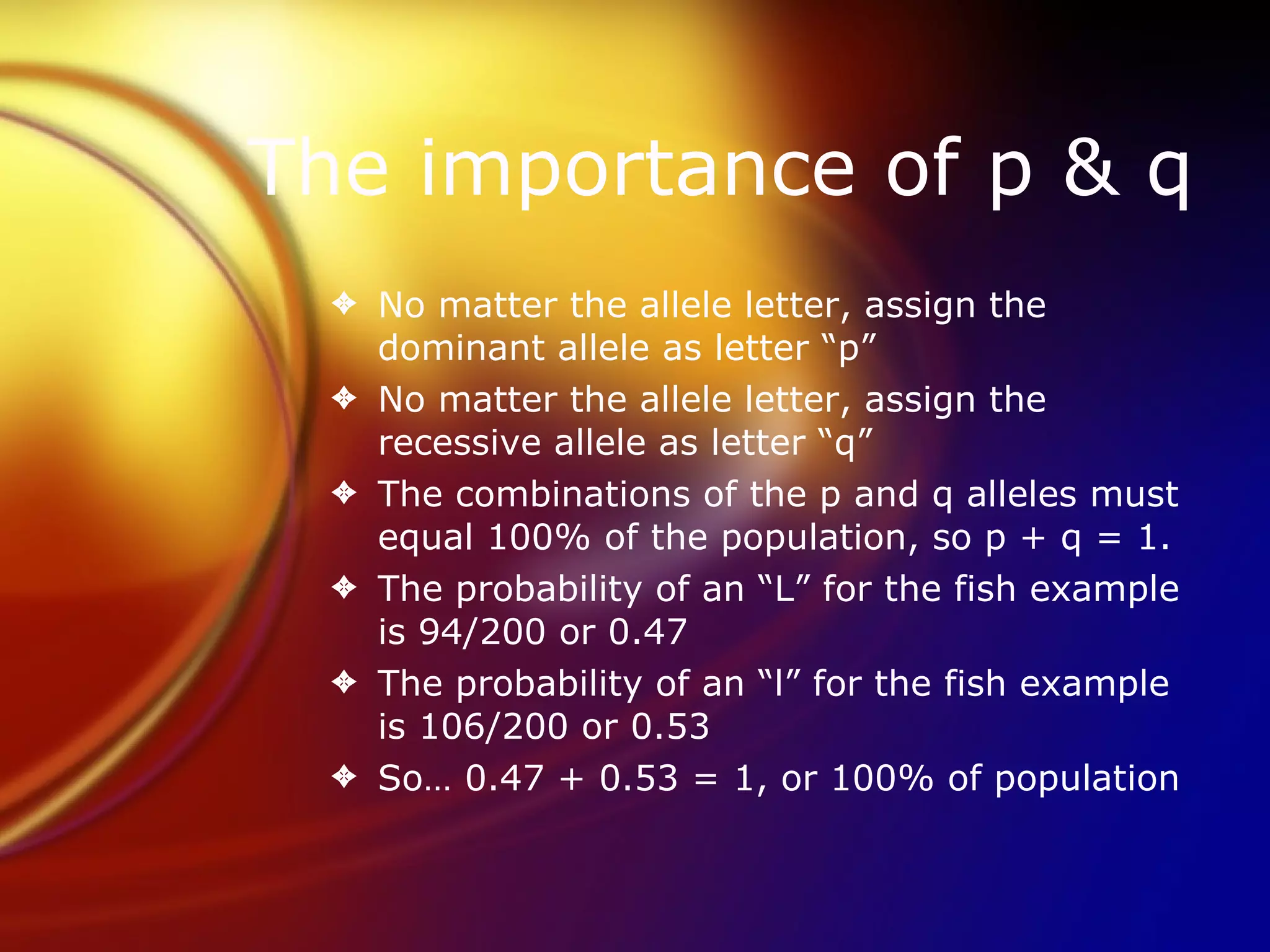
The importance of p & q No matter the allele letter, assign the dominant allele as letter “p” No matter the allele letter, assign the recessive allele as letter “q” The combinations of the p and q alleles must equal 100% of the population, so p + q = 1. The probability of an “L” for the fish example is 94/200 or 0.47 The probability of an “l” for the fish example is 106/200 or 0.53 So… 0.47 + 0.53 = 1, or 100% of population
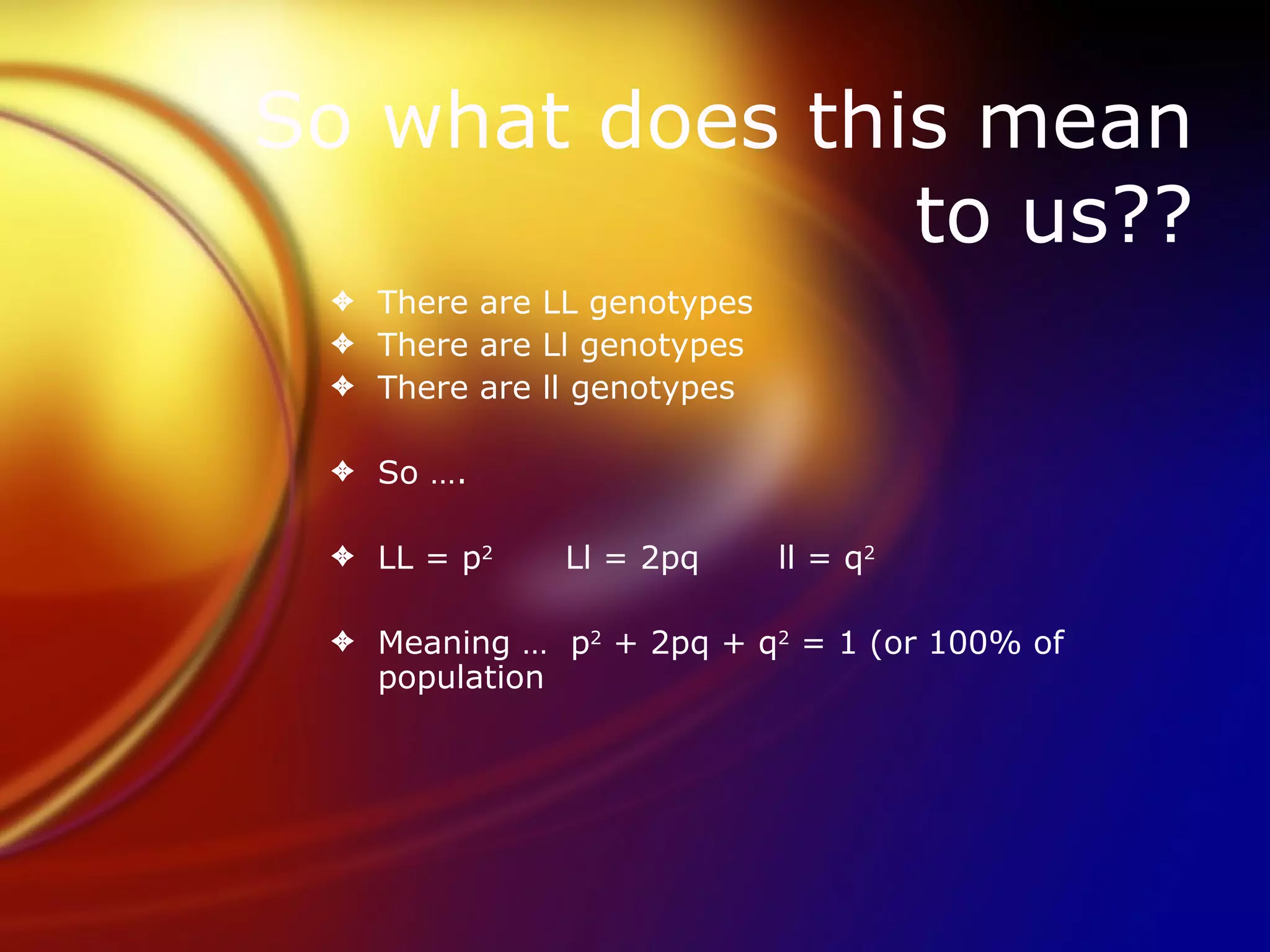
So what does this mean to us?? There are LL genotypes There are Ll genotypes There are ll genotypes So …. LL = p 2  Ll = 2pq  ll = q 2 Meaning …  p 2  + 2pq + q 2  = 1 (or 100% of population
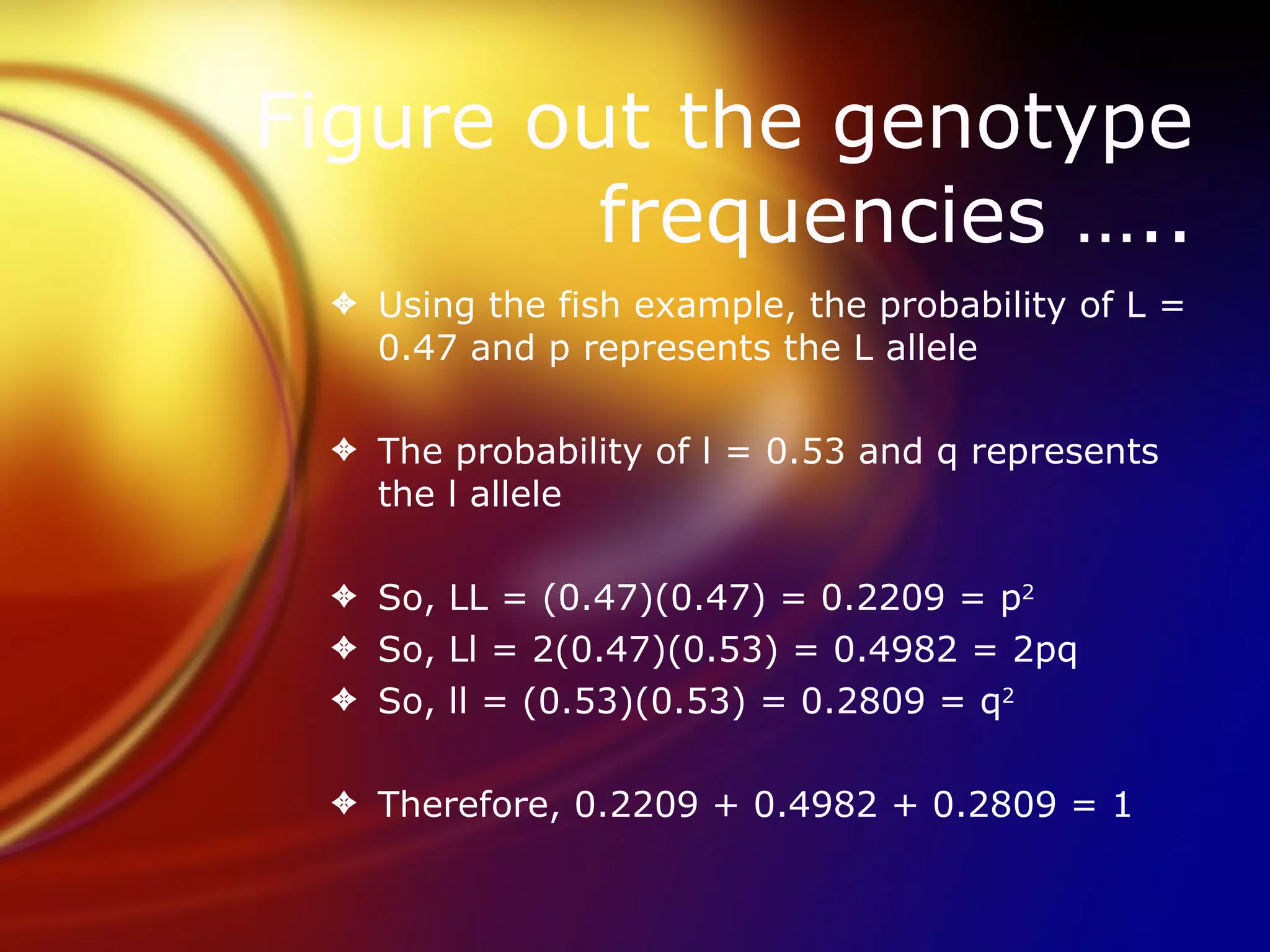
Figure out the genotype frequencies ….. Using the fish example, the probability of L = 0.47 and p represents the L allele The probability of l = 0.53 and q represents the l allele So, LL = (0.47)(0.47) = 0.2209 = p 2 So, Ll = 2(0.47)(0.53) = 0.4982 = 2pq So, ll = (0.53)(0.53) = 0.2809 = q 2 Therefore, 0.2209 + 0.4982 + 0.2809 = 1
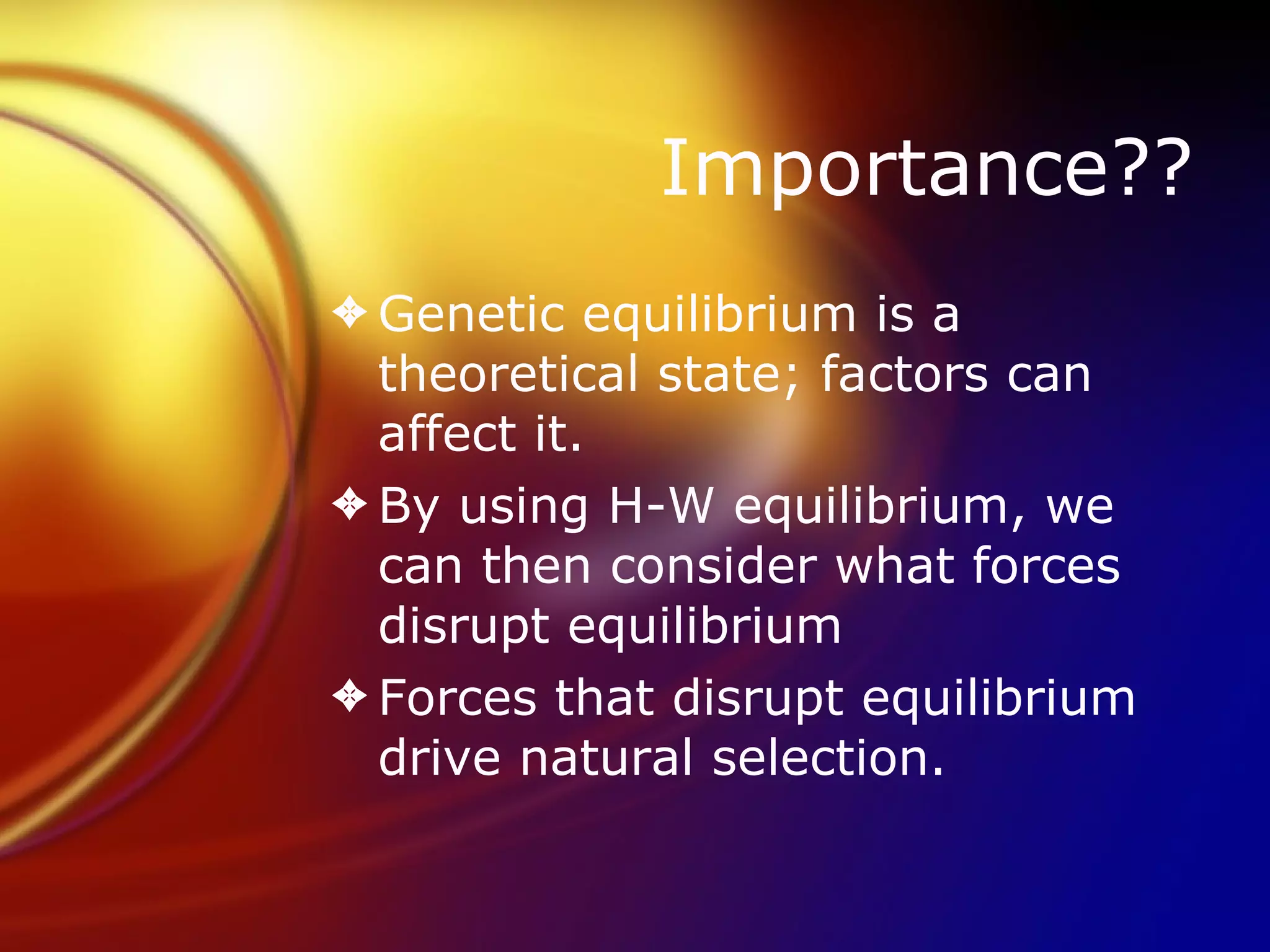
Importance?? Genetic equilibrium is a theoretical state; factors can affect it. By using H-W equilibrium, we can then consider what forces disrupt equilibrium Forces that disrupt equilibrium drive natural selection.

Hardy weinberg powerpoint

  • 1.
  • 2.
    What is Hardy- Weinberg Equilibrium? It allows us to predict allele frequencies in living populations The allele frequency tends to remain the same from generation to generation unless acted on by outside influences. In other words, we can predict what phenotypes/traits will be in a given population
  • 3.
    Hardy - Weinberg assumes that: No net mutations occur Individuals never enter or leave a population The population is large Individuals mate randomly Selection does not occur
  • 4.
    Misc. Info: “gene pool” = total genetic information in a population Review: A = dominant allele Review: a = recessive allele Review: gametes = sperm, egg
  • 5.
    Common Patterns ofInheritance Many populations follow a bell-shaped curve pattern Consider fish length… Long fish = LL Average length fish = Ll Short fish = ll Most samples show a smaller amount of long & short fish, with more of them being average sized.
  • 6.
  • 7.
    Predicting Phenotype &Genetic Frequencies Assume 100 fish in a population This means with 100 fish, 200 total alleles are contributed. 4 are long (LL) So…there’s 8 “L” alleles 86 are average (Ll) So…there’s 86 more “L” alleles and 86 “l” alleles 10 are short (ll) So…there’s 20 “l” alleles Therefore … 8 L’s + 86 L’s + 86 l’s + 20 l’s = 200 total alleles
  • 8.
    Determining frequencies ofalleles There is a total of 94 “L”s out of 200 So … 94/200 = L There is a total of 106 “l”s out of 200. So … 106/200 = l
  • 9.
    The importance ofp & q No matter the allele letter, assign the dominant allele as letter “p” No matter the allele letter, assign the recessive allele as letter “q” The combinations of the p and q alleles must equal 100% of the population, so p + q = 1. The probability of an “L” for the fish example is 94/200 or 0.47 The probability of an “l” for the fish example is 106/200 or 0.53 So… 0.47 + 0.53 = 1, or 100% of population
  • 10.
    So what doesthis mean to us?? There are LL genotypes There are Ll genotypes There are ll genotypes So …. LL = p 2 Ll = 2pq ll = q 2 Meaning … p 2 + 2pq + q 2 = 1 (or 100% of population
  • 11.
    Figure out thegenotype frequencies ….. Using the fish example, the probability of L = 0.47 and p represents the L allele The probability of l = 0.53 and q represents the l allele So, LL = (0.47)(0.47) = 0.2209 = p 2 So, Ll = 2(0.47)(0.53) = 0.4982 = 2pq So, ll = (0.53)(0.53) = 0.2809 = q 2 Therefore, 0.2209 + 0.4982 + 0.2809 = 1
  • 12.
    Importance?? Genetic equilibriumis a theoretical state; factors can affect it. By using H-W equilibrium, we can then consider what forces disrupt equilibrium Forces that disrupt equilibrium drive natural selection.