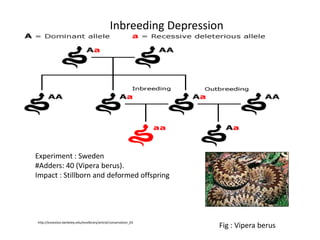
Inbreeding occurs when related individuals mate and can increase the proportion of homozygosity. This raises the chances that offspring will be affected by recessive or deleterious traits, leading to genetic disorders and conditions. Inbreeding depression can result in smaller litters, lower fertility, and stillborn or deformed offspring in experiments with animals like adders. The inbreeding coefficient is used to measure inbreeding depression based on the expected and observed heterozygosity within a population. While inbreeding can establish desirable traits in livestock, it generally reduces survival and fertility over time.


![Inbreeding Depression
Definition: The reduction of survival and fertility rate of inbred offspring.
It occurs both plant and animal population as well as human .
the harmful effect of inbreeding depression first observed by Charls Darwin, in 57 plant
species where self fertilization occurs between the individuals.
Inbreeding coeeficient
Definition: way of measurement of inbreeding depression.
Formula: F= (He – Ho) / He [if, inbreeding is only souce of diseuilibrium]
Here, F= Inbreeding coefficient,
He = Expected Heterozygosity, He = Observed Heterozygosity
Interpretation: F = 0 , no inbreeding
F= 1, complete inbreeding
Low F means less inbreeding
High F means significant inbreeding](https://image.slidesharecdn.com/inbreeding-180412220040/85/Inbreeding-4-320.jpg)


