GENETICS:
THE branch of biology that deals with the transmission and
variation of inherited characteristics in particular chromosome and
DNA.
EVOLUTION:
Gradual directional change especially one leading to a more
advanced or complex form ;growth development.
Development Of Genetics
 The genetics is new science it developing early part of the
twentieth century.
 Twentieth century the British geneticist Bateson and R.C.
Punnett was giving such a public lecture before an audience
in London explained human genetics.
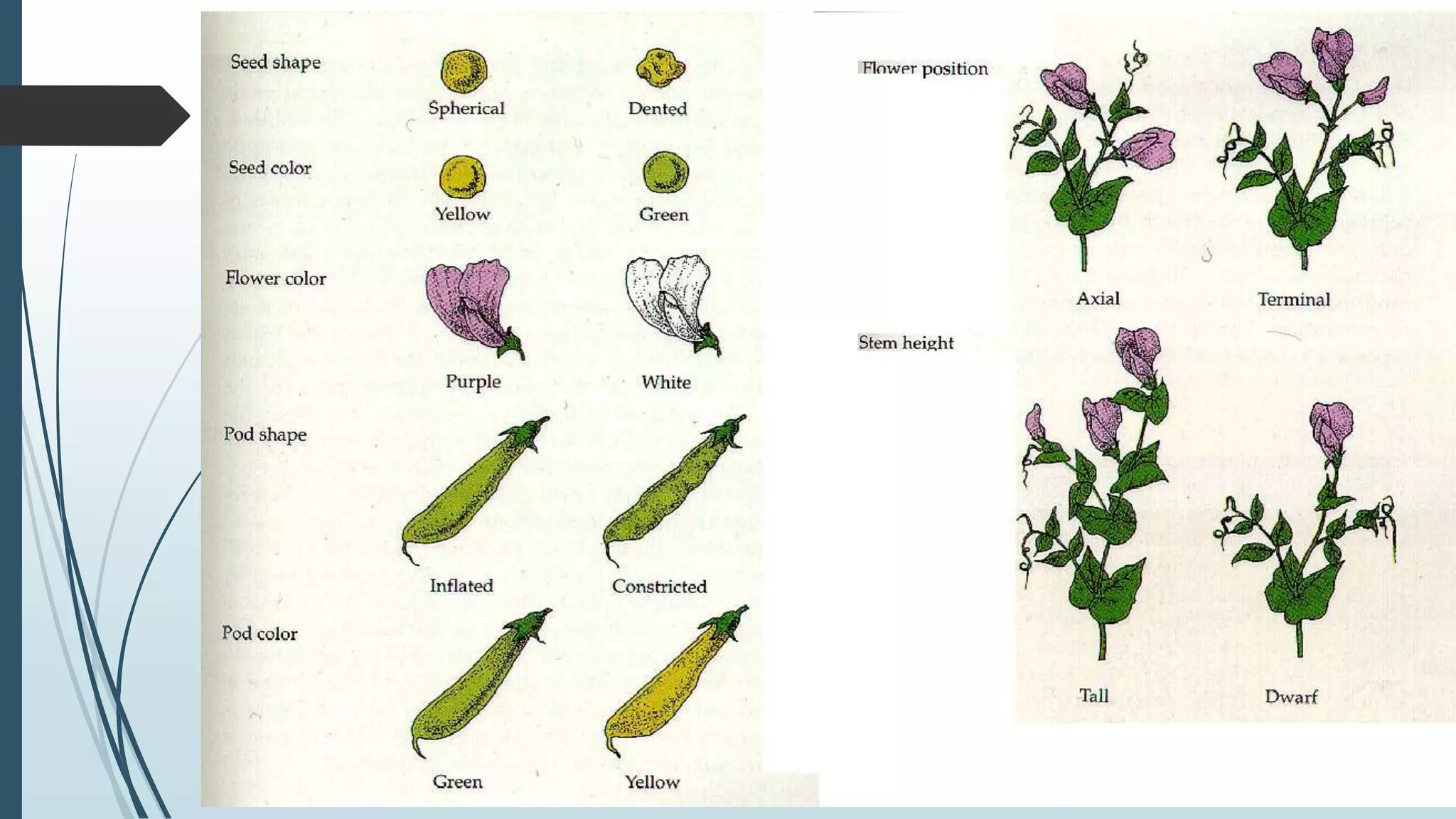
 Instead of using flower or cotyledon color as example of early
mendalism.
MENDEL
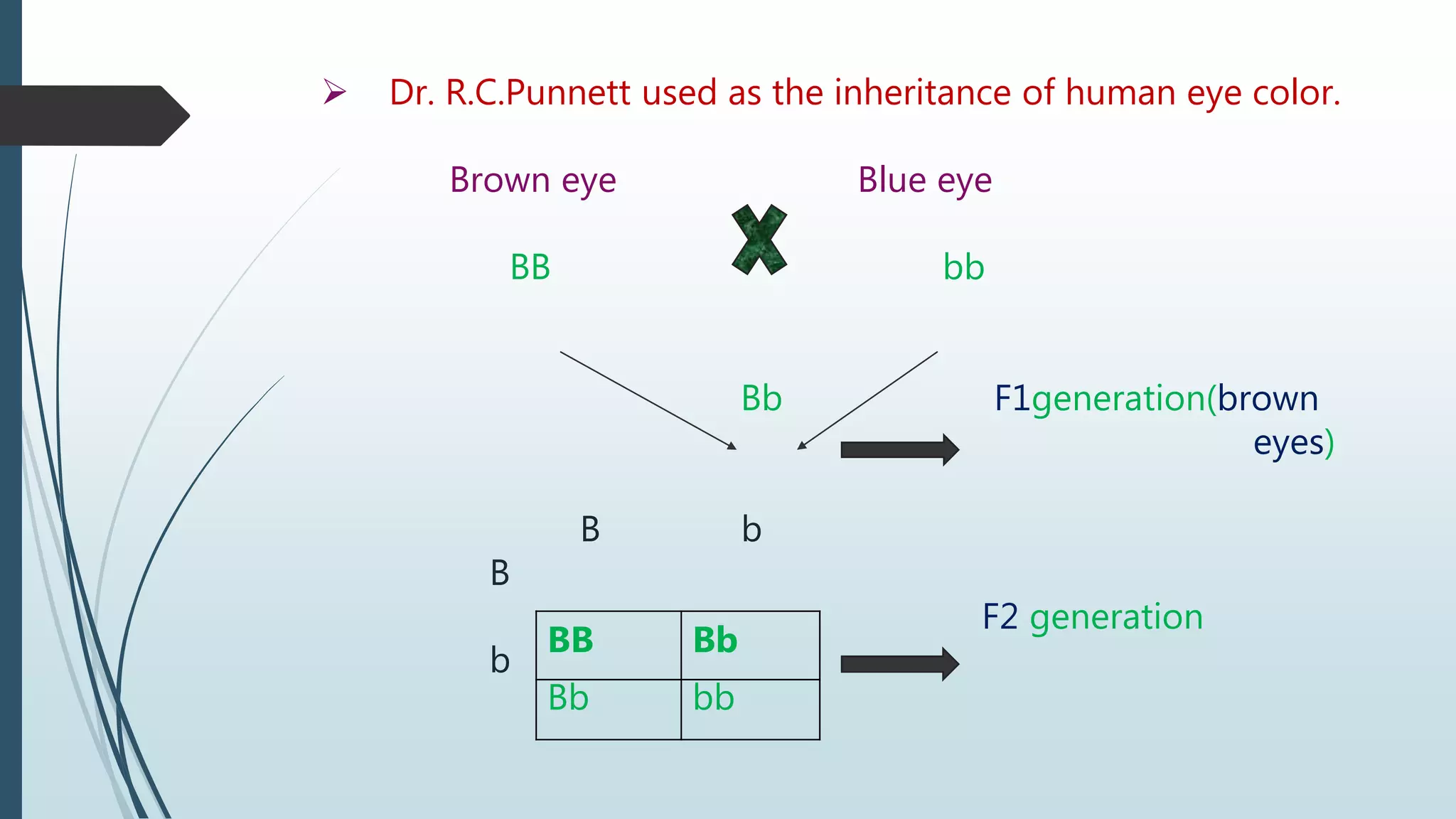
 Dr. R.C.Punnett used as the inheritance of human eye color.
Brown eye Blue eye
BB bb
Bb F1generation(brown
eyes)
B b
B
F2 generation
b
BB Bb
Bb bb
 The F2 generation
phenotype ratio=3:1
genotype ratio=1:2:1
It is know that this example of inheritance of eye color in man
is not 100% correct. But it is a reasonably good approximation
to a simple mendalian monohybrid cross.
HARDY-WEINBERG LAW
 This principle says that allele frequencies in a population are
stable and is constant from one generation to next
generation. Finally assume that there is no migration, no
selection and no mutation.
 Hardy law formula worked out 1908 and also independently
by the German physician Weinberg.so the law become known
as Hardy-Weinberg law or Hardy-Weinberg equilibrium.
Hardy Weinberg
The formula of hardy-Weinberg law
Brown eye Blue eye
BB bb
Bb F1generation(brown
eyes)
B b
B
F2 generation
b
BB Bb
Bb bb
Simple algebra
2
initial frequency of BB=P
2
initial frequency of bb=q
only two alleles involved so, P+q=1(F1 generation)
the distribution genotype in next generation
the genotype of F2 generation=1:2:1
2 2
formula is p+2pq+q=1
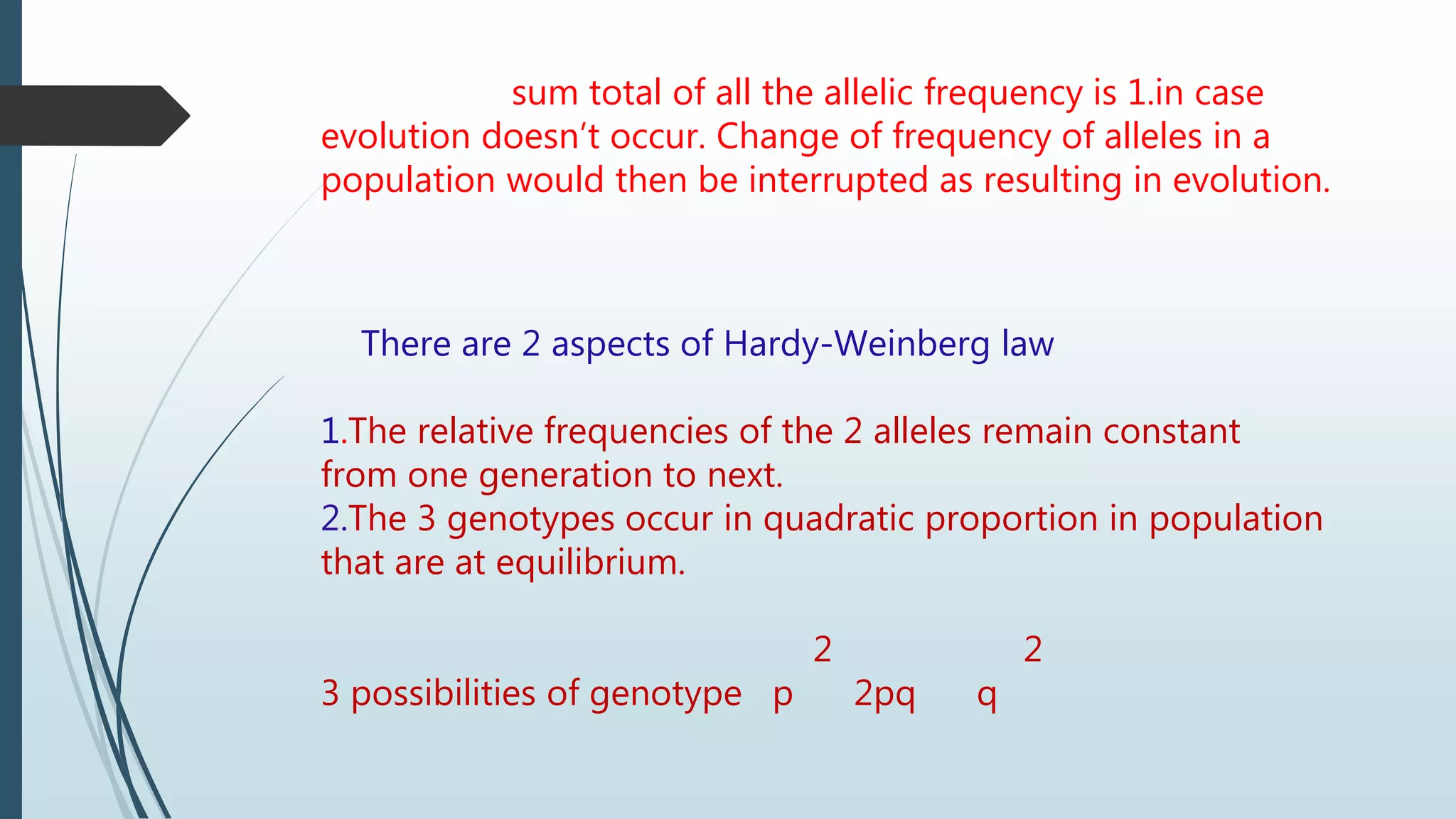
sum total of all the allelic frequency is 1.in case
evolution doesn’t occur. Change of frequency of alleles in a
population would then be interrupted as resulting in evolution.
There are 2 aspects of Hardy-Weinberg law
1.The relative frequencies of the 2 alleles remain constant
from one generation to next.
2.The 3 genotypes occur in quadratic proportion in population
that are at equilibrium.
2 2
3 possibilities of genotype p 2pq q
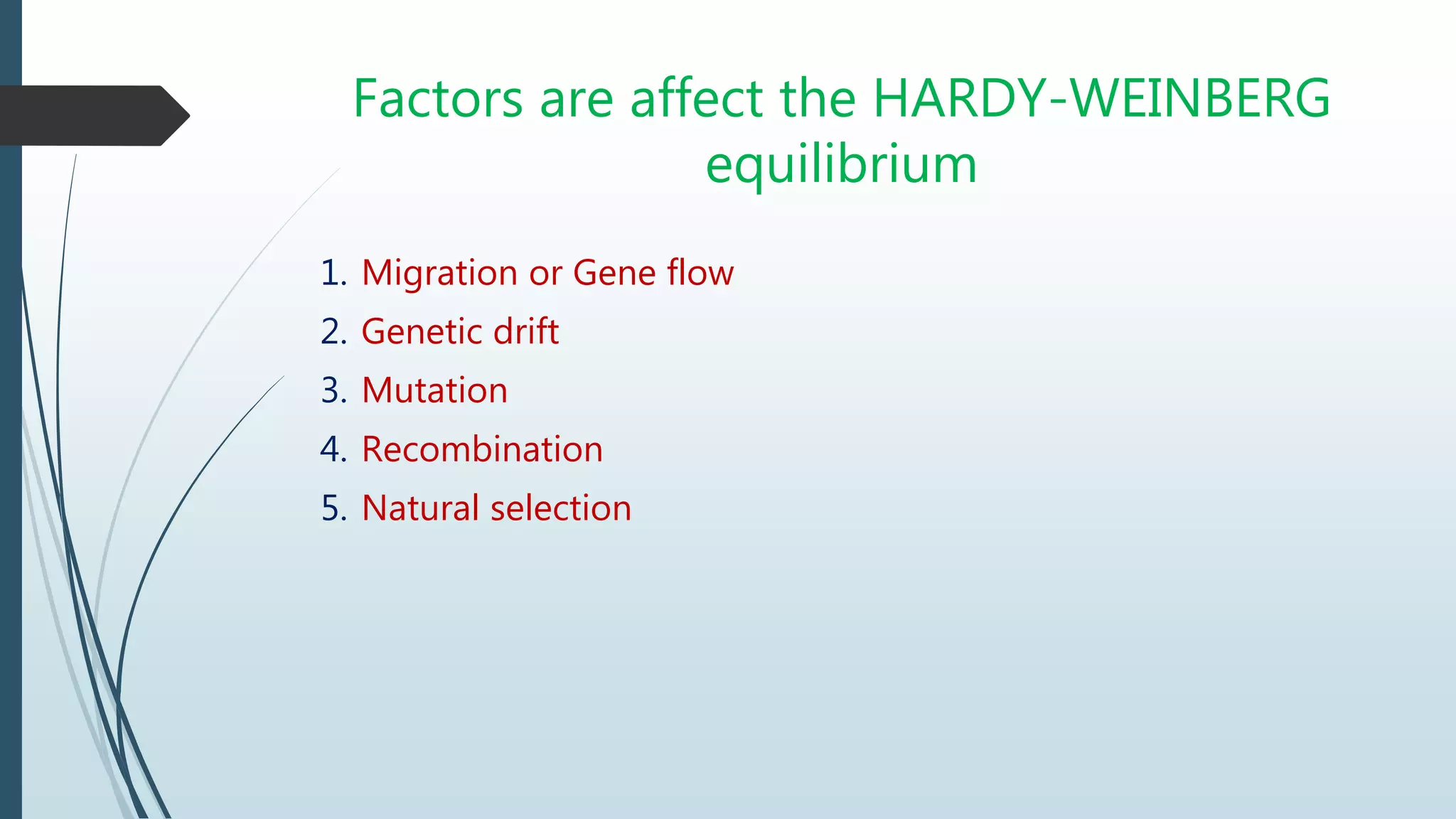
Factors are affect the HARDY-WEINBERG
equilibrium
1. Migration or Gene flow
2. Genetic drift
3. Mutation
4. Recombination
5. Natural selection
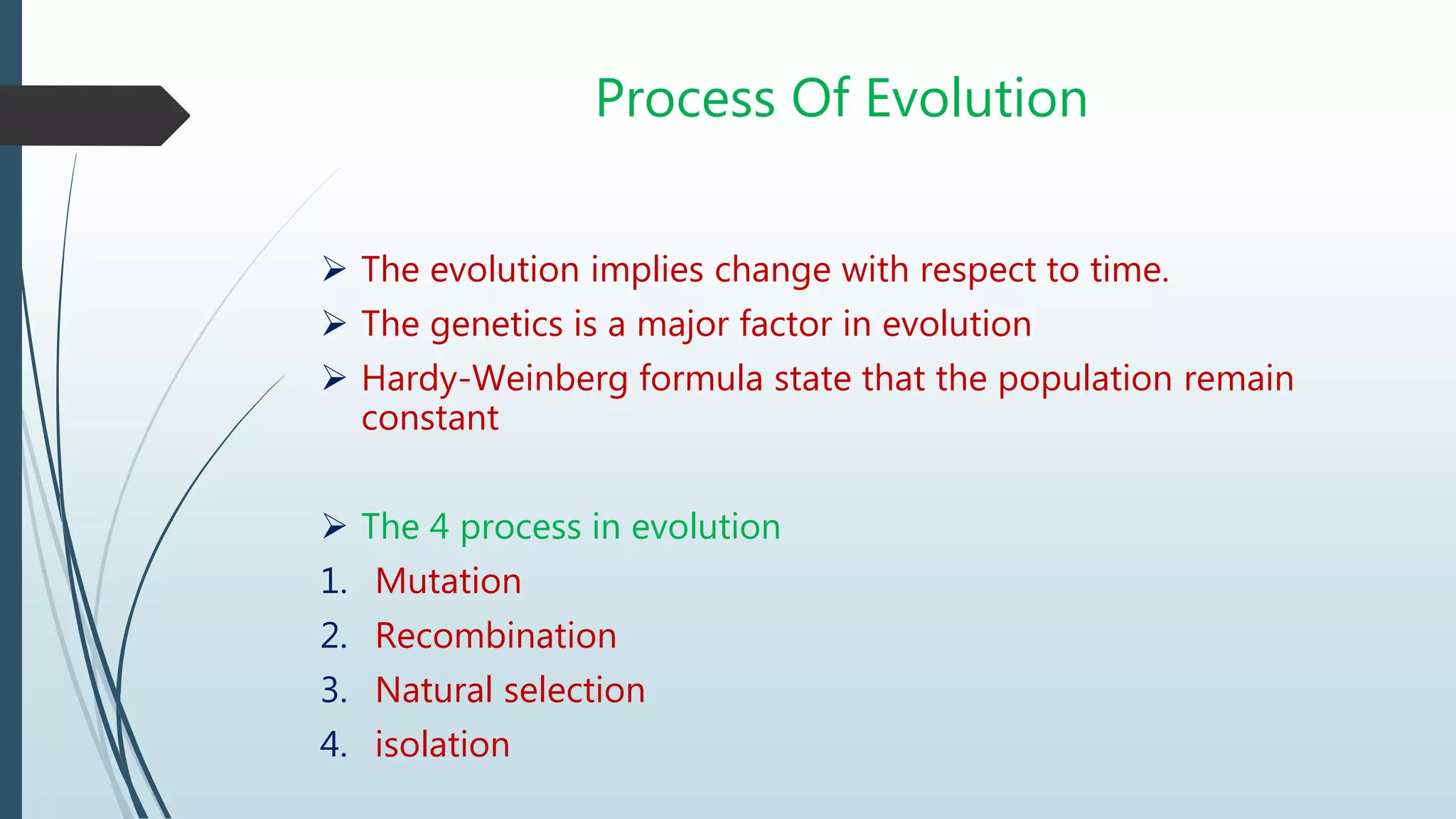
Process Of Evolution
 The evolution implies change with respect to time.
 The genetics is a major factor in evolution
 Hardy-Weinberg formula state that the population remain
constant
 The 4 process in evolution
1. Mutation
2. Recombination
3. Natural selection
4. isolation
Mutation
 The 1ST Important factor of evolution is mutation.
 Mutation is the only mechanism that can introduce genetic variability.
 Mutation provides the raw material for evolution
 Mutation :it supplies the genetic variation to population that makes
possible the new genotypes, that may be necessary for the evolution
success of the population.
ie: mutation are sudden heritable changes in the genetic make up of an
organism. Mutation are stable.
Mutation lead to evolution In 2 ways
1---ADAPTATION
2---ADAPTABILITY
ADAPTATION
 The oversimplification, assume that there is one particular
genotype that best adapts the population to a particular
environmental niche(the sum total of all the environmental
impacts on the organism).
 If this assumption is true it can be shown that the population
will tend toward homozygosity for that single genotype that
best adapts it to the ecological situation.
 The tendency for a population to become homozygous can
be spoken of as adaptation.
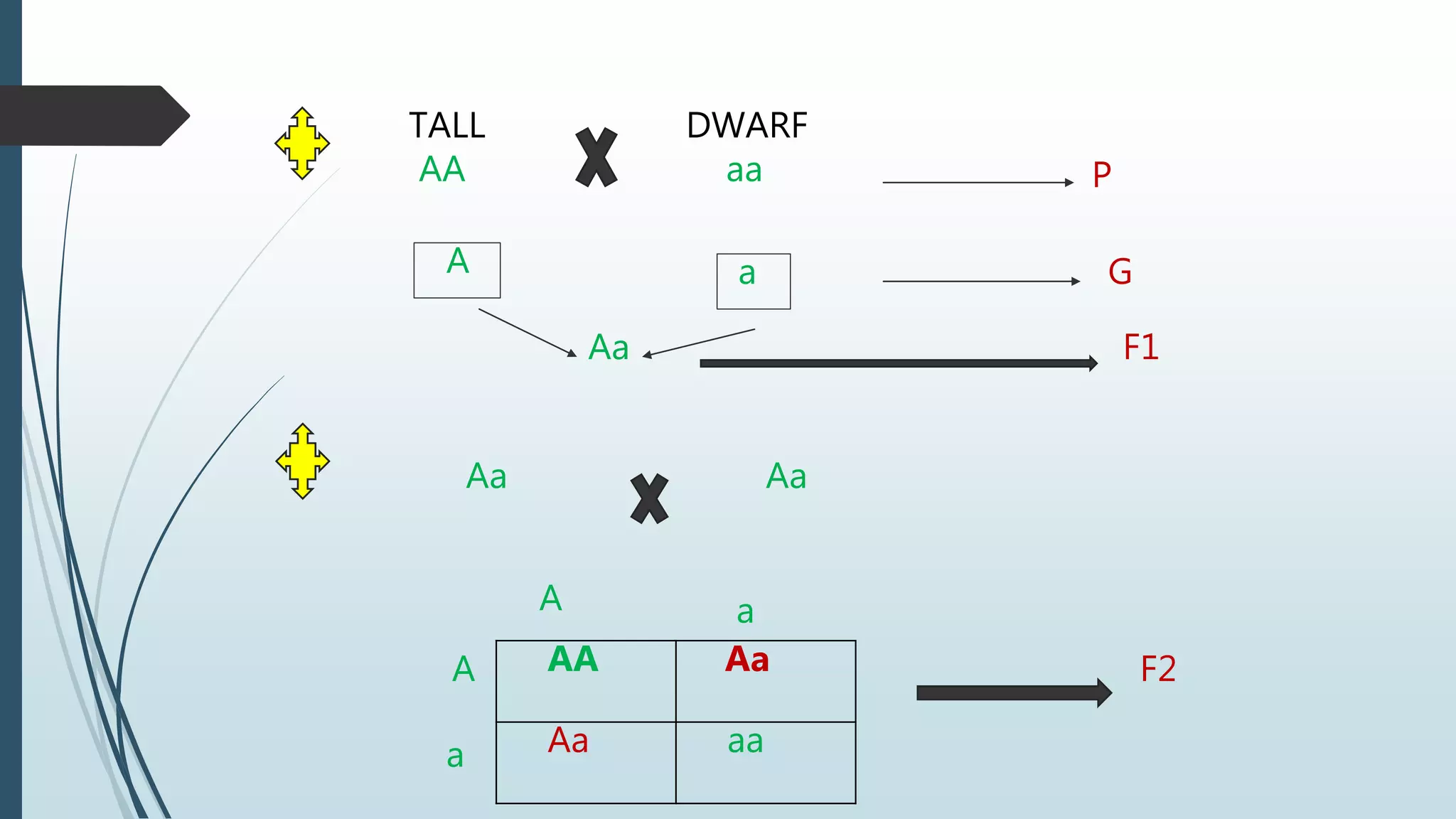
TALL
AA
DWARF
aa
A a
Aa
P
G
F1
Aa Aa
AA Aa
Aa aa
A a
A
a
F2
ADAPTABILITY
 The adaptation serve the well-being of the species only as long as
the environment stays constant.
 In geological record of the earth knows that the environment
doesn't remain constant.
 In most areas the earth organisms are subjected to daily life cycles
of environmental change involving heat ,light and seasonal cycles.
 That the population that tends toward homozygosity is also likely
to become extinct.
 The tendency of a population to become heterozygous is defined
as adaptability
TALL
AA
DWARF
aa
A a
Aa
P
G
F1
Aa Aa
AA Aa
Aa aa
A a
A
a
F2
Genetic variation
 During the long evolutionary period most possible mutations
have occurred at one time or another and have been selected
against or rejected as not being the highly adapted.
 Mutation is the only mechanism that can introduce genetic
variability
Gene mutation
 The particular mutation involves a change of the chemical
quality of the gene.
 In recent year: several chemicals have been found that cause
marked increase of the rate at which mutations occur
this is called as mutagenic substances.
 Eg; 5-Bromo-uracil it almost identical with thymine.
Recombination
 Recombination is 2nd factor considered important for
evolution.
 It defined as the formation of genetic combinations in
offspring that are not present in the parent.
 Mutation is the ultimate source of variability. Mutation build
up a large storehouse of variation.
 Recombination of this genetic variation provides the many
possible genotypes that might mean the difference between
survival and extinction for a given population.
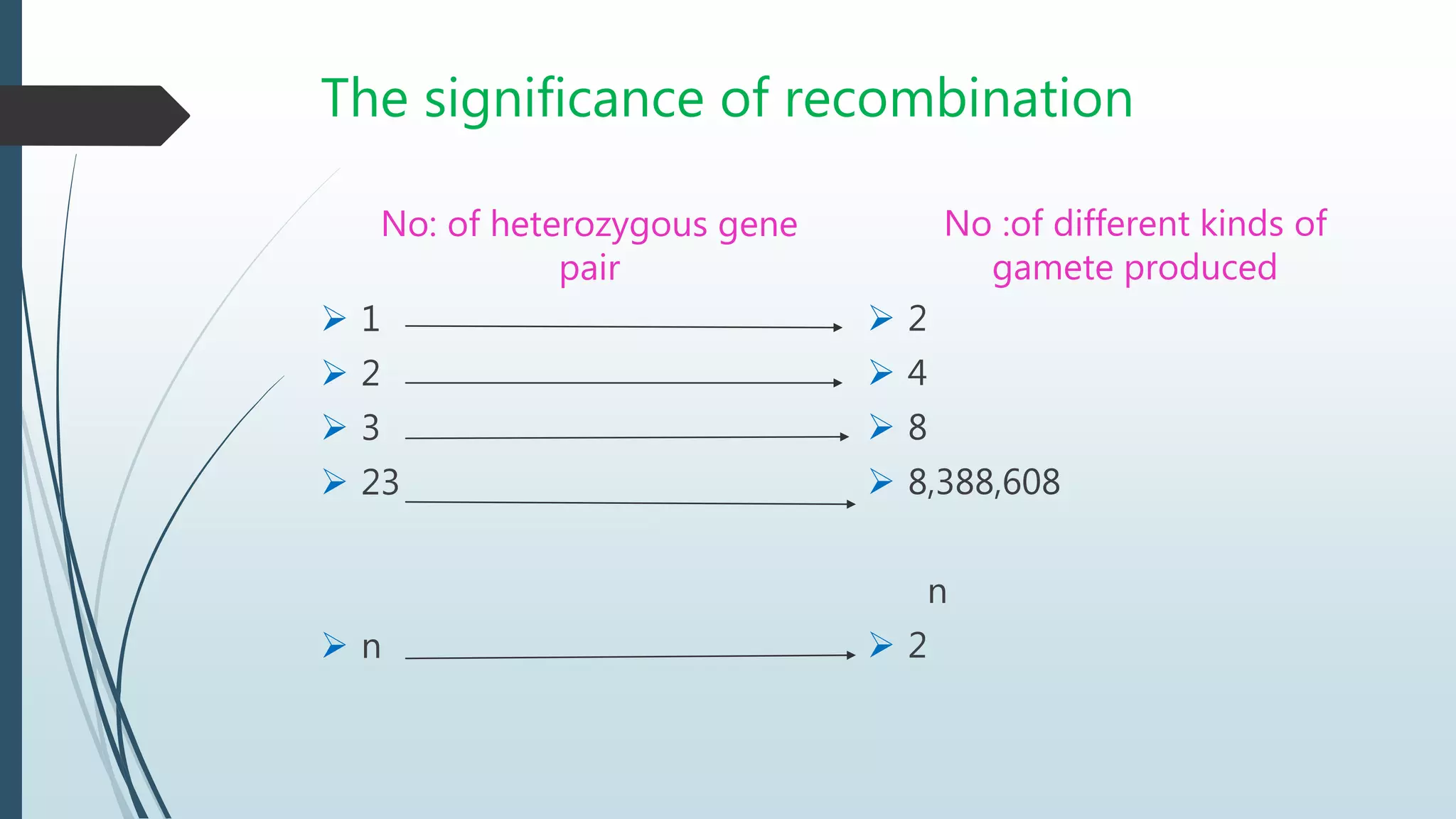
The significance of recombination
No: of heterozygous gene
pair
 1
 2
 3
 23
 n
No :of different kinds of
gamete produced
 2
 4
 8
 8,388,608
n
 2
Importance of crossing over:
 No: of possible genotypes were determined no: of chromosome
involved.
 The no: of genes in most organisms is relatively large the possible
no: of genotypes from recombination due to crossing over become
almost infinities.
 Recombination of all the variation that has accumulated with time
provides that favorable genotype that now allows the population to
survive in the new environment.
 In human 99% gene are homozygous and 1% total genotype
varying from individual to individual.
Natural selection
 Natural selection is the 3rd factor of evolution.
 When Darwin wrote his monumental book on the origin of
species in1859,the title also contained the words by natural
selection.
 Natural selection is defined as :some organism are better
adapted to survive in an otherwise hostile environment.
Adaptive ability is inherited. The end result of the ability to
adapt and get selected by nature.
DARWIN
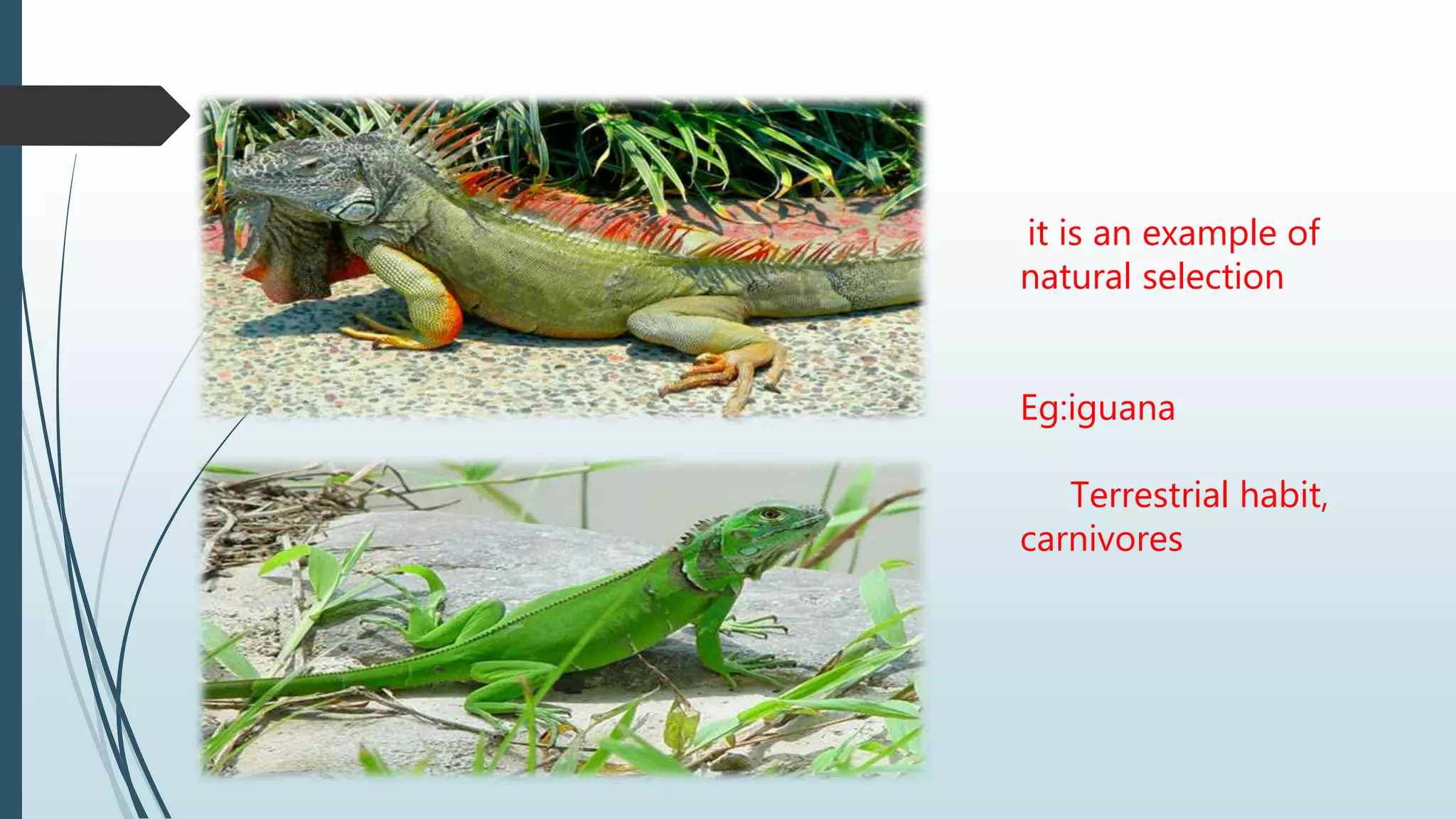
it is an example of
natural selection
Eg:iguana
Terrestrial habit,
carnivores
Iguana (marine habit)
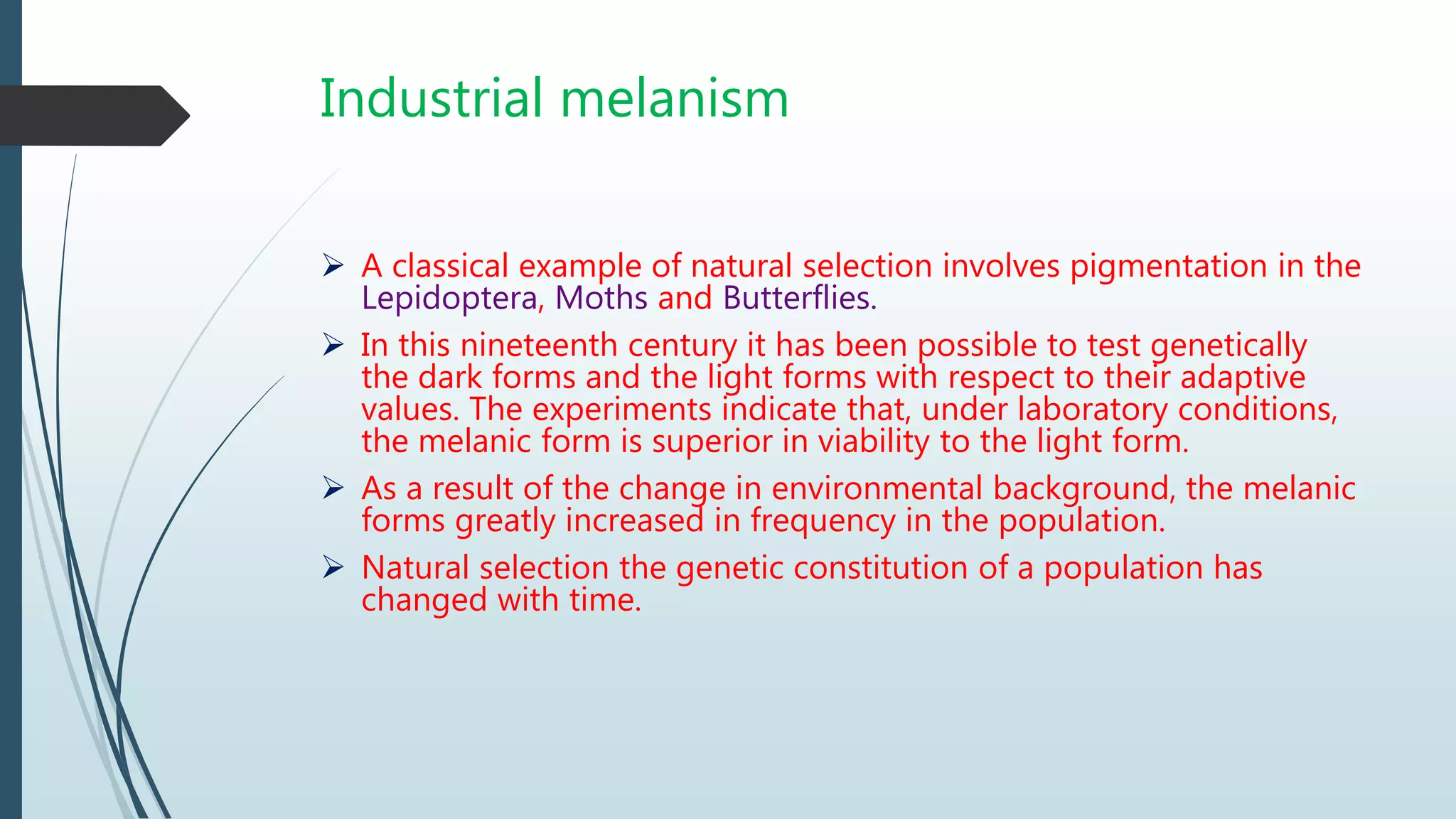
Industrial melanism
 A classical example of natural selection involves pigmentation in the
Lepidoptera, Moths and Butterflies.
 In this nineteenth century it has been possible to test genetically
the dark forms and the light forms with respect to their adaptive
values. The experiments indicate that, under laboratory conditions,
the melanic form is superior in viability to the light form.
 As a result of the change in environmental background, the melanic
forms greatly increased in frequency in the population.
 Natural selection the genetic constitution of a population has
changed with time.
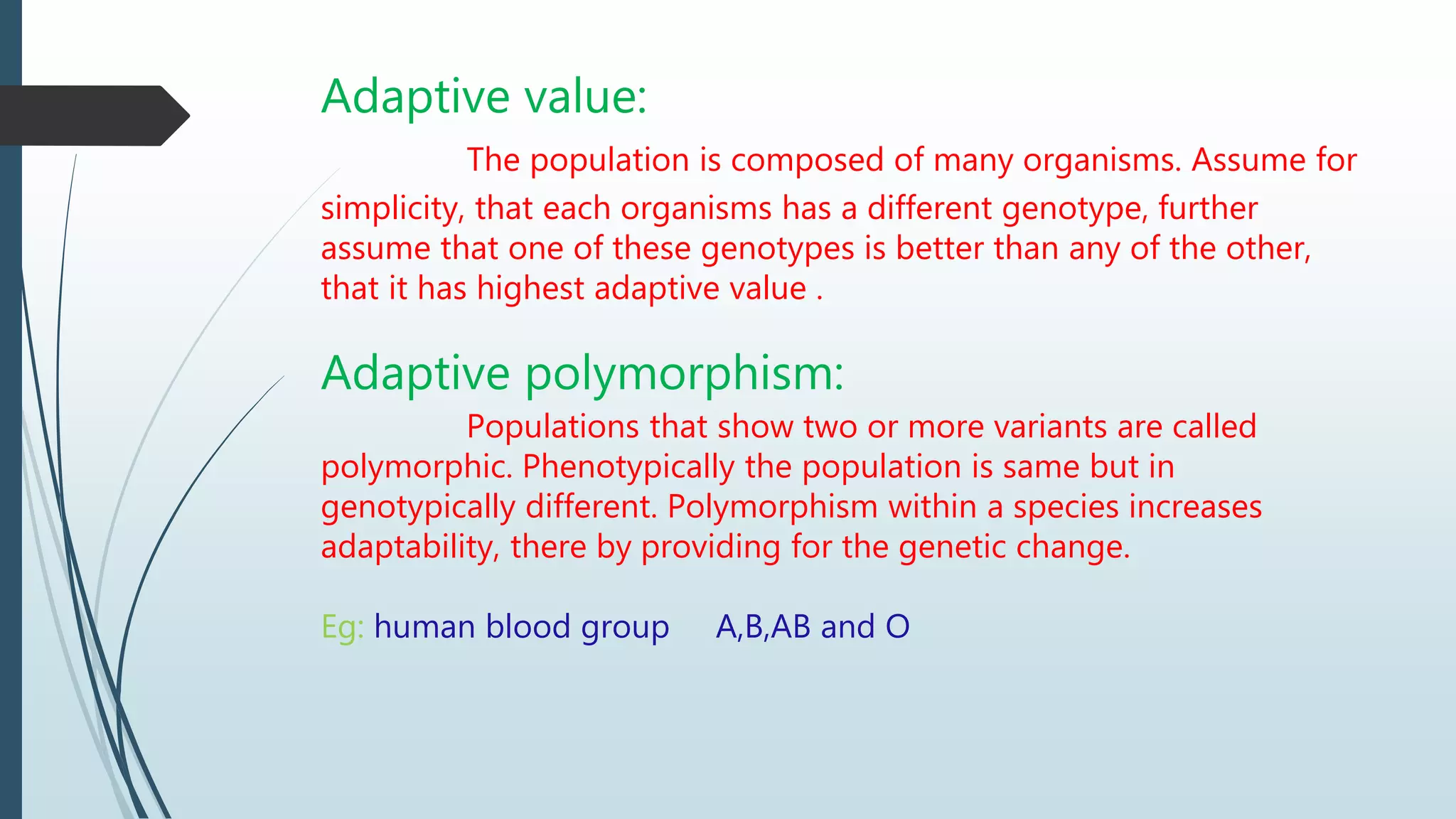
Adaptive value:
The population is composed of many organisms. Assume for
simplicity, that each organisms has a different genotype, further
assume that one of these genotypes is better than any of the other,
that it has highest adaptive value .
Adaptive polymorphism:
Populations that show two or more variants are called
polymorphic. Phenotypically the population is same but in
genotypically different. Polymorphism within a species increases
adaptability, there by providing for the genetic change.
Eg: human blood group A,B,AB and O
Isolation
 Isolation is the 4th factor in evolution.
 Isolation is defined as the separation of two or more
population to prevent the interbreeding.
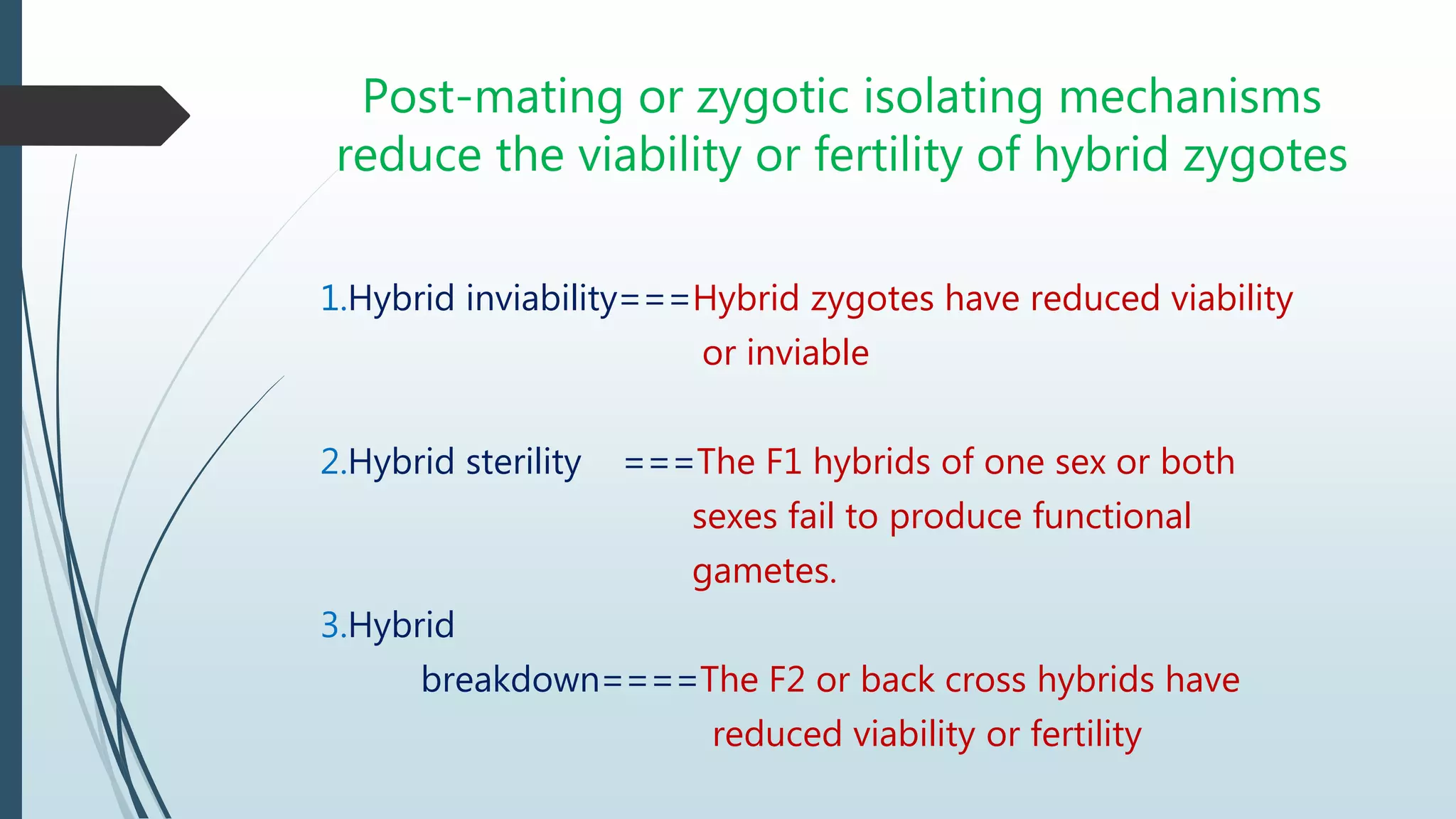
 After the twentieth-century arises more principle that
essentially supported by the Darwinism.
 The geneticists interested in evolution are often referred to as
an Neo-Darwinians (Dobzhansky).
Neo- Darwinism or modern synthetic
theory
Neo Darwinism=Darwin concept of natural selection+gregor
mendal basic+population geneticist+molecular biology.
Modern synthetic theory of evolution recognize 5 basic types of
process.
1.Recombination 2.Mutation
3.Gene flow 4.Natural selection
5.Gene frequency changes
Genetic driftHardy Weinberg
DOBZHANSKY
Isolating mechanisms
(Dobzhansky)
 Isolating mechanisms that tend to separate the two
populations and prevent interbreeding.
 Buildup of isolating mechanisms takes a very long time.
 The isolating mechanisms into two major groups.
1.Geographical isolation
2.Reproductive isolation
Premating
post mating
Geographic isolation:
In which the interbreeding and gene exchange between
population are limited or prevented because the two
populations occupy separate geographical areas and do not
come contact with each other. There is no gene exchange.
Reproductive isolation:
The populations are not necessarily physically separated but are
prevented from exchanging genes through one or more different
isolating mechanisms.
it 2 types
1.premating or prezygotic mechanisms prevent the formation
of hybrid zygote
2.postmating or zygotic isolating mechanisms reduce viability
or fertility of hybrid zygotes
Premating or prezygotic mechanisms
prevent the formation of hybrid zygote
1.Ecological or habitat
isolation ===The population concerned
occur in different habitats in
the same general region.
2.Seasonal or temporal
isolation===Mating or flowering times
occur at different times
3.Sexual or ethological
isolation===Mutual attraction between the
sexes of different species is weak or
absent
Post-mating or zygotic isolating mechanisms
reduce the viability or fertility of hybrid zygotes
1.Hybrid inviability===Hybrid zygotes have reduced viability
or inviable
2.Hybrid sterility ===The F1 hybrids of one sex or both
sexes fail to produce functional
gametes.
3.Hybrid
breakdown====The F2 or back cross hybrids have
reduced viability or fertility
Population
 Population is defined as a collection of organisms of a particular
species, sharing a particular characteristics of interest, most often
that of living in given areas.
 Population is two types
1.Allopteric===Populations that are separate
from each other.
2.sympateric==evolution where speciation
occurs when two populations are
found in the same areas
Genetics and evolution

Genetics and evolution

  • 2.
    GENETICS: THE branch ofbiology that deals with the transmission and variation of inherited characteristics in particular chromosome and DNA. EVOLUTION: Gradual directional change especially one leading to a more advanced or complex form ;growth development.
  • 3.
    Development Of Genetics The genetics is new science it developing early part of the twentieth century.  Twentieth century the British geneticist Bateson and R.C. Punnett was giving such a public lecture before an audience in London explained human genetics.  Instead of using flower or cotyledon color as example of early mendalism.
  • 4.
  • 7.
     Dr. R.C.Punnettused as the inheritance of human eye color. Brown eye Blue eye BB bb Bb F1generation(brown eyes) B b B F2 generation b BB Bb Bb bb
  • 8.
     The F2generation phenotype ratio=3:1 genotype ratio=1:2:1 It is know that this example of inheritance of eye color in man is not 100% correct. But it is a reasonably good approximation to a simple mendalian monohybrid cross.
  • 9.
    HARDY-WEINBERG LAW  Thisprinciple says that allele frequencies in a population are stable and is constant from one generation to next generation. Finally assume that there is no migration, no selection and no mutation.  Hardy law formula worked out 1908 and also independently by the German physician Weinberg.so the law become known as Hardy-Weinberg law or Hardy-Weinberg equilibrium.
  • 10.
  • 11.
    The formula ofhardy-Weinberg law Brown eye Blue eye BB bb Bb F1generation(brown eyes) B b B F2 generation b BB Bb Bb bb
  • 12.
    Simple algebra 2 initial frequencyof BB=P 2 initial frequency of bb=q only two alleles involved so, P+q=1(F1 generation) the distribution genotype in next generation the genotype of F2 generation=1:2:1 2 2 formula is p+2pq+q=1
  • 13.
    sum total ofall the allelic frequency is 1.in case evolution doesn’t occur. Change of frequency of alleles in a population would then be interrupted as resulting in evolution. There are 2 aspects of Hardy-Weinberg law 1.The relative frequencies of the 2 alleles remain constant from one generation to next. 2.The 3 genotypes occur in quadratic proportion in population that are at equilibrium. 2 2 3 possibilities of genotype p 2pq q
  • 14.
    Factors are affectthe HARDY-WEINBERG equilibrium 1. Migration or Gene flow 2. Genetic drift 3. Mutation 4. Recombination 5. Natural selection
  • 15.
    Process Of Evolution The evolution implies change with respect to time.  The genetics is a major factor in evolution  Hardy-Weinberg formula state that the population remain constant  The 4 process in evolution 1. Mutation 2. Recombination 3. Natural selection 4. isolation
  • 16.
    Mutation  The 1STImportant factor of evolution is mutation.  Mutation is the only mechanism that can introduce genetic variability.  Mutation provides the raw material for evolution  Mutation :it supplies the genetic variation to population that makes possible the new genotypes, that may be necessary for the evolution success of the population. ie: mutation are sudden heritable changes in the genetic make up of an organism. Mutation are stable. Mutation lead to evolution In 2 ways 1---ADAPTATION 2---ADAPTABILITY
  • 17.
    ADAPTATION  The oversimplification,assume that there is one particular genotype that best adapts the population to a particular environmental niche(the sum total of all the environmental impacts on the organism).  If this assumption is true it can be shown that the population will tend toward homozygosity for that single genotype that best adapts it to the ecological situation.  The tendency for a population to become homozygous can be spoken of as adaptation.
  • 18.
  • 19.
    ADAPTABILITY  The adaptationserve the well-being of the species only as long as the environment stays constant.  In geological record of the earth knows that the environment doesn't remain constant.  In most areas the earth organisms are subjected to daily life cycles of environmental change involving heat ,light and seasonal cycles.  That the population that tends toward homozygosity is also likely to become extinct.  The tendency of a population to become heterozygous is defined as adaptability
  • 20.
  • 21.
    Genetic variation  Duringthe long evolutionary period most possible mutations have occurred at one time or another and have been selected against or rejected as not being the highly adapted.  Mutation is the only mechanism that can introduce genetic variability
  • 22.
    Gene mutation  Theparticular mutation involves a change of the chemical quality of the gene.  In recent year: several chemicals have been found that cause marked increase of the rate at which mutations occur this is called as mutagenic substances.  Eg; 5-Bromo-uracil it almost identical with thymine.
  • 23.
    Recombination  Recombination is2nd factor considered important for evolution.  It defined as the formation of genetic combinations in offspring that are not present in the parent.  Mutation is the ultimate source of variability. Mutation build up a large storehouse of variation.  Recombination of this genetic variation provides the many possible genotypes that might mean the difference between survival and extinction for a given population.
  • 24.
    The significance ofrecombination No: of heterozygous gene pair  1  2  3  23  n No :of different kinds of gamete produced  2  4  8  8,388,608 n  2
  • 25.
    Importance of crossingover:  No: of possible genotypes were determined no: of chromosome involved.  The no: of genes in most organisms is relatively large the possible no: of genotypes from recombination due to crossing over become almost infinities.  Recombination of all the variation that has accumulated with time provides that favorable genotype that now allows the population to survive in the new environment.  In human 99% gene are homozygous and 1% total genotype varying from individual to individual.
  • 26.
    Natural selection  Naturalselection is the 3rd factor of evolution.  When Darwin wrote his monumental book on the origin of species in1859,the title also contained the words by natural selection.  Natural selection is defined as :some organism are better adapted to survive in an otherwise hostile environment. Adaptive ability is inherited. The end result of the ability to adapt and get selected by nature.
  • 27.
  • 28.
    it is anexample of natural selection Eg:iguana Terrestrial habit, carnivores
  • 29.
  • 30.
    Industrial melanism  Aclassical example of natural selection involves pigmentation in the Lepidoptera, Moths and Butterflies.  In this nineteenth century it has been possible to test genetically the dark forms and the light forms with respect to their adaptive values. The experiments indicate that, under laboratory conditions, the melanic form is superior in viability to the light form.  As a result of the change in environmental background, the melanic forms greatly increased in frequency in the population.  Natural selection the genetic constitution of a population has changed with time.
  • 32.
    Adaptive value: The populationis composed of many organisms. Assume for simplicity, that each organisms has a different genotype, further assume that one of these genotypes is better than any of the other, that it has highest adaptive value . Adaptive polymorphism: Populations that show two or more variants are called polymorphic. Phenotypically the population is same but in genotypically different. Polymorphism within a species increases adaptability, there by providing for the genetic change. Eg: human blood group A,B,AB and O
  • 33.
    Isolation  Isolation isthe 4th factor in evolution.  Isolation is defined as the separation of two or more population to prevent the interbreeding.  After the twentieth-century arises more principle that essentially supported by the Darwinism.  The geneticists interested in evolution are often referred to as an Neo-Darwinians (Dobzhansky).
  • 34.
    Neo- Darwinism ormodern synthetic theory Neo Darwinism=Darwin concept of natural selection+gregor mendal basic+population geneticist+molecular biology. Modern synthetic theory of evolution recognize 5 basic types of process. 1.Recombination 2.Mutation 3.Gene flow 4.Natural selection 5.Gene frequency changes Genetic driftHardy Weinberg
  • 35.
  • 36.
    Isolating mechanisms (Dobzhansky)  Isolatingmechanisms that tend to separate the two populations and prevent interbreeding.  Buildup of isolating mechanisms takes a very long time.  The isolating mechanisms into two major groups. 1.Geographical isolation 2.Reproductive isolation Premating post mating
  • 37.
    Geographic isolation: In whichthe interbreeding and gene exchange between population are limited or prevented because the two populations occupy separate geographical areas and do not come contact with each other. There is no gene exchange. Reproductive isolation: The populations are not necessarily physically separated but are prevented from exchanging genes through one or more different isolating mechanisms. it 2 types 1.premating or prezygotic mechanisms prevent the formation of hybrid zygote 2.postmating or zygotic isolating mechanisms reduce viability or fertility of hybrid zygotes
  • 38.
    Premating or prezygoticmechanisms prevent the formation of hybrid zygote 1.Ecological or habitat isolation ===The population concerned occur in different habitats in the same general region. 2.Seasonal or temporal isolation===Mating or flowering times occur at different times 3.Sexual or ethological isolation===Mutual attraction between the sexes of different species is weak or absent
  • 39.
    Post-mating or zygoticisolating mechanisms reduce the viability or fertility of hybrid zygotes 1.Hybrid inviability===Hybrid zygotes have reduced viability or inviable 2.Hybrid sterility ===The F1 hybrids of one sex or both sexes fail to produce functional gametes. 3.Hybrid breakdown====The F2 or back cross hybrids have reduced viability or fertility
  • 40.
    Population  Population isdefined as a collection of organisms of a particular species, sharing a particular characteristics of interest, most often that of living in given areas.  Population is two types 1.Allopteric===Populations that are separate from each other. 2.sympateric==evolution where speciation occurs when two populations are found in the same areas